
Home / Hayati Pro Ultra Plus Prefilled Pod Kit / Blue Razz Pineapple / Strawberry Ice Hayati Pro Ultra Plus 25000 Prefilled Pod Kit
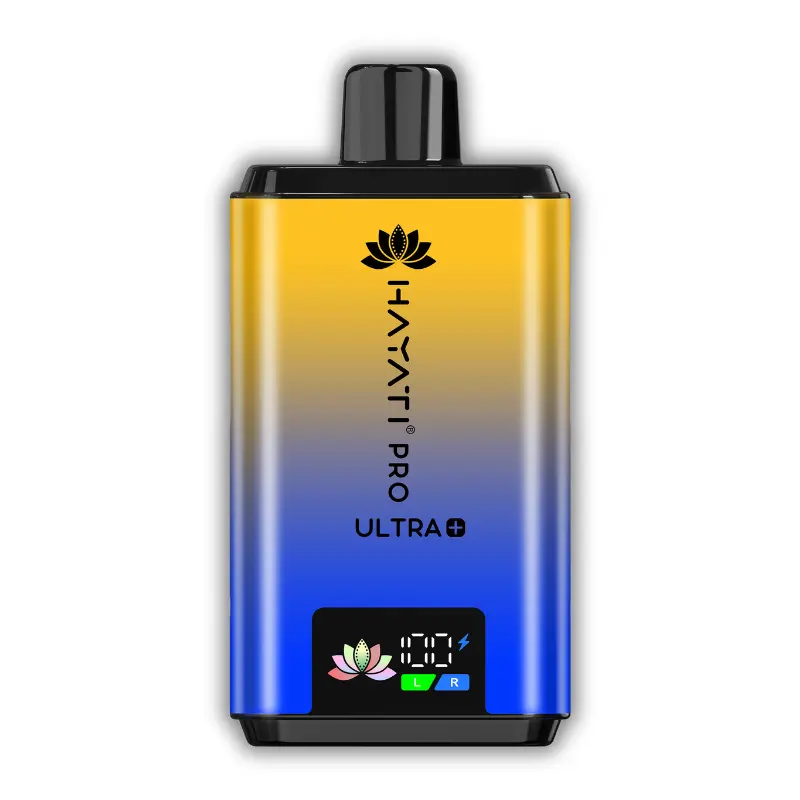
Hayati · Pro Ultra Plus
Blue Razz Pineapple / Strawberry Ice Hayati Pro Ultra Plus 25000 Prefilled Pod Kit
£11.99
✔ In stock — ready to ship
Genuine Hayati
Free over £20
Same-day dispatch
Secure checkout
Eleven pounds ninety-nine buys a working Hayati Pro Ultra Plus and something to put in it. The box holds an 850mAh body and one factory-filled 22ml pod at 20mg nicotine salt, divided between two liquids: Blue Razz Pineapple on one position of the mouthpiece collar, Strawberry Ice on the other. Hayati's own figure for that pod is 25,000 puffs, produced on bench apparatus repeating a draw at a set interval, so read it as a way of lining listings up against one another rather than as anything you can plan a month around. There is nothing to fill, nothing to fit and nothing to prime. Point the collar at whichever side you want and draw.
That describes the listing. It does not describe most of the people reading it, because a fair proportion of anyone who opens a kit page on this platform already owns the hardware. A kit page has two audiences: somebody entering the format for the first time, and somebody who has been on it for months and is working out whether to buy a second one.
There are two reasons to own two, and they are usually confused with each other. The first is flavour: two bodies means two liquids fitted and available at the same instant, with no swapping and no waiting for one pod to finish before the next starts. That case is argued in detail elsewhere on this site and it stands on its own terms. It is also the less common reason.
The second reason is the one this page is about, and it has nothing to do with what you like drinking. It is that a device is a small object you carry, and small objects you carry get put down in places that are not where you are. A second body bought for a place rather than for a flavour lives at work, or in the car, or in a coat, or in the bag that goes everywhere, so that the answer to the question "where is it" is always "here". You are not buying flavour capacity. You are buying redundancy against your own absent-mindedness, and the value of that depends entirely on how often you are absent-minded rather than on what you enjoy.
What follows works out what that redundancy actually costs using the prices on this site, says plainly which of those costs are recoverable and which are not, names the specific circumstances where the purchase makes sense, and says that for most people it does not. There is also a case, particular to this pairing, that a two-flavour pod suits the spare role better than it suits the main one. The flavour analysis itself belongs to the bare pod listing, which takes it further than this page does and reaches it from the other direction.
What a second body is actually for
Start by being precise about the thing being bought, because it is easy to describe it in terms that belong to a different purchase.
A spare does not give you more vaping. Two bodies and one person still produce one person's consumption. It does not give you more liquid in any meaningful sense either, since you can buy liquid at a lower price per millilitre without buying hardware at all. It does not make anything last longer. What it does is eliminate one specific event: arriving somewhere and finding that the thing is somewhere else.
That event has a shape worth describing, because people who have never thought about it in these terms tend to misjudge how often it happens to them. It is rarely a loss. The device is not gone, it is on a kitchen counter, or in yesterday's jacket, or in the door pocket of a car parked two streets away. You will get it back this evening. The cost is not the price of a replacement, it is a number of hours during which you have no access to something you would otherwise have used, in a location you cannot easily leave.
The geometry matters more than the arithmetic
Here is the part that people get wrong, and it decides whether the purchase works at all. A spare only helps if it lives at the destination, not at the origin.
Leaving your device at home and having a spare at home achieves nothing. The spare has to be in the place you turn out to be. That means a second body is not a general-purpose solution, it is a solution to one route: the trip between two fixed points you make often, where the forgetting happens at one end and the need happens at the other. If your life has exactly one such route, which for most people is the commute, a spare at the far end covers almost every incident you will have. If your movements are irregular and you are as likely to end up in a strange part of town as at your desk, a fixed spare covers very little and a carried spare is the only kind that works.
Those two are different products in practice even though they are the same object on the shelf.
- A fixed spare lives in a drawer at work, in a bedside table at a partner's flat, in a locker. It never moves, so it never gets left behind, and the only way it fails is by going flat or running dry without you noticing. It covers one location completely and everywhere else not at all.
- A carried spare lives in the bag, the rucksack or the glovebox. It covers everywhere the bag goes, which is more places, but it inherits the weakness it was bought to fix: a bag can be left behind exactly the way a device can, and when it is, you have lost both at once.
Anyone whose honest diagnosis is "I lose things" should notice that the carried spare does not fix losing things. It fixes forgetting one particular thing, and only when the thing you forget is not the bag. The fixed spare is the version that actually addresses a habit of misplacing objects, because its location is not a decision you make each morning.
What a spare does not fix
Two bodies means two objects with a location each, and the mental overhead of that is not zero. The question changes from "where is it" to "which one have I got and where is the other one". People who buy a spare to reduce the number of things they have to keep track of sometimes find they have increased it, because a device with a job and a place is easy to track while two interchangeable devices are not.
The other thing it does not fix is the pod. A second body running its own pod means two part-used pods on the go at once, both being drawn down at roughly half the rate a single one would be, and both ageing the whole time. That is a genuine cost rather than a theoretical one, and on this particular liquid it lands on the part of the flavour that has the least to spare. More on that below.
Working out what the redundancy costs
All the prices needed for this are published, so the arithmetic can be done properly rather than gestured at.
The number you cannot get around
There is no Pro Ultra Plus body sold on its own. Not at a reduced price, not as a bare replacement, not anywhere in the 492 listings on this site. Every one of the 104 Pro Ultra Plus entries carries liquid: 52 of them are kits at £11.99 with a body included, and 52 are pods at £7.99 with no body. Search for a body without a pod and nothing comes back.
The consequence is direct. The second device necessarily arrives with 22ml attached to it, so the price of redundancy is the whole £11.99 and the liquid is a by-product. You cannot pay £4.00 for a bare body even though £4.00 is the visible gap between this kit and the same pairing sold as a pod alone. That gap is real as an accounting statement and misleading as a budget, and the difference between those two things is worth ten minutes of anybody's attention before spending the money.
Why the four pounds is a delayed rebate, not a discount
The argument for reading the body as costing £4.00 runs like this: you were going to buy 22ml of Pro Ultra Plus liquid anyway at £7.99, this box contains 22ml of Pro Ultra Plus liquid, so the only money the hardware costs you is the difference. That argument is sound for somebody buying a kit instead of a pod for their main device, because the liquid goes straight into use and the displacement is immediate.
It is much weaker for a spare, and the reason is timing. A spare is by definition the device you use less. If it runs one day in five, its 22ml takes five times as long to go down as the pod in your main device, and the £7.99 of value you are counting against the purchase does not arrive for months. If it runs one day in ten, the horizon is most of a year. You have paid £11.99 today for something worth £4.00 today plus a promise of £7.99 spread thinly across a period you cannot predict.
Three conditions have to hold before that promise is worth its face value:
- You keep buying this platform. The moment you move to another format the unused portion of that 22ml is stranded, because Hayati sell different pods for different hardware and publish no interchange between the formats.
- The liquid is one you would have chosen. Easily arranged, and covered below, but it does require you to choose deliberately rather than taking whichever kit is nearest to hand.
- The body outlives the pod it came with. This is the one nobody can price. Hayati publish nothing about how long a Pro Ultra Plus body works for, and there is no figure anywhere in their material that this page could honestly quote. So the horizon over which the £4.00 reading becomes true is unpublished, and it will not be guessed at here.
The honest summary: budget £11.99 and treat the £7.99 as money you get back in liquid at a date of the spare's choosing rather than yours.
Cost per avoided incident
Redundancy is insurance, and insurance is priced against the rate of the event it covers. Nobody else can tell you your rate, but you can. Think back over the last twelve months and count the times you arrived somewhere without it and could not easily go back.
| Times a year you arrive without it | At the £11.99 outlay | At the £4.00 net figure |
| Weekly, 52 | 23p each | 8p each |
| Fortnightly, 26 | 46p each | 15p each |
| Monthly, 12 | £1.00 each | 33p each |
| Quarterly, 4 | £3.00 each | £1.00 each |
| Twice, 2 | £6.00 each | £2.00 each |
| Once, 1 | £11.99 | £4.00 |
These are first-year figures and they are deliberately not extended further, because extending them requires knowing how many years the body works, which is exactly the number Hayati do not publish.
Read the table honestly and most people land in the bottom two rows. Leaving a vape somewhere is an irritating experience that lodges in the memory, which makes it feel more frequent than it is, and a habit that genuinely produces a weekly incident is rare. At two or three occurrences a year, paying £11.99 to remove them is a want. That is a perfectly respectable reason to buy something and it should be called what it is.
The one comparison that flatters the purchase
There is a version of this where the spare pays for itself outright, and it turns on the same fact that made the redundancy expensive in the first place.
If your response to arriving without it is to buy another one, that purchase costs £11.99, because no body ships alone and a £7.99 pod is inert without something to put it in. The emergency replacement and the planned spare are therefore the same price. Planning carries no premium at all. All it changes is the timing and, importantly, which liquid you end up holding: the planned spare contains a flavour you picked, and the panic purchase contains whatever was to hand.
So the test is simple. If you have ever bought a second kit in a hurry because the first one was at home, the spare was already free in retrospect, and you own the body to prove it. Buy a second one on purpose and it will have a place to live instead of becoming a duplicate of the first.
Why this pairing suits the spare role better than the main one
Everything above applies to any Pro Ultra Plus kit, since all 52 of them cost the same. This section does not, because it depends on the pod being a two-position one with a coolant on exactly one side.
The pod listing for this pairing works through what happens when a cooled liquid and an uncooled one share a coil and an airway, and its central finding is uncomfortable: once the iced side has been used, the uncooled side is arguably never tasted completely clean again on that pod. The carry-over falls away with successive draws but there is no rinse, no rest and no coil change available to clear it, so the cost is charged every time the collar is turned from cold to warm. That argument is made properly over there and is not rebuilt here. What matters for this page is the shape of it: the penalty is per crossing.
A main device turns the collar constantly. It is within reach all day, the mood changes, and a pairing that is a twist apart gets twisted a great many times between Monday and Friday. Each of those twists, in one direction, costs a fair reading of the tropical half.
A spare does not behave that way. It gets picked up for an afternoon, or for the length of a shift, or for the stretch between realising the mistake and getting home. In that window most people choose a side and stay on it, because the session is short and there is no leisurely drifting between moods. A spare might charge two crossings a month where a main device charges two a day. The chief drawback of this pod is therefore almost absent in the role.
The benefit, meanwhile, is larger in the spare than in the main device, and for a reason that only makes sense once you remember where the spare is. A main device is used in a place where alternatives exist. If the flavour in it stops suiting you, there is another pod in a drawer at home. The spare is used precisely when you are somewhere you cannot get at your own things, and in that position having a second liquid built into the object is worth more than it is worth at home, because it is the only choice available to you. A cold option and a warm one, both fitted, in the one device you did not plan to be using.
Add the weather. A spare gets used in conditions nobody chose in advance: a hot afternoon on a site, a cold platform, the back end of a long day after a meal. A single-flavour spare is a bet that one liquid will suit whatever the unplanned day turns out to be. This one hedges that bet inside the pod, and a temperature difference is a far wider hedge than a difference of fruit, because the two sides are not competing on the same axis at all.
The counter-case is straightforward, and anyone in it should take it. If you always want the same thing and always will, the width is wasted and a single-flavour pod puts all 22ml where you actually use it. Strawberry Raspberry Ice is the whole pod as one chilled red fruit at the same £11.99, Watermelon Ice does the same in a lighter register, and Blue Sour Raspberry is the option for anyone who wants an edge on the fruit and no cold at all.
The two liquids, in short
A full tasting breakdown of both sides, the order the components arrive in and what each half is and is not, sits on the pod page and is better done there. What follows is enough to decide whether this is a pairing you want sitting in a drawer at work for the next several months.
Blue Razz Pineapple, the warm side
Sweet-shop blue raspberry does the heavy lifting: a rounded, frankly confected sweetness with a tang riding on it, the version of the fruit that exists in sweets rather than the version that grows. Pineapple arrives later in the draw and does structural work rather than sitting beside it as a second fruit. It is thinner and more acidic, and it cuts a line up through the sugar so the blend does not settle into a flat sweet block. There is a faint green edge under it that keeps the whole thing from reading as pure confectionery.
The exhale is where the two meet properly: tropical, heavy on the tongue, long-finishing, with an acid trail behind it. Sugar is high. Not the highest in the range, since a candyfloss build such as Blueberry Cotton K / Raspberry Cotton K sits a register above it, but high. No cooling appears anywhere in this half, in the title or in Hayati's account of it, so treat it as uncooled.
Strawberry Ice, the cold side
Simpler by construction. The strawberry is the ripe, jam-like one rather than a fresh green-shouldered one, landing wide and soft with no acidity to speak of and not much happening in the middle of the draw. The chill builds behind the fruit through the exhale and holds for a few seconds after it. It is the wet, sweet cold that goes with fruit, with nothing leafy or herbal under it, and anyone shopping mainly for cooling will find it well short of a mint liquid.
Measured sweetness is probably moderate. Perceived sweetness will read lower, because a mouth registering cold under-reads sugar, which is one of the effects the pod page takes apart at length.
What the pairing is not
- Cold throughout. Half of this pod has no coolant in it. Anybody buying an iced device with two flavours in it has bought the wrong listing, and Strawberry Ice / Strawberry Raspberry Ice is the one that is chilled in both positions.
- Sour. There is tang from the pineapple and a confectionery zip from the blue raspberry, and neither is an acid spike.
- A dessert or a drink flavour. Nothing creamy, custardy or baked, and nothing carbonated. Raspberry Cola is the soft-drink entry on this shelf if that is what you were after.
- Two versions of one recipe. A tropical blue raspberry and a chilled strawberry share no ingredient. This is two unrelated liquids in one shell, which is part of why it works as a hedge.
Where you keep a spare is the worst thing about owning one
This is the cost nobody includes in the sum, and it is specific enough to the place-based purchase to be worth a section of its own.
The places that make a spare useful are chosen for one property: you can get at it without planning. A car door pocket. A coat that lives on a hook. A desk drawer. A bag that never gets unpacked. Those are exactly the places that are bad for the liquid in it. Sustained warmth and daylight are what age a prefilled pod before it has been fitted, and the components that go first are the light, volatile ones at the top of the profile.
On this pairing that lands badly. The pineapple acid is the finest structure in the tropical half and the thing holding it up against the sugar, and it is the first part of the recipe to fade in a warm pod. A spare that spent a July in a car does not arrive in a broken state, but it can arrive already tasting like a pod at its midpoint: sweeter, flatter, with the bright line through the middle blunted. The cold side tolerates it better, because a coolant is a more durable thing than a fruit acid and the strawberry underneath it was never depending on a sharp top note.
There is a real tension here and no way to resolve it completely.
- The car is the worst common choice and the most frequently suggested one. It is a container that gets hot, stays hot, and sits in direct light.
- A coat pocket is better in the sense that a coat usually hangs indoors, and worse in the sense that coats go through washing machines.
- A drawer at work is the best of the three, being indoors, dark, at room temperature and stationary, which is also why it is the version of the spare that fails least often.
Two practical consequences follow. If the spare is going to live somewhere warm, this is an argument for putting a coolant-led or heavily confected liquid in it rather than this one, since those profiles have less delicate structure to lose. And if the spare is going to live in a drawer indoors, the objection mostly evaporates and the pairing is fine there for a long time.
The second overhead is attention. A spare has a silent failure mode: it does not announce that it has gone flat or run dry, and you find out at the exact moment you were relying on it, which is the one moment the whole purchase existed to protect. A spare therefore needs a routine, and the routine is a genuine ongoing cost of ownership even though it does not appear on any receipt. Check it on a fixed day of the month, top up its charge whether or not it feels necessary, and take a couple of draws so you know it still works. A spare nobody checks is an ornament with a drawer to itself.
The published figures, and what each one is doing here
| Outlay today | £11.99 for the complete kit |
| In the box | One body, one filled pod, ready as supplied |
| Body | 850mAh |
| Liquid aboard | 22ml, both positions combined |
| Strength | 20mg per millilitre, nicotine salt, no other option listed |
| Warm position | Blue Razz Pineapple |
| Cold position | Strawberry Ice |
| Choosing between them | Rotate the mouthpiece collar |
| Hayati's puff figure | Up to 25,000, a laboratory estimate for the pod |
| Heating element | One, inside the pod, shared by both liquids, not replaceable |
| Topping up | Not provided for; the pod is changed whole |
| Same pairing as a pod alone | £7.99 |
| Per millilitre, this box | 54.5p |
| Per millilitre, pod only | 36.3p |
| Not published by Hayati | Cooling level, how the 22ml divides, coil resistance, body lifespan |
| Maker | Hayati |
Two of those rows carry the argument and the rest are context. The first is the 22ml, which on a main device is simply capacity and on a spare is the entire point. A spare is worth something in proportion to how little attention it demands, and 22ml is a long unattended runway. Nothing else sold complete on this site carries more.
The second is the last row, which is a list of blanks. On a purchase justified by redundancy, the single most useful specification would be how long the body keeps working, since that is what the £4.00 reading depends on and what decides whether you have bought a spare or a slightly early replacement. No such figure is published, not for this device and not for any of the others, and any number you see quoted for it somewhere was invented by whoever typed it.
On the nicotine row, 20mg per millilitre is the legal ceiling for e-liquid sold in the UK and the only strength this combination is listed in, on both positions of the collar equally. Nicotine is addictive. What strength anybody uses is their own business and not something a product page should be nudging in either direction.
Cheaper ways to put a device in a second place
An honest page about buying a second body has to admit that this is not the cheapest one available, and it is not close. Since the spare's job is to exist rather than to perform, the obvious question is what the job costs on the other platforms, and the answer is published for all of them.
Across this site there are 183 complete kits with a stated liquid capacity, and four families account for 179 of them, each at a single fixed price:
- Mini Ultra, 19 kits at £3.99, carrying 4ml, which works out at almost exactly £1 a millilitre.
- Rubik, 20 kits at £5.99, carrying 12ml, just under 50p a millilitre and the lowest figure of any prefilled kit here.
- Pro Max Plus, 88 kits at £7.99, carrying 12ml, a shade under 67p a millilitre.
- Pro Ultra Plus, 52 kits at £11.99, carrying 22ml, 54.5p a millilitre and the largest quantity of liquid in any complete kit on the site.
Two metrics pull in opposite directions and it is worth being clear about which one applies. If you are buying liquid, cost per millilitre decides it and the Rubik wins narrowly with this platform second. If you are buying the presence of a working device in a second location, cost per millilitre is close to irrelevant, because the spare is not where your consumption happens. On that metric the question is simply what the cheapest entry price is, and £11.99 is the highest one of the four.
The sharpest version of that comparison is available in this exact flavour pairing. Blue Razz Pineapple / Strawberry Ice in the Mini Ultra kit is £3.99, has the same two flavours and the same 20mg strength, and puts a working device in a second place for a third of the money. On the "£ per place covered" measure it beats this listing three to one and the argument looks finished.
It is not finished, because of the runway. The Mini Ultra holds 4ml against this pod's 22ml, which is five and a half times less. Whatever rate you use a spare at, the Pro Ultra Plus version goes five and a half times as long between the moments when it needs your attention, and attention is the thing a spare is bad at getting. A 4ml spare used a day a week is a pod you will be replacing regularly, in a place where you may not have a replacement, and a spare that has quietly run out is worse than no spare because you were counting on it. A 22ml spare can sit in a drawer for a long stretch and still be there when the day goes wrong.
So the recommendation splits cleanly on one question: is the spare something you will maintain, or something you want to forget about?
- If you will maintain it, buy the cheapest body that takes a liquid you like. The Mini Ultra in this pairing at £3.99 is the direct equivalent, Strawberry Raspberry Ice Mini Ultra and Blue Razz GB Mini Ultra are the same money in other flavours, and the Rubik kit at £5.99 buys three times the Mini Ultra's liquid for half as much again.
- If you want to forget about it, the 22ml is what you are paying the extra for and this listing is the one that does it. That is the only argument for spending £11.99 on a second body rather than £3.99, and it is a real argument, but it is narrower than the price gap makes it look.
One more consideration weighs on the same side. A spare on a different platform means a second pod stock, a second set of listings to reorder from, and a device that draws differently from the one you are used to. Keeping both bodies on the same format means one shelf, one price, one set of flavours and an identical object in both places, so the spare feels like your device rather than like a substitute. Whether that is worth eight pounds is a matter of temperament, and anyone who says it obviously is or obviously is not has not thought about it.
Choosing the flavour for a body you bought for a place
Since every kit on the shelf is £11.99, the flavour in the spare is free to choose and the choice should be made deliberately rather than by grabbing the first listing. The criteria are genuinely different from the ones you would use for a main device, for two reasons: the spare's liquid has to survive time rather than deliver novelty, and it will be used in circumstances you did not pick.
What follows from that is a preference for durability over delicacy. Profiles built on a coolant or a heavy confectionery base change least over weeks of sitting about, because the parts doing the work are not the fragile ones. Profiles whose interest comes from a bright acid line lose that line first. This pairing sits awkwardly across the two, with a durable cold half and a delicate warm one, which is another reason the drawer beats the car.
If the spare will live somewhere warm
Take a build with less to lose. Fruit Bomb / Straw’ Watermelon B’Gum is sweet-shop on both positions with no acid structure to blunt. Watermelon B’Gum / Strawberry B’Gum works the same territory in two related fruits. Blackcurrant Cotton K / Blue Raspberry keeps a candyfloss sweetness on one side and a sharper blue fruit on the other, which gives width without depending on a fragile top note.
If the spare will be used in unpredictable weather
Keep a coolant on at least one position, which is exactly what this listing does. Straw’ Cranberry Cherry / Strawberry Raspberry Ice gives you a cold side and a darker fruit side. Strawberry Ice / Strawberry Raspberry Ice is chilled in both positions, which removes the crossing penalty entirely at the cost of removing the hedge as well. Everything with cooling in it, across every Hayati format, is gathered on Ice Vapes.
If the spare should not compete with your main device
There is a reasonable argument that the spare should hold something you like but would not choose daily, so that reaching for it feels like a change rather than a downgrade. Kiwi Banana / Strawberry Banana is about as far from a blue raspberry as this shelf goes while staying in fruit. Grape GB / Strawberry GB pairs two sweet-shop fruits that are not berries in the usual sense. Straw’ Guava / Dragon Berries goes further into the tropical end than this pod does.
If you want the spare to hold the same thing as the main one
Then the argument for a pairing weakens and a single flavour on both devices is the tidier arrangement, since you are no longer hedging anything. Blueberry Raspberry and Blueberry Raspberry Lemon are the straightforward single-recipe berries at the same price, and Blue Razz Cherry / Blue Razz GB stays in the confectionery blue family on both sides if you want consistency with a little variation inside it.
Neighbours worth knowing about
Blue Razz GB / Lemon Lime sets the same confectionery sweetness against a dry citrus, which achieves contrast without a coolant doing the work. Blueberry Raspberry / Mr Blue runs two distinct blue profiles side by side. On the smaller formats, Straw’ Cranberry Cherry / Cherry Ice Mini Ultra shows what a £3.99 kit does with the same two-position idea. On the 12ml platform, Blue Razz Pineapple as a Pro Max Plus kit is the tropical half on its own at £7.99, Blue Razz Cherry is the darker relative, and Blackberry Ice and Mixed Berries cover the berry ground at the same £7.99.
For browsing rather than deciding, the 52 kits on this platform are on the Pro Ultra Plus kit shelf, kits and refills together are on Hayati Pro Ultra Plus Prefilled Pod Kits & Pods, every complete kit the brand makes is under Hayati Pod Kits, and the fruit shelves cut the same catalogue a different way: Pineapple Vapes is the smallest at 20 listings, with Strawberry Vapes, Raspberry Vapes and Berry Vapes widening out from there.
Running two bodies without making a mess of it
Generic advice about pods is on every listing in the range and is not repeated here. These are the habits that only matter once there are two devices in play.
Give each body a fixed job and a fixed place. The failure mode of two identical objects is that they become interchangeable, and interchangeable objects drift. One is the main device and travels with you; the other lives at the location and does not leave it. Swapping which is which for convenience is how you end up with both in the same room and none where you need one.
Do not rotate them to even out the wear. It is a tempting instinct and it defeats the purpose. A spare that spends alternate weeks as the main device is not a spare, it is two main devices that are each absent half the time, and the location you bought it for is uncovered whenever it is in your pocket.
Put the check in the calendar. Once a month, on a date you will remember, top the spare up and take a few draws. That confirms three things at once: it holds a charge, the pod still feeds, and the liquid still tastes like itself. All three fail silently otherwise.
Watch the stranded liquid in the side you do not use. Both positions share one coil and one working life, so when the element is finished the pod is finished, whatever is left in the neglected store. On a spare this is worse than usual, because a spare's pod is drawn down slowly and a lopsided preference has months to become entrenched. If the cold side has not been touched by the halfway point, that is a signal to buy a single-flavour pod next time rather than another pairing.
Keep the spare's storage indoors where you can. Cool, dark and stationary is what a filled pod wants, and warmth costs you the pineapple acid first, which is the component holding the tropical half in shape. Keep both devices somewhere children and pets cannot get at them, and keep the spare out of a car in summer if there is any indoor alternative at all.
Retire them properly. Each device contains a cell and each spent pod contains an element and a residue of liquid, so neither belongs in a household bin. Vape retailers and local recycling centres take them, and owning two of something doubles how often that applies to you rather than leaving it unchanged.
Questions a second purchase raises
Can I buy just the device without any liquid?
No. Every Pro Ultra Plus listing on this site carries liquid: 52 kits at £11.99 with a body, and 52 pods at £7.99 without one. There is no bare body at any price, which is why a second device costs the full kit price rather than the £4.00 difference between the two formats.
Is a second kit good value at £11.99?
As liquid, yes, at 54.5p a millilitre for the box. As redundancy, it depends entirely on how often you arrive somewhere without your device. At two or three times a year it costs several pounds per incident avoided, which is a want rather than a saving, and the page above sets out the rates where it starts to look different.
Does the spare need to be the same platform as my main device?
Not at all, and a cheaper one does the basic job. A Mini Ultra kit is £3.99 and a Rubik kit is £5.99, both complete. What you give up is the runway: 4ml and 12ml respectively against 22ml here, so the cheaper spares need checking and replacing far more often, and they mean keeping a second stock of pods.
Where should a spare actually live?
At the destination rather than the origin, which usually means the place you travel to rather than the place you leave from. A drawer indoors is the best of the common options because it is dark, stable and stationary. A car is the worst, since sustained heat and light age the liquid before it is ever used.
Is this pairing a sensible one for a spare?
Better than it is for a main device, oddly. The main drawback of a two-position pod is the cost of crossing from the cold side to the warm one, and that cost is charged per crossing, which a spare makes very few of. The benefit, having two options in the one device you can reach, is worth more in a place where you have no alternatives.
Which side has the ice in it?
Strawberry Ice, and only that side. Blue Razz Pineapple carries no cooling term in its name or in Hayati's description of it, so treat the tropical position as uncooled. Hayati publish no figure for how cold the iced side runs.
Why does the tropical side taste thinner after the cold one?
Two things overlap: your mouth is still registering cold, which suppresses sweetness and sharpens definition, and the coil and airway the pineapple has just travelled through were carrying a coolant a moment earlier. The pod listing for this pairing works both effects through in detail and concludes that the uncooled side is arguably never tasted completely clean again once the iced side has been in use.
How long does a Pro Ultra Plus body last?
Hayati do not publish it, and no honest figure for it exists anywhere in their material. That gap matters here more than on most pages, because the case for reading the hardware as a £4.00 purchase depends on the body outliving several pods, and nobody can tell you how many.
What does the 25,000 figure mean?
It is Hayati's laboratory estimate of the workload one sealed coil is built to absorb, taken on apparatus drawing at a fixed length and interval. Useful for ranking one pod against another within the format, and of very little use for predicting your own weeks. On a spare it is even less informative, since a spare's pod is limited by how long the liquid stays good rather than by how much work the coil can do.
Will the liquid in a spare go off while it waits?
It does not spoil, but it does change, and the lightest components go first. On this pairing that means the pineapple acid, which is the part holding the tropical half up against its own sugar. A spare kept indoors and cool holds together for a long time; one kept somewhere warm can be noticeably flatter by the time you get to it.
Can I refill the pod or change the coil?
Neither. The pod arrives filled, the element is built into it and no replacement part is sold, so the whole pod is changed when it is finished. Both positions share that one element, which is also why the less-used side is discarded with liquid still in it.
Should I rotate the two devices so they wear evenly?
No, because that undoes the reason for buying a second one. A spare works by being in a fixed place at all times, and a device that alternates between the drawer and your pocket leaves the drawer empty half the time. Give each body one job and leave the arrangement alone.
What it comes down to
Eleven pounds ninety-nine puts an 850mAh Pro Ultra Plus body and a filled 22ml pod at 20mg nicotine salt in one box, with Blue Razz Pineapple on one position of the collar and Strawberry Ice on the other, and a Hayati laboratory figure of up to 25,000 puffs against the pod. As a first purchase it is a complete device and a wide pairing. As a second purchase it is something else: a way of making sure that wherever you turn out to be, something is there.
The economics of that are not the economics of buying liquid. No body is sold on its own, so the second one arrives with 22ml attached and the cost of the redundancy is the whole £11.99, with £7.99 of it returning slowly as liquid you will eventually use and only £4.00 genuinely spent on hardware once you get there. Against a couple of forgotten mornings a year that is several pounds per incident, and calling it an indulgence is the accurate description. Against a habit that costs you a working day's access once a month, it is about a pound a time, and against anyone who has already bought a replacement kit in a hurry, it is money that was spent anyway on worse terms.
Buy it if the case is specific: a long commute where turning round is not an option, a workplace you cannot leave and return to, a genuine history of putting things down and walking away, or two homes you move between. Put it in a drawer indoors rather than a car, give it one job, and look at it once a month so it is working on the day it matters. Buy the £3.99 Mini Ultra instead if the spare is something you will keep an eye on, and pay the difference here only for the 22ml of runway that lets you stop thinking about it. Anything newly added to the range sits under New Products, and the full Hayati catalogue is there for anyone still deciding which flavour deserves the second body.
Strictly for adults aged 18 and over. Nicotine is an addictive substance.
You might also like


