
Home / Hayati Pro Ultra Plus Prefilled Pod Kit / Blue Sour Raspberry Hayati Pro Ultra Plus 25000 Prefilled Pod Kit
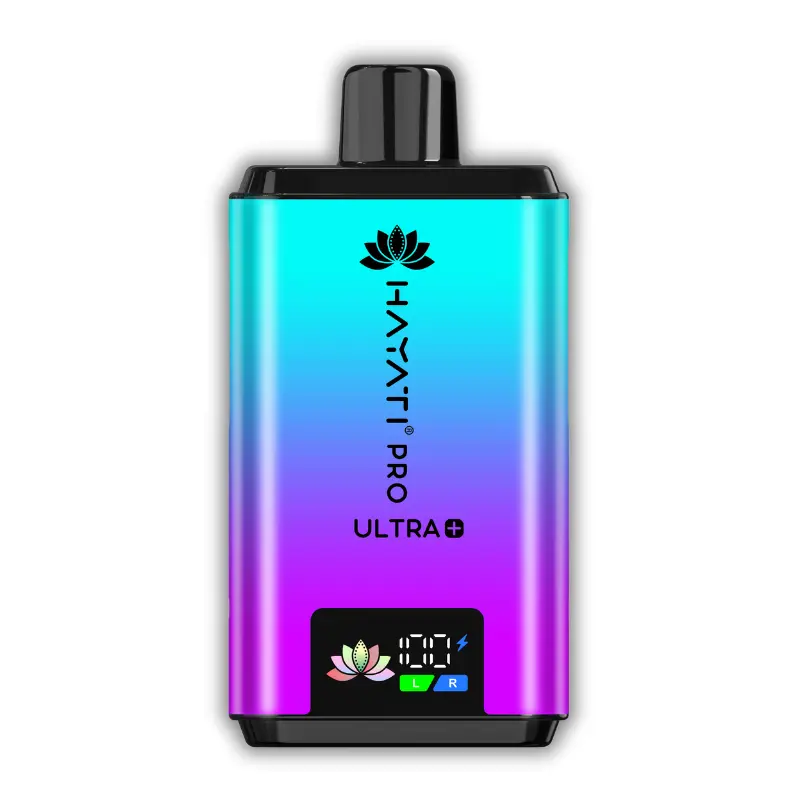
Hayati · Pro Ultra Plus
Blue Sour Raspberry Hayati Pro Ultra Plus 25000 Prefilled Pod Kit
£11.99
✔ In stock — ready to ship
Genuine Hayati
Free over £20
Same-day dispatch
Secure checkout
Blue Sour Raspberry Hayati Pro Ultra Plus 25000 Prefilled Pod Kit is the complete purchase at £11.99: the 850mAh body and a prefilled 22ml pod of 20mg nicotine salt in one box, one flavour in the pod, and no collar on the mouthpiece to turn. Hayati attach a figure of 25,000 puffs to it. That figure is a manufacturer laboratory estimate arrived at under test conditions, it is not carried in the catalogue's own data at all, and the section on the specification sheet below says what it is and is not worth. Everything in that paragraph is ordinary for this shelf. Fifty-two listings sit on the Hayati Pro Ultra Plus Prefilled Pod Kit shelf and almost all of them could open the same way.
What is not ordinary is the argument the listing makes for itself. Twice in one short paragraph, Hayati position this liquid against a product they call a standard blue raspberry. The first time it is a measurement of intensity. The second time it is an instruction about what to buy. Both sentences assume the reader has a reference point in hand and can place this liquid relative to it.
The reference point is not for sale. Not at this price, not at any other price, not on this platform, not on any of the four prefilled platforms Hayati run, and not in a bottle. A plain, unqualified blue raspberry does not exist as a purchasable liquid anywhere in these 492 listings, and the two places its name appears in a title are the same divided pod sold twice, where it is one half behind a collar with a candy-floss blackcurrant.
That is the subject of this page. Not what the liquid tastes like, which four earlier pages have already settled between them and which I will point you at rather than restate, but what it does to an £11.99 decision when the comparison a listing invites you to run cannot be run. I have counted every claim below against data/catalog.json as it stands today, and where the count contradicted the brief I was handed, the count is what is printed.
The two sentences, and what kind of sentences they are
Here is what is on the listing, quoted short and treated as copy under analysis rather than repeated as advice. The first says the liquid is “punchier than a standard blue raspberry”. The second says it is “a natural next step” for a reader who finds “standard blue raspberry a little tame”. Neither sentence has anything to do with nicotine, which is 20mg here as it is on every prefilled pod in the range, and nothing on this page frames anything as a movement up or down a strength. Both sentences are about flavour intensity and nothing else.
They do different jobs. The first is comparative and descriptive: it places the liquid on an axis and tells you which direction along that axis it sits. You could disagree with it after tasting, but you could at least understand what was being asserted. The second is comparative and prescriptive: it identifies a reader by their dissatisfaction with a named product and tells them what to do about it. That second move is the one that costs money, because it converts a description into a purchase.
Prescriptive comparison is a reasonable thing for a retailer to do. It is arguably the most useful thing copy can do on a shelf of fifty-two near-identical boxes, where the specification is the same on every one and the only variable is the liquid. A reader who knows one product and wants to know where a second sits relative to it is better served by a sentence that says so than by another round of adjectives. The problem is not the form of the sentence. The problem is the referent.
A comparison is only as good as the availability of both terms. If I tell you a pod is sharper than another pod, you can go and buy the other pod, put the two side by side across a week, and find out whether I was right. If I tell you a pod is sharper than something that is not stocked, you have a direction without a starting point. You know which way, and you do not know from where, and you cannot find out.
The count, and what it did to the claim I was handed
The version of this angle I was given said seven listings rank themselves against a standard, straight, plain or single blue raspberry, and that this listing is the only one to do it twice and the only one to turn it into an instruction. House practice here is to count a rarity claim rather than repeat it, so I did, and two of those three statements did not survive.
The rule, stated so anyone can repeat it
A listing counts if one sentence of its description names an unmodified blue raspberry as a reference point and positions the product being sold relative to it. The reference has to be marked as the plain version by one of the qualifiers the copy actually uses: standard, straight, plain, single, single-fruit, regular, or the straight version. A sentence that merely mentions blue raspberry as an ingredient of the product does not count, and there are dozens of those. Nor does a sentence that glosses what the word blue tends to signal in a flavour name, which is a naming observation and a different move entirely.
Eleven, not seven
Applied to all 492 descriptions, that rule returns eleven listings carrying twelve such sentences. Restricted to the four qualifiers the brief actually named, it returns eight listings and nine sentences. Either figure is higher than seven, and the correction runs in favour of the argument rather than against it: the absent reference point is invoked more often than I was told, not less.
| Blue Sour Raspberry Pro Ultra Plus 25000 kit | £11.99 | standard blue raspberry, twice |
| Blue Razz Cherry Pro Ultra Plus 25000 kit | £11.99 | the straight version |
| Blue Razz Fruit Twist Pro Max Plus 6000 kit | £7.99 | single-note versions |
| Blue Sour Raspberry Pro Ultra Plus Pods | £7.99 | standard blue raspberry |
| Blue Sour Raspberry Rubik Pods | £3.99 | regular blue raspberry |
| Blue Razz Cherry Mini Ultra Pod Kit | £3.99 | single-fruit blue raspberry, and plain blue razz |
| Blue Razz Pineapple / Strawberry Ice Mini Ultra Pod Kit | £3.99 | straight blue raspberry |
| Blue Razz GB Mini Ultra Pods | £3.49 | plain blue raspberry |
| Blue Razz Pineapple Mini Ultra Pods | £3.49 | straight blue raspberry |
| Blue Razz Cherry Pro Max Nic Salt | £2.49 | single blue raspberry |
| Blue Fusion Pro Max Nic Salt | £2.49 | straight blue raspberry |
The price column is worth reading down. The invocation runs from £2.49 to £11.99, so this is not a habit confined to cheap listings where copy has to work harder, nor to expensive ones where a justification is needed. It is spread across the whole ladder. The two dearest of the eleven are both £11.99 Pro Ultra Plus kits, this one and Blue Razz Cherry Hayati Pro Ultra Plus 25000 Prefilled Pod Kit, which means the absent reference is doing its heaviest commercial work at the top of the range.
Two claims that failed, and what is left of them
The claim that this is the only listing to invoke the baseline twice is wrong. The Blue Razz Cherry Mini Ultra Pod Kit does it twice as well, once as a single-fruit blue raspberry and once as a plain blue razz. The claim that this is the only listing to turn the comparison into a purchase instruction is wrong by a wider margin. At least five of the eleven do exactly that, each with an if-you-find-it construction: the Blue Razz Cherry nic salt, the Blue Razz Pineapple Mini Ultra pods, the Blue Razz Cherry Mini Ultra kit, the Blue Sour Raspberry Rubik pods and Blue Fusion. Prescription is the house habit, not this listing's signature.
What survives the counting is narrower and checkable. The exact phrase standard blue raspberry occurs three times in 492 listings. Two of the three are on this one product, and the third is on its own bare-pod twin. No other listing in the catalogue names its reference point twice using the identical wording. That is a small finding and it is the true one, and it tells you something modest: whoever wrote this listing had the comparison firmly in mind and reached for it twice in four sentences, which is a stronger signal of intent than a single passing clause.
Where this sits against the census that already exists
The comparative-copy census on this site belongs to the Mad Blue Pro Max Nic Salt page, which counted the sentences in which Hayati rank one of their own flavours against another and found twenty-seven of them, twelve concentrated on the bottled nic salt shelf. I am not recounting that and this page takes it as settled, including its finding that five of those twelve use a shared if-too template, which is a house construction filled in rather than composed.
The two counts do not overlap, and the reason matters. Mad Blue's rule requires a sentence to name two or more Hayati flavours, at least one of which is not the product being sold. Every sentence in my eleven fails that test, because a standard blue raspberry is not a Hayati flavour. It is a category, an idea of what the fruit ordinarily tastes like, held in the reader's head rather than on the shelf. So the two sets are disjoint by Mad Blue's own stated rule, and my contribution here is not the discovery that Hayati write ranking copy, which is already established and better established than I could manage. It is the referent: that a second and separate body of comparative copy ranks this range against a product outside it, and that the product outside it turns out not to exist inside it either.
Looking for the referent, and not finding it
If eleven listings send you to a standard blue raspberry, the obvious next question is what a standard blue raspberry costs here. The answer is that it is not priced, because it is not listed.
The string Blue Raspberry appears in exactly two of the 492 titles. Both are the same recipe sold twice, as a bare refill at £7.99 and as a complete kit at £11.99: Blackcurrant Cotton K / Blue Raspberry Hayati Pro Ultra Plus Pods and Blackcurrant Cotton K / Blue Raspberry Hayati Pro Ultra Plus 25000 Prefilled Pod Kit. In both, Blue Raspberry is one half of a divided 22ml pod, sharing the shell with a blackcurrant that has been given a candy-floss treatment, and both listings state in their own text that the two are held apart inside the pod and that turning the rotating mouthpiece selects which one you are drawing on. I am taking the collar from those listings rather than from the oblique in their titles, which on its own tells you two flavours are involved and nothing about how they are arranged.
Two further listings name the flavour without carrying it in the title. The unbranded Hayati Pro Ultra Plus 25000 Pods at £7.99 and the unbranded Hayati Pro Ultra Plus 25000 Prefilled Pod Kit at £11.99 both state in their descriptions that they are listed in the Blackcurrant Cotton K and Blue Raspberry pairing. So four listings in the catalogue name Blue Raspberry, and all four resolve to one recipe. Two of them are the recipe under its own name and two are the same recipe under the range's generic name, which is worth knowing if you search the catalogue and think you have found three or four options. You have found one, priced twice, filed four ways.
Why the divided pod is not a workable substitute for the missing one
It is tempting to say the problem is solved: buy the Blackcurrant Cotton K pairing, turn the collar to the blue side, and there is your reference point. It does not work, for a reason this site has already established and which I am citing rather than rebuilding.
A divided pod has one coil, one wick and one airflow path serving both reserves. The Blueberry Cotton K / Raspberry Cotton K Hayati Pro Ultra Plus 25000 Prefilled Pod Kit page works this through in full, building on a finding first made on the Blue Sour Raspberry Mini Ultra kit page: the draws immediately after you turn the collar are a blend of what you were vaping and what you have switched to, so they are not a reading of the new side. That page's sharper observation is that the carryover conceals itself when the two halves are built alike, because a contaminated draw still tastes like a plausible answer and nothing warns you to wait.
Apply that to the pairing you would have to use. The partner here is a blackcurrant softened with candy floss, which is to say a sweetened, sugared dark berry. The question you came to answer is where the plain blue raspberry sits on sweetness, because that is the axis both of this listing's sentences are about. The contamination pushes your reading of the blue side in exactly the direction you are trying to measure. It does not merely add noise, it adds bias, and it adds it with the sign you would least want. You would come away with an inflated impression of how sweet the reference point is, which would in turn make this liquid's acid look like a larger departure than it is.
There is no way round it within the pod. You cannot rest the coil back to neutral without vaping through the carryover, and vaping through it means more draws of the side you are trying to isolate, which is the thing you were trying to keep clean in the first place. The reference point is not merely unsold. It is unmeasurable with the one instrument the catalogue provides.
A correction to a sibling page, made by counting
The Blue Razz Cherry Pro Ultra Plus Pods page does something genuinely useful that no shelf on this site does for you: it assembles the blue raspberry family by hand and prints the names to scan for, because no category page collects them. Its list runs to eleven names. One of them is plain Blue Raspberry, and no such listing exists.
Stated precisely, because the house rule here is to count before contradicting as well as before repeating. Of the eleven names on that list, nine return at least one standalone listing you can buy on its own. Blue Razz Cherry returns nine such listings, Blue Razz GB eight, Blue Razz Pineapple three, Blue Razz Lemonade three, Blue Razz Mojito three, Blue Razz Blackcurrant two, Blue Razz Fruit Twist two, Blue Razz Gummy Bear one, and Blue Sour Raspberry nine. Two return none. Blue Razz Mint exists only inside the Fresh Mint and Blue Razz Mint pairing, and Blue Raspberry exists only inside the Blackcurrant Cotton K pairing.
Those two are not equally wrong, and the difference is instructive. Blue Razz Mint is printed as a bare name on a list of words to scan for, and scanning for it does turn something up, so the entry is incomplete rather than false. Blue Raspberry is printed with the qualifier plain in front of it, and that qualifier asserts the existence of an unmodified listing. It is the only entry on the list where the wording promises something the catalogue does not hold. A reader following that list in good faith will search, find a pairing, assume they have the wrong listing, and keep searching. The page is right about everything else and right about the need for the list; this one entry should read that the plain version is available only as half of a divided pod.
The stand-ins, and what each of them adds
This is the part of the page that is actually worth money to you. If the reference point cannot be bought, the practical question becomes which purchasable liquid comes nearest to standing in for it, what each candidate adds on top, and what a buyer can and cannot legitimately conclude from the substitution. None of them is the baseline. Some of them are more informative failures than others.
The test a stand-in has to pass
Three conditions, in descending order of importance. It has to be a single flavour, because anything behind a collar brings the carryover problem with it. It has to be recognisably the same fruit, so the comparison is about degree rather than about kind. And whatever it adds beyond the fruit should be as separable as possible, meaning you can attend to it and mentally set it aside rather than having it fused into the same accord.
That third condition is the one that does the sorting, and it is the one most buyers will not think of. An addition that sits alongside the blue raspberry can be listened past. An addition that sits inside it cannot, because it changes the thing you are trying to hear rather than accompanying it.
On this platform, at this volume, there are three
Across the whole Pro Ultra Plus range, 104 listings on the Hayati Pro Ultra Plus Prefilled Pod Kits & Pods shelf, exactly three blue raspberry flavour names are sold undivided: Blue Razz GB, Blue Razz Cherry and this one. Each exists as a £7.99 refill and an £11.99 kit, which is six listings covering three recipes. Fourteen further Pro Ultra Plus listings carry a blue raspberry behind a collar, and every one of those is disqualified by the paragraph above.
Blue Razz GB adds confectionery sugar, and it is the least separable addition of the three. The Blue Razz GB Hayati Pro Ultra Plus 25000 Prefilled Pod Kit is the same price, the same volume, the same body and the same strength as this one, so as a controlled comparison the hardware is perfect. The liquid is not. What GB adds is the soft, rounded sugar of a gummy sweet, and that sugar is not a separate note sitting beside the berry, it is a treatment applied to the berry. Blue raspberry is already a confectionery flavour rather than a fruit that grows anywhere, so adding sweet-shop sugar to it is adding more of something already present. You cannot hear past it, because there is no seam between the two. What you can conclude from GB is where the sweet end of the family lies. What you cannot conclude is anything about the middle, and the middle is what the word standard was pointing at.
Blue Razz Cherry adds a second fruit, and that addition is separable. The kit's own copy puts the cherry underneath, supplying depth while the blue raspberry supplies brightness and bite, and describes the result as having no gum and no ice in the way. Whatever you make of copy as evidence, the construction is the useful part: two fruits occupying different registers, one on top and one beneath. A drinker of wine or a taster of tea will recognise the situation. When two components sit at different heights you can attend to one and let the other recede, imperfectly but usefully, in a way you cannot when two components have been blended into a single impression. So Blue Razz Cherry gives you the best available read on the reference point's top, the bright tangy register that arrives first, and a poor read on its body, because the cherry is exactly where the body would be. That is a real and specific limitation, and it is the opposite limitation to GB's. If you were going to buy one stand-in, this is the one, and knowing precisely which half of the answer it gives you is the difference between a useful purchase and a confusing one.
This liquid adds acid, which is a dial rather than an ingredient. That sounds like the best case and it is not, for a circular reason. Acid is separable in perception: it arrives as sharpness on the tongue rather than as a flavour with its own identity, and it can in principle be listened past. But you already know the direction, because the listing told you, twice. Buying this to work out where the baseline sits gives you a measurement of the gap with the sign already supplied and the magnitude still unknown. You learn what this liquid tastes like, which is worth £11.99 if you want this liquid, and you learn nothing new about the point it was measured from.
The cheaper auditions, and what they trade away
You do not have to spend £11.99 to run any of this. The Pro Max Plus kits put the same recipes in a 12ml pod at £7.99, and the trade is not only volume. It is a different body, a different pod, a different rated figure, and a liquid that may or may not be filled from the same batch, which nobody publishes either way.
Blue Razz GB Hayati Pro Max Plus Pod Kit is the cheap version of the sweet-end reading. Its own copy is unusually direct about what it is doing, describing the tang as seasoning rather than the main event, which is a good phrase for exactly the fused-sugar problem above. Blue Razz Cherry Hayati Pro Max Plus Pod Kit is the cheap version of the better reading, and if you are going to spend £7.99 once to inform an £11.99 decision, this is where that £7.99 goes.
Three further Pro Max Plus kits show you what happens when the addition is neither a sugar treatment nor a second fruit underneath. Blue Razz Blackcurrant Hayati Pro Max Plus Pod Kit adds a fruit that shares the blue raspberry's tart streak, so the two merge rather than stacking, which makes it a poor instrument for this purpose and an interesting liquid on its own terms. Blue Razz Pineapple Hayati Pro Max Plus Pod Kit adds a fruit with its own acidity, so the sharpness you taste has two sources and cannot be attributed. Blue Razz Mojito Hayati Pro Max Plus 6000 Pod Kit adds mint and lime, which is the widest departure of the three and consequently the least useful as a reference, though it is the one most likely to tell you something about your own preferences rather than about the catalogue's.
Can you triangulate the baseline from three modified versions?
This is the question a careful buyer will reach next, and the honest answer is no. It feels as though it should work. Take the sweet version, the cherry version and the sour version, find what all three have in common, and the common factor is the baseline. That is how you would isolate a variable in any other setting.
It fails here for a reason worth stating plainly, because it also explains why the missing listing cannot be reconstructed by any amount of shopping. Flavour perception is not additive. Sugar suppresses the perception of acid and acid suppresses the perception of sugar, and a fruit note read against a sweeter background reads as less intense than the same note read against a drier one. So the blue raspberry in the GB pod is not the baseline plus sugar. It is a blue raspberry that you are perceiving differently because of the sugar. Subtracting the sugar in your head does not return you to the baseline; it returns you to a guess about what the berry would be like if the sugar had not been changing how you heard it, and you have no way to calibrate that guess.
What triangulation does give you, and it is not nothing, is the family's spread. Taste all three and you know how wide the blue raspberry register runs in this range, from the sugared end to the acid end, and roughly where in that spread each listing falls relative to the others. You will have a scale with no zero on it. Relative positions are recoverable; the absolute one is not. For most purchase decisions, relative is enough, and saying so is more useful than pretending the absolute is reachable.
What none of them can tell you
One thing all of the above shares is that the missing baseline was never only a flavour. It was also an expectation. The reader the listing addresses is a reader who has tasted blue raspberry somewhere, plausibly not from Hayati at all, and has formed a private idea of what standard means. Two such readers will have different private standards, and the copy speaks to both as though the term were fixed. That is not a defect of this listing so much as a property of the word, and it puts an upper bound on how much any substitution exercise can achieve. You can find out where this range's blue raspberries sit relative to each other. You cannot find out whether Hayati's idea of standard matches yours, because Hayati have not put theirs on sale.
What £11.99 is actually buying, given all of the above
Strip the comparison out and look at what is left, because that is the real purchase. You are buying 22ml of a blue raspberry with acid in it, a body to run it through, and a claim about direction whose starting point you cannot verify. Two of those three are solid. The third is the one the copy leads with.
That is less damning than it sounds, and pretending otherwise would be as unhelpful as the original sentence. Directional information is genuinely useful even without a fixed origin, in the same way that being told a road runs north is useful even if nobody tells you the altitude. If you have vaped any blue raspberry from any brand and found it sweeter than you wanted, the listing is telling you this one goes the other way, and it is almost certainly telling you the truth. Four separate pages on this site have now examined this liquid across four formats and none of them found the acid claim overstated.
What the missing baseline costs you is precision, and precision is what decides whether 22ml is the right quantity to commit. There is a wide gap between a liquid that is slightly drier than the sweet norm and one that is emphatically sour, and both descriptions are consistent with the word punchier. At 4ml that gap does not matter much, because a pod you dislike is a small loss. At 22ml in a sealed pod that cannot be decanted or part-exchanged, it matters a great deal, because the liquid you do not want is thrown away with the pod that holds it.
So the honest framing of the decision is this. If you already know you like sour fruit liquids, the missing reference point is irrelevant to you, because you are not buying a position relative to a baseline, you are buying a declared sour and this is the largest quantity of one on the site. Buy it and ignore the comparison. If you are uncertain and the comparison is what tipped you, the comparison is the weakest part of the listing and you should not let it do that work. Spend £3.99 or £5.49 on the same liquid in a smaller format first, decide on the strength of your own tongue, and come back. The Blue Sour Raspberry Hayati Pro Ultra Plus Pods page sets out what committing to 22ml of a declared sour involves in far more detail than I will here, and a reader in the second group should read it before spending either amount.
The kit itself, kept brief
The hardware on this listing is the standard Pro Ultra Plus arrangement and there is very little about it that is specific to this liquid, so this section is short by design rather than by omission. In the box: the 850mAh device and the prefilled pod system, filled with 22ml at 20mg nicotine salt. Nothing to fill, nothing to assemble, nothing to prime before the first draw.
One specification matters more than the others here, and it is the one the flavour argument above keeps returning to. There is a single flavour in the pod and no collar on the mouthpiece. That is stated on the listing itself rather than inferred from the absence of an oblique in the title, which matters because the oblique convention tells you two flavours are present and nothing about how they are arranged. A single-flavour pod has no mid-session alternative and no mechanism by which one half contaminates the other, which is what makes it a clean vessel and also what makes it an unforgiving purchase. The Juicy Peach Pro Ultra Plus refill page works through what an undivided 22ml pod costs a buyer who changes their mind, and that reasoning applies unchanged here.
Hayati publish no coil resistance for this pod and no parts breakdown, so I am not going to tell you what is inside it. They also publish nothing about how the pod is retained in the bay, so do not assume any particular arrangement from a photograph. On fitment, the usual caution applies once and then I will leave it: match the range name printed on your device against the range name in this title before ordering, because different Hayati ranges take different pods and a retail page is not the place to settle a compatibility question. The rest of the shelf, all 174 listings of it, is on the Hayati Pod Kits page.
The sheet, including the figure the catalogue does not hold
The table below is ordered by how much each line should influence your decision rather than by the order these things usually appear, because on a shelf where fifty-two boxes share a specification, the ranking is the only informative part.
| What is in the pod | One flavour, Blue Sour Raspberry, with no switching |
| Liquid volume | 22ml, prefilled and sealed |
| Total price | £11.99, device included |
| Nicotine | 20mg, the UK ceiling for a prefilled pod, as nicotine salt |
| Cell | 850mAh, rechargeable, stated in this listing's own text |
| Manufacturer puff estimate | 25,000, a laboratory figure, not present in the catalogue data |
| Cooling | None declared, on this listing or on any of the eleven |
| Shelves it is filed on | Pro Ultra Plus kits, Hayati pod kits, prefilled pod kits, berry, raspberry, new |
Two lines in that table deserve more than a row. The puff figure appears only in the prose of the description. The catalogue's own structured field for puffs reads zero on this listing, and it reads zero on all 492, so the number you see quoted is copy rather than data. Treat 25,000 as what it is, a manufacturer estimate from laboratory conditions, and note that nothing about your own draw length, frequency or the point at which you decide a pod has finished is represented in it.
The cooling line is not mine. The Blue Sour Raspberry Mini Ultra kit page lined up all eleven listings of this liquid and found that not one of them reaches for any word in the ice, menthol, mint, frozen, cooler, chill or freeze families. Eleven writers had eleven opportunities and none took it. I am citing that rather than recounting it, and the consequence for this page is worth one sentence: the sharpness in this pod is chemical, not thermal, so a reader comparing it to the reference point should be thinking about acid and not about temperature.
The slug on this listing does not match its title
One more piece of catalogue housekeeping, because it bears directly on the search problem this page keeps running into. The title of this product ends with the words Prefilled Pod Kit. Its web address ends at the number, with no trailing format words. That is not a one-off: of the fifty-two Pro Ultra Plus listings whose titles end in Prefilled Pod Kit, twenty-one have an address that stops at 25000 and thirty carry the longer form, with one further variant for the shisha listing. There is no rule separating the two groups.
It matters because a reader arriving from a link reads the address before the page loads, and an address that stops at a number looks like a bare pod rather than a complete kit. Anyone comparing a £7.99 refill with an £11.99 kit by glancing at two URLs will get it wrong on this listing roughly two times in five across the shelf. Read the title, and if you are buying from a search result, read the price, because the £4.00 difference between a refill and a kit is the most reliable signal the catalogue gives you.
Where to look next, and on what grounds
The shelves will not assemble the blue raspberry family for you, which is the Blue Razz Cherry pods page's finding and the reason it printed a list of names. What follows is narrower: the listings a buyer of this pod would actually weigh, grouped by the reason for weighing them.
If the missing baseline is what you were really after
Go to the divided pairing and accept its limits. Blackcurrant Cotton K / Blue Raspberry Hayati Pro Ultra Plus 25000 Prefilled Pod Kit at £11.99 is the only kit in the catalogue whose contents include a flavour Hayati are willing to call Blue Raspberry without a qualifier. You will be reading it through carryover from a sugared blackcurrant, so you will overestimate its sweetness, and knowing the direction of the error is most of what you can do about it. The £7.99 refill of the same pairing exists if you already own a body.
There is one place in the range where Hayati themselves set up a controlled comparison inside a single pod, and it is instructive that it is not this one. Red Razz GB / Blue Razz GB Hayati Pro Ultra Plus 25000 Prefilled Pod Kit puts two versions of the same berry either side of the collar and its own copy describes the arrangement as a comparison between them. The comparison Hayati chose to build was red against blue. The comparison their copy keeps inviting, plain against modified, is the one they did not build.
If you want blue raspberry and are not committed to the acid
Blue Razz GB Hayati Pro Ultra Plus 25000 Prefilled Pod Kit and Blue Razz Cherry Hayati Pro Ultra Plus 25000 Prefilled Pod Kit are the other two undivided options at this price and volume, and the section above sets out what each one adds and what that costs you as a reading. If variety within the family matters more than isolating any one version, Blue Razz Cherry / Blue Razz GB Hayati Pro Ultra Plus 25000 Prefilled Pod Kit puts both of them behind one collar, and Blue Razz GB / Lemon Lime Hayati Pro Ultra Plus 25000 Prefilled Pod Kit sets the gummy version against a citrus that works as a palate break rather than as a second sweet.
If the sharpness is the point and the blue is incidental
Two routes, and they are not equivalent. Sharpness from a second fruit's own acidity is a different sensation from sharpness that has been dosed in, and this listing is the dosed kind. Blueberry Raspberry Lemon Hayati Pro Ultra Plus 25000 Prefilled Pod Kit puts the lift in a citrus sitting over a berry core, which reads as brightness rather than as a pucker. Blue Razz Pineapple / Strawberry Ice Hayati Pro Ultra Plus 25000 Prefilled Pod Kit gets it from pineapple on one side and offers a cooled strawberry on the other, and Strawberry Raspberry Ice Hayati Pro Ultra Plus 25000 Prefilled Pod Kit takes the temperature route instead, which is the one thing this liquid deliberately does not do.
If you want a berry blend and the blue raspberry question is exhausted
Blueberry Raspberry Hayati Pro Ultra Plus 25000 Prefilled Pod Kit is the straightforward two-berry option at this volume, sweet without being syrupy on its own account. Blueberry Raspberry / Mr Blue Hayati Pro Ultra Plus 25000 Prefilled Pod Kit pairs it with a mood-named blue whose fruits are not listed, which makes it the wrong purchase for anyone who has just read six hundred words about the value of a fixed reference point. Raspberry Cola Hayati Pro Ultra Plus 25000 Prefilled Pod Kit keeps the raspberry and swaps the blue accord for a soft-drink depth. Straw’ Guava / Dragon Berries Hayati Pro Ultra Plus 25000 Prefilled Pod Kit leaves the register altogether, and H’Bubba Hayati Pro Ultra Plus 25000 Prefilled Pod Kit is the sweet-end anchor of the whole shelf if the acid turns out to have been the problem.
Smaller, cheaper, and the wider shelves
At 4ml, Blueberry Raspberry Hayati Mini Ultra Pod Kit at £3.99 is the cheapest complete kit that will tell you anything about whether a berry blend of this kind suits you day to day. The Blue Sour Raspberry Mini Ultra kit page has already worked through whether 4ml is the right quantity of a sour liquid and what the format premium is, so I will not duplicate that arithmetic. For browsing rather than deciding, Raspberry Vapes holds 119 listings and is the widest reliable sweep for this fruit, Berry Vapes holds 225 and is broad enough to be a category rather than a shortlist, and all 492 Hayati products is there when nothing narrower is working.
The first pod, and how to stop this mattering next time
Practical handling first, and then the part that is specific to a page about missing reference points.
A 22ml pod at a rated 25,000 puffs is a long relationship with one liquid, which changes what counts as good practice. Draw at a steady, unhurried pace rather than in bursts: the flavour on an acid-forward liquid is more sensitive to a wick that has not caught up than a sugar-forward one is, because the sharpness thins out first and what you are left with tastes like a duller version of the same thing rather than like an obvious fault. Rest the device between draws when you notice that happening. Keep it upright when it is not in use, away from heat and direct sun, and out of reach of children and pets. Charge it before it is completely flat rather than running it down to nothing each time.
Know when it is finished. On a declared sour the end of a pod announces itself differently from the way it does on a sweet liquid: acid is a lighter, more volatile part of the profile and it goes before the sugar does, so a tiring pod on this flavour tastes progressively more like an ordinary sweet blue raspberry. That is worth pausing on, because it is the one circumstance in which you will taste something close to the reference point, and it is a degraded pod rather than a product. Do not let that be the impression you form of the baseline.
Now the part that pays off later. The reason the missing reference point can hurt you is that you have nothing written down. Take one minute on your first few days with this pod and record three things in whatever you use for notes: how sharp it was relative to the last blue raspberry you vaped from any brand, whether the sharpness was pleasant at the tenth draw of a session as well as the first, and whether you wanted something else alongside it by the end of the week. That is a private baseline, and it is worth more to you than the absent public one, because it is calibrated to your own tongue rather than to a category word. Do it once and every comparative sentence on this shelf becomes usable, including the eleven counted above. The catalogue will not give you an origin for its scale. You can supply your own.
Questions this listing raises
Can I buy a plain blue raspberry from Hayati to compare this against?
No. Across all 492 listings there is no standalone, unqualified blue raspberry in any format, at any price, on any platform. The name appears in two titles and both are the same divided pod, the Blackcurrant Cotton K and Blue Raspberry pairing, sold once as a £7.99 refill and once as an £11.99 kit.
So what does the listing mean when it compares this to a standard blue raspberry?
It is appealing to your own experience of the flavour rather than to a product on this site. That makes the sentence directional rather than measurable: it tells you which way this liquid departs from the ordinary version of the fruit, and it cannot tell you by how much, because the two readers comparing notes may have different private standards.
Is that unusual, or does the range do it often?
Often. Eleven listings position themselves against an unmodified blue raspberry using one of the qualifiers standard, straight, plain, single, single-fruit or regular, and those eleven span every price from £2.49 to £11.99. This listing is the only one to use the identical phrase twice, but it is one of at least five that turn the comparison into a purchase instruction.
Which purchasable liquid comes closest to the missing one?
Blue Razz Cherry, and specifically because its addition is separable. The cherry sits underneath the blue raspberry rather than being blended into it, so you can attend to the bright top note with reasonable confidence. It gives you a good reading of the reference point's top register and a poor one of its body, which is where the cherry is.
Why not just buy Blue Razz GB, which sounds plainer?
GB is the gummy-sweet version, and the sugar it adds is applied to the berry rather than sitting beside it. Blue raspberry is already a confectionery accord, so there is no seam between the two and nothing to listen past. GB is an excellent guide to where the sweet end of the family lies and a poor guide to its middle.
Could I work out the baseline by tasting three modified versions?
Not reliably. Sugar and acid each suppress the perception of the other, so the berry in a sweeter pod is not the baseline with sugar added, it is a berry you are perceiving differently because of the sugar. What triangulation does give you is the spread of the family and the relative position of each listing within it, which is a scale with no zero marked on it.
Is there any ice or menthol in this one?
None is declared here, and none is declared on any of the eleven listings of this liquid across the whole range. The sharpness you are buying comes from acid rather than from a coolant, so if you want a cold finish alongside a berry you need one of the Ice listings instead.
What is the difference between this and the £7.99 pod of the same flavour?
The liquid is the same and the volume is the same at 22ml. The £11.99 buys the 850mAh body as well, so the £4.00 is hardware. If you already own a compatible Pro Ultra Plus device, the refill is the listing you want.
Why does the web address not say it is a kit?
The catalogue is inconsistent about it. Of the fifty-two Pro Ultra Plus listings whose titles end in Prefilled Pod Kit, twenty-one have an address that stops at the number and thirty spell the format out, with no rule separating them. Read the title and the price rather than the address.
Is the 25,000-puff figure something I can plan around?
Treat it as a manufacturer laboratory estimate rather than a forecast. It appears only in the listing's prose, and the catalogue's own puff field reads zero on this product and on all 492, so there is no structured figure behind it. Your own draw length and how early you decide a pod has finished are not represented in it at all.
Does the liquid change as the pod empties?
The acid is the lighter and more volatile part of the profile, so as the coil tires the sharpness thins before the sweetness does. The practical effect on this particular flavour is that a spent pod drifts towards tasting like an ordinary sweet blue raspberry, which is a signal to change it rather than a preview of anything you can buy.
Where has the flavour itself been written up?
Four pages on this site cover it already and between them they have the subject finished. The Mini Ultra kit page takes it across a draw and diffs all eleven listings of the liquid against each other. The Pro Ultra Plus refill page covers what living with 22ml of a declared sour involves. The Rubik and Pro Max Plus pod pages cover the smaller formats. This page is about the purchase rather than the taste.
The position, plainly
This is a complete Pro Ultra Plus kit at £11.99 holding 22ml of an acid-forward blue raspberry at 20mg, with one flavour in the pod and no collar to turn. On those facts it is a straightforward listing and a reasonable one, and if you already know you want a declared sour in quantity it is the largest single serving of one available here.
The argument the listing makes for itself is weaker than the product. It asks you to place this liquid against a standard blue raspberry, twice, and that reference point cannot be bought in this catalogue in any form other than half of a divided pod with a sugared blackcurrant on the other side. Eleven listings make the same move, so the problem belongs to the range rather than to this page's writer, and it is worth ending on how far the pattern goes. Of the 378 pod, kit and device listings Hayati sell, six have a single-word flavour name and not one of those six is a fruit. They are two invented names and a herb. The bare names that do exist in the catalogue, Blueberry and Cola, are nicotine pouches, and bare Menthol is a bottle. Every liquid you can put behind a coil in this range carries a compound or a qualifier, which means the whole naming convention is built on differentiation from a plain version that the range has never stocked. The comparison is not a slip. It is the grammar of the shelf, and now you know what it is measuring from.
Strictly for adults aged 18 and over. Nicotine is an addictive substance.
You might also like


