Home / Peach Vapes
Peach Vapes
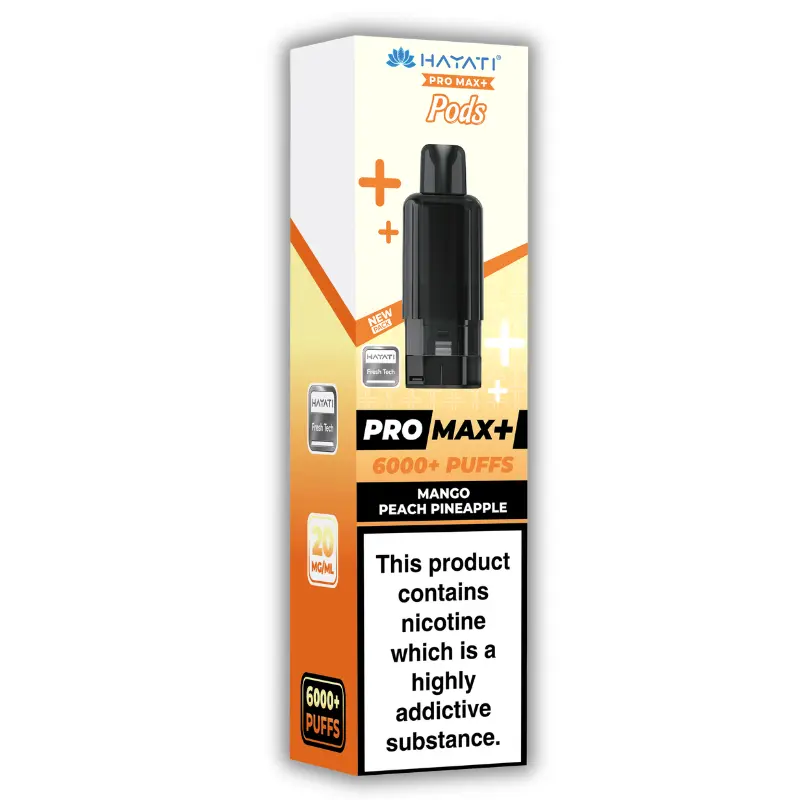
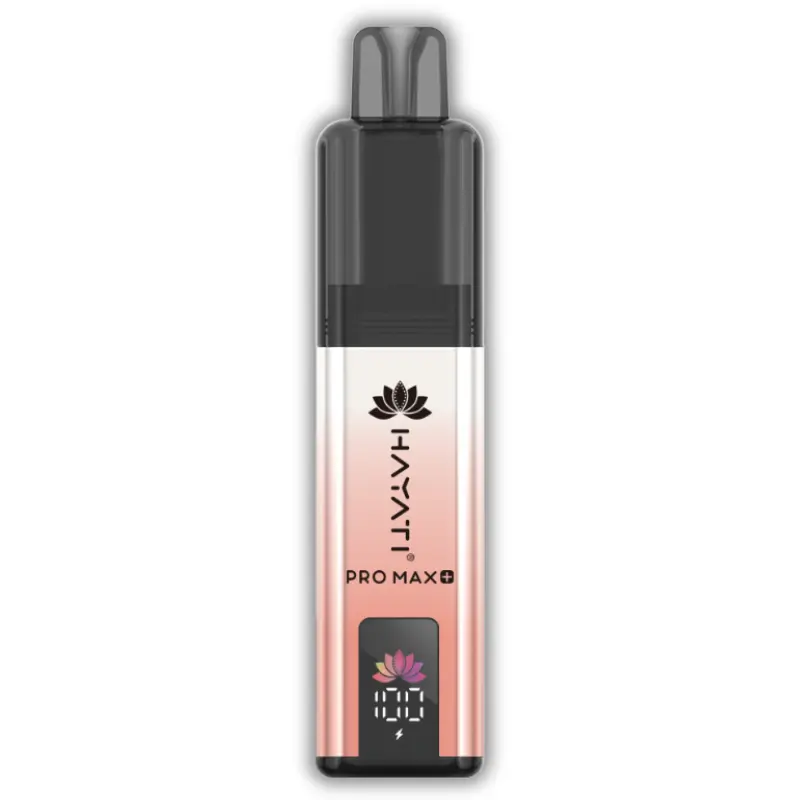
Thirty-two Hayati listings put peach in the title and carry ten distinct flavour names between them. Ten are Juicy Peach on its own in one format or another, five are Mango Peach Pineapple, three are White Peach Raspberry, and six are two-sided pods pairing peach with sour apple or cooled cherry. The remaining eight cover Peach Aura, Peach Green Tea, Cherry Peach Lemon, Lemon Peach Passionfruit and a Peach Mango refill. Prices run £2.49 to £11.99.
Peach is the reason this shelf is worth reading rather than scrolling. Very few fruits can be built four genuinely different ways and still read as themselves. A peach can be pitched ripe and honeyed, green and firm, cooked and jammy, or floral and low in acid, and a competent mixer can hit any of those four and have you name the fruit correctly every time. That plasticity is why thirty-two listings of one fruit are not thirty-two versions of the same thing.
The single most useful fact before you scroll: on this shelf the peach hardly ever supplies its own sharpness. Counting all thirty-two descriptions, exactly two credit the peach itself with a sharp or tangy note. Every other listing either denies sharpness outright or sources it from a second fruit. So the real question here is not which peach, it is what is standing next to the peach and what that neighbour is being paid to do.
New ProductsHayati PodsHayati Prefilled Pods & RefillsHayati Pod KitsHayati Prefilled Pod KitsHayati E-LiquidsHayati Pro Ultra Plus Prefilled Pod Kits & PodsHayati Pro Max Plus PodsHayati Pro Max Plus Prefilled Pod KitHayati Pro Max Nic SaltsHayati Pro Ultra Plus PodsHayati Pro Ultra Plus Prefilled Pod KitHayati Mini UltraHayati RubikHayati Mini Ultra PodsHayati Mini Ultra Prefilled Pod KitHayati Pro Max 50-50 E-LiquidHayati Pro Max 70-30 E-LiquidHayati Rubik Prefilled Pod KitHayati Rubik PodsHayati Nicotine PouchesHayati QuokkaBerry VapesRaspberry VapesIce VapesBlueberry VapesStrawberry VapesCherry VapesSweet VapesExotic VapesLemon VapesBlueberry Raspberry VapesPeach VapesWatermelon VapesApple VapesLemon Lime VapesMango VapesPineapple VapesGrape VapesLemonade VapesMint VapesCola VapesStrawberry Raspberry Ice VapesBlackcurrant VapesJuicy Peach VapesMr Blue VapesSummer Dream VapesBanana VapesKiwi VapesMenthol VapesOrange VapesFresh Mint Vapes
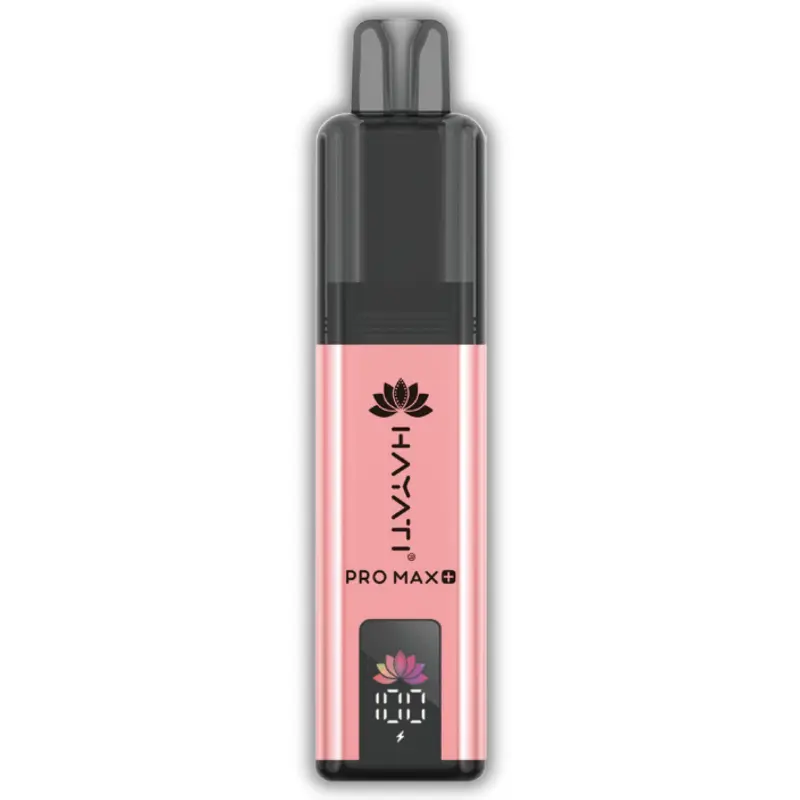
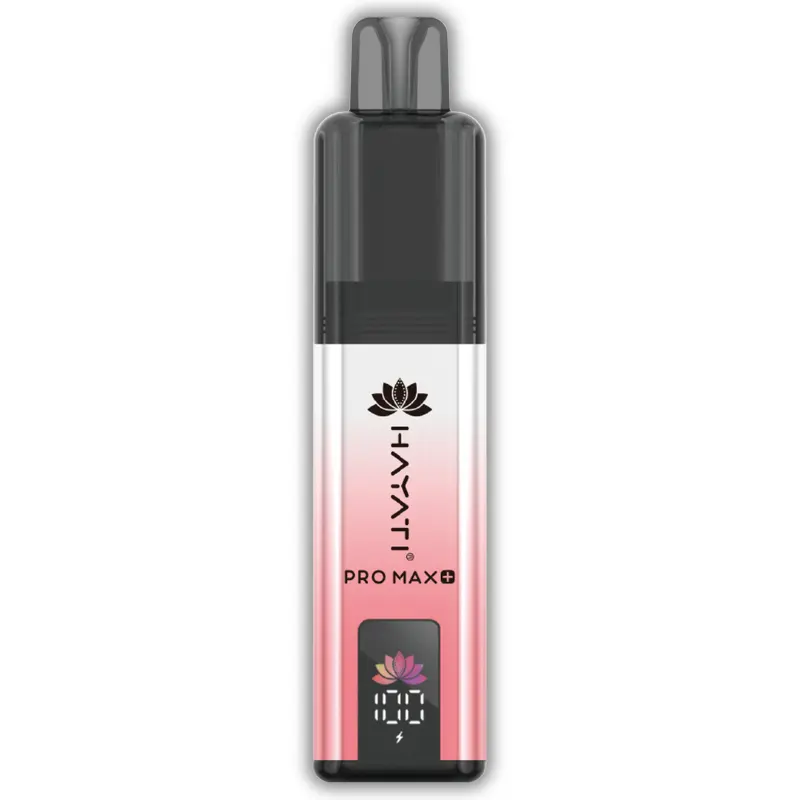
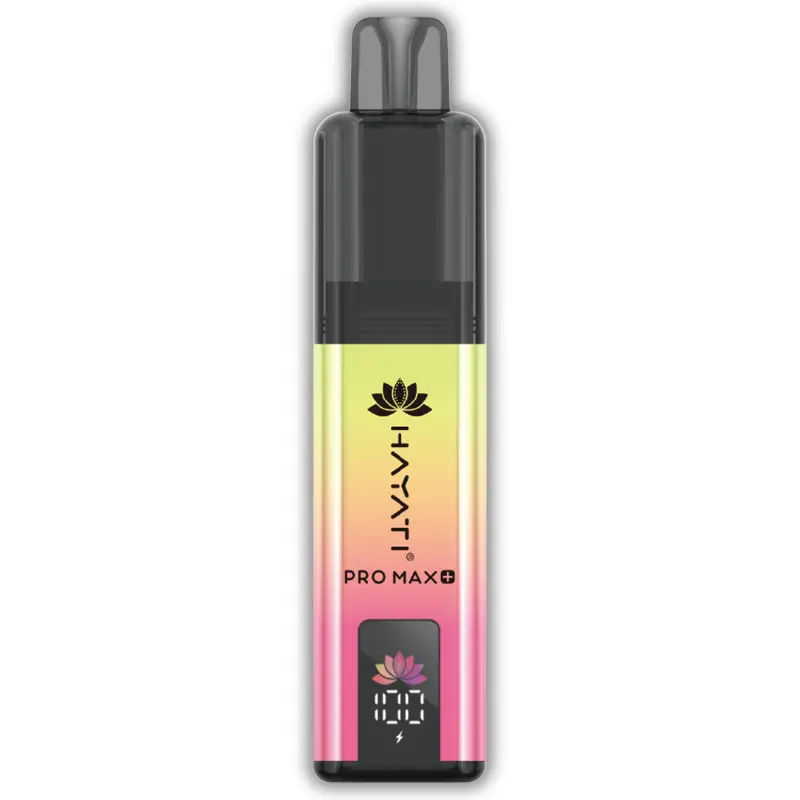
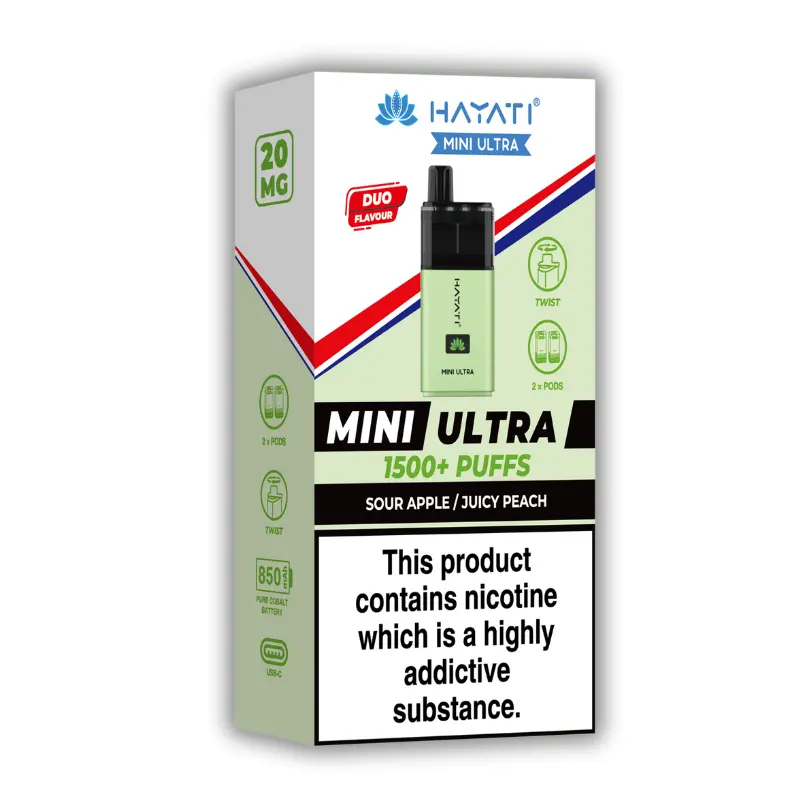
The boundary of this shelf, and what sits just outside it
Every listing here names peach in its title. That is the whole membership rule, and it is worth saying plainly because flavour shelves on this site have been accused of stranger logic. The Apple Vapes page measured how filing actually works across all seventeen single-flavour shelves and settled it: filing keys off a title naming a flavour, it is reliable wherever the title does that, and it degrades only on the handful of listings titled with a range and a nicotine strength rather than a flavour. None of those strength-titled listings lands here, so this shelf is clean. Thirty-two titles name peach and thirty-two listings appear.
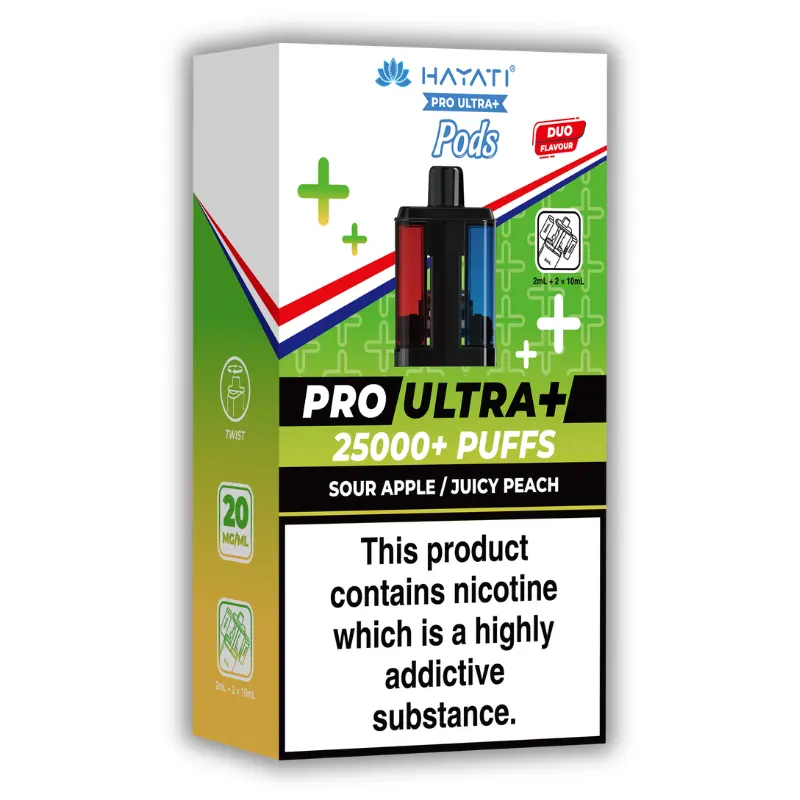
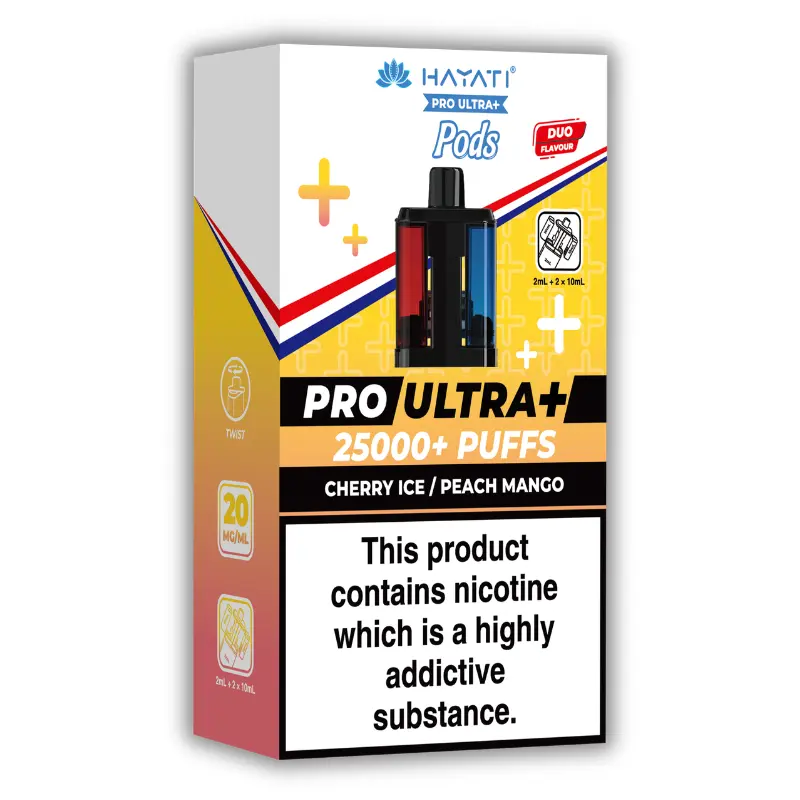
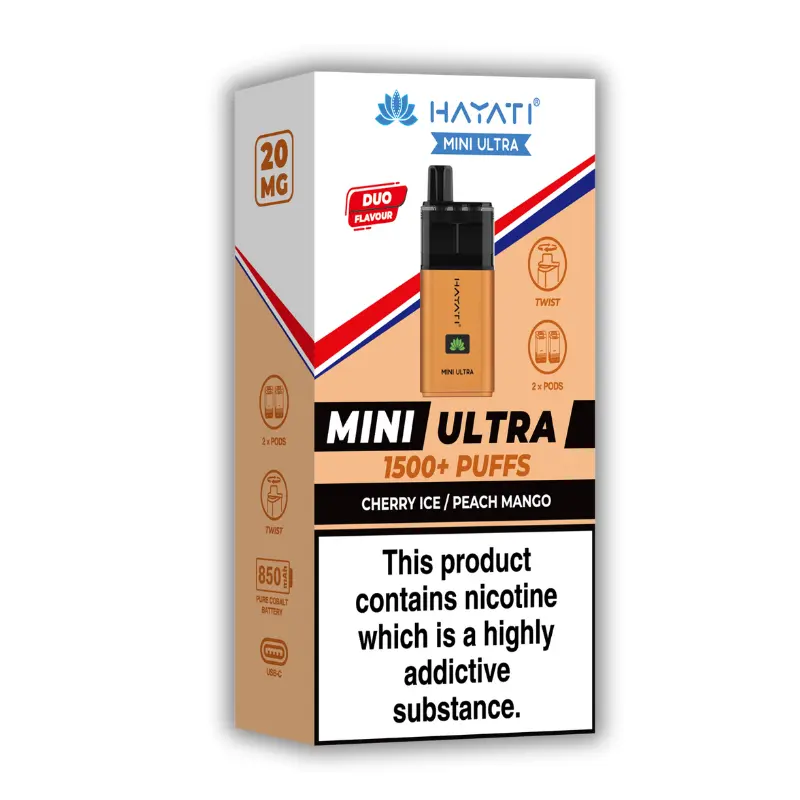
What that rule includes is broader than it looks. Two of the ten flavour names on this shelf are not peach products in the ordinary sense at all. Sour Apple/Juicy Peach Hayati Pro Ultra Plus 25K Pods and Cherry Ice/Peach Mango Hayati Pro Ultra Plus 25K Pods carry an oblique in the name, and an oblique on this platform means one 22ml pod divided into two internal reserves with a rotating collar on the mouthpiece selecting which reserve feeds the single shared coil. It is not a packet with two pods in it. Half of what you pay for in those listings is not peach, and the two halves share one coil, one wick and one liquid budget. Six of the thirty-two listings work that way.
What is deliberately absent matters more. There is no cooled peach anywhere in Hayati's range. Search all thirty-two titles for a cooling word and you find three hits, all of them the phrase Cherry Ice, and all three sit on the far side of an oblique from the peach. Not one listing in the catalogue attaches ice, frozen, cooler, chill or menthol to the fruit itself. If you have arrived here after a summer on iced fruit and expected a peach ice to exist, it does not, and no amount of scrolling will produce one. The nearest thing available is Cherry Ice / Peach Mango Hayati Pro Ultra Plus 25000 Prefilled Pod Kit, where the cold is a separate flavour you turn a collar to reach, and the peach side is explicitly warm.
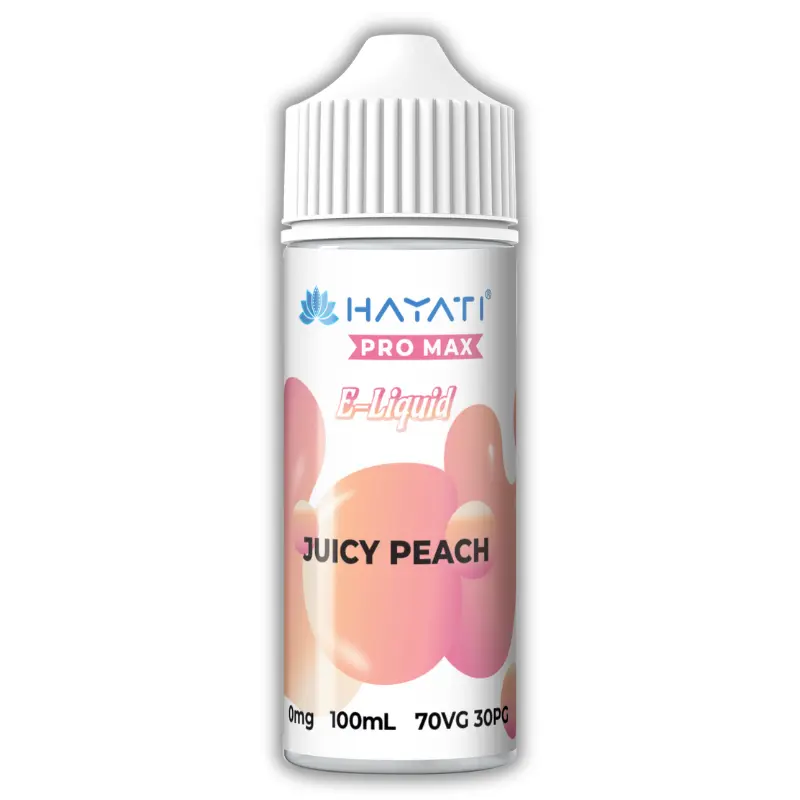
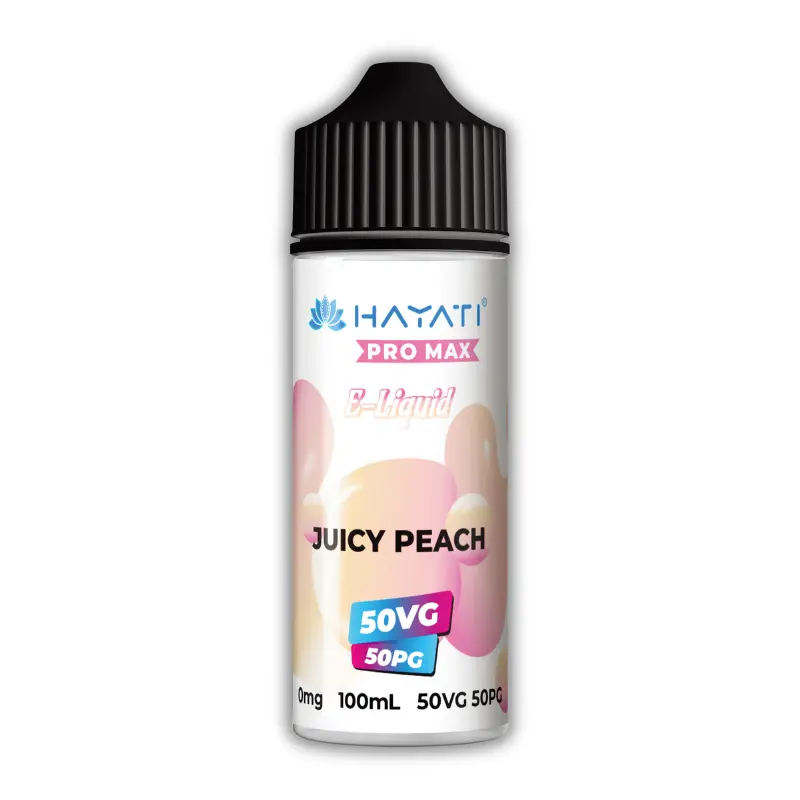
Also absent: peach in a nicotine pouch, peach in any nicotine-free format other than the two 120ml bottles, and peach at any nicotine strength between the 10mg of the small bottles and the 20mg of every prefilled pod. The bottled pair, Juicy Peach Hayati Pro Max 70/30 E-Liquid and Juicy Peach Hayati Pro Max 50/50 Shortfill E-Liquid, are both 0mg shortfills, so the strength is whatever you make it.
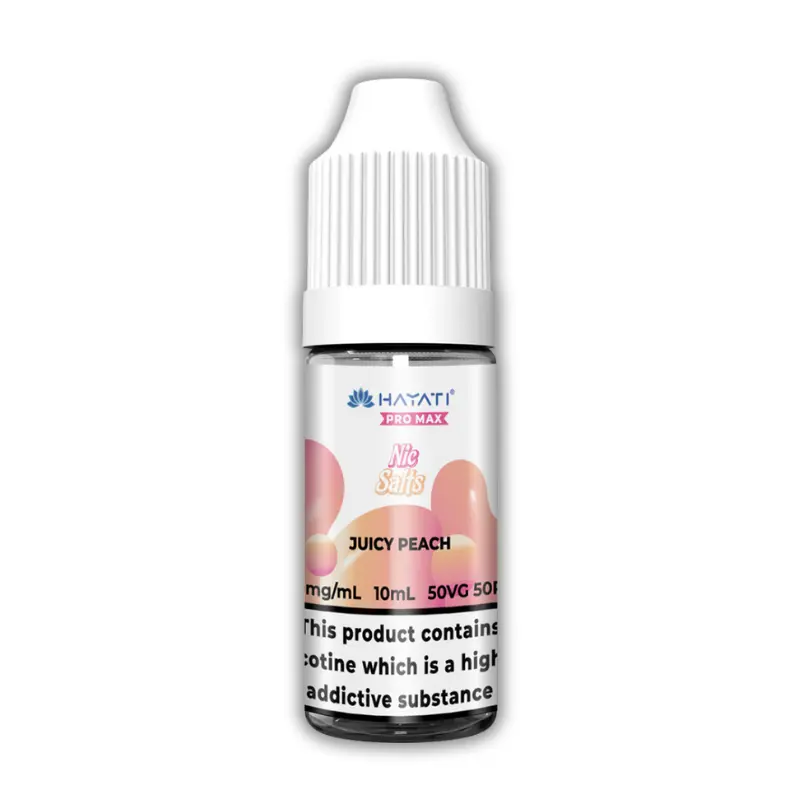
Twelve of the thirty-two are solo peach, meaning the title names no other fruit. Ten of those twelve are Juicy Peach, the remaining two are Peach Aura Hayati Pro Max Plus Pods and its kit. The other twenty listings all put something else in the pod. That ratio is the shape of the shelf in one number: Hayati make one peach that stands alone and deploy it everywhere, and around it they build a small set of partnered blends that each solve the same problem in a different way.
Why a peach is the fruit worth watching
Most fruits in a vape catalogue have one register and stay in it. Blue raspberry is a confection accord and is always a confection accord. Lemon is acid and zest, and a lemon that is neither is not a lemon. Watermelon is thin, sweet and watery by definition, and pushing it anywhere else breaks it.
Peach does not behave like that. The same fruit, over roughly ten days on a tree and another five in a bowl, passes through four states that all read unmistakably as peach and taste very little like one another. Firm and green, it is almost apple-adjacent: crunchy, low in aroma, with a tart edge and a faintly grassy note. Two days later it is the classic ripe fruit, sweet and running, with the aromatic fraction fully open. Cook it and the same fruit becomes something else again, dark and jammy, the fresh notes burned off and a caramel shoulder in their place. And a white-fleshed peach at any of those stages is a fourth thing, lower in acid, and heavier on blossom.
That range is what makes a peach shelf interesting and a peach purchase risky. When somebody says they want a peach vape, the word does not narrow the field nearly as much as they think it does. Two liquids can both be accurate peaches and land at opposite ends of what a person would enjoy.
One note on chemistry, and it is general rather than a claim about any recipe on this page. The compounds most associated with peach in flavour work are a family of lactones, which read as creamy, ripe and slightly coconut-adjacent, sitting alongside esters, a small green note from six-carbon aldehydes that is strongest in underripe fruit, and, in some varieties, a benzaldehyde presence that pushes towards almond. That is textbook flavour chemistry, not a description of what is in any Hayati pod. Hayati publish no ingredient list, no flavour house, no concentration and no proportions for any listing in the range, so nothing below should be read as a statement about a formulation sheet. What can be examined is what Hayati chose to write about each liquid, and how those thirty-two descriptions agree and disagree with one another.
Four axes, and where each listing sits on them
Rather than a tour of thirty-two products, here are the axes that actually separate them. Place a listing on all four and you know most of what a description could tell you.
Axis one: ripeness register, which turns out to have one setting
This is the axis with the most theoretical range and the least actual variation, and finding that out is worth the counting. Of the thirty-two descriptions, twenty-three use the word ripe. Across the other 460 listings in the catalogue the figure is 15 per cent, so ripe is roughly five times as likely to appear on a peach listing as anywhere else. Every one of the eight Pro Ultra Plus peach listings uses it, without exception.
Now look for the opposite. The words firm, underripe and unripe appear once in total across all thirty-two, in Juicy Peach Hayati Pro Ultra Plus 25000 Prefilled Pod Kit, and they appear there as a denial: the copy places the profile closer to the flesh of a fully ripe fruit than a firm one. Green and crisp appear several times on this shelf and never once attached to the peach. They belong to the sour apple in the dual pods and to the cherry.
The cooked and jammy register is in the same position. Syrupy, candied, cloying and sticky turn up eight times between them, and seven of those eight are negations: the sweetness reads natural rather than candied, the raspberry keeps it from turning syrupy, the word aura is said to hint at something airier than a syrupy peach. The single exception is Juicy Peach Hayati Rubik Prefilled Pod Kit, whose copy names a sticky, fragrant sweetness as the target rather than something to avoid. One listing in thirty-two leans towards the jam end and the rest run away from it.
So of the four registers a peach can occupy, this shelf offers one. Everything here is pitched at the ripe, fresh, uncooked fruit. That is a genuinely useful thing to learn before buying, because it means the axis you might have expected to choose along is not on offer, and your decision has to be made on the other three.
Axis two: whether anything sharp arrives, and who supplies it
Most purchases on this shelf are decided here, and the counting produced the most striking result on the page.
Across all thirty-two descriptions, the peach itself is credited with a sharp, tart or tangy note exactly twice. Both times it is Juicy Peach on the Pro Max Plus: Juicy Peach Hayati Pro Max Plus Pod Kit at £7.99 names a slight tang near the finish, and the bare pod at £5.49 names a touch of fresh tang at the end. Nowhere else on the shelf does any peach get given an edge of its own.
The Peach Aura kit page did the narrower version of this count first and it is worth citing rather than repeating. Looking only at the ten listings where Juicy Peach stands alone, it found that exactly two mention the closing sharpness and the other eight explicitly deny it, not by omission but in as many words: the Pro Ultra Plus pair rule out a sour note outright, the Rubik pair say there is no sharpness worth mentioning, and the Mini Ultra pod, the 10ml salt and both bottles all state that nothing sharp or sour competes with the fruit. Eight denials against two affirmations, for one flavour name. That page also laid out the two readings the record cannot choose between: either the Pro Max Plus version is a genuinely different mix, which is entirely possible since a 12ml prefilled pod and a 120ml shortfill are under no obligation to share a recipe, or the sentence is a copywriting variant and there is no differential at all. Both readings survive, and the honest answer is that nobody outside Hayati knows.
What the shelf-wide count adds is that the pattern is not confined to Juicy Peach. Extend the same test to all thirty-two listings, including every blend, and the two affirmations stay at two. In the twenty partnered listings, the sharp note is always sourced from something other than the peach, every single time, with no exceptions and no sharing. Raspberry supplies it in the three White Peach Raspberry listings. Pineapple supplies it in all five Mango Peach Pineapple listings. Lemon supplies it in the two Cherry Peach Lemon listings and in Lemon Peach Passionfruit Hayati Pro Max Nic Salt, where the passionfruit adds a second tangy element on top. In the six dual-reserve pods it comes from the sour apple or from the cherry, which is to say from a separate liquid in a separate compartment.
Read that as a design habit rather than a coincidence. Whoever writes this copy treats peach as a fruit that does not bring acid, and builds around that assumption consistently enough that a buyer can use it. If you want something to arrive at the end of the exhale, you are choosing a partner fruit, not a peach.
Axis three: what the partner is being paid to do
Once you accept that the peach is not going to supply structure, the twenty partnered listings sort themselves by what their second ingredient contributes. There are four jobs on offer and they are not interchangeable.
Acid, straightforwardly. This is raspberry and pineapple. White Peach Raspberry Hayati Pro Max Plus Pods is the clearest case: the copy has the raspberry cutting across a soft foundation and describes it acting as a squeeze of acidity rather than a second headline fruit, which is an unusually precise thing for retail copy to say. The pineapple in Mango Peach Pineapple Hayati Pro Max Plus Pods does the same job in a warmer setting, with the mango carrying the body and the pineapple keeping the sweetness from settling.
Zest, which is acid plus a volatile top note. Lemon does this in Cherry Peach Lemon Hayati Pro Max Plus Pods, and the copy is explicit that the blend travels from rich to soft to sharp inside one draw. That is a sequence rather than a balance, and it is a different purchase from a blend where everything arrives at once.
Astringency and bitterness, which are not acid at all and behave differently. Only Peach Green Tea Hayati Pro Max Plus Pods and its kit take this route. Tea brings a light grassy backbone and a faint bitterness, and bitterness suppresses perceived sweetness by a different mechanism from sourness: it does not create a late event on the tongue the way acid does, it lowers the whole sweetness reading. The copy describes the result as closer to a drink than to a sweet, which is a fair summary. Of all the listings on this shelf, this pair is the only one pursuing restraint by a declared mechanism rather than by adjectives.
Body, which is the opposite job. Mango in Peach Mango Hayati Mini Ultra Pods adds thickness and tropical weight with no sharpness at all, and the copy says so, promising no sharp edges to speak of. If the peach was already soft and you add a second soft fruit, you get more of the same rather than a contrast, and that is a legitimate thing to want.
Worth noticing which fruits Hayati never pair with peach. There is no peach and berry blend other than the raspberry pair. No peach and grape, no peach and blackcurrant, no peach and watermelon, no peach with a mint or a menthol. The partner list is short and every member of it is doing one of those four jobs.
Axis four: is a coolant involved, and the answer is no
Three of the thirty-two titles carry a cooling word. All three are Cherry Ice, all three sit on the other side of an oblique, and the peach half of each of those pods is described as the warm option with no chill. Cherry Ice / Peach Mango Hayati Mini Ultra Pod Kit puts it most directly: the cherry keeps a hint of tartness under the ice while the peach and mango stay soft and rounded throughout.
An absence is more useful here than any presence would be. A coolant is the one component that partially substitutes for acid in a sweet liquid. It creates a late event on the exhale, it suppresses perceived sweetness, and it tends to survive a tiring coil better than a delicate aromatic does. None of the thirty-two peach listings has one. So a buyer who wants a peach that stays legible over a large pod cannot buy that structure in; they have to get it from a partner fruit, or accept its absence.
The corpus has already established, on the Blue Frozen pods page, that Hayati's cooling vocabulary is not graded: Ice appears in ninety titles, Frozen in three, Cooler in two, Chill and Freeze in none, and no listing ever combines an ice-family word with a mint-family word. That finding is cited here rather than recounted. Its relevance to peach is simply that the absence is clean. There is no borderline case, no half-cooled peach hiding behind an ambiguous word. The Ice Vapes shelf and this one share three products and those three are all the same Cherry Ice pairing.
A fifth, smaller axis: where in the blend the peach sits
Eight of the thirty-two listings are three-fruit blends, and all eight put peach in the middle slot of a three-word name. Mango Peach Pineapple, Cherry Peach Lemon, Lemon Peach Passionfruit. Not once does a three-fruit peach blend lead with the peach or close with it.
That would be weak evidence on its own, because word order in flavour naming is unreliable and this corpus has warned against reading it. What makes it interesting is that the copy agrees with the title in seven of the eight cases. The descriptions give peach the middle job in prose too: it follows the lead fruit, it fills in, it softens, it smooths out the citrus, it adds a layer between the others. The one listing that breaks the pattern is Mango Peach Pineapple Hayati Pro Max Plus Pods, which moves the peach to the close instead and calls it the quiet one that rounds off the finish.
Seven of eight is agreement, not proof. It tells you how these descriptions were written, which is by somebody with a clear mental model of what peach is for in a blend. Whether the liquid obeys the model is a separate question, and the answer is not published.
The listing diff: what every peach description says, and what only some say
Hayati write fresh copy for every listing rather than reusing one block, so thirty-two descriptions of ten flavours can be lined up against each other and read as evidence about the vocabulary. Two cautions before the numbers. A word that is common everywhere says nothing when it appears here, so every count below is given against the other 460 listings in the catalogue. And copy is copy: a disagreement between two descriptions of one liquid is evidence about how the text was produced, not proof of two recipes.
What all of them say
Sweet appears on all thirty-two. It also appears on 94 per cent of the rest of the catalogue, so it is house vocabulary and carries no information at all. Discount it entirely.
Soft appears on thirty of thirty-two, against 33 per cent elsewhere. That is a real concentration, roughly three times the base rate, and the two exceptions are both kits whose copy uses softens as a verb instead. Effectively the shelf is unanimous.
Ripe appears on twenty-three of thirty-two against 15 per cent elsewhere, and on all eight Pro Ultra Plus listings. Between them, soft and ripe are the closest thing to a fact this shelf will give you: whatever else a Hayati peach is, it is not sharp and it is not underdeveloped.
What is peach vocabulary specifically
Four words are used on this shelf far out of proportion to their use anywhere else, and they are the most interesting result of the diff.
- Fragrant. Seventeen of thirty-two peach listings, against thirteen of the other 460. That is 53 per cent here and under 3 per cent everywhere else, a concentration of about nineteen to one.
- Stone fruit. Fourteen of thirty-two here, and zero of the other 460. The phrase exists in this catalogue only on peach listings, which makes sense taxonomically and still means it is a marker rather than a description.
- Honeyed. Six here, four everywhere else.
- Velvety. Three here, one everywhere else.
Put together, that is a house register for peach: fragrant, honeyed, velvety stone fruit. It is consistent, it is distinctive, and it describes an aroma-led liquid with no edges. Whether it describes thirty-two liquids or one editorial habit is the question the diff cannot answer, and pretending otherwise would be dishonest.
What only some of them say, and the platform pattern underneath it
The most useful disagreement is not about flavour at all. It is about which platform a listing sits on.
Of the four peach-marker words above, not one appears on any of the eight Pro Ultra Plus listings. No fragrant, no stone fruit, no honeyed, no velvety, across eight descriptions. Those eight instead reach for a sweetness band: three of them place the liquid in the medium-to-sweet range, a phrase that appears on just eight listings in the entire 492-product catalogue. The Pro Ultra Plus peach copy is doing something the rest of the shelf is not, which is quantifying rather than evoking.
Two readings again, and the record does not settle between them. Either the Pro Ultra Plus descriptions were written by a different hand or at a different time with a different style sheet, which is the boring and likely explanation, or the 22ml Pro Ultra Plus peach really is a plainer, less aromatic mix than the 12ml Pro Max Plus one and the copy is tracking that. The first reading costs you nothing. The second one, if true, would mean that Juicy Peach Hayati Pro Ultra Plus 25K Pods and Juicy Peach Hayati Pro Max Plus Pods are not quite the same liquid despite sharing a name, which is exactly what the tang disagreement suggests independently. Two separate signals pointing the same way is worth more than either alone, and it is still not a specification.
Tang is the other instructive count. Sixteen of thirty-two peach listings use a tang word, which sounds like half the shelf until you notice that 44 per cent of the rest of the catalogue uses one too. Peach is barely below the house average for mentioning tang, and as established above, almost every one of those sixteen mentions is either a denial or a credit to a partner fruit. A word count on its own would have told you the wrong thing here. Reading where the word points is what makes it evidence.
The one-offs
Three descriptions say something no other listing on the shelf says, and they are the places where the copy stops being a register and starts being specific.
Peach Mango Hayati Mini Ultra Pods is the only listing anywhere on the shelf to mention the skin of the fruit, describing a hint of fuzzy-skin softness. Everything else describes flesh. Whether that survives into a 4ml pod is unknowable, but it is the only attempt on the shelf to name a texture rather than a taste.
The three White Peach Raspberry listings are the only ones that specify which kind of peach. The pod page did the counting on that and the result is theirs, not mine: strip the hardware suffix from all 492 titles and 173 distinct flavour names remain, of which exactly two specify a variety of the fruit they name, and zero name a cultivar outright. On this shelf, three listings out of thirty-two tell you which peach and all three are the same liquid in three formats. Its conclusion was that the phrase is a genuine signal of formulation intent and a poor guarantee of execution, which is a more useful position than either enthusiasm or cynicism.
And Peach Aura is the only listing whose modifier names nothing tastable. That page priced the suffix properly and its finding stands: Aura is one of roughly eight hybrid names on its shelf rather than a unique case, the strongest account of the word is that it keeps a second solo peach distinguishable from the one already selling at the same price on the same hardware, and the flattering reading, that it marks a softer handling, collapses because Hayati use the identical vocabulary for the plainly named peach it is supposed to be distinguished from.
Where each group lands, and who should buy it
Solo peach: twelve listings, £2.49 to £11.99
Ten Juicy Peach and two Peach Aura, and between them they cover every format Hayati make. This is the group for somebody who wants the fruit and nothing else, and the honest warning attached to it is about volume rather than flavour. Twelve millilitres of one soft fruit with no acid and no coolant is a long way to go without an event, and twenty-two millilitres is nearly twice as far.
The cheapest route in is Juicy Peach Hayati Pro Max Nic Salt at £2.49, a 10ml bottle at 10mg for a refillable pod device you already own. If you want to find out whether a solo peach holds your attention before committing £11.99 to a kit, that bottle answers the question for a fifth of the money. Juicy Peach Hayati Mini Ultra Pods at £3.49 answers it in prefilled form at 4ml, which is a small enough quantity that boredom is not really a risk.
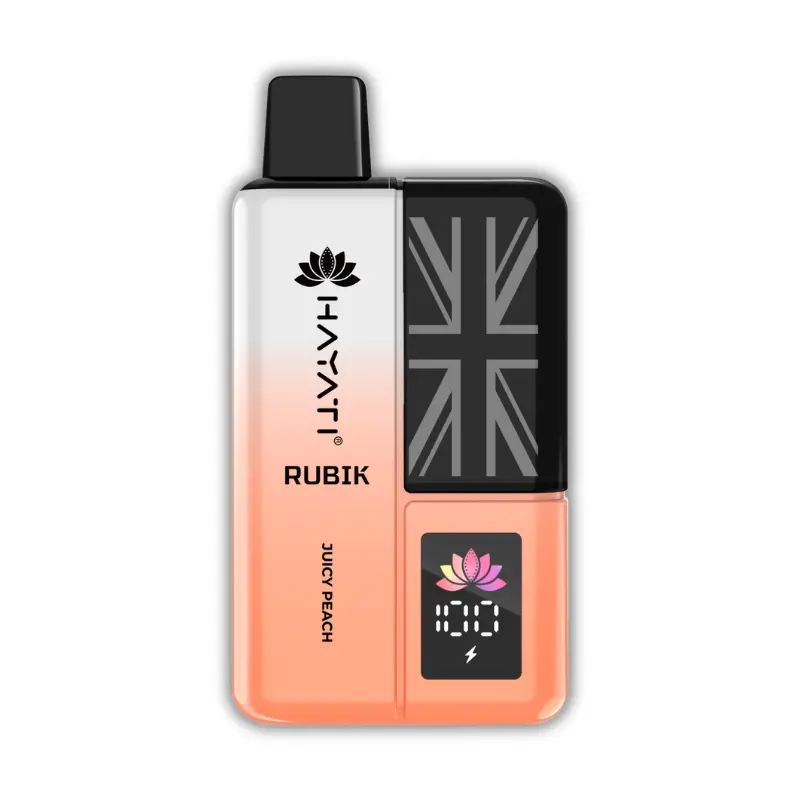
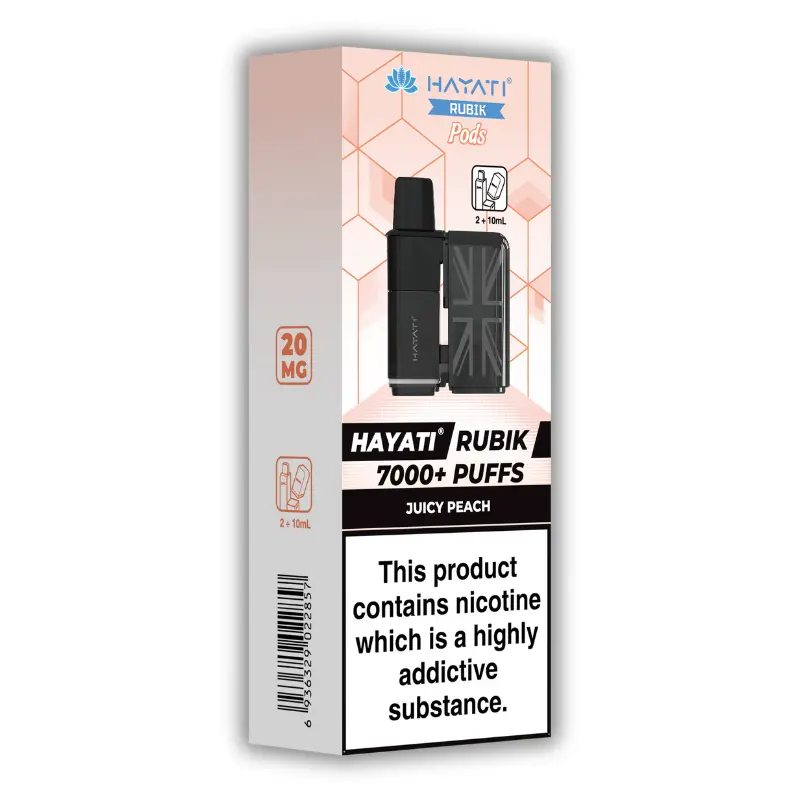
Moving up, Juicy Peach Hayati Rubik Pods at £3.99 and Juicy Peach Hayati Rubik Prefilled Pod Kit at £5.99 hold 12ml, with Hayati quoting a bench figure of 7,000 puffs for the pod. Those puff numbers are laboratory estimates produced under fixed conditions, not a promise about your draw. The Rubik kit is the cheapest way onto hardware with a full-size pod attached.
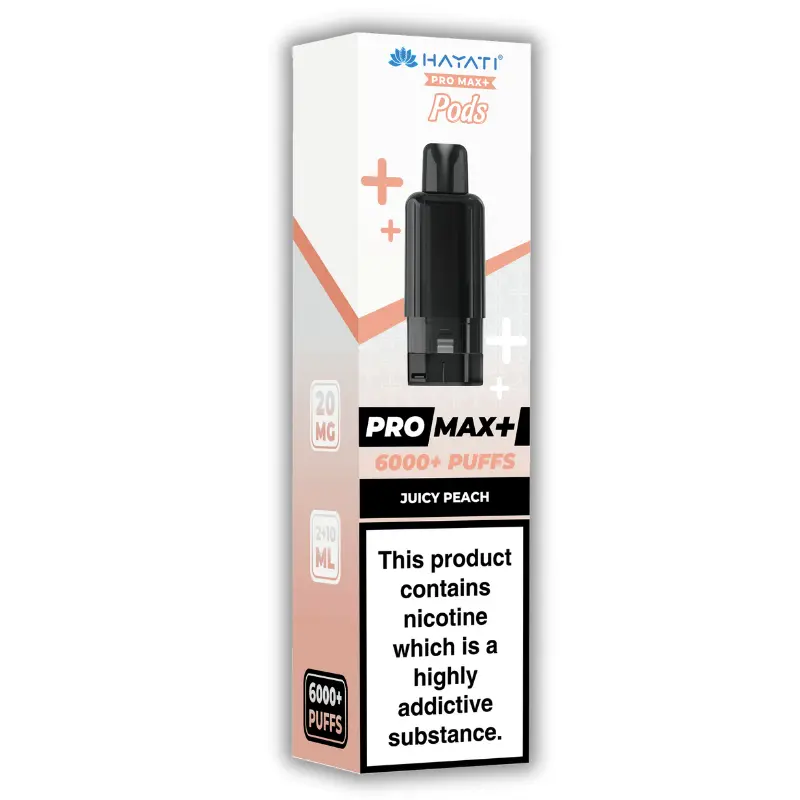
On the Pro Max Plus, Juicy Peach Hayati Pro Max Plus Pods at £5.49 and the kit at £7.99 are the two listings that claim the closing tang, and they are therefore the only solo peaches on the shelf that offer any structure at all. If the tang is real, they are the pick of the twelve. If it is a copywriting variant, they are the same as the other ten at a slightly higher price than some. That is a genuine coin toss and it costs £5.49 to resolve.
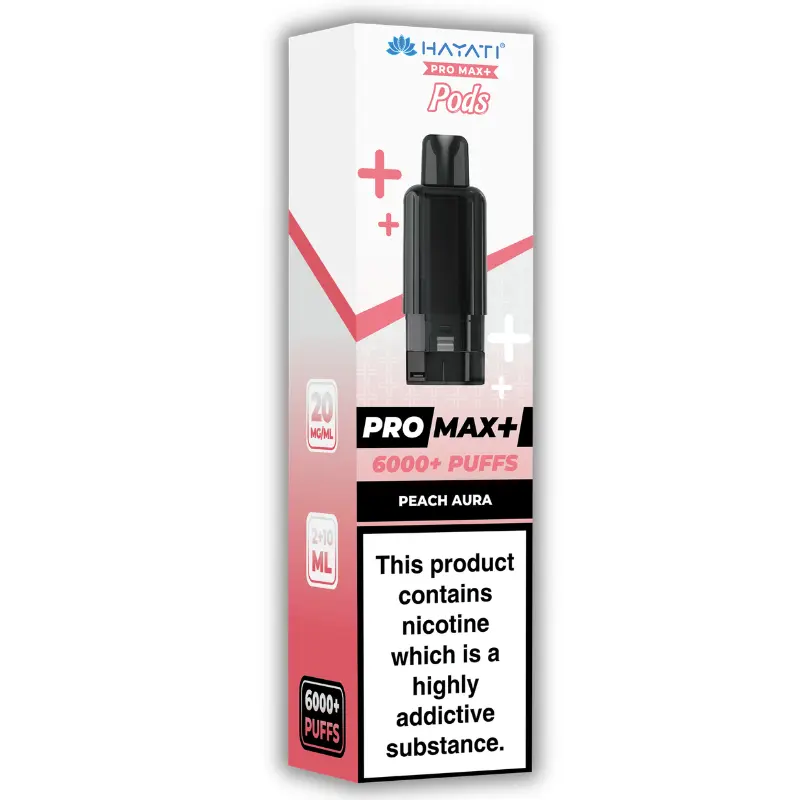
Peach Aura Hayati Pro Max Plus 6000 Pod Kit at £7.99 and its bare pod at £5.49 sit on the same hardware as the Juicy Peach pair and give you less information for the money. Its kit page argues that a peach with no tang and a claim to be less sugary has had its sweetener reduced rather than balanced, which leaves the aroma carrying the liquid almost alone, and that aroma is the component that thins first over twelve millilitres. Worth reading before you buy it rather than after.
At the top, Juicy Peach Hayati Pro Ultra Plus 25K Pods at £7.99 and the 25000 kit at £11.99 hold 22ml with a quoted bench ceiling of 25,000 puffs. This is the largest single-flavour commitment on the shelf and the copy here is the plainest, placing the liquid in a medium-to-sweet band with low sharpness and nothing else claimed.
Peach with an acid donor: eleven listings, £2.49 to £11.99
The group that solves the structural problem by buying a second fruit to do it. Three sub-families.
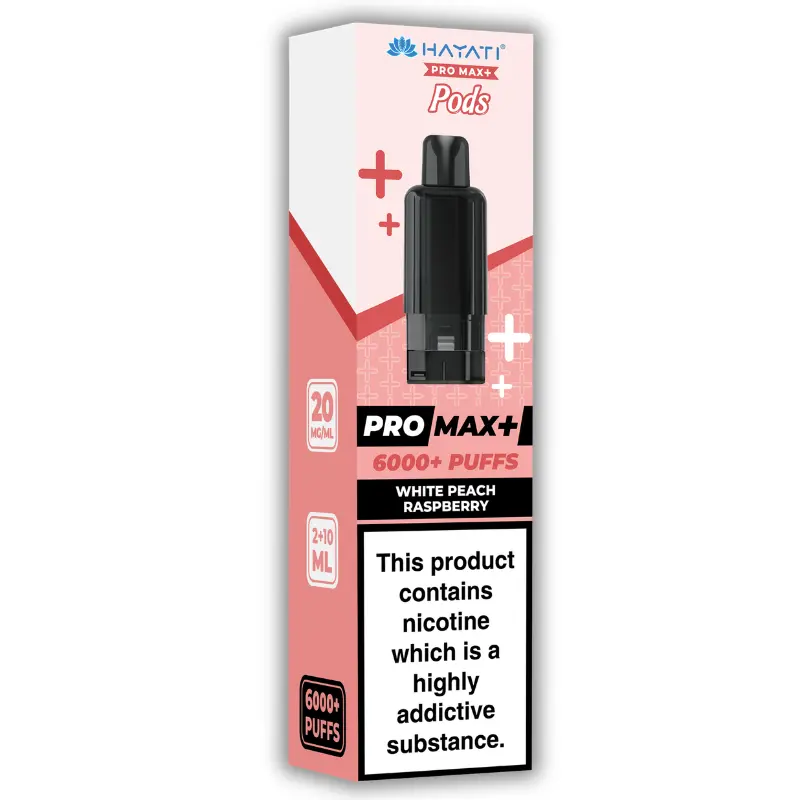
White Peach Raspberry is the most precisely specified thing on the shelf and the most fragile. White Peach Raspberry Hayati Pro Max Nic Salts at £2.49 is the cheap way to hear it, the £5.49 pod is the standard route, and White Peach Raspberry Hayati Pro Max Plus 6000 Pod Kit at £7.99 adds the device. The risk with all three is the one its own product pages identify: a sharp note masks a soft one far more efficiently than the reverse, and the proportion between the two is not published anywhere. Get the ratio right and it is the only pod of its kind in 492 listings. Get it wrong and it is a decent raspberry with a soft backdrop.
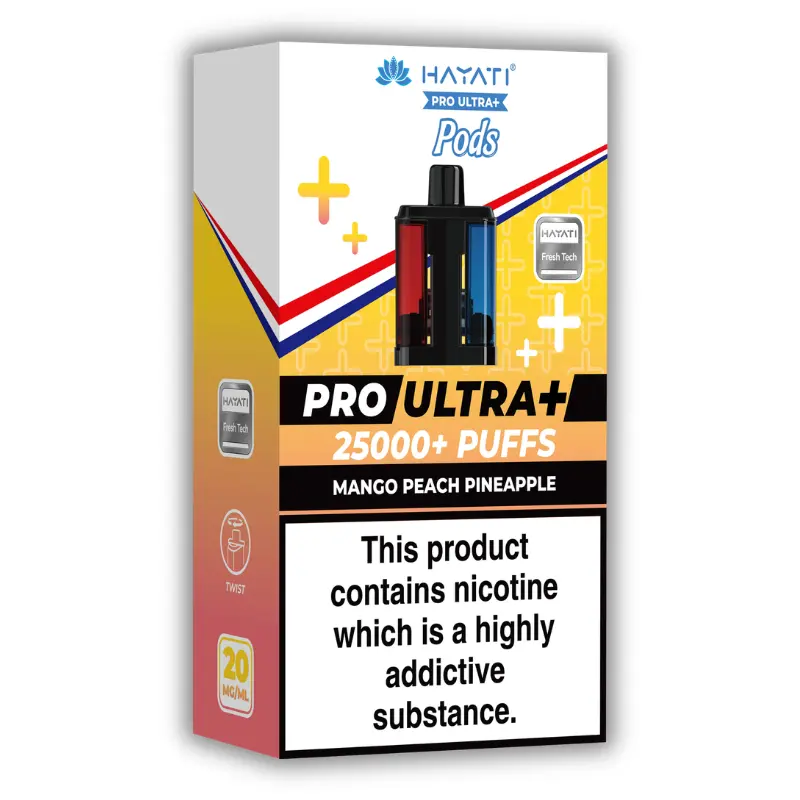
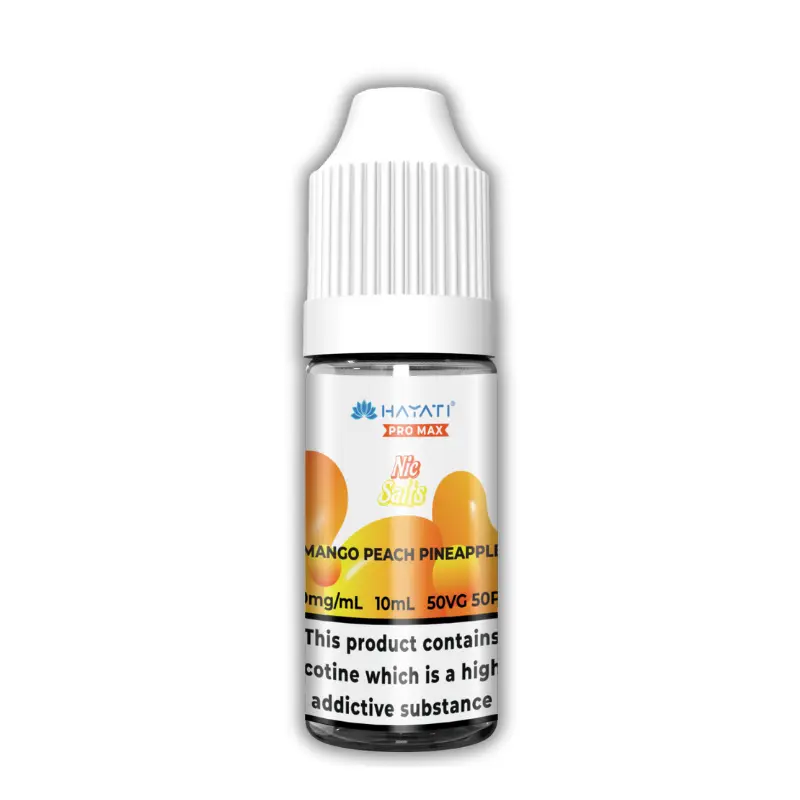
Mango Peach Pineapple is the widest-deployed blend on the shelf, appearing five times: Mango Peach Pineapple Hayati Pro Max Nic Salt at £2.49, the £5.49 Pro Max Plus pod, Mango Peach Pineapple Hayati Pro Max Plus 6000 Pod Kit at £7.99, Mango Peach Pineapple Hayati Pro Ultra Plus 25K Pods at £7.99 and Mango Peach Pineapple Hayati Pro Ultra Plus 25000 Prefilled Pod Kit at £11.99. In all five the mango carries the weight, the pineapple supplies the lift and the peach fills the middle. It is the most robust structure on the shelf, in the sense that three fruits of different weights will read as broadly the same drink across a wide band of proportions, and that robustness makes it the safest of the blends to reorder without thinking. It is also the peach least likely to taste of peach.
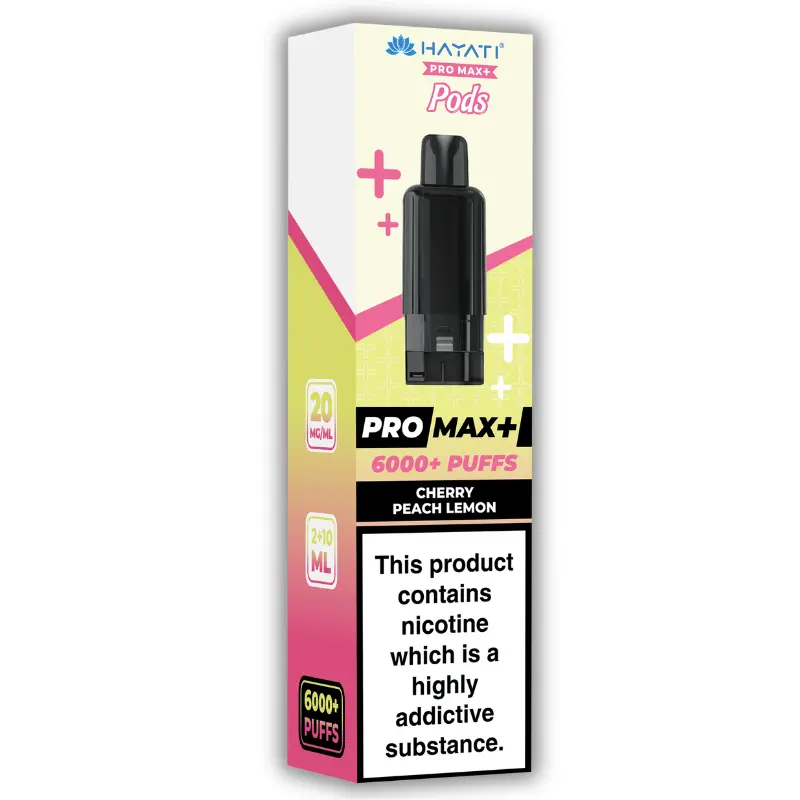
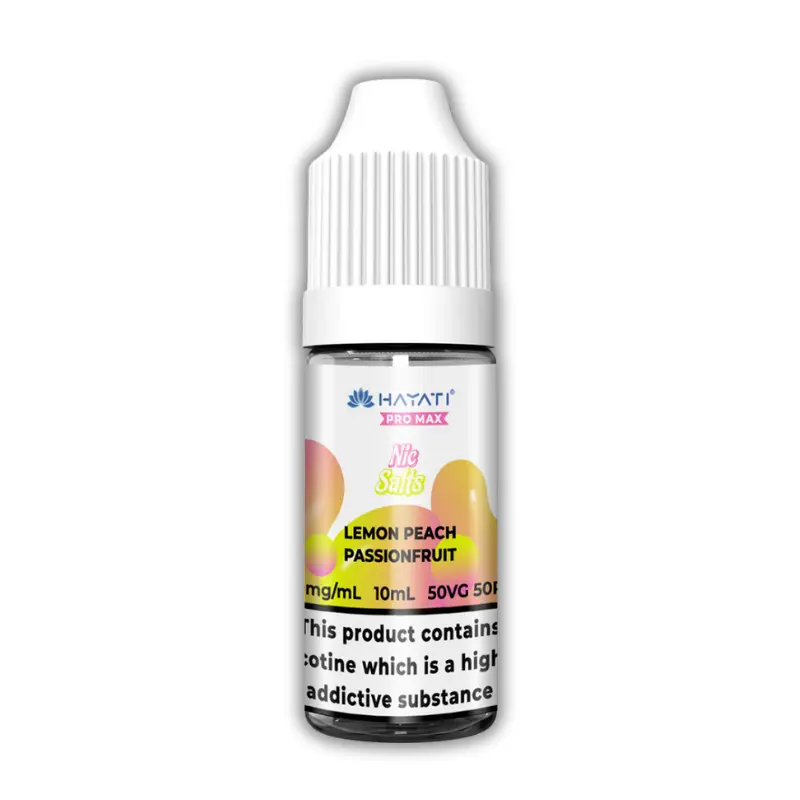
The citrus-led pair take a narrower approach. Cherry Peach Lemon Hayati Pro Max Plus 6000 Pod Kit and its £5.49 pod arrange three fruits as a sequence across a single draw, dark to soft to sharp, and their product pages make the case that a blend you can take apart is a different proposition from one you cannot. Lemon Peach Passionfruit Hayati Pro Max Nic Salt at £2.49 is the only listing of its flavour and the only one on the shelf with two sharp elements against one soft, so it is the furthest thing here from a peach-forward liquid while still being on the peach shelf.
Peach with a structural partner that is not acid: three listings
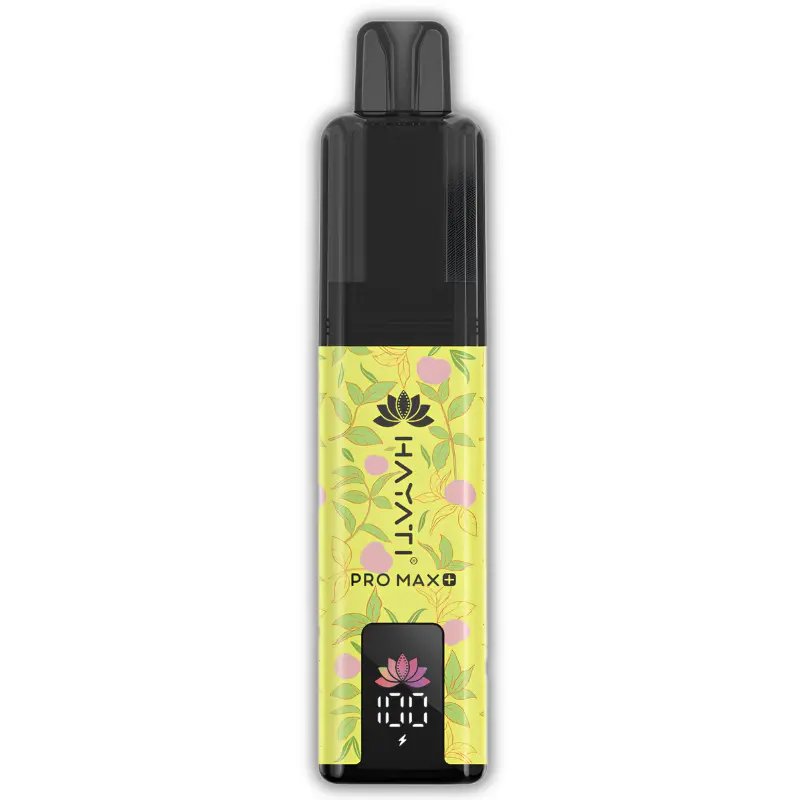
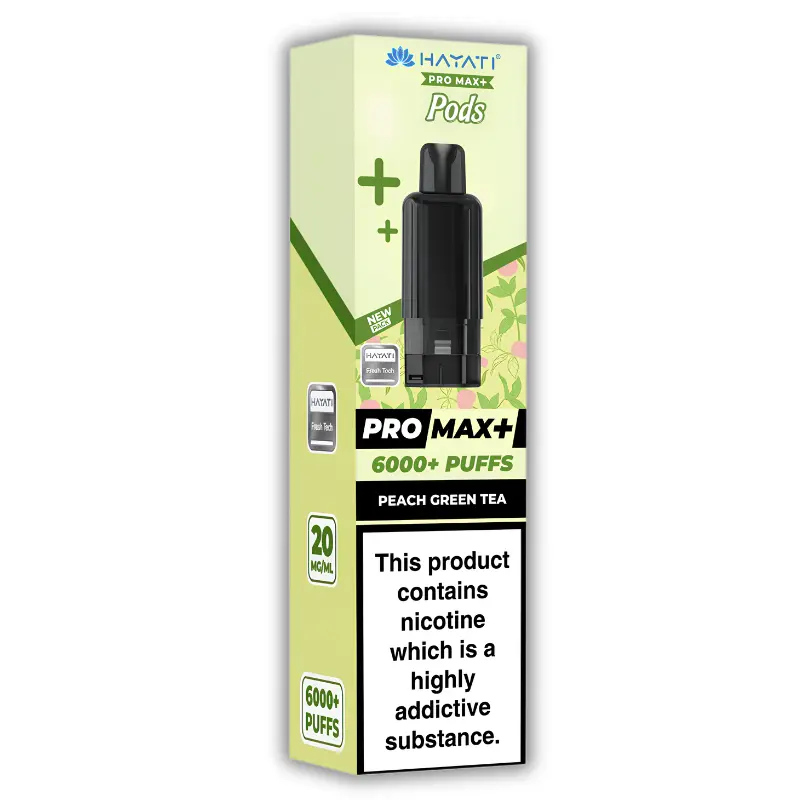
Small group, distinct purpose. Peach Green Tea Hayati Pro Max Plus 6000 Pod Kit at £7.99 and the £5.49 pod use bitterness and a grassy astringency instead of sourness, which lowers the sweetness reading without adding a late sharp event. Its kit page makes the case that tea is the hardest thing on this shelf to execute, and that is worth taking seriously before you spend the money. This is the pick if what you actually dislike about peach vapes is the sugar rather than the softness.
Peach Mango Hayati Mini Ultra Pods at £3.49 goes the other way entirely, adding a second soft fruit for weight. No sharp edges are claimed and none are wanted. At 4ml it is also the smallest commitment to a blend on the shelf.
Peach in a two-reserve pod: six listings, £3.99 to £11.99
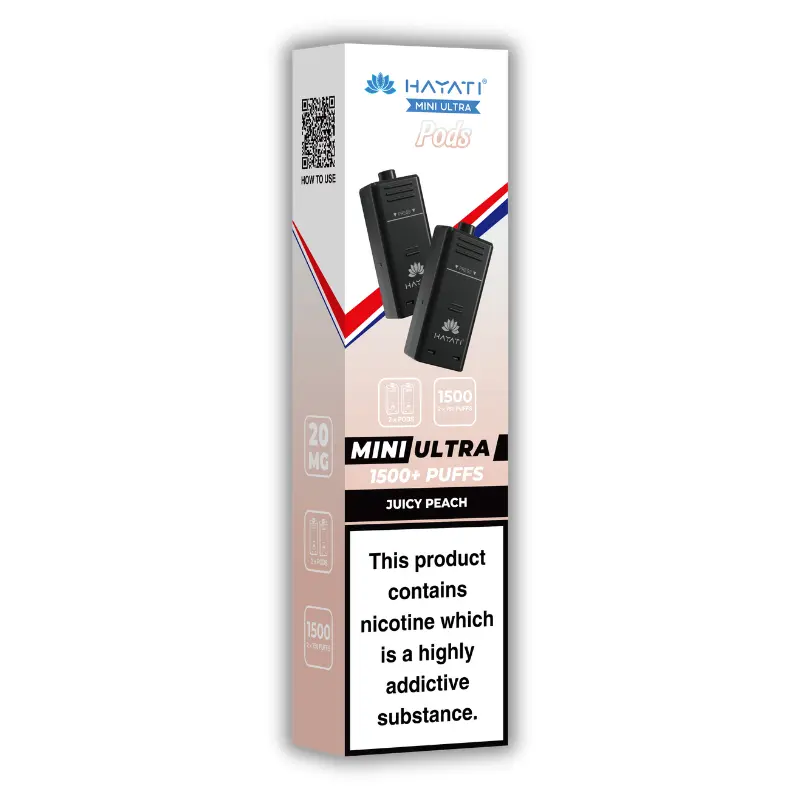
Here you are buying half a peach product. Sour Apple and Juicy Peach is a pairing chosen for distance: the copy has the apple tart and crisp and the peach mellow with very little sharpness, which is about as far apart as two fruits on one coil can be placed. Sour Apple / Juicy Peach Hayati Mini Ultra Pod Kit at £3.99 is the cheapest way to try a collar at all, holding 4ml with a quoted figure of 1,500 puffs. Sour Apple / Juicy Peach Hayati Pro Ultra Plus 25000 Prefilled Pod Kit at £11.99 is the full-size version.
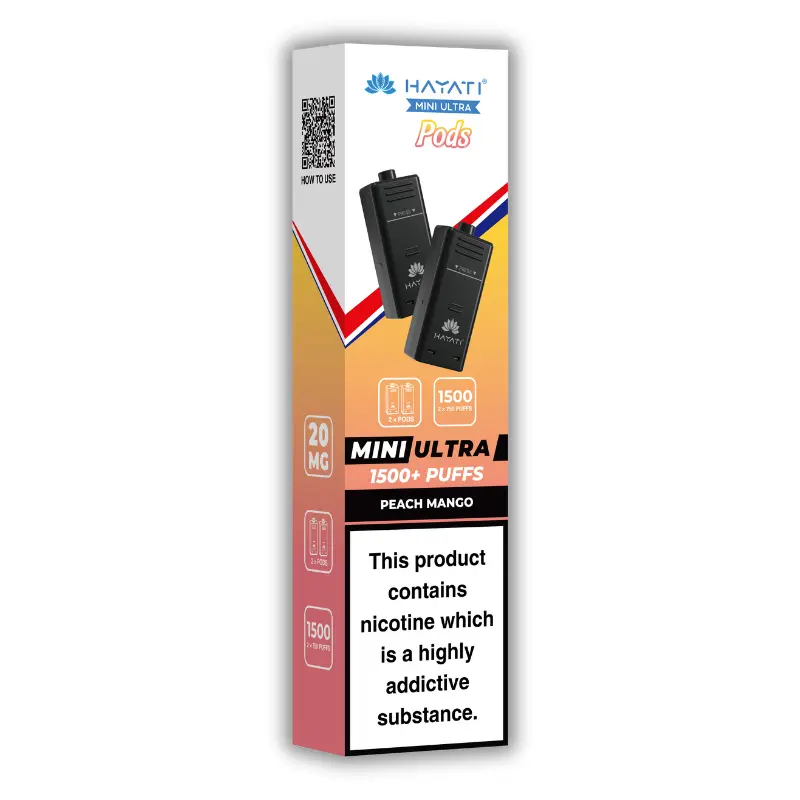
Cherry Ice and Peach Mango is the other pairing and it is the only way to get anything cold into a peach purchase. Cherry Ice / Peach Mango Hayati Mini Ultra Pod Kit at £3.99 and the £7.99 refill pod cover the range.
Three things are true of all six and are worth stating once. Switching is instant and happens dozens of times in a session rather than once, so nothing here works like choosing which of two pods to open first. The two halves share one coil, one wick and one airflow path, which means there is carryover at every turn of the collar and the first few draws after switching are not a clean read of the new side. And the two halves share one liquid budget, so whatever is left in the side you use less is discarded with the pod. On a pairing chosen for distance, that last point has teeth: if you turn out to want the peach and not the apple, you have paid full price for a pod that is half something you will not finish.
The decisions this shelf actually puts in front of you
Do you want the peach to be the subject or the setting?
Twelve listings make it the subject and twenty make it the setting. That is the first fork and it is bigger than any other difference on this page. A solo peach asks you to find a soft, sweet, aromatic fruit interesting for the whole life of a pod. A blend asks you to enjoy something in which the peach is the connective tissue rather than the point. Both are reasonable. Getting this wrong is the most common way to be disappointed by a purchase from this shelf, because the word peach appears in both and tells you nothing about which you are getting.
Does anything need to happen at the end of a draw?
If yes, you need a partner fruit, because the peach will not do it. The strongest candidates are raspberry and lemon, both of which arrive late and clearly. Pineapple is the gentler version of the same job. Green tea does something different and arguably better if the complaint is sweetness rather than shapelessness, since bitterness lowers the whole curve rather than adding a spike at the end.
If no, the solo group is yours and the remaining question is how much of it to buy at once. The answer is less than you think, at least the first time.
How much liquid should one flavour occupy?
A soft aroma-led fruit is the hardest kind of liquid to sustain over a large pod, for a reason that has nothing to do with quality. The aromatic fraction is the part of any flavour that thins as a coil tires, and sweetness is the part that does not. On a blend with two or three identifiable components, losing one still leaves something to taste. On a solo peach with no acid and no coolant, the aromatic fraction is effectively the entire flavour, so when it narrows you are left with sweet vapour that is no longer specifically peach.
The practical consequence: a 4ml Juicy Peach Hayati Mini Ultra Pods refill at £3.49 and a 22ml Pro Ultra Plus pod at £7.99 are not the same purchase scaled. The first is over before the question arises. The second asks the liquid to stay interesting for five or six times as long. If you have never run a solo peach at volume, buy small first.
Kit or refill?
Every prefilled flavour on this shelf exists in both forms where Hayati make both, and the gap is usually £2.50 on the Pro Max Plus and £4.00 on the Pro Ultra Plus. The kit is the better buy exactly once, which is the first time you buy into a hardware family. After that the device is reusable and the refill is the only sensible line item. Check the range name printed on your device before ordering, because Hayati list a separate pod for every range and publish no cross-range fitment.
Bottle or prefilled pod?
The six bottles, four 10ml salts and two 120ml shortfills, are the only listings here where you control the coil. That matters more on this shelf than on most, because the thing that goes first in an aroma-led peach is exactly the thing a fresh coil restores. In a refillable setup a tired coil is a part you change. In a sealed pod it is the end of the product. If you already run a refillable device and you like peach enough to want it as a background flavour for months rather than days, the bottles are the better economics and the better flavour management, in that order.
Formats and what fits what
Four prefilled hardware families appear on this shelf, alongside four 10ml salt bottles and two 120ml shortfills, and the differences that matter are volume and whether the pod carries a collar.
The Hayati Mini Ultra holds 4ml at 20mg with a quoted bench figure of 1,500 puffs, and it is the cheapest prefilled route to any flavour. Four peach listings use it. The Hayati Rubik holds 12ml with a quoted 7,000, and only Juicy Peach appears on it, twice. The Pro Max Plus holds 12ml with a quoted 6,000 and carries the widest peach selection at six flavours. The Hayati Pro Ultra Plus Prefilled Pod Kits & Pods platform holds 22ml with a quoted 25,000, and it is the only one of the four that offers the two-reserve collar pods.
All of those puff figures are the manufacturer's laboratory estimates, produced under controlled bench conditions rather than measured on anyone's actual use, and real draw length and frequency move them considerably in either direction. Treat them as a way of ranking pod sizes, which is what they reliably do, rather than as a quantity you are being sold.
Every prefilled pod on this shelf is 20mg, which is the highest nicotine concentration that may lawfully be sold in the United Kingdom. Nicotine is addictive and the figure states what the liquid contains rather than recommending anything. The four 10ml bottles are 10mg nicotine salt at 50/50, made for refillable pod devices running higher-resistance coils. The two 120ml bottles are 0mg, one at 70/30 for higher-power setups and one at 50/50 for smaller ones.
On the two-reserve pods specifically: what Hayati publish is that the rotating collar selects which side feeds the coil. They publish nothing about how the reserves are divided, whether anything seals between them, or how liquid reaches the wick, so no page including this one should describe that machinery. Describe what the collar does, not how.
Nothing on this shelf is user-refillable except the bottles. A prefilled pod is finished when it is finished, the coil is inside it and is not separable, and a spent pod contains a heating element and residual liquid, which makes it electrical waste rather than household rubbish. Shops selling vaping hardware generally accept spent units over the counter and household recycling centres list them separately. Store spares upright, cool and out of direct light, and keep anything containing nicotine where children and pets cannot reach it.
What the price spread pays for
The shelf runs £2.49 to £11.99 and the spread is almost entirely about volume and hardware rather than about the liquid.
Four listings sit at £2.49, all 10ml bottles at 10mg. Two sit at £3.49 and three at £3.99, all 4ml Mini Ultra pods and kits. One sits at £5.99, the Rubik kit. Six sit at £5.49, all 12ml Pro Max Plus refill pods. Two sit at £6.99, the 120ml bottles, which are the most liquid per pound on the shelf by a wide margin, holding twelve times the volume of a small bottle for under three times the price. Ten sit at £7.99, the crowded band where a complete 12ml Pro Max Plus kit and a bare 22ml Pro Ultra Plus refill arrive at the same number from opposite directions. Four sit at £11.99, all complete Pro Ultra Plus kits.
The £7.99 band deserves attention because three quite different things cost the same there. A Pro Max Plus kit at £7.99 gives you 12ml and a rechargeable device. A Pro Ultra Plus pod at £7.99 gives you 22ml and no device. If you already own a Pro Ultra Plus body, the second is nearly twice the liquid for the same money. If you own nothing, the first is the only one of the two you can use.
Cost per millilitre runs from about 6p on a 120ml bottle to about 87p on a 4ml Mini Ultra refill, a spread of roughly fifteen to one on one shelf. Most of that gap is hardware and the convenience of never filling anything, and none of it is a statement about the liquid.
Where to go next from here
If the peach was never really the point and you were after the partner fruit, the neighbouring shelves are more direct. Mango Vapes and Exotic Vapes share nine products each with this shelf, and eight of those nine are the same eight, which tells you the tropical blends are the biggest overlap here. Pineapple Vapes and Cherry Vapes share five each, and Lemon Vapes, Raspberry Vapes, Apple Vapes and Berry Vapes share three apiece.
For a narrower version of this shelf, Juicy Peach Vapes holds the thirteen listings carrying that one flavour name, including the dual pods. It is the right place to go if you have decided which peach you want and only need to choose a format.
If the sweetness rather than the fruit is what appeals, Sweet Vapes covers that ground across fruits. For the opposite, the three Cherry Ice pairings are the only overlap with Ice Vapes, so a genuinely cooled purchase means leaving this shelf.
By format, Hayati E-Liquids collects the bottles, Hayati Pod Kits collects everything with hardware in the box, Hayati Pods and Hayati Prefilled Pods and Refills collect the bare refills, and Hayati Pro Max Plus Pods is where the largest peach selection lives. New Products and the full All Hayati products listing cover the rest of the range.
Where this leaves you
Thirty-two listings, ten flavour names, one fruit, and a set of decisions that are more legible than the grid suggests. The peach on this shelf is always ripe, never cooked, never green and never cold. It is soft in thirty descriptions out of thirty-two and sharp in two. When something sharp does arrive, it comes from a raspberry, a pineapple, a lemon, a passionfruit or a separate reserve behind a collar, and never from the fruit in the title.
That makes the choice simpler than the count of products implies. Decide whether you want the peach to be the subject or the setting. Decide whether the draw needs to finish on something. Decide how much of one flavour you can live with before it stops registering, and buy less than that the first time. The answers to those three questions pick your listing out of the thirty-two more reliably than any flavour description will, including the ones on this site.
Everything above is drawn from what Hayati publish and from counting how they publish it. No ingredient proportions, sweetener levels, flavour houses or acid figures exist on the record for any listing in this range, so no page can tell you what is in a pod. What a page can do is show you which claims are consistent across thirty-two descriptions and which are made once, and let you decide how much weight a single sentence of retail copy deserves.
Strictly for adults aged 18 and over. Nicotine is an addictive substance.
Frequently asked questions
Is there a peach vape with ice or menthol in it?
No. Searching all thirty-two peach titles for a cooling word returns three hits and every one of them is the phrase Cherry Ice, sitting on the far side of an oblique in a two-reserve pod. The peach half of those listings is described as the warm side with no chill. So there is no cooled peach in Hayati's range at any price or in any format. The closest available thing is Cherry Ice / Peach Mango, where the cold and the peach are separate liquids in one pod and you turn a collar to move between them.
Which peach on this shelf is the least sweet?
On the published record, Peach Green Tea. It is the only listing on the shelf that names a component whose job is to lower sweetness by a stated mechanism, in this case the light bitterness and grassy astringency of tea. Bitterness suppresses perceived sweetness across the whole draw rather than adding a sharp event at the end, which is what an acid does. Hayati publish no sweetener figures for anything in the range, so nothing here is a measurement. It is a reading of which listing describes a method rather than a mood.
What is the difference between Juicy Peach and Peach Aura?
On paper, one sentence. Both are solo peach on the Pro Max Plus at the same two prices, both are 12ml at 20mg, and both are described in almost the same vocabulary. The single differential in the entire published record is that the Pro Max Plus Juicy Peach copy names a small fresh tang at the close and both Peach Aura descriptions rule tang out. The Peach Aura pod page examined the suffix in detail and concluded that Aura names no ingredient and most likely exists to keep a second solo peach distinguishable from the one already selling on the same shelf. Juicy Peach also has a far wider footprint, so it can be sampled in cheaper formats first.
Does White Peach actually taste different from ordinary peach?
White-fleshed and yellow-fleshed peaches genuinely differ: white flesh carries less acid and reads more floral, and that is settled horticulture rather than marketing. Whether Hayati formulated to that target is not published. The White Peach Raspberry pod page worked through both sides and landed on a position worth borrowing: the phrase is a real signal of what the mixer was asked for and a poor guarantee of what the mixer delivered. It is also unusual. Of 173 distinct flavour names across the catalogue, only two specify a variety of the fruit they name, and none names a cultivar outright.
Is Juicy Peach the same liquid in every format?
Not certainly, and there are two independent reasons to doubt it. The descriptions disagree about the finish: two of the ten solo Juicy Peach listings name a closing tang and the other eight deny sharpness explicitly, and the two that affirm it are both Pro Max Plus. Separately, the eight Pro Ultra Plus peach listings use none of the four words that mark peach copy everywhere else on the shelf. Either the copy was written by different hands at different times, which is the likely explanation, or the platforms carry different mixes. A 12ml prefilled pod and a 120ml shortfill are under no obligation to share a recipe just because they share a name.
Which peach holds up best over a large pod?
A blend, and preferably one with more than one identifiable component. The aromatic fraction of any flavour thins as a coil tires while the sweetness does not, so a liquid whose entire identity is aroma has the most to lose. A solo peach with no acid and no coolant is exactly that liquid. Mango Peach Pineapple is the most robust option on the shelf because three fruits of different weights still read as a drink when one of them fades. If you want a solo peach at 22ml, go in knowing the last third is the part at risk.
Do the listings with an oblique in the name contain two pods?
No. An oblique on the Pro Ultra Plus means one 22ml pod divided into two internal reserves, with a rotating collar on the mouthpiece selecting which reserve feeds one shared coil. There is one coil, one wick and one airflow path, so there is carryover at every switch and the first draws after turning the collar are not a clean read of the new side. The two halves also share the 22ml budget, so anything left in the side you use less is thrown away with the pod. Six of the thirty-two listings here work that way.
Can I put a Pro Max Plus peach pod in a Pro Ultra Plus device?
Nothing in this catalogue is offered as fitting more than one range. Every listing names its range, every range has its own pod volume, 12ml on the Pro Max Plus against 22ml on the Pro Ultra Plus, and Hayati publish no cross-range fitment anywhere. So match the range name on the pod to the range name on the body you own, and treat any fitment that is not published as unpublished rather than reasoning from a product name. A retail page, this one included, is not where a hardware specification should be settled.
What does the word fragrant mean on these listings?
Statistically, it means peach. Fragrant appears on seventeen of the thirty-two listings here and on thirteen of the other 460 in the catalogue, which is roughly nineteen times the base rate. Along with stone fruit, honeyed and velvety, it forms a house register used almost exclusively for this fruit. That makes it a reliable marker of what the copywriter thought peach was for, and no kind of specification. It tells you the liquid is meant to be aroma-led rather than sharp or syrupy, and it puts no number on anything.
What is the cheapest way to find out whether I like peach?
Juicy Peach Hayati Pro Max Nic Salt at £2.49, if you already own a refillable pod device with a higher-resistance coil. It is 10ml at 10mg and costs a fifth of the complete Pro Ultra Plus kit. If you want something prefilled, the 4ml Mini Ultra pod at £3.49 is the smallest prefilled quantity of peach Hayati sell, which makes it the low-risk way to test a flavour you may tire of. Both answer the question before you commit to twelve or twenty-two millilitres of it.
Is Mango Peach Pineapple really a peach flavour?
It is on the shelf because the title names peach, and its own copy is honest about the peach being a supporting element. In all five listings the mango carries the body, the pineapple supplies the lift, and the peach fills the middle or rounds off the finish. One of the five calls it the quiet one outright. If you want to taste peach as the subject rather than the connective tissue, this is the wrong group and the solo listings are the right one.
Why does Hayati pair peach with so few other fruits?
The partner list is short and every member of it does one of four jobs: supplies acid, supplies zest, supplies bitterness and astringency, or supplies body. Raspberry, pineapple, lemon and passionfruit cover the first two, green tea covers the third and mango covers the fourth. There is no peach and grape, no peach and blackcurrant, no peach and watermelon and no peach with a mint. Whether that reflects a deliberate policy or simply what the range has got round to making is not something the catalogue reveals.