
Home / Hayati Pro Ultra Plus Prefilled Pod Kit / Fruit Bomb / Straw’ Watermelon B’Gum Hayati Pro Ultra Plus 25000 Prefilled Pod Kit
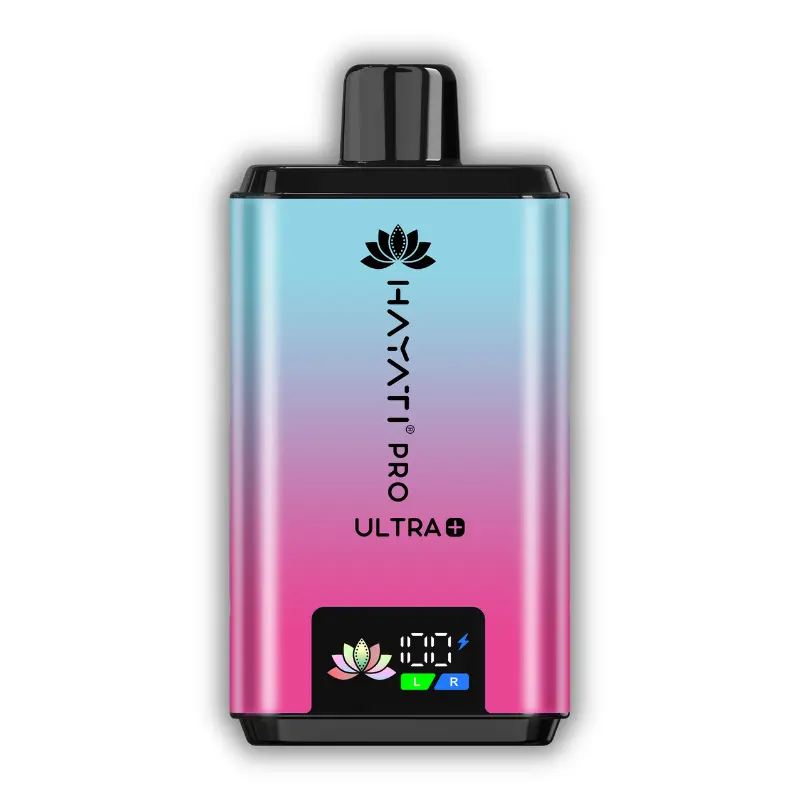
Hayati · Pro Ultra Plus
Fruit Bomb / Straw’ Watermelon B’Gum Hayati Pro Ultra Plus 25000 Prefilled Pod Kit
£11.99
✔ In stock — ready to ship
Genuine Hayati
Free over £20
Same-day dispatch
Secure checkout
Eleven pounds ninety-nine puts an 850mAh Hayati Pro Ultra Plus body in your hand with a filled 22ml pod already seated in it, and that pod carries two liquids instead of one. Fruit Bomb sits in one reserve, Straw’ Watermelon B’Gum in the other, at 20mg nicotine salt throughout, and a rotating collar on the mouthpiece decides which reserve the coil is currently drawing from. Hayati's own bench figure for the pod is 25,000 puffs, obtained in their laboratory on equipment running a fixed draw pattern, which makes it a ranking number between formats rather than an account of anybody's month. Nothing needs assembling, nothing needs pouring, and one purchase completes the whole arrangement.
The oblique stroke in the title has been misread often enough that the bare pod version of this pairing opens by correcting it, so take the correction as settled here. One pod. Two reserves. One coil, one wick and one airflow path, serving whichever side the collar has selected. Hayati publish that the collar chooses a side and publish nothing whatever about how the division inside the shell is arranged, so this page describes what the collar does and declines to describe how.
What no listing on this shelf frames, and what the rest of this page is about, is a choice you are making at the till without being told you are making it. Count the Pro Ultra Plus kit shelf and there are fifty-two boxes on it. Twenty-seven hold a two-sided pod. Twenty-five hold a single blend. Every one of the fifty-two costs the same £11.99, so the price gives you no steer at all. A buyer who has never owned one of these devices is therefore picking between two different shapes of purchase, and the shelf presents that as a choice between forty-odd flavour names.
The argument for the two-sided one can be put in a sentence. A first kit is being asked two questions and gives back a single answer, and a pod with two sides pulls the two questions slightly apart. How slightly is the whole subject. The flavour reading of these two liquids, including why a name that reports a magnitude is a different species of label from a name that reports a fruit, is worked out properly on the pod listing and is not rebuilt here. The separate argument that the hardware rather than the flavour is the load-bearing part of any kit decision belongs to the Blackcurrant Lemonade kit page, which reaches it by counting how completely the kit menu is mirrored on the reorder shelf. Both conclusions are taken as read below.
Twenty-seven two-sided, twenty-five single, and one price across all of them
The obvious count is wrong, and it is wrong in the interesting direction
Counting the shelf looks like a thirty-second job. Look for the oblique in the title, tally them up, and you get twenty-five two-sided listings against twenty-seven singles, which is how the split has been reported elsewhere on this site. That tally is what the titles support and it is off by two in both columns.
Two of the fifty-two kits carry no flavour at all in the title. One is listed simply as the Pro Ultra Plus 25000 kit, and the other is the Shisha 30000 kit. Read what Hayati write underneath each of them and both turn out to be two-sided pods whose pairing has been pushed out of the name and into the body copy. The unnamed 25000 is the Blackcurrant Cotton K and Blue Raspberry pairing, which also has its own properly titled listing at the identical price, so one pairing occupies two slots on the shelf. The Shisha is Apple Mint Grape against Peach Grape Mint, and it is the one box here filled at 5mg rather than 20mg, with a 30,000 figure instead of 25,000 attached to it by the maker.
Move those two across and the real division is twenty-seven two-sided against twenty-five single. The collar is the slight majority arrangement on this platform, not the slight minority, and twenty-six distinct pairings are spread over the twenty-seven listings because of the duplication. The combined kits and pods shelf runs to a hundred and four listings, and the refill half of it splits the same way for the same reason, twenty-seven to twenty-five, with the two unnamed pod listings concealing their pairings exactly as the kits do.
None of that changes what is in the box you are looking at. It matters because a reader deciding whether the two-sided format is a normal way to buy or an oddity should have the number, and because a count taken from titles alone is the sort of thing that gets repeated until it looks like a fact. Two minutes with the product copy moves it.
The two structures are also two different menus
Here is the part of the count that surprised me, and it has consequences for anybody choosing a first box. Take every flavour that appears as one half of a pairing, and take every flavour sold as a whole undivided pod, and compare the two lists.
Forty-one distinct flavours turn up as the half of a pairing. Twenty-five are sold as a single blend. Only ten appear in both columns. Which means thirty-one profiles on this platform exist only as one side of a pod that somebody else assembled, and fifteen exist only as a whole 22ml of themselves, with no way to take them in half measures.
Fruit Bomb is one of the thirty-one. There is no single-flavour Pro Ultra Plus kit or pod of it anywhere, and the only route to it on this platform runs through this pairing. Strawberry Watermelon, which is the closest plainly named relative of the other half, sits in the opposite camp: a whole pod or nothing, never a half. So the structural choice is not purely a choice about how you want to learn. It also narrows what you are allowed to buy, in both directions, and neither shelf page says so.
You are choosing a pairing, not choosing two flavours
One more figure worth having before the argument starts. Forty-one halves could in principle be arranged into eight hundred and twenty different two-sided pods. Twenty-six are offered. Roughly three per cent of the combinations that could exist do exist, and the twenty-six were selected by whoever assembles Hayati's range rather than by anyone weighing up what they would like to find out.
That is the honest frame for everything below. The two-sided pod hands a first-time buyer a second observation, and it hands it over on somebody else's terms. You cannot commission the comparison you would most like to run. You can only pick the closest of twenty-six that were already made.
A first kit is answering two questions in the same breath
The tangle, stated precisely enough to be worth untangling
Somebody buying their first Pro Ultra Plus is taking delivery of two unknowns bolted together. The first unknown is the platform: how narrow the draw is, how warm the vapour runs, how much flavour this particular arrangement of mesh and wick actually delivers, whether the collar is a fiddle, whether 22ml is a sensible quantity to own at one time. The second unknown is the liquid: whether that specific recipe, at this strength, is something you want to spend a fortnight inside.
Both unknowns produce exactly one output, which is whether the fortnight was any good. If the answer is yes, the tangle costs nothing and you carry on. If the answer is no, you are holding a result with two candidate explanations and no way to tell them apart, and the two explanations point at completely opposite next moves. A liquid problem means buy a different pod for £7.99 and keep the device. A hardware problem means the device was the wrong call and the whole pod library standing behind it is irrelevant to you.
Getting that attribution wrong is not symmetrical in cost. A buyer who blames the pod when the device was at fault loses a few pounds and some patience, trying two or three more flavours on hardware that was never going to suit them. A buyer who blames the device when one recipe was at fault writes off a platform over a single sample, which is the expensive error, because platforms carry libraries and a pod carries one flavour. The second mistake is also the more natural one, since the device is the thing physically in your hand and the thing you paid most attention to.
What a split result actually proves, and it is more than it sounds
Now put a two-sided pod in the same situation. Fruit Bomb and Straw’ Watermelon B’Gum are not merely two liquids you happen to own. They are two liquids drawn through the same coil, wetted by the same wick, pulled along the same airway, powered by the same cell, at the same 20mg, in the same week, at the same point in the pod's working life, by the same person with the same expectations. Every variable that is not the recipe is held still, and held still not by careful management but by the physical construction of the thing.
Suppose one side pleases you and the other does not. Every shared factor is eliminated in a single stroke, because a shared factor cannot produce a difference. The device cannot be the reason one side worked and the other did not, since the device did the same job in both cases. Neither can the coil, the airflow, the strength, the volume, your mood that week or your general feelings about prefilled pods. Whatever produced the divergence has to be located in the one thing that changed, which is the liquid.
That is a real inference and a strong one. It is not an impression or a heuristic. It follows from the structure of the pod, and it arrives inside a minute rather than after two purchases and a month of waiting, because the collar moves whenever you want it to move.
Four outcomes, and only two of them do any work
Being rigorous about this means enumerating what can actually happen rather than describing the good case and stopping. There are four.
Both sides please you. Pleasant, and diagnostically empty. You learn that the device suits you and that both liquids suit you, which is useful in the sense that you are happy, but nothing needed disentangling and nothing was disentangled. This outcome would have felt the same on a single-flavour box.
Fruit Bomb lands and the bubblegum side does not. The informative case. Hardware exonerated, liquid identified as the variable, and your next purchase becomes a directed search rather than another guess.
The bubblegum side lands and Fruit Bomb does not. Same inference running the other way, and in practice the more useful of the two, for a reason set out further down.
Neither side pleases you. And here the argument runs into its own wall.
The outcome you most needed resolving is the one it cannot resolve
Two disappointing sides look superficially like strong evidence against the platform, and they are not. The explanations available are exactly the ones you started with, plus one. It could be the device. It could be the coil, which both liquids share, and which is the component most people actually mean when they say a prefilled pod did not deliver. Or it could be a property the two recipes have in common, and on this particular pod there are several: both halves lean sweet on Hayati's own account, neither declares any cooling, and nothing in either build points at an acid line. Dislike sweetness without cooling and both sides fail together for a reason that has nothing to do with the hardware at all.
So the two-sided pod pays out in the two divergent cells and goes quiet in the convergent ones. Of those convergent cells, the happy one needed no help. The unhappy one is precisely the case in which a buyer is about to make the expensive attribution error, and the format offers them nothing. That is the central limit on the whole argument and it deserves to be stated before the argument's advantages, not after them.
The shape of that is worth holding on to. A structure that helps when things go half right and abandons you when things go entirely wrong is genuinely useful, but it is not insurance and it should not be sold as insurance. It is a filter that catches one class of confusion.
The pod does not test the hardware. It only lets you rule it out
One further piece of precision, because it is easy to overstate what is on offer. Nothing about a second reserve tests the device. Testing a device comparatively would require two devices, and you have one. What the second reserve provides is an exclusion argument: given a divergence, the constant cannot be the cause. That is a logical move rather than a measurement, and it works in one direction only.
Which means the honest description of what the extra side buys is narrow. It cannot tell you the device is good. It can tell you the device was not what spoiled a particular liquid. For a first-time buyer standing at the point where they are about to write off a whole platform over one pod, that narrow thing happens to be the most valuable thing available, but it is still narrow and the page would be lying to round it up.
How much the second reserve is really worth
The two halves are not two independent samples
An observation is worth something in proportion to how much it could have differed from the observation beside it. Two readings taken from nearly the same place are close to one reading. So the question is how far apart Hayati actually put the two sides of a pairing, and the shelf answers it in a way that does the argument no favours.
Take the twenty-seven two-sided kits and ask a mechanical question of each: do the two halves share a fruit, or share the confectionery suffix that signals a treatment rather than an ingredient? A count on shared words alone gives fourteen, which is the figure another page on this shelf reached and reported. Widening the test slightly, to treat the catalogue's own abbreviation of Strawberry to Straw’ as the same word and to count a shared suffix such as GB as a shared element, moves two more across and brings the two hidden pairings into scope. Sixteen of the twenty-seven then pair two relatives. Eleven pair two things with nothing in common on the label.
The sixteen are not hard to spot once you look. Blueberry Cotton K / Raspberry Cotton K holds a spun-sugar treatment steady and swaps the berry underneath it. Blueberry H’Bubba / Watermelon H’Bubba does the identical thing with a bubblegum base. Watermelon B’Gum / Strawberry B’Gum uses the same two fruits as this pod's named half and separates rather than blends them. Red Razz GB / Blue Razz GB and Grape GB / Strawberry GB both keep a sugared confectionery register on both sides. Blue Razz Cherry / Blue Razz GB holds blue raspberry constant and varies what is done to it. Strawberry Ice / Strawberry Raspberry Ice keeps the strawberry and the chill on both sides and adds one berry.
Every one of those is a variation rather than a contrast, and a variation produces two readings sitting almost on top of each other. As a diagnostic instrument that is close to useless, because the divergent outcome, the only one that pays, becomes unlikely by design. Two liquids built to resemble each other will tend to please or displease you together.
The axis almost nobody gets to test
One split matters more than the others for somebody who has never used this format, and the shelf barely offers it. Cooling divides vapers more sharply than sweetness or fruit family, it cannot be predicted from a prior you do not have, and it changes how everything else in a liquid reads.
Of the twenty-seven two-sided kits, four put a declared cooling on exactly one side. Three are cold on both. Twenty are uncooled on both. So the single most informative division available to a first-time buyer is present on four boxes out of fifty-two on the whole shelf, and those four are Blue Razz Pineapple / Strawberry Ice, Straw’ Cranberry Cherry / Strawberry Raspberry Ice, Cherry Ice / Peach Mango, and the Straw’ Cranberry Cherry pairing that puts Cherry Ice opposite. If the thing you most want to discover about yourself on new hardware is whether you want a chill in it, three of those four also happen to be among the eleven pairings whose halves share nothing on the label, which makes them the most informative boxes on the shelf by some distance.
This kit is not one of them.
Where this pairing actually sits, which is not where the names suggest
By the mechanical test, Fruit Bomb / Straw’ Watermelon B’Gum falls in the eleven. The two names share no word, no fruit and no suffix, and the two sides are built on genuinely different principles: one is an unlisted mixture presented by its magnitude, the other is two named fruits worked into a confectionery treatment. On the page, that reads as a wide pairing.
On the axes that decide whether somebody stays on a platform, it is narrower than that. Hayati state plainly that both halves lean sweet, so sweetness is held constant rather than varied. Neither side declares ice, menthol or any coolant, so temperature is constant too, and constant at the uncooled end. A bubblegum construction works against tartness by its nature and a balanced mixed-fruit blend with no leading note has nothing obviously pushing acid forward, so there is no reason to expect the sour axis to vary either. Three of the four properties most likely to make a buyer reject the format are the same on both sides of this pod.
What does vary is register. Confectionery against fruit mixture, specified against unspecified, a rounded shape against a busy one. That is a real difference and it is enough to produce a divergent result for plenty of people. It is simply a difference on the axis least likely to be the one that decides whether you keep the device.
Which places this box honestly: better than the sixteen relative pairings, worse than the four that split on cold, and a middling example of the structure it belongs to.
One of the two results cannot be carried anywhere
A complication specific to this pod, and a serious one for anybody buying it as an instrument. A data point is only useful if you can act on it later, and acting on it later means being able to name what you liked.
Straw’ Watermelon B’Gum names its components. If it lands, you have learned that a bubblegum treatment of soft red and melon fruit works for you on this hardware, and you can spend that knowledge immediately on the separated version of the same two fruits, on another bubblegum pairing, or across the twenty-eight watermelon listings and the seventy-nine strawberry ones.
Fruit Bomb does not. Hayati publish that it is a busy mixed fruit with several components arriving together and no single one leading, and they name not one of them. If that is the half that lands, what you have learned is that you enjoyed a liquid whose composition is unpublished, which converts into approximately no guidance at all when you are choosing a reorder. You can buy this pairing again. That is the whole of what the result licenses.
So of the two observations this pod provides, one is transferable and one is a dead end. The bare pod page argues at length that a name reporting a magnitude is not the same kind of label as a name reporting an ingredient, and this is the practical consequence of that argument landing on an entry purchase specifically. A two-sided pod buys two data points, and one of these two arrives without a label on it.
The comparison has to be run properly or it reports nothing
The shared coil that makes the inference valid also makes the measurement awkward, and this cuts both ways in a manner worth being explicit about. Because there is one wick and one mesh, residue from whichever reserve you were using is still present for the first draws after the collar turns. A pull taken straight after the sweeter or busier side will under-read whatever follows it, and the reverse comparison will flatter. The pod listing sets this out and there is no sense in deriving it twice.
What matters for an entry buyer is the discipline it implies. Back-to-back sips are the natural way to compare two things and they are the wrong way to compare these two. Leave a gap, several draws at minimum and preferably longer, and run the comparison in both directions before believing either reading. An instrument used carelessly returns a number, which is worse than returning nothing, because you will act on it.
The case for the single blend, put at its strongest
Fairness requires the other side to be argued rather than sketched, and the single-flavour box has three arguments, two of which are good.
The first is depth against breadth. Twenty-two millilitres of one recipe is a genuinely thorough read on that recipe: how it opens, how it behaves at the halfway mark, what it does as the coil loads with residue, whether it wears out its welcome. Split the same volume between two reserves and each side gets a partial run, and each side is being judged partly against the other rather than on its own. You end up with two shallow readings in place of one deep one. For discovering whether a flavour survives commitment, which is the thing most people actually want to know, depth is the more relevant property.
The second is rehearsal. Twenty-five of the fifty-two refills on this platform are single blends, and if your eventual pattern is to settle on one profile and reorder it, then a single-flavour kit is a faithful preview of the life you are going to lead, collar and all. A two-sided first pod rehearses a habit, the alternating one, that you may never adopt. Most people do not. They find a favourite in the first week and stop turning the collar, at which point they have paid for a structure they are not using and stranded whatever liquid sits in the other reserve.
The third argument is the weakest but not nothing: you chose it. A single blend is a flavour you picked off a list of twenty-five, and a pairing is a pairing somebody else assembled out of eight hundred and twenty possibilities. Getting your own choice wrong teaches you something about your own judgement. Getting somebody else's pairing wrong teaches you rather less.
Against those, the divergence inference and the escape hatch. The point that a single flavour leaves you no in-session way out when you tire of it is made properly on the Juicy Peach pods listing, which owns it, and it is a real cost of the single format that sits alongside the three advantages above rather than cancelling them.
What each side is actually capable of telling you
Straw’ Watermelon B’Gum, the half with an address
Bubblegum is a register rather than a fruit. It describes a soft, faintly powdery sweetness with the edges filed off whatever fruit sits underneath it, a body that reads low and wide across the tongue, and a finish that rounds off rather than tapering. Strawberry takes that treatment without resistance, being soft-edged to begin with. Watermelon is the component doing the work worth noticing, carrying a high, slightly green, watery brightness that survives being sugared and lifts the whole thing above where the strawberry alone would leave it. Expect the melon sitting over the strawberry rather than beside it, expect a rounded finish, and expect no tartness whatever, because the construction is actively hostile to it.
As an instrument, this half is legible, which is its virtue. You can describe what it is doing to yourself in words you could repeat to somebody else, and a reading you can articulate is a reading you can compare against the next pod. If it fades, you will notice what faded. If the device is not delivering, a liquid with a nameable shape shows the gap where the shape used to be.
Fruit Bomb, the half that reports a level instead of a location
What is on the record: a mixed-fruit blend, several fruits arriving together, no individual one taking the lead, described as big and busy, and leaning sweet. What is not on the record: which fruits, how many, their proportions, whether the mixture sits in the red family or the tropical one or across both, and whether anything cold or sharp is in it at all. Nobody who tells you the composition is doing anything other than guessing, and this page will not join them.
What can be reasoned out, flagged as reasoning rather than fact, is structural. A blend with no leading note has had its components balanced against one another instead of layered, and balancing has a predictable effect: the more you put in, the harder any single item is to name. The draw arrives as one wide impression rather than as a sequence with an opening, a middle and a close. Some people want exactly that and find single fruits monotonous over 22ml. It does mean the side is harder to use as a measuring device, because a reading you cannot put into words is a reading you cannot carry forward.
There is a free test available on the first day, and it costs nothing but attention. Take three draws from this side and try to name one fruit. Not a family, a fruit. If you can, the blend has held its resolution. If you find yourself reaching for red, or sweet, or simply fruity, it has traded identification for volume, and you have learned something the listing could not have told you.
Where the pair sits for sweetness, and what that costs the test
Both sides lean sweet, which Hayati state directly, so this box belongs at the sugary end of the format rather than in its middle. For placement, Blackcurrant Cotton K / Blue Raspberry and Grape GB / Strawberry GB occupy comparable ground, while a chilled pairing reads as more restrained because cold suppresses perceived sugar. The sweet shelf collects that whole end of the catalogue at forty-seven listings. No manufacturer publishes a number for sweetness, Hayati included, so the ordering is more trustworthy than the spacing between the items in it.
For the purposes of this page, the consequence is the one already noted and it is worth restating in its proper place rather than leaving implied. Sweetness is the dimension along which this pod does not vary, and sweetness is the dimension along which a great many people discover that a format is not for them. A pairing that agrees on its most likely failure mode is a pairing that will fail together.
What is not in this box
- No cooling on either side. Neither reserve lists ice, menthol or a coolant of any kind. If a chill is part of what you imagine a big fruit flavour doing, it is absent here, and a pairing such as Blue Razz Pineapple / Strawberry Ice puts cold on one half at the same money.
- No acid line. Nothing in either construction suggests tartness, and a buyer who wanted sharpness should look at Blue Sour Raspberry instead, which is built on it.
- No strength choice. One figure, 20mg, with no alternative offered on this listing or its neighbours. Nicotine is addictive and the strength is fixed for the whole run of the pod.
- Not two pods. One sealed pod of 22ml total, divided between two reserves, with a single coil serving both.
- Nothing adjustable. No wattage setting, no airflow ring, no second strength. The collar is the only control on the object.
The box itself, and the one specification that matters for a divided pod
Opening it produces the 850mAh Pro Ultra Plus body and the filled pod, with the pod already wetted at the coil, so there is no soaking or preparation step of the sort a refillable tank needs. Seat it if it has shipped separately, turn the collar to whichever side you want to begin on, and draw. Hayati publish no cross-range fitment information for this hardware, so match the range on the box to the range on the device and treat any compatibility decision from a retail page, including this one, as unverified.
The specification that actually bears on everything above is the single non-serviceable coil. One piece of mesh renders both reserves and cannot be swapped, rested or cleaned. That is the reason the divergence inference works, because the constant really is constant. It is equally the reason two disappointing sides prove so little, because a coil you dislike sits underneath both readings. The same component is the source of the format's diagnostic power and the source of its blind spot, which is a tidier symmetry than product design usually manages.
Stated as unpublished rather than estimated: Hayati give no coil resistance, no airflow figure, no wattage and no information about how the two reserves are kept apart. Figures for these circulate in the trade and get repeated until they take on the appearance of specification. They are not in this product's data. The wider prefilled kit shelf runs to a hundred and seventy-one listings across the brand's platforms if you want to compare what each one does publish.
The published figures, and the division that is missing from them
| What the collar selects | One of two reserves, switchable at any point in a session |
| Side one | Fruit Bomb, mixed fruit, components not named by Hayati |
| Side two | Straw’ Watermelon B’Gum, strawberry and watermelon in a gum register |
| Total liquid | 22ml, prefilled, shared between the two reserves |
| Split between reserves | Not published |
| Nicotine | 20mg salt, the only strength listed for this pod |
| Cooling | None declared on either side |
| Coil | One, sealed in the pod, shared by both reserves |
| Device supplied | Yes, the 850mAh Pro Ultra Plus body |
| Maker's puff figure | 25,000, measured by Hayati under laboratory conditions |
| Structure | Two-sided, one of twenty-seven such kits on the shelf |
| Price | £11.99, identical to every other kit in the range |
| Brand | Hayati |
Read that table as a buyer trying to decide between structures and one row is conspicuous by its emptiness. The split between the two reserves is not published anywhere. Twenty-two millilitres is the total, and how much of it sits behind each position of the collar is a fact Hayati do not state and this page will not invent. Most people reading a two-sided listing assume an even division, and the assumption may well be right, but an assumption is what it is.
That gap matters more here than it would on a page about flavour. If the second reserve is the thing you are buying the box for, the size of the second reserve is the size of your second observation, and you are not told it. Nor is there any row describing the proportion of coil life each side will consume, which is not a fact anybody could publish, since it depends entirely on which way you leave the collar pointing.
Two other rows deserve a second look. The twenty-seven in the structure row is the count this page had to correct by reading the copy under two listings that look like single blends until you do, and it is the difference between the two-sided pod being a minority arrangement and a majority one. The price row is the argument's quiet foundation: every kit is £11.99 whatever is in it, so the second reserve costs nothing in money. It is paid for in volume, in attention and in your not having chosen the pairing, which is a different currency and one no table records.
Choosing between the two structures, by what you want to find out
If you have never owned a Pro Ultra Plus and have no strong flavour preference
Take a two-sided box, and pick it for the distance between its halves rather than for how much you like the two names. The names are the least reliable part of the decision precisely because you have no reference for what this platform does with any of them. What you can read off a title is whether the two sides differ on something that matters, and cooling is the one property declared plainly enough in a name to be counted, which is why the four pairings that put cold on one side only are the strongest instruments here. Blue Razz Pineapple / Strawberry Ice is the most direct of them.
If you already know you want something sweet and uncooled
Then this box is a sound choice and its narrowness stops being a fault, because you are not asking it to survey a range you have already ruled out. What it will do is tell you whether a confectionery treatment or an unlisted mixture suits you better on hardware you have never used, and either answer routes your next order. Straw’ Guava / Dragon Berries is the nearest alternative that stays in the sweet uncooled territory while naming every component on both sides, which trades a little register spread for two transferable results instead of one.
If it is the strawberry and watermelon you are actually after
Buy them directly rather than as half of a pod whose other half you cannot preview. Strawberry Watermelon gives the full 22ml of the two fruits with no confectionery layer over them, which is the drier reading of the pairing. Watermelon B’Gum / Strawberry B’Gum keeps the gum treatment and separates the two fruits, so you meet each on its own. Both are £11.99 and both tell you what is in every millilitre rather than half of them.
If you want the deepest possible read on one thing
Buy a single blend and accept that you are giving up the divergence inference in exchange for a thorough answer about one recipe. Strawberry Raspberry Ice puts a cold red across the whole pod, Watermelon Fruit Twist takes the melon in an uncooled direction, Lemon Lime is the plain double citrus, and Raspberry Cola leaves the fruit category for a soft drink construction. Any of those will tell you more about itself than either half of this pod will tell you about either half.
If £11.99 is more than you want to stake on a platform you have not tried
This is the complication the argument has to face rather than dodge, and it is a real one. This exact pairing exists as a Mini Ultra kit at £3.99, which is a third of the money for the same two liquids in the same two-sided arrangement. Straw’ Cranberry Cherry / Cherry Ice is on that platform too and splits on cold. Those are separate devices with their own pods and they say nothing about how a Pro Ultra Plus behaves, so the flavour question and the hardware question come apart at that price rather than being answered together. If your uncertainty is mostly about flavour, the cheaper box answers it. If your uncertainty is mostly about the platform, it cannot.
If you are considering a different Hayati platform entirely
The Rubik system enters at £5.99 and the Pro Max Plus 6000 at £7.99, the latter carrying a bubblegum construction comparable in register to this pod's named half. Strawberry Cherry Cranberry sits on the same platform as a three-fruit single. Those are different bodies with their own refills, and the pod library standing behind each platform is the thing worth comparing rather than the entry price, since the entry price is paid once and the refills are paid for indefinitely. The full kit listing runs to a hundred and seventy-four boxes across all of them.
If the one thing you want is the lowest nicotine on the shelf
The Shisha 30000 kit is the single exception in the range, filled at 5mg rather than 20mg, with a 30,000 figure attached to its pod by the maker instead of 25,000. It is also, as noted above, a two-sided pod whose pairing is hidden in the body copy rather than printed in the title. Nicotine is an addictive substance, and strength is the one specification on this shelf that varies exactly once.
Running a two-sided first kit so that the comparison means something
All of the following is shaped around using this box as an instrument, because that is what the page has argued it is good for. Somebody who bought it simply because they liked the sound of it can ignore most of it and lose nothing.
Take both readings inside the first three days. A pod is at its most representative early, before the coil has accumulated residue and before your palate has settled around it. Any comparison run in week three is comparing two liquids through a component that has changed underneath both of them. Three or four draws from each side, early, with the collar left alone in between.
Write one line down. This is the single cheapest thing on the list and the one nobody does. Two sentences, one per side, in whatever words come to you. Memory of flavour is unreliable and flattering in a specific direction: it remembers peaks and discards the middle. A written note is the only version of week one that will still exist in week three.
Allow a gap in both directions. Switch, wait, draw a few times, then judge. Then run it the other way round on a different occasion. If the two directions disagree, what you have measured is carryover rather than the liquids, and the result should be thrown away rather than believed.
Do not settle in the first week. The commonest failure with a two-sided pod is finding a favourite early and never turning the collar again, which converts the box into an expensive single. Alternate deliberately for the first fortnight at least. The second reserve is the only part of this purchase that is doing anything a single blend could not.
Expect both sides to read sweeter later on. Fine aromatic material thins before sugar does, so the proportion of what is left shifts towards sweetness as the pod empties. On a box where both halves already lean sweet, the two will converge rather than separate, and the convergence runs towards sugar. A pod that feels cloying at the two-thirds mark is showing you proportion rather than a change in the recipe.
Keep it flat, cool and dark when it is not in use. A drawer will do. Heat and daylight over weeks dull a sweet profile, and the definition goes before the sweetness does, which on this pod means the fruit detail thins while the sugar stays put. Anything holding nicotine belongs where children and pets have no access to it, spares included.
Retire it on definition, not on volume. The coil usually finishes before the liquid does, and a pod producing sugar with no shape behind it has nothing further to tell you. A spent one still contains mesh, a cell and liquid residue, so it goes to a retailer take-back or a recycling point rather than into household waste.
Questions a first-time buyer actually asks
Is this two pods in a box?
No. One sealed pod holding 22ml in total, divided into two reserves, with a rotating collar selecting which one reaches the coil. The two names in the title describe what is inside a single item. The device is the second thing in the box, not a second pod.
Why would I choose a two-sided kit over a single-flavour one at the same price?
Because a first kit leaves you unable to tell whether a disappointing fortnight was the device or the liquid, and a pod with two sides can settle that question when one side works and the other does not. Everything except the recipe is shared, so a difference between the two halves has to come from the recipe. If both sides disappoint you, that inference is unavailable and you are no better off than with a single blend.
How many of the kits on this shelf are two-sided?
Twenty-seven of the fifty-two, with twenty-five holding a single blend. Counting obliques in titles gives twenty-five, which is the figure usually quoted, but two listings that name no flavour at all turn out to contain pairings described only in the body copy. All fifty-two cost £11.99 regardless.
How much of the 22ml is on each side?
Hayati do not publish it. The total is stated and the division is not, so an even split is an assumption rather than a specification. Anyone quoting you a figure for each reserve is supplying something the product data does not contain.
Do the two sides mix when I turn the collar?
The liquids are held apart, but the coil and the wick are shared, so residue from the previous side is still present for the first draws after a switch. Allow several pulls before forming a view, or you will consistently under-rate whichever side follows the sweeter one.
What fruits are in the Fruit Bomb half?
Hayati do not say. What they publish is that several fruits arrive together with none of them leading. No individual fruit is named anywhere in the product data, so any specific list you are offered is somebody's guess rather than a fact about the liquid.
Is either side cold?
Neither declares ice, menthol or a coolant. This is an entirely uncooled pod on both sides, which also means it cannot tell you anything about how coolant behaves on this device. Only four of the twenty-seven two-sided kits put a chill on exactly one side, and those are the boxes to look at if that is the question you want answered.
Can I buy Fruit Bomb on its own?
Not on this platform. It appears only as half of this pairing here, in the kit and in the matching refill, which is true of thirty-one of the forty-one flavours that turn up as one side of a pod. Fifteen other profiles run the opposite way and are sold only as a whole 22ml.
What happens if I only like one side?
You keep vaping that side, and the liquid in the other one goes into the bin with the pod when the coil is finished, since the reserves are not separable purchases. That is the cost of the hedge, and it is paid in liquid rather than in money, because the box costs the same as a single-flavour one.
What does the 25,000 figure actually mean?
It is Hayati's own laboratory measurement, taken with equipment drawing to a set pattern rather than by a person vaping. Treat it as a way of ranking one format against another. Your own pod will finish when the coil stops rendering the liquid properly, which is usually before the liquid runs out.
Is there a cheaper way to try these two flavours?
The identical pairing is sold as a Mini Ultra kit at £3.99. That is a different device with its own pods, so it answers the flavour question at a third of the price and tells you nothing about how a Pro Ultra Plus performs. Which of the two boxes is right for you depends on which of the two unknowns you actually care about.
Will the two sides taste more alike over time?
Probably. Fine aromatic detail degrades before sweetness does as a coil accumulates residue, and both halves here are sweet to begin with, so the direction of travel is towards their shared property. Expect more difference between them in week one than in week three.
The recommendation, stated as a rule
For a first Pro Ultra Plus at £11.99, take a two-sided box, and choose it on the distance between its halves rather than on how much you like the two names. That is the rule, and the reasoning behind it is narrower than the enthusiasm usually attached to it. The second reserve does not test the hardware. It lets you rule the hardware out when one side works and the other does not, which is the one moment a new buyer is most likely to make the expensive mistake of rejecting a platform over a single recipe. It gives you nothing when both sides disappoint, which is the outcome you would most like it to explain.
The rule has a condition attached, and the condition does most of the work. Sixteen of the twenty-seven two-sided kits pair two relatives, and two relatives rarely diverge, so the informative outcome is unlikely by construction. If the pairing in front of you holds a fruit or a confectionery treatment constant across both sides, the structure is buying you almost nothing and you would do better with the single flavour you actually wanted, since at least you chose that one. Only four pairings on the whole shelf split on cooling, which is the division a new buyer learns most from, and those four are the strongest entry boxes here.
This box sits between the two cases. Its halves share no word, no fruit and no treatment, which puts it in the better eleven, and the two sides really are built on different principles: a named confectionery blend against an unlisted mixture presented by its size. But it holds sweetness constant, holds the absence of cooling constant, and offers no acid on either side, so three of the four properties most likely to turn somebody off the format never vary inside the pod. It also produces one result you can carry to your next order and one you cannot, because half of what you are tasting has no published composition. As an instrument it is honest and mid-range. As a sweet, uncooled, fruit-and-confectionery box for somebody who already knows that is the territory they want, it is straightforwardly a reasonable buy at a price that is identical to everything around it. What £11.99 puts on the table is an 850mAh body, 22ml at 20mg divided between two reserves, one shared coil, no cooling, a laboratory figure of 25,000 puffs from the maker, and two answers where a single blend would have given you one.
Strictly for adults aged 18 and over. Nicotine is an addictive substance.
You might also like


