Home / Hayati Mini Ultra Prefilled Pod Kit / Strawberry Raspberry Ice Hayati Mini Ultra Pod Kit
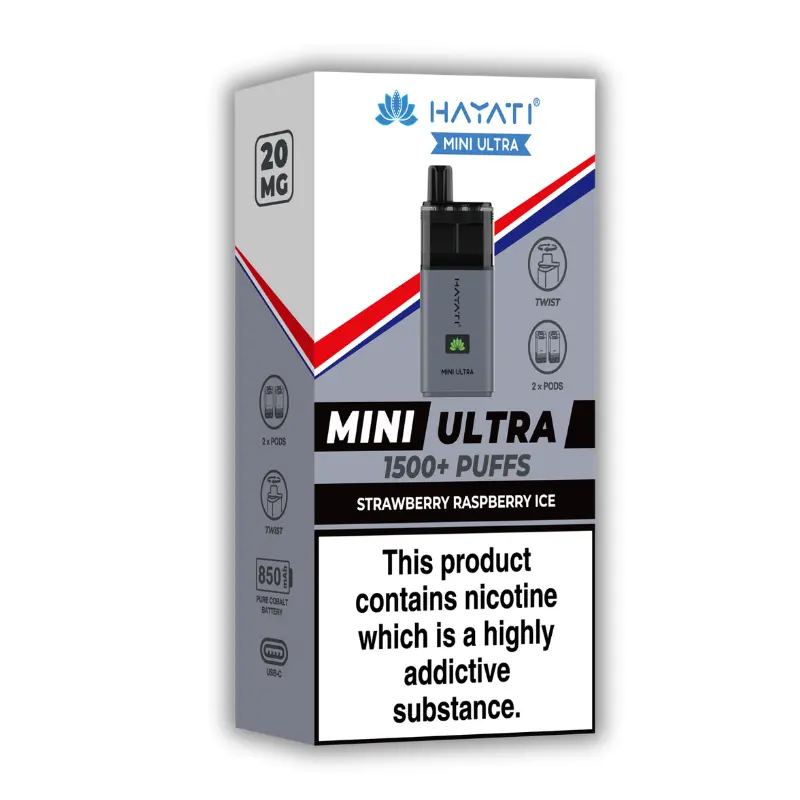
Hayati · Mini Ultra
Strawberry Raspberry Ice Hayati Mini Ultra Pod Kit
£3.99
✔ In stock — ready to ship
Genuine Hayati
Free over £20
Same-day dispatch
Secure checkout
Four millilitres of Strawberry Raspberry Ice at 20mg nicotine salt, a Mini Ultra body underneath it, £3.99, nothing to assemble and nothing to fill. Hayati put an 850mAh cell in the device and rate the pod by laboratory test at up to 1,500 puffs, a figure produced by apparatus drawing to a fixed schedule rather than by anybody's week. As a description of an object that is the end of it, and if the object were the point this page would stop here.
The point is what the object can be used for. Strawberry Raspberry Ice is one of a handful of recipes Hayati manufacture in every single way they sell liquid, and this listing is the smallest unit any of them comes in. A recipe that turns up everywhere, in a container small enough to finish inside a week, on the cheapest ticket any complete kit here carries, is not really a small purchase. It is a measuring stick. Most of what a buyer wants from a product grid is a sense of where something sits, and sitting requires a surface to sit on. This pod is the nearest thing this catalogue has to one.
Several pages on this site end by telling you to judge a liquid against something rather than in isolation, which is good advice given twice over with no object attached. The argument below is that the object exists, that it is this one, and that the case for it is not that it is inexpensive but that it is short, fixed and familiar in a way nothing else here manages at once. The second half of the argument is the honest part: a measuring stick has limits, some of them severe, and a page that sold you an instrument without describing its error bars would be selling you a worse instrument than it thinks.
Testing the claim before building on it
The version of this I was handed said the most-replicated flavour in the range. That is not true and the catalogue says so in about a minute, so here is the count and the narrowed claim that survives it.
Strip every title down to its flavour names, splitting the dual listings at the oblique, and set the pouches and the refillable Quokka hardware aside. What remains is 157 distinct flavour names spread across 492 listings. Strawberry Raspberry Ice appears fifteen times. Blue Razz GB appears sixteen, so on raw repetition this recipe is not first, and two other names are level with it at fifteen.
Raw repetition is the wrong measure anyway, and the reason is visible in how those sixteen Blue Razz GB listings are made up. Eight of them are dual pods in which the flavour occupies one collar position and something else occupies the other. Only eight are listings where it is the whole product. Count sole occupancy instead, meaning the number of separate things you can order in which this flavour is the only liquid, and the picture tightens sharply.
Hayati operate seven product lines, and four of those sell the same liquid twice, once with a body and once as a refill on its own. That makes eleven distinct purchase slots rather than seven, which is the useful denominator. Eleven is also the ceiling for sole occupancy, and exactly seven names in the catalogue reach it: this one, Lemon Lime, Blueberry Raspberry, Blue Razz Cherry, Blue Sour Raspberry, Summer Dream and Mr Blue. Each of those seven can be bought as the sole flavour in every one of the eleven slots, with no gaps and no duplicates.
Two corrections to the record while the counting is open, because the Strawberry Raspberry Ice Hayati Rubik Prefilled Pod Kit page ran a version of this count and got the number right by a route that does not hold. It reported eight names covering all seven lines, which is correct, then said the group drops to seven at eleven slots because Blue Sour Raspberry has a Pro Ultra Plus kit and no Pro Ultra Plus bare pod. That bare pod exists and is listed at £7.99, so Blue Sour Raspberry does not drop out. Eight names reach all eleven slots.
The number seven is still right for the stricter test, and the name that falls is Juicy Peach. It reaches every slot, but its Mini Ultra kit slot is filled only by the divided Sour Apple pairing, so there is no kit in which Juicy Peach is the whole fill. Right figure, wrong reason, wrong name, and worth putting straight because the eleven-slot idea is load-bearing on two pages now.
So the honest version of the repetition claim: joint highest in listing count among the names with complete coverage, and one of seven that can be bought whole in every slot Hayati sell. That is still not enough to single this recipe out, because seven candidates is six too many.
The property that does single it out
Run one filter over those seven and six of them fall away. Of the names available whole in all eleven slots, exactly one declares a coolant in its title, and it is this one. Lemon Lime, Blueberry Raspberry, Blue Razz Cherry and Blue Sour Raspberry are all room-temperature recipes. Mr Blue and Summer Dream name no fruit at all, which disqualifies them from reference work for a separate reason covered below.
That matters because of how much of this catalogue is cooled and how little is said about it. A cooling word appears in 121 of the 492 titles. Not one of those titles, and not one of the descriptions behind them, states a level, a scale or a compound. Cooling is declared as a yes or a no and experienced as a quantity, and the Ice Vapes shelf, ninety-eight listings as it currently stands, is a shelf sorted on a binary that nobody has calibrated. A reference recipe with no coolant in it can tell you nothing about any of those ninety-eight.
The last piece is familiarity, which is the one property you cannot manufacture. A reference is only useful if you arrive already holding a rough impression of it, and the impression comes from exposure rather than from reading. Red berry is the profile this catalogue is built on: 176 of 492 titles name strawberry, the abbreviated Straw’, raspberry or razz, which is better than a third of everything here. Twenty-nine titles put a red berry and a cooling word together. The Pro Ultra Plus pods page counted that segment properly and argued that its density makes choosing inside it close to impossible, and I am taking that finding as given rather than running it again. What I am taking from it is the opposite conclusion. A segment so crowded that its members are hard to tell apart is a segment almost everybody has already been through, and a profile almost everybody has already been through is the one worth measuring against.
Put the three together and the narrowed claim is specific enough to be worth something: the smallest unit, at four millilitres, of the only recipe in the catalogue that is both available whole in every purchase slot and declared cold, sitting at the centre of the largest flavour family on the site. Nothing else here has all of that.
What a reference has to be, and why the corpus has not named one
Three requirements, and they pull against each other, which is why the field of candidates is thin.
It has to be short. Not small for the sake of being small. Short because a reference that changes while you are using it is not a reference, and two separate processes change a cooled berry liquid over the life of a pod. Both take time and volume to arrive. A container you finish inside a week is a container in which neither has properly begun, which is the whole of the argument in the section after next.
It has to be fixed. Every listing of this recipe on every platform is 20mg in the sealed formats, the volume is stated, the price does not move between flavours on a given shelf, and the flavour name has meant the same three words across fifteen separate listings. There is no variant, no strength option and no seasonal edition to confuse one purchase with another. That sounds like a complaint about a dull range and it is the exact property an instrument needs.
It has to be familiar. This is where the mood-named listings fail and it is worth saying plainly. A name that commits to no fruit cannot function as a reference, because you cannot hold a profile in your head that the listing never described. Two of the seven full-coverage names are in that position. They are perfectly good liquids and they are useless as a measuring stick, for the same reason a ruler with no markings is useless.
Now the gap. Pages on this site do name references, and they name them constantly. The blue corner has one. The cooling shelf has one at the top end. The blackcurrant axis has one. Each of those is a reference for a single axis, chosen because it is the plainest example of a family, and each is named in a format that ties you to it for weeks. None of them was chosen for the properties that make an instrument work, and none of them is catalogue-wide. So the corrected version of the gap is not that nobody names a reference. It is that every reference this corpus names is local, large and picked for what it is rather than for what it can measure.
A general-purpose instrument has to be picked the other way round. You want the thing that will still be the same next month, that you can finish before it moves, and that sits in the middle of the territory rather than at one edge of it. The plainest example of a family is by construction at the edge, which is exactly what makes it a good demonstration of that family and a poor yardstick for anything outside it.
The arm that a divided pod cannot supply
There is a sharper version of the same gap, and a page in this corpus has already found it from the other direction. The Blue Razz Cherry / Blue Razz GB Pro Ultra Plus pods listing set out to use a dual pod as a comparison between two treatments of one base, then noticed that the pod contains no untreated arm: both halves are modified, so a level result cannot distinguish between the base dominating and the two modifiers cancelling out. Its conclusion was that separating those needs a third arm the pod does not contain.
That is precisely what a separately purchased small pod is. The dual formats on this site can compare A with B and cannot compare either with nothing, because the thing they lack is a fixed point outside themselves. A 4ml unit of a recipe you already know is the fixed point, bought for less than the difference between a kit and its refill on most platforms, and carried alongside rather than instead of whatever you are assessing. The divided kits on the Hayati Mini Ultra Prefilled Pod Kit shelf are good at variety and structurally incapable of supplying their own baseline. That is not a fault in them. It is a consequence of there being one coil.
Four things the instrument can settle
Be concrete about what a reference reading actually produces, because vague instructions to compare are what created this gap in the first place.
Where a candidate sits on sweetness. Every listing of this recipe that comments on sweetness puts it at medium, and the Rubik page established that none of the fifteen reaches for confectionery language, which in a range that uses candy words freely is a real signal rather than an absence. So you have a mid-scale anchor. Draw on the reference, then on the thing you are assessing, then on the reference again, and the question stops being how sweet is this and becomes sweeter or less sweet than the anchor. Ordinal readings are the only kind available here, and they are considerably more useful than an adjective.
Where a candidate sits on cooling. Same mechanism, applied to the axis the catalogue is least articulate about. Ninety-eight products on the ice shelf and no number anywhere. A declared-moderate coolant on a fruit base is the natural mid-point of that axis, and once you have a mid-point you can sort the shelf into things colder than the anchor and things warmer than it. That is a coarse instrument and it is infinitely better than the binary the titles give you.
Whether a listing's vocabulary corresponds to anything. This corpus keeps finding that Hayati's descriptive words are unevenly informative. Jammy appears on twenty-seven listings, which means its presence tells you nothing at all. A reference lets you test a word instead of trusting it: take a listing that claims a sharper or tangier berry, set it against the anchor, and find out whether the claim survives contact. Half the time it does. The other half you have learnt something about the copy rather than about the liquid, which is still worth knowing.
Whether your own threshold has moved. This is the strongest use and the least obvious one. The Smooth Strawberry Ice pods page sets out, in more detail than I could improve on, how continuous exposure to a cooling agent raises the level at which you notice cold, how that drift runs across days and weeks rather than resetting overnight, and why it is indistinguishable from the product having been changed. Its discriminator is that adaptation takes the cold and leaves the fruit exactly where it was. What that page could not offer is a way to run the test alone, since its suggestion is to hand your pod to somebody who has not been vaping cooled liquids. A sealed 4ml unit of a recipe whose cold you have a filed impression of does the same job without needing a second person. If the anchor reads noticeably milder than you remember while its strawberry is untouched, the thing that moved is you.
Five things it cannot settle, and the confound behind most of them
Now the limits, which are more interesting than the uses and considerably more important.
The confound is the coil, and it is not small. The Blueberry B’Gum Pro Max Plus pods page states the problem in one sentence that should be attached to every comparison anybody makes on this site: the only reliable comparison is between the start and the end of one pod’s own life rather than between one pod and another. Two sealed pods are two coils, two wicks and two airflow paths, none of which Hayati publish. Not one of the fifty Mini Ultra listings uses the word coil, states a resistance or names a wick material, and the position is the same across the other platforms. So a difference you hear between the anchor and a candidate could be the liquid, and it could equally be that one of the two units renders everything a little more efficiently than the other, and nothing published on either listing lets you tell which.
That is a real limitation and it narrows the instrument considerably. What survives it is direction on large differences. If a candidate is markedly sweeter, markedly colder or markedly sharper than the anchor, a hardware difference is an implausible explanation for the whole of the gap. If the two land close together, the reading is worthless, because the gap is within the range that two unpublished coils could produce on their own. Large differences, yes. Fine distinctions, no, and anybody claiming otherwise is over-reading two sealed units.
It cannot tell you about the candidate’s hardware. Follows directly. The reading is about your palate at one moment, and about the liquid only to the extent that the difference is big enough to outrun the noise. It is not a measurement of the other product’s coil, its airflow or its build, and nothing on a retail page, this one included, should be read as one.
It cannot give you an absolute figure for anything. There is no published coolant level, no sweetness scale, no ratio between the two berries and no VG/PG split for any sealed pod in this range. Every reading the instrument produces is a rank order. Colder than, sweeter than, sharper than. Anybody who converts that into a number has invented the number.
It cannot settle whether you will still want the candidate in a fortnight. The Cherry Berry Mini Ultra kit page worked out which questions four millilitres answers and which it leaves open, and the boundary it drew holds here without modification: four millilitres settles the questions that are about your palate and leaves open every question that is about time. Using a small pod as a reference does not change that. It changes who the reading is about, not how long the reading covers.
It cannot be read across a temperature difference. The Blue Razz Pineapple / Strawberry Ice Pro Ultra Plus pods page puts it in six words: comparison needs a shared baseline, and a temperature difference destroys it. Setting a cooled anchor against an uncooled candidate does not tell you their relative sweetness, because the coolant is trimming the sweet tail on one side and not the other. The instrument works within the cooled half of the catalogue and produces nonsense across the line.
One arithmetic warning attaches to all of this and it is already documented on the Blue Sour Raspberry Mini Ultra kit page, which showed that the four prefilled platforms imply wildly different puffs per millilitre from their published ratings. Those numbers cannot be describing the same physics, so never use a puff figure to compare a candidate with the anchor. Compare millilitres, which are measured, or compare nothing.
Why the reference has to be this small, and the trap in that
An instrument that drifts is worse than no instrument, because it produces readings that look valid. Two things drift on a cooled red berry, and both are volume-dependent, which is why the format is the argument rather than an incidental detail.
The coil. The Pro Ultra Plus pods page traced this for exactly this recipe and reached a conclusion sharp enough to be worth citing rather than restating: raspberry is a high, volatile note, high notes are the first casualty as residue accumulates, and a worn pod of Strawberry Raspberry Ice converges on plain iced strawberry. Read that as a problem for an instrument and it is fatal. The second berry is the component that gives the profile its definition, so a reference in the back half of a long pod is no longer the reference you calibrated against. It has quietly become a different, simpler liquid, and it will give you confident readings the whole time.
Your threshold. The slow coolant adaptation described above is the second drift, and it runs on exposure rather than on time in the drawer. Its effect on an instrument is the mirror image of the first: the coil takes the raspberry and leaves the cold, adaptation takes the cold and leaves the fruit. A reference exposed to enough of its own coolant stops reporting cold at the level it used to, and every candidate it is then used on will read colder than it is.
One precision is worth adding, because a sibling page tested a version of this claim and found it wanting. The Blue Sour Raspberry Mini Ultra kit page examined whether a small pod suits a sour liquid on the same logic, and concluded that the palate half of the argument does not hold for acid, because acid adaptation resolves within a session and is fully reset by a night’s sleep. It found the argument had to be re-founded on the coil instead. That verdict is correct and it does not transfer. Coolant is the case where the slow version is established rather than assumed: the sibling pages on the cooled liquids set out a threshold shift that runs across weeks and is not undone overnight, which is a different mechanism from the one the sour page rejected. So on this recipe both drifts are live, where on a sour one only the coil is, and that is the reason the format argument is available here and was not available there.
Four millilitres is where neither has arrived. At a moderate rate that is a week or so, which is roughly a third of what a 12ml pod runs to and well under a fifth of a 22ml one. Those ratios hold whatever your own consumption is, which makes them more dependable than any puff figure. The coil has taken on very little. The slow threshold shift runs on a scale of weeks and has barely started. What you are drinking at the end of a 4ml pod is close to what you drank at the start, which is a mild disappointment if you bought it for pleasure and the entire specification if you bought it as an instrument.
The corollary nobody selling this would volunteer
If exposure is what moves the threshold, then using the reference constantly destroys the property that made it a reference. That is not a quibble. It is the central operating condition of the thing.
A buyer who likes this recipe enough to run it as their only flavour will, within a few weeks, be holding a pod they can no longer read anything against, because their own threshold will have settled to it and the candidate they test next will be measured with a moved rule. The failure is silent, in the way the sibling pages describe: nothing tastes wrong, the readings keep coming, and they are all shifted in the same direction.
So the instrument has to be kept out of the rotation to stay an instrument. Buy it for the reading, run it for the reading, and let the gaps between readings be long enough that your threshold has settled back. That is an awkward thing for a product page to recommend, since it argues for buying less of a product rather than more, and it is what follows from the mechanism. Anybody who wants this recipe as a daily liquid should buy it in a format sized for that and treat the two purchases as unrelated, which is what the Strawberry Raspberry Ice Hayati Rubik Pods and the larger pods exist for.
There is a storage caveat attached, and it too has already been worked out elsewhere. Buying six small pods to keep an instrument permanently to hand puts five of them in a drawer for as long as a large pod would have sat in a device, and no listing publishes a fill date, so an aged unit is indistinguishable on paper from a fresh one. Keep one spare, not a shelf of them.
What the liquid actually is, and the one thing its own copy cannot agree on
The draw-by-draw account of this blend is already written properly on the Pro Ultra Plus pods listing, which takes the broad low strawberry, the structural job the raspberry performs above it, the late arrival of the cooling and where the sweetness lands. That is the best single description of this liquid on the site and rebuilding it would waste your time. What has not been done is the reading that matters for a reference, which is: given how many near neighbours this recipe has, what distinguishes it from them, and is there anything in its own copy that a buyer could use.
Line up all fifteen Hayati descriptions of this flavour and something shows up that none of the individual listings makes visible. Ten of the fifteen claim, in one form or another, that the blend resists becoming heavy, sugary or sticky over a run. That is a claim about accumulation rather than about taste, and it is unusual in this catalogue in one specific way: four of the fifteen talk explicitly about what happens across a session, against forty out of 492 listings overall. A recipe whose copy is three times as likely as the average to mention sessions is a recipe whose writers kept reaching for duration.
The interesting part is that those ten do not agree about which component does the work. Three credit the raspberry’s acid, in the form of a tart lift that stops the blend feeling heavy. Four credit the coolant, on the grounds that a cold finish leaves the berries reading fresher and lighter. The Rubik listing credits both by name in one sentence, putting the cold against the jammy tendency and the raspberry against the sweetness piling up. Two credit the balance of the three elements without naming any of them.
That spread is not evidence of two recipes. This corpus has established twice over that a disagreement between listings of one liquid is evidence about how the copy was produced, and the Rubik page already used this exact flavour to show it, finding that the Mini Ultra kit and the Rubik kit land on opposite sides of the jammy line. What the spread is evidence of is something a single listing cannot show you: the blend has two independent mechanisms for stopping sweetness accumulating, and they are close enough in effect that nine separately commissioned writers could not agree which one they were hearing.
That is the distinguishing feature, and it is the reason the recipe works as a reference rather than merely being popular. Most sweet liquids in this catalogue manage accumulation one way or the other. An acid line clears the palate chemically. A coolant truncates the sweet tail by dropping the perceived temperature at the back of the mouth. This recipe carries both at once, at moderate levels, which means a single 4ml unit demonstrates the two strategies the rest of the range picks between. Set it against something that has only acid and you hear what the cold was contributing. Set it against something that has only cold and you hear what the raspberry was contributing. Neither reading is available from a liquid that only does one of them.
One caveat on that, and the Rubik page got there first: the two mechanisms are not equally durable. The acid line is carried by the raspberry, and the raspberry is the note a tiring coil takes first, so the fallback runs on the same clock as the thing it is meant to back up. On a long pod that is an unfortunate piece of engineering. On four millilitres it is irrelevant, because neither clock has run, and that is one more reason the small unit is the one where this recipe is most fully itself.
What it is not
Boundaries, set against the near neighbours rather than in the abstract.
- Not sour. Acid and sourness are different, a distinction the Straw’ Cranberry Cherry pairing page draws carefully. Nothing here makes the jaw tighten. Blue Sour Raspberry Hayati Mini Ultra Pod Kit is the same size and price with a declared sour layer, and it is the right purchase if the acid line here reads as too polite.
- Not a confection. None of the fifteen reaches for candy language, which is meaningful in a range that does so freely. Blueberry Cotton K / Raspberry Cotton K Hayati Mini Ultra Pod Kit is the shelf’s demonstration of what spun-sugar sweetness does to two berries.
- Not a mint. The cold has no herb behind it. Blueberry Straw’ Menthol / Blueberry Raspberry Menthol Hayati Mini Ultra is where this shelf reaches for the other cooling vocabulary, which the Blue Frozen pods page established is not a graded scale.
- Not a three-fruit red. Adding a name means trimming the others. Strawberry Raspberry Blueberry Hayati Pro Max Plus Pod Kit is the same two berries with a third given room out of the same budget.
- Not a strong reading of anything. Moderate sweetness, moderate cold, moderate acid. That is a weakness in a flavour you want to be thrilled by and the precise requirement for a reference.
The kit itself
One box, one body, one prefilled pod, ready on arrival. Nothing to prime, no spare, no assembly and no first-use decision to get wrong. The pod is filled and closed before dispatch and carries its own heating element, so the two finish together whether or not the element had more in it.
Hayati publish four numbers for this listing and no more: 4ml, 20mg, 850mAh and a laboratory rating of up to 1,500 puffs. The word coil does not appear anywhere in the fifty Mini Ultra descriptions, in either direction, and neither does an airflow figure, a wick material or a parts breakdown. No refill route is published, so treat the pod as sealed and replace it rather than trying to top it up. Say the fitment point once and leave it: check the range name printed on your device against the range name in this title before ordering, and do not take a compatibility decision from a retail page.
The Hayati Mini Ultra range runs to fifty listings, twenty complete kits and thirty bare pods, and the per-millilitre arithmetic for the format has been worked through in detail on the Blue Sour Raspberry kit page. It is not repeated here, partly because it is already settled and partly because the argument on this page does not depend on it. Disposal is the ordinary obligation for a device with a cell and a liquid residue in it: electrical take-back points and local recycling facilities that handle battery-containing equipment will take the whole unit, and it does not belong in a household bin. Keep it out of reach of children and pets.
The figures, and whether you can reference against each one
An ordinary specification table lists a value and stops. For a page arguing that this product is an instrument, the more useful third column is whether each row holds still, because a row that drifts is a row you cannot base a reading on.
| Row | Value | Stable enough to reference against? |
| Liquid on board | 4ml, sealed before dispatch | Fixed. Identical on all fifty Mini Ultra listings |
| Nicotine | 20mg nicotine salt | Fixed. The UK ceiling for a prefilled pod and the only figure offered here |
| Cell | 850mAh | Fixed as published, though what it does over time is not |
| Manufacturer’s puff rating | Up to 1,500, a laboratory estimate | No. Not comparable across formats and never a forecast |
| Flavour positions | One. No collar, nothing to select | Fixed, and it is what makes a clean reading possible |
| Fruits named | Two, strawberry and raspberry | Fixed |
| Cooling | Declared in the title | The declaration is fixed. The intensity you perceive is not |
| Sweetness | Medium on the collective reading of fifteen listings | Reasonably. Nothing published, but nothing contradicts it either |
| Raspberry top edge | Present when new | Drifts. The first component a tiring element takes |
| Purchase slots this recipe occupies | 11 of 11, whole | Fixed, and checkable against the catalogue |
| Price | £3.99 with the body, £3.49 for the pod alone | Fixed across all twenty kits and all thirty pods on the shelf |
| Not published | Coil resistance, airflow, wick, VG/PG, berry ratio, coolant level | Nothing to reference against, and no page should supply one |
Read the right-hand column rather than the middle one and the shape of the instrument becomes obvious. Most of what Hayati publish about this product is genuinely fixed, which is unusual and useful. Two rows drift, and they are the two the argument above spends its length on. One row cannot be used for comparison at all, and it is the number printed largest on most listings in this range.
The puff rating deserves the extra sentence. Up to 1,500 is what Hayati rate the pod at under laboratory conditions, produced by a machine drawing consistently on a fresh device. It is useful for placing a product in a class and useless for anything else, and setting it beside the ratings on the 12ml or 22ml formats produces four incompatible answers to the same question. The strength row is a plain statement rather than a recommendation: twenty milligrams per millilitre is the maximum concentration permitted for a nicotine-containing liquid sold in the UK, it is identical across the shelf, and nicotine is an addictive substance.
Where to go from here, by what you are trying to do
Organised by purpose rather than by flavour, since the purpose is what this page has been about.
If you want the reference and nothing else
You are in the right place, and the only decision left is whether you need the body. If you already own a Mini Ultra, Strawberry Raspberry Ice Hayati Mini Ultra Pods at £3.49 is the same four millilitres without the device. There is a real argument for taking the kit even so, and it is not about the fifty pence. A reference is most useful when it can be drawn on immediately after the candidate rather than after swapping pods, and that requires two bodies. If you intend to do this properly, a second device is the thing that makes bracketed readings possible at all.
If you want to run the recipe rather than measure with it
Then this is the wrong row and the page has been honest about why. Four millilitres of a flavour you have already chosen ends just as it gets going, and running small pods back to back gives you the same continuous exposure you would have had from one large one. Strawberry Raspberry Ice Hayati Rubik Prefilled Pod Kit at £5.99 holds twelve millilitres and its page makes the case for that volume specifically. Strawberry Raspberry Ice Hayati Pro Max Plus Pod Kit at £7.99 is the same twelve on the largest platform Hayati run, and Strawberry Raspberry Ice Hayati Pro Ultra Plus 25000 Prefilled Pod Kit at £11.99 is twenty-two for anybody who has settled completely. If you own refillable mouth-to-lung hardware, Strawberry Raspberry Ice Hayati Pro Max 50/50 Shortfill E-Liquid is the same name in a bottle, supplied without nicotine so a shot is a separate purchase and a separate decision.
If you want the blend with something to switch to
Two Pro Ultra Plus pods carry this recipe in one collar position. Straw’ Cranberry Cherry / Strawberry Raspberry Ice Hayati Pro Ultra Plus 25000 Prefilled Pod Kit is the better of the pair, because a drying cranberry build stays distinguishable from a sweet cooled berry as both age. The Blue Razz Pineapple / Strawberry Ice Hayati Pro Ultra Plus 25000 Prefilled Pod Kit takes the iced strawberry half of this profile and sets a blue razz against it. Note for anybody tempted to use a dual pod as a comparison tool: both halves share one element and one airway, so the first draws after a switch are a blend rather than a reading, which is the whole reason a separate unit does this job better.
If you want a second reference on a different axis
The instrument described here covers the cooled red-berry territory and stops at its edges. For the uncooled berry axis, Blueberry Raspberry Hayati Mini Ultra Pod Kit is the natural companion: another of the seven full-coverage names, the same size and price, the same second berry doing structural work, and no coolant at all, which makes it the control for every reading where you need to know what the cold was contributing. Blue Razz Cherry Hayati Mini Ultra Pod Kit covers the confection-leaning blue corner, and Blue Razz GB Hayati Mini Ultra Pod Kit is the plainest version of the base that corner is built on, which is why other pages treat it as the blue anchor. Between those three and this one you have most of the axes the catalogue varies on, at four millilitres each.
If you want variety in a pocket rather than a measurement
Eleven of the twenty kits on this shelf divide their four millilitres between two flavours behind a rotating mouthpiece, and the Cherry Berry kit page has worked out properly what that costs and what it buys, including why none of the eleven is sold as a refill. Pick a pairing with genuine contrast rather than two versions of one idea: Cherry Ice / Peach Mango Hayati Mini Ultra Pod Kit sets a cooled red against a warm tropical, and Fruit Bomb / Straw’ Watermelon B’Gum Hayati Mini Ultra Pod Kit moves into confection. Blackcurrant Lemonade / Straw’ Lemonade Hayati Mini Ultra Pod Kit is the opposite case, two lemonades differing only in the fruit, which will blur more than either would alone. The Grape GB and Straw’ Cranberry Cherry pairings on the same shelf sit in between those two extremes.
If red berry has simply worn out
More than a third of this catalogue being red is why people burn out on it. Blackberry Ice Hayati Pro Max Plus 6000 Pod Kit keeps the cold and moves to a darker fruit that holds tartness in reserve, which is the closest thing to a like-for-like swap if the cold is the part you want to keep. Blue Razz Pineapple on the Pro Max Plus puts a tropical acid against the blue base instead, and both Blueberry Raspberry and Blue Razz Cherry exist at twelve millilitres on that platform if one of the reference units above has turned into a flavour you actually want. Blueberry Raspberry Hayati Rubik Prefilled Pod Kit is the uncooled rotation partner at the volume most people actually use, and it is the one worth having in the house if the threshold problem described earlier is the one you recognise. Further out, the Blackcurrant Cotton K pairing changes the sweetness type rather than the fruit, and the Fruit Bomb pairing performs the same manoeuvre at twenty-two millilitres.
For browsing rather than deciding, the narrow Strawberry Raspberry Ice Vapes shelf collects eighteen listings, three more than the fifteen carrying the phrase, because somebody filed three further products alongside them by judgement rather than by text match. Raspberry Vapes and Strawberry Vapes are the component shelves, Berry Vapes is the whole family at 225 listings, and Hayati Prefilled Pod Kits holds every sealed kit across the platforms if the format rather than the fruit is what is still open.
Using it as an instrument, in practice
Everything below is aimed at getting a reading you can trust rather than at getting through the pod, which is a different activity with different advice.
Do not take the reading in the first hour. A pod fitted moments ago is saturated in a way it will not be again, and the Blue Razz Fruit Twist pods page makes the point that a reading taken in that state sits above everything that follows for reasons unconnected to anything you are measuring. Draw on it ordinarily for an hour, then establish what the anchor sounds like.
Take it on the first draw of the morning. Borrowed from the Spearmint kit page and directly applicable. A night has undone the short-term part of the adaptation and nothing else, so morning readings on day one and day six are comparable in a way two afternoon readings are not.
Bracket the candidate. Anchor, candidate, anchor again, in that order, on single unhurried draws with a gap between them. The second anchor reading is the one that catches you having drifted during the test. If the two anchor readings do not match, you have not measured the candidate, you have measured your own session, and the whole set should be discarded.
Hold the conditions still. Cooling perception moves with how warm you are, so a reading taken outdoors in February and one taken in a heated room are not the same reading. Same room, same time of day, well clear of coffee, a fizzy drink or toothpaste.
Do not chain. Back-to-back pulls raise the temperature of the element and stack the short-term adaptation, and a hot element presents a liquid differently from a cool one. Twenty or thirty seconds between draws is worth more on a cooled berry than it would be on a warm fruit, because there are two things being flattened rather than one.
Vary the pull deliberately, then stop varying it. A short sharp draw brings the raspberry forward because the higher notes register first, and a long slow one lets the strawberry fill underneath until the raspberry is only an edge. That is worth exploring once to know the range of the instrument. After that, fix one style and use it for every reading, or you will be measuring your own technique.
Write the reading down. Not the verdict, the reading: where the sharpness sat in the draw, how far the cold reached on the exhale, whether the sweetness registered before or after the cooling. A remembered impression decays into cold red berry within a fortnight, which describes twenty-nine listings, and a reference you cannot recall accurately is not a reference. Two lines in a phone is enough.
Retire it before the raspberry goes. The instrument is valid while the top edge is intact and stops being valid when the profile has flattened into strawberry plus cold. On four millilitres that should not happen, which is the point, but if the pod has been sitting part-used for weeks it can. Store it upright somewhere cool and dark, away from a window and a radiator, and out of reach of children and pets.
Questions this listing raises
Is this a two-flavour pod?
No. One liquid across the whole four millilitres, no rotating mouthpiece and nothing to select. Eleven of the twenty kits on this shelf are divided and their titles show both names separated by an oblique. This one carries a single name, which is what makes a clean reading possible.
Is the flavour identical to the twelve and twenty-two millilitre versions?
It carries the same name and all fifteen listings of it agree on the same core structure, so the recipe is very probably shared. Hayati publish no formulation for any of them, so nobody outside the factory can confirm it, and different heating elements would render even an identical liquid differently. Treat the name as travelling and the exact experience as not guaranteed to travel with it.
How cold is it?
Moderate on the collective reading of the fifteen descriptions, present on every exhale, nowhere near the level where the cold becomes the flavour. No coolant figure or scale is published for anything in this range, so that is an inference from the copy rather than a number anybody has issued. If a hard chill is what you want, this is not the entry to pick.
Why would I buy a small pod of a flavour I already know?
Because knowing it is the qualification. A reference only works if you arrive with a filed impression of it, so the fact that you have had this profile before is what makes the unit useful rather than what makes it redundant. What you get from it is a fixed point to set the next unfamiliar purchase against.
Can I tell whether a pod has weakened or whether I have adapted to it?
Partly, and the discriminator is on the Smooth Strawberry Ice pods page rather than here. Adaptation takes the cold and leaves the fruit where it was, whereas a tiring element dulls everything and takes the top notes first. Drawing on a fresh unit of a recipe you know well is a way to run that check without needing somebody else to taste your pod.
How reliable is a comparison between two sealed pods?
Reliable for large differences and unreliable for small ones. Two pods are two unpublished heating elements, so part of any gap you hear could be hardware rather than liquid, and nothing on either listing lets you separate the two. If a candidate reads markedly sweeter or colder than the anchor, believe the direction. If the two land close, the reading is inside the noise.
Does four millilitres tell me whether I would get tired of a flavour?
No. Four millilitres settles the questions that are about your palate and leaves open every question that is about time, a boundary the Cherry Berry Mini Ultra kit page drew in detail. Flavour fatigue needs volume to show itself and this pod ends before it arrives.
Should I run this as my everyday pod?
You can, and it will stop doing the job described on this page if you do. Continuous exposure to a coolant raises the level at which you notice cold, so a reference you use daily settles into the background and every later reading is shifted. Keep it out of the rotation if you want it to keep working, and buy a larger format if you want it as a daily liquid.
What strength is it, and is there a choice?
Twenty milligrams per millilitre of nicotine salt, with no options. That figure is the maximum permitted concentration for a nicotine-containing liquid sold in the UK and it is identical across all fifty Mini Ultra listings, so it is a constant of the range rather than a property of this flavour. Nicotine is an addictive substance.
Is the 1,500 figure something I should plan around?
Treat it as a class marker rather than a forecast. It is Hayati’s own laboratory estimate, produced on apparatus drawing to a fixed schedule, and every Mini Ultra listing carries the identical number whatever is in the pod. It also cannot be compared with the ratings on the other platforms, since those imply incompatible yields per millilitre.
Is the pod refillable?
No refill route is published and the pod arrives sealed and prefilled, so treat it as a single-use item and replace it rather than attempting to top it up. The element is inside the pod and is discarded with it, which is why the two always finish together.
What is the difference between this and the bare pod listing?
Fifty pence and a device. The pod listing is the restock for somebody who already owns a Mini Ultra body; this one includes the body. For reference work there is a case for owning two bodies regardless, because setting the anchor against a candidate is much easier when you are not swapping pods between draws.
The short version
Four millilitres of Strawberry Raspberry Ice at 20mg nicotine salt, an 850mAh Mini Ultra body, £3.99, and a manufacturer’s laboratory rating of up to 1,500 puffs that exists for placing a product rather than predicting a week. The liquid is a broad sweet strawberry, a raspberry top edge that gives it definition, and a moderate cooling finish on the exhale, described draw by draw on the Pro Ultra Plus pods listing and not repeated here.
What is particular to this listing is the size and the position together. Seven recipes in this catalogue can be bought whole in all eleven of the ways Hayati sell liquid, and exactly one of the seven declares a coolant. This is the smallest unit of that one, sitting at the centre of the largest flavour family on the site, on the cheapest ticket any complete kit in the catalogue carries. Short, fixed and familiar at once is a combination nothing else here manages, and it makes this pod more useful as a measuring stick than as a week’s liquid.
The limits are real and worth holding onto. A reading tells you about your own palate at one moment and about large differences in a liquid, and it cannot separate a liquid from an unpublished heating element, cannot produce an absolute figure for anything, and cannot be read across a temperature difference. It works because four millilitres ends before the element or your threshold has moved, and it stops working the moment you run it often enough for your threshold to settle to it. Buy it for the reading, keep one spare, and buy a larger format if what you actually want is the flavour.
Strictly for adults aged 18 and over. Nicotine is an addictive substance.
You might also like