Home / Juicy Peach Vapes
Juicy Peach Vapes
Thirteen tiles sit on this shelf, priced from £2.49 to £11.99, and all thirteen are the same recipe. Every one of them also appears on Peach Vapes, which holds 32 tiles, so this page is a child of that one in the strict sense: nothing here is missing from the parent, and the parent carries a further set that this page cannot show you.
The word doing the narrowing is not behaving like an adjective. Thirteen titles in the whole 492-listing catalogue carry the word Juicy and every single one of them reads Juicy Peach, a count established on the Juicy Peach Hayati Rubik Prefilled Pod Kit page rather than here. There is no Juicy Mango and no Juicy Berry. A grading word that only ever grades one thing has stopped grading and become part of a proper name, which makes the parent shelf a fruit and this shelf a recipe. Those are different kinds of category, not one nested inside a larger version of itself.
The useful consequence sits above the grid for a reason. There is nothing here to compare on flavour, because there is only one flavour. What this shelf actually asks you to decide is how much of a single liquid to commit to a single sealed coil, and on this particular liquid that decision carries more weight than it would almost anywhere else in the range.
New ProductsHayati PodsHayati Prefilled Pods & RefillsHayati Pod KitsHayati Prefilled Pod KitsHayati E-LiquidsHayati Pro Ultra Plus Prefilled Pod Kits & PodsHayati Pro Max Plus PodsHayati Pro Max Plus Prefilled Pod KitHayati Pro Max Nic SaltsHayati Pro Ultra Plus PodsHayati Pro Ultra Plus Prefilled Pod KitHayati Mini UltraHayati RubikHayati Mini Ultra PodsHayati Mini Ultra Prefilled Pod KitHayati Pro Max 50-50 E-LiquidHayati Pro Max 70-30 E-LiquidHayati Rubik Prefilled Pod KitHayati Rubik PodsHayati Nicotine PouchesHayati QuokkaBerry VapesRaspberry VapesIce VapesBlueberry VapesStrawberry VapesCherry VapesSweet VapesExotic VapesLemon VapesBlueberry Raspberry VapesPeach VapesWatermelon VapesApple VapesLemon Lime VapesMango VapesPineapple VapesGrape VapesLemonade VapesMint VapesCola VapesStrawberry Raspberry Ice VapesBlackcurrant VapesJuicy Peach VapesMr Blue VapesSummer Dream VapesBanana VapesKiwi VapesMenthol VapesOrange VapesFresh Mint Vapes
The parent, the child, and the two kinds of count that separate them
Two figures frame this page and both are tile counts, meaning listings that appear in a grid, as opposed to title counts, meaning listings whose names contain a given word. Peach Vapes holds 32 tiles. This shelf holds 13. All 13 also appear on the parent, and the parent carries 19 further listings that do not appear here. Containment is exact in one direction and not at all in the other.
Keep the tile-and-title distinction in view, because it has recently stopped being decorative. Flavour tags on this site are now pooled across same-liquid siblings, so a bare pod and the kit built around it land on the same flavour shelf even where the source data disagreed about them, and that has moved tile counts without touching title counts. In this corner of the range the two measurements happen to coincide: 13 tiles here against 13 titles containing Juicy, and 32 tiles on the parent against 32 titles naming peach. Coincidence is the right word. It is not a rule, it does not hold everywhere, and anyone building on a number from a page like this one should check which sort it is before reusing it. Every figure below says so.
A word that has stopped being an adjective
Before anything is built on the name, the first word in it has to earn its place, and the counting has already been done. The Juicy Peach Hayati Rubik Prefilled Pod Kit page found that thirteen of the 492 titles in the catalogue carry Juicy and that all thirteen are Juicy Peach, with no Juicy Mango, no Juicy Berry and no Juicy anything else anywhere in the range. It then looked at body copy and found the reverse behaviour: the word turns up in the description text of 129 listings, 116 of which have no Juicy in their title at all, which is roughly a quarter of everything Hayati sell. Its verdict was that in a title the word is an index entry and in prose it is filler. That finding stands and is not re-derived here.
What has not been drawn out of it is what the count does to the shelf itself, and that is this page's subject. An adjective in a product name has a job: it grades the noun beside it, it could be exchanged for a different grade, and a reader can picture the same noun without it. None of those three things is true of Juicy on this site. It grades nothing, because there is no ungraded Peach and no rival grade to set against it. It cannot be exchanged, because Hayati never apply it to a second fruit. And it cannot be removed, because what is left would name a fruit rather than a liquid.
Set that against a modifier still doing its work. Mint Vapes collects 19 tiles and the mint inside them arrives variously as Lemon Mint, Black Mint, Frosted Mint and Fresh Mint. Cross the modifier off any of those and a coherent product survives, because mint is a thing an adult vaper can want without first deciding which sort. Fresh Mint Vapes is therefore a slice of a noun, cut with a word that grades it, and the noun goes on existing either side of the cut. Cross Juicy off Juicy Peach and no product survives. Peach survives, as the name of a fruit, and a fruit is what the parent shelf collects.
Which gives an unusual relationship between this page and the one above it. A sub-shelf is normally the same category with a filter applied: one device family, one price band, one level of cooling, the parent's logic narrowed. That is not what is happening here. Peach Vapes indexes a fruit. This page indexes a recipe. A recipe is not a narrowed fruit. It is a different species of category filed at the same level in the same navigation, and nothing in the interface warns you that the two answer different questions.
A fruit shelf and a flavour shelf are for different people
Here is the practical form of the argument, and if you take one thing from this page it should be this.
A fruit shelf is an ingredient index. It gathers everything containing the fruit and takes no view on how much of it there is or whether it leads. The parent page counted its own tiles on exactly that axis and its figures stand: on the peach shelf, twelve make the fruit the subject and twenty make it the setting, with peach reduced in those twenty to connective tissue between a mango and a pineapple, or a soft floor for a raspberry to land on. All of them sit in one grid at one tile size with the same word in the name, which is the point of an ingredient index and also its weakness.
A flavour shelf is a recipe index. It gathers one liquid and shows you the containers that liquid comes in. That is why the grid above looks repetitive. It is repetitive. Ten of these are the recipe on its own, in seven different containers, and the remaining three are the recipe sharing a pod with a sour apple. Not one tile here is a blend where peach plays a supporting part, which is precisely what more than half the parent shelf consists of.
So two people arrive and only one of them is in the right place. The first wants peach, meaning the fruit, somewhere in the liquid, and would be perfectly happy to meet it inside a three-fruit blend or behind a raspberry. Everything on this shelf is wrong for that person, not because any of it is poor but because all of it is one answer repeated. The second has tasted this specific liquid, or has read enough to want it, and needs to work out which container to buy it in. That person is home.
Nothing on the page currently tells you which of the two you are. Thirteen tiles carrying the same fruit on the front look like thirteen choices, and they are one choice already made and offered thirteen times with different lids on it. The question that sorts you takes a second to answer. When you think the word peach, are you thinking of a taste you have had and want back, or of a fruit you would like to find somewhere in the pod? First answer, stay on this page. Second answer, go up to Peach Vapes, where 19 further listings are waiting that this shelf structurally cannot offer, including every blend in the range that contains the fruit.
What is on this shelf, and the three tiles that complicate the claim
Ten of the 13 are Juicy Peach alone. Three are Sour Apple / Juicy Peach, a pod holding both liquids at once with a rotating mouthpiece to pick between them. Hayati state that the two flavours are kept separate inside the pod and that the mouthpiece is how you choose. They do not publish how the two sides are divided or how liquid reaches the element, so this page will not describe that machinery, and neither should any other.
Those three are why the one-recipe claim needs a footnote rather than an asterisk. They genuinely contain this liquid. They contain roughly half of it, sitting next to something built to be its opposite, and that turns out to matter later in a way that has nothing to do with taste.
By container, the shelf runs as follows. All prefilled pods here are 20mg.
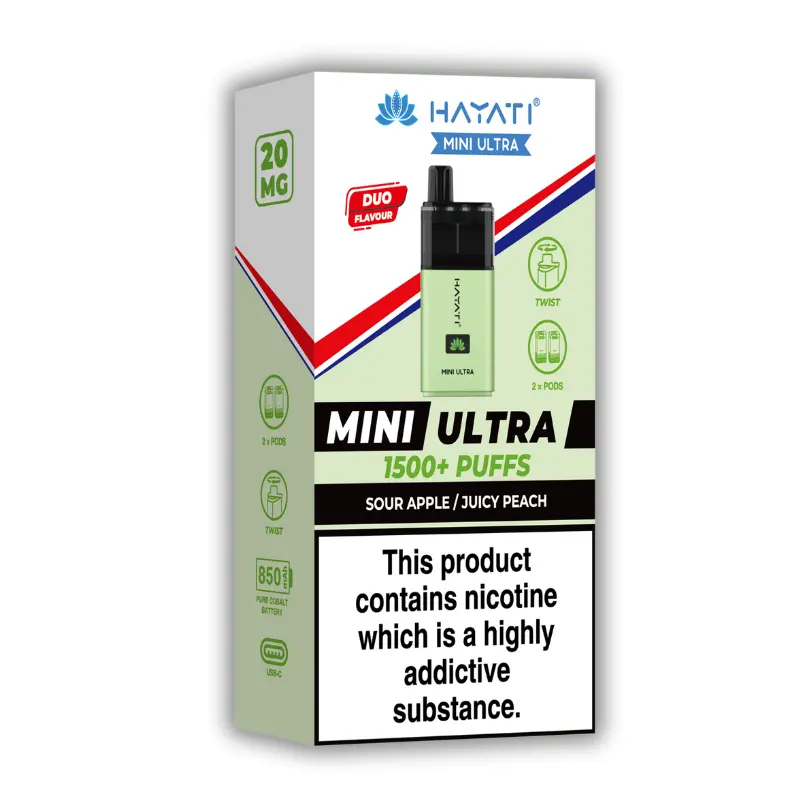
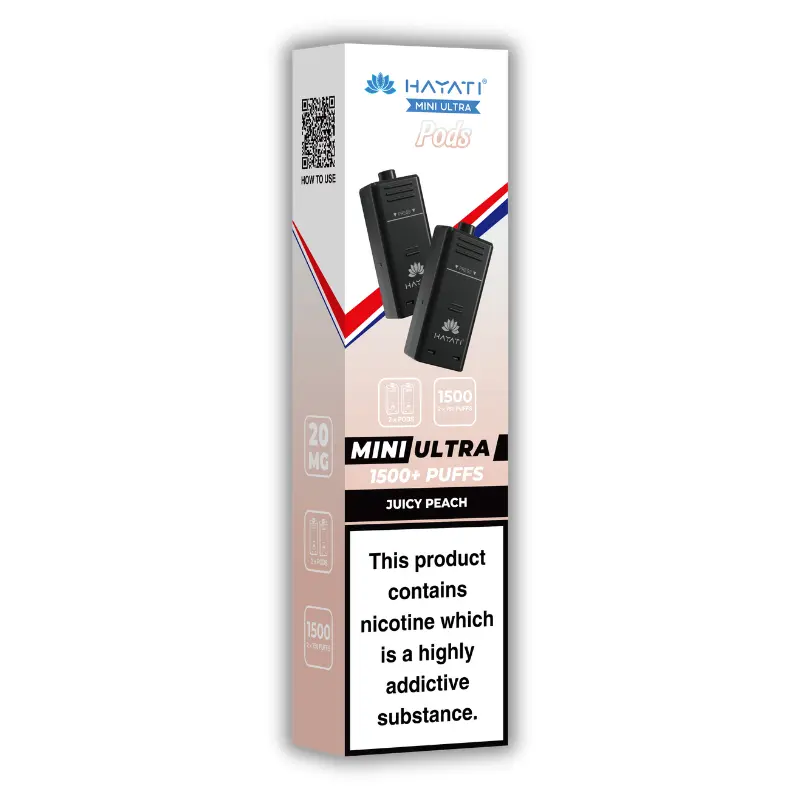
- 4ml on the Mini Ultra. Juicy Peach Hayati Mini Ultra Pods at £3.49, pod only, with Hayati quoting a bench figure of 1,500 puffs. Sour Apple / Juicy Peach Hayati Mini Ultra Pod Kit at £3.99 puts the dual pod and an 850mAh device in one box.
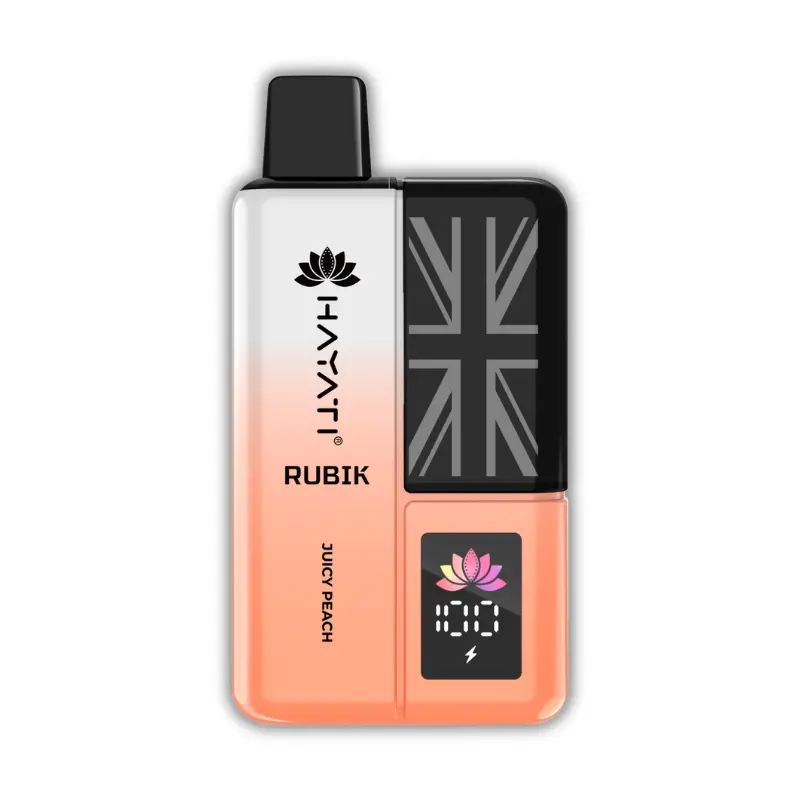
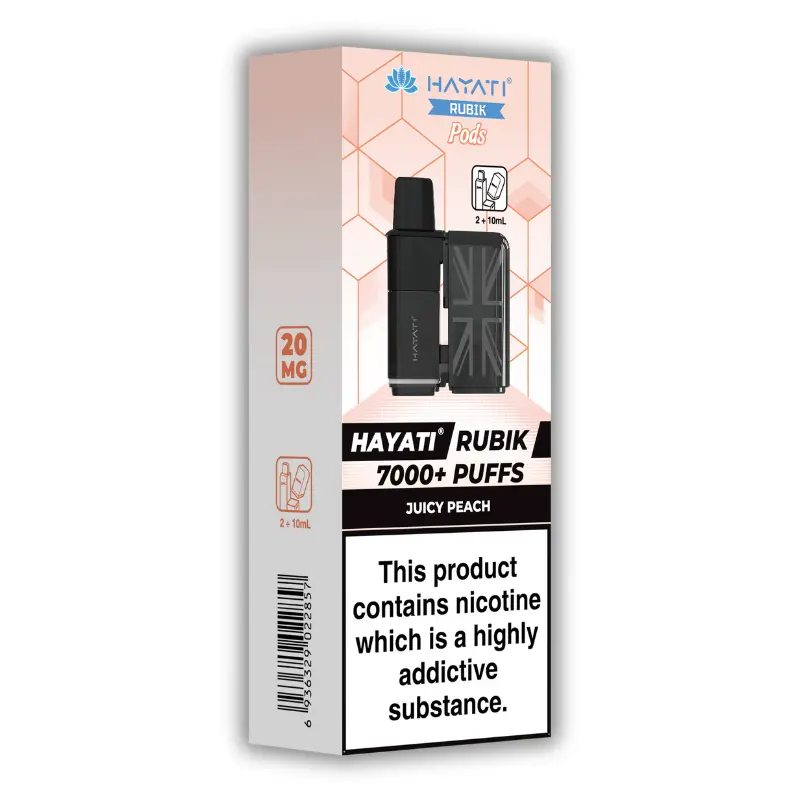
- 12ml on the Rubik. Juicy Peach Hayati Rubik Pods at £3.99 and Juicy Peach Hayati Rubik Prefilled Pod Kit at £5.99, both quoted at 7,000 puffs on the bench.
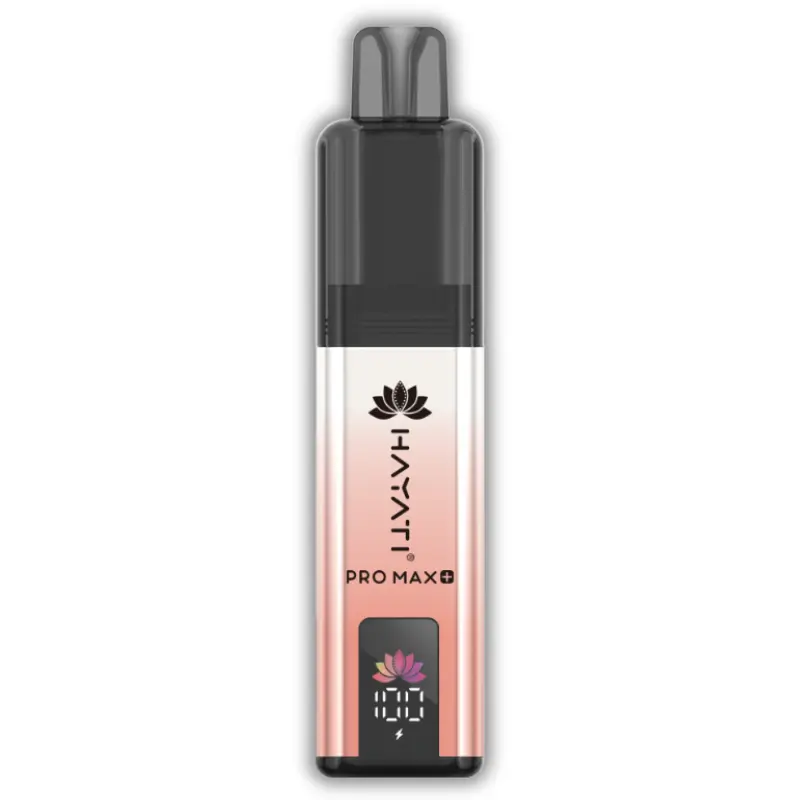
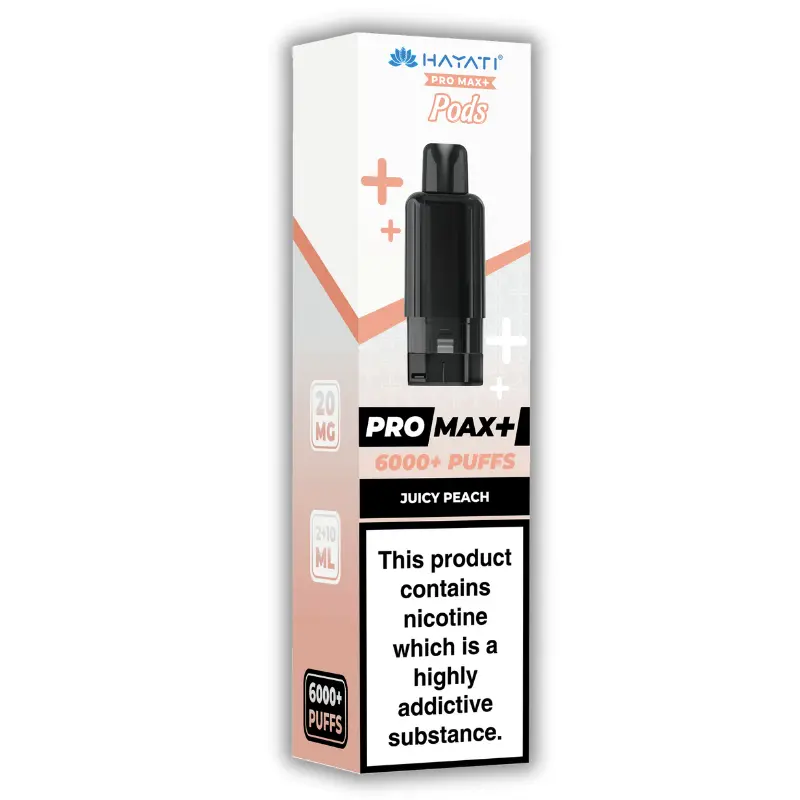
- 12ml on the Pro Max Plus. Juicy Peach Hayati Pro Max Plus Pods at £5.49 and Juicy Peach Hayati Pro Max Plus Pod Kit at £7.99, quoted at 6,000.
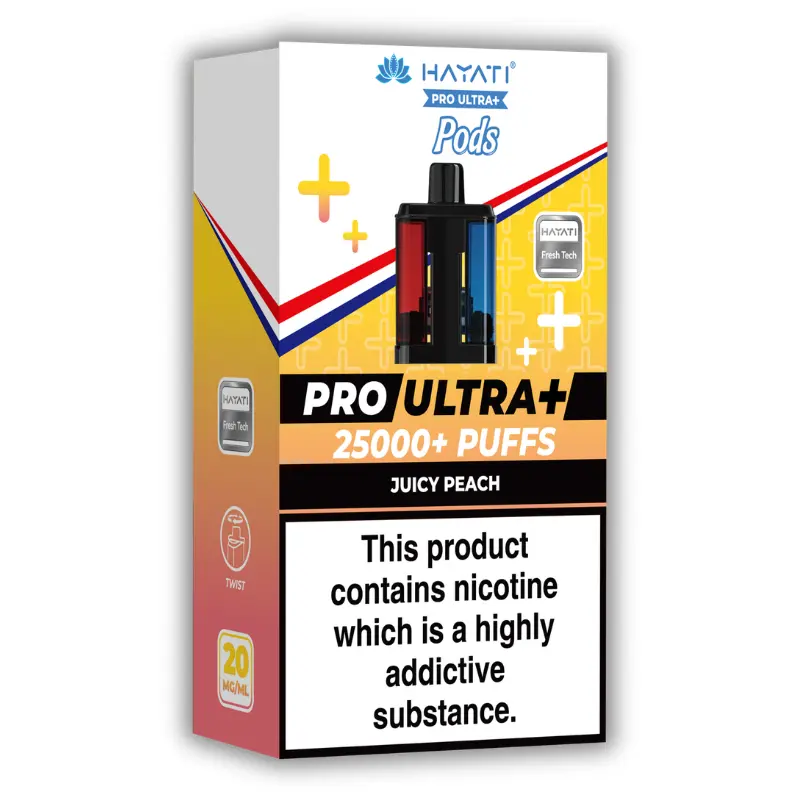
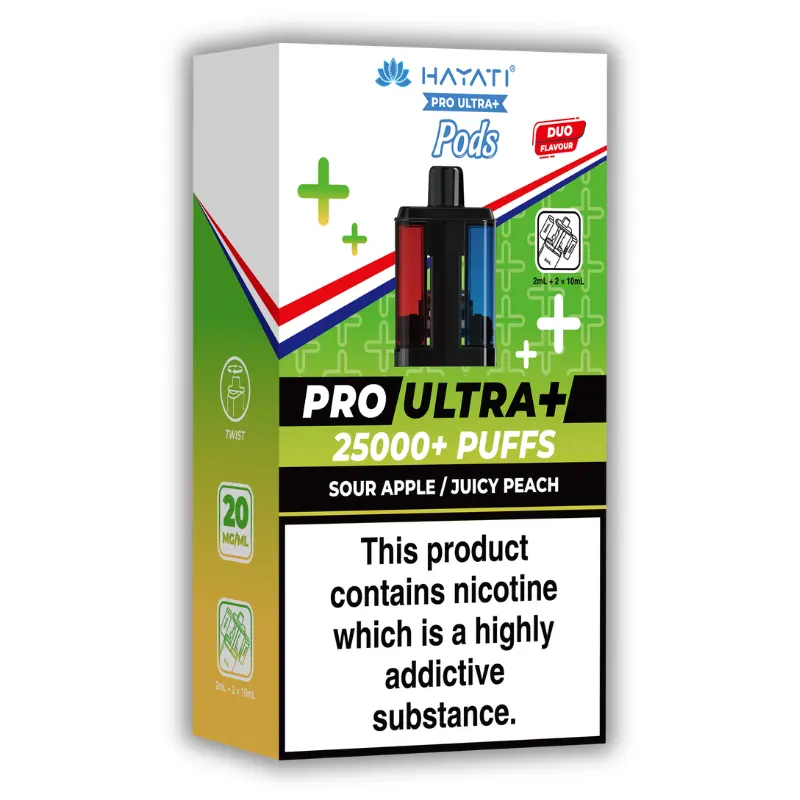
- 22ml on the Pro Ultra Plus. Four tiles, quoted at 25,000. Juicy Peach Hayati Pro Ultra Plus 25K Pods at £7.99 and Juicy Peach Hayati Pro Ultra Plus 25000 Prefilled Pod Kit at £11.99 are the solo pair; Sour Apple/Juicy Peach Hayati Pro Ultra Plus 25K Pods at £7.99 and Sour Apple / Juicy Peach Hayati Pro Ultra Plus 25000 Prefilled Pod Kit at £11.99 are the dual pair, at identical prices.
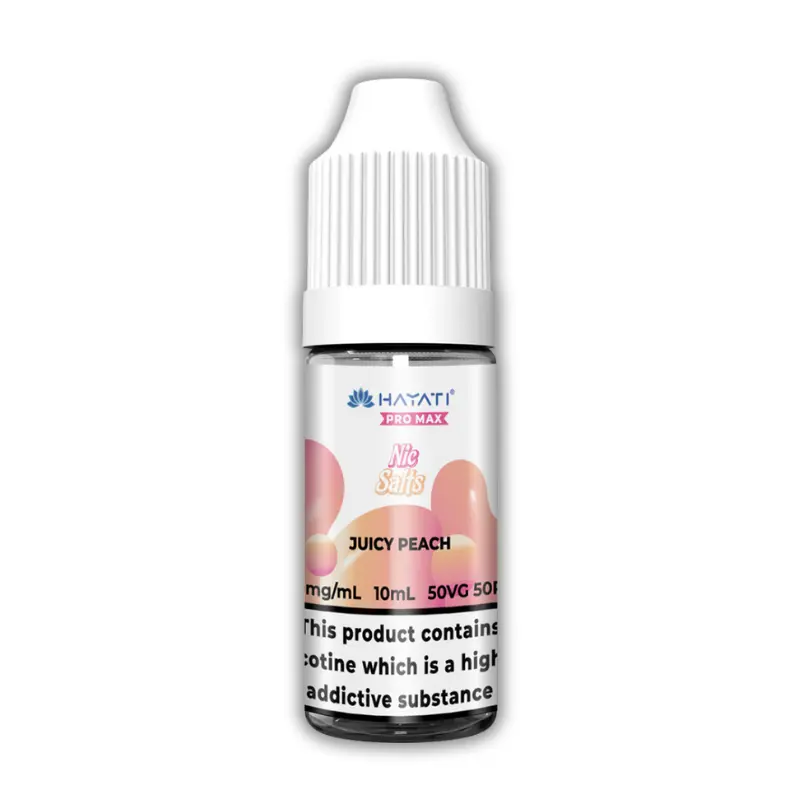
- 10ml bottled. Juicy Peach Hayati Pro Max Nic Salt, a 10mg nicotine salt at 50/50, £2.49.
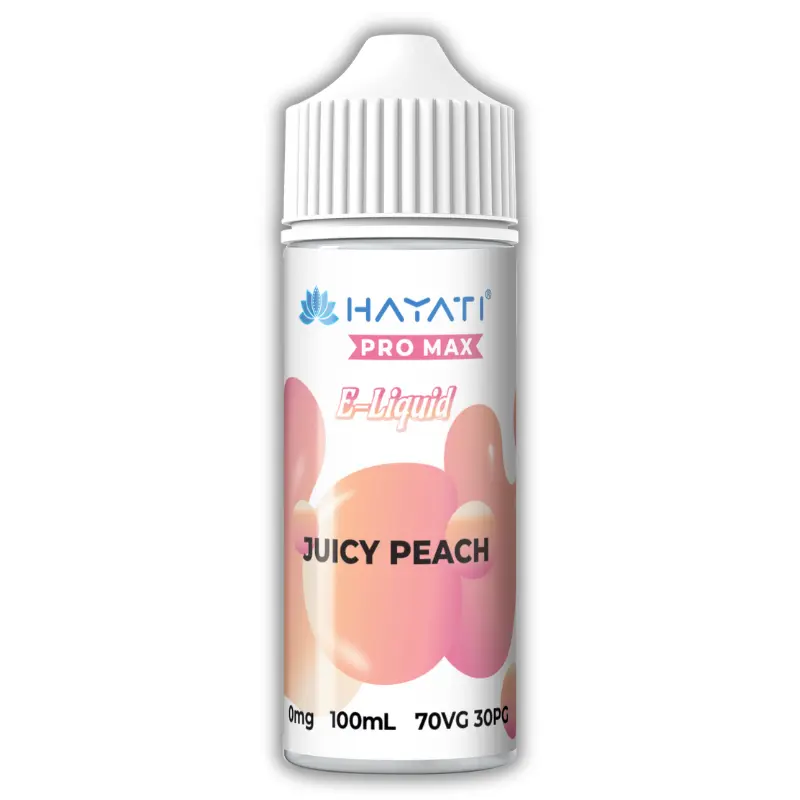
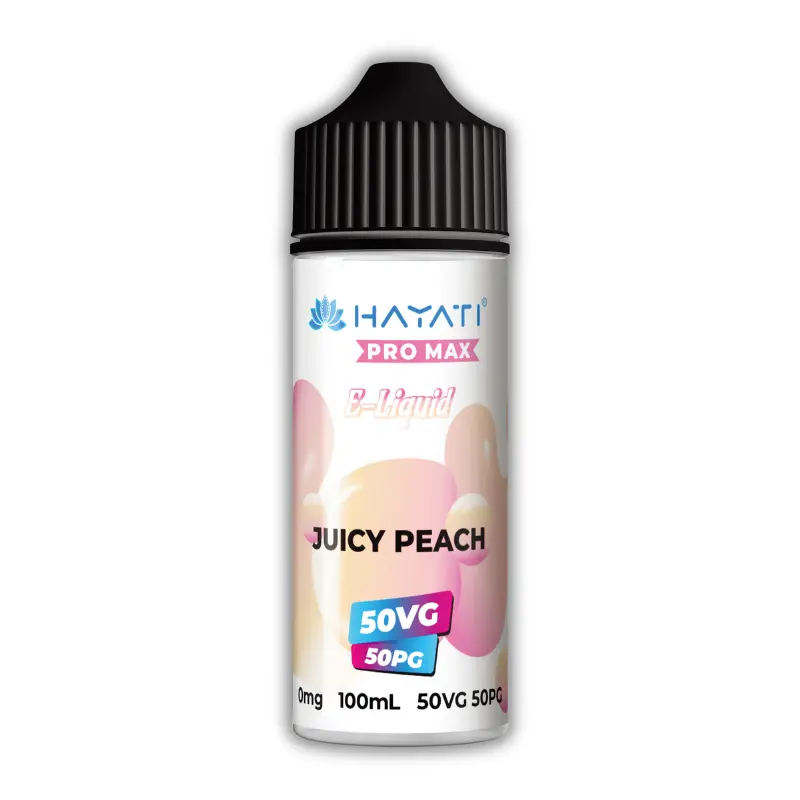
- 120ml bottled. Juicy Peach Hayati Pro Max 70/30 E-Liquid at 70VG/30PG and Juicy Peach Hayati Pro Max 50/50 Shortfill E-Liquid at 50/50, both 0mg, both £6.99.
Every one of those quoted puff figures is a laboratory number produced on a test rig under fixed conditions. They rank pod sizes reliably and they are not a quantity anyone is selling you. Draw length and frequency move them a long way in both directions.
What is deliberately not here
No cooled version exists. Not on this shelf and not on the parent, where the only cooling word in 32 titles belongs to a cherry on the far side of an oblique. If you want this fruit with a coolant behind it, the range does not make one, and Ice Vapes will not help because it shares nothing at all with this page.
No other partner exists either. The recipe is sold alone or with sour apple, and with nothing else. Peach does get paired with raspberry, mango, pineapple, lemon, passionfruit, cherry and green tea elsewhere in the range, but those are different recipes under different names, which is exactly why they file on the parent and not here.
Strengths run 20mg on every prefilled pod, 10mg on the single small bottle, and 0mg on the two large ones. Nothing sits between 10mg and 20mg, so if a mid strength is what you want, the 120ml pair are the only listings on the shelf that let you set one yourself. Nicotine is addictive, and those numbers state what a liquid contains rather than recommending anything to anybody.
The vocabulary, counted inside the thirteen
The parent page settled the method for this and it is worth applying rather than repeating: count a word inside the shelf and outside it, because a word that is common everywhere tells you nothing however often it appears here. Run that on the 13 descriptions and three things fall out.
Two words are unanimous and one of those is worthless. Soft appears in all 13, against 40 per cent of the other 479 listings, which is a real concentration. Ripe also appears in all 13, against 16 per cent elsewhere, which is a larger one. Sweet appears in all 13 too and in 94 per cent of everything else, so it carries no information whatever and should be discounted on sight.
The interesting result is the split, and it falls along a hardware line rather than a flavour one. Stone fruit appears in nine of the 13 and in 1 per cent of the rest of the catalogue, which makes it a marker. The four descriptions that omit it are the four Pro Ultra Plus tiles, all of them, with nothing else missing from the set. Fragrant appears in seven of the 13 and is absent from those same four plus both Mini Ultra tiles. Honeyed and velvety turn up once each, on the Pro Max Plus pod and the 70/30 bottle respectively.
So the 22ml platform describes this liquid in a vocabulary the 12ml platforms do not use, and the 4ml platform sits halfway. The parent page found the same absence across a wider set and reached the cautious reading, which is the right one to keep: this is evidence about who wrote the copy and when, not evidence of two liquids. A copy desk working through a platform in one sitting produces exactly this pattern. It is worth knowing anyway, because it means a buyer comparing the Pro Ultra Plus listing against the Rubik one and concluding that the Rubik version is the more aromatic mix has read a style sheet and called it a specification.
One recipe means there is nothing to compare, and that is where the difficulty starts
On an ordinary flavour shelf the page earns its keep by separating neighbours: this one is sweeter, that one has ice, the third is the same idea with the acid turned up. None of that is available here. Thirteen tiles, one liquid, and the only differences between them are volume, strength, hardware and price. Which sounds like it should make the page shorter and in fact makes the remaining decision heavier, because of what this particular liquid is.
The corpus has already characterised it and the characterisation is not up for re-litigation. The Sour Apple/Juicy Peach Hayati Pro Ultra Plus 25K Pods page drew the distinction that everything else rests on: the apple beside it is an event, meaning something specific happens at a fixed point in every draw, while the peach is a gradient, sweet from the opening and constant to the finish with no moment in it that demands attention. Nothing cuts across it, so nothing catches. Nothing terminates it, so it fades rather than stopping. The Juicy Peach Hayati Rubik Prefilled Pod Kit page then took that one step further and produced the finding that makes this shelf awkward: a flavour with a sharp identifying feature has a signal that either turns up or does not, so the moment something goes wrong you know, whereas a smooth build with no landmark in it degrades without ever announcing that it has, because every stage of the decline still tastes like a perfectly plausible peach.
Put the two together with the shape of this shelf and the problem is visible. You cannot choose between these tiles on flavour, because the flavour is identical across all of them. The only axis left is how much of it you buy at once. And the liquid you are buying is one that will get worse behind a sealed coil without telling you, which means the size of your commitment is not a convenience question here. It is the question.
Do not rebuild the detection method, use it
There is a way of catching a decline you cannot feel, and it already exists in full on the Juicy Peach Hayati Rubik Prefilled Pod Kit page. It points the instrument at the finish rather than the opening, on the reasoning that sweetness is the last component to fail and the opening of this liquid is sweetness, so watching the front of the draw monitors the one part that will still be reporting normally long after the flavour has thinned. It then converts the observation into a number, because a written description drifts and a yes-or-no answer cannot track a quantity that shrinks, and the only number available without instruments is time. Read it there. It is set out properly, with the procedure, the sampling advice and the retirement threshold, and summarising it here would only make a worse copy of it.
What is worth adding is a consequence of that method that only shows up on this shelf, and it concerns the three dual tiles.
The Rubik page recommends carrying a landmark, meaning a pod of something with a hard edge, and it is precise about why: a landmark does not measure your pod, it measures you. Each sealed pod carries its own element, so a mint pod knows nothing about a peach pod's coil. Take a draw on the landmark, and if it arrives at full strength your palate is working today, which means the flatness you noticed in the peach belongs to the peach pod. If the landmark is muted too, the problem is upstream of both and today's reading should be thrown away.
Now apply that to Sour Apple/Juicy Peach Hayati Pro Ultra Plus 25K Pods and Sour Apple / Juicy Peach Hayati Mini Ultra Pod Kit, where the event and the gradient share one element. The logic inverts. If you turn the collar and the apple arrives sharp and on time, you have learned that both your palate and the coil are in working order, which means any flatness in the peach is your baseline drifting rather than hardware. That is genuinely useful and it is free, because the landmark is already in your hand. But if the apple is also muted, you have learned only that something is wrong, with no way to tell palate from coil, because a tired element flattens both sides equally. A shared-element landmark answers a narrower question than a separate one does. It is better than nothing by a distance, and it is not a substitute for a second pod on a second device.
Choosing a format for a flavour that will not report its own decline
The number to optimise is not price and it is not millilitres. It is millilitres of this one liquid committed behind a single element you cannot replace. Rank the shelf on that and it reorders completely.
| Listing | Volume | Price | Per ml | Sealed exposure |
| Pro Max 70/30 and 50/50 bottles | 120ml | £6.99 | about 6p | you set it |
| Pro Max nic salt | 10ml | £2.49 | about 25p | you set it |
| Mini Ultra pod | 4ml | £3.49 | about 87p | 4ml |
| Mini Ultra dual kit | 4ml | £3.99 | about £1.00 | about 2ml of peach |
| Rubik pod | 12ml | £3.99 | about 33p | 12ml |
| Rubik kit | 12ml | £5.99 | about 50p | 12ml |
| Pro Max Plus pod | 12ml | £5.49 | about 46p | 12ml |
| Pro Max Plus kit | 12ml | £7.99 | about 67p | 12ml |
| Pro Ultra Plus dual pod | 22ml | £7.99 | about 36p | about 11ml of peach |
| Pro Ultra Plus solo pod | 22ml | £7.99 | about 36p | 22ml |
| Pro Ultra Plus dual kit | 22ml | £11.99 | about 55p | about 11ml of peach |
| Pro Ultra Plus solo kit | 22ml | £11.99 | about 55p | 22ml |
The last column is the one that matters and it is the one no product page puts in front of you. Read down it and the recommendation more or less writes itself.
If you own a refillable device, the problem does not apply to you
Juicy Peach Hayati Pro Max Nic Salt at £2.49 is the whole recipe at 10mg in a 10ml bottle at 50/50, made for mouth-to-lung pod kits with higher-resistance coils. It is also the cheapest listing on the shelf, which means the correct first purchase of this flavour and the cheapest purchase of this flavour are the same item, and that almost never happens on a shelf like this. The reason it is correct has nothing to do with the money. In a refillable setup the part that ages is a part you change, so the invisible decline stops being a trap and becomes a maintenance interval.
Juicy Peach Hayati Pro Max 70/30 E-Liquid and Juicy Peach Hayati Pro Max 50/50 Shortfill E-Liquid at £6.99 extend the same logic to 120ml at 0mg, with the 70/30 built for sub-ohm tanks and direct-to-lung devices and the 50/50 thin enough for small mouth-to-lung coils. At roughly 6p a millilitre they are fifteen times cheaper per unit than the smallest prefilled pod on the shelf. They are the right answer for somebody who already knows they want this liquid as a background flavour for months rather than days, and the wrong answer for anybody still finding out, because 120ml is a long way to be wrong.
If you want prefilled and own nothing
Sour Apple / Juicy Peach Hayati Mini Ultra Pod Kit at £3.99 is the pick, and not because it is cheap. It puts an 850mAh device in the box, it holds only 4ml, and roughly half of that 4ml is a sour apple that behaves as an event, which means you are buying the smallest sealed commitment on the shelf with a landmark already inside it. The cost is that you get about 2ml of the peach, which is a very short acquaintance. The benefit is that a very short acquaintance is exactly what a first meeting with an invisible-decline flavour should be.
Juicy Peach Hayati Mini Ultra Pods at £3.49 is the same 4ml of hardware exposure with no device and no landmark, which makes it the right buy only if you already own a Mini Ultra body. At about 87p a millilitre it is the most expensive liquid on the shelf by some distance, and it is still the right first prefilled purchase of this particular recipe, because what you are paying for is a small commitment rather than a quantity of liquid.
If you own a Rubik or a Pro Max Plus body
Juicy Peach Hayati Rubik Pods at £3.99 is the cheapest 12ml of this liquid anywhere on the shelf, at about 33p a millilitre against about 46p for Juicy Peach Hayati Pro Max Plus Pods at £5.49. Same stated volume, same 20mg, same recipe, £1.50 apart. If you happen to own both devices, that is a settled question rather than a preference. Hayati quote 7,000 on the bench for the Rubik pod and 6,000 for the Pro Max Plus one, both laboratory figures, and the difference between them is not large enough to overturn a 27 per cent gap in price per millilitre.
The one thing the Pro Max Plus pair have that the Rubik pair do not is a documented closing tang. Both Juicy Peach Hayati Pro Max Plus Pods and Juicy Peach Hayati Pro Max Plus Pod Kit name a small fresh tang at the end, and the parent page established that they are the only two of the solo group to do so while the other eight deny sharpness in as many words. Two readings of that survive and the record does not choose between them: a genuinely different mix, or a copywriting variant. If the tang is real it is also a landmark, which on this liquid would be worth the £1.50 on its own. That is a coin toss and it costs £1.50 to flip.
If you are set on the Pro Ultra Plus
Do not make Juicy Peach Hayati Pro Ultra Plus 25K Pods or Juicy Peach Hayati Pro Ultra Plus 25000 Prefilled Pod Kit your first purchase of this recipe. Twenty-two millilitres of a gradient behind one sealed element is the largest exposure on the shelf to the flavour least able to tell you it has faded, and the same platform will sell you Sour Apple/Juicy Peach Hayati Pro Ultra Plus 25K Pods at exactly the same £7.99 and Sour Apple / Juicy Peach Hayati Pro Ultra Plus 25000 Prefilled Pod Kit at exactly the same £11.99. The dual listing halves your peach exposure per element and supplies the sour apple as a running check. There is no price penalty for taking it. The only reason to buy the solo version is that you have already lived with this liquid at 12ml, know you want 22ml of it and nothing else, and would rather not spend half a pod on an apple.
That last preference is legitimate and worth stating plainly, because the dual pod's own arithmetic cuts the other way: the two sides share one body of liquid, so whatever is left in the side you use less gets thrown out with the pod. Somebody who only ever wanted peach has paid full price for an apple they will not finish. Both of those are true at once, and which one dominates depends entirely on whether you already trust the flavour.
The rule in one line
Buy the smallest sealed volume of this liquid that your hardware situation allows, until you have run one pod of it end to end with a number written down at both ends. After that, buy the cheapest per millilitre you can use, which is the 120ml bottle if you refill and the Rubik pod if you do not.
Prices, volumes, and where the same liquid costs less
The spread runs £2.49 to £11.99 and none of it is about the liquid. Four price points carry more than one listing and two of them are genuinely confusing.
Three different things cost £7.99. A complete Pro Max Plus kit with 12ml and a device. A bare Pro Ultra Plus pod with 22ml and no device. And a bare Pro Ultra Plus dual pod, also 22ml, also no device, of which about half is apple. If you own a Pro Ultra Plus body already, the second of those is nearly twice the liquid of the first for the same money. If you own nothing, the first is the only one of the three you can actually use today.
Two different things cost £11.99, and they are the two Pro Ultra Plus kits, solo and dual, at parity. Two cost £6.99, the pair of 120ml bottles, separated only by VG ratio. Two cost £3.99, and they could hardly be less alike: a 12ml Rubik refill and a complete 4ml Mini Ultra kit with a device in the box.
The device premium is worth pricing on its own, because it varies more than you would expect across one shelf. On the Rubik, a kit costs £2.00 more than its own refill. On the Pro Max Plus it is £2.50. On the Pro Ultra Plus it is £4.00. So the cheapest way onto hardware that takes a full-size 12ml pod of this recipe is the Rubik kit at £5.99, which undercuts the Pro Max Plus kit by £2.00 for the same stated volume and strength.
Cost per millilitre across the shelf runs from about 6p to about £1.00, a spread of roughly seventeen to one. Almost all of that gap is hardware, sealed-pod convenience and the nicotine you do not have to add yourself. None of it is a statement about the recipe, which is constant.
Formats, fitment, and one filing quirk worth knowing
Six of the 13 are bare refills and file on Hayati Pods and Hayati Prefilled Pods & Refills. Four are complete kits and file on Hayati Pod Kits and Hayati Prefilled Pod Kits. Three are bottles and file on Hayati E-Liquids. That adds to 13, which is the arithmetic you would expect, and it is also slightly wrong in a way a buyer can trip over.
Five listings here have the word Kit in the title. Only four of them appear on Hayati Pod Kits. The odd one out is Juicy Peach Hayati Pro Ultra Plus 25000 Prefilled Pod Kit, which is filed with the bare refills instead, so a buyer who filters the site by pod kits will not see it even though its own description says the device and the pod system come in the box together. It does appear correctly on Hayati Pro Ultra Plus Prefilled Pod Kit and on Hayati Pro Ultra Plus Prefilled Pod Kits & Pods, so the range shelves have it right and the format shelf does not. Whatever caused that, the effect is the same: if you are shopping by format, check the range shelf too.
By range, this shelf touches four hardware families. Hayati Mini Ultra holds the 4ml pair. Hayati Rubik holds the 12ml Rubik pair. The Pro Max Plus pair are not collected under a range link from this page, so reach them through the product listings above. Hayati Pro Ultra Plus Prefilled Pod Kits & Pods covers the 22ml four, split between Hayati Pro Ultra Plus Pods for the bare refills and Hayati Pro Ultra Plus Prefilled Pod Kit for the complete kits.
Nothing in this catalogue is offered as fitting more than one range. Each listing names the family it belongs to, each family states its own pod volume, and Hayati publish no cross-range fitment anywhere. So read the range name on the body you own and buy the pod that names the same range, and treat anything unpublished as unpublished rather than inferring it from a product name that happens to look similar. A retail page is the wrong place to settle a hardware question.
The bottles work differently and that difference is the whole reason they matter on this shelf. In a refillable setup you own the coil, so the component that fades is one you replace on a schedule. In a sealed pod the coil is inside the pod and the two finish together. That is a fair trade on most flavours and a heavier one on this one. A finished pod still holds an element and a little liquid, which makes it electrical waste rather than household rubbish, and shops that sell vaping hardware will generally take one back over the counter. Store spares upright and out of direct sun, and keep anything containing nicotine where children and pets cannot reach it.
Where to go next, and why most neighbours are not neighbours
This shelf has an unusually thin border. Measured against every other flavour shelf on the site, it overlaps with exactly two. Peach Vapes shares all 13, because containment. Apple Vapes shares three, which are the Sour Apple / Juicy Peach trio, and it is the right shelf if the apple turns out to be the half you wanted. Every other flavour shelf shares nothing at all with this page.
That includes the ones you might expect. Mango Vapes, Pineapple Vapes, Cherry Vapes, Lemon Vapes and Raspberry Vapes all contain peach blends, and none of those blends is this recipe, so none of them files here. Exotic Vapes and Sweet Vapes are broad groupings that miss this shelf entirely. Berry Vapes, Watermelon Vapes and Ice Vapes have no connection to it whatever. A zero overlap is information rather than an omission: it tells you that leaving this page means leaving this liquid, which is a different situation from the usual one where an adjacent shelf offers a near neighbour.
For a contrast pod to carry alongside, the useful property is a hard edge rather than a particular fruit, so Ice Vapes and Mint Vapes are the productive places to look, and Fresh Mint Vapes in particular collects the range's plainest non-fruit option. By format, Hayati Pods and Hayati Prefilled Pods & Refills collect every bare pod in the range, Hayati Pod Kits and Hayati Prefilled Pod Kits collect everything with hardware in the box, and Hayati E-Liquids collects the bottles. New Products and the full All Hayati products listing cover everything else.
Where this leaves you
Thirteen tiles, one recipe, and a page whose real work was never flavour comparison because there was nothing to compare. What this shelf is, structurally, is a child of a fruit index that has quietly changed category on the way down: the parent collects an ingredient, this page collects a liquid, and the navigation gives you no signal that the two are different sorts of thing. Knowing which you are looking for is worth more than any tasting note, because it decides whether you should be here at all.
If you belong here, the decision in front of you is a volume decision wearing a flavour shelf's clothes. The liquid is a gradient with no landmark in it, the corpus has established that a gradient degrades without announcing it, and the method for catching that decline exists and should be read rather than reinvented. Everything else follows: start small, write a number down, prefer the container whose coil you can change, and treat the 22ml solo pod as a repeat purchase rather than a first one.
None of the above is a claim about what is in a pod. Hayati publish no proportions, no sweetener levels and no flavour house for anything in this range, so no page can tell you that. What a page can do is count what they publish, say which measurements are tiles and which are titles, and be honest about which of the two shelves you are standing on.
Strictly for adults aged 18 and over. Nicotine is an addictive substance.
Frequently asked questions
Is this shelf just a smaller version of Peach Vapes?
No, and the difference is a category difference rather than a size one. Peach Vapes holds 32 tiles and indexes a fruit, so it collects every listing containing peach including blends where the peach is a minor part. This page holds 13 tiles and indexes one recipe. All 13 appear on the parent, but the 19 tiles that do not appear here are not simply the ones a filter removed. They are other liquids. A narrowed fruit shelf would still be a fruit shelf. This is a different object, filed at the same level in the same menu, which is why it is easy to land on the wrong one.
What does the word Juicy actually tell me about the flavour?
Nothing, and the counting behind that is on the Juicy Peach Hayati Rubik Prefilled Pod Kit page. Thirteen titles in the catalogue carry Juicy and all thirteen are Juicy Peach, so the word never grades a second fruit and cannot be discriminating between anything. In prose the picture reverses: the word appears in the description text of 129 listings, 116 of which have no Juicy in the title, which is roughly a quarter of the range. That page's conclusion is the one to keep. In a title it is an index entry. In prose it is house filler. Either way it narrows nothing about the liquid.
Are all thirteen tiles genuinely the same liquid?
Ten of them are Juicy Peach on its own and three are Juicy Peach sharing a pod with a sour apple, so the honest answer is that the recipe is constant and the packaging is not. One caveat stands on the record. The parent page found that Juicy Peach Hayati Pro Max Plus Pods and Juicy Peach Hayati Pro Max Plus Pod Kit are the only two of the solo group whose copy names a closing tang while the other eight deny sharpness outright, and that the split falls along a platform line. Two readings survive: a different mix, or a different copywriter. Nobody outside Hayati can settle it, and the page that raised it says so.
Which one should I buy first?
It depends on one thing only, which is whether you own a refillable device. If you do, Juicy Peach Hayati Pro Max Nic Salt at £2.49 gives you the whole recipe at 10mg in 10ml, and the coil that eventually tires is a part you replace. If you do not, Sour Apple / Juicy Peach Hayati Mini Ultra Pod Kit at £3.99 puts a device and the smallest sealed volume on the shelf in one box, with a sour apple sharing the pod as a built-in reference point. What you should not do first is buy 22ml of it, and what you should not do at all is buy a 120ml bottle of something you have never tasted.
Why is the Rubik refill cheaper per millilitre than the Pro Max Plus one?
Hayati price the ranges differently and the listings say so plainly: Juicy Peach Hayati Rubik Pods is £3.99 for 12ml at 20mg and Juicy Peach Hayati Pro Max Plus Pods is £5.49 for 12ml at 20mg. That is about 33p a millilitre against about 46p, for the same recipe and the same stated volume. The Rubik copy describes the range as one of the compact, lower-priced families. The bench puff ratings differ slightly, 7,000 against 6,000, both laboratory estimates, and that gap is far too small to explain the price. If you own both bodies, buy the Rubik pod.
How do I tell when a pod of this has gone off?
Not by tasting it and trying to remember yesterday, because that is exactly the failure this liquid produces. The working method is set out in full on the Juicy Peach Hayati Rubik Prefilled Pod Kit page and is worth reading there rather than in summary: it points the measurement at the finish instead of the opening, because the opening here is sweetness and sweetness is the last thing to fail, and it converts the observation into a time in seconds so that a reading from week one is comparable with a reading from week four. A written description drifts. A number does not.
Do the Sour Apple / Juicy Peach listings really belong on a Juicy Peach shelf?
Yes, and they are also the reason this page says one recipe with a footnote rather than flatly. Sour Apple/Juicy Peach Hayati Pro Ultra Plus 25K Pods, Sour Apple / Juicy Peach Hayati Pro Ultra Plus 25000 Prefilled Pod Kit and Sour Apple / Juicy Peach Hayati Mini Ultra Pod Kit each hold this liquid and a tart green apple in one pod, with a rotating mouthpiece to choose between them. Hayati state that the two are kept separate inside the pod and publish nothing about how the sides are divided or how liquid reaches the element. Practically, you are buying about half as much peach as the volume suggests, next to something built to be its opposite. All three also file on Apple Vapes.
Why does the Pro Ultra Plus kit not show up under Hayati Pod Kits?
Because of how it is filed rather than what it is. Five listings on this shelf carry Kit in the title and only four appear on Hayati Pod Kits and Hayati Prefilled Pod Kits. The one left out is Juicy Peach Hayati Pro Ultra Plus 25000 Prefilled Pod Kit, which sits with the bare refills on Hayati Pods instead, although its own description says the device and pod system come together in the box. It is filed correctly on Hayati Pro Ultra Plus Prefilled Pod Kit and Hayati Pro Ultra Plus Prefilled Pod Kits & Pods, so the range shelves have it and the format shelves do not. If you shop by format anywhere on this site, it is worth checking the matching range shelf as well.
Is there an iced or menthol version of this flavour?
There is not, in any format or at any price. Nothing in this range attaches a cooling word to this recipe, and the parent shelf is no help either, since the only cooling word across its 32 titles belongs to a cherry sitting on the other side of an oblique from a peach. Ice Vapes shares nothing with this page at all. If cold is a requirement, the practical route is to carry a separate cooled pod on another device and alternate, which has the side benefit of giving you the hard-edged reference point this liquid otherwise lacks.
Can I use a pod from one of these ranges in a device from another?
Treat that as unknown, because Hayati publish no cross-range fitment for anything in the catalogue. Every listing names its own family, and the families state different pod volumes: 4ml on the Mini Ultra, 12ml on the Rubik and the Pro Max Plus, 22ml on the Pro Ultra Plus. Two pods looking similar is not evidence. Read the range name moulded or printed on the body you own, buy the pod that names that same range, and do not settle a hardware compatibility question from a shop page, this one included.
What is the cheapest way to get this flavour?
By total outlay, Juicy Peach Hayati Pro Max Nic Salt at £2.49, which needs a refillable mouth-to-lung device you already own. By cost per millilitre, Juicy Peach Hayati Pro Max 50/50 Shortfill E-Liquid or Juicy Peach Hayati Pro Max 70/30 E-Liquid at £6.99 for 120ml, which works out at roughly 6p a millilitre and comes at 0mg, so you add nicotine yourself or run it without. By cheapest prefilled, Juicy Peach Hayati Rubik Pods at £3.99 for 12ml. Those three answer different questions and the gap between the extremes is about seventeen to one, which is a lot of variation for one unchanging liquid.
Should I buy the 22ml solo pod at all?
As a repeat purchase, yes, if you have already run this liquid through a smaller pod and know you want it. As a first purchase, no. It is the largest sealed commitment on the shelf to a flavour the corpus has established will decline without signalling it, and the same platform sells Sour Apple/Juicy Peach Hayati Pro Ultra Plus 25K Pods at the identical £7.99 and Sour Apple / Juicy Peach Hayati Pro Ultra Plus 25000 Prefilled Pod Kit at the identical £11.99, halving your peach exposure per element and adding a sharp reference on the same pod. The counter-argument is real too: half of that pod is an apple you may never finish.