Home / Hayati Pro Ultra Plus Prefilled Pod Kit / Cherry Ice / Peach Mango Hayati Pro Ultra Plus 25000 Prefilled Pod Kit
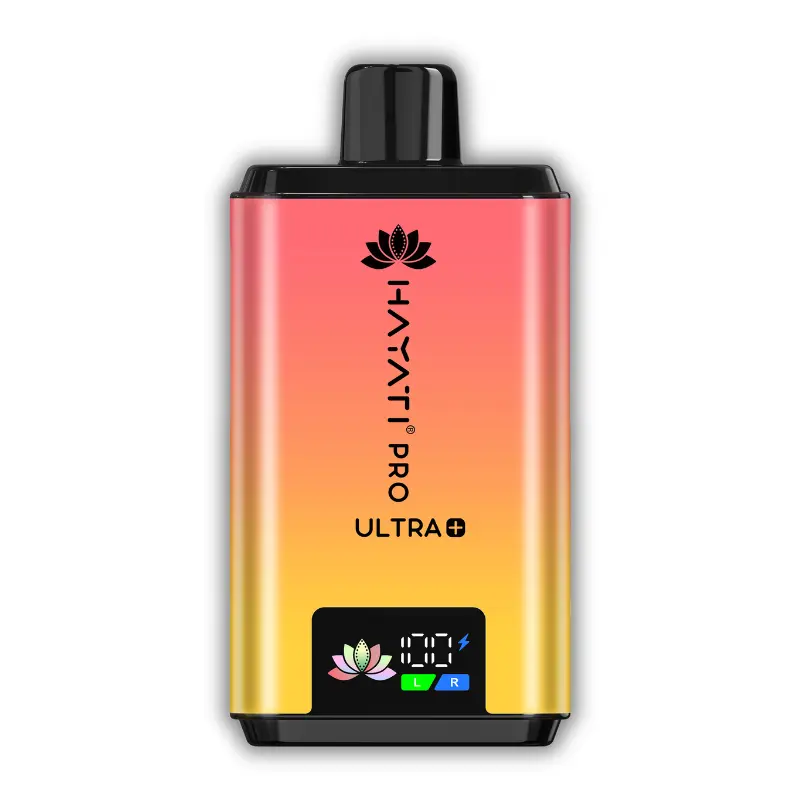
Hayati · Pro Ultra Plus
Cherry Ice / Peach Mango Hayati Pro Ultra Plus 25000 Prefilled Pod Kit
£11.99
✔ In stock — ready to ship
Genuine Hayati
Free over £20
Same-day dispatch
Secure checkout
This box holds a Hayati Pro Ultra Plus body with an 850mAh cell and, seated in it, one pod already carrying 22ml of liquid at 20mg nicotine salt. The pod holds two flavours rather than one. Cherry Ice occupies one reserve, Peach Mango the other, and Hayati state that the two are kept apart and that a twist of the rotating mouthpiece moves the feed from one to the other. So the oblique in the title divides a single object rather than listing the contents of a box, and the £11.99 covers the device and both liquids together. Nothing is filled, measured or primed. Hayati's own bench figure is up to 25,000 puffs, taken on test apparatus drawing to a fixed cycle, which makes it a number for lining listings up beside each other rather than a forecast of your own month.
What makes this particular pairing worth several thousand words is not that a cold flavour sits next to a warm one. Plenty of pods do contrast. It is that the two things inside this pod want opposite conditions from the one piece of hardware they are both obliged to use.
Peach and mango are both carried by lactones. Those are large, high-boiling molecules, they are slow to leave a wick, and they need a coil running warm and held at temperature for long enough to lift them. Cherry Ice is a moderate red fruit with a coolant behind it, and a coolant is felt more strongly, not less, when the vapour carrying it is cooler. One half therefore prefers a hot, generous, slow delivery. The other prefers a cool, brisk, efficient one. On a bottle of liquid that is an interesting problem with an obvious solution, which is to change the settings. On a sealed pod there is no solution, because the coil, the power and the airflow are fixed at manufacture and the collar does not touch any of them. The collar chooses which liquid arrives. It does not change the conditions the liquid arrives under.
That is the page. Everything below works out what the fixed compromise is likely to be, which of the two halves it costs, why the order you use them in matters more here than on almost anything else on this shelf, and what the unequal component counts either side of the oblique do and do not tell you.
Two recipes, one set of conditions, and no dial
What the tropical half needs
Mango and peach share a compound family, and it is the reason they blend so easily and the reason this half is difficult to deliver. Both are identified primarily by lactones, the gamma and delta decalactone group and their relatives, which read as creamy, honeyed and soft. The full argument for why that family behaves the way it does belongs to the mango bottle listings in this range, which set it out at length and are not going to be re-derived here. The findings that matter for this pod are three.
Lactones are heavy. By the standards of flavour chemistry they are large molecules, and large molecules are stubborn about leaving a liquid. Short-chain esters, the material that carries berries and apples, come off at the first suggestion of warmth. Terpenes, which carry citrus, are lighter still. A lactone is at the other end of that range, and getting a useful quantity of it off a wick and into a mouth takes more energy than getting a berry ester off the same wick.
Lactones arrive late. Because they are slow to volatilise they occupy the back of a draw rather than the front, and they carry on arriving after the vapour has gone. That is why a mango liquid is still faintly present in the mouth a minute later when a raspberry one has cleared.
Lactones are quiet. This is the one people miss. A lactone is perceived at lower intensity than a benzaldehyde or a citral present in comparable quantity, so peach and mango are not competing on volume. They compete on duration and on body, which is a weaker position, and it means that any condition which under-delivers them does not make them sound faint. It makes them disappear into the general sweetness of the liquid and leave nothing behind to indicate they were meant to be separately audible.
Put those together and the tropical half of this pod has a clear preference. It wants a coil that runs warm, and it wants the element held at temperature long enough for the heavy end to come across. Under those conditions peach leads the inhale, mango fills in beneath it, and the creamy tail is audible as its own layer rather than as an undifferentiated sweet finish. Under cooler, shorter conditions the light material at the top of the recipe still arrives in full, because it never needed help, and the part that makes the blend specifically peach and specifically mango arrives at a fraction of its intended level.
What the cold half needs
Cherry Ice is built the other way round in almost every respect. The Cherry Ice Hayati Pro Ultra Plus 25000 Prefilled Pod Kit works through the chemistry properly: benzaldehyde is what makes a cherry flavour identifiable as cherry, it is also what people recognise as marzipan, and a cherry recipe is a dosing decision about how much of that kernel register to let through and what to lay over the top of it. That page also sets out the three structural reasons this particular recipe keeps the kernel buried rather than exposed, which are the placement of the chill as a finish rather than a front note, the absence of any acid in the fruit, and the shortness of a cold finish cutting off the part of the draw where a slow almond note would otherwise surface. None of that is being rebuilt here. What matters for the present argument is where those materials sit on the volatility scale and what a coolant does.
Benzaldehyde is mid-weight. Heavier than a citrus terpene, lighter than a lactone. It does not need much help to arrive, and the supporting material that gives cherry its flesh is not fragile either, which is why the Cherry Ice listing is able to say that a cherry pod at 18ml is still recognisably cherry when a light melon or pear at the same volume has become recognisably sweet. There is very little at the fragile top of this profile to lose, and very little at the stubborn bottom that requires coaxing. It is a profile that arrives adequately under a wide range of conditions.
The coolant is the interesting part. Cooling agents do not work by lowering temperature; they act on the same cold-sensing machinery in the mouth that an actually cold thing acts on, which is why the sensation persists for tens of seconds after the vapour has gone. But the two inputs add. A cool vapour carrying a coolant reads colder than a warm vapour carrying the identical dose, because the real thermal signal and the chemical one are landing on the same place at the same time. Anybody who has taken the same iced liquid through a cool device and a hot one knows the effect without needing a mechanism for it.
So the cherry half's preference runs the other way. It gains from a cooler vapour, because that is where its defining feature is most pronounced, and it loses very little from a shorter, cooler delivery because nothing in it depends on the heavy end coming across. There is more than that. A warmer coil is actively unhelpful to this recipe, and the Cherry Ice pages establish why: as an element runs warmer and accumulates residue, the lighter fruit-facing material mutes while the heavy kernel register does not, and the balance tips towards almond. Heat is the condition under which a cooled cherry goes marzipan.
The conflict stated plainly
One liquid in this pod is improved by heat and degraded by cold. The other is improved by cold and degraded by heat. They are fed by one element through one airway at one power setting, none of which is published and none of which you can alter, and the collar you can turn changes neither the temperature nor the airflow nor the dwell time. It changes the supply.
This is worth separating from the ordinary observation that two flavours in one pod share a coil. Every dual listing in the format shares a coil, and the usual consequences of that (carry-over at the switch, both halves ageing on one clock, one budget of liquid) apply to all of them equally. What is specific here is that the shared hardware is not merely shared, it is contested. On Kiwi Banana / Strawberry Banana Hayati Pro Ultra Plus 25000 Prefilled Pod Kit both halves are soft uncooled fruit blends with a component in common, so whatever setting the factory chose, it is roughly as right for one side as for the other. The same goes for Straw’ Grapefruit / Straw’ Dragonfruit Hayati Pro Ultra Plus 25000 Prefilled Pod Kit, which holds strawberry constant and varies what sits against it, and for Blueberry H’Bubba / Watermelon H’Bubba Hayati Pro Ultra Plus 25000 Prefilled Pod Kit, where a single house treatment runs across both positions. Those pods have one setting and one kind of liquid to serve with it. This one has a single setting and two liquids that would have been given different settings if anybody had been asked.
The honest limit on all of this needs stating before the reasoning goes any further. Hayati publish no coil resistance for the Pro Ultra Plus, no running wattage and no airflow figure. Nothing below is quoting a specification, because there is no specification to quote. What follows is inference from how the two liquids are built, from what a manufacturer designing a 22ml sealed pod is trying to optimise, and from what the corpus of tasting notes on this range already records. It is reasoning, offered as reasoning, and a retail page that handed you a resistance figure for this device would be inventing it.
Where the compromise probably sits, and why
Two settings were available to whoever specified this hardware, in the loose sense that a coil, a power curve and an airway can be pitched hot and generous or cool and economical. Take the arguments for each in turn, because the answer is not obvious and a reasonable person could land the other way.
The case for a warm setting is straightforward and mostly commercial. Warm vapour reads as richer. It carries more of everything. A buyer taking a first draw from a new device tends to reward density, and a pod whose heavy end is fully lifted feels like more product for the money. On the tropical half specifically, a warm setting is the difference between a blend that resolves into peach and then mango and a blend that reads as a single sweet tropical mass. If Hayati had built this pod for the Peach Mango side, warm is what they would have chosen.
Against that, the argument for a cool setting is longer and, I think, stronger. It rests on four things.
First, the number on the box. A bench figure of 25,000 puffs against 22ml of liquid implies a very small quantity of liquid consumed per draw, which in turn implies modest power. Whatever one thinks of laboratory puff ratings as a guide to real use, and they are close to useless as one, they are not arbitrary: a manufacturer who wants a large figure has to build hardware that vaporises sparingly. High power and a big nominal puff count are not compatible ambitions. The rating is therefore weak evidence about the direction of the compromise, and it points cool.
Second, the battery. An 850mAh cell has to see 22ml of liquid through to the end, and a warm-running coil empties a cell faster per draw. A device that needs charging twice as often generates complaints in a way that a slightly restrained flavour does not.
Third, and most important, the coil has to survive the whole pod. There is one element in here, it is not serviceable, and when it is finished the remaining liquid is finished with it. Warm running accelerates residue. The mango bottle listing works through the loop this creates on a lactone-heavy liquid, and it is genuinely vicious: you want temperature in order to lift the heavy material, temperature accelerates the residue, and the residue's first victim is the delivery of the heavy material. A manufacturer building a 22ml sealed unit has every incentive to run it cool and make the element last, because a pod that dies at 14ml is a refund and a pod that tastes slightly flat is not.
Fourth, the failure modes are not symmetrical, and this is the argument I find decisive. Consider what goes wrong at each setting.
Set the hardware warm and the tropical half is served properly, but the cherry half develops the kernel problem early. Heat pushes the heavy register forward, the almond stops sitting under the fruit as depth and starts sitting over it as a flavour, and what the buyer reports is that their cherry vape tastes of marzipan or of medicine. That is a change of kind. It reads as a fault, it is the single most common complaint made about cherry liquids generally, and it is the thing the Cherry Ice recipe has visibly been constructed to avoid.
Pitch it cool instead and the cherry half is served properly, indeed served better than it would be otherwise, while the tropical half under-delivers its lactones and reads as warm generic sweetness with a soft trailing finish. That is a change of degree. Nobody returns a pod for it. Most people do not even identify it as a problem, because there is no absent thing to notice; a blend that was supposed to resolve into two fruits and instead resolves into one pleasant tropical impression has not obviously failed at anything.
A manufacturer choosing between a setting that distorts one half and a setting that flattens the other will choose the one that flattens, every time. Flattening is invisible. Distortion generates complaints.
So which half loses
Peach Mango loses. On the balance of the reasoning above, this pod is pitched cool to moderate, the cherry side is close to the conditions it was designed for, and the tropical side is being asked to deliver its slowest and quietest material through hardware that is not set up to lift it.
There is a piece of corroborating evidence in the corpus, and it is worth spelling out because it is the sort of thing an argument like this usually lacks. If this platform ran hot, the Cherry Ice single-flavour pod would show the kernel forward from the first draw, because heat is exactly the condition that brings it forward. The tasting record on the Cherry Ice listings says the opposite: the almond has to be gone looking for at the start of a pod, it sits under the fruit as depth, and it only migrates to the front late in the pod's life once residue has built up and the element has begun running warmer than it did when new. A profile whose heavy register stays buried until the coil is tired is a profile running on hardware that was not warm to begin with. That is a fairly direct observation about the running temperature of this platform, arrived at from the other side.
Two caveats, both real. The inference could be wrong, and the place it would most likely be wrong is the assumption that a factory chooses one point on the scale deliberately rather than inheriting whatever the coil supplier provides. And even if the direction is right, the size of the effect is unknown. "Under-lifted" could mean the tropical half loses a quarter of its intended body or it could mean it loses a tenth, and nothing published lets anybody say which. What is on firmer ground is the direction, the reason for it, and the practical consequence, which is that the half of this pod most likely to disappoint is the half that is not cold.
The broader point, which outlasts this listing
A divided pod is usually described as two products sharing a housing. That description survives right up until the two recipes want different things from the hardware, and then it stops being true. Two liquids behind one collar are not independent. They are two formulations that have been forced to accept a single compromise, chosen by somebody who was not obliged to tell you where they set it, and the quality of that compromise for each half depends entirely on how far apart the two recipes sat to begin with.
Which gives a useful way of reading any two-sided listing in this range before buying it. Ask how far apart the two halves are in the material they are built from, not in how they taste. Two berry blends are close. A confectionery pairing like Blue Razz Cherry / Blue Razz GB Hayati Pro Ultra Plus 25000 Prefilled Pod Kit is close, both halves being built on the same sugared idea. A dry citrus set against a sweet confection, as on Blue Razz GB / Lemon Lime Hayati Pro Ultra Plus 25000 Prefilled Pod Kit, is further apart but still on comparable material, since both lean on light fast components. A coolant against a lactone is about as far apart as this catalogue gets. The wider the gap, the worse the compromise serves at least one side, and the more it matters to know in advance which side that will be.
What that predicts, draw by draw
The cherry side, arriving as intended
The inhale opens without a spike. Red, wet and immediately identifiable, the wetness coming from sugars in solution rather than from acid, because there is no acid anywhere in this recipe. Through the middle of the draw the body fills in, dense and closer to a glacé or preserved cherry than to a fresh sharp one off the stalk. Throat character stays mild. The cold arrives on the exhale as a defined event rather than a gradient, the sweetness steps back as it lands, and the finish comes out crisp and dry rather than syrupy. Twenty seconds later the mouth is close to neutral with a faint residual coolness and very little fruit left behind.
That is a complete flavour arriving under conditions that suit it. There is nothing in the cherry recipe that the hardware is failing to deliver, and the coolant is arguably being flattered by a cool-running device. If you bought this pod for the cold half, the hardware is on your side and the rest of this page is mostly about somebody else's problem.
The tropical side, arriving short
Here is what I would expect from the same hardware on the other position, stated as prediction rather than as fact, since a page cannot taste a pod on your behalf.
The opening is fine. The light top of the recipe, the bright just-ripe edge and whatever green or floral material sits at the front of the peach, does not require heat and turns up in full. Sweetness is present from the first instant and is the loudest thing in the draw.
The middle is where the shortfall begins. Peach ought to establish itself as a distinct fruit through the inhale, wide across the tongue with no peak in it, and mango ought to arrive underneath around the midpoint, heavier, slightly resinous, with a faintly savoury edge the peach does not have. Under-lifted, those two do not separate. You get the sweetness of both and the identity of neither, which is the specific way a lactone-carried blend fails: not faint, but merged.
The finish is where it shows most clearly. A properly delivered peach and mango leaves a creamy tail that is audible as its own layer and persists past the vapour. Under-lifted, the tail shortens and thins into general sweetness that clears faster than it should. If you want a single diagnostic for whether your pod is getting the heavy end across, that is it: pay attention to what is in your mouth fifteen seconds after a tropical draw. A soft creamy presence means the lactones are arriving. Nothing much, or plain sugar, means they are not.
One further consequence follows and is worth flagging because it will otherwise be misread. A blend delivering its heavy end poorly reads as sweeter than it is, since the sweetener load is arriving in full while the aromatic material that would have given it shape is not. So the tropical half of this pod may well strike you as the sweeter of the two by a wide margin. Some of that is real, the cherry having a coolant knocking its perceived sweetness down. Some of it is the hardware removing the structure that would otherwise have carried the sugar.
The one variable you still have
Coil, power and airflow are sealed away. Draw length is not, and it is the only lever left. The Mango Peach Pineapple Hayati Pro Max Plus 6000 Pod Kit and the cherry-and-stone-fruit listings on that platform work through pull length in detail, and the finding generalises: a brisk pull of about a second moves less air across a warm element and vaporises less liquid, which leaves the light material unaffected because it never needed the help, while the heavy material barely gets started. A slower pull of around three seconds holds the element at temperature longer, moves more liquid, and the extra output is not distributed evenly. The light end was already fully present and does not get proportionally louder. The heavy end was the part being left behind, so the heavy end is the part that gains.
On a single-flavour pod that is a preference. On this one it is the closest thing available to un-sharing the compromise, and it is genuinely useful, because the optimal technique differs by position.
On Peach Mango, draw long and unhurried. Three seconds rather than one. That is the only way to give the lactones the dwell time the hardware is not giving them, and on this half the difference between a short pull and a long one is the difference between tropical sweetness and a blend with a shape.
On Cherry Ice, do the opposite. Shorter, brisker pulls. The fruit arrives regardless, the vapour stays cooler, which flatters the coolant, and you avoid pushing the heavy kernel register forward, which is the one thing that can spoil this recipe. A long hot pull on the cherry side is working against both of its strengths at once.
So the collar is not the only thing that changes between positions. Your technique should change with it, and a person who draws the same way on both halves is under-serving one of them whichever way they draw. That is an unusual thing to have to say about a pod, and it follows directly from the two recipes having been put behind one fixed setting.
The switch costs more in one direction than the other
Two kinds of carry-over, not one
Any pod with two reserves and one element has residue in the shared path when you change sides. The Blue Razz GB / Lemon Lime pairing and the lemon-led duals in this format have already worked out the general mechanism, which is that a wick holds a fraction of a millilitre and the flavour consequence depends on which of the two liquids is the more assertive. That treatment stands and is not being repeated. What belongs on this page is a second kind of carry-over that the liquid-residue account does not cover, and which is the one that actually bites here.
When you leave the cherry side, the coolant does not stop working when the vapour clears. It is not a flavour sitting on your tongue waiting to be washed off. It has acted on the cold-sensing apparatus in your mouth, and that signal takes tens of seconds to decay, which is longer than the gap between two draws taken at any ordinary pace. The Blue Razz Pineapple / Strawberry Ice Hayati Pro Ultra Plus 25000 Prefilled Pod Kit makes the broader case that a coolant runs on its own separate track rather than sitting on the flavour track at all, and that is the framework this borrows. The narrow point here is about persistence and direction.
A mouth still registering cold does three things to whatever arrives next. It suppresses perceived sweetness. It sharpens the perceived definition of edges and acidity. And it flattens the perception of warmth and creaminess, which is precisely the register a peach and a mango occupy.
Read that list against the argument above and the problem announces itself. The half of this pod that is already under-delivering its warm, creamy, heavy material is also the half whose first draws after a switch arrive into a mouth actively configured to under-report exactly that material. The two effects do not cancel. They stack, and they stack on the same side, every time. Somebody who turns from cherry to tropical and takes three draws to decide what they think has taken a reading of the worst version of Peach Mango that this pod is capable of producing.
Going the other way costs almost nothing. Turn from tropical to cherry and you arrive with a mouth carrying a faint residual sweetness and a trace of soft fruit in the wick. The cherry is a definite, mid-weight, unmistakable thing with a coolant behind it, and it walks straight through that. There is no configuration of a mouth coming off a soft tropical blend that makes a cold cherry hard to read.
So the switch is asymmetric in cost, heavily, and the direction of the asymmetry is fixed by chemistry rather than by preference. Cherry to tropical is expensive. Tropical to cherry is close to free.
A running order, with the reason for each part
The Cherry Ice/Peach Mango Hayati Pro Ultra Plus 25K Pods listing arrives at some of the same habits from a completely different argument, about which half needs your attention rather than which half needs the hardware, and where the two agree that is worth knowing rather than worth hiding. The ordering below is derived from the thermal problem and stands on that.
Open the pod on the tropical side and stay there for a proper stretch. Not a few exploratory draws. An hour or an evening, before the collar has ever been turned to cherry. Two separate things make this the single best reading of Peach Mango you will ever get: the element is at its cleanest, which matters more to a lactone-carried liquid than to anything else on this shelf, and there is no coolant anywhere in the system or in your mouth. Every later reading is worse on at least one of those counts.
Switch in blocks, not in draws. Each turn of the collar towards the tropical side costs you a recovery period of perhaps half a minute and a handful of under-read draws. Turn it four times an hour and a meaningful fraction of your tropical draws are being taken inside that window. Turn it twice a day and almost none of them are. The collar makes per-draw switching physically possible, which is not the same as it being a good idea, and on this particular pairing it is the worst way to use it.
Within a session, put the tropical block first and the cherry block after it. This follows directly from the direction of the cost. Running tropical first means it arrives into a neutral mouth on a clean path; running it second means it arrives into a mouth still reporting cold. The cherry is indifferent to the order, so the ordering decision is free: you lose nothing by putting the robust half second and you gain the only clean conditions available for the fragile one.
Leave the collar on the tropical side when the device goes down. The pods listing for this pairing reaches the same conclusion by a different route and deserves the credit for it. The thermal reason to do it is this: the first draw after any long gap is the one draw in a session taken with no carry-over of any kind, neither in the wick nor in your mouth, and it is the single most valuable draw the pod produces. Spending it on the half that does not need favourable conditions is a waste. An absent-minded reach takes whatever the collar was left on, so where you park it decides where that draw goes.
If you must switch to tropical mid-session, buy yourself a gap. Water, a few minutes, something else to do. The cold signal decays on its own timetable and nothing accelerates it much, but a gap of a minute or two is worth considerably more than the first three draws you would otherwise have spent finding out that the tropical side tastes thin. It does not. It is being read through a filter.
Do not form or revise an opinion of Peach Mango in the first dozen draws after a switch. Stated separately from the habit above because it is a judgement rule rather than a handling one. More perfectly serviceable tropical reserves get written off in that window than anywhere else, and the person doing the writing off has no way to know from the inside that the reading was compromised.
Late in the pod, use the cherry side as your instrument. This is the one piece of the ordering that reverses. Both halves run through one element and both age on its clock, but they report its condition very differently. A tiring coil makes the tropical half gradually flatter, which is indistinguishable from the flatness the hardware was imposing on it from the start, so it tells you nothing. The cherry half does something specific: as residue builds and the element runs warmer, the kernel register moves from underneath the fruit to on top of it, and a nutty, dry, marzipan character opens the draw where fruit used to. The Cherry Ice listings treat that turn as an end-of-life signal for a single-flavour pod. On this pod it is better than that, because the half you may hardly be using becomes a diagnostic for the state of the element that both halves depend on. If you are mostly on the tropical side, turn the collar to cherry once a week purely to read it.
Two fruits against one, and what the range actually does
Counting before claiming
An asymmetric pairing gets described as unusual fairly often, and the description deserves testing rather than repeating. Two things need separating here, and the first is what this pod actually is.
It is two components against one, not three against one. Peach Mango names two fruits. Cherry Ice names one fruit and a cooling term, and a cooling term is not a fruit. Anybody carrying over a three-against-one description from elsewhere in the range is describing Straw’ Cranberry Cherry / Cherry Ice Hayati Pro Ultra Plus 25000 Prefilled Pod Kit, which sets a three-fruit blend against the identical cold cherry and is a genuinely wider gap than this one.
The second thing is whether unequal counts are rare. They are not. Twenty-five distinct kits on this platform put two flavour names either side of an oblique. Of those, twenty name countable fruits on both sides, the remaining five being opaque or house-vocabulary names where no honest count is possible. Of the twenty, twelve are balanced, with the same number of named fruits on each side, and eight are not. So roughly two in five of the countable pairings are asymmetric, which makes an uneven split ordinary rather than remarkable.
What is rare is the size of the gap. Seven of those eight asymmetric pairings differ by exactly one component, and this listing is one of the seven. Only a single pairing in the whole set differs by two, and it is the Straw’ Cranberry Cherry and Cherry Ice pod named above. So the honest version of the claim is narrow: a one-fruit gap is common, a two-fruit gap happens once, and this pod sits in the common group.
The temperature split is the genuinely uncommon property of this listing, and it has already been counted on the pods page for this pairing. Four of the twenty-five pairings put a cooling word on one side of the oblique and not the other. Three of those four, including this one, also happen to put the single fruit on the cold side and the multiple fruits on the warm side, which means the cold-versus-warm division and the simple-versus-crowded division arrive together nearly every time they arrive at all. That is the fact worth carrying away, and it is not about fruit counting. It is about the same structural decision showing up twice.
What a crowded half does that a simple one does not
Set the counting aside and the practical question is what a buyer should expect from a side with several components against a side with one. Three things, and the third is the one that connects back to the hardware.
A crowded half has more to lose and loses it invisibly. When a single-fruit half weakens you notice, because the one thing the liquid was doing is now being done less well. When a multi-fruit half weakens, the first casualty is not volume but separation: the components stop being individually audible before any of them gets quieter. You are left with something that tastes broadly similar and has quietly stopped being a blend. Fruit Twist Hayati Pro Ultra Plus 25000 Prefilled Pod Kit is the version of that failure baked in from the start, a blend broad enough that it arrives as mixed fruit sweetness and nothing more specific.
A simple half is more reproducible. One fruit and a coolant will taste the same on a Tuesday morning and a Friday evening, through a head cold, after coffee, on the fifth day of the pod. A blend depending on the relationship between its parts is at the mercy of whatever your palate is doing, because the relationship is what varies. That is not a quality judgement in either direction, it is a difference in variance, and some people want a liquid that never surprises them while others find that boring.
The third is the one this page has been building towards. A crowded half is more exposed to a fixed hardware setting than a simple one, for the straightforward reason that its components do not all sit at the same volatility. One setting can be right for a single fruit. One setting cannot be right for three materials that come off a wick at different rates, so a crowded half is always being delivered in a distorted proportion, and how distorted depends on how far apart its components sit. Peach and mango are close to each other, which limits the damage: they are both lactone-carried, so the setting that under-lifts one under-lifts the other and the proportion between them survives even when the level does not. Compare a genuinely spread blend like Blueberry Raspberry Lemon Hayati Pro Ultra Plus 25000 Prefilled Pod Kit, where a light citrus sits over two berries and the citrus arrives in full under any conditions while the berries do not. That blend changes shape with the hardware. This one changes level.
Which is a mildly encouraging note to end the counting on. The tropical half of this pod is crowded in the sense of having two named fruits, and it is under-served by a cool setting, but the two fruits are close enough relatives that what you lose is body rather than balance. A less closely matched pair on the same side of the same pod would have arrived deformed as well as quiet.
The hardware, briefly, because the flavour is where this page earns its keep
The box holds the Pro Ultra Plus body with its 850mAh cell and the prefilled pod, and that is the whole contents. No liquid to pour, no coil to fit, no priming interval to observe before the first draw. The pod is not refillable and the element inside it is not replaceable, so the pod is the consumable and the body is the durable part, which is the entire logic of buying this listing once and the bare pod at £7.99 on every occasion afterwards. The £4 between the two prices is the device, and you only need to buy a device once.
Check the range name printed on your device against the range name in this title before ordering a pod on its own, because Hayati publish nothing about fitment between their formats and a pod from one range should not be assumed to seat in another. The rest of the kits on this platform are on the Hayati Pro Ultra Plus Prefilled Pod Kit shelf, and kits and refills together are gathered under Hayati Pro Ultra Plus Prefilled Pod Kits & Pods.
The specification that decides how this particular pairing behaves is the one nobody publishes, which is how the element is pitched. That is the whole of the argument above and it is worth restating as a hardware fact rather than a flavour one: the coil is shared, its conditions are fixed, the collar selects supply and not settings, and Hayati state only that turning the mouthpiece swaps which reserve is feeding. How the two are kept apart inside the pod is not published, so this page describes what the collar does and stops there. There is also no indicator to tell you which position is live, which sounds trivial and stops being trivial in week two. A pen mark on the housing solves it in seconds.
The published figures, and the ones that are missing
The table below is ordered by how much each line actually affects a purchase, which puts the two liquids first and the commercial details last. The final rows are the blanks, which on this listing carry more weight than several of the numbers.
| Cold position | Cherry Ice. One fruit with a cooling finish |
| Warm position | Peach Mango. Two fruits, no cooling term anywhere in Hayati's description |
| How you change between them | A twist of the rotating mouthpiece. Hayati state the two are stored apart |
| Total liquid | 22ml, covering both positions together |
| Split between the two | Not published. Hayati give one figure and do not break it down |
| Nicotine | 20mg per ml, nicotine salt. No other strength offered for this pairing |
| Heating element | One, shared by both liquids, built in and not serviceable |
| Battery in the body | 850mAh |
| Supplied in the box | The device and the prefilled pod. Nothing to fill |
| Manufacturer's puff figure | Up to 25,000, a laboratory estimate rather than a use figure |
| Price of this kit | £11.99 |
| Same pod without a device | £7.99 |
| Brand | Hayati |
| Not published: coil resistance | No figure anywhere in the range |
| Not published: running power | No figure, and no airflow specification either |
| Not published: cooling level | The word Ice in the name is the whole statement on the subject |
Three rows deserve more than a glance, and two of them are blanks.
The missing coil and power figures are the ones this page has spent its length on. They are absent from every listing in the range, not just this one, which is normal for sealed hardware and is a real information gap on a pairing whose two halves want opposite settings. A buyer choosing this pod is choosing a compromise whose position they cannot see, and the argument above is an attempt to work out where it probably sits, offered as an argument rather than as a substitute for a number.
The missing split is the second. Whatever proportion of the 22ml sits behind each position, it was decided at manufacture and there is no way to move liquid between them or to top either up. If the division favours the cherry, this is a cold single with a tropical option attached. If it favours the tropical side, most of your money is behind the position the hardware serves least well. The pods listing for this pairing costs that problem out in pence per millilitre, and the arithmetic is the same here with £4 of device added to the front of it.
The puff figure is the third, and the useful way to read it is not as duration. Nobody draws to a laboratory cycle. Read as workload it says something narrow and true: it is the total work one non-serviceable element is rated to absorb across the whole 22ml, whichever reserve happens to be supplying it. Running mostly on one side does not earn the other side a fresh element. Nicotine sits at 20mg per millilitre, which is the ceiling permitted for e-liquid sold in the United Kingdom, and nicotine is addictive. That is a statement of what is in the pod and not a recommendation of a strength.
Where it sits, and what to buy instead
If the cold half is what you want
Then this pairing is arguably the wrong purchase, and saying so is more useful than not. The argument on this page is that the hardware suits the cherry and short-changes the tropical side, which means a buyer who only wants the cherry is paying for a reserve they will get the worst of. The Cherry Ice kit puts the identical cold cherry across the whole 22ml for the same £11.99, with no collar, no carry-over and no half of the volume behind a position the coil does not flatter. It is also the page to read for the kernel chemistry, which governs how that profile ages.
Staying cold and changing the fruit, Watermelon Ice Hayati Pro Ultra Plus 25000 Prefilled Pod Kit is the lighter and more watery reading of the same idea, with none of the depth the cherry has and none of the kernel risk either. Strawberry Raspberry Ice Hayati Pro Ultra Plus 25000 Prefilled Pod Kit keeps red fruit but adds a tang the cherry does not have, and it has no kernel register at all, so nothing new ever appears in it as the coil ages. Everything with cooling in it across all the Hayati formats is collected on Ice Vapes, which runs to ninety-eight listings.
If you want to keep a cold half but set it against something that is not fighting the hardware, Straw’ Cranberry Cherry / Strawberry Raspberry Ice Hayati Pro Ultra Plus 25000 Prefilled Pod Kit is the closest thing to a corrected version of this pod. Both halves are berry constructions carried on lighter, faster material, so the warm side is not asking the element for anything it cannot easily give, and the temperature contrast survives intact. The same pairing logic with the cherry held constant is Straw’ Cranberry Cherry / Cherry Ice Hayati Pro Ultra Plus 25000 Prefilled Pod Kit, which is this pod's structure with the gap widened on the fruit-count axis and narrowed on the chemistry one.
If the tropical half is what you want, which is the harder case
There is no standalone Peach Mango in this format, so the obvious substitution does not exist and three imperfect routes do.
The closest liquid on the same hardware is Mango Peach Pineapple Hayati Pro Ultra Plus 25000 Prefilled Pod Kit, which keeps both of your fruits and adds a third. The addition is not decoration, and on this page's argument it matters more than it first looks. Pineapple brings acid, acid rides in the liquid fraction rather than needing to be volatilised, and a blend with a sharp component still has something definite to say when the heavy end is being under-delivered. A cool-running element hurts that blend considerably less than it hurts this one, because it has a backstop this one lacks. Whether you want the pineapple is a separate question, and some people find it takes the top of the draw and does not wait its turn. The same three fruits at a lower price on the 12ml platform are on the Mango Peach Pineapple Hayati Pro Max Plus 6000 Pod Kit.
Going the other way, Triple Mango Hayati Pro Max Plus Pod Kit is the undiluted version of the problem rather than an escape from it: a liquid whose entire proposition is the heavy end of the mango, sold in sealed hardware whose settings you cannot touch. If this page's reasoning is right, that listing is the one with the most to lose to a cool element and the most to gain from a slow, unhurried draw. The bottled version of the same flavour is where the lactone argument is set out in full, and it is the thing to read if the chemistry above is what interested you.
The third route is the smaller format. Cherry Ice / Peach Mango Hayati Mini Ultra Pod Kit at £3.99 is the same two flavours in Hayati's compact system, and Peach Mango also exists there on its own as a Mini Ultra pod, which is the only way in the catalogue to buy this flavour without the cherry attached. Different hardware, so nothing on this page about the running conditions of the Pro Ultra Plus carries across, and Hayati publish no fitment between their formats. At that price it is a cheap way to find out whether you want the tropical half at all before committing 22ml to it.
Elsewhere in the cherry and tropical families
Uncooled cherry, for anybody who liked the fruit and not the chill, is Cherry Berry Hayati Pro Ultra Plus 25000 Prefilled Pod Kit, which puts a soft red blend underneath the cherry instead of a coolant on top of it. Blue Razz Cherry Hayati Pro Ultra Plus 25000 Prefilled Pod Kit takes cherry into confectionery territory, where the sweetener does the structural work that the cold does here. The whole cherry family across every Hayati format sits on Cherry Vapes, seventy-two listings deep.
By fruit shelf, Peach Vapes holds thirty-two listings and Mango Vapes only twenty-one, which is the smallest of the three families this pod touches by a clear margin. That is worth knowing if mango is the note you are chasing rather than a passenger: the range does not offer many routes to it, and several of the ones it does offer pair it with peach, which is the same compound family again rather than a contrast.
For a two-position pod that divides on something other than temperature, Sour Apple / Juicy Peach Hayati Pro Ultra Plus 25000 Prefilled Pod Kit splits on acid, and it is a useful comparison for the argument here because acid is the one flavour property that does not depend on the element at all. It rides in the liquid and arrives whatever the temperature. A pairing divided on acid is therefore a pairing whose contrast survives any hardware setting, which is precisely what a pairing divided on volatility cannot claim. And if the point of a two-sided pod for you is a reset rather than a contrast, Fresh Mint Hayati Pro Ultra Plus 25000 Prefilled Pod Kit in a second device does that job better than any half of any pairing, since a palate tired by heavy sweet fruit is the reason most people stop tasting the fruit.
Living with a pod that wants two different things
The general handling of a prefilled pod is the same across this range. What follows is the part that is specific to owning two liquids with opposite requirements behind one fixed setting.
Write four words down during the tropical side's opening run. How sweet it reads, whether the peach and the mango separate, whether anything creamy is still in your mouth fifteen seconds later. That is the benchmark you will want three weeks later, when the question is whether the pod has aged or whether your last reading was simply taken badly.
Do not chain-draw the cherry side. Successive draws with no recovery gap let an element run hotter than it otherwise would, and a hotter element on this recipe means kernel. It is the fastest way to make a perfectly good cooled cherry taste medicinal, and people usually blame the pod.
Judge the pod's age from the cherry and its flavour from the tropical side. The two halves report different things about the same element. Marzipan arriving at the front of a cherry draw, repeatedly, on a cool device and a fresh palate, means the coil has turned and both halves are finished. A single nutty draw after chain-drawing or straight after coffee is not a signal. Check it once the conditions are ordinary.
Expect the halves to diverge late. A coolant is durable material and survives the whole pod largely unchanged, so the cherry keeps its defining feature to the last millilitre. Lactones are not fragile either, but their delivery depends on an element that is getting worse at delivering things, so the tropical half gets quieter and shorter in the finish as the pod runs down. The likely late-pod picture is a cherry that still reads correctly opposite a tropical side that has contracted to plain sweetness. That is reasoning from how the two liquids are built, not anything Hayati publish.
Store it cool, dark and upright, and think about which half you are protecting. Warmth in storage lifts perceived sweetness and takes the finest top notes first, and on this pod the finest top notes are the ones distinguishing a peach from a mango. A spare left somewhere warm for a month can seat already behaving like a pod at its midpoint on the tropical side, while the cherry arrives more or less intact. Keep spares and anything else containing nicotine somewhere children and pets cannot get at them.
Give a pod that has been standing a few draws before judging it. Liquid settles against an unused wick and the first pulls arrive heavy. On the tropical half that reads as syrup, which is the least flattering version of it and not what the pod has become.
Order the replacement before this one ends. A 22ml pod winds down rather than stopping, and the temptation is to run a turned element for another few days because it is still producing something. Since the cherry's end signal is a change of flavour rather than a fade, that last stretch is actively unpleasant rather than merely weak, and having the refill in the house removes the reason to push on.
Dispose of it properly. A spent pod still contains an element and a film of liquid, so it belongs in vape recycling or a retailer take-back point rather than in household waste, and the device itself is electrical goods at the end of its life.
Questions this pairing raises
Is this two pods or one?
One. A single pod holds both liquids in separate reserves, and Hayati state that a twist of the rotating mouthpiece swaps which of them is feeding. The 22ml figure covers both together rather than describing each. You fit one pod and change flavour in your hand, dozens of times a session if you want to, although this page argues you should not.
Which side is the cold one, and is any of the cooling on the other half?
Cherry Ice is the cold side and only that side. Peach Mango carries no cooling term in its name or anywhere in Hayati's description of it, and is presented as a warm tropical blend. So half of this pod is not chilled at all, which regularly surprises people who read the word Ice in the title and assumed it covered the whole thing.
Can I change the power or the airflow to suit whichever half I am on?
No. The element, its running conditions and the airway are all fixed inside sealed hardware, and the collar selects which liquid reaches the coil rather than changing anything about how the coil behaves. Draw length is the only variable left to you, and it is a real one: a slower pull lifts more of the heavy material in the tropical half, and a brisker one keeps the vapour cooler on the cherry half.
Why does the tropical side taste thinner right after the cherry side?
Two things at once. Your mouth is still registering cold for some tens of seconds after the vapour has gone, and a mouth registering cold under-reports sweetness, warmth and creaminess, which is exactly the register peach and mango occupy. On top of that, the shared wick was carrying a coolant a moment earlier. Both effects push the same way, so the first draws after that particular switch are the least representative reading of Peach Mango the pod can produce.
Does the same thing happen in the other direction?
Barely. A mouth coming off a soft tropical blend is carrying a little residual sweetness and nothing that interferes with a definite mid-weight fruit and a coolant. The cherry reads correctly almost immediately. That is why this page recommends running the tropical block first and the cherry block after it, rather than the other way round.
How much liquid is behind each position?
Hayati publish 22ml as one number and do not break it down, so an even division is a working assumption rather than a specification. Nothing published describes any way of moving liquid between the two or topping either up, so whatever the ratio is, it was fixed at manufacture and liquid left in the side you do not use goes in the bin with the pod.
What coil is in it, and what wattage does it run at?
Neither figure is published, for this listing or for anything else in the range. That is ordinary for sealed hardware and it is a genuine gap on a pairing whose two halves would want different settings, which is the subject of most of this page. Anyone quoting you a resistance or a wattage for this device has made it up.
How will I know when the pod is finished?
Use the cherry side to tell you. As the element ages it runs warmer and the almond register in the cherry moves from underneath the fruit to on top of it, giving you a nutty, dry opening where fruit used to be. That is a change of flavour rather than a drop in level, which makes it much harder to ignore than the gradual thinning the tropical half will be doing at the same time. Verify it on a cool device and a fresh palate before acting on it.
Is the pod refillable when the liquid runs out?
It is not. The pod arrives filled and sealed with its element inside it, and when the liquid or the coil is finished the whole pod is replaced. The same two flavours without a device cost £7.99, which is the order to place on every occasion after this one.
Would I be better off buying two single-flavour kits instead?
If you are confident about what you want, yes, and for a reason this page has been making throughout. Two separate pods are two separate compromises, each one made for a single recipe, and neither has to accommodate the other. One divided pod is a single compromise stretched across two recipes. The trade is cost and convenience against fit, and the wider apart the two flavours sit in the material they are built from, the worse the fit gets.
Does the collar show which side is selected?
There is no indicator, so you either work it out by taste or mark the housing yourself. A pen mark aligned with one position settles it permanently and takes a few seconds. It is a minor irritation and it applies equally to every two-position listing in this format.
The short version
Eleven pounds ninety-nine buys the Pro Ultra Plus body with its 850mAh cell and a 22ml pod at 20mg nicotine salt carrying two liquids, selected by turning the mouthpiece. Cherry Ice is a ripe, moderately sweet red fruit with a cold finish that closes the draw. Peach Mango is a warm, soft, uncooled blend of two closely related fruits with no chill on it anywhere.
The thing worth knowing before ordering is that those two want opposite conditions from one sealed, unadjustable element. Reasoning from what a 22ml sealed pod has to optimise, and from the fact that the cherry's kernel note stays buried until the coil is tired, the compromise looks pitched cool, and the tropical half is the one paying for it. That is an inference and it is offered as one. Hayati publish no resistance, no wattage and no airflow figure.
What follows practically is a running order rather than a verdict. Open on the tropical side and give it a long clean run, switch in blocks rather than draw by draw, put tropical before cherry within a session and never the reverse, leave the collar parked on the tropical side, and draw slowly on that half and briskly on the other. Buy it if you want both a cold fruit and a warm one and accept that one of them is being served better than the other. Buy the single Cherry Ice if the cold half is the real target, because it is the half this hardware suits and there is no reason to pay for a reserve you will get the worst of.
Strictly for adults aged 18 and over. Nicotine is an addictive substance.
You might also like