
Home / Hayati Pro Ultra Plus Prefilled Pod Kit / Blueberry H’Bubba / Watermelon H’Bubba Hayati Pro Ultra Plus 25000 Prefilled Pod Kit
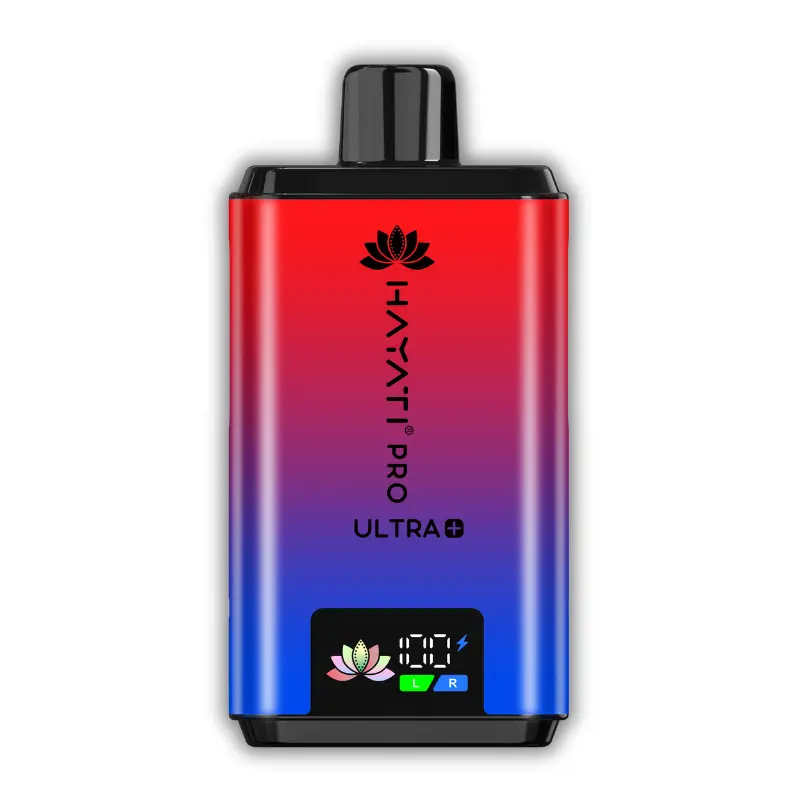
Hayati · Pro Ultra Plus
Blueberry H’Bubba / Watermelon H’Bubba Hayati Pro Ultra Plus 25000 Prefilled Pod Kit
£11.99
✔ In stock — ready to ship
Genuine Hayati
Free over £20
Same-day dispatch
Secure checkout
Blueberry H’Bubba / Watermelon H’Bubba Hayati Pro Ultra Plus 25000 Prefilled Pod Kit is a complete box at £11.99: the 850mAh rechargeable body, and a prefilled pod holding 22ml of 20mg nicotine salt liquid with two fruited bubblegums held apart inside it. A collar on the pod selects which of the two reserves is feeding the coil, and this listing states that arrangement rather than leaving it to be guessed from the oblique in the title. Hayati put an upper bound of 25,000 puffs on it, which is a laboratory estimate from a draw rig and not a forecast of anybody's month. It sits on the Hayati Pro Ultra Plus Prefilled Pod Kit shelf, which runs to 52 boxes, every one of them at £11.99. The ticket price is carrying no information at all.
Five pages on this site already deal with this flavour stem, and between them they have finished the job. The gum family has been counted, the two markers have been set out against each other in a grid, the naming has been traced to the hardware, the question of whether a heavy confectionery treatment flattens two fruits into one has been worked through at length, and the draw-by-draw for both halves exists on the matching refill. This page is not going to find a sixth thing to say about the taste. It would either repeat one of those pages or invent something, and the second is worse than the first.
So the subject here is different. It is replacement cadence, and specifically a problem that divided pods create for the person trying to decide when to retire one. A pod like this has one coil, one wick and one airflow path, shared. Both reserves age together because there is only one thing ageing. What almost nobody does is drink the two reserves equally, and once the use is lopsided, something quietly follows that changes how you should read the pod and, before that, whether you should buy this box at all rather than the single-flavour one beside it at the same money. The short version is that the side you use less is never tasted on a coil that its own use produced, and the verdict you form about it in week three is mostly a verdict about the coil.
What is already settled here, and by which page
Taking this in order, so that nothing below is mistaken for a new claim about the liquid.
The direct twin is the Blueberry H’Bubba / Watermelon H’Bubba Pro Ultra Plus refill pod at £7.99, which is the same 22ml of the same two liquids without a body in the packet. That page owns the naming analysis outright. It built a grid of the two gum markers against the three fruits Hayati attach to them, found all six cells occupied, and concluded that the two words cover identical ground rather than denoting two different confections. It then found the sharper pattern underneath: the marker tracks the hardware. A fruit carries one word on the small platform and the other on the large one, and the inversion holds for two fruits across four pairs of listings. It also read all 492 descriptions looking for places where Hayati relate one gum spelling to another, found three, and found that all three point inward at this marker rather than outward from it. That work is cited here and reopened nowhere. If the name is what brought you, read it there.
The Watermelon B’Gum / Strawberry B’Gum kit and its refill own the other big question, which is whether two different fruits under one strong confectionery coat end up as one flavour. That argument is settled where it sits and this page is not going to restate its conclusion, borrow its reasoning or arrive at it from a different direction. Nothing below is a claim about whether these two sides resemble each other.
The Blueberry Cotton K / Raspberry Cotton K kit has a Mini Ultra sibling which owns the carryover problem, and that is the mechanism closest to this one, so it needs distinguishing properly rather than in passing. Its finding is about the moment of switching. Turn the collar on a pairing whose two sides share a treatment and the first several draws are a blend of both, and because the blend still tastes broadly correct, nothing warns you that the switch has not finished. That is a contamination problem, it lives in the seconds after the collar moves, and its remedy is a clearing count. What this page is about is not the seconds after the switch. It is the state of the coil at the moment you take the reading, which is a property of the previous fortnight rather than of the previous four draws, and no clearing count touches it.
The Blueberry Raspberry / Mr Blue kit shares a shelf with a pairing whose kit page owns the third adjacent mechanism, which is the Lemon Lime and Summer Dream box. Its argument is about the order in which the two reserves empty. Because the side you prefer is drawn down faster, it runs dry first, and the pod finishes as a single-flavour device dispensing the half you were using less. That is a consumption-rate argument with a consequence at the end of the pod's life. This page makes no claim about which reserve empties first and takes no position on the split, which Hayati do not publish anyway. The claim here is about the coil's age every time the minority side is drawn, from roughly day two onwards, and it applies to a pod that is only half used as much as to one about to run out.
One more thing is worth carrying forward rather than testing. The Grape GB / Strawberry GB kit sits opposite a Pro Max Plus pod page for Strawberry H’Bubba which made a prediction: that two pods carrying this gum marker with different fruit words in front of them are likelier to resemble each other than two pods carrying the gelatine marker, because in a gum listing the fruit is a tint on a flavour that is already complete without it. That page labelled it a prediction and it is being treated as one, not as a finding. Its relevance here is only this, and it is a matter of odds rather than of taste: if the fruit word is doing modifier work rather than naming the flavour, then a buyer who wants one of these two sides considerably more than the other is a likely outcome rather than an unlucky one. Which is the condition everything below depends on.
One coil, and only one of the two sides is winding it
Start with what is on the record, because the argument needs very little and inventing hardware to support it would be the quickest way to ruin it.
Hayati state that the two flavours are kept apart inside the pod and that turning the collar moves from one to the other. They publish nothing about how the division is made. No valves, no seals, no account of how the reserves are arranged, and no per-side volume, so eleven millilitres a side is a working assumption and is flagged as one wherever it appears on this site. What they do publish, and what every divided listing in the range implies, is that there is one coil. One pod, one mouthpiece, one airflow path, one heating element. Nothing here requires more than that.
Now the part that follows from it and that nothing in this catalogue's copy points out. A coil's condition at any moment is a function of how much liquid has passed through it in total. Not how much of a particular liquid, and not how much since you last turned the collar. The residue that accumulates on mesh and wick is cumulative and indifferent to which reserve supplied it, because the reserves are upstream of the only part that does any work. So if you settle on the blueberry side and draw on it four times out of five, the coil's state is being set, almost entirely, by the blueberry.
Which means the watermelon side is being served by a component that it did not age. It is drawn through mesh that has been worked by the other liquid, and its own contribution to that wear is small enough to ignore. Put in the terms that matter to somebody holding the device: the coil gets older while you are not using that side, and you did nothing to it.
Follow what that does to your experience of the two halves, because the asymmetry is the whole of the point and it is easy to miss.
The majority side is tasted constantly. Several times an hour, every day, on a coil that changes slowly. You meet each small decrement immediately after the last one, so you never encounter a gap. Your sense of what that liquid tastes like is continuously updated, and it drifts along with the hardware without ever presenting you with a discontinuity to notice. You will very likely finish the pod believing the blueberry held up well, and there is nothing wrong with that belief except that it was formed under conditions that could not have produced any other one.
The minority side is tasted in visits. Once every few days, perhaps once a week. Each time you come back to it, the coil has jumped forward by whatever the other side did in the interval, which on a four-to-one split is most of a week's worth of work. The same gradual decline that reads as nothing on the majority side arrives on the minority side in steps, and a step is exactly the kind of change a person notices and attributes. So the watermelon is worse than you left it, noticeably, and the obvious explanation is sitting right there: it is the watermelon. The blueberry is fine. You had some an hour ago.
That inference is the error this page exists to name. The two sides have been exposed to the same coil, but not to the same reading conditions, and the difference is not in the liquid. It is in the sampling schedule. A liquid sampled continuously hides the hardware's arc inside your own adaptation. A liquid sampled at intervals displays that arc as a series of drops, each one landing on the liquid's account.
There is a stricter way to put it, and the strict version is what makes the practical advice later in this page follow. After the first day or two, you will never again taste the minority side on a coil comparable to the one you first tasted it on. Not because the coil is finished, but because the coil is no longer where it was, and you have no second one. The first reading you took of the watermelon is the only reading you will ever have of it on fresh mesh, and every reading afterwards is a composite of a liquid and a piece of hardware whose condition was determined by a different liquid.
None of this is a fault in the product. It is an ordinary consequence of putting two reserves behind one coil, which is what a divided pod is for and what makes the collar possible in the first place. It is worth saying plainly because the buyer's natural reading of the situation is wrong in a predictable direction, and because the direction it is wrong in leads to a purchasing decision, which is the subject of this page.
Why this particular box sits at the far end of the effect
The mechanism above applies to all 25 divided boxes on this shelf. What varies is how much room the effect is given, and three things here give it as much as the catalogue has to offer. One of those three is genuinely notable. The other two were in the brief that started this page as distinguishing features, and counting them showed they are not, so they are stated below at their real size rather than at the size that would have suited the argument.
Volume, which is the strongest of the three
Twenty-two millilitres is the largest fill Hayati put behind a single coil. Across all 492 listings the capacities on record are 2ml, 4ml, 7ml, 12ml and 22ml, and 104 listings carry the 22ml figure with nothing above it. The whole Hayati Pro Ultra Plus Prefilled Pod Kits & Pods group is built on that number, kits and refills together. So the coil in this box is being asked to do the longest continuous run this catalogue asks of any coil, and the total ageing the minority side will be exposed to over the pod's life is correspondingly the largest available.
The contrast that makes this concrete is the Mini Ultra, where the same divided arrangement runs on 4ml. The Fruit Bomb / Straw’ Watermelon B’Gum Mini Ultra kit at £3.99 has the same one-coil structure and roughly a fifth of the work to get through. Its Cotton K stablemate made the point that a coil working through 4ml finishes closer to where it started, so the arc a buyer has to reason about is short. Here the arc is five and a half times longer, and a lopsided user is straddling all of it with one side and dipping into it with the other.
The liquids themselves, which is real but not unusual
Both sides are sweetened confectionery. Hayati's copy on this listing describes both halves in those terms and names no acid line and no cooling agent on either one, and the refill listing says the same. Heavily sweetened liquids leave more behind on a coil than thin, sharp ones do, which is not a controversial proposition in this format, and sweeteners are the component most implicated. So there is nothing in this pod pulling in the other direction: no acid, no coolant, no green or herbal element, on either side. Whatever loading happens, happens on both sides at once and with nothing offsetting it.
The brief that commissioned this page treated the absence of cooling as part of what makes this pairing extreme, and it is not, so the claim is narrowed here rather than repeated. Count the divided pairings in the catalogue and normalise the spelling variants, and there are 28 distinct ones. Twenty of the 28 have no cooling word on either half. Only five pair a cooled side against an uncooled one, and three have cooling on both. Two sides without a coolant is therefore the ordinary case for a divided Hayati pod, not a distinguishing property of this one. What can honestly be said is narrower: this pairing has nothing on either side that slows the loading, which is true, and it shares that with most of its shelf.
A second claim in the same family deserves the same treatment. Holding the treatment word constant and varying only the fruit, which is what this title does with H’Bubba on both sides of the oblique, is done by 11 of the 28 pairings. Roughly four in ten. The Red Razz GB / Blue Razz GB kit, the Grape GB / Blue Razz GB kit and the Cotton K pairing all do it, and so does the B’Gum box. So the structure is a house habit rather than a peculiarity, and any page claiming this pod is unusual for having twin markers is overstating it. The relevance of the structure to this page is unaffected, because what matters is not how rare it is but what it predicts: a pairing built on one treatment with the fruit swapped gives a user fewer distinct jobs for the two sides to do, which makes settling on one of them likelier than it would be on a pairing that offers a real contrast.
No way to buy a fresh-coil re-read, which is the notable one
This is the claim that survived counting, and it survived in a slightly weaker form than it arrived in, so both figures are given.
Neither Blueberry H’Bubba nor Watermelon H’Bubba is sold on its own anywhere in this catalogue. Each appears in exactly two listings out of 492, and the two are this kit and its £7.99 refill, which are the same pod with and without a body. There is no single-flavour Watermelon H’Bubba pod, no Blueberry H’Bubba bottle, and nothing on the Pro Max Plus carrying either name. If you want to taste one of these halves you buy the pair, and if you want to taste it again on a new coil you buy the pair again.
How unusual is that? Taken as raw title strings, seven of the 31 divided pairings in the catalogue have neither half available on its own. Merge the pairings that are the same two flavours written two different ways, which the data does in at least three places, and it is six of 28. Either way it is about one in five, which is uncommon rather than unique, and the brief's phrasing has been narrowed accordingly. What matters for the buyer is not the ratio but which side of it this box falls on. It falls on the side where there is no escape route.
Compare the position on the Mini Ultra, where the Cotton K page found both halves of its pairing also sold as separate single-flavour refills, so the divided pod there functions as a one-off decision procedure with a cheap way out afterwards. That way out does not exist here. It does not exist on the B’Gum pairing either, nor on the Blackcurrant Cotton K / Blue Raspberry kit, which is in the same group of six. On this shelf a divided pairing whose halves are locked together is locked together permanently.
Put the three together and the position is specific. The longest single-coil run in the catalogue, two liquids with nothing in either of them to slow the loading, and no purchasable way to meet the minority half on fresh mesh a second time. That is not a reason to avoid the product. It is the reason the reading problem is worth a page here rather than on a 4ml box.
What the minority side will actually do, and how to read it
A mechanism is only useful if it tells you what to look for, so this section is about the signals rather than the theory. Everything in it is tagged for confidence, because some of it is well founded and some of it is inference from the register.
Take the general behaviour first, stated once and not laboured. As residue builds on a coil, the lightest and most volatile material in the liquid is the first thing it stops carrying. Heavier components, and particularly the sugars and the bulk sweetener load, survive longer because they are not depending on volatility to reach you. That ordering is about as close to settled as anything in this format gets, and several pages on this site rely on it.
Apply it to a fruited gum and the consequence is specific, and this part is inference from what the two listings describe rather than anything Hayati publish. A bubblegum accord is a heavy, long-finishing construction whose recognisable character does not depend much on light top notes. The fruit sitting on top of it does. Blueberry in this register is a dusky, quiet thing and watermelon is a thin, watery, faintly cool top note, and both of them are doing their work in exactly the part of the liquid that a loading coil gives up first. So what you should expect to lose on either side, as the pod works through its 22ml, is the fruit rather than the gum.
Here is where the asymmetry from the previous section turns into something you can observe. On the majority side you will very likely not notice this happening, because it happens in increments of a day and you are there for all of them. On the minority side you will notice it in one go, and the specific thing you will notice is that the fruit word has become difficult to find. You turn the collar to watermelon expecting watermelon, and what arrives is gum with something lighter about it. Not a different flavour. A flavour you can no longer name the second half of.
Note carefully what that is and is not a claim about. It is a claim about your ability to describe one side. It is not a claim that the two sides have become the same thing, which is a separate question, belongs to the B’Gum pages, and is not being answered, supported or contradicted here. The two propositions can look alike from a distance and they are not. One is about convergence between two liquids. This one is about the vocabulary available to you for a single liquid whose identifying element is the part the hardware stops delivering.
Four signals, in the order they are likely to arrive
The fruit becomes a direction rather than a fruit. Early on, the watermelon side is watermelon and the blueberry side is blueberry. Later, the honest description of each is a direction: the lighter one, the darker one. If you catch yourself describing a side by comparison with the other rather than by what is in it, that is the first signal and it usually arrives before you think anything is wrong.
The sweetness changes character rather than level. The pod does not go less sweet. Sweetener is among the last things to fail. What changes is how the sweetness presents: less like a flavour with a shape and more like a coating that sits across everything, with a finish that lasts longer and says less. Reasonably confident, and it is the signal most people report first on any heavily sweetened pod even if they describe it differently.
A faint caramelised edge on the exhale. Probable rather than confident. A coil carrying a sugar load runs into thermal territory that the same coil would not reach when new, and on a gum accord there is little in the profile to hide a burnt-sugar note behind. If you find one, it is from the hardware and it will be on both sides, which makes it one of the more reliable tells that you are reading the coil rather than the liquid.
The switch takes longer to clear. The Cotton K page established that the clearing count after turning the collar is not fixed and rises if the collar has been parked in one position for a couple of days. That finding is cited, not recounted. Its value here is as corroboration from a different direction: if the number of draws it takes to get a clean read of the new side has gone up, the residue load has gone up, and the residue load is the thing this whole page is about.
One signal that is worth naming precisely because it is unreliable: the flavour going quiet during a long session. That is usually saturation rather than hardware, it resolves if you put the device down for an hour, and both sides being heavy sweetened confections means it will happen more here than on a sharp pod. It is not evidence about the coil and it should not be counted as any.
The one comparison this hardware still permits
Given all of the above, what can you actually establish about the minority half? Less than you would like, and the useful move is to be exact about which comparison is sound and which is not.
The comparison that is not sound is the one everybody makes: today's watermelon against last week's watermelon. Two readings, days apart, with the coil in a materially different state at each, and the coil's state driven by a variable you were not tracking. That comparison cannot distinguish a liquid you are tiring of from a coil that has aged, and on a lopsided pod it will almost always return the same answer regardless of which is true.
The comparison that is sound is the one the hardware makes available by accident. Both sides run through the same coil, so at any single moment the coil is a constant, and a reading of one side immediately followed by a reading of the other is a controlled comparison. Not of absolute quality, which you cannot get at, but of the two sides against each other on identical hardware. It is the only variable in this pod you can hold still, and you get it for free.
To use it, three things have to be true of the reading, and the first is borrowed rather than invented here. Respect the clearing count, because a contaminated draw on a treatment-constant pairing does not announce itself and the Cotton K page worked out why in detail. Take both readings in the same sitting, one straight after the other, not one in the morning and one at night. And take the majority side first, because you already know what it should taste like, so it is the side that can tell you whether the coil has moved.
What that gets you is one clean inference and one blocked one, and the asymmetry is worth stating because it is the honest limit of the method. If the majority side has also moved, it is the coil, and you can stop wondering about the watermelon. If the majority side seems unchanged and the minority side has fallen away, you still cannot conclude it is the liquid, because you have no fresh-coil control to compare against and you have just spent several sections establishing that the majority side's apparent steadiness is partly an artefact of how often you taste it. The test can exonerate the liquid. It cannot convict it. On a pod where the minority half is not purchasable on its own, that limit is permanent.
The single-flavour H’Bubba Pro Ultra Plus 25000 kit page recommends keeping a written reference from the first two days, because on an unreadable liquid memory is the only instrument available. That habit is worth adopting here too and it does not solve this problem, which is worth saying so that nobody thinks it does. A written note fixes your memory of the first reading. It does not give you a second coil to take the later reading on. It tells you that the watermelon has changed, which you already suspected. It cannot tell you what changed it.
The box, kept short
The Pro Ultra Plus body is covered at length elsewhere on this site and there is nothing to add to it here, so this is deliberately brief and the shelf carries the rest.
What arrives is the device and the prefilled pod, ready to use, with nothing to fill, prime by hand or assemble. The device is rated at 850mAh and is rechargeable. No charging connector is stated in the specification for this product and none is stated here; several pages on this site once asserted one and it has since been removed, so treat a connector claim on any retail page as unverified, including ours. Coil resistance, wattage and how the pod is held in the bay are all absent from the published data and are left absent rather than filled in. Check the range name printed on your device against the range name in this title before ordering a replacement pod.
The specification that bears on this page is the one that reads as housekeeping. The pod is prefilled and not refillable, which means the coil and the liquid are a single unit with a single lifespan and no part of the arrangement can be changed. You cannot fit a new coil to test the old liquid, or put the liquid in something else, and the 22ml and the mesh are retired together. On most pods that is a convenience matter. On a divided pod where one side is under-used, it is the reason the reading problem has no fix inside the product, and the reason the decision that matters is the one you take before you buy. For everything else about the platform, the Pro Ultra Plus kits and pods group holds all 104 listings on this body.
The sheet
Ordered by how much each row bears on the argument above, rather than by the order a spec sheet usually runs in.
| Reserves behind the coil | Two, selected by a collar. Split not published |
| Coils | One, shared by both reserves, not serviceable |
| Total liquid per coil | 22ml, the largest fill in the catalogue |
| Either half sold separately | No. Both names appear only on this kit and its refill |
| Cooling on either side | None stated on either half |
| Nicotine | 20mg nicotine salt |
| Manufacturer puff rating | Up to 25,000, a laboratory estimate |
| Battery | 850mAh, rechargeable |
| Supplied as | Complete kit: device plus prefilled pod |
| Price | £11.99, the flat figure across all 52 boxes on the shelf |
| Position on that shelf | 1 of 25 divided boxes; the other 27 are single-liquid |
Three rows want a sentence. The 20mg is the legal maximum for a prefilled pod sold in the United Kingdom rather than a decision Hayati took about this flavour, so it is not a point of difference between boxes on this shelf; 51 of the 52 carry it, the exception being the Pro Ultra Plus Shisha 30000 kit, which is filled at 5mg. The listing does not itself specify the nicotine preparation, and calling it a salt follows the rest of this site and the standard practice for the format rather than anything printed on this product.
The last row carries a correction, offered in the spirit this site handles them. Our own page for the single-flavour H’Bubba kit describes that box as one of 25 single-liquid boxes on this shelf. Recounting gives 52 listings, of which 25 carry two flavour names and 27 carry one, so the single-liquid figure is 27 and the 25 belongs to the divided group. The rest of that page's shelf arithmetic holds up on checking and the error does not affect anything it argues. It is noted because the house rule here is to count a sibling's figure before repeating it, and this one did not survive the count.
What the collar is worth, and when £11.99 is better spent elsewhere
This is the part the rest of the page has been for. The collar costs nothing at the till, because the shelf is flat at £11.99 and a divided box is priced identically to a single one. What it costs is paid later and in kind, and the question is whether you are going to get anything back for it.
The proposition of a divided pod is that you get two things to choose between, dozens of times a session, for the price of one. That proposition is real and it holds completely for a buyer who alternates. Two sides drawn at similar rates age the coil together, get sampled at similar intervals, and are read under comparable conditions throughout, so everything above simply does not arise. If you are the sort of person who runs a morning flavour and an evening one, or who wants somewhere to go when the current side gets heavy, a divided pod does exactly what it says and this one is a perfectly ordinary example of it.
If you are not, the collar is not neutral. It is worse than neutral, because it does not merely go unused. It puts eleven millilitres or so of a liquid you are not drinking behind a coil that your other liquid is wearing out, and then hands you readings of that liquid which you have no way to interpret. You end the pod with a firm opinion about Watermelon H’Bubba, or about Blueberry H’Bubba, that was formed almost entirely on aged mesh and that you will carry into your next purchase. That is not nothing. It is a wrong belief about a product, acquired at £11.99, and the box is the thing that produced it.
So the test before buying is simple and you can apply it honestly in about ten seconds. Do you expect to use both of these roughly equally? If yes, buy the box; it is doing its job. If you already suspect one of the two fruits is the one you actually want, or if you know from experience that you settle on one side of a divided pod and stay there, the money goes further somewhere else.
The single-flavour route at the identical price
Hayati point this out themselves on this very listing, which is unusual enough to be worth a sentence. Their copy ends by telling a reader who wants the gum without a fruit on it where to go: "If you prefer your bubblegum without fruit", it says, and then names the plain box. That is the H’Bubba Pro Ultra Plus 25000 kit, one of the 27 single-liquid boxes on this shelf, and it is £11.99, the same as this one. Same body, same 22ml, same rating, one liquid instead of two. Everything in this page's argument disappears, because a single-liquid pod has no minority side. There is one channel, you are in it constantly, and the coil ages under the only thing you are drinking.
The caveat is that the plain box is not the same flavour as either half of this one, and its own page makes a good deal of how little the name tells you. It is the right recommendation for somebody who wanted the gum. It is the wrong one for somebody who specifically wanted the blueberry or the watermelon, and for that person the honest answer is that the fruited versions are only sold together and there is no way round it.
A shorter run per coil
The other route is to keep the fruit and take a smaller fill, which shortens the arc the coil has to travel and therefore shortens the distance between your first reading and your last. Twelve millilitres is the Pro Max Plus figure and it is roughly half of this one, so a coil on that platform is asked to do about half the work before the pod is retired. The Blue Razz GB Pro Max Plus kit at £7.99 is the confectionery example on that platform, and Blue Frozen is there at the same money if you would rather have something cold than something sweet. Neither is this flavour, and neither is divided, which is rather the point: a smaller single pod gives you a shorter arc and no minority side at once. The Blueberry Cherry Cranberry Rubik kit at £5.99 is the cheapest way into a berry blend on this site and works on the same logic.
If you do want two sides, pick two that will actually get used
The failure mode described on this page comes from a pairing with no obvious division of labour. Both halves here are sweet confections in the same register, which gives a user no structural reason to move between them, and that is the condition under which one side wins and the other sits. A pairing built around a contrast gives the collar a job.
Five of the 28 pairings put a cooled side against an uncooled one, which is the clearest version of that. The Straw’ Cranberry Cherry / Strawberry Raspberry Ice kit is the example on this shelf, and a warm berry against an iced one is two genuinely different experiences that a person is likely to want at different times of day. The Blue Razz Cherry / Blue Razz GB kit does something subtler, setting a fruit reading of blue razz against a confectionery one, so the two sides differ in treatment rather than in fruit. And the Fruit Bomb / Straw’ Watermelon B’Gum kit pairs a blend against a gum, which is the same idea with the axes swapped.
If it was one of these two fruits you were after
Blueberry is the better served of the two. The Blueberry Raspberry kit is the plain berry version at £11.99 with no confectionery treatment on it, and the Blueberry Raspberry Lemon kit adds a citrus line to the same pairing, which is the one thing this pod has none of. Mr Blue and Blue Razz GB are the two ways of going bluer and sweeter as single liquids, and the whole of the Blueberry Vapes shelf runs to 90 listings if none of those is right.
Watermelon is thinner on the ground, with 29 listings on the Watermelon Vapes shelf and most of them blends. Strawberry Watermelon is the direct single-liquid route at the same £11.99, and Watermelon Fruit Twist is the same fruit in a blend whose other components are not disclosed by the name. If it is specifically watermelon under a confectionery treatment you wanted, the B’Gum pairing is the only other place it appears and it is divided too, so the same reasoning applies to it.
And if the sweetness is the part you would want a brake on, Blue Sour Raspberry is the acid end of this shelf, while the Sweet Vapes group collects the 61 listings that go the other way. The Straw’ Guava / Dragon Berries kit is worth naming as a divided box whose two sides are both fruit-led rather than confectionery-led, for a buyer who likes the structure but not the sugar.
Running this one, if it is the one you are taking
Assume you have decided the box is right, which for a genuine two-side user it will be. The handling that follows is specific to a divided pod with an uneven owner, because general pod advice is everywhere and adds nothing.
Take both readings on day one, in the same sitting. This is the only moment when the coil is new for both halves, and it will not come back. Fifteen minutes and a clearing count between the two is enough. Whatever you write down then is the only uncontaminated pair of readings the pod will ever give you, and if you skip it the comparison is gone for the life of the pod.
Use each side in long stretches rather than dipping. A shared coil carries the previous liquid into the next several draws, so frequent switching means a fair share of your pod is spent tasting neither side properly. Half a day on one position is a sensible minimum. This also happens to make the minority side's visits less frequent and more deliberate, which is better than a scatter of contaminated three-draw samples.
Take the paired reading before you conclude anything about a side. Majority first, then clearing count, then the other. If both have moved, the coil has moved and there is nothing to decide. This is worth doing once in week two and once in week three rather than continuously, because the point of it is to catch a step, not to monitor.
Judge retirement on flavour rather than on volume. Twenty-two millilitres of two sweet things is a long run, and finishing the last stretch of a pod that stopped delivering a fortnight ago achieves nothing. Retiring a pod with liquid in it is a cost of this format rather than a mistake, and it is a cost that a heavily sweetened fill asks for more often than a thin sharp one does.
Keep it upright, cool and out of direct light. Warmth thins liquid, and on a divided pod the usual symptom is liquid where you do not want it, which is at the mouthpiece. Sweetened liquids also darken with heat and a gum accord has little room to move in that direction. A drawer indoors is fine. Store it out of reach of children and pets, as with any nicotine product.
Dispose of it as electrical waste. There is a cell in the body and a coil with residual liquid in the pod, which puts both outside the household bin. Many vape retailers and larger supermarkets run a take-back point. On a divided pod there is the extra wrinkle that whatever is left in the side you used less goes with it, since the two share one budget and neither is separable, which is one more argument for settling the question of whether you want two sides before you pay rather than afterwards.
Questions this box raises
Is this two pods or one?
One. A single 22ml pod with two reserves inside it and a collar that selects which one feeds the coil, all of it in a single complete kit with the device. There is no second pod in the packet and the two flavours are not separable purchases.
Can I buy just the watermelon side?
No. Neither Blueberry H’Bubba nor Watermelon H’Bubba exists as a single-flavour listing anywhere in this catalogue. Each name appears in exactly two of the 492 listings, this kit and its £7.99 refill pod, which are the same divided pod with and without a body. About one pairing in five on this site is locked together like that.
Does the side I use less last longer?
In liquid terms, yes, and that is the subject of a different page on this site, which works through which reserve empties first and what it means for the end of the pod's life. What this page is about is separate: the coil serving that reserve is being aged by the other side regardless, so the liquid lasting longer does not mean it will taste the way it did.
So is the watermelon actually worse, or is it the coil?
You cannot tell with certainty, and that is the honest answer rather than a dodge. Taste both sides one after the other in a single sitting with a clearing count between them. If the side you use constantly has also changed, it is the coil. If it has not, you still lack a fresh-coil control, so the question stays open.
Is there any ice or menthol here?
Neither listing names a cooling agent on either half. Both sides are described as sweet confectionery. If cold is what you want, this is the wrong box and the shelf has cooled options at the same price.
How is this different from the £7.99 pod with the same name?
The pod is the same 22ml of the same two liquids with no device in the packet, for somebody who already owns a compatible body. The £4.00 difference is the body. If you do not have one, the kit is the only route in; if you do, the refill is the repeat purchase.
What does H’Bubba mean, and why is it on both sides?
It is Hayati's shorthand for a bubblegum confection, and this title holds it constant while swapping the fruit. The refill page for this pairing counts the whole gum family, sets the two gum markers against the three fruits Hayati use them with, and works out what the words are doing. That analysis is there rather than here.
Will the two sides taste the same after a while?
That question belongs to the B’Gum pages, which put a strong confectionery treatment on two different fruits deliberately to test it, and this page takes no position on it either way. What is argued here is narrower and about one side at a time: the fruit is the part a loading coil stops carrying first, so the half you use less becomes harder to describe on its own terms.
Is 22ml unusual?
It is the largest fill in this catalogue. Capacities on record are 2ml, 4ml, 7ml, 12ml and 22ml, and 104 listings carry the 22ml figure with nothing above it. It is standard for the Pro Ultra Plus rather than special to this box, but it does mean the coil here has the longest run any coil on this site is asked to do.
Can I fit a new coil partway through?
No. The pod is prefilled and not refillable, and the coil is part of it, so liquid and coil are retired together. Nothing in the published data covers coil resistance or how the pod is held in the bay, and none of that is stated here.
What is in the box?
The 850mAh rechargeable device and the prefilled pod, ready to use. No charging connector is stated in the specification and none is claimed here. Replacement pods are a separate purchase.
Which should I buy if I already know I prefer one of the two?
Not this one. The plain H’Bubba kit is the same £11.99 for a single liquid, or a 12ml Pro Max Plus box costs less and gives the coil half as much work. The collar is worth paying for only if you are going to turn it, and on this shelf it is priced as though everybody will.
Where that leaves it
This is an ordinary, competently built divided box: 22ml, 20mg, an 850mAh body, two sweet fruited gums behind one collar, £11.99 like everything else on its shelf. The flavour question has been answered five times over elsewhere on this site and nothing here disturbs any of it.
What is worth carrying away is the thing the format does to an uneven user. One coil means the hardware ages on the total, not on the side, so a reserve you visit once a week is met each time on mesh that the other reserve has moved on without you. The decline you notice on the minority half is real, and most of it is not the liquid. With neither of these two flavours sold on its own, there is no second reading available at any price, which makes the honest limit of what you can learn here quite low and the decision worth taking before you pay rather than after.
So: alternate, and this is a fair box. Settle on one, and you have paid the same £11.99 for the single-flavour kit and received eleven millilitres of doubt along with it. The rest of the range is on the Pro Ultra Plus kit shelf.
Strictly for adults aged 18 and over. Nicotine is an addictive substance.
You might also like


