
Home / Hayati Pro Ultra Plus Prefilled Pod Kit / Sour Apple / Juicy Peach Hayati Pro Ultra Plus 25000 Prefilled Pod Kit
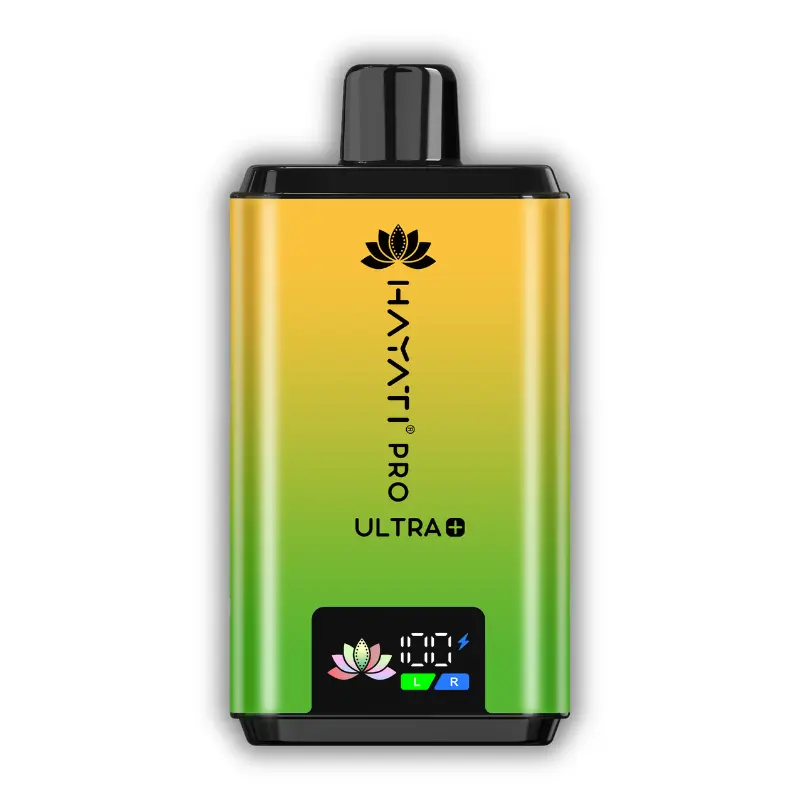
Hayati · Pro Ultra Plus
Sour Apple / Juicy Peach Hayati Pro Ultra Plus 25000 Prefilled Pod Kit
£11.99
✔ In stock — ready to ship
Genuine Hayati
Free over £20
Same-day dispatch
Secure checkout
Eleven pounds ninety-nine buys a complete Pro Ultra Plus: the 850mAh body and, seated in it, a single prefilled pod holding 22ml at 20mg nicotine, divided into a tart Sour Apple on one side and a ripe Juicy Peach on the other, with a rotating mouthpiece deciding which of them reaches the coil. Hayati publish a laboratory figure for the pod of up to 25,000 puffs, produced on test equipment running a fixed cycle rather than by anybody actually drawing on it. Nothing needs filling. Nothing else needs buying first. The oblique in the title means two liquids in one pod, not two pods in one box, and the same pairing sold without a device at £7.99 is what you order on every occasion after this one.
That pairing has already been argued out at length. The bare pod listing sets out why a sharp acid-forward apple and a soft low-acid peach protect each other, why the two directions of the swap are not worth the same, and why the peach belongs underneath as the base with the apple taken in short blocks on top. Those conclusions hold here, the liquid being identical, and there is no point in writing them twice.
What is genuinely different about this listing is not the liquid. It is the slot the liquid occupies. This is a kit, which means the flavour on the front of the box is the one flavour decision in your entire relationship with this device that you will make while knowing nothing. Every pod after it is chosen by somebody who has held the thing, felt how it draws, learned how warm the vapour runs and discovered where this range sets its idea of sweet. The kit's flavour is chosen before any of that exists, and it arrives welded to a purchase you are making for a completely different reason, which is that you want the hardware.
Almost nobody treats that as a decision worth a method. This page does. It sets out the three arguments people actually use, says which of them survives, applies the answer to this box, and ends by saying how much of your attention the question really deserves.
The purchase you cannot decline
What is and is not irreversible here
Be precise about the trap, because overstating it is easy. The flavour is not permanent. If the apple turns out to be more acid than you can live with and the peach reads too syrupy, you are a week and £7.99 away from something else, and the device carries on regardless.
What is locked in is the buying of it. You cannot order this device without also ordering 22ml of a liquid, because Hayati do not sell the body on its own anywhere in the prefilled range. Whichever box goes in the basket, you are paying for a flavour, and you are paying for the largest single unit of liquid this shelf sells. The choice is not reversible the way a free trial is reversible. It is reversible the way a meal you already ordered is reversible: order something else next time, and you still paid for this one.
Set that against a normal purchase on this platform. A month in, you know the draw is narrow and slow, you know how a sweet fruit behaves at the halfway mark and how it behaves at the end, and you have a reference for what this range calls sharp. Standing on all of that, you pick the next pod off the combined Pro Ultra Plus shelf with a real basis for the choice. Every one of those is informed. The kit's is not, and there is exactly one of them.
One page on this shelf already has a strategy, and it is a good one
The claim that nobody offers a method here needs narrowing, because it is not quite true. The Blackcurrant Lemonade kit page works through how to choose a kit in four steps, and the steps are right. Pick the platform first, on the size of the pod library standing behind it. Check second that the profile you want is sold as a pod on that platform and not only as a kit. Check third what strengths you will be able to buy afterwards, which is the genuinely one-way door. Only fourth, and last, pick the flavour in the box.
Its conclusion is that the flavour is close to incidental, and on its own terms that conclusion is correct. It is better evidenced than most things written about this range, too: Hayati are demonstrably capable of selling a kit with no flavour attached, since the refillable listings do exactly that, which makes the flavour on the other boxes a merchandising decision rather than a technical one. That page also allows one exception, where an unfamiliar liquid muddles your reading of unfamiliar hardware and the platform ends up blamed for something the pod did. The exception is real and this page accepts it rather than restating it.
So the gap is narrower than a disagreement. That page answers how to choose a kit, and in that comparison the flavour genuinely is the last of four inputs. Nobody has answered the smaller question sitting inside it: given that the platform, the strength and the price are already settled, and given that a flavour is going to be attached whether you think about it or not, what should go in the slot? Four steps ending in "and then pick a flavour" have not told you how.
The range shows how far the incidental reading can be pushed. The Pro Max Plus 6000 kit sold at 10mg puts a nicotine figure in the title where every sibling puts a fruit, and the liquid inside is whatever Hayati decided could carry a second fill. Closer to home, the Pro Ultra Plus kit listed with no flavour in its name at all leaves the buyer to find out. Both prove a flavour can be a by-product of a listing. Neither is an argument that yours should be.
Three arguments people actually use
Ask around and the reasoning divides into three positions. They are rarely stated as positions, which is part of why they are rarely examined, and each optimises something different.
Pick something safe and middling
The case: a first kit does two jobs at once, tasting a liquid and assessing hardware, and you cannot separate them. A flavour you dislike sours your view of a device that is perfectly competent, and 22ml is a long time to sit inside that confusion. Choose something unobjectionable, get a clean reading of the machine, treat flavour as a later problem.
Where it holds up: the confounding is real and the consequence is expensive, because what gets wrongly rejected is the platform rather than the pod, and rejecting a platform throws away a pod library you never looked at.
Where it goes wrong: "safe" gets heard as "mild", and mild is a poor instrument. A flavour with nothing much happening in it is harder to read, not easier. You cannot tell whether a quiet pod has gone quiet because the coil is tiring, because you have adapted to it, or because it was never loud to begin with, and that ambiguity damages the hardware assessment far more than a liquid you actively dislike. What the argument needs is not blandness but legibility: something you can describe to yourself accurately, so that changes in it mean something.
Pick the thing you most want to try
The case: you are paying for 22ml either way, so spending it on something you feel nothing about throws the liquid away. If there is a flavour you have been curious about, the kit is free curiosity.
Where it holds up: only where the flavour you are curious about is not obtainable more cheaply, and usually it is. This exact pairing sits in a Mini Ultra kit at £3.99, and the peach half alone turns up in a Rubik kit at £5.99. Those are different devices with their own pods and say nothing about this one, but they answer the flavour question for a third of the money.
Where it goes wrong: 22ml is the largest commitment on this shelf and curiosity is the cheapest thing to satisfy elsewhere, so spending the big unit on the speculative choice is backwards. A curiosity purchase also tends to produce a result you cannot act on either way.
Pick whatever you are most likely to reorder
The case: the kit is a test, so test what you want to know. If you think your default on this device will be a sweet red fruit, put one in the box and find out whether it holds across 22ml. The kit then does double duty, as hardware and as a trial of your future standing order.
Where it holds up: it is the only one of the three whose output you can act on directly. A yes is your restock. A no eliminates your leading candidate before you buy six of it.
Where it goes wrong: it assumes a default exists to test. Plenty of buyers have none, and a default guessed at before you have used the device is a guess about a guess.
Which argument wins, and the reason none of them state
Rank them by what the answer is worth afterwards
The safe choice optimises the cleanliness of the hardware reading. The curiosity choice optimises enjoyment of liquid already paid for. The reorder choice optimises how useful the result is once the pod is gone.
Only the third produces something you can spend. A clean hardware reading is a means rather than an end, and once the device is kept it has no further value. Enjoyment of the first pod ends with the pod. Knowing whether the profile you suspected would be your default actually survives a fortnight is a fact you will use on every order for as long as you own the thing. So the reorder argument is closest to right, with the safe argument demoted from a goal to a constraint: choose for reorder-likelihood, subject to the flavour being legible enough that you can tell what is happening to it. Curiosity is the one to reject, not because it is frivolous but because it is cheap on a £3.99 box and expensive on a 22ml one.
The reason the incidental reading misses
All three arguments, and the four-step method that puts flavour last, share an assumption: that the kit pod's effects end when the pod does. They do not, and that is the part nobody on this shelf has written down.
Flavour judgements are almost entirely relative. Nobody perceives an absolute quantity of sweetness; what registers is sweeter or less sweet than some reference already in your head. The same goes for sharpness, for body, for how cold counts as cold, and for how much flavour a draw is supposed to carry. On unfamiliar hardware you have no reference at all, because the device shapes all of it: the airway, the temperature of the vapour and the wick's delivery rate decide between them how much of a liquid arrives and in what shape. Your first 22ml is where that reference gets built, and it gets built whether you intend it or not.
Afterwards, every pod is described to yourself in terms of the first. Sweeter than the one that came with it. Sharper than the one that came with it. Thinner, colder, less interesting than the one that came with it. The kit pod stops being a flavour and becomes the origin of the scale.
Which is why the reversibility argument does not fully land. The flavour is reversible and the reference is not. Bin the pod, buy another, and the scale you built with it is still the scale in use, so an unrepresentative first pod quietly skews a year of purchases. Somebody whose kit came filled with a candyfloss-sweet confectionery profile spends twelve months finding everything else thin. Somebody whose kit was a sharp citrus spends it finding everything else flabby. Neither knows it is happening, because a reference point is invisible from the inside.
What follows for the slot
The criterion, then, is not where on the scale your kit flavour sits. It is how much of the scale it lets you see. A liquid occupying one narrow position calibrates one point, and one point does not define an axis. Two positions, far apart on an axis that matters, do.
That gives a rule worth about a minute of anybody's time. Choose for reorder-likelihood, keep it legible, and where you can, prefer a box that shows some of the range's spread rather than one point in it. The last clause narrows the field fast, because only one kind of listing here can do it.
Why a two-sided pod answers the question, and how far
Hedging is common here; hedging on the right axis is not
A two-sided pod is the only way to place two bets in one slot, and the slot is a bet made in ignorance, so the fit is obvious. It is worth checking how special that makes it, because the obvious next move is to overclaim.
Counting the Pro Ultra Plus kit shelf: fifty-two listings, of which twenty-five carry two flavour names either side of an oblique. A two-sided kit is therefore not unusual. It is close to half the shelf, and anybody calling the structure rare has not looked.
The narrower fact is what the two sides are doing. Of those twenty-five, fourteen pair names sharing a word, a crude but honest proxy for two relatives rather than two strangers. Blue Razz Cherry / Blue Razz GB holds blue raspberry constant and varies the treatment. Blueberry Cotton K / Raspberry Cotton K holds a spun-sugar base constant and moves the berry. Blueberry H'Bubba / Watermelon H'Bubba does it again with bubblegum. As calibration samples those give you two readings sitting almost on top of each other.
Eleven pair names with no word in common, and reading those eleven by what their titles describe, most separate on temperature. Blue Razz Pineapple / Strawberry Ice and Cherry Ice / Peach Mango both set a cooled half against a warm one. By my reading three of the twenty-five divide on acid instead, and two of those three use citrus as the sharp element. That classification is my judgement applied to product names rather than a taxonomy Hayati publish, so take the number as a considered reading and not a specification.
One count is not a judgement call. Across all 104 Pro Ultra Plus listings, kits and pods together, apple appears in exactly two, and they are this pairing in its two formats. There is no other apple on this platform. The wider apple vapes shelf runs to twenty-four listings, though several are apple only by way of a shisha blend and one or two look like filing decisions, so the platform figure is the useful one. Different pods for different hardware is the rule across this catalogue, so check the range on the box against the device in your hand before ordering from a mixed shelf.
What the hedge buys, and what it does not
Put the two findings together. A first-time buyer picking this box gets two readings at opposite ends of the axis the range's fruit listings genuinely spread along, which is acid. Sweetness is a dial nearly everything here sits high on. Cold is declared in the name when it is present and absent when it is not, so it is a property you can read off a title without tasting anything. Acid is the axis you cannot predict from a label, cannot infer from a fruit name, and have no prior for on hardware you have never used. Both ends of it in your first 22ml is worth more than one end twice.
The limit is equally plain. Two points on one axis is not a tour of the range. After 22ml you will know where you stand on sourness and on ripeness and nothing whatever about how coolant behaves on this device, since neither reserve declares any. You will have no reading on confectionery constructions, which are a large part of what this shelf sells, and you will have met two single fruits and no blends. Anybody whose eventual default turns out to be a cold candy profile has calibrated the wrong instrument.
The other cost is arithmetic. Roughly half of 22ml goes to a side you may not want, and the sides are not separable purchases, so somebody who only ever wanted peach has paid for apple they will throw away. The hedge has a premium, the premium is about half your liquid, and a hedge only earns its premium while you are genuinely uncertain. Knowing your answer already means not buying an instrument to find it.
The two liquids, and what each is good at measuring
Sour Apple, the half that measures you
Hayati describe this side as crisp and tart with a sourness that announces itself early. The pod listing argues from the naming that this is a green reading rather than a soft red one, and that reasoning belongs there. Taking it as read, what matters for a first kit is the shape of the thing.
Acid arrives before the fruit does, and it arrives as a sensation rather than a taste: a tightening along the sides of the tongue and a salivary response no amount of sugar produces. Apple identity fills in immediately behind it, thin through the middle, dry rather than juicy. The finish is short and stops rather than fading, there being neither the sugar nor the body to carry it on. Sweetness is present as ballast, keeping the acid civil, and by the standards of a shelf that also sells candyfloss and bubblegum this sits well below the middle.
As an instrument it measures your tolerance rather than the device's behaviour. Acid is the one property in this range with a genuine ceiling, everybody's ceiling is different, and nobody knows theirs in advance. Twenty-two millilitres taken in short blocks will tell you whether a declared sour belongs in your rotation, belongs there occasionally, or should be avoided on every future order. That answer routes a great many purchases, among them Blue Sour Raspberry, which puts the same pucker into a berry, and Lemon Lime, the plain double citrus with nothing sweet underneath it.
What it is not: no pastry, no cinnamon, no baked warmth, nothing dessert-shaped, no fizz. And no cooling, so the crispness is chemistry rather than temperature.
Juicy Peach, the half that measures the device
Ripe rather than fresh, sweet in a way that reads as flesh rather than sugar laid over the top. The draw opens sweet and stays sweet, the only movement across it a modest thickening towards the back as the body fills in. No acid crosses it anywhere. The finish fades rather than stopping.
Where the apple is an event, this is a gradient, and a gradient makes the better diagnostic of hardware precisely because it has nowhere to hide. A liquid with a spike at the front reads as working even on a tired coil, because the spike survives conditions that flatten everything around it. A liquid whose appeal is spread evenly does not. If the peach reads full and specific, the device is delivering properly. If it reads as generic sweetness with the fruit sanded off, something has changed, and the something is either the coil, your own adaptation, or the trace of apple still sitting in a shared wick.
That division of labour is the strongest practical thing on this page. The apple tells you about your preferences. The peach tells you about the machine. Running the peach as your base, which the pod listing recommends for entirely separate reasons, also happens to keep the better test instrument in use most of the time.
The peach travels further across the catalogue than the apple does, so whatever you learn about it transfers. It turns up in four different profiles among the Pro Ultra Plus listings and is collected across every Hayati format on the Juicy Peach shelf, with the wider stone-fruit group on peach vapes, thirty-two listings and short enough to read end to end. Hayati also sell this peach on its own as a single-flavour Pro Ultra Plus kit, for anyone who has decided in advance to put the whole 22ml behind it.
The axis this box leaves unmeasured
On sweetness, the peach sits comfortably above the middle of the shelf and the apple well below it, a spread but not a wide one, since neither is a confectionery build. Blue Razz GB sits above both, and the sweet-shop constructions higher again.
On temperature there is no spread at all, because both halves are warm. Cold changes how sweetness reads, how long a finish persists and how much flavour registers in the first place, so a buyer who has never had a cooled pod on this device has a blank where a fairly important reading should be. The cheap fix is the next pod rather than a different kit. Lemon Mint sets cold against citrus, and the cooled duals named earlier put it against a warm half inside one pod.
The kit, kept short
Two items arrive: the 850mAh Pro Ultra Plus body and one pod, filled and sealed before despatch, holding both liquids. There is nothing to prime, no soak to wait out, no bottle involved. The coil sits inside the pod, fixed at manufacture, and retires when the pod is finished rather than being replaced within it.
The specification that matters most for these two liquids is that one coil handles all 22ml whichever side fed it. The reserves are kept apart and the selection happens at the mouthpiece, but the wick and the element are shared, so there is carry-over at every turn of the collar and the first draws after a switch are not a clean reading of what you just chose. Hayati state that the collar selects a side and publish nothing about how the reserves are divided or held apart, so this page describes what it does and not how. The 22ml is given as one undivided total, making an even split a working assumption rather than a figure from the sheet.
On price, the £4 between this box and the bare pod is the device, paid once. Buy the kit on your first order and pods after that, because a second kit is a second body you already own. Everything on this platform sits together on the Pro Ultra Plus kit shelf, and the equivalent boxes across every other Hayati system are gathered under Hayati pod kits.
The sheet, read as an evaluation tool
Most spec tables on this shelf get read as a comparison between products. On a first kit the more useful reading is a list of what you are about to measure, and what you will not be able to.
| Listing | Sour Apple / Juicy Peach Pro Ultra Plus 25000, complete kit |
| Maker | Hayati |
| Price | £11.99 |
| Hardware included | Yes, the 850mAh rechargeable body |
| Liquid supplied | 22ml, filled before despatch |
| Strength | 20mg, no alternative offered for this pairing |
| Side one | Sour Apple, tart and crisp, acid at the front |
| Side two | Juicy Peach, ripe and gently sweet |
| Changing side | Rotating mouthpiece |
| Coolant declared | None, on either side |
| Hayati's laboratory figure | Up to 25,000 puffs |
| Coil | Fitted in the pod, retired with it |
| Split of the 22ml | Not published |
| Your next order | The pod on its own, £7.99 |
| Slug | sour-apple-juicy-peach-hayati-pro-ultra-plus-25000-prefilled-pod-kit |
The 22ml is the size of your experiment and it is fixed, there being no smaller unit of this pairing on this platform. That cuts both ways: a generous sample, and one you cannot abandon halfway without writing off liquid.
The 20mg is the ceiling permitted in the United Kingdom and the only figure offered here, so strength is not a variable in your evaluation. It is a constant, convenient for the experiment and inconvenient for anyone who wanted a choice. The one Pro Ultra Plus listing carrying a different figure is the Shisha 30000 kit, which also differs in its rating and is not obviously the same device. Nicotine is addictive, and no retailer's page can tell you what strength suits you.
The laboratory figure is a workload rather than a duration. It describes what one non-serviceable coil is expected to process across the full fill under machine conditions, which makes it fair for lining listings up beside each other and useless as a prediction of your own month.
The blank row deserves a stare. Hayati publish no coil resistance, no airflow figure, no wattage and no split between the two reserves for this product, so none of those appears here. Numbers for some of them circulate on other listings, wearing a specification's clothes.
How it stands against the other boxes
Against the other two-sided kits
Every kit here is £11.99, so price plays no part and the comparison is entirely one of fit. Judged as calibration samples, the relatives-pairings lose on spread. Red Razz GB / Blue Razz GB is a perfectly good pod that gives you variety across a fortnight, which is a reasonable thing to want, and it will teach you about one region of the range rather than the distance across it.
The temperature-divided pairs are the real alternative and for some buyers the better one. Cherry Ice / Peach Mango and Blue Razz Pineapple / Strawberry Ice both calibrate cold against warm inside a single pod, and cold is the second most consequential axis here. Pick one of those instead if you already know you like acid, or already know you hate it, because then the reading this box offers is one you do not need.
On acid specifically, Blue Razz GB / Lemon Lime is the structural twin: a sugared confectionery half against a dry citrus one, dividing on the same axis. Its sweet side is considerably sweeter than this peach, so the gap is wider. Wider is not automatically better for a calibration sample, because a candy half tells you about a treatment rather than about a fruit, and the reference it builds makes every single-fruit pod afterwards read thin.
Against the single-flavour boxes
A single flavour is the right kit for anyone who has a default and wants to test it, which is the reorder argument at full strength. Blueberry Raspberry Lemon and Strawberry Watermelon put the whole 22ml behind one idea, a longer and more reliable test of that idea than half a pod can be. Take one of those over this box if the sentence "I know what I want, I just want to check it holds up" describes you.
Where a single flavour goes wrong is where the name does not say what is inside. Fruit Twist and its watermelon variant are honest listings, and both pages deal squarely with what their names disclose, but attaching an undescribed blend to a hardware assessment adds an unknown to an experiment that already has one. That is the exception the Blackcurrant Lemonade page identified, and it is correct.
Against not buying a kit at all
If a Pro Ultra Plus is already in your pocket, none of this applies and the kit is the wrong listing. Buy the pod. If the platform itself is the open question, the full Hayati range is where to compare formats before committing to one.
Running a first kit properly
General handling for a prefilled pod applies here as everywhere. What follows is aimed at the narrower job of using a first kit as an evaluation, which is what this page has argued it is.
Write three things down in the first two days. How sweet the peach reads, how sharp the apple reads, and how much flavour a draw seems to carry. Four words each is enough. Those are the numbers you will unconsciously use for a year, and writing them down converts an invisible reference into something you can check later against a pod that disappointed you.
Do not judge the peach in the minutes after an apple block. The pod listing explains why at length; the short form is that your palate is still sharpened and there is apple sitting in the shared wick. Give it a break, a mouthful of water and a dozen draws before forming any view. More first kits get written off in that window than anywhere else.
Do not chain-draw the acid side. Rapid repeated pulls on an acid-led liquid accumulate the drying, tightening sensation faster than they deliver apple, and they leave your mouth in a state that spoils the next twenty minutes on either side. Slow and restricted is what the narrow airway is built around, and pulling harder raises the temperature of the vapour rather than the amount of flavour in it.
Expect the halves to age unevenly. Acid is durable, being no kind of aromatic. The peach's appeal is exactly the soft ripeness that tends to go first, so the likely late-pod picture is a recognisable apple opposite a peach contracted towards plain sweetness. That is reasoning from the structure of the two liquids rather than a published finding, and it is worth knowing before you conclude at week three that the device has failed.
Store it cool, dark and upright where you can. Warmth and light work on the reserve you are not using just as much as on the one you are, and on a two-sided pod one side may sit untouched for weeks. Anything containing nicotine belongs somewhere children and pets cannot reach it.
Retire it properly. A finished pod contains an electrical component along with the last of the liquid, so it goes to a retailer's take-back point or a local recycling facility rather than into household waste. The device outlives many pods and eventually goes the same way.
Questions a first-time buyer asks
Is this two pods, one apple and one peach?
No. One pod holds both liquids in separate reserves, and a rotating mouthpiece decides which reaches the coil. The 22ml is the total across both sides rather than per side. You fit one pod and change flavour in your hand, as often as you like.
Does the flavour on a kit box actually matter?
Less than most buyers think and more than nothing. It is reversible within a week for £7.99, so it ranks well below the platform and the strengths sold for it. What it does irreversibly is set the reference point you judge every later pod against, which is why a box showing two positions rather than one is worth a moment's preference.
I already know which flavour I want. Should I buy this?
Probably not. A hedge costs roughly half the pod in liquid you did not want, and that premium only makes sense while you are genuinely undecided. Anyone with a settled preference is better served by a single-flavour kit putting the whole fill behind it.
How much of the £11.99 is the device?
Four pounds, the gap between this listing and the identical pod sold alone. You pay it once. Every order after this should be the bare pod, because a second kit means buying a second body you already have.
Is there any cooling in either side?
Neither reserve is described as cooled and no coolant is mentioned anywhere in this product's information. The contrast is built entirely from sourness against ripeness. Cooling is declared in the title of a listing on this shelf when it is present, so a name is enough to tell you.
What do the two reserves hold individually?
Hayati give 22ml as one total and do not break it down, so an even division is a sensible working assumption rather than a published figure. Most people use the two sides at different rates anyway, which makes the more useful question which one you empty first.
Which side should I start on?
The peach, treated as your base, with the apple taken in short blocks. The bare pod listing sets out the full reasoning, and the short version is that turning from peach to apple is a gain every time while the return costs you a flat few minutes. It is also the better order for judging the hardware, the peach being the more revealing of the two.
What is the 25,000 figure for?
Ranking listings against one another. Hayati produce it in a laboratory on equipment drawing to a fixed pattern, which makes it consistent between products and a poor forecast of anybody's fortnight. Read it as the workload one built-in coil is expected to handle across the full fill.
Can I get sour apple on this platform any other way?
Not at present. Across all 104 Pro Ultra Plus listings, kits and pods together, apple appears only in this pairing, in its two formats. Other Hayati systems carry apple profiles of their own, but those are separate hardware with their own pods.
What happens when one side runs dry before the other?
It becomes a single-flavour pod for whatever remains, with the coil already part-way through its working life. There is no way to rebalance the sides and no refill arrangement described for this product. Anyone who consistently finishes one side and abandons the other is better matched to a single-flavour listing.
The short version
A complete Pro Ultra Plus at £11.99: the 850mAh body plus one prefilled pod holding 22ml at 20mg, split between a tart Sour Apple and a ripe Juicy Peach and selected by turning the mouthpiece. Hayati's laboratory figure for it is up to 25,000 puffs. One coil serves both sides and retires with the pod. Refills are the same pairing at £7.99, and the flavour argument itself belongs to that listing.
The argument here is about the slot rather than the liquid. The flavour attached to a kit is the only one you choose while knowing nothing about the device, and the only one you cannot decline. Of the three ways people pick it, choosing for reorder-likelihood beats choosing for safety or for curiosity, because it is the one whose answer you can spend afterwards. Legibility is a constraint on that choice rather than a goal, and curiosity is cheaper to satisfy on a £3.99 box than on a 22ml one.
The reason it matters at all, which the case for treating it as incidental does not address, is that a first fill on unfamiliar hardware becomes the reference every later pod is measured against. The flavour is reversible; the reference is not. On that criterion a two-sided pod earns its place, and this one earns it on the axis that counts, since the range's fruit listings spread along acid and this box hands you both ends of it. Half the Pro Ultra Plus kit shelf is two-sided, so the structure is ordinary. Dividing on acid rather than temperature is not, and apple exists nowhere else on this platform.
Keep the exercise in proportion. The platform and the strengths sold for it are the decisions worth real thought, the flavour is a minute's worth, and half of this pod goes to a side you may not want. Buy it if you are undecided and want your first 22ml to show you the width of the range rather than one point in it. Buy a single flavour if you already know your answer, and buy a cooled pairing if the reading you lack is temperature rather than sourness.
Strictly for adults aged 18 and over. Nicotine is an addictive substance.
You might also like


