
Home / Hayati Pro Max 70-30 E-Liquid / Watermelon Lemon Burst Hayati Pro Max 70/30 E-Liquid
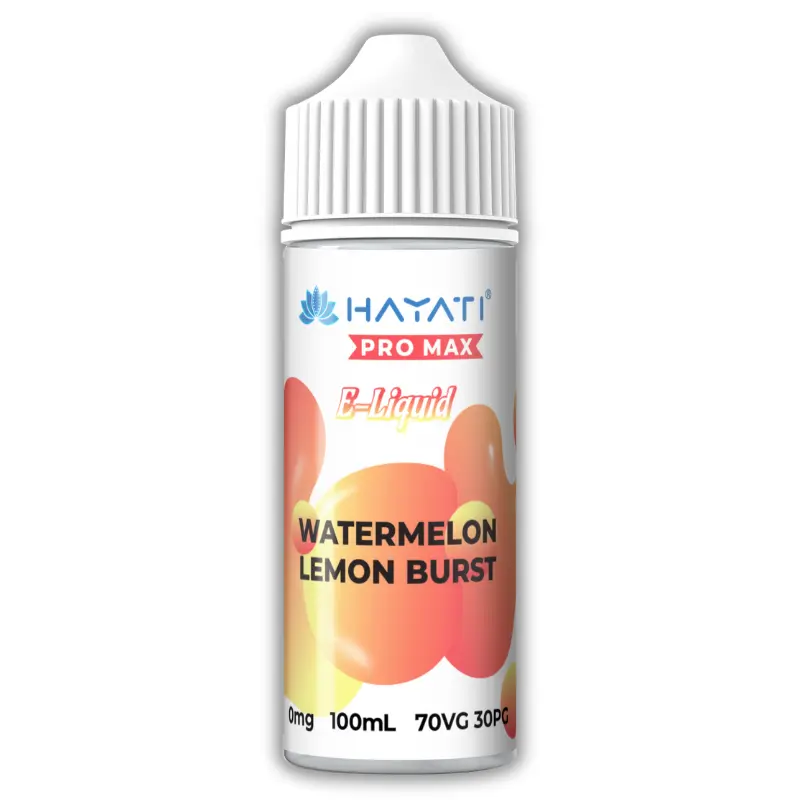
Hayati · Pro Max
Watermelon Lemon Burst Hayati Pro Max 70/30 E-Liquid
£6.99
✔ In stock — ready to ship
Genuine Hayati
Free over £20
Same-day dispatch
Secure checkout
Three words name this liquid and only two of them are ingredients. Watermelon Lemon Burst is 120ml of Hayati Pro Max e-liquid in a base mixed at seventy parts vegetable glycerol to thirty parts propylene glycol, listed at 0mg, priced at £6.99. The first two words say what is dissolved in it. The third says something different in kind, and it is the only word in the title that could be struck out without costing you a single fact about the contents.
Striking it out would still lose something, and identifying what is the job of this page. Burst is not a fruit, a temperature, a quantity, a colour or a mood. It describes a shape: a fast arrival, a peak reached early, a decline that begins before the draw is finished. That is a statement about when the flavour happens rather than about what it is made of, and across a catalogue of 492 listings almost nothing else attempts a statement of that kind. Hayati name fruit constantly. They name cold constantly. They occasionally name loudness, texture, or a scene. They name the time course of a draw exactly twice, and both times they do it with this word.
So the first third of what follows is a count, because a claim about how unusual a naming device is deserves to be checked rather than asserted. The second third asks whether a liquid can honour a promise of that sort at all, which is a fair question given how many words in this trade point at sensations no aerosol can produce. And the last third is where the two threads collide, because this particular bottle is the glycerol-weighted version, a base whose whole character is body, coating and volume, and body is the opposite of an edge.
The verdict is reached rather than left hanging, and it is a narrow one. Nothing below argues that this is a poor liquid. It argues that of the two bases Hayati sell this flavour in, the thick one is the wrong home for a flavour named after its own timing, because timing is the single property a thick base cannot leave alone. Everything here is reasoned from the published figures and from the two descriptions Hayati wrote for this flavour. Where a conclusion goes past those, it is labelled as inference.
Counting the word, because a rarity claim should survive being counted
Every listing in the range that uses it
The shop carries 492 listings. Nineteen are hardware with no flavour in the title, and the remainder resolve into 173 distinct flavour-name strings, a figure the Rainbow bottle on this shelf established when it went through the same data. Of those 173 names, exactly two contain the word Burst, and they account for four listings between them.
- Pineapple Lemon Burst, sold twice, both times as prefilled Pro Max Plus hardware: the complete pod kit and the bare replacement pod.
- Watermelon Lemon Burst, sold twice, both times as a 120ml bottle: this one and the even-ratio version at Watermelon Lemon Burst Hayati Pro Max 50/50 Shortfill E-Liquid, both at £6.99.
Four listings out of 492 is eight tenths of one per cent, and two names out of 173 is a little over one per cent. Before anything is read into that, here is what the two names have in common, because the overlap is tighter than a two-item sample has any obligation to be.
Both are three words. Both put Burst last. Both name exactly two fruits and no third. Both put lemon in second position, immediately before the shape word. And in both, the fruit in first position is the large, watery, high-volume one and the lemon is the small, sharp one. The grammar is identical down to the ordering: bulk fruit, sharp fruit, shape.
The lemon is the part worth pausing on. Eighteen of the 173 names in this catalogue carry lemon as a fruit, with a further six naming lemonade, and the Lemon Vapes shelf collects 54 listings in total. Lemon is therefore common. Burst is not, and every single time Hayati have reached for it they have reached for lemon in the same breath. Lemon does not need Burst. Burst, so far, has needed lemon.
Two out of two is a coincidence you could get by chance, and this page is not going to pretend otherwise. What makes it worth reporting rather than dismissing is that it agrees with the physics further down: of the fruits in common use here, lemon is the one with the steepest onset and the one most capable of producing the sensation the word describes. A naming habit that lines up with a mechanism is more interesting than one that does not, even at a sample of two.
One more structural detail. The two Burst flavours do not overlap in format at all. Pineapple Lemon Burst exists only as sealed prefilled hardware, and this flavour exists only as a large bottle. There is no Burst pod of watermelon and lemon, and no Burst bottle of pineapple and lemon. If you have met the word on this site before, you met it on a different platform with a different fruit underneath it.
Sorting the other 171 names by what their non-fruit words actually claim
A rarity claim is only as good as the population it is measured against, so here is the population, sorted by what each naming device is doing. Every figure below counts distinct name strings first and listings second, and both were taken off the catalogue rather than off another page.
| Naming device | What it tells you | Names / listings |
| Ingredient | What is in it | The large majority of the 173 |
| Cold words (Ice, Frozen, Cooler, Menthol, Mint, Ice Cold) | A temperature sensation | 45 names, 121 listings |
| Magnitude words (Triple, Double, Mixed, Bomb) | How much, or how many | 8 names, 20 listings |
| Texture words (Smooth, Juicy, Fizzy, Frosted, Jelly, Cotton) | How it feels in the mouth | 12 names, 32 listings |
| Taste-axis words (Sour) | Where it sits on one dimension of taste | 7 names, 21 listings |
| Mood and scene titles | An atmosphere, and no recipe | 4 names |
| Colour nicknames and Rainbow | A hue, used as an index to flavour | 6 names |
| Drink forms (Crush, Punch, Cooler) | A vessel or a category of beverage | 3 names, 6 listings |
| Variation words (Twist) | That something has been altered | 3 names, 8 listings |
| Envelope words (Burst) | When the flavour arrives and how fast it goes | 2 names, 4 listings |
Read down the right-hand column and the pattern is plain. A fruit name answers what. A magnitude word answers how much. A cold word answers what it feels like. A mood name answers none of those and admits it. Not one of them answers when, and when is a genuinely separate axis. A loud flavour and a fast flavour are not the same thing, and you can have either without the other: a heavy dessert accord can be extremely loud and arrive slowly, while a light citrus top can be quiet and arrive instantly.
The two near misses, and why they are near rather than equal
Two entries in that table have a reasonable claim to be doing what Burst does, and both deserve a paragraph rather than a dismissal.
Bomb. Fruit Bomb appears in three name strings across four listings, and a bomb is, on any honest reading, partly an event with a shape. It has a bang. But the primary sense of the word in a flavour context is size, not speed, and the corpus read it that way when it was written: the page that owns the Fruit Bomb pod treats the name as a claim about loudness and works through what a blend gives up when it smooths out its own internal contrasts. The word points first at how much and only secondarily at how quickly. It is the closest rival to Burst in the range, and it is still a magnitude word with an envelope implication rather than an envelope word outright.
Fizzy. This one is more interesting, and it changes the shape of the finding rather than weakening it. On the face of it Fizzy is a texture word, naming a mechanical sensation on the surfaces of the mouth. The corpus has taken it apart at length, and the conclusion reached on the Fizzy Cherry Rubik pod kit page is worth stating exactly because it is not obvious: fizz cannot be delivered by a vape at all, since the sensation requires gas dissolved in a liquid and an aerosol holds none, and what the six Fizzy Cherry listings are actually describing, when you read them together, is not a texture but a speed. All six define the treatment by what it prevents, and what they say it prevents is heaviness and settling. That page's line is that heaviness and settling are envelope properties rather than textures, and that the same loudness can arrive with two entirely different shapes.
Take that finding seriously and the census gets sharper rather than blunter. There are two places in this catalogue where a name is really about the time course of a draw. In one of them the word on the label names a physical impossibility and the envelope has to be inferred from six descriptions. In the other the word names the envelope directly, in plain English, with nothing to decode. Burst is the only name in 173 that says out loud what Fizzy can only imply, and unlike Fizzy it promises something a liquid can actually do.
The remaining candidates fall away more quickly. Crush and Punch name drinks, not events. Pop appears once, inside Ice Pop, where it names a frozen sweet rather than a sudden onset. Twist names a variation or a strip of peel. Smooth and Juicy name mouthfeel, and the corpus already has a page on what a texture word can and cannot promise. None of them is about timing.
The honest limits of the count
Three qualifications, because a census with no caveats is usually a census that stopped early.
The categories above are mine, and somebody drawing the lines differently would get different totals. Put Bomb in the envelope column and the answer becomes three names rather than two. Insist that Fizzy is a texture word full stop and the finding gets narrower and cleaner. The count that does not move under any reasonable definition is the one about Burst itself: four listings, two names, both containing lemon.
Second, a device used twice is a habit, not a system. Nothing here claims Hayati have a policy about envelope words. The likelier reading is that a copywriter reached for a vivid noun on a citrus pairing and then reached for it again on the next citrus pairing, which is how house vocabulary forms in the first place.
Third, and most important, a name is a marketing decision and a liquid is a formulation. The two are made by different people at different times. Everything below about what the blend does is reasoned from the two published descriptions and from how the named fruits behave, not from any assumption that the label was signed off by whoever mixed it.
Can a liquid deliver an envelope at all?
This question has to be settled before the name can be judged, because the range is full of words pointing at things no aerosol can produce. The short answer is yes, unlike fizz, and the reason is worth setting out properly since the whole verdict rests on it.
What is already established, and is not being rebuilt
Two findings from elsewhere on this site are taken as read. The first is that vapour cannot carbonate anything, so a name promising bubbles is promising a substitute at best. The second, from the same page, is that an aroma can absolutely be fast: a volatile top note with a steep onset and a short decay registers and clears inside a second or two, while a heavy low-volatility material comes on slowly and lingers, and the two produce quite different impressions at identical intensity. Loudness and shape are independent variables. That argument belongs to the Fizzy Cherry Rubik pod kit page and there is nothing to gain from deriving it twice.
The three clocks inside one draw
What has not been set out is why a draw has enough internal structure to be shaped deliberately, and the answer is that the sensations do not all travel by the same route or at the same speed. Three separate channels are running at once.
Taste is the fastest. Sour, sweet, salt and bitter are detected by receptors on the tongue, in direct contact with condensed aerosol the moment it lands. There is no transport delay worth speaking of. An acid in a liquid registers as sharpness essentially at the instant of contact, which makes acid the earliest thing in any draw that contains it.
Light aroma is next. Small molecules with high vapour pressure leave the condensed droplets readily and reach the olfactory receptors quickly. Citrus character is built almost entirely from that class, and it both arrives early and clears early, because the same property that gets it there fast also lets it disperse fast.
Heavy aroma is last and stays longest. Larger, less volatile compounds, the ones behind dark fruit, caramelised sugar and creamy accords, are slower to leave the droplet and are mostly perceived retronasally, on and after the exhale. They come on late and they hang about.
Those three clocks are what every inhale-and-exhale description in the trade is really describing, and they give a formulator a genuine, if crude, running order to work with. Weight a blend towards acid and light aromatics and it front-loads. Weight it towards heavy aromatics and residual sweetness and it back-loads. Nothing about that requires special equipment or a clever delivery mechanism, only a choice about proportions, which is why an envelope is buildable and a fizz is not.
How much shape is actually available
Two limits keep this from becoming a fantasy about precision engineering.
A draw lasts somewhere in the region of two to four seconds, which supports perhaps two or three distinguishable stages rather than five. And the stages overlap heavily, because nothing switches off when the next thing starts. What a formulator can produce is a gradient with a weighted front or a weighted back, not a sequence of discrete events. Anyone expecting the sharp on-off of a physical sensation will find the reality softer than the word suggests.
Even so, this puts Burst in an unusual position among the names in this range. Most of the non-fruit words here are unfalsifiable. You cannot prove a liquid is not a Summer Dream. You cannot check a colour nickname. A claim about timing, by contrast, is testable on a single draw by anybody paying attention, because you either notice the flavour arriving early and thinning, or you notice it building through the exhale, and the two are not easily confused. Whatever else is true of it, Burst is one of the very few words on these shelves that could be shown to be wrong.
Which of the two fruits is the burst
The name lists watermelon first and lemon second, and the running order in your mouth is the reverse. That is the central fact about how this liquid presents, and everything in this section is an unpacking of it.
Watermelon has no attack, and that is not a criticism
Watermelon's behaviour in a liquid has been worked through carefully elsewhere on this site and the findings are cited rather than rebuilt. Its aroma sits in a small family of nine-carbon aldehydes and alcohols generated when the flesh is cut, they are faint, they are short-lived, and there is no deep reservoir of character to draw on, which is why a whole melon smells of nothing and a cut one smells of melon briefly. The identifying green note lives just inside the rind and is routinely dropped by formulators because it reads as an off note in a sweet product. Real watermelon is overwhelmingly water, and texture does most of the work that the name conjures.
What follows for the shape of a draw has not been said, and it is simple. Watermelon is the flattest envelope in the range. It has no steep onset because there is no single powerful marker compound to supply one, no dramatic decay because nothing rose sharply in the first place, and its main contributions in a liquid are sweetness and a broad watery body. Sweetness and body are level properties. They are present from the start of a draw to the end of it and they do not do anything interesting in between.
That makes watermelon an excellent floor and a hopeless event. It fills the middle of the mouth, it keeps the vapour from reading as thin, it rounds off whatever is sitting on top of it. In this blend it is the substrate, not the subject. Hayati's own copy for this bottle agrees, calling the melon a light base with the citrus arriving on top of it, and the 29 listings on the Watermelon Vapes shelf are mostly built the same way, with the melon underneath something louder.
Lemon is the only fruit here with two fast channels
Lemon is the opposite creature and it is fast twice over, which is what makes it the one fruit in this pairing capable of supplying an envelope.
Its acid is a taste, so it is on the first of the three clocks and arrives without delay. Its aroma is built from small, light, high-vapour-pressure terpenes and aldehydes, so it is on the second clock and arrives almost as quickly. There is very little in lemon that sits on the third clock at all. It has almost no heavy, slow, lingering fraction, which is exactly why a lemon note is famous for evaporating out of a finished product and why citrus is the first thing to go stale in anything.
Put those together and the shape is unmistakable: a steep rise, an early peak and a decay that begins while the draw is still running. That is a burst in the literal sense of the word, and it is the only one of the two named fruits that can produce it. Watermelon supplies the volume the event happens inside. Lemon supplies the event.
There is a secondary question about which lemon. A peel-led lemon leads with oily, aromatic, faintly bitter zest character. A juice-led lemon leads with acid and reads thinner and sourer. They behave differently: peel supplies aroma, juice supplies taste, and only one of them survives a long session comfortably. Hayati use the word zest on both bottles of this flavour and also describe the citrus as sharp and tangy, which points at both channels being in play rather than either alone. That is as far as the published material goes, so treat the split as unknown and the presence of both as probable.
The draw, front to back
Reasoning from the above rather than from a tasting, here is the order the blend should present in, with the caveat that this is an inference from composition and not a report.
The opening is sharpness before identity. Acid registers before the nose has resolved what fruit it belongs to, so the first thing to land is a brightness and a tightening along the sides of the tongue rather than anything recognisable as lemon. Within a fraction of a second the citrus aroma catches up and the sharpness acquires a name.
The middle is where the melon appears, and it appears as filling rather than as a flavour arriving. The vapour thickens, the sweetness comes up, and the sensation spreads from the edges of the tongue to the whole of the mouth. Nothing about the watermelon announces itself. It is simply that the space around the citrus stops being empty.
The exhale is where the two separate. The lemon aroma is largely spent by now, having been the fastest thing in the blend, and what is left of it is the acid, which decays more slowly than its aroma does. So the finish is a receding sourness over a soft sweet body, with the melon outlasting the citrus by some margin. Two or three seconds after the exhale there is a mild sweetness and not much else.
That is a front-loaded liquid with a long soft tail, which is a slightly unusual profile: most front-loaded blends are front-loaded all the way through and finish short, while this one has a floor that carries on after the event is over. Whether that reads as generous or as a slow fade to nothing depends on what you wanted from the second half of the draw.
Hayati describe this flavour twice, and the two descriptions disagree in a revealing way
This flavour is sold in two bottles and Hayati wrote fresh copy for each. Lining the two up against each other is the single most useful piece of evidence available, and it produces three findings.
The first is agreement on the essentials. Both descriptions make the melon light, sweet and watery. Both make the lemon sharp, tangy and zesty. Both name contrast as the defining property of the blend: one calls the contrast between soft fruit and citrus the thing that defines it, the other calls the contrast the appeal. When two independently written descriptions agree on a structural property, that property is about as close to a published fact as this catalogue offers.
The second is that both attribute the burst to the lemon, explicitly, in their own words. One has a burst of sharp lemon cutting through the melon. The other has the lemon bursting through and brightening the fruit. Neither ever attaches the word to the watermelon. So the reading argued above from volatility is not merely consistent with the copy, it is the copy's own reading, arrived at twice.
The third is a difference, and it is the one that matters for this bottle. In the even-ratio description the lemon is the actor: it bursts through, it brightens, it livens. In the description of this bottle the lemon has been demoted to a defensive job, credited with keeping the vapour from tasting flat, while the thing said to gain from the base is the melon, which is given a fuller and rounder feel by the denser aerosol. Same flavour, same brand, same copy department, two bases. In one the citrus does something. In the other it prevents something.
That tells you something about the writing of the copy and nothing certain about the mixing of the liquids, and it is offered on those terms. A copywriter may simply have been reaching for whatever suited a page about a thick base. But it is a striking thing to find, because it is exactly the change the physics in the next section predicts, arrived at independently by somebody who was not making an argument.
Sweetness, cooling, and what this is not
On sweetness, this lands in the middle of its shelf and probably a little below the confectionery builds. Neither of the two named fruits is a heavy sugar source. Watermelon is watery rather than syrupy and lemon brings none at all, so whatever sweetness is present comes largely from the base and from whatever sweetener is in the concentrate. Acid also masks sugar perceptually, which means first impressions will understate how sweet it is, and the masking weakens as a coil tires. Nothing in this line publishes a sweetness figure, so read that as an argument from structure and not as a measurement.
On cooling, there is none declared. The title carries no cooling word and nothing in the supplied description mentions a coolant, so this page treats the liquid as uncooled. That reading rests on a finding established elsewhere rather than on a guess: the Blue Frozen pods page ran a census of the cooling vocabulary across the whole catalogue and established that a cold word in the title is a reliable signal that a coolant is present, and that the several cold words in use are not ranked against one another. If you want the cold as well as the citrus, Watermelon Ice Hayati Pro Max 70/30 E-Liquid is the same melon with a coolant instead of a lemon, and Blue Frozen Hayati Pro Max Nic Salts is the small bottle where that census lives.
One confusion is worth heading off on any high-acid liquid: sharpness is not coldness. Acid produces a tightening at the sides of the tongue and a prickle at the back of the throat that people routinely describe as refreshing, and there is no drop in perceived temperature anywhere in it. Read a description of this bottle as cooled and you will find it warmer than expected.
Three exclusions, all supported rather than guessed. It is not a lemonade: no soft-drink roundness, no sweet base under the citrus, and the catalogue keeps its lemonade builds in their own group, of which Berry Lemonade Hayati Pro Max Nic Salt and Blue Razz Lemonade Hayati Pro Max Nic Salt are two examples in the small bottles. It is not a sour candy either: a confectionery sour uses a dedicated souring agent over a sweet base to produce a deliberate pucker, which is a different sensation from fruit acid, and Blue Sour Raspberry Hayati Pro Max 70/30 E-Liquid is the declared sour on this shelf. And it is not a melon-led blend despite the word order, for all the reasons above.
The base, and the one property it cannot leave alone
What the two bottles on this shelf have already settled
The physics of the carrier split is done, properly, by the Vimbull Ice bottle that sits on the same shelf in the same size, and repeating it would be a waste of your time and mine. Four of its conclusions are taken as read here. Glycerol is thick and propylene glycol is not, so the mix decides which device the bottle belongs in long before it decides anything about taste. It produces more aerosol per millilitre, so a fixed dose of flavouring is spread across a larger volume of vapour and the concentration in any given mouthful falls even though the dose per millilitre has not moved. It is faintly sweet on its own account, before any flavouring is added. And it carries coolant compounds less efficiently than propylene glycol does, which is the one limb of the argument that does not apply to this bottle, since there is no coolant in it to be carried badly.
That page also established the piece of range structure that makes any of this checkable. Twenty large bottles exist in each carrier, and the two rosters match item for item: no flavour is offered one way and withheld the other. Name, size, strength and price are identical across every pair, so the only thing that moves is what the flavouring is dissolved in. The Hayati Pro Max 70-30 E-Liquid shelf is one half of that pairing and this flavour is one of the twenty.
The Rainbow bottle added the finding that matters most for a blend with parts in it. Dilution across a larger aerosol volume is usually imagined as turning the volume down, and on a single-fruit liquid that is roughly what it does. On a blend it does something else, because detection and identification have different thresholds: drop every component by an equal fraction and they will not all fall past the naming threshold together, so the faintest go first while the loudest keep their identity. A diluted blend does not get quieter. It loses members. That conclusion is theirs and is cited rather than re-derived.
The new point: a level survives being reduced, an edge does not
Here is what neither of those pages needed to work out, because neither was writing about a flavour named after its own timing.
Every effect a base has on a flavour is an effect on a level. It raises the sweet floor. It lowers the concentration of aromatics per mouthful. It thickens the mouthfeel. Those are all quantities, and a quantity that has been reduced is still the same quantity, only smaller. A quieter mango is a mango. A slightly sweeter berry is a berry. A blend with one member below the naming threshold is a shorter blend. In every case the identity survives the operation and you are left with a diminished version of the thing you bought.
An envelope is not a level. It is a rate: how fast the sensation climbs and how fast it falls. And a rate that has been reduced is not a smaller version of the same event, it is a different event, because the whole of what distinguishes a burst from a swell is the steepness of the climb. Halve the intensity of a fast attack and you still have an attack. Slow it down and you have nothing that anybody would call a burst, whatever its peak height. There is no such thing as a gentle burst. The word only has content at one end of the scale, which is precisely why it is the one property that cannot absorb blunting.
So of all the flavours on this shelf, this is the one whose defining property sits in the category the base cannot leave alone. That is the argument, and three mechanisms carry it.
The peak does not only shrink, it moves later
Start with the dilution effect and look at it as a question of timing rather than of loudness, which is the step that has not been taken before.
A sensation is not perceived until its concentration at the receptor crosses a threshold. Within a draw, concentration is not constant: it builds from zero as the aerosol arrives and the volatiles come off it. If you lower the whole curve by spreading the same dose across more vapour, you have not only made the peak lower, you have made the crossing point later, because a curve rising towards a lower maximum takes longer to get above any fixed threshold. The peak shrinks and it shifts back into the draw.
On a level-shaped flavour that delay is invisible, because the flavour is still there for the rest of the draw and a tenth of a second at the start is not part of the product. On this flavour the first part of the draw is the product. The name is a promise about the opening, and a mechanism that pushes the opening later is attacking the promise directly rather than attacking it as a side effect.
A coating mouthfeel is a filter on both ends of the event
The second mechanism is the one the Rainbow bottle touched on between draws, and the interesting version of it is what happens inside a single draw.
A glycerol-heavy liquid coats. The film it leaves is the sensation people describe as richness, and it persists past the exhale. Two consequences follow for a fast flavour, and they attack opposite ends of the envelope.
At the front, the receptor surfaces are already occupied when the new draw lands. An acid arriving onto a bare tongue registers as a step. An acid arriving through an existing film registers as a ramp, because it has to displace or diffuse through something before it reaches anything that can detect it. The magnitude may be identical and the onset is not.
At the back, the same film slows clearance. A burst is defined as much by its ending as by its beginning, and a decay that drags is a decay that blurs into whatever comes next. A liquid that does not clear between draws cannot present a second attack as cleanly as it presented the first, which means the shape degrades across a session rather than being reproduced each time.
A thin base does neither of those things to any great degree. That is not a virtue of thin bases in general, it is simply the property that happens to matter on this liquid and on almost nothing else.
The sweet floor raises the bar the acid has to clear
The third mechanism is the shortest, because half of it is already established. Sweetness and sourness suppress each other perceptually, so raising the background sweetness of a base reduces how sour a fixed quantity of acid reads. The Vimbull bottle made that point about level and it is not being remade.
The addition here is about timing again. If the acid has to clear a higher perceptual bar before it registers as sharpness, then it registers later as well as more weakly, for exactly the reason set out above. And the acid is the earliest thing in this draw, the thing that arrives before the nose has even identified the fruit. Delay the earliest element and you have not softened the blend, you have removed its first stage, and a two-stage liquid that loses its first stage is a one-stage liquid.
The base feeds the floor and taxes the event
Put the three together and the asymmetry is the whole verdict. Of the two named fruits in this bottle, one is a level and one is an edge. The base is generous to levels: it gives the watermelon exactly what a watery, quiet, low-acid fruit lacks, which is body, weight and a little sweetness, and Hayati say as much in their own copy for this bottle when they credit the denser aerosol with making the melon fuller and rounder. The base is hostile to edges: it lowers the acid, delays it, coats over it and stops it clearing. Every gram of what the ratio adds goes to the part of the name that is not the point, and every cost it imposes lands on the part that is.
So the answer to the question this page set itself is yes. The 70/30 is the wrong version of this particular name. Not the wrong liquid, and not a bad bottle. It is a perfectly coherent product: a sweet, rounded, watery melon with a citrus lift, in a thick base, for an open tank. But it is not a burst, and the word on the label is the one thing this base is guaranteed to take away. The even-ratio bottle of the same flavour is the one that delivers what the title claims, at the same 120ml, the same 0mg and the same £6.99.
There is more to the verdict than the complaint, and stopping at the complaint would be dishonest. Buying the burst and buying the flavour are two different purchases, and only the first of them is damaged. A hundred and twenty millilitres is a great deal of liquid, and an insistent acid attack repeated several hundred times a day is one of the fastest ways to tire of something. Anyone who liked the idea of watermelon with citrus on it, rather than the idea of a fast event, will find this the more liveable of the two bottles and will not miss what has been blunted. The blunting only costs you if you were listening for the thing that got blunted.
Hardware settles it before taste does, in any case. Hayati file this bottle with open tanks and low-resistance coils and send owners of narrow, restricted-draw pods to the thinner version instead, and a liquid this thick in a device built around a thin one misbehaves in ways the flavour tends to get blamed for.
Three places this argument could fail
Everything argued here is built out of the published figures and the known behaviour of two carriers and two fruits, and none of it is a tasting report.
The concentrate dose may differ between the two bottles. Raising the flavouring percentage in a glycerol-heavy mix to offset dilution is ordinary practice, and if Hayati have done it then the peak is higher than predicted, though the coating and the sweet floor would still be doing their work on the timing. No flavour percentage is published for anything in this range, so there is no way to check.
The word may describe the name rather than the liquid. Burst might have been chosen because a citrus pairing needed a third word, with nothing behind it. If so, the analysis of what the base does still stands and the complaint about it does not, because there would be no envelope to damage in the first place. The fact that both descriptions attach the word to the lemon specifically, rather than using it as a general intensifier, is mild evidence against that reading.
And people differ enormously in how they perceive acid. Salivary response, sensitivity to citric acid and the rate at which a coating clears all vary between individuals far more than sweetness perception does. Somebody at one end of that range may find the attack perfectly intact in this base, in which case the argument above simply does not describe their bottle.
The label, line by line
Everything in this table comes from this listing's own data or from a count run against the catalogue. Where Hayati publish nothing, the row says so rather than borrowing a figure from a neighbour.
| Line | What this listing says |
| Shape word in the title | Burst, one of two names in 173 that describes timing rather than contents |
| Fruits named | Watermelon, then lemon, in that order in the title |
| Which fruit the copy credits with the burst | The lemon, on both bottles of this flavour |
| Base | 70 vegetable glycerol to 30 propylene glycol |
| Nicotine | 0mg |
| Volume printed | 120ml |
| Price | £6.99 |
| Coolant | None declared, and no cooling word in the title |
| Hardware Hayati place it with | Open tanks and low-resistance coils, not narrow restricted-draw pods |
| Same flavour, other base | Watermelon Lemon Burst at 50/50, 120ml, 0mg, £6.99 |
| Full title | Watermelon Lemon Burst Hayati Pro Max 70/30 E-Liquid |
| Shelves it appears on | Hayati Pro Max 70-30 E-Liquid, Hayati E-Liquids, Lemon Vapes, Watermelon Vapes, New Products |
| Not published | Flavour concentrate percentage, the split between lemon peel and lemon juice character, sweetener level, coil resistance, and whether 120ml describes the liquid or the container |
The shape row is at the top because it is the row this page is about, and because it is the only line in the table that changes depending on which base you buy. Every other entry except the ratio itself is shared with the even-ratio bottle word for word.
The strength row reads 0mg, which is all the nicotine information the listing carries. No opinion on strengths appears here, none are ranked against each other, and nothing is suggested about what to do with a bottle at zero.
The volume row hides a question the Vimbull bottle raised on behalf of the whole range, and it is worth knowing about rather than settling: nothing states whether 120ml refers to what has been poured in or to what the container would hold, and all forty of the large bottles print the figure with the same silence attached. Take it as the number on the label.
Two small inconsistencies in how this flavour is labelled are worth a sentence, because they affect whether a buyer can find the other bottle. The even-ratio version carries the word Shortfill in its title and this one does not, although both are the same size at the same strength. And that bottle's web address drops two things its title contains, both the word shortfill and the e of e-liquid, so somebody who arrives at a page by reading a link will see a shorter product name than the one printed on the listing. Slugs lose words routinely, and a buyer comparing the two bottles by their addresses rather than their titles will not be looking at quite the same pair of names.
The last row is the one worth reading twice. The concentrate percentage would settle the central question of this page one way or the other, and it is not published for any product in this range, so anybody stating it with confidence has it from somewhere other than Hayati.
How it sits against the bottles around it
The same flavour in the other base
This is the only comparison that really decides anything and the shop makes it harder to see than it should be, because the two bottles sit under slightly different titles. Watermelon Lemon Burst Hayati Pro Max 50/50 Shortfill E-Liquid is the same flavour, the same 120ml, the same 0mg and the same £6.99 on an even base. Everything argued above points at it if the timing is what you came for, and Hayati's own copy for it is noticeably more confident about the lemon. Everything argued above points away from it if you run an open tank, because the hardware question comes first and a thin liquid in a wide-aperture tank is a different kind of problem.
The rest of the thick shelf, sorted by envelope rather than by fruit
The twenty bottles on this shelf are usually sorted by flavour family, and this page suggests a more useful sort for anyone deciding about the base: how much of each flavour's identity is an edge, and how much is a level. Edges lose to this base. Levels do not.
At the edge end sit the acids. Blue Sour Raspberry Hayati Pro Max 70/30 E-Liquid wears the word sour on the front of the bottle, and a sour label describes a level built out of acid rather than a moment of it, so it has more to give away before anything stops being recognisable. Lemon Lime Hayati Pro Max 70/30 E-Liquid is the closest relative this bottle has on the shelf: two citrus fruits with no soft floor underneath at all, which makes it sharper, drier and thinner than this one, and arguably a purer test of what the base does to citrus, since there is no melon absorbing the difference. Fizzy Cherry Hayati Pro Max 70/30 E-Liquid is the other bottle here whose name is really about speed, for the reasons set out above, and it is the single most interesting neighbour if the census in the first half of this page is what brought you.
In the middle are the fruits with a coolant on top, where the base mainly costs the cold rather than the fruit. Watermelon Ice Hayati Pro Max 70/30 E-Liquid is the direct experiment for anybody wanting to know what the melon does on its own, since it swaps the lemon for a coolant and leaves everything else alone. Banana Ice Hayati Pro Max 70/30 E-Liquid and Strawberry Raspberry Ice Hayati Pro Max 70/30 E-Liquid are the same construction with louder fruit. Juicy Peach Hayati Pro Max 70/30 E-Liquid works one fruit on its own around a creamy lactone, which sits almost entirely on the slow clock, which makes it close to the opposite of this bottle in shape and a good thing to have in a second tank.
At the level end are the sweet builds, which lose the least because they have no edges to lose. Blue Razz Gummy Bear Hayati Pro Max 70/30 E-Liquid and Blue Razz Cherry Hayati Pro Max 70/30 E-Liquid are confection profiles whose identity is a sustained sweetness, and a base that adds sustained sweetness does them no structural harm. Blueberry Raspberry Hayati Pro Max 70/30 E-Liquid is a two-berry contrast, and Blueberry Cherry Cranberry Hayati Pro Max 70/30 E-Liquid is the one bottle on the shelf with a genuinely dry note in it, the cranberry, which is the nearest thing here to a counterweight against a sweetening base. Fresh Mint Hayati Pro Max 70/30 E-Liquid is the outlier and the obvious rotation partner, since it is the only bottle on the shelf with no sugar in its concept at all.
The thin bottles of the same size
Anyone who wants the large-bottle economics without the viscosity has the matching twenty to choose from. Lemon Lime Hayati Pro Max 50/50 Shortfill E-Liquid and Watermelon Ice Hayati Pro Max 50/50 Shortfill E-Liquid are the two nearest neighbours of this flavour in the other base, and Blue Razz Cherry Hayati Pro Max 50/50 Shortfill E-Liquid is the confection end of the same set. Comparing any one of those against its thick twin on the same hardware, where your hardware permits it, is the cheapest way to find out what the base does to your own perception rather than in principle, and the answer transfers to this bottle even though this bottle was not the one you tested.
The small bottles, for placing yourself before committing to 120ml
Sixty-five of the listings here are small 10ml nicotine bottles mixed evenly, and they rival a 120ml purchase only in the sense that they are an inexpensive way to audition a taste. For the citrus axis specifically, Lemon Mint Hayati Pro Max Nic Salt puts lemon against something that also sits on the fast clock, which makes it an unusually bright pairing, and Blueberry Raspberry Lemon Hayati Pro Max Nic Salt is the reverse arrangement, with the lemon as a third element behind two berries rather than as the event. For the melon axis, Strawberry Watermelon Bubblegum Hayati Pro Max Nic Salt shows what happens when the melon is buried under a confection accord rather than lifted by an acid, which is the opposite treatment of the same quiet fruit.
If you do not have a tank
Liquid in a bottle needs a device you can pour into, and the bulk of this catalogue is sealed and prefilled. If that describes your drawer, the price per millilitre on a large bottle is beside the point, and the choice worth making is among the prefilled formats. The wider Hayati E-Liquids heading holds 105 listings and mixes both bottle bases in with the small ones, which makes it an awkward place to shop when the base is what you are deciding on, and the full range at all Hayati products runs to 492.
Living with 120ml of a fast flavour
Most of the practical notes for any large bottle follow from thickness and from volume. On this one they both bear on the same thing, which is the opening of the draw, so they are worth putting in those terms rather than in general ones.
Thickness changes filling and it changes the first draw after a pause. This liquid pours slowly and it soaks into cotton slowly, and it gets appreciably more sluggish as the temperature drops, so a bottle that has spent the night somewhere cold wants a few minutes in the hand before it behaves normally. The reason that matters more here than on a heavier flavour is the front of the draw: a wick that is fractionally behind at the moment you start pulling produces its thinnest vapour in the first half second, and the first half second is where this liquid keeps everything it has. A slow wick does not make a dessert liquid taste wrong. It takes the top off this one.
Coil ageing has a predictable direction on any liquid and an unusually consequential one on this. Residue buries the light volatile compounds first and leaves the heavy ones standing, which is why complex liquids taste flat long before they taste burnt. Here the light volatile fraction is the lemon aroma, and the heavy fraction is the sweetness and the melon body. So a tiring coil subtracts the event and leaves the floor, and it does so while still producing a full cloud of something perfectly pleasant. The failure is not that it stops working. The failure is that it stops being what the name said.
That gives a test rather than a rule, since coil life depends on the tank and the power rather than on the bottle. Take a draw on a fresh coil and attend to the first half second, before the sweetness arrives. That is your reference point, and it costs nothing to establish. When the opening stops happening and the draw starts at the melon, the coil has consumed the part you paid for. That moment arrives well before anything anyone would describe as a spent coil, and on this bottle it arrives sooner than it would in the even-ratio version, because the base has already spent some of the same margin.
Storage is worth a note for a reason specific to the citrus. Light and warmth work on the smallest and most volatile compounds hardest, and those are exactly the ones this flavour is built on, so a bottle this size, which stays open for weeks rather than days, has more to lose from a sunny shelf than a heavy dark-fruit liquid would. A closed cupboard, the cap seated firmly after every fill, and no chilling, which achieves nothing and makes a thick liquid harder to pour. A container of this size should be kept where children and pets cannot get to it, along with anything else you would store that way.
Last, the rotation point, which is specific rather than general. A fast flavour is the one most damaged by palate fatigue, because fatigue flattens the difference between a peak and a background and this liquid is nothing but that difference. Having something structurally opposite already loaded in a second tank is worth more here than on a rounder bottle, and the useful opposite is not another fruit. It is something with no sugar in its concept, which keeps the contrast intact rather than adding to the floor.
Questions buyers ask about this bottle
What does the word Burst actually claim?
It claims a shape rather than an ingredient: the flavour arrives fast, peaks early and declines before the draw ends. Across 173 distinct flavour names in this catalogue it is the only word used that describes the timing of a draw rather than its contents, its size, its temperature or its texture. It appears on four listings in total, two of them this flavour and two of them Pineapple Lemon Burst.
Which of the two fruits is the burst?
The lemon, and Hayati say so themselves on both bottles of this flavour, attaching the word to the citrus each time and never to the melon. The reasoning agrees with the copy: lemon carries both an acid that registers on the tongue instantly and an aroma made of light, fast molecules, while watermelon's identifying compounds are faint and broad and contribute sweetness and body rather than an onset.
Does the name mean the watermelon comes first?
No, and the word order is misleading on this one point. The title reads watermelon then lemon, and the draw runs the other way: the citrus lands first because acid and light aromatics are the fastest things in the blend, and the melon fills in behind it as the vapour builds. The melon then outlasts the lemon on the finish, so it is the last thing present as well as the second thing to arrive.
What is the 70/30 actually describing?
The carrier the flavouring sits in: seventy parts vegetable glycerol against thirty of propylene glycol. Glycerol supplies nearly all of the visible cloud and brings a mild sweetness with it, while propylene glycol is runny, fills a wick quickly and holds flavour compounds well. Tilt the mix towards the glycerol end and you get a thicker fluid, a heavier cloud, a faintly sweeter floor and a wick that refills more slowly.
Is the 70/30 or the 50/50 the better buy for this flavour?
Hardware decides first, and if you run an open tank the question of taste may not arise. If your hardware takes both, this page argues the even-ratio bottle is the one that presents the flavour as named, because a thick base blunts and delays a fast attack and the attack is what the word Burst is promising. If you want the melon and the citrus rather than the timing, the thick bottle is rounder, fuller and easier to live with over 120ml.
How sweet is it?
Mid-range for this shelf and probably a little below the confection builds, because neither named fruit is a heavy sugar source. Watermelon is watery rather than syrupy and lemon brings none, so most of the sweetness comes from the base and from whatever sweetener sits in the concentrate. Acid masks sugar, so it will read drier on first acquaintance than it does after a week, and no sweetness figure exists on any label in this line.
Is there any cooling in it?
None is declared. The title carries no cooling word and the description mentions no coolant, and a census of the cooling vocabulary across the whole catalogue established that Hayati are consistent about naming a coolant in the title when one is there. What people sometimes read as coldness on a citrus liquid is the acid producing a prickle and a tightening, which is a different sensation and does not lower perceived temperature.
What nicotine strength is this?
0mg. That figure is the whole of what Hayati publish about nicotine in this listing.
Will it work in a small refillable pod?
Hayati place this base with open tanks and low-resistance coils and point owners of narrow, restricted-draw pods at the thinner version instead. The mechanism is how fast a wick can refill: thick liquid travels through cotton at a lower rate, and feed slots cut for a runny one cannot keep up with the coil. Which device you own settles the case, though nobody disputes which way the effect runs.
Why does it stop tasting of lemon while the tank is still full?
Residue on a coil buries the lightest and most volatile compounds first and leaves the heavy ones working, and on this blend the light fraction is the entire citrus aroma. What survives is the melon and the sweetness, which is a real flavour and is not the one the name describes. Watching the first half second of a draw on a fresh coil gives you a reference point, and the change is detectable from that long before the coil tastes spent.
Is it the same liquid as the 50/50 version?
Same flavour name, same brand, same 120ml, same 0mg, same £6.99, different base. Whether the concentrate underneath is identical is not published, and formulators sometimes raise the flavouring percentage in a thicker mix to compensate for dilution. The two descriptions agree closely on substance, with one notable difference: the thin bottle's copy makes the lemon the active element, while this bottle's copy credits the base with rounding out the melon and gives the lemon the job of keeping the vapour from tasting flat.
Are there other Burst flavours to try?
One, and it is on different hardware. Pineapple Lemon Burst is sold as a prefilled Pro Max Plus pod and as a complete kit, and it uses the same naming grammar: a bulk fruit, then lemon, then the shape word. It is built differently, though, because pineapple brings acid of its own, so that one is an acid stacked on an acid while this one is an acid over a sweet watery floor. No Burst flavour exists in both a pod and a bottle.
What you are buying, in plain terms
Watermelon Lemon Burst at 70/30 is 120ml of an uncooled watermelon and lemon liquid at 0mg for £6.99, in a base weighted heavily towards vegetable glycerol and placed by Hayati with open tanks. Two of its three title words name fruit. The third names a shape, and it is the only naming device of that kind in a catalogue of 492 listings, used twice, both times on a lemon pairing.
A shape is a real thing for a liquid to promise. Unlike fizz, which needs gas that an aerosol does not contain, an envelope can be built simply by weighting a blend towards materials that arrive fast and clear fast, and lemon is the fruit best equipped to supply one because its acid is a taste and its aroma is light. Watermelon, quiet and watery and slow, is the floor the event happens on. The name lists them in the opposite order to the one your mouth receives.
The complaint against this bottle is narrow and specific. Everything a base does to a flavour is done to a level, and a level that has been reduced is still itself. An envelope is a rate, and a rate that has been slowed is not a smaller version of the same event. This base lowers the acid, delays it past the moment the word is about, coats over the arrival and stops the sensation clearing between draws, and every one of those costs lands on the lemon while the added body and sweetness go to the melon. It feeds the part of the name that is not the point and taxes the part that is. That is the verdict: the thick bottle is the wrong version of this particular name, and the thin one in the same size at the same price is the version that keeps it. If the timing was never what you were buying, none of that costs you anything, and you should buy this one and enjoy the fuller melon it gives you instead.
Strictly for adults aged 18 and over. Nicotine is an addictive substance.
You might also like


