
Home / Hayati Pro Max Nic Salts / Blueberry Raspberry Lemon Hayati Pro Max Nic Salt
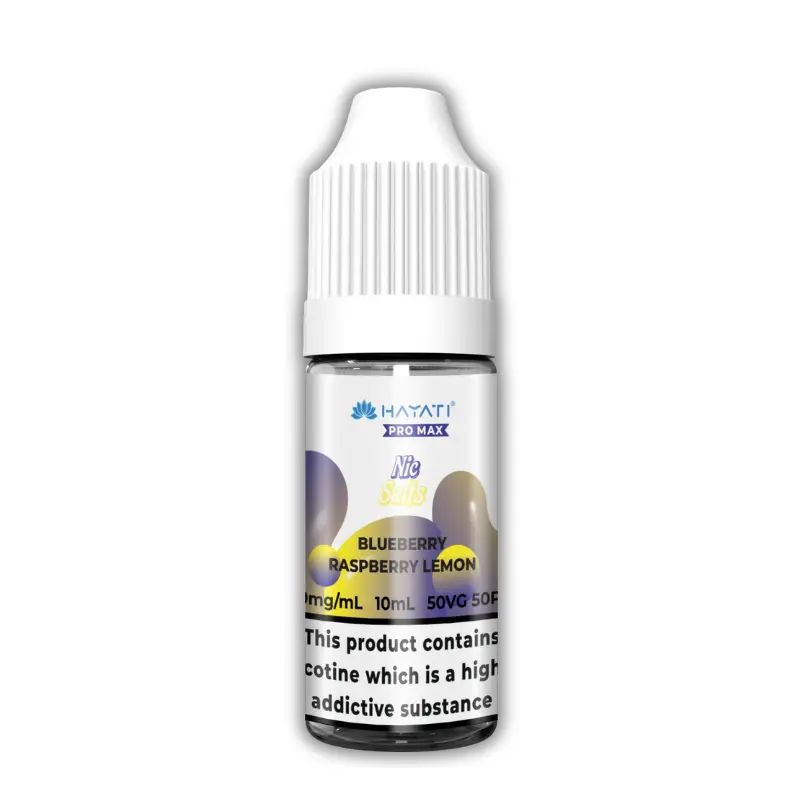
Hayati · Pro Max
Blueberry Raspberry Lemon Hayati Pro Max Nic Salt
£2.49
✔ In stock — ready to ship
Genuine Hayati
Free over £20
Same-day dispatch
Secure checkout
£2.49 buys a 10ml bottle of Hayati Pro Max nicotine salt at 10mg per millilitre, mixed at an even 50:50 vegetable glycerine to propylene glycol, filed under the code HPM-NS-BLUEBERRY-RASPBERRY-LEMON and named for three fruits. Liquid only. No pod, no coil, no device, nothing that draws power. You supply all of that, and this page is going to argue that the part you supply is the reason to buy this particular bottle rather than any of the other ways Hayati sell the same recipe.
The flavour question has already been settled elsewhere on this site, and settled thoroughly. The Blueberry Raspberry Lemon Pro Ultra Plus 25K Pods page takes this recipe apart draw by draw: what the citrus is doing structurally, why the two berries need something between them, where the sweetness sits, the complete absence of any cooling, and a reasoned prediction about which component gives out first. That work is done and this page will not redo it. Read it if what you want is a tasting note.
What that page could not do, because it is about a sealed 22ml pod with a coil built into it, is tell you how to find out for yourself. This bottle can. Hayati sell the plain two-berry pairing as Blueberry Raspberry Pro Max Nic Salt on the same shelf, at the same £2.49, in the same 10ml bottle, at the same 10mg, in the same 50:50 base. Two bottles, £4.98, 20ml of liquid, and one variable between them. Run both through the same pod in the same device on the same airflow setting and the only thing that has changed is the lemon.
That is an unusual thing for a catalogue to make available, and the rest of this page is about how unusual, exactly how to run the comparison, what it can settle, what it cannot, and what the three published listings of this recipe reveal when you read them against each other instead of one at a time.
The pairing this shelf makes testable
Start with the shape of the family, which has already been counted twice on this site and does not need counting a third time. The Blueberry Raspberry Mini Ultra Pod Kit page establishes the figures: twenty-two listings in a catalogue of 492 carry these words in a title, spread across four recipes, and the split is thirteen for the plain pairing, four for the cherry version, three for this one and two for the menthol version. Its other finding matters here as well, which is that no single piece of Hayati hardware reaches all four. Those numbers are cited, not re-derived, and the page that owns them is the place to go for the reasoning behind them.
Take that four-recipe family and ask a narrower question: which of the four ever reached a bottle?
Two of them. The plain pairing and this one. There is no Blueberry Raspberry Cherry nic salt and no Blueberry Raspberry Menthol nic salt. Cherry exists on prefilled hardware only, as Blueberry Raspberry Cherry Pro Max Plus 6000 Pod Kit, as its matching bare pods, and as one half of the divided Blueberry Raspberry / Blueberry Raspberry Cherry Pro Ultra Plus kit. Menthol exists twice, both times on Mini Ultra hardware. Neither was ever poured into a bottle you could put in your own pod.
So the bottle shelf carries exactly half the family, and the half it carries is the half that differs by one citrus.
Why the shelf itself is the control
The reason two bottles constitute a controlled comparison rather than just two purchases is a property of the shelf, and the Strawberry Raspberry Blueberry Pro Max Nic Salt page has already documented it: the Hayati Pro Max Nic Salts shelf runs to 65 listings, every one of them 10ml, every one 50:50, every one 10mg, and every one £2.49 apart from a single range-level entry. That page draws the consequence out properly, that the recipe is the only thing which varies across the whole shelf. I am citing it rather than recounting it, because the count is theirs and it is right.
What follows from it for this page is specific. Volume, ratio, strength and price being fixed across all 65 means a buyer comparing any two bottles on this shelf is already holding four things constant without having to think about it. Add the fact that you are supplying the hardware, and a fifth, sixth and seventh fall into place: same pod, same coil, same airflow. Seven variables pinned, one moving. That is a cleaner experimental setup than most people ever get to run on a vape, and it costs less than five pounds.
There is a distinction to make here before it gets muddled, because a nearby page argues something that sounds opposite and is not. The Strawberry Raspberry Blueberry page makes the case that on a liquid carrying real citrus or acid, the equipment is a second-order variable, meaning the recipe asserts itself across a range of hardware. Nothing on this page contradicts that. Holding a variable fixed because you want to read a different one cleanly is not the same claim as saying the fixed variable is large. If anything the two positions support each other: the reason a two-bottle comparison is worth running at all is that the difference you are looking for is bigger than the noise from the hardware, and the reason to pin the hardware anyway is that you want to remove even the small noise.
Counting the rarity claim, and narrowing it
The version of this argument I was given said this is the only place in the catalogue where a base and one of its own extensions can be compared cheaply with everything else held constant. I counted it, because a claim of that shape is worth checking before it goes on a page, and it is not true as stated.
Take all 65 names on the nic salt shelf and look for any case where one name is another name plus something on the end. There are two, not one:
- Blueberry Raspberry, and Blueberry Raspberry Lemon. This bottle.
- Strawberry Watermelon, and Strawberry Watermelon Bubblegum. Both also £2.49, both also 10ml, 10mg and 50:50, because everything on the shelf is.
So the comparison described above can be run on two pairs, not one, and anybody who wanted to test the same idea on a different fruit set has a second option for the same money. The claim as handed to me was overstated and I have narrowed it rather than repeat it. What survives the count is worth having, and there are two separate things left standing.
The first is about what the added component is. In the Strawberry Watermelon pair the extension is bubblegum, which is a confectionery register laid over two fruits, and the listing for it says as much: the fruits stay identifiable while the gum comes forward later and stays. That is a change most buyers can predict without buying anything. Sugar and a chewing-gum roundness on top of fruit produce roughly what you expect them to produce. Lemon into a two-berry base is not predictable in the same way, because acid does not add a taste so much as rearrange the ones already there, and the direction of that rearrangement is exactly what the comparison is for. Of the two pairs on this shelf, this is the only one where the extension is an acid.
The second is about where else each pair exists. Strawberry Watermelon and Strawberry Watermelon Bubblegum coexist on precisely one platform in the whole catalogue, which is this bottle shelf. The bubblegum version is otherwise a Mini Ultra pod and the plain version is not on the Mini Ultra at all. So if the test is simple exclusivity, that pair beats this one outright, and it would be dishonest to write the sentence the other way round. This pairing coexists on two platforms: this shelf, and the Pro Ultra Plus. Which sounds like a weaker position and is actually the more useful one, because it means the alternative route has a price on it, and a price you can quote is what turns an observation into a purchasing argument. The rest of this section is that argument.
What a base is, and why this one has extensions at all
The description of Blueberry Raspberry as a base with things built on it is not my coinage and not an assumption. The Blueberry Raspberry Rubik prefilled kit page established it, working from the full set of listings, and its finding is that the plain pairing is constructed to a specification that a base has to meet, which is part of why the pairing tastes as unpointed as it does. The reasoning belongs to that page and I am not going to restate it. What I need from it is only the conclusion, because the whole of this page depends on it: the plain pairing is not a smaller version of this recipe, it is the thing this recipe was built on top of. If you want the same idea at a lower price on hardware you may already own, Blueberry Raspberry Rubik Pods sit at £3.99 and are where that page's argument lives next door to.
A base with four recipes hanging off it is an unusual object in this catalogue, and the interesting consequence for a buyer is that the base is the only one of the four you can meaningfully taste in isolation. The other three always arrive with the base underneath them. That is the asymmetry the two-bottle comparison exploits.
What the other route costs, and why it is a different test
The Pro Ultra Plus is the only other platform carrying both recipes, and it is worth pricing properly because the gap is the argument.
Each of them is a 22ml sealed prefilled pod at 20mg, listed at £7.99. The plain pairing as a Pro Ultra Plus pod, and this recipe as the 25K Pods listing already cited. Two pods, £15.98, 44ml of liquid, both requiring a Pro Ultra Plus body you already own. If you do not own one, the entry point is the Blueberry Raspberry Lemon Pro Ultra Plus 25000 Prefilled Pod Kit at £11.99, which brings hardware with it and changes the arithmetic again.
Three things make that a different kind of test rather than a more expensive version of the same one.
Each pod brings its own coil. The mesh is fitted inside at manufacture and is not a part anybody can reach. Two pods means two coils, and two coils means the hardware is no longer constant. If the plain one reads flatter to you, you cannot separate the recipe from the element that heated it. That is not a hypothetical problem, because coils vary between units in ways nobody publishes.
Twenty-two millilitres is not a sample. Hayati's own laboratory estimate against each of those pods is up to 25,000 puffs, and whatever you make of a figure obtained on test equipment, the volume is real and it is more than twice what both of these bottles hold together. You cannot run the pair back to back in an afternoon. A comparison spread over weeks is a comparison in which your palate, the weather, what you had for lunch and the state of each coil have all moved. The second impression is not being formed by the same person who formed the first.
The strength is fixed at 20mg there and 10mg here. Within each route the figure is constant, so neither comparison is corrupted by it, but the two routes are not testing the liquid at the same concentration. Nicotine is addictive, and the figure is a plain specification rather than a recommendation. If you already run 10mg in a refillable pod, the bottle route is testing the recipe at the strength you will actually live with, which the 20mg route is not.
Set against that, £4.98 gets you 20ml at 10mg through one coil, in one sitting if you want, with nothing sealed and nothing committed. The trade is volume for control. You are buying less than a third of the liquid and getting a result you can trust considerably further.
The routes that look like alternatives and are not
Two other bottled listings of the plain pairing exist and neither works as the control, which is worth stating because both are easy to reach for.
Blueberry Raspberry Pro Max 50/50 Shortfill at £6.99 has the right ratio and the wrong everything else: 120ml rather than 10ml, and 0mg rather than 10mg. A nicotine-free liquid and a 10mg salt do not draw the same, so the comparison would be reading two differences at once. Blueberry Raspberry Pro Max 70/30 at the same £6.99 changes the ratio as well, to a high-vegetable-glycerine base intended for a different kind of draw entirely, and is also 120ml at 0mg. Both are perfectly reasonable products for what they are. Neither is a control, and the wider Hayati E-Liquids section is where to look if a 120ml bottle is actually what you wanted.
The prefilled versions of the plain pairing have the same problem from the other direction. Blueberry Raspberry Pro Max Plus Pods at £5.49 and the matching Blueberry Raspberry Pro Max Plus Pod Kit at £7.99 both put the base on hardware this recipe never reached, so there is nothing on that platform to compare it against. They are good ways to meet the base. They are not ways to meet the difference.
Running the comparison properly
The setup is straightforward and most of the value is in the parts people skip.
The order matters, and only one order works
Run the plain pairing first. This is the single instruction on this page that will change your result if you ignore it.
A coil holds residue, and citrus residue is assertive. Run this bottle first and the lemon will still be arriving faintly when you fill with the plain pairing, and you will record the base as having a brightness it does not have. The error runs one way only. Berry residue underneath a citrus-carrying liquid is far harder to notice, because the berries are present in both and a little extra of something already there reads as nothing at all.
So: plain pairing first, for long enough to form a real impression rather than a first-draw impression. Two or three days of ordinary use is enough. Then change to this bottle.
Dealing with carryover, and being honest about it
One coil is the whole point of the exercise and it is also the exercise's weakest joint. There is no arrangement in which a wick that has been saturated with one liquid for three days gives you a completely neutral reading of the next one. The realistic choices are these, and they are not equal.
The cheapest is to change nothing and simply discount the first hour after the switch. Fill, let it settle, use it normally, and do not trust anything you notice until the following morning. Cheap, and adequate for the question most people are actually asking, which is whether the lemon is audible at all.
Better is a second identical pod, dedicated to the second liquid, in the same device. That removes the residue problem completely and keeps the body, the battery behaviour and the airflow setting constant, which are the things you were trying to control in the first place. It costs whatever a spare pod costs for your device and it is the version I would run. Two pods of the same model, one label on each, one device.
What does not work is running the two liquids in two different devices at the same time. It feels like the rigorous option and it is the least rigorous one available, because you have reintroduced every hardware variable you were trying to pin down, and you have added the problem of comparing two things your palate never meets consecutively.
The three questions to ask, in order
Write the answers down before you switch liquids. Memory of a taste is unreliable in a specific direction: it converges towards whatever the label led you to expect, which on a bottle labelled with three fruits means you will remember tasting three.
Can you name raspberry as a separate thing? Take two unhurried draws on a neutral palate, not after coffee and not at the end of a long session, and answer yes or no. Do it on the base and do it again on this bottle under matched conditions. This is the question the refill page identifies as the one that moves, and a straight before-and-after on two liquids is the cheapest way to see whether it moves for you.
Where in the draw does anything change? Front, middle, or finish. You are not trying to write a review, you are trying to locate the difference on a timeline. This one matters because the three published listings of this recipe disagree about the answer, which is the subject of the next section.
How long does the taste stay after you exhale? Count it if you have to. A shorter residue is the effect acid is supposed to have, and it is the difference most people feel clearly without being able to name, usually reporting it as one liquid being easier to keep using across a day.
What the test settles, and what it does not
It settles whether the lemon is audible to you at 10mg in a 50:50 base through your own hardware. That is a genuinely useful thing to know and it is not knowable any other way, because published descriptions are written to sell and your palate is not in the catalogue.
It settles which of the two you would rather own. Two bottles at £4.98 is a smaller commitment than one £7.99 pod, and the outcome of the comparison is a default you can then buy repeatedly with some confidence.
It settles whether the base reads as too round for you on its own, which is a real dividing line and the reason the four-recipe family exists at all.
It does not settle proportions. Nothing published by Hayati states how much of this recipe is citrus, no listing in the range states it, and a comparison tells you the direction of a difference rather than its size in any measurable sense.
It does not settle anything about the 22ml prefilled versions. Same recipe name in the product data, different strength, different coil, different volume, different manufacturing run. Whether a liquid tastes the same through a mesh element you cannot see at twice the nicotine is not something a retail page should tell you, this one included.
It does not settle the wear question. The refill page sets out a reasoned prediction about which component of this blend loses definition first, over the life of a single long pod. Two 10ml bottles through your own coil cannot test that, because bottle and coil are ageing simultaneously and you have no way to say which of them changed. That test needs a sealed pod with a fixed volume, which is what the pod page is about, and it is a good example of the two formats answering genuinely different questions rather than one being better.
And it does not settle batch variation. Two bottles bought on the same day are two bottles from whatever was in the warehouse, and a difference you find might be a difference between those two units. Nothing in the catalogue carries a batch reference or a fill date, so this is a limit you cannot work around, only acknowledge.
Three listings of one recipe, read against each other
This recipe has exactly three listings in the whole catalogue: this bottle, the Pro Ultra Plus pods, and the Pro Ultra Plus kit. Hayati wrote separate copy for each, and the three do not say the same thing. Lining them up is a small piece of evidence about how the descriptions were produced, and it is worth being clear from the start that it is evidence about the writing rather than about the liquid. One recipe name, one flavour field in the product data, three sets of words.
What all three agree on
One property survives in every version: the lemon is subordinate, and its job is to keep the berries from reading as heavy. The bottle says the citrus keeps the blend from tasting heavy. The pods listing says it keeps the berries from feeling heavy. The kit says the citrus lifts the berries rather than overpowering them. Three writers, three phrasings, one idea.
A property that every listing asserts is about as close to a fact as this kind of copy gets, and it is consistent with the conclusion the refill page reached independently by reasoning about what acid does in a sweet blend. Take it as established: the lemon is not a third headline fruit and nobody at Hayati is claiming it is.
Where they disagree, and what the refill page concluded
The disagreement is about position. Each listing puts the lemon somewhere different in the draw.
- This bottle calls the lemon a finishing touch and puts the zing on the exhale. Citrus arrives late, on that reading.
- The kit describes a general lift and says the result comes across as fruity first and tangy second. Citrus arrives late as well, but diffusely, as an overall impression rather than at a point.
- The pods put the lemon running across the top of the blend. Not a position in time at all, but a layer sitting over the whole thing.
The 25K Pods page on this site works through the draw in detail and concludes that the third reading is the right one, with the citrus present at the opening as well as returning at the finish. That is its finding and I am citing it rather than re-arguing it. What it means for you is that the exhale-only description on the front of this bottle is incomplete rather than wrong, and if you are running the comparison above, the second question is where you should expect to find a difference at both ends of the draw rather than only at the end of it.
Two things only the bottle says
The more interesting half of the diff is what appears on one listing and nowhere else.
First, this is the only one of the three that names the base. The bottle copy explicitly compares the blend with the plain Blueberry Raspberry and describes the result as livelier and a little sharper than it. Neither Pro Ultra Plus listing mentions the plain pairing at all. That is a small thing and it is also exactly the right thing on exactly the right listing, because this bottle is the one where the comparison is actually available to make. Whether that is deliberate or a coincidence of who wrote which listing is not knowable from here, and I am not going to pretend otherwise.
Second, this is the only one of the three to claim an effect that develops over time. The copy says the citrus prevents the berries building into a heavy sweetness across a full session of use, and the unit of use it names is a pod.
Which this product does not have. This is a 10ml bottle. There is no pod in it, no pod supplied with it, and no defined quantity that constitutes a pod, because the pod is whatever you own. The most economical explanation is that the sentence was drafted against one of the prefilled listings, where a pod is a real and fixed unit, and then carried across when the bottle listing was written. I am reporting that as an observation about the copy, not as a claim that the underlying liquid differs from the prefilled versions.
It has one practical consequence worth a line. The duration claim on this bottle is untethered to any quantity, so it cannot be tested as written. If you want to test it, you have to supply the unit yourself: one pod's worth of your own device, start to finish, with the same question asked at the beginning and the end. Which is a fine test, and it is yours rather than Hayati's.
A caution about reading too much into it
Three listings is a small sample and copy variation is normal. Different words for the same idea prove nothing, and this corpus has recorded before that a word appearing on twenty-seven listings is house vocabulary rather than a signal. The only reason this particular diff is worth publishing is that the three versions disagree on something specific and locatable, the position of the citrus in the draw, and that the site had already answered that question from a different direction. Where the diff and the draw-by-draw agree, the finding is solid. Where the diff throws up an oddity like a pod named on a bottle, it is a note about drafting and nothing more.
One more pattern, with its own deflation attached
While comparing listings I looked at how the plain pairing describes itself, since a base that gets extended four ways might be expected to define itself against those extensions. Thirteen listings carry the plain recipe. Six of them define it by naming something absent. Four of those six name cold, menthol, or a second liquid behind a collar. Two name citrus, and both of the two are bottles: the nic salt, which says the two berries have room to contrast without ice or lemon in the mix, and the 50/50 shortfill, which says no ice or citrus is named in the blend. None of the ten prefilled listings of the base mentions lemon at all.
That looks like a finding and it mostly is not, which is worth saying plainly rather than leaving as an implication. The simplest explanation is that each listing names whichever sibling exists on the same shelf. The Mini Ultra base points at the Mini Ultra menthol because that is what a Mini Ultra buyer can reach. The Pro Ultra Plus kit mentions having no second side because half its shelf is divided pods. And the bottles mention lemon because on the bottle shelf, lemon is the only extension there is. The copy is shelf-local.
The residue after that deflation is still useful. Hayati's own descriptions treat the relevant contrast to the plain pairing as being whatever is purchasable beside it, and on this shelf that is this bottle. Two of the three bottled base listings tell you, unprompted, what the alternative is. The catalogue is pointing at the comparison whether or not anyone intended it to.
The bottle, briefly
There is not a great deal to say about a bottle and most of it has been said on 65 other pages, so this section is short by design.
Ten millilitres of liquid with a cap on it. No coil, no battery, no charging of any kind, nothing to replace and nothing to seat. You pour it into a refillable pod and the performance you get is the performance of your own hardware, which is the whole reason this format supports the argument above. Fill a pod, leave it a few minutes before the first draw if the wick is new, and use it.
The 50:50 ratio deserves one sentence and one only, on the axis this page cares about. Both bottles in the comparison are mixed at the same ratio, which means vapour density, wicking speed and how quickly the pod empties are all held constant across the test alongside everything else. A 70/30 liquid in the second half of the comparison would change the draw as well as the recipe, and that is precisely why the 120ml high-vegetable-glycerine version of the base is not the bottle to reach for.
On what it will run in, Hayati state that this is intended for refillable pod systems and low-power mouth-to-lung hardware rather than for sub-ohm tanks, and that is the whole of what is published about compatibility. Check your own device against that before buying, and do not take a hardware answer from a retail page, including this one.
Store it upright with the cap seated. That instruction is on the listing and it is not decorative for a liquid whose lightest component is a citrus aromatic.
The figures, and the two rows that matter
| Sold as | A 10ml bottle of liquid. No hardware of any kind. |
| Recipe | Blueberry and raspberry with lemon over them |
| Nicotine | 10mg per millilitre, in salt form |
| Base mix | 50:50 vegetable glycerine to propylene glycol |
| Ticket | £2.49 |
| Code | HPM-NS-BLUEBERRY-RASPBERRY-LEMON |
| Brand | Hayati, Pro Max line |
| Cooling | None declared anywhere in the listing |
| Intended hardware | Refillable pods and low-power mouth-to-lung kits, not sub-ohm tanks |
| Coil | Yours. Not supplied, not specified, not Hayati's problem. |
| Storage | Upright, cap on |
| Comparison partner | Blueberry Raspberry at the same £2.49, identical on every row above |
Two of those rows carry the page. The last one is the argument in a line: there is a second bottle on this shelf that matches this one on every specification except the recipe, which is what makes a controlled comparison possible for £4.98 rather than £15.98.
The coil row is the other. Every prefilled listing of this recipe has a fixed mesh element inside it that you did not choose and cannot inspect, and the specification does not state its resistance. On a bottle, that variable transfers to you, and it transfers as something you control rather than something you receive. That is an advantage only if you use it, which means running both liquids through the same one rather than through whatever happens to be in the device that week.
The row that would settle the remaining question is not in the table and could not be. Nothing states what proportion of this recipe is lemon. Three fruits are named in an order that hints at a hierarchy and the hierarchy is not quantified anywhere, which is normal for the category and remains the one thing no amount of comparing will measure.
Where it sits among the neighbours
The useful way to sort the alternatives here is by what they do about the same problem, which is a two-fruit blend that tends towards roundness.
The other half of the pair
Blueberry Raspberry Pro Max Nic Salt is the one to buy alongside this, not instead of it, if the comparison is what interests you. If it is not, and you simply want one bottle, the base is the calmer of the two and the one more people settle on as an all-day liquid. Its own page takes a different line on what a buyer on this shelf is choosing between, and the two pages are designed to be read together rather than as rivals.
Citrus taken further, at a different register
If the comparison comes out with you wanting more citrus rather than less, the answer is not a bigger dose of this. It is a different construction. Berry Lemonade Pro Max Nic Salt at £2.49 puts berry over a lemonade base, which inverts the hierarchy: the citrus becomes the floor and the fruit sits on it. That is a genuinely different drink and worth knowing about before assuming this bottle is the citrus option on the shelf.
On prefilled hardware the same idea appears as Blue Razz Lemonade Pro Max Plus Pods at £5.49 and the matching Blue Razz Lemonade Pro Max Plus Pod Kit at £7.99, which take a blue raspberry rather than a real berry pairing and set it in the same lemonade frame. The broader Lemon Vapes shelf runs to 54 listings and is the place to browse if citrus rather than berry is what you are actually shopping for.
Sharpness that arrives a different way
Acid distributed through a liquid and a sour coating on the front of a draw are not the same sensation, and people who want the second one are often sold the first. Blue Sour Raspberry Pro Max Nic Salt at £2.49 is the bottle that takes the coated approach on a single berry, and Blue Sour Raspberry Pro Max Plus Pods at £5.49 put it on prefilled hardware. If what you want is for the sharpness to be the event rather than the scaffolding, start there rather than here.
Cold instead of acid
Cooling is the other way to keep a sweet blend legible and it behaves differently, holding up later into a coil's life than a volatile aromatic does. Blue Frozen Pro Max Nic Salts is the bottle to look at for that approach on the same shelf, at the same money. It is a blunter instrument than citrus and that is sometimes exactly what is wanted. Note that the family's own cooled version, the menthol recipe, never reached a bottle at all, so this is a different fruit set rather than a cooled version of this one.
Other bottles built on berries
Blackberry Raspberry Pro Max Nic Salts is the shelf's other two-berry pairing and the closest structural parallel to the base, with a darker fruit in the blueberry position. Kiwi Grape Raspberry Pro Max Nic Salt is a three-fruit bottle where the third fruit is a genuine third fruit rather than an acid over a pair, which is a useful contrast for understanding what this recipe is doing. Strawberry Raspberry Blueberry Pro Max Nic Salt is three berries with nothing imported from outside the category at all, and its page is the one that documents the shelf's uniformity in full. Berry Vapes collects 225 listings if you want to browse the whole area rather than pick from a shortlist.
The blue bottles that do not tell you what is in them
Three listings on this shelf occupy roughly the same colour and name themselves for an impression rather than an ingredient. Mad Blue Pro Max Nic Salt, Blue Fusion Pro Max Nic Salt and Blue Razz Mojito Pro Max Nic Salts are all £2.49 and all sweeter and less literal than this recipe. Their own pages deal with the naming problem directly. They are mentioned here for one reason: the comparison this page describes cannot be run on any of them, because a name that does not itemise its contents cannot be set against a version of itself with one item added.
The same pairing on hardware
If the outcome of the comparison is that you want this recipe permanently and would rather not refill, the Pro Ultra Plus listings above are where it lives. If it is the base you settle on, it is available on more platforms than anything else in the family, from Blueberry Raspberry Rubik Pods at £3.99 upward through the Pro Max Plus listings to the 22ml Pro Ultra Plus versions. The Blueberry Raspberry Mini Ultra Pod Kit at £3.99 is the cheapest complete route into the family and its page explains what that particular box does and does not open up.
Browsing rather than choosing
Blueberry Raspberry Vapes gathers 46 listings, though the Mini Ultra page's warning applies: only twenty-two of those actually carry the words in a title, and the rest are neighbours filed alongside on tag. The Hayati Pro Max Nic Salts shelf is the right place to work through if you have decided the bottle format suits you, since every listing on it costs the same and a change of recipe costs nothing but the risk of preferring the old one.
Living with the bottle
General liquid handling applies here as it does to everything on the shelf. What follows is the part that is specific to a warm, uncooled blend whose most fragile component is the one you bought it for, and to a bottle being used as one half of a test.
Label the pods if you are running two. This sounds trivial and it is the failure mode that actually happens. Two identical pods in a pocket, filled a day apart, and by the time you form an opinion you are no longer certain which is which. A strip of tape settles it. Write down the answers to the three questions as well, at the time, because a recorded yes or no is worth more than a remembered impression a week later.
Let a new wick soak. A few minutes between filling and the first draw, longer if the pod has been sitting dry. A citrus note is the first thing a partly dry wick fails to deliver properly, so an early draw on an unprimed pod will under-report exactly the component this bottle exists to add. If you take your first reading there, you will conclude the lemon is quieter than it is.
Slow down, especially in a run of draws. Consecutive pulls run a coil hot and heat costs the light components first, which on a blend like this produces a temporary flattening that people read as a spent coil. The underlying mechanism and its consequences over a long pod belong to the refill page and are argued there properly. For the purposes of this bottle, the practical rule is short: never take a comparison reading during a run, and if the blend has gone jammy on you, rest it and read it again later.
Keep it out of the light and out of the heat. A bottle on a sunny windowsill or in a car through a warm month is losing volatile aromatics with no coil involved. A drawer is adequate. This matters more on the second bottle of a comparison than the first, because the one sitting unopened for a fortnight while you work through the base is the one with time to change before you get to it. Buy both together and store both the same way, or you have introduced a variable at the last moment.
Do not mix the two bottles. A bottle invites it in a way a sealed pod does not, and the temptation after a comparison is to split the difference. Two cautions. It destroys the control, so you can no longer go back and re-run the test on either liquid. And the result is a ratio nobody formulated, which is not the same object as either of the two things Hayati actually sell.
Refill before the pod runs dry. A wick drawn on with very little liquid left in it takes damage quickly, and the damage shows up first as a loss of the light end of the blend. On a comparison that is not just a worse vape, it is a corrupted reading, because you will attribute to the recipe something that belongs to the coil.
Retire the pod between phases if you can. If you are running one pod rather than two, a fresh one at the switch is the closest a single-pod version of this test gets to clean. Failing that, discount the first day entirely and know that you are doing so.
Disposal and storage of the bottle. An emptied bottle still holds a residue of nicotine-containing liquid, so it belongs at a vape retailer's take-back point or a local recycling facility rather than in a kitchen bin. Keep full and empty bottles alike out of reach of children and pets, with the cap seated.
Questions this listing actually raises
Do I need anything else to use this?
Yes. This is liquid only, so you need a refillable pod device of your own with a working coil in it. Nothing in the pack draws power or holds a charge. The listing states it is intended for refillable pods and low-power mouth-to-lung hardware rather than sub-ohm tanks.
What is the actual difference between this and the plain Blueberry Raspberry bottle?
One added component, lemon, in the same volume at the same strength in the same base for the same money. That is the entire published difference, and it is why the pair can be used as a comparison. What the lemon does to the two berries is analysed in full on the Pro Ultra Plus pods page for this recipe.
Is it worth buying both bottles at once?
If you want to know what the citrus is contributing, yes, and £4.98 is what it costs. If you already know you prefer a berry blend with a bright edge, buy this one on its own and skip the exercise. The comparison is a method, not an obligation.
Can I compare the two using the prefilled pods instead?
You can, and it will cost £15.98 for two 22ml Pro Ultra Plus pods, with a separate coil sealed inside each one and 44ml of liquid to work through. The recipe is then not the only thing that changed between the two halves of the test, and the two impressions will be weeks apart rather than days.
Is there any ice or menthol in this bottle?
None is declared and none appears in the description. The blend runs warm throughout. The family does have a cooled recipe, Blueberry Raspberry Menthol, but it exists only on Mini Ultra hardware and was never sold as a bottle.
Is it sour?
No. The sharpness is fruit acid running through the liquid rather than a sour coating on the front of the draw, which is a different sensation. Anyone who wants the tartness itself to be the main event should look at a listing that says sour on the label.
Why does the description mention a pod when this is a bottle?
Good question, and the honest answer is that it looks like copy drafted for one of the prefilled listings and carried across. The sentence about the citrus holding back a build-up of sweetness names a pod as the unit of use, and this product has no pod in it. It is an observation about how the listing was written rather than evidence about the liquid.
Can I get this in a different strength or a bigger bottle?
Not on this shelf. All 65 nic salt listings are recorded at 10mg per millilitre in 10ml bottles, so there is nothing to select. The two prefilled versions of this recipe are listed at 20mg. Nicotine is addictive and the figure is published as a plain specification.
Is this the only base-and-extension pair on the nic salt shelf?
No, and I checked because the claim was put to me that it is. There are two. Strawberry Watermelon and Strawberry Watermelon Bubblegum form the other pair, also at £2.49 each. This is the only one of the two where the added component is an acid rather than a confectionery note, and it is the only one of the two whose recipes also coexist on a second platform.
How long will 10ml last me?
That depends entirely on your device, your coil and how you draw, none of which the listing knows about. What can be said is that 10ml is a fraction of the 22ml in a single Pro Ultra Plus pod, which is the reason the bottle works as a sample and the pod does not.
Will it taste the same as the 22ml prefilled version?
The recipe name and the flavour field in the product data are the same. The strength is not, the coil is not, the volume is not, and no listing states whether a given batch tastes identical across different heating elements. That is not something a retail page should settle for you.
Can I mix this with the plain bottle to get something in between?
Physically yes, and the bottle format allows it where a sealed pod does not. Two reasons not to: you lose the ability to re-run the comparison on either liquid, and the result is a proportion nobody formulated, so it is not the same product as either of the two on the shelf.
Where that leaves it
A 10ml bottle of 10mg nicotine salt in an even 50:50 base, £2.49, two berries with a squeeze of citrus over them, no cooling of any kind, and no hardware supplied.
The flavour case for it has already been made at length on the Pro Ultra Plus pods page and is not repeated here. What this listing adds, and what no prefilled version of the recipe can offer, is a controlled comparison. The plain pairing sits on the same shelf at the same price, identical on volume, ratio, strength and format, and you supply the pod and the coil for both. Two bottles, £4.98, seven variables held still and one allowed to move.
The claim that this is the only such pair in the catalogue did not survive counting and has been narrowed on this page: there are two pairs on the shelf, and the honest statement is that this is the one where the extension is an acid, and the one whose alternative route has a quotable price of £15.98 against it. The Strawberry Watermelon pair is the more exclusive of the two and it would be wrong to say otherwise.
Buy the pair if you want to know what lemon does to two berries that otherwise fall into each other, and follow the order: base first, this one second, one pod each if you can run to it, questions written down. Buy this one alone if you already know you want a berry blend with an edge on it. Buy the base alone if you want the calmer of the two and do not care why. All three are reasonable, and only the first of them tells you anything you did not already know.
Strictly for adults aged 18 and over. Nicotine is an addictive substance.
You might also like


