
Home / Hayati Pro Max Nic Salts / Lemon Mint Hayati Pro Max Nic Salt
Hayati · Pro Max
Lemon Mint Hayati Pro Max Nic Salt
£2.49
✔ In stock — ready to ship
Genuine Hayati
Free over £20
Same-day dispatch
Secure checkout
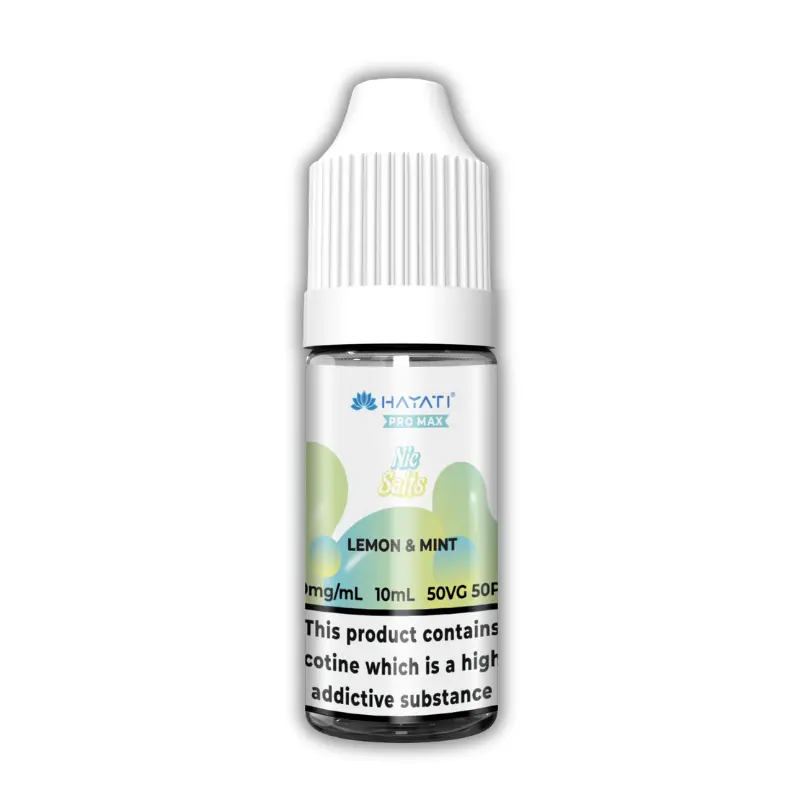
Ten millilitres, ten milligrams of nicotine salt, a fifty-fifty base and two words on the label. Lemon Mint is £2.49 and it sits on the Hayati Pro Max Nic Salts shelf with sixty-four other bottles priced the same way, which makes it one of the cheapest things Hayati sell and the cheapest of the three listings that carry this particular liquid. That is the commercial summary and it takes a line. The bottle has no hardware in it, no puff rating attached to it and nothing to charge, so most of what a product page normally spends its length on does not apply here.
What is left is the liquid and the catalogue it sits in, and this is the third page this site has written about that liquid. The Lemon & Mint 25K pods listing carries the same recipe as a bare refill and its page worked through what the word mint can and cannot promise in a vape, ending with the honest answer that the published facts do not settle it. The Lemon Mint Hayati Pro Ultra Plus 25000 Prefilled Pod Kit at £11.99 took the lemon apart draw by draw and counted what a platform commitment buys. Both of those arguments are finished and neither is going to be run again here.
Two things about this bottle are not in either of them, and both come out of counting rather than tasting. The first is a fact about the whole catalogue: Hayati apply a cold word to ninety-five product titles and have never once applied one to a lemon. There is no Lemon Ice among the 492 listings, no Lemon Frozen, no iced lime, no iced orange and no iced lemonade. The only three titles where a lemon and a cold word appear together attach the cold to a cola. So the single flavour concept in which Hayati ever describe a lemon as cooled at all is this one, and the word they use for the cooling is the name of a plant.
The second is a fact about the copy. Hayati wrote fresh descriptions for all three listings of this liquid, and the three do not say the same things. One of them names a category for the mint. It is this one, the £2.49 bottle, and that is a curious place for the most specific piece of writing in the set to end up. What follows sets out both counts, says what did not survive checking, and then stops short of the sensory question, because that question belongs to the pods page and it answered it as far as it can honestly be answered.
The treatment Hayati never apply to a lemon
The cooling vocabulary in this range has already been counted properly. The Blue Frozen Hayati Pro Max Nic Salts page ran the census across every title in the catalogue and published the totals: Ice on ninety, Frozen on three, Cooler on two, and Freeze and Chill on none at all, with no evidence anywhere that the words are graded against each other. That work stands, it has been checked, and there is no reason to repeat it.
The census asked which cold words Hayati use. It did not ask what those words are attached to. That is the question this page contributes, and the answer turns out to be sharper than the question deserves.
Fifty-seven lemons and not one of them cold
Fifty-seven of the 492 listings carry lemon or lemonade in the title. Fifty-four of them are filed on Lemon Vapes, which is the shelf this bottle appears on. Across all fifty-seven, the number that carry a cold word applied to the lemon is zero.
Three titles do put a lemon and a cold word in the same string, and all three place the cold somewhere else. Two of them are the Rubik pair, where the flavour is built on cola with a squeeze of citrus over it and the chill lands on the cola; Hayati's own copy for those describes the fruit as a slice in the glass rather than as the subject. The third is a Mini Ultra listing where the cold word belongs to a cola on one side of a divided pod and the lemon appears in a three-citrus blend on the other side entirely. In none of the three is anybody icing a lemon.
Widen it past lemon and the pattern holds. Twenty-four titles name lime and one of them carries a cold word, which is the same Mini Ultra listing where the word belongs to the cola. Seven name orange, and the cold count is the same listing again. Two name grapefruit and neither is cold. Nineteen name lemonade and not one of those is cold either. Twenty-one listings badge themselves as sour, which is the range's other way of advertising acid, and not one of those twenty-one is also badged cold. Every acid fruit Hayati sell is sold warm.
What ninety-five cold labels are attached to instead
Strip the cold word off each of those ninety-five titles and you are left with twenty-four distinct flavour stems. Written out they are banana, blackberry, blue, blue razz pineapple and strawberry, Bru, bubblegum, cherry, cola, grape, kiwi, lemon cola, lychee, mango, pineapple, red apple, red berry, smooth strawberry, strawberry, strawberry raspberry, a cranberry and cherry compound, Vim, Vimbull and watermelon.
Read that list as a group rather than as items. Every entry on it is a sweet fruit, a sweet soft drink, or a confection. There is not an acid-led flavour anywhere in it. Banana Ice Hayati Pro Max Nic Salts is soft sugar with a cold edge. Blackberry Ice Hayati Pro Max Nic Salts and Cherry Ice Hayati Pro Max Nic Salt are dark sweet fruit with the same treatment. Bru Ice Hayati Pro Max Nic Salt is a sugary orange soda with the same treatment. The stems that look tartest, kiwi and pineapple, are still fruits nobody describes as sour on their own.
That gives the gap a shape. Cooling in this catalogue is not distributed at random across flavours; it is distributed across sweet flavours, and it is the standard companion to sugar. The reason is not mysterious and has been noted elsewhere on this site in passing: a cold signal suppresses the perception of sweetness, so a liquid carrying a generous sweetener load reads as less cloying with cooling in it than without. Ice is a corrective, and what it corrects is sugar.
A lemon does not need that correction. Acid does the same job by a different route, and it does it for free, because the sharpness is already the flavour rather than something added to manage the flavour. Put a cooling compound on a lemon and you are applying a second corrective to a fruit that was never in danger of tasting sweet. You get a flavour that is doubly restrained and no more interesting, and you have spent an ingredient to get there.
Where the argument stops being a count and starts being a reading
This needs saying before the page builds anything on it. Everything above is a fact about labels. Titles are marketing copy, they are chosen by whoever writes the range, and a title is not an ingredients declaration. The count establishes that Hayati never advertise a lemon as iced. It does not, by itself, establish that no lemon in the catalogue has a cooling compound in it.
What makes the reading better than a guess is that Hayati label their cooling consistently everywhere else. Ninety-five titles announce it. The Blue Frozen page noted approvingly that its own listing goes further and names menthol specifically rather than saying cooling and leaving the agent unstated, and the Strawberry Mojito bottle page found the clearest case of all: the Fresh Menthol Mojito copy credits mint with a herbal coolness and credits menthol separately with pushing the chill further, two different words for two different jobs inside a single sentence. A manufacturer that distinguishes those two that carefully, on that many products, and then never once uses the cold vocabulary on a lemon, is at least telling you what it thinks it has made.
That is weaker than a specification and it should be treated as weaker. It is a consistent labelling practice, and a consistent labelling practice is evidence about labelling before it is evidence about liquid. The brief that commissioned this page put the conclusion more strongly, as a formulation choice rather than a labelling one, and counting does not get you that far. The narrowed version is what is written above: the labelling is a fact, and the formulation reading is an inference from it that a specification could overturn tomorrow.
One more title, and it is not a liquid
The census counted Ice, Frozen, Cooler, Chill and Freeze and found ninety-five titles. There is a ninety-sixth title with a frost word in it, and the census did not miss it so much as not ask about it, because the word is Frosted and Frosted was not in the vocabulary being counted. Frosted Mint is a nicotine pouch. It is filed on Mint Vapes alongside the liquids, it is the single title in 492 where a frost word and a mint word sit next to each other, and there is no e-liquid in it at all.
That is worth one paragraph rather than a section, and it is reported here because a count that only reports the results that flatter it is not a count. It does not disturb the finding. A pouch has no coil, no base ratio and nothing to vaporise, so whatever Frosted is doing in that name it is not doing it to a lemon or to a liquid.
Three listings of one liquid, and what the copy does not agree on
Hayati sell this recipe three times, and they wrote it up three times rather than pasting one description across all three. That is common across the range and it is useful, because a set of independent descriptions of the same liquid is the closest thing to an experiment the catalogue offers. Where all three agree you have something close to a fact. Where one of them says something the others do not, you have either the most interesting sentence about the product or a copywriter's variation, and saying which is the whole job.
What all three assert
The lemon leads. All three put it first in the sentence and all three attach a sharpness word to it: zesty and tangy on the pods, brightness and tang on the kit, a sharp zesty tang here. The mint follows rather than arrives together. All three place it at the finish, and all three say it cools. All three call the result crisp rather than sugary, and all three position the liquid away from the sweet end of the range. Nothing in any of the three suggests a third component, a fizz, a sweetened body or a candy treatment.
Four agreements across three independently written descriptions is a reasonably firm reading. A buyer can take it that the lemon is the subject, the mint is the finish, and the sweetener load is low by the standards of a range that also contains H’Bubba Hayati Pro Max Nic Salt and Mr Blue Hayati Pro Max Nic Salt. Beyond that the three start to diverge.
The noun that appears twice in 492
This bottle's flavour paragraph credits the taste to two things and names them as a pair: the citrus, and the herb. That second noun is doing more work than it looks.
Run the bare noun herb across all 492 descriptions in the catalogue and it returns exactly two listings. One is this bottle. The other is Strawberry Mojito Hayati Pro Max Nic Salt, which sits on the same shelf at the same price and whose page already counted the wider herb vocabulary across the range and published the figure. That count included the adjective, and this one deliberately does not, because the two behave differently.
The adjective herbal appears on thirteen listings, and eleven of those thirteen are products where mint is the entire recipe rather than a component of one: the Fresh Mint family across its formats, the Spearmints, the plain Menthol, the pouch. On those, herbal is describing a character. The noun herb is different. It names a category of ingredient, it says the thing in the bottle belongs to a class that is neither fruit nor confection nor sensation, and Hayati have used it twice in 492 descriptions. Both times, the mint is standing beside a fruit as a partner rather than being the whole liquid.
Two out of 492 is small enough to be meaningful and large enough not to be a typographical accident. Compare it with a word that is genuinely house vocabulary and the difference is obvious: descriptions in this catalogue reach for jammy, zesty and refreshing constantly, and those words carry no information because they are applied to everything. Herb is not that. It appears where somebody meant it.
What the other two listings say instead, and the correction that follows
The claim handed to this page was that only the bottle gestures at a plant. That is not quite right, and the corrected version is more interesting.
The kit description asks you to picture fresh lemon zest with a sprig of mint. Sprig is the only occurrence of that word in all 492 descriptions, and a sprig is unambiguously a piece of a plant. It is a botanical image rather than a category word, but it is a botanical image, and a page claiming the kit copy says nothing about a plant would be wrong. So the honest count is that two of the three listings point at a plant and they do it in different registers: the bottle names the class, the kit draws the picture.
The third one does neither, and its silence is the most informative part of the set. The pods listing opens by calling the whole thing a fresh, cooling citrus flavour. Not a citrus and herb flavour. A citrus flavour that is cooling, with the mint demoted to something that follows through at the finish. Of the three descriptions, that is the only one whose opening sentence would be equally accurate if the mint in the bottle were a compound with no smell at all.
Three writers describing one liquid, and the one who was writing the bare refill wrote the version most compatible with there being no plant in it. That is not proof of anything about the recipe. It is a reminder that the evidence here is three pieces of prose, produced at different times for different price points, and that they were not coordinated.
The second claim, narrowed
The other thing this page was told is that only the bottle places the liquid within the range. Checking that against the three descriptions does not support it as stated. All three position the liquid against something. The pods copy aims it at buyers who find the candy and bubblegum end of the range too much. The kit copy calls it a sensible choice if heavy candy or dessert flavours are not for you. Both of those are placements.
What is true, and what survives the check, is narrower and better. Those two placements are negative. They tell you what the liquid is not near. This bottle's placement is the only positive one in the set: it puts the liquid somewhere between two named groups, the range's pure mints on one side and its citrus blends on the other. That is a coordinate rather than an exclusion, it names two groups that actually exist on the shelf, and it is checkable against the catalogue. The pure mints on this shelf are Fresh Mint Hayati Pro Max Nic Salt, Spearmint Hayati Pro Max Nic Salts, the plain Menthol and arguably Black Mint Hayati Pro Max Nic Salt. The citrus blends are Lemon Lime Hayati Pro Max Nic Salt and the lemonades. Hayati are telling you the liquid falls between two identifiable sets of their own products, which is a more useful sentence than anything in the other two descriptions.
Which listing publishes what
One more difference across the three, and it is the one that most buyers would actually want.
The product data for the two Pro Ultra Plus listings gives a capacity of 22ml and a nicotine strength of 20mg and leaves the base ratio blank. Neither of them publishes a VG/PG split at all. This bottle publishes 50/50. It is the only one of the three listings of this liquid that says anything whatsoever about the composition of the base, and it is the one costing £2.49.
That inversion runs through the whole set. The cheapest listing is the most documented listing. It is the one that names a base ratio, the one that names a class of ingredient for the mint, and the one that gives a positive placement inside the range. The £11.99 listing publishes a device and a capacity and lets the liquid look after itself. If you were deciding which of the three descriptions to trust as a source of information about the recipe, you would pick the one attached to the smallest bottle, which is not how anybody expects a catalogue to work.
Why a word in a description is still weaker than a line on a specification
All of the above is copy analysis, and copy analysis has a ceiling. It needs stating plainly rather than left to be inferred.
The word coolant does not appear anywhere in the 492 descriptions. Neither does any trade name for a cooling compound. Hayati publish no ingredient declaration for any product in this range, no concentration figures, and nothing that would let a buyer distinguish an aroma from a sensation on paper. What they publish is flavour prose, and flavour prose is written to sell rather than to specify. A copywriter chose the word herb. A formulator did not sign it.
So the finding is modest and worth having anyway. Hayati's own house language treats mint and menthol as different things, uses cold vocabulary heavily and never on a lemon, and on one of three listings of this liquid reaches for a word that names a plant. Taken together that is a consistent set of signals pointing the same way. It is not a specification, it could be overturned by one line of a specification, and anybody who tells you it settles the matter has promoted a copywriting decision to a formulation fact.
The question this page is not going to answer
Whether the cooling in this liquid comes from a mint aroma, from a compound dosed alongside it, or from both at once, is the question the Lemon & Mint 25K pods page exists to address. It sets out why the two are different in kind, why formulators usually choose the sensation, what each version would taste like, and how a buyer can settle it on the first draws of a fresh pod. Its conclusion is that the published facts do not resolve it and that the resolution has to come from the product rather than the page.
Nothing here overturns that and nothing here is meant to. What this page adds is the catalogue context that page did not have room for: that the absence of a cold badge on this liquid is not an isolated omission but part of a pattern covering every acid fruit in the range. That makes the second of its two readings, the one where the cooling here is genuinely milder than the level that earns a cold badge, slightly better supported than it was. Slightly. The sensory question goes back where it came from.
A correction to something this site has published
Reading the sibling pages turned up a disagreement between two of them, and leaving it in place would be worse than naming it.
The Lemon Vapes shelf page, in the section that groups the cooled and minted listings, states that mint cools by aroma rather than by a dedicated cooling agent, and states it flatly, as a property of the liquid. The pods page for the identical product says the opposite in effect: that the published facts do not reveal which mechanism is present, that the trade routinely uses compounds producing a cold signal with no smell, and that a buyer cannot tell from the listing. The Mint Vapes shelf page takes the same cautious line and defers to the pods page on it.
Two of our pages cannot both be right. The supportable position is the pods page's. Hayati publish nothing about the cooling agent in this liquid, and a page that says mint cools by aroma is doing exactly what the range's own naming has been used to justify above, which is reasoning from a label to a formulation and then stating the result in the same voice as a price. That the reasoning points the same way as this page's count does not make it safe. A count of labels supports a hedged inference; it does not support a flat assertion. The shelf page overstates it and this page does not follow it.
This matters practically rather than pedantically. A buyer who reads the shelf page and concludes the cooling is purely aromatic will expect it to fade as a coil tires, because aroma does. A buyer who is actually holding a liquid with a compound in it will find the cold is the last thing to go. Those are different experiences of the same bottle, and a page should not choose between them on the strength of a title count.
The liquid, as far as a third page can honestly take it
The lemon in this recipe has been analysed properly already. The kit page worked through how a citrus can be built from juice, zest or pith, which of those Hayati's description points at, why the sweetness sits low, and the consequence of a two-component liquid having a busy front, a busy finish and not much in the middle. That analysis applies to this bottle unchanged, because it is the same recipe, and there is no version of redoing it that would not be a worse copy of it.
What is left for this page is the two things that are different about the bottle rather than the liquid.
Ten milligrams, and what a lower figure does to a two-note flavour
The bottle is 10mg. The two prefilled listings are 20mg. That is a plain difference in the product data and it is the largest single difference between this listing and its siblings after the format.
Nicotine is not flavourless. It carries a dry, faintly peppery, slightly bitter character of its own, and it contributes to the physical sensation at the back of the throat. In a liquid with a heavy sweetener load and three or four fruits stacked up, that contribution disappears into the mix and nobody notices it. In a two-note liquid with low sweetness, made of a sharp citrus and a finish, there is much less material for it to hide behind. Halving the figure therefore changes the texture of this particular recipe more than it would change the texture of Mango Peach Pineapple Hayati Pro Max Nic Salt or Blueberry Raspberry Lemon Hayati Pro Max Nic Salt, both of which have a fruit body to absorb it.
That is stated as a description of how a thin recipe behaves, not as a recommendation. Nobody should pick a strength off a product page, 10mg is the figure on this bottle and 20mg is the figure on the other two, and both are what they are.
An even base under a liquid with almost no body
Fifty-fifty is the base on every bottle in this line, so the number itself distinguishes nothing. What is worth a paragraph is what an even base is actually doing underneath this specific recipe, because the answer is less than usual.
The propylene glycol half is the better carrier for light, volatile aromatic material and it is the half that produces the sensation at the throat. The vegetable glycerine half is heavier, faintly sweet on its own, and it is what gives a liquid body and visible vapour. Most recipes on this shelf have something for the glycerine to support: a berry has weight, a cola has depth, a confection has a sugary middle. A sharp citrus with a cooling finish has almost none. Nearly everything in this bottle lives in the light fraction.
The practical consequence is that a fifty-fifty base here behaves closer to how a higher-PG base behaves elsewhere, in the sense that the flavour is front-loaded and the body is thin. That is not a fault and it is the same property the kit page identified as a thin middle, arriving here from the base rather than from the recipe. It also means this is a liquid with very little insulation. There are two components. Lose either one and you notice immediately, which is not true of Blackcurrant Lemonade Hayati Pro Max Nic Salts or of the three-fruit blends.
What it is not
It is not a lemonade. There is no fizz, no carbonated impression and no diluted sugar-water base, which is the entire architecture of Pink Lemonade Hayati Pro Max Nic Salt, Berry Lemonade Hayati Pro Max Nic Salt and Blue Razz Lemonade Hayati Pro Max Nic Salt. It is not a mojito construction, which pairs mint with lime over a sweet body and, in Hayati's case, usually adds a fruit on top. It is not a menthol bottle and it is not badged as one; Hayati file their twelve menthol listings on a separate shelf from the mints, and not one of those twelve contains a lemon either. And it is not a cooled fruit in the sense that the ninety-five iced titles are cooled fruits, because it has never been given their badge.
The numbers, and which of them tells you anything
Six lines of published data, ordered by how much they actually decide.
| Base ratio, as published | 50/50 VG/PG. The only composition figure any of the three listings of this liquid publish. |
| Nicotine, as printed on the listing | 10mg per millilitre, salt. Half the figure carried by the two prefilled versions. |
| Volume and price | 10ml at £2.49, which is 24.9p per millilitre before anything is wasted. |
| Flavour field in the product data | Lemon Mint. No secondary profile is recorded, unlike the Spearmint listing which carries one. |
| Stock code | HPM-NS-LEMON-MINT. |
| Shelf filing | Hayati Pro Max Nic Salts, Hayati E-Liquids, Lemon Vapes, Mint Vapes, New Products. |
| Cooling agent | Not published. No cooling compound is named on this listing or on any of the 492. |
| Intended hardware | Refillable pods and low-power mouth-to-lung devices, with a higher-resistance coil recommended by Hayati. |
The base ratio is at the top because it is the only line here that is genuinely scarce information, for the reason set out above: the two more expensive listings of this same liquid do not give it. Everything else in the table is either shared with sixty-four other bottles, in the case of the strength and the volume and the ratio itself, or is administrative.
The price per millilitre deserves a word because it is the number people compare and it is the number that misleads. Twenty-four point nine pence per millilitre is what the liquid costs before it reaches a coil. What you actually pay per millilitre consumed depends on how much stays in a wick you retire, how much evaporates out of a bottle that is opened repeatedly, and how much you spill refilling. None of that is captured by the arithmetic, and the gap between the two figures is proportionally larger on a 10ml bottle than on a 120ml one, which is one of the honest arguments for Lemon Lime Hayati Pro Max 50/50 Shortfill E-Liquid as a format if you have already settled on a citrus and want it in quantity.
The filing line is more interesting than it looks. Of the 492 listings, the Lemon Vapes shelf holds fifty-four and the Mint Vapes shelf holds nineteen, and the two shelves overlap on exactly three products, all of which are this liquid. Narrow to this bottle's own shelf and the number becomes one: of the sixty-five bottles in the Pro Max Nic Salts line, eight carry a lemon or a lemonade and five carry a mint or a menthol, and Lemon Mint is the only bottle that is in both sets. It is also worth noting that Mint Vapes and Ice Vapes, as shelves, share no products at all. The filing keeps the two cooling families apart just as firmly as the titles do.
Where it sits among sixty-five bottles
Everything on this shelf is £2.49 and 10ml and 10mg, with a single exception priced at £2.79, so the choice between them is purely a choice of flavour. That is unusual and it makes the shelf easy to reason about. What follows is organised by what you came for.
If the mint is what you came for
This is the wrong bottle, and the shelf has four better answers. Fresh Mint Hayati Pro Max Nic Salt is the one Hayati describe in terms of a green herbal taste rather than pure cold, and its page has already done the work on what a volatile herb asks of a 10ml bottle. Spearmint Hayati Pro Max Nic Salts is the only listing in the range that names an actual species, and it is the softer and sweeter reading of mint; its page covers what mint does to a coil in detail. Black Mint Hayati Pro Max Nic Salt puts a dark note under the mint for more weight. The plain Menthol bottle is the opposite end, filed on a different shelf and built around the sensation rather than the taste.
Against all four of those, Lemon Mint has a fruit in the front half of every draw, and that fruit is the loudest thing in the bottle. Buying it for the mint is buying a supporting part.
If the lemon is what you came for
Then the question is what you want beside it, because Hayati do not sell a solo lemon. Lemon Lime Hayati Pro Max Nic Salt is the closest thing to a pure citrus on the shelf and it puts a second acid fruit alongside the first, greener and more tart, with nothing to soften it. Lemon Peach Passionfruit Hayati Pro Max Nic Salt goes the other way and puts soft fruit underneath, which fills the middle that a two-note liquid leaves empty. Blueberry Raspberry Lemon Hayati Pro Max Nic Salt demotes the lemon to an accent on two berries.
The sorting rule between those and this one is simple. Lemon Lime keeps the lemon sharp and adds more sharpness. Lemon Mint keeps the lemon sharp and adds a finish of a different kind. The three-fruit bottles keep the lemon and bury it. If what you want is a citrus that stays legible to the last millilitre, the first two are the candidates and the third is not.
If it is the lemonade idea you liked
Different architecture, and the shelf is well supplied. Pink Lemonade Hayati Pro Max Nic Salt softens the citrus with red fruit. Berry Lemonade Hayati Pro Max Nic Salt is the unspecific one, a mixed-berry base under a sharp lift. Blue Razz Lemonade Hayati Pro Max Nic Salt takes the same idea into candy territory, and Blackcurrant Lemonade Hayati Pro Max Nic Salts is the darkest and most specific of the four. All four carry a sweetened body that Lemon Mint does not have. If the bottle you are holding tastes austere and you wanted refreshment, it is one of those you actually wanted.
If the cold is the point
Then the honest advice is to buy a bottle that advertises it, because this one does not, and the whole first half of this page is about the fact that Hayati have never claimed it does. Blue Frozen Hayati Pro Max Nic Salts is the cold-led bottle on this shelf and its listing says so in plain words. Cherry Ice Hayati Pro Max Nic Salt, Blackberry Ice Hayati Pro Max Nic Salts and Banana Ice Hayati Pro Max Nic Salts are the fruit-first versions, where the cooling is applied over the fruit rather than being the subject. Black Mamba Hayati Pro Max Nic Salts is filed with the menthols despite naming no fruit at all.
Nothing on that list is in competition with this bottle. They are solving a different problem, and the count in the first section is the reason: they are all sweet material with a corrective applied, and this is acid material with no corrective needed.
If you wanted a drink rather than a fruit
Cola Lime Hayati Pro Max Nic Salt is the nearest thing to this bottle's logic on the drinks side: a sweet base cut with a citrus, where the citrus is there to stop the sweetness accumulating. Cherry Cola Hayati Pro Max Nic Salt takes the fruit in the other direction and adds weight instead of cutting it. Bru Ice Hayati Pro Max Nic Salt is the one that puts a cold finish on a soda. And Hayati Pro Max Shisha Nic Salts is the other bottle on this shelf where mint runs through a fruit blend rather than being the flavour, though its title does not say so and the mint there sits between an apple and a grape rather than beside a citrus.
If you want this exact liquid in more of it
The 22ml prefilled versions are the route, and the difference between them is only the hardware. The Lemon Mint Hayati Pro Ultra Plus 25000 Prefilled Pod Kit at £11.99 puts a device in the box and the pod is rated by the manufacturer at up to 25,000 puffs, a laboratory figure produced by equipment repeating one identical draw at a fixed interval rather than a forecast of anybody's fortnight. The Lemon & Mint 25K Pods listing at £7.99 is the same pod without the device, for anyone who has the hardware already. Check the range name on your device against the range name in this title before ordering either.
Worth being blunt about the arithmetic in the other direction, though. This bottle is the same flavour idea at a quarter of the pod's price and a fifth of the kit's. The Lemon Vapes shelf page makes that point already and treats the bottle as a diagnostic rather than a purchase, which is right as far as it goes. What it did not add is the reason the bottle is the better diagnostic and not merely the cheaper one: it is the only one of the three that publishes a base ratio, and it is the only one where the coil is yours. Those are both relevant to the open question, for the reason in the next section.
Shelves rather than single bottles
If none of the above narrows it, the three shelves worth reading through are Lemon Vapes for the fifty-four listings that carry a citrus, Mint Vapes for the nineteen that carry a plant word and for the three-way split its page sets out between mint as a plant, mint as a sensation and mint as a modifier, and Hayati E-Liquids for the hundred and five bottles across every strength and format Hayati sell. The whole catalogue is at all Hayati products if you would rather browse than filter.
Living with a bottle whose agent is unpublished
The generic version of this advice has been written several times on this site and there is no point in a sixth copy. The Spearmint page covers priming a fresh coil and what mint residue does over a pod's life. The Fresh Mint page covers headspace, why the last quarter of a mint bottle is the most exposed part, the ghosting problem when a pod has held something sweet, and why a herbal liquid gains nothing from being left to stand. All of that transfers here without modification and none of it is repeated.
What belongs to this bottle and to nothing else is one thing, and it follows directly from everything above.
The coil is yours, and that is the only lever any of this gives you
Of the three listings carrying this liquid, two are factory-filled pods with the coil sealed inside them. The coil resistance is not published, the power is not adjustable, and there is no version of either product where a buyer influences how hot the liquid runs. This bottle is the exception. You choose the pod, you choose the coil resistance, and on most devices you choose the power.
That lever matters here specifically because of the open question. The two candidate mechanisms behave very differently under heat. A cooling compound is comparatively heavy and unreactive and its effect is close to indifferent to how hard you run it; it will be there at the bottom of the power range and it will be there at the top. A volatile green aroma is not indifferent at all. It is the lightest material in the bottle, it is the first thing driven off by sustained heat, and it is the first thing lost as residue builds on a wick.
So whatever is actually in this liquid, the bottle is the only format in which the question has a practical consequence you can act on. Hayati's own note on the listing, which is to pair it with a higher-resistance mouth-to-lung coil, points the same way, and a higher-resistance coil run at the lower end of its range is the condition under which a fragile aroma has the best chance of surviving and under which a cooling compound loses nothing. That is not a procedure and it is not a test. It is the reason the recommendation on the listing is worth following on this liquid more than on a berry.
Two components and nothing in reserve
A three-fruit blend degrades gracefully. Lose the top note and there is still a middle and a base, and the liquid goes from interesting to ordinary rather than from working to broken. This one has a citrus and a finish. There is no third element underneath either of them.
The consequence is that a tiring coil is audible here sooner than on almost anything else on the shelf. Citrus is the first casualty on a wick carrying residue, because the part of a lemon that identifies it as a lemon rather than as generic sharpness is exactly the light aromatic fraction that residue mutes. Lose that and what is left is a sharp edge with no fruit attached to it. On Mango Peach Pineapple Hayati Pro Max Nic Salt the same amount of coil wear would be a nuisance. Here it removes half the product.
What to keep it away from
Citrus oils are aggressive towards some plastics over time, which is a general property of the material rather than anything Hayati publish about this liquid, so it is worth treating the bottle as something to store rather than something to leave standing in a warm car or on a windowsill. Upright, capped, cool, dark, and somewhere children and pets cannot get at it. An empty bottle is ordinary plastic once rinsed, and whether your local collection takes it is a local question worth checking rather than assuming.
The one thing that will not degrade
Worth ending this section on the asymmetry, because it is the practical residue of the whole argument. If the cooling in this bottle turns out to be a compound, it is the most durable thing in the liquid and you will still have it on the last millilitre of a tired coil. If it turns out to be a plant, it is among the least durable, and it will go at roughly the same point the lemon starts to flatten. A buyer who finds the cold outlasting the fruit by a wide margin has learned something about the recipe. A buyer who finds them fading together has learned something else. Neither of those is a test anybody needs to run on purpose; it is just what the bottle will tell you if you are paying attention over 10ml.
Questions this bottle raises
Is this the same liquid as the Pro Ultra Plus pods and kit?
Yes, as far as anything published goes. It is the same flavour concept sold at three price points across two formats, and the Mint Vapes shelf page establishes that directly. The strength differs, 10mg here against 20mg on both prefilled versions, and the volume differs, 10ml here against 22ml. Hayati do not publish anything that would let you tell whether the recipe itself is identical or merely the same idea.
Why does the title say Lemon Mint here and Lemon & Mint on the pods?
Hayati use both spellings for the same flavour and the split does not follow the format or the platform. The Mint Vapes shelf page notes the inconsistency and it is one of several in the catalogue. It has no meaning beyond making the product harder to search for, which is a real annoyance if you are trying to find all three listings at once.
Is there menthol in it?
Not according to the listing, which names mint and does not name menthol. Hayati are reasonably careful about the distinction elsewhere: the Fresh Menthol Mojito bottle credits mint and menthol separately in one sentence, and the Blue Frozen listing names menthol explicitly. Whether the absence of the word here means the absence of the compound is the question this page has deliberately handed back to the Lemon & Mint pods page.
Is it cold, then?
Hayati describe the mint as adding a fresh, cooling edge at the finish, and all three listings of this liquid say something similar. What none of them say is how much, and this product has never been given one of the ninety-five cold badges the range uses. On the evidence, expect a finish rather than a front. If you want something that is definitely cold, Blue Frozen Hayati Pro Max Nic Salts says so on its own listing.
How sweet is it?
Low by the standards of this shelf. All three listings call the pairing crisp rather than sugary and all three aim it away from the confectionery end of the range. That said, both acid and cooling suppress the perception of sweetness, so a liquid built on both can carry more sweetener than it tastes like it carries, and perceived sweetness is the only part of that a buyer can judge.
Why is it only 10mg when the pods are 20mg?
Every bottle on the Hayati Pro Max Nic Salts shelf is 10mg, so the figure is a property of the line rather than a decision about this flavour. The prefilled pods across the range are filled at 20mg. There is nothing in the product data explaining the difference and no strength option is offered on this listing.
What does 50/50 mean for this liquid in particular?
It is an even split of vegetable glycerine and propylene glycol, and it is the base on every bottle in this line. What is specific here is that this recipe has very little for the glycerine half to support, being a sharp citrus and a finish with no sweetened body between them, so the liquid behaves as front-loaded and light rather than round. It is also the only one of the three listings of this flavour that publishes a ratio at all.
What hardware does it want?
Refillable pods and low-power mouth-to-lung devices, with Hayati recommending a higher-resistance coil on the listing itself. It is not intended for high-power sub-ohm setups, where the strength and the thin base are both a poor match. That recommendation is worth following more closely here than on a fruit bottle, for the reasons in the handling section above.
Is there a bigger bottle of this flavour?
Not of this flavour. Hayati's larger formats in the citrus direction run to Lemon Lime Hayati Pro Max 50/50 Shortfill E-Liquid at 120ml, which is a different recipe and supplied without nicotine. For more of this exact liquid the only routes are the 22ml prefilled pod and the kit, both at 20mg.
Why does a lemon never get an Ice badge in this range?
That is the count this page contributes. Across fifty-seven lemon and lemonade titles, twenty-four lime, seven orange, two grapefruit and twenty-one sour-badged listings, not one carries a cold word applied to it. The twenty-four flavour stems that do carry one are all sweet fruit, sweet soda or confectionery. The reading is that cooling in this catalogue is applied to sugar, and a lemon has nothing for it to correct.
Is this a mojito?
No. A mojito construction pairs mint with lime over a sweetened body, and Hayati's versions usually add a fruit on top of that, as Strawberry Mojito Hayati Pro Max Nic Salt does. This is two components, the citrus is a lemon rather than a lime, and there is no sweet base underneath. The two bottles share a shelf and a price and very little else.
Is it a good bottle to keep alongside something sweeter?
It works in that role, which is the common reason people buy a low-sweetness citrus. A sharp bottle reads as a contrast after something like H’Bubba Hayati Pro Max Nic Salt or Cherry Cola Hayati Pro Max Nic Salt. One caution: the Spearmint page's point about a mint leaving something behind in a wick applies to this liquid too, so a pod that has held this will put a faint edge under whatever goes in next.
The short version
A 10ml bottle at £2.49, 10mg nicotine salt on a fifty-fifty base, carrying a lemon that leads and a mint that finishes. The flavour analysis belongs to the two Pro Ultra Plus pages that came first, and the question of what the mint actually is belongs to the pods page, which established that the published facts do not resolve it and set out how a buyer can.
What this listing adds is two counts. Hayati put a cold word on ninety-five titles and have never put one on a lemon, a lime, an orange, a grapefruit or a lemonade; the twenty-four flavour stems they do cool are all sweet, which suggests cooling in this range is a corrective for sugar rather than a treatment for fruit in general. And of the three descriptions Hayati wrote for this one liquid, this bottle's is the only one to name a class of ingredient for the mint, using a noun that appears twice in 492 descriptions, and the only one to place the liquid positively between two groups of its own products rather than merely away from the sweets. It is also the only one of the three that publishes a base ratio, which makes the cheapest listing the best documented one.
Both counts are about labels and copy, and neither is a specification. Hayati publish no ingredient declaration and no cooling agent for anything in this range, so a consistent pattern in the writing is the strongest evidence available and it is still not strong. Anyone whose decision turns on whether the mint is a plant or a compound should read the Lemon & Mint pods page and settle it on the product. Anyone who wants a low-sweetness citrus with a cool finish, in the cheapest and most adjustable format Hayati sell it in, is already holding the right listing.
Strictly for adults aged 18 and over. Nicotine is an addictive substance.
You might also like


