
Home / Hayati Pro Max Nic Salts / Berry Lemonade Hayati Pro Max Nic Salt
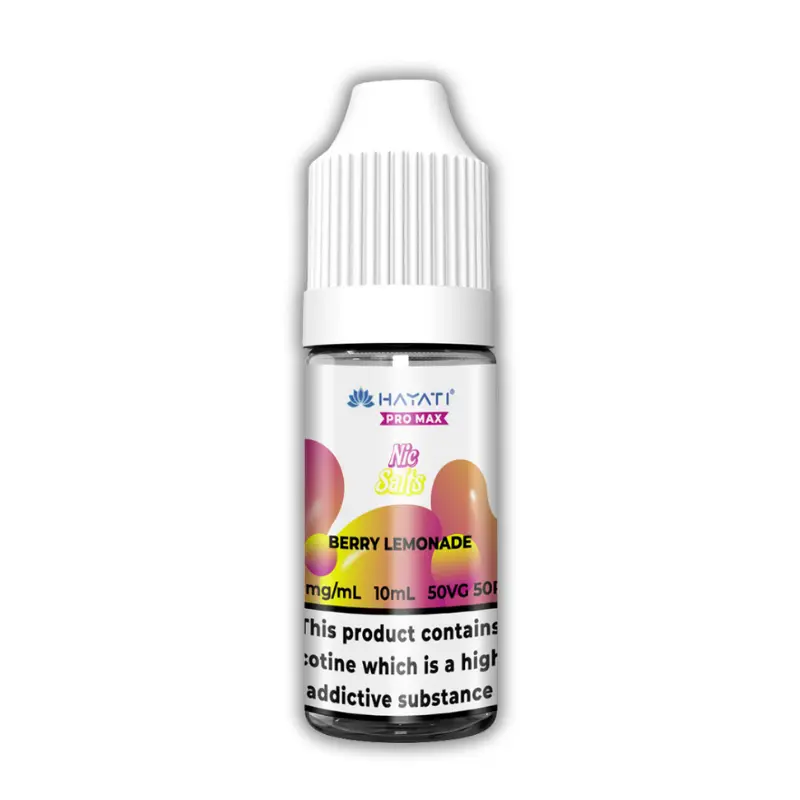
Hayati · Pro Max
Berry Lemonade Hayati Pro Max Nic Salt
£2.49
✔ In stock — ready to ship
Genuine Hayati
Free over £20
Same-day dispatch
Secure checkout
Berry Lemonade arrives as a 10ml bottle of 10mg nicotine salt at £2.49, mixed 50/50, and sits on the Hayati Pro Max Nic Salts shelf alongside sixty-four other bottles. That is the whole of the commercial description, and it is the same description sixty-three of its neighbours carry. What the liquid tastes like has also already been worked out at length, twice, on the two prefilled listings of the same recipe: Berry Lemonade Hayati Pro Max Plus 6000 Pod Kit takes the accord apart draw by draw and settles that the name contains no fruit and no drink, only a category and a treatment, and Berry Lemonade Hayati Pro Max Plus Pods grades the same liquid against six requirements of a default flavour and finds it excellent on palate neutrality and unreliable on consistency. Both of those are settled. This page does not re-open either.
There is something else on this listing worth an argument, and it is not in the liquid. It is in the sentence Hayati wrote about it. Most product copy on this catalogue talks about one product. This one talks about two others, names them, and then tells you this bottle is the vaguer of the three. Copy that recommends its own neighbours is unusual enough that it is worth asking how often it happens, where it happens, and whether a buyer can do anything with it.
So that is what this page is: a census of every place in Hayati's 492 listings where the copy points at a different flavour in the range, and a method for deciding which of those signposts you should act on and which you should ignore. The short finding is that the bottle shelf is where Hayati signpost. Twenty of its sixty-five listings name at least one other flavour, against forty-seven of the remaining four hundred and twenty-seven everywhere else. Roughly three bottles in ten carry a pointer; roughly one listing in nine does anywhere else. If you buy 10ml bottles, the copy is quietly running a recommendation engine for you and nobody has read it back.
The payoff for this particular bottle is not flattering and it is accurate. Hayati's own copy files Berry Lemonade as the unspecified rung of a four-bottle lemonade set. This page agrees with that filing rather than arguing against it, and spends its length on why the filing is trustworthy, where its limits are, and what a buyer should do with it.
What a cross-reference is, and what it can be evidence of
Define the object first, because the whole census depends on the definition being tight enough to count.
A cross-reference, for the purposes of this page, is a place in a product description where the copy names a different flavour from the Hayati range as a product. Not as an ingredient, not as a description of a taste, but as a thing sitting somewhere else in the catalogue that you could buy instead of, or as well as, the one you are reading about. Berry Lemonade's description contains two of them. It names Blackcurrant Lemonade and it names Blue Razz Lemonade, and both are real listings at the identical £2.49 a few squares away.
The capitalisation test, and why it does most of the work
The distinction between naming a product and describing a taste is not always obvious from the words, and getting it wrong inflates the count badly. Run a plain search for flavour names inside descriptions and you get a great many hits that are nothing of the kind. The blackberry bottle's copy mentions a bowl of mixed berries; Mixed Berries is also a real flavour on the Pro Max Plus platform, but nobody reading that sentence is being sent anywhere. The strawberry confectionery bottle mentions a gummy bear sweet; Gummy Bear is also a bottle on this shelf. Neither sentence is a signpost. Both are ordinary English that happens to collide with a product name.
What separates them reliably, across all 492 listings, is capitalisation. When Hayati mean the product they capitalise it, because it is a proper name. When they mean the taste they do not. The difference is visible in the same sentence more than once on this shelf: one bottle's copy describes itself as more layered than a straight blue raspberry in lower case, and in the same breath sends you to Mr Blue and Mad Blue in upper case. The writer knew which was which even if the style sheet never said so.
Applying that test cuts the count hard. A case-blind sweep of the catalogue turns up seventy-five listings with a flavour name in the text. Requiring the capital letters brings it to sixty-seven. The eight that fall away are all descriptive uses of phrases that also happen to be products, and dropping them is the difference between a count that means something and a count that flatters itself.
The caution behind that comes from an existing page on this site. The Blackcurrant Lemonade Hayati Pro Max Plus 6000 Pod Kit page established that a word's presence in Hayati's copy means nothing until you know how often the house uses it: jammy turns up on twenty-seven listings, so it carries no information at all, while squash appears exactly once in 492 and therefore carries a great deal. That test is theirs and I am applying it rather than rediscovering it. Lower-case blue raspberry is the house vocabulary case in its purest form. It appears across dozens of listings as the standard gloss on what blue razz means, and treating any of those as a recommendation would have put roughly a fifth of the catalogue into a census it does not belong in.
What the reference is evidence about
Now the harder question, which is what a signpost actually tells you.
It is strong evidence about how the copy was written. When a description says that this bottle is the lighter alternative to another named one, you know for certain that the person writing it had the other listing in front of them, held the two in mind at the same time, and made a judgement about how they differ. That is a real editorial act and it leaves a real trace. You are reading somebody's substitution set, which is to say the small group of products they considered near enough to this one to be worth mentioning in a paragraph of eighty words.
It is much weaker evidence about the liquid. The copywriter is not necessarily a taster. The relationship they assert between two flavours may have come from a tasting, or it may have come from reading both names and reasoning about them, which is a thing this catalogue's copy demonstrably does elsewhere. A sentence claiming one bottle is darker than another could be a tasting note or it could be an inference from the words blackcurrant and strawberry. Nothing in the listing tells you which.
So the honest reading of a cross-reference is this. It reliably tells you which products Hayati consider adjacent, and adjacency is genuinely useful information when you are shortlisting sixty-five bottles that all cost the same. It does not tell you that the two liquids taste the way the sentence says they do. Treat the pairing as trustworthy and the comparison inside it as a hypothesis. That distinction sounds fussy and it is the difference between using the network well and being led about by it.
There is one more property worth naming before the count. A cross-reference costs the retailer something. Every sentence that names a neighbour is a sentence not spent selling the product it sits on, and two of the ones in this census actively send the reader elsewhere. Copy that does that is doing something other than pushing a unit, which is a reason to take it slightly more seriously than the surrounding adjectives.
The census: counting signposts across 492 listings
The method, stated so you can repeat it
Take every distinct flavour name Hayati use anywhere in the catalogue, which comes to a hundred and sixty once the dual listings are split at the oblique into their two halves. Search every product description for each of those names, with word boundaries, matching the capital letters. Discard any hit where the name is part of the product's own title, so that a divided pod naming its own second half does not count as pointing anywhere. Discard any shorter name wholly contained inside a longer one that also matched, so that a listing naming Strawberry Cherry Cranberry is not also recorded as naming Cherry. What is left is a list of listings that name a flavour other than themselves.
Single-word flavour names need one extra guard. Menthol, Spearmint, Cola, Rainbow, Bubblegum and a handful of others are real products, and they are also ordinary words that start sentences. A capitalised Menthol at the beginning of a sentence tells you nothing, so those names only count when they appear mid-sentence. That adds three edges to the total, all of them real: the mint bottles genuinely do refer to each other.
The result, and the two figures I had to correct
Sixty-seven of the 492 listings carry at least one cross-reference. That is one listing in seven, across every format Hayati sell.
The distribution is the interesting part. Twenty of the sixty-five bottles on the Pro Max Nic Salts shelf carry one, which is thirty-one per cent. Forty-seven of the other four hundred and twenty-seven listings carry one, which is eleven per cent. The bottle shelf signposts at close to three times the rate of everything else in the catalogue.
Two numbers I was handed did not survive the count and both needed adjusting. The figure given to me for the catalogue-wide total was sixty-four and the correct figure by this method is sixty-seven. The gap is the three mint edges that a two-word-minimum search misses, and I have kept them because Spearmint and Menthol are as much products as Cherry Cola is. The shelf figure of twenty was right, though it was quoted against a shelf of sixty-four and the shelf holds sixty-five. Sixty-four of those bottles are £2.49 and one, a family listing rather than a single flavour, is £2.79. I have counted the shelf as sixty-five throughout, because the census is about what the copy does and the family listing has copy like any other. It happens to name nobody.
The rate comparison survives the correction comfortably. Roughly a third against roughly a tenth was the claim, and thirty-one per cent against eleven per cent is what the catalogue says.
Why the bottles and not the pods
An explanation is worth offering here, clearly labelled as one, because the census establishes the pattern and not its cause.
The most likely reason is arithmetic. A 10ml bottle is £2.49. Sending a reader from one bottle to another costs the retailer nothing at all, because the two transactions are identical in value and the reader may well buy both. Sending a reader from an £11.99 kit to a different £11.99 kit is the same trade, but sending them from a kit to a pod, or from a pod to a kit, is not, and most of the catalogue outside this shelf is built from kit and pod pairs where the two SKUs of one flavour differ in price by several pounds. Copy in that situation has something to lose by pointing sideways. Copy on a shelf of identically priced 10ml bottles does not.
A second possibility, not exclusive of the first, is that the bottle shelf is simply the densest cluster of near-identical products in the catalogue. Sixty-five liquids, one format, one strength, one ratio, one price. The only thing separating them is flavour, so flavour comparison is the only thing the copy can usefully do, and comparison naturally reaches for the neighbour's name. On a kit listing there is hardware to talk about and the copy talks about it instead.
I cannot distinguish those two explanations from the catalogue alone and neither can you. What matters for a buyer is that the effect is real and reproducible, whatever causes it.
Load-bearing or decorative: four questions to put to a signpost
Not every cross-reference is worth the same. Some are a genuine instruction you can follow to the basket in one click; some are scene-setting. Four questions separate them, and they are quick enough to run in your head while you read a listing.
One: does the name resolve to a product you can buy
This is the capitalisation test again, applied at the point of purchase rather than at the point of counting. If the phrase is lower case it is almost certainly a taste description and there is nothing behind it. If it is capitalised, check that a listing of that exact name exists, because a capitalised phrase can still be a flourish.
On the bottle shelf this filter removes nothing at all. All twenty-eight cross-references on the nic salt shelf resolve to a real listing. That is a stronger result than I expected before running it and it is worth taking seriously: on this shelf, if the copy capitalises a flavour, that flavour exists.
Two: does it resolve to a bottle, or to a pod
Here is the filter that matters most, and the one where the bottle shelf turns out to behave very differently from the rest of the catalogue.
Every one of the twenty-eight bottle-shelf references points at another bottle on the same sixty-five-product shelf, and every one of those bottles costs the identical £2.49. Not one of them sends you to a pod, a kit, a shortfill or a different platform. A reference on this shelf is therefore always actionable in the simplest possible sense: the thing named is a swap you could make at no extra cost, in the same format, at the same strength, in the same ratio.
Contrast what a reference does elsewhere. On the prefilled shelves a signpost frequently points at a different format of the same flavour, which is a fulfilment note rather than a flavour recommendation. It can point at a dual-flavour pod that contains the flavour you are already reading about, which is an upsell. It can point at the listing's own second half, which is not a reference to anything. Three of the sixty-seven are cases where a divided listing simply spells out in the body what its own title abbreviated, and five more are a product naming its own twin in another format. None of those eight are recommendations at all, and on the bottle shelf none of them occur, because bottles have no twin format and no divided version.
The practical upshot: a cross-reference read on a 10ml bottle listing is worth acting on, and the same sentence pattern read on a pod listing needs checking before you trust it.
Three: which way is the sentence pointing
Twenty-eight references, and they are not all doing the same rhetorical job. Sorting them by what the sentence is actually trying to achieve gives five kinds, and the proportions tell you how much weight each deserves.
- Recruiting. The commonest by a distance. The sentence names a neighbour, identifies a fault or a limit in it, and offers the bottle you are reading as the correction. If that one is too dark, or too busy, or too one-note, this is the lighter, simpler or more varied option. Blackberry Ice Hayati Pro Max Nic Salts does this against Blackberry Raspberry Hayati Pro Max Nic Salts, and Strawberry Jelly Beans Hayati Pro Max Nic Salt does it against the strawberry gummy bottle. Roughly half the references on the shelf take this shape.
- Positioning. The sentence places the bottle on a scale defined by two named neighbours, without claiming either is deficient. The cherry cola bottle puts itself between the chilled cola and the sharper lime one; the mint bottle puts itself between one that is too soft and one that is too icy. Blue Fusion Hayati Pro Max Nic Salt does a loose version of this, placing itself in a colour family alongside two others rather than on a line between them. Three references.
- Pairing. The sentence suggests owning both. The cola lime bottle proposes switching between itself and the chilled one; another drinks-flavoured bottle suggests keeping a pair of them going. Two references, and they are the only ones on the shelf that assume you will buy twice.
- Referring out. The sentence sends you away. Two of these exist and both are on bottles whose own name is a generic.
- Conceding. The sentence names what the bottle lacks against its neighbours before it says anything else in its favour. Exactly one of the twenty-eight does this, and it is on the listing you are reading.
Weight them accordingly. A recruiting reference is the weakest evidence in the set, because the copy has an obvious interest in the comparison landing the way it states it. Positioning is better, because a bottle placed between two named neighbours is making a claim that can be checked against both. Pairing is better still, since it gives up a substitution sale in order to suggest an addition. Referring out and conceding are the strongest, because in both cases the copy is saying something against its own interest, and copy rarely does that by accident.
Four: is it answered
The last question is whether the bottle being named names you back. Most do not. Of the twenty-eight references on the shelf, exactly two pairs are reciprocated: the two cherry bottles, where each names the other, and the pair formed by this bottle and Blue Razz Lemonade Hayati Pro Max Nic Salt.
A reciprocated pair is worth more than a one-way pointer, for a reason that has nothing to do with taste. Two listings written at different times by writers working from the same catalogue independently arrived at the same adjacency. That is two judgements agreeing rather than one, and on a shelf where every other property is identical, agreement about adjacency is close to the only corroboration available. Neither sentence gets you a tasting note. Both together get you a reasonable confidence that the two liquids really do occupy neighbouring positions.
The shape of the network across the bottle shelf
Clusters rather than a web
Twenty bottles emit a reference, twenty-one receive one, and nine do both. Thirty-two of the sixty-five bottles are connected to at least one other. That is not one network. It is six or seven small ones that never touch.
The mint bottles refer to each other and to nothing else. The cola and cherry bottles form a six-node cluster around the drinks idea, with the chilled cola bottle named three separate times from inside it. The blue bottles point at each other. The gummy and confectionery bottles point at each other. The lemonades point at each other. Not a single reference on the shelf crosses from one of those groups into another. The one that looks as though it might, a red berry bottle naming a dark mood-named one, is still a dark-fruit comparison being made inside the berry family.
That is a meaningful limit on what the network can do for you. It will move you around inside a flavour family with reasonable confidence and it will never suggest you try something different. If you arrive at Blue Razz Mojito Hayati Pro Max Nic Salts and want to know what else is like it, the copy has nothing to say, and if you arrive at a lemonade and want to leave the lemonades, the copy will not help you leave. Hayati's signposts are a map of one neighbourhood at a time.
The bottles everybody names
Three bottles are named three times each: the strawberry gummy one, the plain blue one, and the chilled cola. Another twelve are named once and never name anybody, which makes them pure destinations. Black Mamba Hayati Pro Max Nic Salts, Pink Lemonade Hayati Pro Max Nic Salt, Blackcurrant Lemonade Hayati Pro Max Nic Salts and Blackberry Raspberry are all in that group. Their own copy names nobody at all.
Being named is the better signal of the two, and the reason is structural rather than clever. A listing that names a neighbour is telling you what its writer thought about while writing it. A listing that gets named by three separate other listings has been independently treated as a reference point by three different pieces of copy, which makes it the fixed thing that the others are being described against. For a buyer who wants the bottle that the rest of a family is described in relation to, the in-bound count is the number to read, and it is the one nobody surfaces.
There is a caution attached. A bottle that gets named repeatedly is likely to be one of the plainest things on the shelf, because plain flavours make convenient reference points. Being a hub is evidence of legibility, not of quality.
The thirty-three that are not in it at all
Half the shelf is outside the network entirely. Thirty-three bottles neither name anything nor get named, and they are not the obscure ones. Cherry Berry Hayati Pro Max Nic Salts is in that group. So are Blue Frozen Hayati Pro Max Nic Salts, Blueberry Raspberry Hayati Pro Max Nic Salt, Blue Sour Raspberry Hayati Pro Max Nic Salt, Lemon Lime Hayati Pro Max Nic Salt, Banana Ice Hayati Pro Max Nic Salts, Strawberry Watermelon Hayati Pro Max Nic Salt and Strawberry Raspberry Blueberry Hayati Pro Max Nic Salt, all of which are ordinary, central, easily described liquids that a comparison could reach for without difficulty.
The silence means nothing. It is not a verdict on the bottle and it is not a signal that the flavour stands alone. It is a record of which listings happened to be written by somebody in a comparative mood, and no more than that. The single most important limit on this whole census is that absence of a signpost carries no information, and a reader who starts treating unlinked bottles as somehow unranked will be reading noise.
Which also sets the ceiling on the method. It covers thirty-two bottles. For the other thirty-three you are back to reading the flavour descriptions, and the site's own pages, and working it out yourself.
This bottle's own entry, read by the same rules
Run the four questions against Berry Lemonade and it comes out unusually well on three of them and singular on the fourth.
The names resolve. Both capitalised flavours in the sentence exist as bottles, both are £2.49, both sit on the same sixty-five-listing shelf. Nothing here points at a pod, a kit or another platform. As a piece of practical instruction it could hardly be more direct: two products, both one click away, both the same money.
The concession, and the one other bottle that makes it
The direction is what makes this listing worth a page. Every recruiting reference on the shelf names a neighbour in order to find fault with it. This one names two neighbours in order to find a fault with itself. The copy says this bottle is "less specific than" the blackcurrant one and the blue razz one, and only then argues that the vagueness is a property worth having, for a reader who wants the lemonade shape without a single fruit running the show.
That is a concession followed by a recovery, and the order matters. The sentence gives up the strongest thing a flavour name can offer, which is a promise you can picture, before it offers anything in return. Product copy almost never does that, because the concession is remembered and the recovery is not.
Counting stops this being a lonelier claim than it is. One other bottle on the shelf makes a version of the same move. The plain Gummy Bear listing tells a reader who wants a specific fruit in front to look at the strawberry version or the blue razz version instead, and that is the same admission: I am the general case, the named ones are over there. So two of the twenty signposting bottles describe themselves as the unspecified member of a set. The claim I was given, that Berry Lemonade is one of the very few listings pointing away from itself, survives counting, but the honest number is two and not one, and the parallel is exact enough to be useful. Gummy Bear is to the strawberry and blue razz gummy bottles precisely what Berry Lemonade is to the blackcurrant and blue razz lemonades.
The two differ in what they do after the admission. The gummy listing sends you away and stops. This one argues that the general case is the thing to want. Of the twenty-eight references on the shelf, that recovery happens once. Whether you find the argument persuasive is a separate matter, and the two prefilled pages on this flavour have already made the case for it at length, from the flavour side and from the rotation side respectively. What I can say from the census alone is that the listing is not bluffing about the position. It has correctly filed itself.
The only answered pair among the lemonades
The reference is also reciprocated, which puts it in a set of two on the whole shelf. Blue Razz Lemonade Hayati Pro Max Nic Salt names this bottle back, alongside the pink one, and offers itself as the blue-fruit version of the same idea. Two independently written listings, each identifying the other as a near neighbour.
Read the two sentences together and they do not quite agree, which is itself informative. This listing frames the relationship as one of specificity: the others are precise, this one is not. The blue razz listing frames it as one of fruit: same construction, different berry in front. Those are different axes, and a buyer holding both sentences learns something neither gives alone, which is that the lemonade treatment is being held constant across all four bottles and only the fruit half varies. Nobody says that anywhere. It falls out of the pair.
The blue razz bottle's own page takes up a different question about that listing, concerning the ceiling its platform sets, and I am leaving that where it belongs. The division between us is that it owns the platform argument and this page owns the network one.
Four bottles, five names
The Lemonade Vapes shelf holds nineteen products across every format Hayati make, a figure the pods page for this flavour already established. Filter it to 10ml bottles and four remain: this one, the blue razz, the pink and the blackcurrant. All £2.49, all 10mg, all 50/50.
Five lemonade flavours exist in the wider range, though. The fifth is the strawberry one, and it never reaches a bottle at all. Straw' Lemonade Hayati Mini Ultra Pods at £3.49 is a prefilled pod for a different device, and the same flavour also appears on the largest platform, but there is no 10ml version of it to sit beside these four. That is the format gap worth knowing about if you are working through the lemonades as bottles, and it is exactly the kind of thing a cross-reference cannot tell you, because no bottle names a flavour that has no bottle.
Inside the four, the reference pattern is lopsided in a way that maps onto how specific each name is. The two vaguest names, this one and the blue razz one, both signpost. The two most literal names, the pink one and the blackcurrant one, signpost nothing and simply describe themselves. That is a small pattern on a small sample and I would not push it further than a sentence, but it is consistent with the reading that a listing reaches for its neighbours when its own name leaves work undone.
Agreeing with the copy rather than arguing with it
The conclusion this page reaches about the bottle is the one Hayati's own copy already reached, and stating that plainly is more useful than manufacturing a disagreement.
Berry Lemonade is the unspecified rung of a four-bottle lemonade set. The blackcurrant one gives you a dark, tart, recognisable fruit against the citrus. The blue razz one gives you a sweet candied berry against it. The pink one gives you a soft red sweetness that rounds the lemon off. This one gives you a composite that refuses to resolve into any of those, which is why the copy could not name a fruit in the sentence and did not try. Every one of the four is the same price and the same format, so the choice between them is purely a choice about how much definition you want in the fruit half.
If you want definition, one of the other three is the purchase and the copy is telling you so. If you want the shape of a lemonade without a fruit taking the lead, this is the one built for it. That is the whole decision, and the listing got there in one sentence.
A shortlisting method built on the signposts
Here is how to use the network on a shelf of sixty-five identically priced bottles, in five steps, with its limits attached.
Start from a bottle you already know. The network is only navigable from a known position, because every edge is a comparison and a comparison needs one fixed end. Pick a bottle you have finished and liked, or one you have finished and did not, and read its description looking only for capitalised flavour names. Ignore every lower-case fruit word on the page. Most listings will give you nothing, because thirty-three of the sixty-five are outside the network, and that is not a failure of the method.
Check the direction before you trust the comparison. If the sentence is telling you that the bottle you are reading corrects a fault in the one you liked, that is a sales position and the fault may be invented. If it is placing itself between two named bottles, or suggesting you own both, or conceding something, take it more seriously. The two references on this shelf that send a reader elsewhere are the most reliable sentences in the whole census, precisely because they are the only ones with nothing to gain.
Follow the in-bound links, not just the out-bound ones. This is the step that pays and it needs a little manual work, because no listing tells you who names it. If you want the reference points of a flavour family, find the bottle that several others are described against. On the drinks side of the shelf that is the chilled cola; on the blue side it is the plain blue one; on the confectionery side it is the strawberry gummy. Those three have each been used as a yardstick by three separate listings, which tells you they are the legible members of their groups.
Expect the trail to stop at the family boundary. No reference on this shelf crosses from berries to drinks, or from mints to confectionery. Two or three hops inside a family is the most the network will give you, and then it ends. If your aim is to leave a family rather than explore one, close the listings and use the shelves instead: Berry Vapes runs to two hundred and twenty-five products across every format, Lemon Vapes to fifty-four, and the full Hayati E-Liquids listing to a hundred and five.
Know when the method has run out. Thirty-three bottles have no edges at all, and several of them are the most central flavours on the shelf. Blueberry Raspberry Lemon Hayati Pro Max Nic Salt combines two families and sits outside the network entirely; so does Lemon Peach Passionfruit Hayati Pro Max Nic Salt. For those you are reading descriptions and reasoning for yourself, which is what you would have been doing anyway.
The worked version for this bottle takes about a minute. Start at Berry Lemonade. It names the blackcurrant and the blue razz. The blue razz names it back and adds the pink. Those three, plus this one, exhaust the bottled lemonades, and the blackcurrant and pink listings emit nothing further, so the trail closes after two hops. Four bottles, twelve pounds if you buy all of them, and the copy has told you which one is which. On that family, the network works completely.
The bottle itself, and the numbers on it
Everything on the specification sheet is shared with the rest of the shelf, which is the point of the preceding four thousand words: when sixty-five products carry identical numbers, the only differentiator left is what the copy says about the flavours, and the copy turns out to say more than it looks like it does.
| Flavour name | Berry Lemonade |
| Reference | HPM-NS-BERRY-LEMONADE |
| Range | Hayati Pro Max Nic Salts |
| Price | £2.49 |
| Nicotine | 10mg nicotine salt |
| Volume | 10ml |
| Base ratio | 50 VG / 50 PG |
| Cross-references in its own copy | Two, both to bottles on this shelf |
| Shelves it appears on | Six, including Lemonade Vapes and Berry Vapes |
Two of those rows are worth a note and the rest are shelf constants.
The 50/50 ratio is the one that decides what hardware this belongs in. An even split of the two bases carries flavour compounds well and stays thin enough to move through a narrow wick without leaving a dry patch behind it, which is why it is the standard for small pod hardware and the wrong choice for anything built to make large clouds at low resistance. Put this in a high-power tank and the liquid will move faster than the wick can replace it. That is a hardware mismatch rather than a flavour one, and it applies to all sixty-five bottles on this shelf equally.
The 10mg figure is the lower of the two strengths Hayati bottle. It is a plain fact about what is in the bottle and nothing more, and nobody should be reading a strength number as a recommendation about their own use. What it does mean for this particular liquid is that the nicotine contributes very little to the throat sensation, so what you notice at the back of the draw is the acid in the lemonade half rather than the nicotine, and if you are used to a stronger bottle in the same hardware that difference will be the first thing you register.
The last two rows are not Hayati's and are the product of this page's count. I have put them in the table because on a shelf where the first seven rows are identical across sixty-five products, the number of signposts a listing carries is one of the few rows that actually varies.
Where it sits among the neighbours
Inside the lemonade set, which the copy has already ranked
Take the four bottles in the order of how much the fruit half asserts itself. Blackcurrant Lemonade Hayati Pro Max Nic Salts is the most assertive, with a dark tart fruit that the citrus has to work around, and its own page on this site takes that liquid apart in detail. Blue Razz Lemonade Hayati Pro Max Nic Salt is next, with a sweet candied berry that is unmistakable even though the fruit it is named for does not exist. Pink Lemonade Hayati Pro Max Nic Salt is third, with a soft red sweetness whose job is to round the lemon rather than to compete with it. This bottle is fourth, with a composite that stays a composite.
Ordering them that way makes the choice concrete. Buyers who want to be able to name what they are tasting should go up the list. Buyers who find that a named fruit becomes tiring by the second refill, because a single recognisable note repeats at you in a way a blur does not, should come down it. At £2.49 each the experiment costs less than most people spend finding out.
If the berry half is what you came for
The berry side of this shelf is crowded and most of it is outside the network, so the copy will not steer you and these are ordinary recommendations rather than census findings.
Strawberry Raspberry Blueberry Hayati Pro Max Nic Salt is the direct counter-proposal to this bottle: the same broad red and blue territory, but with the three fruits named separately and built so you can pick them apart. If the objection to Berry Lemonade is that nothing resolves, that is the bottle that answers it. Cherry Berry Hayati Pro Max Nic Salts puts one fruit in front of the blur instead of three beside it. Blueberry Raspberry Hayati Pro Max Nic Salt narrows it to a pair.
For a darker reading, Blackberry Raspberry Hayati Pro Max Nic Salts is one of the shelf's reference points and the bottle that Blackberry Ice Hayati Pro Max Nic Salts defines itself against. Black Mamba Hayati Pro Max Nic Salts is named by a red berry bottle as the dark end of the same spectrum, which is the only description of it anywhere in Hayati's copy that comes from outside its own listing, and on a name that tells you nothing that is worth having.
If the citrus half is what you came for
The sharpness here is structural rather than a lemon you could identify blind, which the kit page for this flavour establishes in detail. If you want the citrus to be a fruit rather than a spine, the lemon-forward bottles are a different proposition. Lemon Lime Hayati Pro Max Nic Salt puts two citrus fruits in front with nothing sweet hiding them. Lemon Peach Passionfruit Hayati Pro Max Nic Salt keeps the lemon but swaps the berry half for stone and tropical fruit. Blueberry Raspberry Lemon Hayati Pro Max Nic Salt is the nearest thing this shelf offers to a named-fruit rendering of what Berry Lemonade does with a blur, since it lists the two berries and the citrus separately instead of blending the first two into a category.
None of those four bottles are in the cross-reference network. Their listings name nobody and nobody names them, which is a good demonstration that silence on this shelf is not a ranking.
If you want the sharpness plus something cold
There is no cooling agent in this one. The kit page settles that from the title convention and I am not restating the reasoning. If cold is what you are actually after, Blue Frozen Hayati Pro Max Nic Salts and Banana Ice Hayati Pro Max Nic Salts are the bottles that say so in the title, and the refreshing quality people describe in this liquid comes from acid rather than from any coolant.
Sweet, sour and confectionery, at the edges of the family
Blue Sour Raspberry Hayati Pro Max Nic Salt takes the acid idea and makes it the event rather than the structure, which is a different experience from a sour spine running under fruit. Strawberry Jelly Beans Hayati Pro Max Nic Salt is a confectionery reading of a berry and sits inside the gummy cluster of the network. Blueberry Cherry Cranberry Hayati Pro Max Nic Salt is the shelf's driest berry blend and its listing carries a recruiting reference of its own. Strawberry Watermelon Hayati Pro Max Nic Salt goes the other way into soft sweetness with no acid structure at all.
For a mood-named bottle to test the census against, Blue Fusion Hayati Pro Max Nic Salt is the clearest case on the shelf. Its name records a colour and nothing else, and its copy compensates by naming two neighbours in one sentence to place itself. A listing whose name does no work leans harder on the network, which is the same behaviour this bottle shows in a milder form.
The same liquid elsewhere, and a format note
Berry Lemonade also exists as a prefilled pod and as a complete kit on the Pro Max Plus platform, at 20mg in a 12ml pod rather than 10mg in a 10ml bottle, and those two pages carry the flavour analysis and the rotation analysis respectively. The bottle is the cheapest way to meet the recipe and the only one of the three where you supply your own hardware, so the comparison between formats is really a comparison between paying for liquid and paying for liquid plus a pod.
Before buying any prefilled Hayati product, match the range name printed on your device to the range name in the listing title, because Hayati sell several pod systems that do not interchange.
If you want a sense of how the other formats price the same idea, Blue Razz Lemonade Hayati Pro Max Plus Pods at £5.49 is the nearest lemonade equivalent in prefilled form, and the full Hayati range of 492 products shows how thinly the lemonade idea is spread across the rest of it.
Running the bottle, and using it as an instrument
A 10ml bottle at £2.49 is the cheapest unit of information Hayati sell, and on a shelf where the copy hands you a substitution set for free, that is worth exploiting rather than just noting.
The one diagnostic a bottle gives you and a sealed pod does not
Acid-led liquids fade in a specific order. The bright edge at the front of the draw rides on the lightest aroma compounds in the blend, and those are the first casualties once residue starts building on a coil. When this liquid loses its sharpness it does not become a weaker version of itself, it becomes a soft indeterminate sweetness with nothing underneath to carry it, because the accord was built so that no single fruit would dominate.
On a prefilled pod you cannot tell whether that has happened to the liquid or to the coil, and the pods page for this flavour treats it as a fixed cost of the format. With a bottle the question is answerable in ten minutes. Fit a fresh coil or a fresh empty pod, fill it from the same bottle, and draw. If the sharpness comes back, the coil was the problem and the liquid is fine. If it does not, the bottle has been open too long and oxidation has taken the volatile citrus end off it. That test costs you a coil and a millilitre, and it turns a vague impression into an answer.
The same test also tells you something about the other bottles on the shelf, because the failure mode is shared by every acid-structured liquid on it. Learn to read it on a cheap bottle and you can read it anywhere.
Storage, and why it bites harder on this one than on a dark fruit
Keep the bottle upright, capped tight, somewhere dark and cool, and out of reach of children and pets. All of that is generic. What is specific to this blend is which part of it goes first.
Citrus and light berry top notes are the most volatile things in the bottle and they are also the entire structure of the flavour. A dark fruit liquid losing its top notes is still a dark fruit liquid. This one losing them is a sweetness with no address. So the usual advice about a nic salt keeping for months applies in the sense that the liquid remains what it is, and does not apply in the sense that matters here, because the part you bought is the part that leaves.
Practical version: buy this in ones rather than in fours, finish an open bottle within a few weeks, and do not decant it into something half empty that will sit around. If you want a lemonade you can stockpile, the blackcurrant one has a fruit underneath that survives the loss of its citrus, which is a real difference between two bottles at the same price.
Priming, wattage and the first few draws
Fill, leave it five minutes, and draw dry once or twice with the device off before you fire it, so the wick is wet through rather than wet at the edges. A 50/50 liquid soaks in faster than a thick one, so five minutes is genuinely enough, and the temptation to skip it is what produces a first draw that tastes burnt on an otherwise sound coil.
Start lower on the power than you think and come up. Acid is the first thing to turn unpleasant when a coil runs hot, and the sharpness that makes this liquid work is exactly the property that will bite at the back of the throat if you push it. The sweet spot on a narrow mouth-to-lung setup is usually a slow, long draw rather than a short hard one, which gives the fruit time to arrive after the acid rather than arriving on top of it.
The part-used bottle problem
Ten millilitres is roughly five fillings of a 2ml pod, which means a bottle is a commitment of several days at least and often a fortnight. That is short enough to be a low-risk purchase and long enough that a bottle you dislike sits in a drawer. Two things help. Alternate it with something structurally different rather than something similar, because two acid-led fruit liquids in rotation blunt each other and you will stop being able to tell them apart. And if you have decided a bottle is not for you, use it as the palate reset between other liquids rather than pouring it away; a sharp, short-finishing blend is well suited to that job and it gets the bottle emptied.
Refill discipline on an acid-led liquid
Top up before the pod runs low rather than after. A wick that has been drawn on dry, even briefly, carries a scorched note afterwards that sits exactly where the citrus should be, and on this blend that means the thing you notice first is the thing that has been damaged. On a heavy dessert liquid the same damage hides under the sweetness for another day or two. Here it does not hide at all, which is an argument for keeping the level up rather than for anything to do with the liquid's quality.
Questions buyers ask about this bottle
What does Berry Lemonade actually taste of?
A soft red and pink berry composite with a sharp lemonade structure running under it, no cooling agent, and a sweetness level somewhat above the middle of this shelf. That is the short answer, and the long one is already written: the Berry Lemonade Hayati Pro Max Plus 6000 Pod Kit page takes the accord apart draw by draw on the same recipe, including which berry leads and why the citrus half turns up as sharpness rather than as a fruit you could name.
Which of the four lemonade bottles should I buy?
It depends entirely on how much definition you want in the fruit half. The blackcurrant one is the most assertive, the blue razz the most candied, the pink the softest, and this one the least specific of the four. All are £2.49, all are 10mg at 50/50, and Hayati's own copy on this listing says as much in one sentence.
Is Berry Lemonade the same liquid as the Pro Max Plus pod version?
It is the same flavour at a different strength in a different format. The bottle is 10mg in 10ml for you to put in your own hardware; the prefilled pod is 20mg in a sealed 12ml pod for a specific device. Anyone comparing the two should expect the higher strength to change the throat sensation rather than the flavour balance.
Does the copy naming two other flavours mean this one is worse?
It means it is vaguer, which the copy states directly and then argues is the point. A blend built so that no single fruit resolves is harder to grow tired of than one built around a recognisable note, and harder to get excited about. Whether that trade suits you is the actual question, and it is not a quality judgement in either direction.
How many of the bottles on this shelf name another flavour in their copy?
Twenty of the sixty-five, carrying twenty-eight references between them. Every single one of those twenty-eight points at another bottle on the same shelf at the identical price, and none of them points at a pod, a kit or a different platform. Across the whole 492-product catalogue the figure is sixty-seven listings, so the bottle shelf signposts at roughly three times the rate of everything else.
Should I trust those cross-references?
Trust the adjacency and treat the comparison as a hypothesis. A listing naming a neighbour proves that whoever wrote it considered the two products near enough to mention together, which is genuinely useful when sixty-five bottles share every other property. It does not prove that the two liquids relate the way the sentence claims, because nothing in the catalogue tells you whether the writer tasted either of them.
If a bottle's copy names nobody, does that mean it stands alone?
No, and this is the most important limit on the whole exercise. Thirty-three of the sixty-five bottles neither name anything nor get named, and several of them are the most ordinary flavours on the shelf. The silence records which listings happened to be written comparatively and nothing else.
Is there any ice or menthol in this one?
No. Hayati flag cooling in the title when it is present, and there is no cooling word in this one. The impression of freshness that people describe here comes from the acid in the lemonade half, which makes the mouth water and clears the palate, and that is a different sensation from a coolant even though the vocabulary overlaps.
What hardware does the bottle suit?
A 50/50 mix at 10mg belongs in low-power, narrow-draw pod hardware with a higher-resistance coil. It is too thin for a sub-ohm tank, where it will move faster than the wick can replace it. Nothing about that is specific to this flavour; it applies to all sixty-five bottles on this shelf.
How long does a 10ml bottle last?
That depends entirely on how much you vape and on the resistance you run, so nobody can answer it for you. What is fixed is the volume: 10ml fills a 2ml pod about five times. The more useful question for this particular liquid is how long the bottle stays at its best once opened, and the answer there is weeks rather than months, because the volatile citrus end is both the first thing to go and the whole structure of the flavour.
Why does my bottle taste flatter than it did last week?
Two candidates: the coil has gunked and stopped delivering the light aromatic end, or the bottle has been open long enough to lose it. With a bottle you can tell the difference, which you cannot with a sealed pod. Fit a fresh coil, fill from the same bottle, and if the sharpness returns it was the coil.
Is there a bottled version of every lemonade Hayati make?
No. Four of the five reach a 10ml bottle: this one, the blue razz, the pink and the blackcurrant. The strawberry lemonade exists only in prefilled form, on the Mini Ultra and on the largest platform, with no bottle beside the other four. The nineteen-product Lemonade Vapes shelf covers all of them across every format.
The short version
Berry Lemonade is a 10ml, 10mg, 50/50 nicotine salt at £2.49, and the liquid inside it has been described in full on two other pages of this site, so this one went looking for something the flavour writing had left alone.
What it found is that Hayati's bottle shelf carries a recommendation network nobody reads. Twenty of the sixty-five bottles name at least one other flavour in their copy, twenty-eight references in total, and every one of them resolves to another bottle on the same shelf at the same money. The rest of the catalogue signposts at about a third of that rate, and when it does, it frequently points at a different format rather than a different flavour. So a cross-reference read on a 10ml bottle is worth acting on in a way the same sentence on a pod listing is not.
Read as one of those signposts, this listing is the odd one out in a specific and checkable way. Twenty-six of the twenty-eight references on the shelf are written to sell the bottle they sit on. Two are written to send the reader somewhere else, and one of those two is this one, which concedes that it is the least defined of the lemonades before it argues that the lack of definition is what you would be buying it for. Its reference is also one of only two on the shelf that gets answered, since the blue razz bottle names it straight back.
The conclusion the census reaches is the conclusion the copy already reached, and there is no point pretending otherwise. This is the unspecified rung of a four-bottle lemonade set. If you want a fruit you can name leading the citrus, three other bottles at the same price will give you one. If you want the lemonade shape with the fruit half deliberately unresolved, this is the bottle built for it, and Hayati have been honest enough about that to say so on the listing.
Strictly for adults aged 18 and over. Nicotine is an addictive substance.
You might also like


