
Home / Hayati Pro Max Nic Salts / Strawberry Watermelon Bubblegum Hayati Pro Max Nic Salt
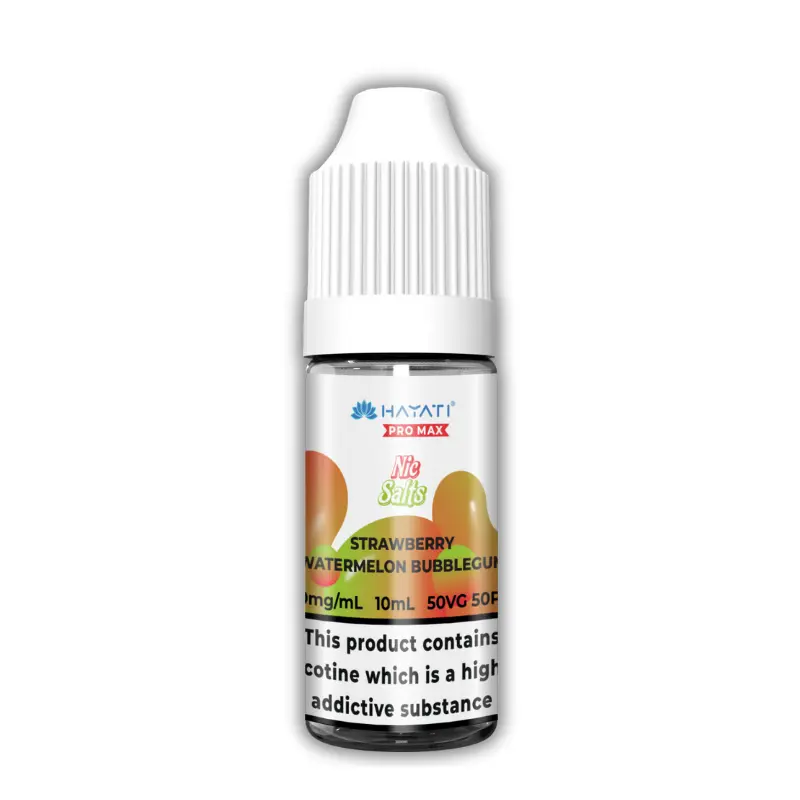
Hayati · Pro Max
Strawberry Watermelon Bubblegum Hayati Pro Max Nic Salt
£2.49
✔ In stock — ready to ship
Genuine Hayati
Free over £20
Same-day dispatch
Secure checkout
Two pounds forty-nine buys ten millilitres of Strawberry Watermelon Bubblegum, mixed at 10mg nicotine salt in equal parts vegetable glycerine and propylene glycol, with nothing in the box but the bottle. Three components in the name, two of them fruit and one of them a confection, and the confection is the one that decides what the liquid is.
What makes this bottle worth a long page is not the liquid on its own. It is the bottle sitting next to it. Strawberry Watermelon holds every published variable fixed and drops the confection: identical fruits, identical £2.49, identical volume, strength, base and shelf. One word of difference in the title and, as far as anything published can tell, one ingredient of difference in the bottle. That is a rarer thing than it sounds. Retail shelves are built to make products look different from each other, not to hold everything constant and move one term, and a pair that does move one term is worth more than either half of it.
The quiet bottle got there first and used the position to make an argument. Its case, worked out at length on its own page, is that a blend with nothing loud in it is not a failure of ambition but a specific construction with a specific payoff: that the things which impress you on a first draw are the things that fade fastest, that both sweetness and coolant habituate in proportion to how strong they were to begin with, and that the liquid with no peak has nothing to lose. It closed by naming this bottle as the controlled experiment and telling the reader to buy both, run each for a week, and see which one they reach for in week three.
So this page is the other half of that experiment, and it has three jobs. Confirm the pair really is a pair, because an experiment with a broken control proves nothing. Test whether the quiet bottle's reasoning predicts the right thing about this one, and be willing to find that it does not. And then ask the flavour question the quiet page was not in a position to ask, which is whether two of the faintest fruits in the catalogue survive being put under one of the loudest treatments in it, or whether the gum simply takes their place and leaves the names on the label doing decorative work.
First, check that the control is a control
An argument built on a matched pair falls over if the pair is not matched, so here is the check, run before anything is built on it.
Twelve listings in Hayati's 492 carry this fruit pair in some form. Most of them are not comparable to each other at all. Two are Pro Ultra Plus pods at 22ml and 20mg, two are the matching kits at £11.99, two are Pro Max Plus pods and kits, three are Mini Ultra items at 4ml, and one is the Fruit Bomb pairing that puts the gummed version opposite a busy mixed fruit. Different volumes, different strengths, different hardware, different prices. Comparing any two of those tells you about the format as much as the flavour.
Exactly two of the twelve are 10ml bottles at 10mg in a 50/50 base at £2.49 on the Hayati Pro Max Nic Salts shelf. This one and the plain one. They carry the same seven shelf assignments, down to being filed under Berry Vapes despite neither strawberry nor watermelon being a berry in the way the rest of that shelf is. Their product codes differ by one appended word. Everything published about them is identical except the third term in the name.
One honest limit on that, and it is the same limit the quiet bottle's page put on its own count. Hayati publish a flavour name, a strength, a ratio, a volume and a price. They publish no ingredient list, no concentrate percentages and no sweetener loading for any of the sixty-five bottles. So "the same strawberry with a gum added" is a claim about how ranges are built rather than a fact about two recipes, and it is possible that the fruit concentrates differ between the two bottles as well. What can be said is that nothing published distinguishes them except the confection, and that a copy desk adding a third component to an existing two-component name is describing an addition rather than a reformulation. Treat the control as good enough to reason with and not good enough to settle anything to a decimal place.
The word is spelled out here, and the spelling turns out to mean nothing
Before the argument, a smaller finding that the corpus asked for and that came out more sharply than expected.
Hayati name this confection four different ways. The Watermelon B'Gum / Strawberry B'Gum page cites the census that established it, which belongs to the Blueberry B'Gum pod page: four tokens across 492 listings meaning chewing gum, with B'Gum on seven, H'Bubba on seven, Hubba Bubba spelled out on two and Bubblegum spelled out on four. Twenty listings in total, roughly four in every hundred. That page's conclusion was that a buyer can infer nothing from which spelling appears, and it reached that conclusion by pointing at the inconsistency itself. The count is not re-run here.
What is worth adding is that the conclusion can be proved rather than inferred, because Hayati's own body copy gives the game away. Every one of the fourteen listings whose title clips the confection expands it inside the description. All fourteen. The clearest case is the Fruit Bomb / Straw' Watermelon B'Gum Mini Ultra kit, whose title clips two words and whose opening sentence then names the same side in full as Strawberry Watermelon Bubblegum. The 25K pod version does the same thing, describing its second side as a strawberry and watermelon bubblegum while the title above it says B'Gum. The writer is not distinguishing two things. They are abbreviating one.
Why abbreviate at all is answered by measuring the titles. Across the twenty gum listings, the ones that spell the confection out average forty-two characters and the ones that clip it average fifty-seven. Every single title containing an oblique clips, seven out of seven, and the four longest titles in the whole gum family are all dual-flavour listings running past eighty characters. Put two flavour names and a hardware suffix in one field and something has to give, which is also why Strawberry gets clipped to Straw' on twenty-two listings, all of them long ones.
The length story is pressure rather than rule, and the counter-example should be stated rather than buried. The shortest title of all twenty is H'Bubba on the nic salt shelf, at thirty-one characters, and it clips despite having all the room in the world. But that one is not really a clipping of anything in the way B'Gum is. H'Bubba and Hubba Bubba are sold as separate products with separate spellings of what is evidently the same idea, which is a different kind of naming mess from an abbreviation applied under space pressure.
Where that leaves this bottle: it is one of four listings in 492 that spell the confection out in a title, and two of those four are this flavour, since the Mini Ultra pod version spells it out too. A single-flavour bottle title has room, so the word goes in whole. The practical value of that to a buyer is small but real. It is not evidence of a different or better gum, and anyone reading the full spelling as a sign of a more serious confectionery treatment is reading something that is not there. What it does buy is certainty about the register, which an abbreviation does not, and which the letters GB in particular do not, for reasons the Blueberry B'Gum page sets out at length and this page takes as settled.
The sibling's argument, and what it predicts about this bottle
Here is the case this page has to test, stated as fairly as it can be in a paragraph.
The quiet bottle's page counted the whole shelf against a definition of loudness, asking whether a name declares anything that raises its voice. Six categories qualified in that test, running from coolants and acids through sweet-counter registers and drink builds to fruits with one dominant marker, with mood names counted because they hide whatever they hide. Sixty-three of the sixty-five carry at least one. Two carry none, and only one of those two names a pair of fruits. Widened to all 192 distinct flavour names in the catalogue, the number of names that put two different fruits together and attach nothing is still one. That count is theirs and it is not re-run here, though the confectionery slice of it is worth restating from my own tally, because it is the slice this bottle sits in: nine of the sixty-five bottles carry a confectionery word in the title, and three of those nine are the letters GB, which the corpus has already decided cannot be counted as a known treatment.
From that count the sibling page built a mechanism. Sensory systems report change rather than absolute level, so a steady input gets quieter the longer it is held, and the rate of decline scales with how strong the input was at the start. In its terms, every liquid has a starting height and a slope, and only the starting height is visible at the till. Weeks later you are living on the slope instead. From which follows the claim this page has to test: something that begins loud and drops steeply can finish below something that began soft and hardly moved at all.
Applied to this bottle the prediction is specific and it is not flattering. This is the same fruit pair with the loudest available amplifier bolted on. It should be more immediately impressive, and it should fall further and faster. The buyer who liked the plain one over weeks should tire of this one sooner.
Where that reasoning holds
On the sweetness channel it holds, and it holds harder here than the sibling could have known, because sweetness is not one channel among several in this bottle. It is the structural element the whole thing is built on. A confectionery accord does not have a sweetness dial that happens to be turned up. Sweetness is what makes the ester stack read as a sweet-counter product rather than as a fruit salad, and a gum accord without it stops being identifiable as gum at all.
Sweetness adapts on two clocks and both of them work against a bottle constructed this way. Over an afternoon, each sugared thing lands lighter than the one before it, so definition erodes inside a single sitting. Over a month, the threshold at which anything registers as notably sweet creeps upward, so an unchanged dose buys a smaller reaction. Neither effect is a fault in the product and neither can be formulated out. Both scale with the starting dose, which means the bottle carrying the most sweetness has the furthest to fall.
The costly part is not the fade but the correction. The reflex when a sweet liquid flattens is to want a sweeter one, and the shelf has plenty: Strawberry Jelly Beans, Gummy Bear and Strawberry GB all sit in the same register at the same £2.49. Running three of them in sequence ratchets a rotation in one direction until nothing on the shelf reads as sweet any more. The sibling is right about this, it is right for the reason it gives, and this bottle is a good illustration of the problem rather than an exception to it.
Where the reasoning is carrying a mechanism that does not apply here
The sibling's strongest evidence is not sweetness. It is cooling, and cooling is where the argument is on the firmest ground, because the mechanism is known in detail. A cooling agent is an agonist at a temperature-reporting channel in the tissue. It is a direct switch rather than an aroma, it fires at roughly comparable strength for most people, and precisely because it is a direct receptor signal it habituates quickly and predictably. Two weeks into a cooled bottle the chill has become the ambient condition. That is not a matter of taste or attention, it is a property of the receptor, and the sibling was right to lean on it.
The problem is that this bottle has no coolant in it. Not one of the twenty gum listings in the catalogue carries a cooling word except a single bottle, which the Blueberry B'Gum page identified and which is not this one. Gum, in this range, is warm by default. So the sibling's best-evidenced fading mechanism is simply absent from the product it was used to predict, and what remains of this bottle's loudness is aroma and sweetness rather than a receptor effect with a clock on it.
Aroma behaves differently, and the difference is not a technicality. Olfactory adaptation is real and it is fast, but it is fast in both directions: a constant smell recedes within minutes of continuous exposure and comes back within minutes of removal. It is a within-session effect, not a within-fortnight one. Nothing about vaping a gum accord on Monday makes it quieter on Friday in the way a coolant genuinely does, because the receptor population is not being held in a depressed state across days.
What actually kills a confectionery flavour over weeks is a different thing wearing the same clothes, and conflating the two is the error in the prediction. You do not stop perceiving a gum accord. You stop wanting it. The technical name for the short version of this is sensory-specific satiety, and the ordinary name for the long version is getting sick of something. It is a change in how much you like an input, not a change in how strongly you register it, and the two come apart sharply. A liquid you have grown tired of is still perfectly audible. It is simply no longer the thing you want to put in your mouth, which is a judgement rather than a measurement, and which recovers on a break of days or weeks rather than requiring anything to be rebuilt.
So the sibling's prediction is half right, and the half it gets wrong matters more than the half it gets right. It correctly identifies that this bottle has more to lose and loses more. It incorrectly assumes that the losing works the same way, and it transports a receptor mechanism onto a product that has no coolant in it and therefore no receptor effect to transport.
Two failure modes, and only one of them tells you it is happening
Set the two bottles side by side on how each one fails and the comparison changes shape.
The plain bottle fails by falling below notice. Its own page concedes the point rather than hiding it, and the concession is the important sentence on it: a gentle slope is still a slope, adaptation has not been abolished, and with so little there to begin with, the step down into near-nothing passes unregistered by the person taking it. Somebody can run a bottle like that long after it has stopped giving them anything and say, meaning it, that it is exactly as it was. The failure is perceptual, and it is silent.
This bottle fails the opposite way. It stays exactly as loud as it was, and one morning you do not want it. The failure is hedonic, and it announces itself. There is no ambiguity about whether a gum accord has gone quiet, because it has not: you can taste every bit of it and you have simply had enough. Nobody has ever been uncertain about whether they are bored of bubblegum.
That asymmetry is the thing the sibling's framing misses, and it cuts in this bottle's favour on an axis the sibling did not measure. Durability was treated there as a single quantity, and it is two. One is whether the liquid still produces the same percept at week three, and the plain bottle wins that outright. The other is whether the liquid tells you the truth about its own condition, and this one wins that outright. A failure you can see costs you a fortnight off it. A failure you cannot see costs you continued reorders of something that has stopped doing anything, which at £2.49 a bottle with sixty-four alternatives on one shelf is the more expensive mistake in every sense except the arithmetic.
None of which refutes the sibling. Its central claim, that percept stability is worth buying and that nobody at the point of sale is selling it, is almost certainly correct, and this bottle does not overturn it. What is wrong is the step from percept stability to durability as though the two were the same word. On a liquid with no instrument on it, stability and death look identical from the inside, and the sibling's own page says so in as many words two sections before it recommends the thing.
One place this bottle is measurably better instrumented, and it is the coil
The instrument point has a second application that decides a practical question.
The plain bottle's page names, as one of its costs, that there is no decline signal on a coil. A citrus liquid tells you the coil is finished by losing its zest and a cooled one tells you by losing its chill, and a quiet fruit pair has neither instrument, so a tiring coil produces a general thinning indistinguishable from your own adaptation.
A gum accord has the instrument. What a struggling coil takes first is the light volatile material at the top of the ester stack, which on this liquid is the pear-drop and rosy lift that makes the accord read as gum rather than as generic sweetness. Lose that and what is left is the broad sweet base with the identifying top removed, and eventually a caramelised edge from residue on the wire. That is a specific, recognisable and fairly early signal, and it arrives well before the liquid becomes unpleasant.
Which is convenient, because this bottle needs the warning more than the plain one does. A heavily sweetened liquid is the hardest thing on this shelf for a coil to deal with, and that is not an inference, it is in Hayati's own copy, counted and set out in the format section below.
What you actually taste, and whether the fruit names still mean anything
The quiet page asked what two fruits do with nothing over them. The gum census page asked whether a confectionery treatment flattens the difference between two fruits kept apart behind a collar. Neither asked the question this bottle poses, which is whether either fruit contributes anything identifiable when all three components are dissolved into one liquid with nothing keeping them separate.
What the corpus has settled, cited rather than rebuilt
Two findings are taken as established and are not re-derived here.
The first is about the fruits. The plain bottle's page worked out why this pair is unusually hard to build with: strawberry has no single dominant compound, its identity living in a composite of dozens of esters plus a furanone contributing a cooked-sugar sweetness, so pushing any one element up produces jam or boiled sweet rather than more strawberry. Watermelon has it worse again. Its aroma is a set of light nine-carbon compounds that only appear once the flesh has been opened, and they are weak and short-lived, which is why a whole melon gives off nothing at all. Two fruits with no lever between them, in that page's phrase, and the formulator's main tool removed before work starts.
The second is about the treatment. The B'Gum pod page established, citing the Blueberry B'Gum composition work, that a bubblegum accord is a flavour with no original: a stack of loud fruit esters deliberately arranged so none of them wins, with a rosy floral note no real fruit has and a broad sweet base underneath, which reads as gum precisely because your nose cannot land on a dominant marker. It then did the channel analysis that this page depends on. Perceived flavour is a handful of largely independent channels reporting at once, and a gum accord occupies and saturates five of roughly eight of them: sweetness pushed to the top of its range, the fruit-ester channel crowded by design, the floral lift supplied by the accord itself, the vanilla-ish rounding underneath, and finish length governed by the sweetener load. Acid, cooling and body are what remain open, and its verdict was that neither of these two fruits brings acid, no coolant is present, and the entire distinction travels down the body-and-water channel alone.
Its third finding is the one that does most of the work below. The masking is not even-handed. Strawberry's character is jammy, cooked-sugar, lightly floral and soft-edged, which is the accord's own neighbourhood, so strawberry is absorbed rather than merely covered. Watermelon's distinguishing material is a thin, green, faintly cucumber-adjacent freshness over very dilute sugar, and a gum accord contains nothing of that kind at all, so the melon's one property lands in territory the treatment has left empty. Loudness in the treatment's own register is camouflage; quietness in a different register is contrast.
The new step, which the blend makes harsher
Everything above was worked out for a pod that keeps its two flavours apart. This bottle does not keep anything apart, and the difference is not cosmetic.
Hayati say so themselves, without meaning to. The 25K pod description makes a virtue of separation, saying the two flavours are kept apart so the gum never muddies the fruit side. The Mini Ultra kit listing says much the same, that neither bleeds into the other. That is the maker's own copy conceding, in a sales line, that what a gum does to a fruit it shares a chamber with is muddy it. In this bottle there is nothing to keep apart. One solution, one wick, one coil, three components mixed uniformly, and the gum meets the fruits on every draw.
So the channel analysis applies with the collar removed, and removing the collar removes the only thing that made either fruit separately audible. Apply it and you get three predictions, tagged by how much weight each will bear.
Reasonably confident: the strawberry is not audible as strawberry. It is present and it is doing work, but the work is not the work the name advertises. Every property strawberry contributes already exists inside the accord, so adding it does not place a fruit on top of a gum, it shifts the gum's balance toward its red and jammy corner. What you perceive is a gum that leans red, not a strawberry in a gum. This is not a criticism of the formulation. It is a consequence of building with a fruit whose character lives in the same region as the treatment covering it, and the alternative, pushing the strawberry hard enough to be separately audible, produces boiled sweet rather than fruit for the reason the plain bottle's page sets out.
Probable: the watermelon is the one you can find, and you will not name it. A thin, slightly green quality on the finish, most noticeable at the end of the exhale and easy to miss on a warm device or a tired coil, is the only place either fruit is separable. It is also the least nameable channel there is, easy to confuse with how hard you drew and not what anyone means when they ask whether they can taste the fruit. Worth noting that this is the same answer the census page reached from the opposite direction, working from two fruits kept apart rather than one blend. Two routes to the same conclusion is worth more than either alone.
Reasonably confident: everything else is the gum. Sweetness near the top of the shelf's range, an ester stack that does not resolve into any one fruit, a floral lift over it, a rounded base under it, and a long sugary finish that hangs on after the vapour has gone. That is the product. Anyone buying this and describing it afterwards will describe a bubblegum, because that is what it is.
So are the names decorative?
Not decorative, and not descriptive either. Directional is the accurate word.
The fruit names on this label do not predict a fruit percept and a buyer expecting one will not get it. What they do predict is which corner of gum-space the accord sits in. Strawberry means the stack leans red and jammy rather than blue, green or tropical. Watermelon means the finish runs a shade thinner than a straight gum's would. Both of those are real differences you could pick in a side-by-side against H'Bubba, which is the same shelf's plain unfruited gum at the same price, and neither of them is a fruit arriving in your mouth.
Stated as a purchase decision: if you want to taste a strawberry, this bottle will disappoint you and the plain one is next to it at the same price. If you want a red-leaning bubblegum with a slightly lighter finish than a straight gum, that is exactly what is being sold and the fruit names are telling you the truth about it, just not in the grammar they appear to be using.
The maker's account, and one place it is probably describing the name
Hayati's copy for this bottle says the fruits stay recognisable on the inhale and that the gum comes forward on the exhale and lingers. The Mini Ultra listing of the same flavour puts the components in the same order, fruit first and a gum finish. Two listings of one liquid agreeing is the closest thing to a fact this catalogue produces, so the agreement is worth taking seriously rather than dismissing.
The second half of it is almost certainly right and for a reason that applies to every pod and bottle on the site: most flavour identity arrives retronasally, on the way out, which the Blueberry B'Gum page establishes and this page does not re-derive. A dense ester stack with a floral lift is going to be at its most legible on the exhale, and a heavy sweetener load does linger afterwards.
The first half is the suspicious part. An inhale carries sweetness, vapour density and whatever the liquid does at the back of the throat, and rather little in the way of identity, because the aroma has not yet travelled the path that supplies one. A claim that two faint fruits are recognisable on the inhale, on a draw where the loudest component is reportedly still holding back, is describing an expectation rather than a percept. It is what you would write if you were working from the name. That is a small point and it is offered as a reading rather than a finding, but it is the kind of thing this corpus has caught before.
One more check, because a word is only evidence if it is not house furniture. Sugary appears in 109 of the 492 descriptions, so it says nothing about any particular liquid. Chewy appears in fourteen. But candy base appears exactly once in 492 and this is the listing, bold and full-flavoured appears exactly once and this is the listing, and sweet-toothed appears twice. Set that against what the same copy desk did on the plain bottle, where the unique constructions were all about absence, and a pattern emerges that is worth a sentence: on the quiet listing the writer reached for original language to describe what is missing, and on this one to describe how much there is. They are telling you, in their word choices rather than their claims, which property they think defines each bottle. On both counts they are right.
What it is not
It is not tart, and nothing in it supplies acid. It is not cooled, chilled or mentholated, and the range names cooling explicitly when it is present. It is not a fresh strawberry and it is not a slice of melon. It is not a sequence of events across a draw, because a draw delivers a uniform solution at a fixed concentration and has no interior, which the Blueberry B'Gum page works out properly. And it is not going to fade in your mouth the way a stick of gum does, which is the same page's central argument and the single most common mismatch between what a gum name promises and what a vaporised liquid can deliver.
A bottle of confectionery liquid costs more than the bottle
The format arguments for a 10ml bottle are largely settled in this corpus and are cited rather than rebuilt. The plain bottle's page owns the strongest of them, which is that a bottle lets you fit a fresh coil and run the same liquid on it, separating your own adaptation from the liquid's decline in a way no sealed pod permits. It also works through the economics of a £2.49 first purchase, where the barrier is too low for the decision to carry information and the fourth reorder is the only honest signal. Both apply here and neither is re-argued.
What is specific to this bottle is the consumable, and there is a count that makes the point better than any reasoning could.
Of the sixty-five bottles on the Hayati Pro Max Nic Salts shelf, exactly four carry a coil-wear warning in Hayati's own description. All four are confectionery names, and this bottle is one of them. Widen the search to all 492 listings in the catalogue and only eight carry such a warning: those four bottles and four shortfill listings, six of the eight naming a confection outright.
The interesting part of that count is what is missing from it. Not one prefilled pod carries the warning. Not one kit. Every single listing that tells a buyer sweet liquid is hard on a coil is a bottle, and the reason is commercial rather than chemical. A sealed pod retires its coil with its liquid, so the coil cost is already inside the pod price and the buyer never sees a separate bill for it. There is nothing to warn about because there is nothing the buyer can do and nothing extra they will be charged. On a bottle the coil is your purchase, bought separately, at a different till, on a different day, and how fast this liquid gets through them is a real cost that lands on you and not on the listing. Makers warn about costs their buyers will notice.
Which reframes what £2.49 buys. It is not the price of ten millilitres of liquid. It is the price of ten millilitres plus however many coils ten millilitres of this consumes, and the second term is the one that varies between bottles on a shelf where the first term does not vary at all. This page cannot do the arithmetic for you because coil prices are not among the facts it is allowed to state and they differ by hardware anyway. What it can tell you is the shape of the sum: take what a coil costs you, divide by the millilitres one normally lasts on an untreated liquid in your device, and that is your baseline cost per millilitre of ownership. Then run the same sum on this bottle. The gap between the two numbers is the real price of the confection, and on most setups it is larger than the difference between any two bottles on this shelf, all of which cost the same £2.49.
The plain bottle makes that sum unusually easy to run, which is one more thing the matched pair is good for. Same device, same coil type, same 50/50 base, same strength, one liquid with a confectionery load and one without. Most buyers never get a clean read on what sweetener costs them because they change three things at once. Here you can change one.
On what is in the packet, there is very little to say and it should be said briefly. A bottle, a cap, ten millilitres. Nothing to plug in, nothing to screw on, nothing to charge, and the listing takes for granted that the hardware is already yours. Splitting the carrier fluids evenly keeps the mixture thin enough for a small wick to keep up with, and the version of that which matters here is that a thin base ferries a heavy sweetener load onto hot metal briskly and without fuss, which is as much a liability as an advantage. Strength is 10mg per millilitre, as a salt. Nicotine is addictive. What follows from the flavour construction is that nothing else in this liquid generates any sensation of its own where a draw lands, no chill and no acid, so the whole of that sensation is nicotine with nothing over it, and opinions divide on whether the result reads as soft or as slightly bare.
The published numbers, ordered by what this page argues
The rows lead with the confection and the control, because those are the two facts that decide the purchase. Everything from the strength downwards is identical on sixty-four other bottles and settles nothing.
| Confection named | Bubblegum, spelled out. One of four titles in 492 that spell it rather than clipping it, and two of those four are this flavour |
| Matched control on the same shelf | Strawberry Watermelon, same price, volume, strength and base, with the gum omitted. The only single-variable pair of bottles in the range |
| Coil-wear warning in the maker's own copy | Present. One of only four bottles in sixty-five that carries one, and all four are confectionery names |
| Named fruits and what each does | Strawberry, which tilts the accord toward its red corner rather than arriving as a fruit. Watermelon, which thins the finish slightly and is the only separable element |
| Cooling | None named. Nineteen of the twenty gum listings in the catalogue carry no cooling word, and the exception is not this bottle |
| Acid, sour or citrus element | None named, and neither fruit supplies any |
| Sweetener loading | Not published for this or any bottle on the shelf. Structural to a confectionery register rather than an additive on top of one |
| Nicotine | 10mg in every millilitre, as a nicotine salt. No second strength on this listing |
| Base | 50/50 vegetable glycerine to propylene glycol |
| Volume | 10ml, one bottle |
| Supplied hardware | None whatsoever |
| Intended for | Low-wattage refillable kit taken on a tight, restricted draw. Not a sub-ohm liquid |
| Price | £2.49 |
| Product code | HPM-NS-STRAWBERRY-WATERMELON-BUBBLEGUM |
| Brand | Hayati |
Two rows deserve a note. The coil-wear row is third rather than buried because it is the row with a pound sign attached to it that the price row does not capture, for the reasons set out above. And the cooling row is worth reading as information rather than as an empty cell: a warm, sweet, uncooled liquid with no sharp element anywhere in it is a particular kind of vaping, sustained and unvarying, which some people find tiring across a long session and others choose precisely because nothing in it jolts.
The strength row says 10mg and that is a plain statement rather than a position on any scale. What is worth knowing in the context of this page is that a salt preparation is less abrasive at a given strength than freebase would be, and on a liquid carrying a heavy sweetener load that matters, because sweetness and throat sensation compete for your attention in ways that make a harsh liquid and a sweet one an unpleasant combination.
What sits near it, and who should buy which
The useful way to shop around this bottle is to decide which of its three components you actually wanted, because the shelf has a good answer for each.
If you wanted the fruits
Strawberry Watermelon is the answer and it is the same £2.49. Its own page argues at length that the two fruits are unlikely to be separately identifiable even without a gum over them, so temper the expectation, but you will at least be tasting fruit rather than a confection with fruit-shaped tinting. It is the control for everything above and the single most useful neighbour this bottle has. In sealed form the same pairing exists as Strawberry Watermelon Pro Ultra Plus pods at £7.99, which is a different economic object entirely and carries its own analysis.
If you wanted the gum
H'Bubba is the plain version at the same price, a gum with no fruit attached, and its own listing describes itself as the simpler option against the fruit-and-gum blends elsewhere in the range, which is a fairly direct reference to this bottle. There is also a cooled bubblegum on the same shelf, the only listing in the entire twenty-strong gum family that carries a cooling word, which is worth knowing about if the warmth is what tires you rather than the sweetness.
That cross-referencing is unusual enough to flag on its own. The plain fruit bottle points at the bubblegum version for anyone who finds it too sugary. H'Bubba points at the fruit-and-gum blends as the more complicated thing it is an alternative to. The cooled gum points at H'Bubba as the one it is for people who find too rich. Three listings in a range of 492 that define themselves by reference to each other, forming a sweetness ladder nobody published as a ladder. Read together they are a more honest guide to where this bottle sits than any single description is.
If you wanted to hear the two fruits separately
Blending is the thing stopping you, so the answer is a pod that does not blend. Watermelon B'Gum / Strawberry B'Gum at £7.99 applies the same confection to each fruit separately and puts a collar between them, and its page is where the channel analysis this one leans on was worked out. Its verdict is that you will probably discriminate the two sides and probably not name them, which is a more modest promise than the title makes and an honest one. The matching 25000 kit at £11.99 is the same liquid supplied with a body.
For the same structure across a wider fruit gap, Blueberry H'Bubba / Watermelon H'Bubba runs a gum over two fruits further apart than these two are, with a kit version alongside it. If the question this page raises interests you as a question, that pod is the better experiment than this bottle is.
If you want this exact flavour on other hardware
Strawberry Watermelon Bubblegum Mini Ultra pods at £3.49 are the same three components sealed at 4ml and 20mg, which is a different strength and a different format decision. The Fruit Bomb Mini Ultra kit at £3.99 puts this flavour opposite a deliberately busy mixed fruit, and the same pairing scales up to Pro Ultra Plus 25K pods at £7.99 and the complete 25000 kit at £11.99. Check the range name on whatever device you own against the range name in the title before buying prefilled hardware. All of them differ from this bottle in the way that matters most to the argument above: the coil cost is inside the price and invisible.
If the sweetness is the problem
This bottle sits near the top of the range for sweetness with no acid and no coolant to push against it, which is why it is filed on Sweet Vapes as well as the fruit shelves. The opposite direction is well stocked. Blue Sour Raspberry leads with acid and is about as far from this as the shelf goes. Strawberry Kiwi is the smallest step away, holding the strawberry and swapping the quiet partner for a genuinely tart one. Strawberry Cherry Cranberry goes further with real tartness under a three-fruit build. Blackberry Raspberry and Blueberry Raspberry both drop the strawberry for berries with an edge on them.
Worth remembering the one honest exception in the sibling's own argument while you shop this direction: acid is the amplifier that does not habituate, so a tart bottle keeps doing on day thirty roughly what it did on day one. That makes the acid direction the strongest answer to everything this page has said about fading, and the catch is that most people cannot take it all day.
If cold or a drink construction is what you actually wanted
Strawberry Raspberry Ice keeps the strawberry and adds both an acid berry and a coolant, which is two amplifiers at once and structurally the opposite of the plain bottle. Red Berry Ice does the cold end without committing to which berries are involved. For a shape rather than an ingredient, Strawberry Mojito takes the same strawberry into a herbal drink register and Blue Razz Mojito does it without the strawberry at all.
The shelves themselves
The full Hayati Pro Max Nic Salts shelf runs to sixty-five bottles at one price, which makes it unusually easy to read end to end and unusually hard to choose from. Watermelon Vapes is short enough to read in a sitting, and scanning it shows how seldom this particular fruit is trusted to carry a listing by itself. Strawberry Vapes is much longer and is where the confectionery treatments cluster. Everything Hayati make sits on the full catalogue if you would rather browse by something other than fruit.
Running a bottle of something this sweet
Advice that would apply to any bottle on the shelf is skipped below. These are the points that change because a confection, rather than a fruit, is the loudest thing in the mixture.
Buy coils in a multipack, and treat that as part of the purchase. This is the bottle that justifies it. Hayati say so on the listing, four bottles in sixty-five carry that warning and all of them are confectionery, and the maker only bothers to mention it on the formats where the buyer pays the bill. Keeping a spare in the drawer turns a coil going off from an evening's annoyance into a two-minute job.
Learn the decline signal, because this liquid has one. What goes first is the bright top of the ester stack, the pear-drop and rosy lift that makes the accord legible as gum. When a draw reads as broad sweetness with the identifying edge shaved off it, the coil is on its way out and you have days rather than weeks. Leave it past that and a caramelised note arrives from residue baked onto the wire, which is the point at which you have wasted liquid. This is the one axis on which this bottle is easier to live with than the plain one, which has nothing to listen for.
Never let the wick run dry on this one. A dry draw on any liquid produces a scorched note. A dry draw on a sweetener-loaded liquid deposits caramelised residue that does not come off, and the coil never fully recovers. Refill at the point where you notice the level rather than at the point where the flavour changes, because on this liquid the flavour change and the damage arrive together.
Do not put this in a pod you want to use for something else afterwards. A gum accord is ester-dense, sweetener-heavy and persistent, and it will still be detectably present in a wick two liquids later. The plain bottle's page makes the point that you can add something loud to a quiet liquid and change it, but not the reverse. The hardware version of that asymmetry is this one: anything quiet that follows this bottle through the same pod will taste of gum, and the quiet bottle is precisely the thing you will want to compare it against. Run the comparison with two coils or run it in the other order.
Put it down during long sessions. A constant sweet stimulus flattens perceptually within twenty minutes or so, which is a fact about perception rather than about the liquid, and it is the single most common reason somebody concludes a confectionery flavour has gone off when nothing has changed. Twenty minutes away and it comes back. If it does not come back, that is the hedonic thing described earlier and a fortnight on something else is the answer.
An opened bottle drifts, and here it drifts in your favour. Air exchange takes the light aromatic fraction and leaves the sweetness, because sugar-type material is not volatile in the same way. On the plain bottle that is a real loss, since the light fraction is the entire product. On this one the robust part is the part you bought, so a half-used bottle held for a month reads a little flatter at the top and is still recognisably the same thing. This is the rare respect in which the loud construction ages better than the quiet one, and it follows from exactly the same mechanism.
Store it dark, cool and closed. Sweet liquids darken faster than sharp ones when they are left somewhere warm, and with no acid or coolant in the mix there is nothing to mask an oxidised note if one develops. A drawer indoors is enough. Keep the cap fully seated on the thread rather than resting on it, and keep bottles away from children and animals.
Dispose of the empty properly. A bottle that held nicotine liquid is not ordinary household plastic even when it looks empty. Rinse it out, put it wherever your local service takes small plastics, and never tip the last of it down a sink.
Questions this bottle actually raises
Will I taste strawberry and watermelon, or just bubblegum?
Mostly the gum, and this page argues that plainly rather than hedging it. The fruits are present and they shape the accord, tilting it red and thinning the finish slightly, but neither is likely to arrive as a nameable fruit. If tasting fruit is the point, the plain Strawberry Watermelon bottle is the same price on the same shelf.
How is this different from the plain version?
Same two fruits, same £2.49, same 10ml at 10mg in a 50/50 base, with a confectionery treatment added. The gum supplies a body and a shape the fruits cannot generate themselves, at the cost of being much sweeter and much more emphatic. The two bottles together are the only single-variable comparison the range offers.
Which of the two will I still want in a month?
Honestly, it depends on which way you would rather be let down. The quiet one holds its percept better and gives you no warning when it stops working. This one stays exactly as loud as it started and you may simply go off it, which you will notice immediately. A failure you can see costs you a fortnight's break. A failure you cannot see costs you repeat purchases of something doing nothing.
Is there any cooling in it?
None, and no cooling word appears on the listing. The range names cooling explicitly whenever it is present. Nineteen of the twenty gum listings across the whole catalogue are uncooled, so a warm finish is the default for this register rather than a decision specific to this bottle.
Will it get through coils faster than other liquids?
Expect so, and Hayati say as much on the listing itself. Sweeteners do not vaporise cleanly and a fraction bakes onto the wire, insulating it and slowing the feed. Four of the sixty-five bottles on this shelf carry that warning and all four are confectionery names. Factor coil cost into what the bottle actually costs you.
Why is bubblegum spelled out here when other listings clip it?
Because a single-flavour bottle title has room and a dual-flavour pod title does not. Every oblique title in the gum family clips the word, and all fourteen clipped listings expand it in their own descriptions, so the spelling is a formatting decision and carries no information about the liquid. Only four titles in 492 spell it out, and two of those four are this flavour.
How sweet is it against the rest of the shelf?
Near the top. Two things put it there: sweetness is the structural element of a confectionery register rather than a seasoning on top of one, and neither fruit brings any acid to work against it. There is no restrained position anywhere in this bottle, which is worth knowing before you commit.
Does the gum fade in the mouth the way real gum does?
No, and it cannot. A draw delivers a uniform solution at a fixed concentration for two or three seconds, so there is no release curve inside it and nothing about one draw changes the next. The Blueberry B'Gum pod page works that out properly and is the better read if the question interests you. What the name delivers is the opening of a piece of gum, repeatedly, without the decline.
Is anything included besides the liquid?
No. Ten millilitres in a bottle, a cap on top, and that is the whole of it. There is no hardware of any description in the packet, and the listing is written for somebody restocking rather than starting out.
Can I use it in a sub-ohm tank?
That is not what it is mixed for. High-wattage coils burn through a thin 50/50 mixture much too fast, which wastes it and makes the draw unpleasant besides. A 10mg salt is also pitched at a tight airway rather than an open one, and a sweetener-loaded liquid at sub-ohm power gunks a coil in days.
Is 10mg the only strength?
It is the only one on this listing, stated as 10mg of nicotine salt per millilitre. Nicotine is addictive at any strength. Nothing here is a recommendation about which strength anybody should be using.
What should I run alongside it?
Something occupying a channel this does not touch, which in practice means acid rather than another sweet fruit. Tartness is the one amplifier that does not habituate, so a sharp bottle stays useful as a contrast for far longer than a second sweet one will. Do not run a quiet liquid immediately after this in the same pod, because the gum will still be in the wick.
Where this leaves it
£2.49 for ten millilitres at 10mg nicotine salt in an even glycerine and glycol base, no hardware supplied, two fruits and a confection named, and the confection is the product.
The reason this bottle earns a long page is the bottle beside it. Same fruits, same price, same everything, minus the gum, which makes the pair the closest thing to a controlled experiment a retail shelf produces. The quiet bottle used its side of that pair to argue that loud things fade fastest and that a liquid with no peak is the one you can stay on. Tested against this bottle, the argument holds on sweetness, which is this liquid's dominant channel and does adapt in proportion to its dose, and it fails where it borrows a coolant's receptor mechanism for a product that has no coolant in it. What actually finishes a confectionery bottle is not that you stop tasting it. It is that you stop wanting it, which is a different thing, which recovers on a break, and which above all announces itself. The quiet bottle's own page concedes that its liquid gives you no such signal. So the honest verdict is that the two bottles fail in opposite directions and the sibling measured only one of them.
On the flavour, the answer is less kind and it should be said without softening. Both fruits here are faint, watery and carried by fragile aromatic material, and a gum accord occupies most of the perceptual channels on which either could have registered. What arrives is a bubblegum that leans red, with a slightly thinner finish than a plain one, and the fruit names are directional rather than descriptive. They tell you which corner of the register this sits in. They do not predict a strawberry or a melon and nobody should buy expecting either.
Buy it if the sweet-counter register is what you want and you would like it tinted red rather than served plain. Buy the plain pairing if the fruit was the point, buy the split pod if you want to hear the two fruits against each other, and buy something with acid in it if what this page describes sounds tiring. And whatever you buy, price in the coils, because on a bottle the confection is the part you pay for twice.
Strictly for adults aged 18 and over. Nicotine is an addictive substance.
You might also like


