
Home / Hayati Mini Ultra Prefilled Pod Kit / Lemon Lime Hayati Mini Ultra Pod Kit
Hayati · Mini Ultra
Lemon Lime Hayati Mini Ultra Pod Kit
£3.99
✔ In stock — ready to ship
Genuine Hayati
Free over £20
Same-day dispatch
Secure checkout
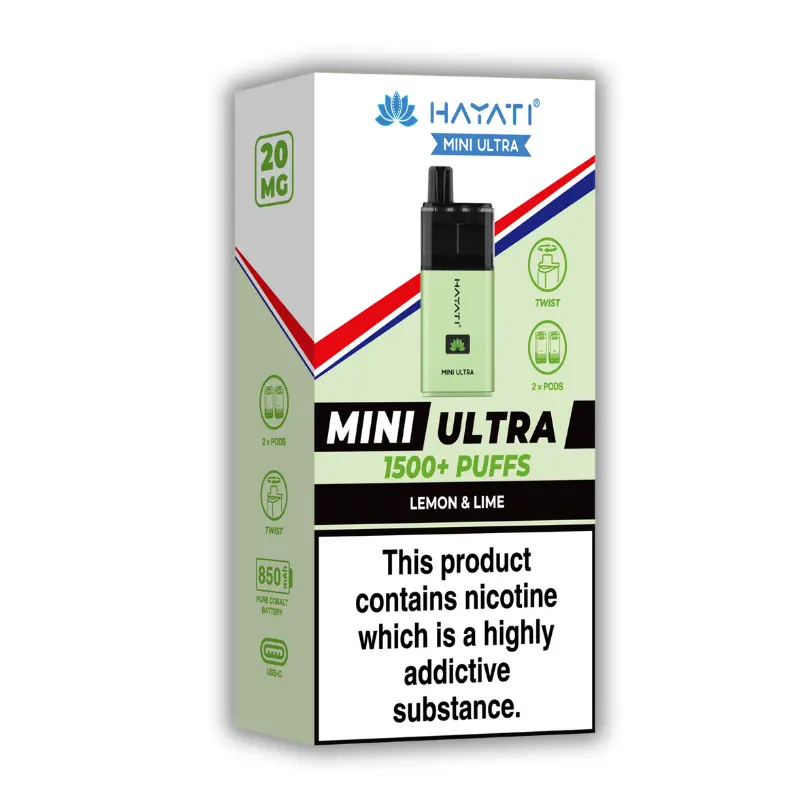
Three pounds and ninety-nine pence buys the Mini Ultra body with a sealed four millilitre pod of two citrus fruits already fitted to it, and there is nothing further to choose. The strength is 20mg as a nicotine salt. The cell is listed at 850mAh. Hayati print a rating of up to 1,500 puffs against the pod, which is a bench measurement taken on a machine and not an account of anyone's week. Buy the liquid without the hardware and it is the Lemon Lime Hayati Mini Ultra Pods refill at £3.49. Check the range name printed on your device against the range name in this title before ordering a refill, and do not settle a compatibility decision from a retail page, this one included.
That is the whole product, and it is worth noticing how little of it is specific to Lemon Lime. Every figure in the paragraph above is true of all nineteen of this listing's shelf-mates. The only thing on the page that distinguishes it from them is the flavour name, and Hayati have already had ten other goes at describing that flavour, on ten other listings of the same recipe, several of which have a page on this shop. So this page does something else, and the something else came out of a question nobody buying a vape thinks to ask and everybody buying a vape actually uses: how you arrive here.
This listing is filed on seven shelves. That sounds like seven routes in and seven ways to narrow a catalogue of 492 products down to the one you want. Counted, it is not. Six of the seven are nested inside one another in a chain, one of them holds the entire shop, and the pair that look like two different ideas turn out to differ by three listings out of 174. The seven labels carry two genuinely independent facts between them. This page is about what that costs a buyer looking for a citrus pod, what the filing gets wrong about this particular flavour, and how to build the cross-section the shelves refuse to give you, which for Lemon Lime on a Mini Ultra body contains exactly one listing and you are reading it.
The angle this page was handed, and the page that already owns it
Honesty first, because the alternative is writing a second version of something that is already here and pretending it is new.
The argument commissioned for this page was that nine of the twenty Mini Ultra kits carry a single flavour, that those nine are very nearly the same set as the small group of flavours Hayati manufacture on every product line they run, and that the cheapest complete device in the range is therefore stocked with the company's own shortlist rather than with its leftovers. It is a good argument. It is also, in full, the subject of the Blue Razz Cherry Hayati Mini Ultra Pod Kit page, which counts both lists, establishes that they share eight of nine names, identifies the one substitution in each direction and explains why the narrowest platform acts as the gate on the whole thing. Lemon Lime is one of the eight. That page names it as the only exit from berries on the list. There is no second version of that finding worth writing and I have not attempted one.
Three other pieces of ground around this listing are occupied and are cited here rather than rebuilt. The Cherry Berry Hayati Mini Ultra Pod Kit page holds the census of this platform. Fifty listings sit on the range as a whole. Twenty of those fifty arrive with a device and the remaining thirty are refills for one you already have. Of the twenty, eleven put two flavours behind a rotating mouthpiece. None of the thirty refills does, which is that page's sharpest finding and not mine. Every shelf figure about the Mini Ultra below comes from that count. That page also works out at length what four millilitres of a liquid can and cannot settle for a buyer, which is the other obvious question this format raises and which is therefore closed.
The Blue Razz GB Hayati Mini Ultra Pod Kit page holds the pairing census across the whole catalogue, including this citrus's own tally of partners, and it caught the spelling problem I come back to below. The Blue Razz GB / Lemon Lime Hayati Pro Ultra Plus 25000 Prefilled Pod Kit page works out the price of a bare body on every range where the subtraction is possible, arriving at fifty pence for this one, so that sum is taken as read below rather than repeated.
And the liquid itself belongs to the Lemon Lime Rubik kit page, which lines up all eleven Hayati descriptions of this recipe against each other, works out the cost of retiring a pod before it is empty on four platforms, and establishes the finding that matters most for anyone standing where you are standing: a Mini Ultra pod is too small to reach the point at which a tired element stops carrying the lime, so the column for this platform in its table is flat. That page names a break-even of about 4.6ml and recommends this kit by name for anyone whose own threshold sits below it. I am not going to re-derive any of it, and the per-millilitre arithmetic it contains is the correct place to look if price per unit of liquid is what you are weighing.
What all of that leaves untouched is the route. Every one of those pages is about what is in the pod or what the pod costs. None of them is about the machinery that puts this listing in front of you, which is the seven shelf tags at the bottom of it, and which turns out to be considerably less informative than it looks.
Seven shelves, two facts
Here are the seven, with the number of listings each one holds, counted from the catalogue as it stands rather than from any figure printed elsewhere.
| Shelf | Listings | What it actually separates |
| Hayati Mini Ultra Prefilled Pod Kit | 20 | Kits on one platform |
| Hayati Mini Ultra | 50 | Everything on one platform |
| Hayati Prefilled Pod Kits | 171 | Sealed kits, every platform |
| Hayati Pod Kits | 174 | The same 171, plus three refillables |
| Lemon Lime Vapes | 21 | Titles bracketing lime with lemon |
| Lemon Vapes | 54 | Titles naming lemon in any form |
| New Products | 492 | Nothing. It is the whole shop. |
The chain, drawn out
Take the first two. All twenty listings on the Hayati Mini Ultra Prefilled Pod Kit shelf also appear on the Hayati Mini Ultra shelf, with no exceptions in either direction. One is a strict subset of the other, so a buyer who has already filtered to the platform gains exactly one thing by clicking the kit shelf, which is the removal of the thirty refills. That is a useful click if you do not own the body. It is not a second axis of information.
Take the second pair. All twenty of those kits also appear on Hayati Prefilled Pod Kits and on Hayati Pod Kits, and those two shelves stand in the same relation to each other: 171 listings inside 174. The three listings that separate them are the three Quokka devices, which are refillable and arrive empty rather than sealed and filled. Three out of 174 is one and seven tenths of a per cent. Two shelf names that read as meaningfully different categories are, in practice, the same shelf with three items moved.
Then the flavour pair. All twenty-one listings on Lemon Lime Vapes appear on Lemon Vapes, again strictly, so that is a third chain rather than two independent filters. Twenty-one inside fifty-four.
Which leaves one label unaccounted for, and it is the one that does the least.
The shelf that is the whole shop
Every single listing in this catalogue carries the New Products tag. All 492 of them. Not the recent arrivals, not the last quarter's additions, not a rolling window: the complete range, including listings that several pages on this shop treat as long-established fixtures of the line.
That is worth stating flatly because a good number of pages here describe that shelf as the place where new arrivals land before settling into the permanent shelves, and a buyer who reads that and clicks expecting a short list gets the entire catalogue instead. One page on this shop has it right and says that New Products and the full range both run to 492 and are the last resort. That page is correct and the others are repeating a reasonable-sounding inference from a shelf name, which is the failure mode this shop's own brief keeps recording. The supporting evidence is blunter than the tag: every listing in the source data carries an identical creation timestamp, one value across all 492 records, so nothing in the catalogue could distinguish a new product from an old one even if a shelf wanted to.
The consequence is small but real. Of the seven routes into this listing, one of them narrows nothing at all, and it is the one whose name most strongly implies that it does.
What is left when the redundancy is removed
Strip the chains back to their independent content and the seven labels resolve into two questions and a residue. The first question is which platform and whether the device is included, which is answered by the Mini Ultra kit shelf and is the same answer four of the seven labels give at different levels of zoom. The second is what is in the pod, answered by the two lemon shelves, one of which is a subset of the other. The residue is the 492.
This is not peculiar to this listing. Across the whole site there are fifty-two shelves, and fifty-one of those fifty-two are a strict subset of at least one other shelf. There are eighty-four such containment relationships among them. The only shelf that is not inside anything is the one that holds everything. A navigation structure of fifty-two categories carries a good deal less independent structure than fifty-two implies, and a listing wearing seven tags is not being described seven times over.
The shelf that narrows most is the one that tells you least
Here is where the filing stops being a curiosity and starts costing something.
Of the seven, the shelf that reduces 492 down furthest is the twenty-listing kit shelf. Twenty is a manageable number. It is exactly the number of things a person can look at in one sitting and form a view about. So that is where a buyer who wants a cheap complete device ends up, and it is the correct place for them to be.
But every one of those twenty listings is physically the same object. Four millilitres, an 850mAh cell, 20mg nicotine salt, the same manufacturer laboratory rating, and £3.99. I checked all fifty Mini Ultra listings against those figures and there are no exceptions on the shelf in either direction: the twenty kits are uniform, and the thirty refills are uniform at £3.49 with no cell figure because there is no cell. Not one listing on this platform is priced differently from its neighbours, holds a different volume, or carries a different strength.
The 20mg figure in particular carries no information here at all. It is the ceiling for retail sale of a nicotine e-liquid in the United Kingdom, and every prefilled pod Hayati sell at full strength sits on it. It is not a decision anybody made about this citrus, and reading it as one would be reading a legal maximum as a recipe note.
Put those two observations together and you get an odd result. The shelf that narrows the catalogue most aggressively is the shelf on which narrowing conveys the least, because after the filter has run, every candidate is identical except for a flavour name. The filing has done its work and handed you a decision it cannot help with. Everything that remains is a taste question and the shelves have nothing to say about taste beyond the word in the title.
The two lemon shelves are the mirror image of that problem. They narrow on taste, which is what is left, but they cut across four different kinds of transaction at once. The Lemon Lime Vapes shelf page makes exactly this point about its own twenty-one listings, which resolve to seven recipes sold in sealed pods that assume you own a body, complete kits that supply one, a 10ml bottle for a refillable device and two 120ml bottles for a tank. Sorting that by price produces an order that means nothing, because a £2.49 bottle and a £3.99 kit are not competing for the same money. So the flavour shelves give you the right axis and the wrong grain, and the format shelves give you the right grain and no axis.
Where the filing actively misleads a citrus buyer
The redundancy above is inefficient rather than wrong. There are three places where the filing on this particular flavour will actually mislead somebody, and two of them are specific to Lemon Lime.
Four Mini Ultra listings on the lemon shelf, two recipes
Filter the Lemon Lime Vapes shelf down to this platform and four listings come back. They are this kit, its £3.49 refill twin, a 4ml refill of Orange Lemon Lime, and the Cola Ice / Orange Lemon Lime Hayati Mini Ultra Pod Kit. Four listings, two recipes, and the two recipes are not variations on a theme. Orange Lemon Lime is a three-fruit blend in which Hayati's own copy gives the orange a sweeter, juicier role as the base of the profile, which is a structural change rather than a garnish: a two-acid citrus and a citrus with a sweet floor under it behave differently across a draw and taste different at the end of one.
The fourth of the four is stranger still, because half of that pod is cola. A buyer who filters a catalogue to Lemon Lime and to the Mini Ultra, on the entirely reasonable assumption that both filters are about what they will taste, is shown a divided pod whose other side is a cooled soft drink. The shelf is not wrong to include it. The title does contain the words. But a filter that returns a cola pod to a citrus query is a filter that has matched a string rather than a flavour, and the buyer is the one who has to notice.
Widen to the Lemon Vapes shelf and the same platform returns seven listings covering four lemon-bearing recipes, with a blackcurrant lemonade and a strawberry lemonade joining the two citrus ones. Lemonade is a sugar base with an acid on top of it, which is close to the opposite construction from the one in this pod, and the Blackcurrant Lemonade / Straw' Lemonade Hayati Mini Ultra Pod Kit is a perfectly good purchase that shares almost nothing with this one except a fruit name in the data.
The name that is spelled three ways
Count the titles in the catalogue that carry this citrus and you get twenty-one, which is the shelf size. Count the ones that spell it as two plain words and you get eighteen. The other three write it with an ampersand, and their web addresses spell it out as a word, so the same flavour exists in the data under three different strings.
The Blue Razz GB kit page found this while running its pairing census and recorded the counting consequence, which is that an automatic tally splits this flavour in two and makes it look less used than it is. The consequence for a buyer is different and has not been stated. If you type the exact phrase into a search box rather than using the shelf, you will miss three listings that the shelf includes. All three sit on one platform's refill range, which is a small enough pocket that it reads as a single batch of titles entered to a different house convention rather than as a deliberate distinction, and the whole catalogue contains only four ampersands in 492 titles, all four on that same refill shelf, three of them this citrus.
None of the three is a Mini Ultra listing, so this does not affect what you can buy for £3.99. It affects the buyer who moves up a platform later and searches instead of browsing, and it is worth knowing that on this site the shelf is more reliable than the search box for this particular flavour.
The slug is not the title, and this shelf has two instances
A related problem has already been identified and named on this shop by the Blueberry Straw' Menthol / Blueberry Raspberry Menthol Hayati Mini Ultra listing, whose web address drops the second cooling word its title carries and which worked out that a buyer arriving from a link reads the address rather than the title. That listing is also the only Mini Ultra product whose title carries no trailing format word, so the complete kit is the one that looks least like a kit. That argument belongs there.
The second instance on the same shelf is the Blue Razz Pineapple / Strawberry Ice Hayati Mini Ultra Pod Kit, whose title says blue raspberry and whose address begins with blueberry. Two of the twenty kits on this shelf have addresses that disagree with their names. That is a tenth of the shelf, and it is worth a sentence here only because the argument of this page is that the routes in are less trustworthy than they look, and the address is a route in.
For completeness, this listing has no such problem. Title and address agree, and both say what is in the pod.
The cross that is not a shelf, and how to build it
The thing a buyer actually wants at this point is a cross-section: this flavour, on this platform, with the device supplied. No shelf on the site is that cross-section, because the shelves are drawn on one axis at a time. But the cross is easy to construct by hand and the result is worth having, because it is very short.
Take the twenty-listing kit shelf and intersect it with the platform shelf and you get the twenty-listing kit shelf back, which is the nesting described above. Take the platform shelf and intersect it with the pod-kits shelf and you get the same twenty, which is a neat demonstration that the kit shelf is not an independent category at all but the product of two others. Now intersect the twenty with the lemon-lime shelf and you get two listings: this one and the cola pairing. Restrict to undivided pods and you get one.
That is the whole answer. There is exactly one way to buy this liquid on this body with the body included, and there is exactly one way to buy it on this body without, and they are fifty pence apart. Every other Lemon Lime purchase in the catalogue involves a different platform, a different volume and a different price, and four of them require hardware you may not have.
Stated that way the decision stops being a shelf-browsing exercise and becomes two questions. Do you want four millilitres of it, and do you already own the body. Neither of those is a question the filing can answer and neither is hard once it is asked plainly.
The liquid, in the space the other pages have left
Several listings of this recipe already have pages on this shop, and between them the flavour analysis is genuinely finished. What follows is the minimum needed to make the comparisons below usable, with pointers to the long versions.
Two fruits and nothing else. Lemon opens the draw and carries most of the acidity, arriving bright and sour from the first moment rather than building. Lime lands at the close, greener and more aromatic, with a faintly bitter edge that Hayati's copy for this particular listing attributes to peel. There is no sweetener underneath it, no berry, and no cooling agent of any kind.
Two structural findings about it are established elsewhere and both bear on a four millilitre pod. The Lemon Lime Vapes shelf page establishes that no title in the entire 492-listing catalogue begins with the word lime, that lime is bracketed with lemon in twenty-one of the twenty-four titles that name it and with cola in the other three, and that Hayati name blends in tasting order, so a component arriving at the finish cannot head a name without the name misdescribing the draw. The Lemon Lime Rubik kit page takes that forward into the consequence: because lime's distinguishing material is the lightest in the liquid, it is the first thing a residue-loaded element stops carrying, and a pod that has lost it is not a quieter version of itself but a plain lemon. That page also concludes that four millilitres is too little liquid for that to happen, which is the single most useful thing anyone has said about this format and this flavour together.
One point of confidence worth flagging, because this shop's brief asks for it. The absence of cooling is not an inference from the name. Two of Hayati's eleven descriptions of this recipe define it partly by what has been left out, one saying there are no berries or ice in it and the other that only two fruits are present and no cooling is named. I read all eleven, and none of them attaches ice, menthol, mint, frozen or any related term to the liquid. The only cooling that touches the flavour anywhere in the range is on the other side of the cola pairing, which is a different liquid in the same housing. If you want cold citrus, Hayati do not make a cooled version of this one and you will have to change flavour, not format.
Sweetness sits at the bottom of the range for this catalogue. That is a genuine differentiator on a shelf where, as the Blue Razz Cherry page sets out, the solo kits are otherwise berries and one cherry. It is also the reason a four millilitre pod suits this liquid better than it suits most: an acid profile does not fatigue a palate the way a sugar-forward one does within a session, so the constraint on how much of it you use in a sitting is different in kind.
The kit itself
What arrives is a body and a filled pod, packed together, with no assembly step between opening the box and using it. Four millilitres inside, 20mg as a salt, a cell listed at 850mAh. The puff figure Hayati attach to it, up to 1,500, is a laboratory measurement produced on a machine at a fixed draw, and it will not transfer to your own use. It also will not transfer across platforms: the ratings printed against a twelve or twenty-two millilitre pod were produced at different volumes, so treating 1,500 and 25,000 as points on one scale compares two measurement conventions rather than two products.
What Hayati leave out matters more here than what they put in. No resistance figure, no wick material and no output figure appears anywhere in the data for any listing on this range, and a retail page that supplies one has invented it. The liquid side supports one useful statement and no more: an acid profile with no sweetener in it puts less on a heating element than a confectionery blend does, so the element in a pod this small is under a light load for its whole working life. The Lemon Lime Rubik kit page reaches that conclusion from the arithmetic rather than from the chemistry and its version is the one to read.
A rechargeable cell implies a charging arrangement and the data does not name one. Four pages on this shop once asserted a connector type for Hayati hardware and all four were wrong, which is a useful reminder that a sibling page is not a source. Treat any statement of that kind as unverified until the manufacturer publishes it.
Everything else about the body is common to 171 listings and visible at a glance on Hayati Prefilled Pod Kits. The one consequence worth carrying out of the pricing work cited earlier is that the hardware in this box accounts for a small fraction of the ticket, which is why £3.99 reads as a liquid price with a device attached rather than a device price with liquid thrown in.
The sheet, with the filing rows included
The rows below are ordered by how much each one actually decides, which puts two rows at the top that a specification table would normally leave off entirely.
| Shelf tags carried | Seven, carrying two independent facts |
| Listings at the cross of flavour, range and kit | Exactly one, and you are on it |
| Cooling named for this recipe | None, in any of its eleven descriptions |
| Selector | Absent. A single reserve, one flavour throughout |
| Fill | 4ml, the smallest figure Hayati print |
| Strength | 20mg salt, which is the UK retail ceiling |
| Ticket with the body | £3.99, matching every kit on the range |
| Ticket without it | £3.49 |
| Cell | 850mAh |
| Puff figure and its status | Up to 1,500, laboratory, not cross-platform |
| Element resistance | Absent from the data |
| Charging connector | Absent from the data |
| Range and brand | Hayati Mini Ultra |
A handful of those rows repay a comment. The rest are on the sheet because a specification that quietly drops a line reads as though it were complete.
The first two rows are the subject of this page and they are the only rows that separate this listing from nineteen others sold at the same money on the same shelf. Everything from price downwards is a property of the platform, so reading those rows as a description of Lemon Lime would be reading a shelf as a product.
The cooling row is the one that most often changes a decision for a citrus buyer and it is the row a specification sheet usually omits because there is nothing to put in it. An absence is information here. It is why this liquid reads as sharper than a cooled fruit at the same acidity, and it is why the finish falls away rather than carrying.
The two blank rows are deliberate. Hayati publish a volume and a cell figure and then stop, and a sheet that quietly omits the gaps reads as though everything relevant has been covered. It has not been. Any account of what is inside this device, wherever you find it, is a guess by whoever wrote it.
What else to buy, sorted by which filter you are escaping
The comparisons below are grouped by which of the two real axes you want to move along, because that is the decision the shelves leave you with.
Same flavour, more of it
If the citrus is settled and four millilitres is the problem, the volume ladder runs upward from here and the flavour does not change. The Lemon Lime Hayati Pro Max Plus Pod Kit at £7.99 carries twelve millilitres with a device, which is three times the liquid at twice the price. The Lemon Lime Rubik kit at £5.99 is the other twelve millilitre route and its page is the one to read, since it works out when a larger pod stops being the better buy for this specific liquid. The Pro Ultra Plus version at £11.99 is the twenty-two millilitre commitment.
Worth saying plainly: buy the four millilitre version because you want a question answered, not because you want the liquid. It is the smallest quantity of this recipe Hayati will sell you together with the means to use it, and that is a different purpose from stocking up.
Same flavour, with something to turn to
The Mini Ultra never divides this citrus, so a pod with a collar means moving platform. The Lemon Lime / Summer Dream Hayati Pro Ultra Plus 25000 Prefilled Pod Kit puts it opposite an unnamed sweet blend in one twenty-two millilitre pod, and its page works through what it means that one half is described and the other is a mood word. The Blue Razz GB pairing sets the same citrus against a sugar-forward confection, which is the widest gap Hayati have built with this liquid in it.
Both of those are single pods with two internal reserves and one shared coil, not two pods in a box, and switching is made by turning the mouthpiece rather than by choosing at the start. The four millilitre shelf has divided kits too, but none of them contains this flavour.
Same shelf, different taste
If the range and the ticket are why you are here, the nineteen other listings at £3.99 are what you are really choosing between, and only one axis separates them. On the acid side, Blue Sour Raspberry Hayati Mini Ultra Pod Kit is the closest neighbour this pod has, although it gets its sharpness from a dosed sourness sitting on a sweet berry rather than from two fruits that are sour on their own account. Those are different mechanisms producing a similar first impression, and its page goes into the difference at length. For something plainer, Blueberry Raspberry Hayati Mini Ultra Pod Kit is the one berry recipe on the range that Hayati write up as two named fruits rather than as a single confectionery accord.
Turning to the divided half of the shelf, the same money buys two liquids instead of one. Cherry Ice / Peach Mango Hayati Mini Ultra Pod Kit sets something cooled opposite something not. Grape GB / Strawberry GB Hayati Mini Ultra Pod Kit holds both halves in one register and changes only the fruit. Blueberry Cotton K / Raspberry Cotton K Hayati Mini Ultra Pod Kit goes further still and changes almost nothing. Straw' Cranberry Cherry / Cherry Ice Hayati Mini Ultra Pod Kit weights itself towards cherry on both sides. What you give up in all four cases is that the four millilitres is a shared budget, so liquid left in the half you use less of goes in the bin with the pod.
Still citrus, but not this construction
Three directions lead away from a two-acid profile without leaving the fruit. Adding a third citrus gives you the orange-led blend that shares this shelf, available as a Mini Ultra refill and as half of the cola kit. Adding a sugar base gives you lemonade, which is the opposite construction: the Mini Ultra lemonade pairing is linked above, and at twenty-two millilitres the Straw' Lemonade Hayati Pro Ultra Plus 25000 Prefilled Pod Kit is the larger version of the idea.
Keeping the lemon and losing the lime gives you the Lemon Mint Hayati Pro Ultra Plus 25000 Prefilled Pod Kit, which is the nearest thing the range has to a cooled version of this profile without actually being one. Hayati's copy puts the brightness on the lemon and a lingering cool sensation on the mint, and the reading I would offer, flagged as a reading rather than a specification, is that the mint has been given the closing position the lime holds here rather than added on top of it. That is the honest answer for anyone who wants cold citrus from Hayati. There is no chilled edition of this recipe, only a different recipe with a similar shape.
Wider than the two shelves
The Lemon Vapes shelf runs to fifty-four listings and, as its own page establishes, not one of them sells lemon unaccompanied, so every option on it is a lemon plus something. The Banana Ice Hayati Rubik Prefilled Pod Kit is worth naming for a reason unrelated to taste: Banana Ice is the flavour Hayati use for the handful of generic listings in the range that are organised around a nicotine figure rather than a fruit, which is the one place in the catalogue where the filing is built on something other than flavour and format. And if none of the shelves narrows usefully, All Hayati products is the unfiltered list, which is the same 492 the New Products tag returns.
Running four millilitres of an uncooled citrus
Handling advice is the most repeated material on a site like this one, so what follows is restricted to the parts that change because of this liquid, this volume or this price.
Early draws misreport, and on four millilitres the cost of that is proportionally higher than anywhere else in the range. A wick needs a little time in contact with liquid before it carries properly, so the opening pulls on any sealed pod come through thin. At twenty-two millilitres those pulls vanish into the total. At four they are a share of the purchase you can actually notice. Leave the kit standing for a few minutes once it is out of the packaging, then take the first draws gently.
Judge it on the back half of the draw, not the front. The lemon arrives immediately and will register whatever you do, so a quick pull taken while distracted reports lemon and reports nothing else. The lime is at the close, and the question you are spending £3.99 to answer is almost certainly about the lime, since that is the component that separates this from every other sharp citrus in the range. Slow draws with a pause after them are the only way to hear it.
Acid does not fatigue a palate the way sugar does, which changes how you should pace it. A sweet blend rewards short sessions with gaps because the sweetness is what wears. This one holds its reading across a longer stretch, so if you are using the pod to decide whether to commit to a larger format, you can trust a long sitting here in a way you could not with a confectionery flavour.
Do not expect to reach the point where the pod tells you it is finished. On larger formats a citrus announces its own decline, because the lime goes first and its absence is categorical rather than gradual. Four millilitres is below the threshold at which that happens, according to the Rubik page's arithmetic, so this pod will taste much the same on the last mouthful as on the first and will simply stop. That is a genuine advantage of the format and it is specific to a liquid whose distinguishing component is the fragile one.
Temperature is the storage variable to watch and the only one worth a sentence. Warmth thins a liquid, a thinner liquid arrives at the element faster than the element can turn it over, and the result is a pod that goes harsh with no warning. A car windscreen in summer is the case that actually happens. Store it standing up, somewhere it will not cook, and out of reach of children and pets.
Disposal is not household waste. A finished pod contains a heating element and a film of nicotine liquid, which puts it in the same category as any other small electrical item with a chemical in it: a retailer take-back bin or a council site that handles electricals. The body follows the same route whenever it stops taking charge, and on a purchase made for four millilitres of liquid that is likely to be long after the pod it shipped with.
Questions this listing raises
Is this pod divided between two flavours?
It is not. The title names one flavour, the pod holds one liquid, and there is nothing to turn. Just over half the kits on this range are divided, a count that belongs to the Cherry Berry page, and this listing sits in the undivided remainder. A divided kit costs the same £3.99.
Why is this listing on seven shelves?
Because the shelves are drawn one axis at a time and then nested inside each other. Four of the seven describe the platform and format at different levels of zoom, two describe the flavour with one inside the other, and the seventh holds all 492 listings in the catalogue. Seven labels, two independent facts.
Does the New Products shelf really contain everything?
Yes. All 492 listings carry that tag, and every record in the source data shares a single identical creation timestamp, so there is nothing in the catalogue that could separate recent arrivals from anything else. Several pages on this shop describe it as where new items land first. Counted, it does not narrow anything.
Is there any cooling in it?
There is none, and that holds for every one of the eleven listings Hayati write for this recipe rather than for this one alone. Two of those eleven state the absence outright instead of leaving it to be inferred. The nearest cold thing to this flavour in the range sits on the far side of the cola pairing and is not the same liquid.
How sweet is it?
Low, by the standards of this catalogue. There is no sweetener under the two fruits and Hayati's copy across the range is consistent about that. On a shelf whose undivided kits are otherwise berries and one cherry, this is the option for someone who wants acidity rather than sugar.
Can I get the liquid on its own?
There is a bare refill of it for this range at £3.49, so the gap between owning a body and not owning one is fifty pence at this size. Where that figure comes from is derived on a Pro Ultra Plus page cited earlier. Without a Mini Ultra body already in hand, the refill is of no use and the kit is the listing you need.
Why do some listings spell this flavour with an ampersand?
Three titles in the catalogue do, and their web addresses spell the word out instead, so the same flavour exists under three strings. All three sit on one platform's refill range and none is a Mini Ultra listing. The practical effect is that searching for the exact phrase returns fewer results than browsing the shelf does.
Is Orange Lemon Lime the same liquid with an extra fruit?
Not in the way that phrasing suggests. Hayati describe the orange as the sweeter, juicier base of that blend, which puts a sweet floor under a profile that here has none. It is a different construction rather than the same one with an addition, and it is sold on this platform as a 4ml refill and as half of the cola kit.
What does the 1,500 figure mean in practice?
For your own use, very little. It is a rating Hayati produce on a machine at a fixed draw, published as an upper bound under those conditions, and no product page can turn it into a number of days. It is also not a figure to hold against the ratings on larger pods, since each was measured at its own volume.
Will the flavour fade before the pod is empty?
On this format, unlikely. The component that goes first in a citrus is the lime, and the Rubik kit page works out that four millilitres is below the volume at which an element accumulates enough residue for that to happen. A larger pod of the same liquid has to be managed for it. This one does not.
Which shelf should I actually browse?
The twenty-listing kit shelf if you want a complete device, because it is the only filter that reduces the catalogue to a set you can read in one sitting. Bear in mind that after it has run, every remaining candidate is physically the same object at the same price, so the decision it hands you is entirely a flavour decision.
Is this good value compared with the larger kits?
Per millilitre, no, and the Lemon Lime Rubik kit page has the arithmetic. Four millilitres with a device attached is an expensive way to buy liquid and an inexpensive way to buy an answer. Which of those you are doing is the question worth settling before you order.
The position, plainly
This is one of twenty listings that share the lowest price Hayati put on a complete device, filled here with a two-fruit citrus that carries no sugar under it and no cooling in it, and physically identical to the nineteen sitting beside it. The only thing separating them is what is in the pod, which means the shelves that brought you here have already done everything they can do and the rest is taste.
The seven shelf tags on this listing look like seven ways to find it and carry two facts between them: it is a Mini Ultra kit, and it is a lemon flavour. One of the seven holds the entire 492-product catalogue and narrows nothing. Two more differ from each other by three listings. The cross-section a buyer actually wants, this liquid on this body with the body included, is not a shelf at all, and when you build it by hand it contains a single listing.
Buy it if four millilitres of sharp uncooled citrus is the question you want answered and you do not already own the body. Buy the £3.49 refill instead if you do. Buy one of the larger formats if the flavour is already settled and what you want is liquid, and read the Rubik kit page first, because it works out where that crossover sits for this recipe rather than guessing at it.
Strictly for adults aged 18 and over. Nicotine is an addictive substance.
You might also like


