
Home / Hayati Mini Ultra Prefilled Pod Kit / Cola Ice / Orange Lemon Lime Hayati Mini Ultra Pod Kit
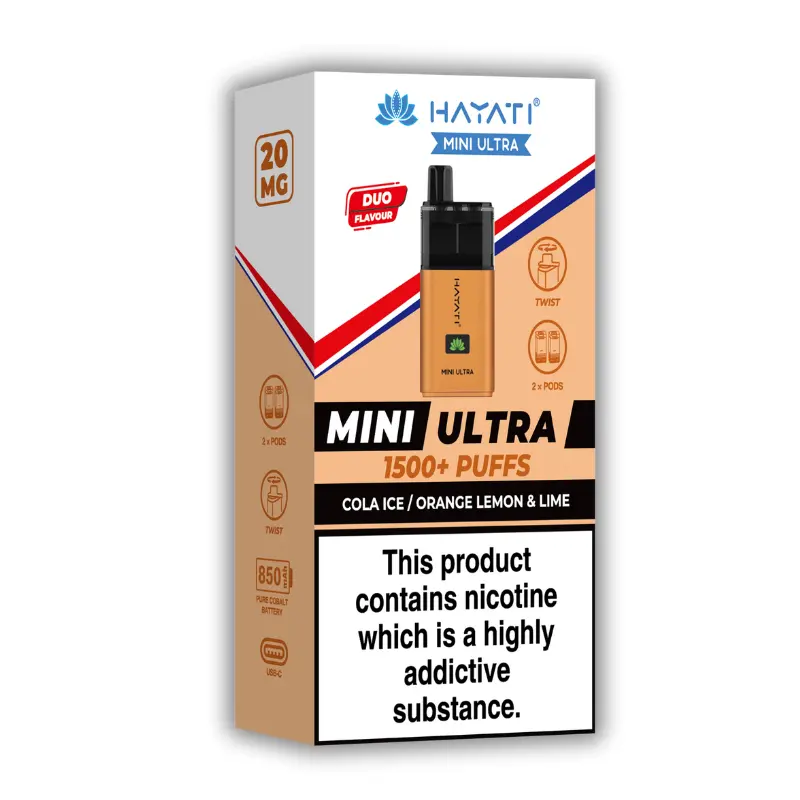
Hayati · Mini Ultra
Cola Ice / Orange Lemon Lime Hayati Mini Ultra Pod Kit
£3.99
✔ In stock — ready to ship
Genuine Hayati
Free over £20
Same-day dispatch
Secure checkout
Hayati's Mini Ultra at £3.99 puts two liquids behind one rotating mouthpiece: Cola Ice on one setting, Orange Lemon Lime on the other, with the body and its prefilled pod supplied together. The pod carries 4ml across both sides at 20mg nicotine salt, the cell is rated 850mAh, and Hayati's own bench figure is up to 1,500 puffs, a number produced by apparatus drawing to a fixed pattern rather than a forecast of anybody's week. The listing says in its own words that turning the collar swaps you between the two and that the flavours never mix, so this is one divided pod rather than two pods in a box, and it is worth checking that sentence on any oblique title rather than reading the punctuation and assuming.
What makes this particular pairing worth several thousand words is not the hardware, which is the same body sold twenty times over on this shelf at the same money. It is what the listing claims about the contents. Hayati describe the two sides as soft-drink-inspired profiles, both of them in one clause, which is a sentence they write nowhere else in 492 listings. Almost every divided pod in the catalogue sets fruit against fruit, sweet against sweet, or cold against warm. This one proposes to sell you two manufactured drinks.
That premise deserves testing before it is repeated, and testing it turns up something more interesting than the claim itself. It also raises the question that the rest of this page is really about. A soft drink is not just a flavour. It is a flavour plus a physical sensation, and the physical sensation is the one thing a vape has no mechanism for. Work out what is left when the fizz is removed, and what a formulator reaches for to stand in its place, and you have the honest account of what £3.99 buys here. The answer is not the same for both halves, which is the most useful thing about the pod.
Counting the drinks before accepting the claim
How much of this catalogue is a drink at all
An assertion of the form "this is the only listing that does X" should be counted rather than repeated, and the count here is worth having for its own sake, because the answer is smaller than a scroll through the shelves suggests.
Of the 492 listings Hayati sell, 52 carry a drink outright in the title: 18 colas, 19 lemonades, seven mojitos, five juices, two green teas and a coffee pouch. Add the three clipped brand references whose own copy confirms what they are nodding at, and the figure moves to 59. Vim Ice appears four times and Hayati's copy for it names a British mixed-fruit cordial directly. Vimbull Ice appears twice and the copy calls it two familiar soft drinks combined. Bru Ice appears once and the description names an orange Scottish soda without hesitation.
Two more titles look like drinks and are not. Pipeline Punch appears twice and its own copy explains the punch as a way of blending several fruits, not as a drink being imitated. Caribb Crush appears twice and is described as a tropical fruit blend. Counting those as drinks takes you to 63, and I would not count them, because the test has to be what the listing says the liquid is aiming at rather than what the word means in a dictionary.
Narrow it once more to drinks that are carbonated, which is the whole point of the argument further down, and the set shrinks again. Colas, lemonades and the three clipped sodas come to 44 of 492. Mojitos are a cocktail rather than a soft drink, and the corpus has already worked through what a cocktail name can and cannot promise a pod on the Blue Razz Mojito pods page, which established that the defining component of a cocktail is definitionally absent from a vape. Juices, tea and coffee are drinks with no gas in them, so they lose nothing by being vaporised.
Under one listing in eleven, then, is aiming at something that comes out of a bottle with bubbles in it. The fruit register is not just the majority of this catalogue. It is nine tenths of it, and choosing a drink is a deliberate step out of the default.
The rarity claim I was handed, and what survives counting it
I was given this pairing as the only one in the range where both halves are soft drinks rather than fruit. That is overstated, and saying so is more useful than writing around it.
The catalogue holds 61 listings whose flavour name contains an oblique, across the Pro Ultra Plus and the Mini Ultra. Go through them and exactly two put a drink on both sides. One is this pod. The other is the Blackcurrant Lemonade / Straw' Lemonade Hayati Mini Ultra Pod Kit, which sits on this same shelf at this same price, and which does it more plainly than this one does, because both of its halves have a drink in the name. Mine does not. Cola Ice names a drink. Orange Lemon Lime names three fruits.
So the claim fails on titles. What replaces it is narrower and, I think, more interesting.
First: of the 61 divided listings, this is the only one that pairs two different categories of drink. The lemonade kit is one drink served twice, a berry version and a strawberry version of the same base, which the Sour Apple page's taxonomy would file as a pairing of relatives. This one puts a cola against a citrus soda, which are not variations on each other.
Second, and this is the finding worth the space: this is the only listing in 492, divided or single, whose own description applies the soft-drink frame to both halves at once. Hayati use the words soft drink or soft-drink on nineteen listings and every other one of them attaches the phrase to a single profile. Only here does one sentence cover two liquids with it.
What only this listing says about the citrus half
Orange Lemon Lime is sold four times in this catalogue and the four descriptions do not agree about what kind of thing it is, which is exactly the sort of evidence that lining a flavour's listings up against each other produces.
The Orange Lemon Lime Hayati Pro Ultra Plus 25000 Prefilled Pod Kit at £11.99 calls it citrus through and through. Its refill pod calls it a three-way citrus blend and takes care to rule out anything else. The Mini Ultra single pod describes three fruits layering. Not one of those three reaches for a drink. This listing, alone of the four, puts the liquid in the soft-drink register, and it does so in the opening sentence rather than as an aside.
Two things follow. The first is a caution the Cherry Berry Hayati Mini Ultra Pod Kit page established, which keeps proving itself: these descriptions were plainly written platform by platform, in batches, so when a term shows up on one range and is missing from another the explanation is sometimes the author rather than the liquid. The soft-drink framing may be nothing more than a Mini Ultra writer reaching for a phrase that covered two halves in one clause.
The second difference the same split produces is a flavour property rather than a category, and it is the one I want. Both Mini Ultra descriptions of this liquid name a bitter edge coming off the lime peel. Neither Pro Ultra Plus description mentions bitterness at all. That term is not filler in this catalogue: it appears on eleven listings out of 492, which is rare enough that its presence means something. Hold onto it, because bitterness turns out to be load-bearing further down.
A copy of a copy, and why that is not a complaint
Nobody buying this pod is trying to taste an orange. That sounds like a small point and it changes how the whole thing should be judged.
A strawberry liquid is an imitation of something that grows. There is an original out there, it varies by variety and season and ripeness, and the flavour house is chasing a moving target that every buyer has their own version of in their head. That is why people argue endlessly about whether a peach liquid is any good and never quite resolve it.
A cola liquid is an imitation of something that was itself designed. The original is a manufactured article, built to a recipe, produced to a specification and kept deliberately identical from can to can. So a cola vape is a copy of a copy, two removes from anything that ever grew, and the citrus soda on the other side of this collar is the same kind of object. Confectionery works this way too, which is why the gummy and cotton-candy listings on this shelf are a legitimate target rather than a cheat. A manufactured flavour is a perfectly reasonable thing to reproduce, and the catalogue treats it as one.
What being a copy of a copy actually changes is how fidelity can be judged, and here the two halves of this pod part company in a way nothing on the listing tells you about.
The Raspberry Cola Hayati Pro Ultra Plus 25000 Prefilled Pod Kit page made the useful observation that a cola's reference standard is a commercial secret kept deliberately unchanged, and that the secrecy is precisely why buyers agree with each other about cola liquids far more than they agree about mangoes. Everybody is comparing against the same fixed article. That argument is sound and it is taken as given.
Now apply it to the other half and it collapses, because there is no equivalent fixed article. Orange, lemon and lime is a combination several manufacturers sell and none of them owns. There is no single canonical version to be measured against, no secret formula everybody has drunk, and no consensus reference in anybody's memory. Two people can both know exactly what a cola tastes like and disagree completely about what a citrus soda tastes like, because they grew up drinking different ones.
Which produces a genuinely lopsided pod. One half can be right or wrong in a way you will recognise immediately. The other half can only be pleasant or unpleasant. If the cola side misses, you will know within three draws and you will be able to say what it missed. If the citrus side misses, you will have nothing to say except that you did not care for it. That asymmetry is worth knowing before you form a verdict on the pod as a whole, because it means the two halves are not being marked on the same scale.
The sensation neither half can have
What is already settled, and is not rebuilt here
Three pages in this shop have worked over the carbonation problem and there is no sense repeating them. The short version, taken as established.
Fizz is two events happening together. Dissolved gas forms a weak acid in the liquid, which registers as sharpness, and the gas comes out of solution as thousands of small bursts against the surfaces of the mouth, which registers as touch. Both halves need a liquid holding gas. Vapour is an aerosol and has neither, so no flavourist can put carbonation in a pod. That is the Cola Ice Pro Ultra Plus kit page's framing and it is right.
Acidity covers part of the gap. It produces the tightening at the sides of the tongue and the salivary response that are a real component of what fizz feels like, and it is the reason a well-built cola liquid reads as lively rather than inert. The Cola Ice Pro Max Plus pods page took that a step further and worked out that in a cooled cola there is a second substitute available, because a coolant is the only material in the liquid producing a physical sensation on the surfaces of the mouth rather than a smell or a taste, and it is therefore the only candidate for standing in for the mechanical half. That page also priced the trade honestly: the cold spends the warmth of the spice to buy back a fraction of the feel of a can, and it buys back only a fraction, because a coolant is a smooth plateau where carbonation is a granular stutter.
All of that is taken as read. What nobody has looked at is what happens when the coolant is not available, which is the situation on the other side of this collar.
The catalogue's own vocabulary, counted
Before reasoning about what a formulator would do, it is worth checking what Hayati are actually willing to claim, and the answer is nothing.
The word carbonated appears exactly once in all 492 descriptions. It is on Fizzy Cherry, which is a fruit rather than a drink, and even there it is used in a simile: the fizzy element is said to mimic the pop of a carbonated drink. Not one of the 44 carbonated-drink listings says its liquid is carbonated. They say fizzy-inspired, fizzy-feeling, a fizzy soft-drink character, echoes the sparkle of a cold can. Every single one of them hedges the fizz into a comparison and then moves on.
The counterpart finding is funnier and more revealing. The word squash appears exactly once in 492 descriptions, on the Blackcurrant Lemonade Hayati Pro Max Plus 6000 Pod Kit, describing a tall glass of blackcurrant squash topped up with fizzy lemonade. That is the one place in the whole catalogue where the copy reaches for the honest name of a soft drink with the gas taken out, and it reaches for it as one half of a simile rather than as a description of the liquid.
Put those two counts beside each other and you have the trade's own position, stated by omission. Everyone writing this copy knows the gas is not in the pod. Nobody will say so.
What a formulator has left to work with
Strip the carbonation out of a cola or a citrus soda and what remains is the syrup: the aroma compounds, the sweetener and the acid. That is not a hypothetical, it is literally what a soft drink is before the water and gas arrive, and it is also a product you can buy, which is why the squash comparison above is so exact. The formulator's problem is to make a syrup read as a drink. There are three tools available and they are not equally good.
Acid is the first and the best. It does the chemical half of the job outright, since carbonic acid in a fizzy drink is a mild acid and citric or malic acid in a liquid is a mild acid, and the tongue is not fussy about which one arrived. It produces the same tightening, the same watering, the same dry finish. This is the substitute the corpus has already credited, and on a citrus liquid it is doing more of the work than on anything else in the catalogue, because three of the fruits named here are acid sources to begin with.
Bitterness is the second, it is less obvious, and it is the one actually declared on this listing. Consider what separates a soft drink from a cordial, beyond the gas. A cordial is sweet and fruity and nothing else. A soft drink almost always has a bitter component in it, whether that is the peel oil in a citrus soda, the kola and spice notes in a cola, or the quinine-style bitterness in the drier adult sodas. Bitterness is the thing that keeps a drink from reading as sugar water, and it works the same way in a pod as in a glass, because it is a taste rather than a physical event and nothing about vaporising it removes it. Hayati's copy for this pod names a slightly bitter edge from the lime, and the same phrase appears on the Mini Ultra single pod of the same liquid and on neither Pro Ultra Plus listing. On the cola side, the spice group carries a faint version of the same function.
Dryness is the third and the least reliable. A fizzy drink finishes dry, partly because the acid scrubs the palate and partly because the bubbles physically disturb it. A formulator can approximate that by holding the sweetener down and letting the acid finish exposed, which is why a soft-drink liquid that is too sweet immediately stops reading as a drink and starts reading as a sweet. The trouble is that sweetener is also what holds an aggressive acid in check, so there is a narrow band to hit and no way for a buyer to know from a listing where a given pod sits in it.
And that is the whole toolkit, on the uncooled side. Acid, bitterness, restraint with the sweetener. The one tool the cooled side has and this side does not is the coolant.
The only pod in the catalogue where you can hear both strategies on one coil
Here is what makes this pairing genuinely unusual, and it is not what the listing thinks is unusual about it.
Cola Ice is a soft drink that has bought a substitute for the mechanical half of the fizz, at a cost the cola pages have already worked out in detail. Orange Lemon Lime is a soft drink that has not. The two sit in one pod, feed one coil, and are separated by a quarter turn of the mouthpiece. Nowhere else in 492 listings can you switch between the cooled and uncooled answers to the same problem without changing device, changing coil, or waiting a fortnight for a pod to empty.
What you should expect to hear, on the reasoning above rather than on anything published: the cola side reads as more physically present and less like a syrup, with a finish that goes on working after the vapour has gone. The citrus side reads as sharper at the front and stops sooner, because acid is immediate and has nothing following it. Neither reads as fizzy. One reads as a cold drink and the other reads as a drink at room temperature, and if you have ever poured a citrus soda into a glass and left it an hour, you already know what that second thing is like.
How close any of this can actually get, honestly
Not very, and the honest answer is more useful than an encouraging one.
Acid gets most of the chemical half, which is genuinely a substantial portion of the sensation. Bitterness and a restrained sweetener keep the liquid on the drink side of the line that separates a soda from a squash, which is worth more than it sounds, because that line is where most soft-drink liquids actually fail. Together those two get you a liquid that tastes like the drink and behaves like the drink in the mouth for the first second.
What nothing can supply is the granular, intermittent, several-hundred-events-per-second quality of gas leaving solution. A coolant is the nearest thing available in the same channel and the cola pages are right that it is the only candidate, but it is a plateau standing in for a stutter and it peaks in the wrong place at the wrong moment. It buys a fraction. On the uncooled half, there is no fraction to buy, so what you have is an accurate citrus syrup at whatever temperature the coil made it, which is a perfectly good thing and is not a drink.
That, incidentally, is the most likely explanation for the disagreement between this listing and the three other Orange Lemon Lime descriptions. Both readings are defensible, because a de-fizzed citrus soda and a three-fruit citrus blend converge on almost the same liquid once the gas is gone. The one property that would separate them is the one property that cannot be in the pod. A copywriter who calls it a drink and a copywriter who calls it fruit are describing the same reserve and disagreeing only about what it is pointing at.
The two liquids, and what the collar can measure
Cola Ice, cited rather than rebuilt
The anatomy of a cola accord is worked out in full on the Cola Ice Pro Ultra Plus kit page, which takes it apart into its citrus, spice, vanilla and acid groups. The taxonomy of what a coolant is doing to it belongs to the Cola Ice Pro Max Plus pods page, which separates contrast, redundancy and contradiction and puts cola in the third bucket, because the accord is assembled from cassia, nutmeg, coriander seed, vanilla and pressed peel oil, and those are warm materials that a coolant argues with rather than complements. The ownership arc, where a fresh pod sits at its brightest and a tired one at its sweetest, belongs to the Cola Ice Pro Max Plus kit page. All three are on the Cola Vapes shelf with the rest of the eighteen, and none of their reasoning is repeated here.
What this listing adds to those is a single fact: Hayati describe the cooling as an icy finish bringing to mind a glass fresh from the fridge, and they publish no figure for it, here or anywhere in the range. That is the number the cola pages identified as the one that decides everything about a cooled cola, and it remains unpublished.
Orange Lemon Lime, cited rather than rebuilt
The citrus side has had the same treatment. The page for the 22ml refill, which the catalogue lists as Orange Lemon & Lime Hayati Pro Ultra Plus 25K Pods, works through why three citrus fruits contribute one acid rather than three, since citric acid dominates in all of them and the tongue reports magnitude rather than identity. It also works through where the three genuinely differ, which is the peel oil, and reaches the conclusion that the blend is best understood as one citrus with three regions of its own profile reinforced rather than as three flavours in sequence: orange underneath as the only one carrying body, lemon at the top as the brightest and earliest, lime at the finish as the green, faintly bitter thing that stops the draw instead of letting it fade. Anyone who wants that account should read it there.
Two additions from this listing. The first is the bitter edge, named here and on the Mini Ultra single pod and nowhere else, which the section above argued is one of only three tools available for making a syrup read as a drink. The second is what this liquid does not have, which the 22ml page is also clear about: no coolant, which means no durable component at all. A coolant survives coil ageing and warm storage largely intact and is why a cooled pod feels lively to the end even when its fruit has gone quiet. This half has nothing holding that line. Every bit of its liveliness is fruit acid and volatile peel notes, and peel notes are the most fragile material in either reserve.
The two halves share their citrus group, and that is the useful part
Read the two ingredient accounts back to back and something obvious has been sitting there the whole time. The citrus group of a cola accord is oil pressed from the peel of oranges, lemons and limes. The other half of this pod is orange, lemon and lime.
One qualification, because the corpus has already caught it: published accounts of the classic cola recipe do not agree on whether lime belongs in the citrus group. Some list all three, some name only orange and lemon. The Cola Lime pods page identified that as a genuine disagreement in the source material rather than an error by anyone, and nobody outside the company holding the formula can settle it. So the overlap is either exact or exact with one fruit spare.
Either way, this pod contains an accord and, on the other side of the collar, that accord's own top note isolated and sold as a flavour in its own right. That is not a coincidence of naming. It is the reason my angle described these two as closely related despite one being dark and the other bright, and it is correct: on the axis that actually matters to a formulator, they share more material than most of the divided pods on this shelf.
Which sets up the one measurement this pod can make that nothing else in the catalogue can.
The Cola Ice pods page established that heavy cooling pulls a cola towards its own top note, because the spice is overruled in the temperature channel while the citrus and the acid are untouched, and that the top note belongs to a different drink. That page could not tell you how far your pod had travelled in that direction, because the coolant figure is unpublished and there was nothing to compare against.
Here there is. Turn the collar and you are drawing the destination of that drift. If the cola side and the citrus side read as noticeably close to each other, the coolant in your pod is on the strong side and the spice is losing badly. If they read as two obviously different liquids, with the cola clearly warmer and rounder underneath the chill, your coolant is moderate and the argument applies to you only in a mild form. That is a comparative judgement against a fixed mark rather than an absolute one against a memory, and you can make it in under a minute on the first day.
Two honest limits on it. The switch carries the previous liquid in the shared path for some number of draws, so do it twice and use the second reading. And it tells you about your pod rather than about the platform, because Hayati publish nothing about the concentrate being identical across formats and this is a smaller coil than the one the cola pages were describing.
The kit itself
Two items arrive: the compact Mini Ultra body with its 850mAh cell, and the divided pod already seated. Nothing to fill, nothing to soak, no bottle involved, and the repeat purchase afterwards is a pod rather than another kit.
The specification that would matter most for this pairing is one Hayati withhold. Their whole account of the internals is that the flavours are held apart and the mouthpiece chooses between them. How the reserves divide, what separates them and what stops one bleeding into the other are not described here or in any of the other forty-nine listings on this range. A single mouthpiece over a single airway is a strong hint that one heater and one vapour route serve both sides, and every carryover claim on this page leans on that hint, but a hint drawn from the shape of the thing is not a published fact and is not treated as one. No parts diagram exists either, so what the collar does is described below and how it does it is not.
The consequence that actually bites on this pairing is that a cooled liquid and an uncooled liquid are sharing that path. Coolant is a robust material and it sits on a wick and on the surfaces of your mouth for some minutes after you have stopped drawing it. The citrus half has no cold of its own, so any cold you taste on that side is imported from the other reserve. That is a different situation from the pairings where both halves are fruit, and it is the whole basis of the running order recommended further down.
One line on compatibility and then it is done: check the range name printed on your device against the range name in this title before ordering anything, and do not take a fitment answer from a retail page, this one included. Everything else about the platform sits on the Hayati Mini Ultra Prefilled Pod Kit shelf, with the full fifty listings under Hayati Mini Ultra.
The sheet, read for a divided drink pod
Rows are ordered by how much each one bears on the argument above rather than by the conventional order, which puts three blanks near the top.
| Cooling strength on the cola side | Not published, here or anywhere in the range | The figure that decides how far the cola has drifted towards the citrus half |
| Split between the two reserves | Not published; the 4ml is quoted whole and never itemised | Halving it gives about two millilitres each, which is my arithmetic and not their claim |
| Sweetener load on either side | Not published | Decides whether a de-fizzed soft drink reads as a drink or as a cordial |
| Declared register | Two soft-drink-inspired profiles, in Hayati's own words | The only listing in 492 that applies the phrase to both halves at once |
| Cooled side | Cola Ice, described as finishing icy | Carries the one substitute available for the physical half of carbonation |
| Uncooled side | Orange Lemon Lime, sweet orange, sharp lemon, a slightly bitter lime edge | Runs on acid and bitterness alone, with no durable component behind them |
| Selecting between them | Rotating mouthpiece; the listing states the two never mix | The switching language is on this listing, so the collar is not an inference |
| Total liquid on board | 4ml, factory filled and sealed | Days rather than weeks, which changes what a divided pod is for |
| Nicotine | 20mg salt | Constant across all fifty Mini Ultra listings, so not a choice you make here |
| Cell | 850mAh | Rechargeable, and the part of the purchase you keep when the pod is finished |
| Hayati's bench rating | Up to 1,500 puffs | A machine estimate for ranking, quoted at the same figure whether a pod is split or not |
| Element specification | Absent from all fifty descriptions on this range | No resistance, no material, nothing to predict draw temperature from |
| Topping it up | No route given; it ships filled and closed | When the liquid stops, the pod is done |
| Same pairing in a larger format | Does not exist | One of only three divided Mini Ultra kits with no Pro Ultra Plus twin |
| Price complete | £3.99 | The same as every other kit on this shelf, so price decides nothing |
Three of those fifteen rows say the information does not exist, and two of the three are the rows this page needed most. That is not a criticism of Hayati, who publish roughly what everyone in this format publishes, but it does mean that a page giving you a cooling figure or a per-side volume would be inventing one.
The nicotine row is worth a sentence because it interacts with the flavour rather than sitting beside it. Twenty milligrams per millilitre is the highest strength a nicotine-containing liquid may be sold at in the United Kingdom, so it is a property of the range rather than of this pairing, and there is nothing to select. Its relevance here is narrow: a salt preparation is formulated to sit low on throat presence, which removes one more candidate for a physical sensation and concentrates the entire job onto the acid on one side and the acid plus the coolant on the other. That is exactly the shortage this page has been describing. Nicotine is addictive, and what strength anybody uses is their own business rather than something a product page should steer.
On the 1,500 figure, one observation and no more. It is identical across divided and undivided Mini Ultra listings, which is the cross-check that tells you 4ml is the whole pod rather than the size of each side. It ranks listings measured the same way. It forecasts nobody's week.
Whether a divided pod is worth it here
The economics are already settled, and they are not the 22ml economics
The Sour Apple / Juicy Peach Hayati Mini Ultra Pod Kit page did the work that decides this section, and its finding is cited rather than rebuilt.
Summarised, its reasoning goes like this. What a turn of the collar costs you is fixed. A few draws go to clearing the previous liquid out of the shared route no matter how large the reserve behind it, and where one half has altered some property your palate has settled into, the recovery runs on the clock and a cheap pod cannot hurry it along. What a turn of the collar buys you is not fixed. The case for putting two unlike things in one housing is that each rescues the other from a staleness that only turns up after long exposure, and a couple of millilitres never delivers long exposure. Charge constant, payoff falling. The consequence is an inversion: the pairing type that justifies itself over 22ml is the one that justifies itself least over 4ml, and two closely related liquids become the better small purchase precisely because flipping between them is nearly free.
That page also produced the count that places this one. Eleven divided kits sit on this shelf. Eight of them are sold as the identical pairing at 22ml and three are not, those three being this pod, the twin menthols in the Blueberry Straw' Menthol / Blueberry Raspberry Menthol Hayati Mini Ultra, and the lemonade kit. I have checked both figures against the catalogue and both stand.
So where does this pairing sit
Two properties pull in opposite directions and the verdict depends on which one dominates.
On the flavour axis, this is a relatives pairing and a closer one than it looks. The two halves share their citrus group, as the section above set out. Both are sweetened manufactured drinks rather than fruit. Both carry an acid that is doing structural work rather than performing. By the Sour Apple finding that alone would make this a good small pod, because relatives give you variation without demanding a reset you cannot afford at this volume.
On the temperature axis it behaves like an opposed pairing, and that is where the charge comes from. One side is cooled and the other is not, and the Sour Apple page's own treatment of the cold-divided pairs notes that cold leaves a sensation on the surfaces of the mouth for some minutes rather than merely shifting a baseline, so its handover is not free either.
Having cooling on one side and not the other is itself common enough that it earns no special pleading. Four of the eleven divided kits are built that way, and a fifth puts menthol on both sides. What is specific to this one, and is not true of the other three, is that the charge falls in one direction only. In Cherry Ice / Peach Mango Hayati Mini Ultra Pod Kit, Blue Razz Pineapple / Strawberry Ice Hayati Mini Ultra Pod Kit and Straw' Cranberry Cherry / Cherry Ice Hayati Mini Ultra Pod Kit, both halves are fruit and the uncooled half has a body of its own for a stray coolant to sit on top of. Here the uncooled half is a thin, acid-led citrus with no temperature component anywhere in it, so imported cold does not layer over it. It replaces its character, because a cold citrus is a completely different proposition from a room-temperature one and there is nothing else in the liquid loud enough to argue.
Going the other way is close to free. Take citrus residue into the cola side and it lands on a liquid that already contains that citrus group and is about to deploy its own coolant over the top of it. You will not notice.
The verdict, and the running order that follows from it
This is a better £3.99 than the opposed pairings on this shelf and a slightly worse one than the true relatives, and the reason is entirely the cooling rather than the flavours.
Put in order for anybody choosing among the eleven: Blueberry Cotton K / Raspberry Cotton K Hayati Mini Ultra Pod Kit and the lemonade pair are the cheapest pods to switch on, because neither side moves any property the other side needs. This one is next, because its halves are related in composition but separated by a temperature. The cold-against-fruit pairs come after that. Sour Apple / Juicy Peach, which is the shelf's only pairing divided on acid alone, is the one where switching costs most and delivers least at this size, as its own page concedes.
The running order follows directly. Start on Orange Lemon Lime. Run it until you have had enough of it or until you judge you are about halfway through. Turn the collar once, to Cola Ice, and leave it turned.
Two independent reasons land on that same answer, which is worth more than one would be. The first is the asymmetry above: the expensive direction is cola to citrus, so a single switch made in the other direction pays that charge zero times across the pod's whole life. The second is fragility. Peel oil is the most delicate material in either reserve, heat and use take it before anything else, and the citrus half is made of almost nothing but peel oil while the cola half has vanilla, spice and a coolant to fall back on. Putting the fragile half on the fresher element costs the cola nothing.
The obvious temptation is the audition: try both in the first ten minutes to see what arrived. That spends the free switch and then an expensive one immediately, before either reading means anything, and the citrus you meet on the way back is the worst citrus this pod will ever give you. The one exception is the coolant measurement described earlier, which is worth the charge precisely because it is a comparison rather than a verdict, and which you should make deliberately and then stop.
What to buy instead, and what to buy next
Twenty kits on this shelf cost the same £3.99, so nothing here is a price argument.
If the drink register is what draws you and the cooling is not, the lemonade pair is the shelf's other two-drink kit and it has no cold on either side. If you want the citrus without the cola, Lemon Lime Hayati Mini Ultra Pod Kit gives you four millilitres of undivided citrus rather than two, which the Cherry Berry page correctly argues is the better instrument when your purpose is reaching a verdict on one liquid. Its refill, Lemon Lime Hayati Mini Ultra Pods at £3.49, is the cheapest way to keep a citrus in a rotation afterwards.
Because this pairing has no larger twin, the continuation is not obvious and it is worth stating. If the sample comes back cola, the same flavour name exists as a single Mini Ultra pod for this same body, and larger versions exist on the Pro Max Plus and Pro Ultra Plus platforms, all gathered on the Cola Vapes shelf. If it comes back citrus, the Orange Lemon Lime single pod fits this body and the 22ml kit exists for anyone who wants weeks of it. What does not exist anywhere is the pairing at a larger size, so if the combination is what you like, this box is the entire offer.
Lemon Cola Ice Hayati Rubik Prefilled Pod Kit at £5.99 deserves a specific mention, because it does undivided what this pod does divided: cola, citrus and cooling in one liquid rather than two reserves. Anybody who finds themselves switching constantly on this pod is describing a preference for that one. It is on Rubik hardware, so it is a different device rather than a refill.
For the single-flavour alternatives on this shelf, Blue Sour Raspberry Hayati Mini Ultra Pod Kit is the declared sour if acid as an event is what appeals, Blue Razz Cherry Hayati Mini Ultra Pod Kit is a two-fruit single for anyone who would rather have both components in one draw than selectable between draws, and Blue Razz GB Hayati Mini Ultra Pod Kit marks where the confectionery end of the sweetness scale actually sits, which is well above either half of this pod. Strawberry Raspberry Ice Hayati Mini Ultra Pod Kit is the shelf's straightforward cooled fruit and is the right calibration draw if you want to know how strongly cooling registers for you before judging the cola side.
Two further points of comparison outside this shelf. Blue Razz GB / Lemon Lime Hayati Pro Ultra Plus 25000 Prefilled Pod Kit at £11.99 is the 22ml version of a genuinely opposed pairing with a citrus half, and reading its copy against this pod's makes the size argument concrete. Fruit Bomb / Straw' Watermelon B'Gum Hayati Mini Ultra Pod Kit is the shelf's confectionery pairing and the clearest contrast in register with this one: two manufactured sweets against two manufactured drinks, at the same money, on the same body.
The wider shelves are worth a line each. Lemon Lime Vapes holds twenty-one listings and Orange Vapes only twelve, which is a fair indication of how thinly orange is represented in a catalogue this size. Ice Vapes gathers all ninety-eight cooled listings if the chill is the part you are shopping for, and the complete catalogue is at the full Hayati range.
Living with four millilitres of two drinks
A prefilled pod removes most of what you could get wrong, so what follows is specific to this pairing rather than general handling.
Decide the order before you switch it on. Citrus first, cola second, one turn. The whole argument above reduces to that sentence, and unlike a 22ml pod there is no room to correct a bad start, because the pod will be finished this week.
Make the coolant comparison once, deliberately, on day one. Two draws on the cola, two on the citrus, two back on the cola. What you are listening for is how far apart they sound, which is an inverse reading of how strongly your pod is cooled. Then go back to the citrus and stay there. Done once it costs you four draws. Done casually all afternoon it costs you the pod.
Give the citrus side a beat in the mouth. Acid needs contact time with the tongue to produce the watering that is most of what makes a de-fizzed soft drink read as a drink rather than a syrup. Pull straight through to the lung on a narrow airway and you skip that entirely, which flattens the profile with nothing wrong with the pod. This matters more on the uncooled half than on the cooled one, because the cooled one has a second physical event to fall back on and this one does not.
Leave a gap between draws, particularly on the citrus. Consecutive pulls run the element hot and drive off the volatile peel notes before touching anything heavier, and peel is where all three of those fruits keep whatever separates them. Four quick draws on this side produce less orange, lemon and lime than one unhurried one.
Accept that one side will run out before the other. Nothing here shows you a level, and nothing lets you move liquid between the reserves, so whichever setting you favour empties first and the last stretch of your ownership has only one flavour in it, drawn through an element that has already done most of its work. Follow the order recommended here and the stretch you end on is cola, which is the half with vanilla, spice and a coolant left to hold it up when the delicate material has gone.
Keep it upright, out of direct sun and off warm surfaces. Heat and light work on the reserve you are not drawing exactly as hard as on the one you are, and on this pairing the material most at risk is the same on both sides: the peel oil that carries the citrus half outright and holds up the front of the cola draw. A pod stored badly here does not lose a little of everything, it loses the opening of both flavours. Nicotine-containing kit belongs where children and pets cannot reach it.
Discount whatever the dregs tell you. Once a reserve stops keeping the wick properly wet, everything drawn through it runs thinner and hotter than the same liquid did an hour earlier. Four millilitres reaches that state sooner as a proportion of its life than a larger pod does, so both of your verdicts should be formed while there is obviously liquid to spare.
Dispose of body and pod as one item. What you are left with at the end is a housing with a cell in it and a used pod containing a heating element and a smear of residual liquid, which puts the whole assembly in the small electrical stream rather than the bin under the sink. Retailers running an electricals take-back will accept it, as will council sites equipped for anything containing a battery. Buy at this size habitually and the housings pile up faster than most people expect, which belongs in the £3.99 calculation.
Questions this pairing gets asked
Is this two pods, one of each flavour?
No. A single pod carries both liquids in reserves kept apart, and the mouthpiece decides which of them feeds the heater. This description spells that arrangement out in its own words, which is worth verifying on any title with an oblique in it, since not every such listing in the range bothers to say. Four millilitres is the figure for the pod entire, not for each setting.
Does either side actually taste fizzy?
No, and nothing in a vape can. Carbonation needs gas dissolved in a liquid, and vapour is an aerosol with neither gas nor bubbles. What a soft-drink liquid does instead is approximate the sharp, mouth-watering part with acid, keep itself on the drink side of the line with a bitter edge, and hold the sweetener down so the finish stays dry. That gets a fair distance. It does not get you a can.
Which side should I start on?
The citrus. Turning from citrus to cola is close to free, because the cola contains that same citrus group and deploys its own cooling over the top. Turning from cola to citrus carries coolant into a liquid with no temperature of its own, which changes the reading rather than adding to it. Make one switch, in the free direction, and leave it.
How much liquid is on each side?
They decline to tell you. Four millilitres is quoted identically whether a pod carries one flavour or two, and no description on the range itemises a split pod. Divide it in half and you get about two millilitres per setting, which is arithmetic performed on their figure rather than a figure they supplied, and it is flagged that way everywhere it appears above.
Is the citrus side cooled as well?
Not according to the listing, which attaches the icy finish to the cola alone and describes the other side purely in terms of sweetness, sharpness and a bitter edge. Hayati mark cooled listings plainly with a cooling word, so the absence is reliable. You will still taste some cold on that side in the minutes after a switch, because the two share one path and coolant lingers.
Why does the citrus taste cold right after I switch?
Because it is, in effect. Coolant is a durable material that sits on the wick and on the surfaces of your mouth for some minutes after you stop drawing it, and the citrus half has no temperature of its own for it to blend into. Give it a few minutes and a couple of draws and it clears. This is the main reason to make only one switch on this pod.
Is the Orange Lemon Lime really a soft drink, or is it just three fruits?
The catalogue cannot agree. This listing calls both halves soft-drink-inspired; the three other listings of the same liquid describe a citrus blend and never mention a drink. Both readings are defensible, because once the carbonation is removed a citrus soda and a three-fruit citrus blend arrive at nearly the same liquid, and carbonation is the one property that cannot be in a pod. Hayati's descriptions also cluster by platform, so the difference may be about who wrote the copy.
Is there a bigger version of this pairing?
No. Eight of the eleven divided Mini Ultra kits exist as the same pairing on the Pro Ultra Plus at 22ml. This is one of the three that do not, along with the menthol blueberries and the lemonade pair. Both flavours exist separately in larger formats, but the combination is sold at this size and nowhere else.
How sweet is it?
Both halves sit below the confectionery listings on this shelf and above the sour ones, which is where a soft-drink profile tends to land. The cola is the rounder of the two, since vanilla and syrup sweetness spreads broadly across the palate rather than announcing itself and vanishing. The citrus tastes tarter than it is, because acid suppresses the perception of sweetness and a three-citrus liquid needs a fair sweetener load to stay balanced. Hayati publish no figure for either.
Can I reorder this as a pod without the body?
Not the pairing, no. Anything split on this range is a one-time buy, since all thirty refills behind the kits carry one flavour apiece, and the Cherry Berry page lays that structure out at length. Both of these liquids do exist as undivided refills for the same housing, so continuing means choosing the setting you got on with and buying four millilitres of it.
What is the 1,500 figure actually for?
Putting listings in order against each other, and not much more. It comes from apparatus pulling at a set length and rhythm, so it compares products fairly and predicts nobody's fortnight. The handy thing about it here is that it does not change between split and unsplit listings, which is how you know four millilitres describes the pod entire.
Which half will tell me more in a few days?
The cola, by some distance, because there is a fixed reference article behind it that almost everybody has tasted and you will know within a few draws whether the liquid has hit it. The citrus has no canonical original, so the most you can learn is whether you enjoyed it, which routes fewer later purchases. That lopsidedness is a property of the two targets rather than of the recipes.
The short version
What £3.99 gets you is the whole setup: a small rechargeable housing rated 850mAh, and a factory-filled pod carrying four millilitres at 20mg nicotine salt with a chilled cola on one setting and an uncooled orange, lemon and lime on the other, chosen by turning the mouthpiece. Hayati's bench figure is up to 1,500 puffs, which describes how much work the element is expected to process and says nothing about calendar time.
The claim that both halves are soft drinks is Hayati's, it is unique to this listing among 492, and it does not quite survive counting: the lemonade kit on the same shelf puts a drink on both sides by name, which this one does not. What does survive is narrower and better. This is the only divided listing in the catalogue pairing two different categories of drink, and the only listing of any kind whose own copy puts two liquids in the soft-drink register at once. Drink-named listings run to 52 by title, 59 counting the clipped soda brands, and only 44 of the 492 are aiming at anything carbonated.
Which sets the real problem, since carbonation is the one thing a pod cannot have. Acid covers the chemical half of it, bitterness keeps the liquid from collapsing into a cordial, and a restrained sweetener keeps the finish dry. Those three get a soft-drink liquid a long way and they do not get it to a can. The cooled half has a fourth tool, and the cola pages have already priced what it costs; the uncooled half does not, so it is an accurate citrus syrup at room temperature and is described as fruit on the three other listings that sell it. That disagreement is not carelessness. It is what happens when the property distinguishing two categories is the property that had to be left out.
Practically, the two halves share their citrus group, which makes this a closer pairing than it looks and a decent small pod by the switching arithmetic the Sour Apple page established, with one qualification: the cooling makes the handover expensive in one direction only. So run the citrus first, turn the collar once to the cola, and do not go back. Make the two-way comparison deliberately on the first day, because it is the only reading available anywhere in this catalogue of how strongly your cola is cooled, and then leave the collar alone.
Strictly for adults aged 18 and over. Nicotine is an addictive substance.
You might also like


