
Home / Hayati Mini Ultra Prefilled Pod Kit / Blueberry Straw’ Menthol / Blueberry Raspberry Menthol Hayati Mini Ultra
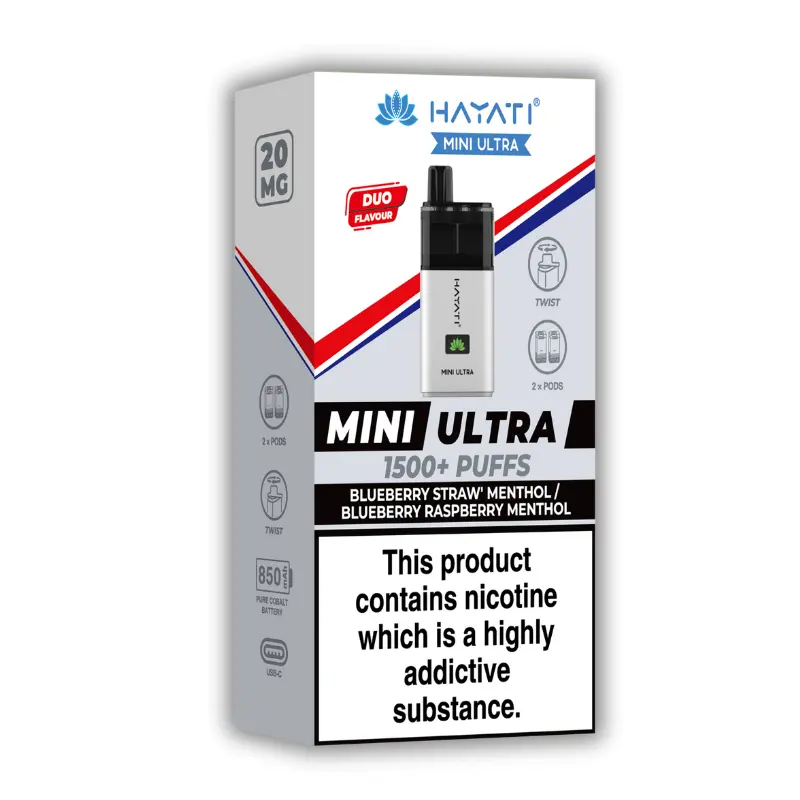
Hayati · Mini Ultra
Blueberry Straw’ Menthol / Blueberry Raspberry Menthol Hayati Mini Ultra
£3.99
✔ In stock — ready to ship
Genuine Hayati
Free over £20
Same-day dispatch
Secure checkout
Read the name of this listing slowly, because almost everybody reads it wrong the first time. Blueberry Straw' Menthol on one side of the oblique, Blueberry Raspberry Menthol on the other. Two words appear twice. Blueberry appears twice and menthol appears twice, and the only thing that changes across the divide is the red fruit sitting between them. This is a Hayati Mini Ultra at £3.99, complete with the body and an 850mAh cell, and a single prefilled 4ml pod at 20mg nicotine salt holding both blends apart from each other. The listing states in its own words that the two flavours are kept separate and that a turn of the rotating mouthpiece decides which one reaches the coil, so this is one divided pod rather than two pods in a box, and that is on the record for this product rather than guessed from the punctuation. Hayati rate it at up to 1,500 puffs, a figure produced by test apparatus drawing to a fixed pattern.
The reason the name gets misread is worth stating at the top, because it has consequences for what the pod can tell you. The handle this listing is filed under drops the second menthol. The title carries it. Anyone who arrives here from a URL, a search result or a category tile rather than from the product name will come in expecting a cooled blend set against an uncooled one, and that is not what is in the pod. Both sides are cooled. The menthol is not the variable. It is one of the two things being held still.
Which turns out to make this pod more interesting rather than less. Hold a base fruit and a coolant constant, vary one middle term, and you have built the tightest comparison in a catalogue of 492 listings. Not a claim to make without counting, so the counting is the next section. What follows after that is an argument about what a comparison this narrow genuinely entitles you to conclude, why a constant that is held is not the same as a constant that is neutral, and why four millilitres is not a compromise on this particular product but the one volume at which the whole exercise works.
Reading the title against the handle, and counting before claiming anything
Sixty-one listings in this catalogue put an oblique inside the flavour part of the title. Thirty-three of the sixty-one repeat at least one word across the divide, which the Straw' Cranberry Cherry and Cherry Ice pod page established and I am taking rather than recounting. A shared component in a two-sided listing is close to a house habit and is not rare in the slightest.
Narrow it once. Of those sixty-one, twelve repeat two or more words across the oblique. That thins the field considerably but it still does not isolate anything, because most of the twelve are repeating a treatment word and a filler: the three Cotton K pairings share a confection name, the Razz pairings share a family prefix, and two nested Strawberry Ice listings share a fruit plus a cooling word while adding a berry on one side.
Narrow it the way that actually matters. Take the flavour names on either side of the oblique, line them up word for word, and ask how many pairings have the same number of terms and differ in exactly one of them. Twenty-four listings do, which is a good deal more than I expected and which makes the frame-and-swap design a genuine Hayati habit rather than an accident.
Now the last cut, and it is the one that produces a number of one. Of those twenty-four, how many have the differing term in the middle, with a held word in front of it and a held word behind it? One. This listing. Every other frame-and-swap pairing in the catalogue changes the first term or the last term, so the variable sits at an edge with the constant on one side of it only. Lemon Lime against Lemon Blueberry holds the front and swaps the tail. Blue Razz Cherry against Blue Razz GB does the same. Grape GB against Strawberry GB holds the tail and swaps the front. Blueberry Cotton K against Raspberry Cotton K holds two tail words and swaps the head. This pod is the only one in 492 listings where the thing that moves is bracketed on both sides by things that do not.
Two honest limits on that, because a count of words in titles is not a count of recipes. The first is that the names are marketing copy and a formulation could differ in ways no title records. The second is that a medial position is a fact about typography until you check that the bracketing words are doing structural work, and here they are: the word in front is the base fruit and the word behind is the treatment. Frame, variable, frame. That is what a controlled comparison looks like written down, and no other listing here is written down that way.
One more count, this time on the coolant. Cooling appears on both sides of the oblique in five listings, which resolve to three arrangements across their various formats: a nested pair of iced strawberries, a pair of mints, and this. Of the three, the iced strawberry pairing is nested rather than substituted, since one side is the other with a berry added, and the mint pairing swaps the entire front of the name. This is the only cooled-on-both-sides pairing that substitutes a single term inside a fixed frame, and it is the only one of the three sold at four millilitres.
Finally, the coolant word itself. Menthol appears in seven of the 492 titles, a count the Double Menthol pods page did properly and which I have verified rather than assumed. Three of those seven are this kit and the two single pods that make it up. That page also worked out that four of the seven attach menthol to a fruit, and this pairing supplies three of the four. Put differently: outside a drink-named nic salt, every listing in this catalogue that puts menthol on named fruit is this product or one of its halves. The Menthol Vapes shelf now runs to twelve listings and a quarter of it is this box and its two refills.
What a comparison this narrow actually licenses
The standard for this kind of claim in this corpus was set by the Straw' Cranberry Cherry and Cherry Ice pod, which looked like a single-variable instrument, and which found on inspection that at least five things moved when the collar turned. Its list was the company the shared fruit kept, the structural role that fruit played at each setting, a formulation that probably differed, a sweetness that differed for two stacked reasons, and a tail that behaved differently at each end. Its verdict was that the pod offered a degraded version of a valuable experiment. That page is the bar, and the honest thing to do is run the same inventory here rather than assert that this one is better.
So here is everything that moves between the two settings of this collar.
The second fruit. Strawberry at one setting, raspberry at the other. This is the intended variable and the reason to own the thing.
Acid. Raspberry carries a real acid load, mostly perceptible along the sides of the tongue at the front of an inhale. Strawberry carries very little by comparison. So the fruit swap is also an acid swap, and there is no version of substituting these two berries that is not. This is not a confound in the way the cherry pod's confounds were confounds, because acid is part of what the word raspberry means in a flavour context. It is an entailment of the variable rather than a second variable riding alongside it.
Sweetness. Moves in the opposite direction for the same reason. Hayati's own copy says as much, describing the strawberry side as the mellower one and the raspberry side as sharper and more tart. Again an entailment rather than an independent mover.
The perceived strength of the menthol. Hayati state that the chill comes across crisper on the raspberry side. That is entirely consistent with an identical dose of coolant being read differently by a mouth that is receiving less sugar, which is the direction the Cherry Ice kit page established for the relationship between cold and perceived sweetness. It does not require two different menthol loadings and it should not be taken as evidence of any.
The menthol dose itself. Unpublished. It could differ. Nothing in Hayati's material states that the coolant is at the same concentration on both sides, and a flavour house dosing a coolant into a sweet blend and into a tart one has two different jobs. This is a genuine confound and it cannot be removed from the outside.
The blueberry base. Hayati assert that the two blends share a base, which is a stronger position than the cherry pairing ever got, since nothing in that product's material claimed the cherry was the same cherry at both settings. But an assertion in retail copy that two blends share a base most likely means both are blueberry-led rather than that both draw on one concentrate at one dosing. And the two halves' own separate listings describe the blueberry differently: the standalone strawberry pod gives the blueberry a mellow, rounded character, while the standalone raspberry pod gives it depth and sweetness. That is a disagreement between two pieces of copy about one component, and this corpus has repeatedly found that such disagreements are evidence about how the copy was written rather than about two recipes. It is still a second genuine confound, and a smaller one.
Count it up. Two entailments of the variable, which are not confounds, and two genuine unpublished unknowns. Against five independent movers on the cherry pod. This is the tighter instrument by a clear margin and the reason is structural rather than lucky: the shared components here are named on both sides of the oblique and occupy the same slot in both names, which is precisely what the cherry pairing failed to do when it put its shared fruit in the lead at one setting and third in a list at the other.
So state the finding narrowly, because the narrow version is the valuable one
What this pod licenses is not a conclusion about menthol. Menthol is held. You cannot learn what a coolant does to a berry from a product that cools both berries, and any page telling you otherwise has read the handle instead of the title.
What it licenses is this: which second red fruit you want sitting on a cold blueberry, on one coil, at one nicotine strength, on the same day, in front of the same palate, with everything else as close to held as this catalogue gets. That is a real result and a surprisingly rare one. Most people never establish anything that clean about their own taste, because the ordinary way to compare two liquids involves two devices, two coils at two different ages, and a gap of days between the two readings.
There is also a portable version, and the portable version is worth more than the specific one. Strawberry and raspberry are not merely two fruits. They are two strategies for doing the same job. Strawberry does it with sugar, body and a broad aroma. Raspberry does it with acid and a narrow, highly identifiable aroma. Find out which of those you want underneath a cold finish and you have learned something that applies to the ninety listings in this range that carry ice in the name, not just to these two. That is the prize, and it is available for £3.99.
One thing this pod cannot do, and which is worth naming because the missing arm is the obvious question. To isolate the menthol you would need the same berries uncooled, and unlike the cherry pairing, which had no such liquid anywhere in its range, this one does. The Blueberry Raspberry Hayati Mini Ultra Pod Kit at £3.99 is the identical two berries with nothing over them, on the same hardware, and the same blend is also sold as a bare Mini Ultra pod that would run on the body already in this box. The Cotton K Mini Ultra page made the equivalent purchase for its own treatment and had to buy two complete kits to do it. Here the second arm can be a refill rather than a second device, which is a cheaper and tidier way to run the same experiment. On fitment, match the range name printed on your device to the range name in the title rather than assuming anything seats across ranges.
A constant is not the same thing as a neutral
Here is the part that complicates the tidy picture above, and it is the most useful thing on this page.
Menthol is being held constant across the collar. Held constant is not the same as being out of the way. A measuring instrument that is identical at both settings can still distort what it measures, and this one does, for a reason that is specific to menthol and does not apply to most of the cooled liquids in this range.
What is in the pod that is not in an Ice listing
The corpus has already settled the distinction and I am applying it rather than rebuilding it. The cold you feel from a menthol liquid is not a temperature. The vapour is warm when it arrives and stays warm. Menthol binds a cold-sensing channel in the tissue of the mouth and throat and the channel reports a drop that never happened, which the Double Menthol pods page sets out properly. The trade also has purpose-built cooling compounds that hit the same channel with little or no smell of their own, and the Blue Frozen pages in this corpus established both the practical consequence of that and a four-second test for telling them apart, which is to take one draw normally and one with the nose pinched shut and see how much minty character disappears.
That is the distinction, and it decides what this pod is doing. An odourless coolant is a single contribution: cold, delivered on a channel that carries nothing else, with nothing added to the aroma. Menthol is two contributions in one molecule. It delivers the cold, and it delivers a smell, and the smell is not neutral fruit-friendly material. It is herbal, camphorous, faintly woody and slightly medicinal, which is the character the Double Menthol kit page names as the one aroma present in a liquid that has nothing else in it.
Hayati publish no coolant type for this pod, so strictly the two sides could be carrying a synthetic agent with the word menthol used loosely on the label. I do not think that is the likely reading. Menthol is named in only seven titles out of 492 while ice is named in ninety, and a house that uses a generic sensation word nine times out of ten and reaches for a specific compound name three times in one product family is most plausibly naming what is in it. Mark that as probable rather than confirmed, and settle it on your own pod with the nose-pinch test if it matters to you.
Which of the two things a drinker will actually notice
Take the cold first, because it is the easy half. Cold arrives on a channel nothing else in this pod is using. There is no acid strong enough to be confused for it, no carbonation reference, no warmth from a spice, no astringency. It is fast, it arrives whatever you do with your breath, it works on a tired palate, and it outlasts the exhale by a good number of seconds because the receptor stays open after the molecule has gone. In a pod containing a quiet dark berry and one red fruit, the cold is going to be the loudest single event in every draw at both settings, and most people will describe this product as a cold one before they describe it as a berry one.
The herbal half is the interesting question and the answer is that it matters far more than its loudness suggests, because of where it lands. It lands in the aroma channel. That is the only channel a fruit has for saying which fruit it is.
This corpus has already established the relevant fact about the base, and it is the fact that makes the problem sharp. A raw blueberry is close to aromatically mute, and the version of blueberry that people recognise is the cooked one: stewed, skins broken, sugar concentrated, matt rather than glossy, with a faint floral lift above the sweetness and a slight skin-derived drag on the finish. That argument belongs to the Blueberry Raspberry Cherry Hayati Pro Max Plus 6000 Pod Kit page and it is not being re-derived here. What it means for this product is that the base fruit is bringing a quiet, diffuse aroma and a faint floral note into a liquid that also contains a loud, dry, camphorous aroma from the coolant. Quiet things lose to loud things in a shared channel. The blueberry's floral lift is the single most likely casualty of the menthol in this pod, and that is not a fault, it is arithmetic.
The asymmetry, which is the actual finding
Now put the two halves of the menthol next to the two fruits and something falls out that neither the Cherry Ice page nor the Cotton K page had occasion to notice.
Strawberry and raspberry differ on two channels. They differ in aroma, and they differ in acid. Menthol's second contribution occupies one of those two channels and cannot touch the other. Aroma is contested. Acid is not, because acid is a taste registered by direct contact on the tongue and a camphorous smell has no access to it whatsoever.
So the coolant is not neutral with respect to the comparison you are running. It suppresses part of what separates the two sides and leaves the rest untouched. The difference you will detect between the strawberry setting and the raspberry setting is therefore weighted towards acid and away from aroma, relative to what the same two fruits would show you if the coolant were odourless.
Follow that one step further and it stops being a technicality. Strawberry's entire contribution is aroma, sugar and body. It has no acid to fall back on. Raspberry's contribution is split, with the acid half safe from the menthol and the aroma half exposed to it. The menthol therefore takes more from the strawberry side than from the raspberry side, not because the dose differs but because of what each fruit is made of. Anybody who runs this pod, decides the raspberry side is the more distinctive of the two, and concludes that raspberry is the better fruit has arrived at a reasonable preference by a route that includes an artefact. Part of what they measured was the coolant standing on the strawberry.
That does not invalidate the comparison. It narrows it in a specific and statable way, which is the same service the cherry pod page performed for its own product. You may say which of these two cooled berry blends you prefer. You may not say which of these two red fruits you prefer in general, because you met one of them through a filter that suits it less well.
Clean or intrusive: a prediction, marked as one
The last question worth answering is whether the herbal note reads as crisp or as medicinal over a sweet dark berry, and the honest answer is that it depends which side you are on, with the mechanism being the thing worth knowing rather than the verdict.
A sweet fruit accord with menthol over it and no acid in it is, structurally, the construction of a throat lozenge. That is not a health remark and nothing about this product does anything to anybody. It is a remark about a familiar flavour shape: sugar, a soft fruit reference and a camphorous cooling note, with nothing sour anywhere in it. People have a strong learned association with that shape and it is the association that makes a menthol-over-sweet-fruit liquid tip into reading as medicinal rather than as fresh.
Acid is the single most effective thing for breaking the association, because lozenges are not sour. Which gives a specific prediction, and I would put it at probable rather than confirmed, since nobody has published a formulation and I am reasoning from how the components behave rather than from a tasted liquid. The menthol should read crisp over the raspberry side and carry a higher risk of reading medicinal over the strawberry side, and the deciding factor is not the coolant dose but the presence or absence of an acid.
The prediction is falsifiable on your own pod, which is the point of making it. If you find the strawberry side lozenge-like and the raspberry side bracing, the mechanism above is doing the work. If you find both crisp, then either the menthol is dosed lightly enough to stay out of trouble or the strawberry is carrying more acid than its usual character suggests. If you find both medicinal, the coolant is heavier than the copy implies and the acid on the raspberry side is not enough to rescue it.
- Reasonably confident: both sides are cooled, since both names carry the word and the listing describes a chill on each.
- Reasonably confident: the coolant contributes an aroma as well as a sensation, which is the property that separates menthol from the odourless agents used across the Ice listings.
- Probable: the coolant is dosed identically on both sides, on the grounds that the copy attributes the difference in crispness to the fruit rather than to the cooling.
- Probable: the herbal note sits more comfortably over the raspberry side than over the strawberry side, for the acid reason above.
- Unknown: the coolant concentration, the flavouring concentrations, whether the blueberry is the same blueberry at both settings, and how the 4ml divides between the two reserves. Hayati publish a total and nothing else, and an even split is a reading rather than a fact.
The constant is not doing the same job at the two settings
One more consequence of holding a coolant still across a fruit swap, and it is the deepest thing this pod can teach anybody.
The Blueberry Raspberry Cherry page ran a census of the base fruit across all 492 listings and found something that bears directly on this product. Forty-six titles carry blueberry, seventy-four carry raspberry, twenty-eight carry both. Not one liquid in the entire catalogue is sold as blueberry and nothing else. Every listing that names blueberry without raspberry brings something else in to do the job raspberry normally does: lemon in one, cranberry in another, pomegranate in a third, a confectionery treatment in several, and a coolant in exactly one. That page named the menthol build as the listing that hands the acid job to a coolant, and the menthol build it was pointing at is the strawberry half of this pod.
Which means the two settings of this collar are not two flavours. They are the range's two answers to blueberry's standing problem, sitting on one coil.
At the raspberry setting, raspberry does the lifting. Acid at the front, a perfumed top note over it, and the menthol arrives as an addition to a blend that already had a bright element in it. The coolant is decorative there in the strict sense that removing it would leave a coherent liquid, which you can verify for £3.99 by buying the uncooled version of that exact pairing.
At the strawberry setting there is no acid to speak of. Strawberry is sweet, broad, aromatic and soft, and putting it over a cooked-reading blueberry produces a liquid with two sweet fruits, two rounded profiles and nothing whatsoever pulling upward. The menthol is the only lift in the liquid. It is load-bearing. Take it out and the blend does not become a milder version of itself, it becomes a different and much heavier object, and the catalogue's own behaviour confirms this: blueberry and strawberry appear together in only five titles across the whole range, and three of those five are the three-berry blends that also contain raspberry. The pairing of blueberry with strawberry and no raspberry exists exactly twice, and both instances are this pod's strawberry side, sold as a half and sold on its own as Blueberry Straw' Menthol Hayati Mini Ultra Pods at £3.49. Hayati do not build that combination without something sharp in it, and on this listing the something sharp is the coolant.
So the constant is identical in name, probably identical in dose, and structurally doing two entirely different jobs. That is the mirror image of the cherry pod's problem, where the shared fruit turned out to be in the floor of one blend and the ceiling of another. Here the shared coolant is scaffolding at one setting and ornament at the other, and knowing which one you are on changes what a preference means. Preferring the strawberry side is partly a statement that you like what menthol does when it is the only bright thing in a liquid. Preferring the raspberry side is partly a statement that you would rather a fruit did that work.
The two blends, taken across a draw
Everything above is structure. This section is what the liquid does, with the inference marked where it is inference, because Hayati publish three short paragraphs about this product and nobody outside the factory has a formulation.
The strawberry setting
The opening is soft and it is slow. Neither fruit here is a front-loaded fruit. Blueberry's identifiable character is the cooked one and cooked notes are slow to arrive, and strawberry, while broad, is not sharp enough to announce itself in the first instant of an inhale. What you get early is sweetness with a dark tint to it and not much definition.
The middle is where the two fruits do their work and where they also blur into each other, which is the honest thing to report about this side rather than pretending to a separation that a sweet blueberry and a sweet strawberry are unlikely to produce. Hayati's copy for the standalone pod says the strawberry layers over the blueberry, and their copy for the kit says the blueberry is softened by the strawberry. Those are two different descriptions of the same relationship and they cannot both be exactly right, which tells you the copy is describing an impression rather than a structure. The impression they agree on is roundness, and roundness is what this side is for.
The exhale is where the menthol takes over and it takes over completely. The chill arrives late, clears the sugar off the tongue and leaves the herbal note behind it, which on this side has very little competition because neither fruit is holding much of the aroma channel by that point. This is the part of the draw where the medicinal risk lives. If this side is going to bother you, it will bother you two seconds after you have finished the exhale.
What this side is not: it is not a fresh strawberry. Nothing in it is fresh in the sense of raw fruit off a plant. The blueberry reads cooked by the nature of the material and the strawberry is sitting in sugar, so the register is preserve rather than punnet, with a cold finish thrown over it.
The raspberry setting
The opening is genuinely different and the difference arrives immediately. Raspberry's acid is a contact effect on the tongue with no distance to travel, so it is the first thing in the draw and it is there before any aroma has reached the back of the nose. Where the strawberry side opens soft, this one opens with a small tightening along the sides of the tongue.
The middle is better defined for the reason the Cotton K page argued about the same two dark berries, which is that raspberry has one of the more identifiable aromas in soft fruit while blueberry does not. Against a quiet base, the raspberry is nameable. Against a quiet base plus a camphorous coolant it is less nameable than it would otherwise be, for the channel reason above, but it is still the most legible single thing in either half of this pod.
The exhale is the crisper of the two and Hayati say so. My reading of why is that nothing has changed about the coolant and everything has changed about what it is landing on. Cold over a sweet liquid reads as a lid. Cold over an acidic one reads as a continuation, because acid and cold both narrow a finish and they narrow it in the same direction. The two combine into something that feels tighter rather than colder.
What this side is not: it is not sour. There is a real acid component and it is doing structural work, but it is the ordinary acidity of a raspberry rather than a dosed sour treatment. If a front-loaded tang is what you are after, Blue Sour Raspberry Hayati Mini Ultra Pod Kit puts it at the front of every draw on the same body, and the Blue Sour Raspberry Hayati Pro Max Plus Pod Kit does the same at twelve millilitres.
What the three listings agree on, and the one place they part
This flavour arrangement is sold three times: as this kit and as the two single pods. Lining the three descriptions up is cheap evidence and it produces one useful result and one caution.
All three agree that blueberry is the base and that the cooling is a finish rather than an opening. All three give the raspberry side the sharper character and the strawberry side the mellower one. That level of agreement across three independently written descriptions is about as close to a fact as this material gets.
Where they part is on which component carries the softness. The kit's description puts it in the strawberry, saying the red fruit softens the blueberry. The standalone strawberry pod puts it in the blueberry, calling the base mellow and rounded in its own right. The standalone raspberry pod gives the blueberry depth and sweetness instead, which is a third characterisation again. A component described three ways in three listings of one flavour family is a copywriting variant rather than three recipes, and it is exactly the sort of thing this corpus has caught before. Treat the shared base as shared in name and probably in kind, and do not build anything load-bearing on the adjectives.
Four millilitres, and why the small pod is the right instrument for this question
The obvious complaint about a divided pod at this size is that you are paying for two flavours and getting very little of each. On most pairings that is fair. On this one the small volume is not a compromise, it is the thing that makes the comparison trustworthy, and the reason is specific to a product that cools both of its halves.
A palate adapts to a coolant faster and more completely than to almost anything else in a liquid. The Double Menthol pods page states that flatly and its kit sibling reconciles two clocks that look contradictory and are not: within a single session, an aroma fades markedly while a coolant does not, and across days and weeks the ordering reverses, because a nose resets overnight while a reduced response to a coolant builds up over repeated exposure and takes days rather than hours to come back. I am taking that finding rather than re-running it.
Apply it here. Both sides of this pod are cooled, so turning the collar buys you no relief from cold. A mixed pairing gives you an escape hatch, which is why the Fruit Bomb pod argued that switching reserves resets part of the adaptation. This one does not have that hatch, because the thing you would be escaping is present at both settings. The Blue Frozen nic salt page puts the consequence bluntly for a rotation of two cold liquids and its conclusion transfers exactly: a second cold thing tastes weaker than it is because the first one has already recalibrated you. This pod is two cold liquids inside one housing.
Which would be a serious problem at twenty-two millilitres. It is not a problem at four. The Double Menthol kit page, arguing about a twelve millilitre pod, said the volume was what turned adaptation from a curiosity into the thing that decides whether the pod gets finished, and that at two millilitres none of it would matter. Four millilitres across two reserves puts each side somewhere around that lower figure. There is not enough liquid in this object to give the multi-day accumulation a run-up. You will meet the cold at close to full strength for the life of the pod, and more importantly for the argument this page is making, you will meet it at close to the same strength on the last day as on the first.
That is what makes the comparison honest. Run this exact pairing at a larger volume and you would be comparing your day-one response to strawberry against your week-four response to raspberry, with your own cold receptors drifting downward underneath both readings and no way to tell the drift from the difference. The single confound that would most efficiently destroy a menthol-held comparison is the one the volume disarms.
A second and unrelated mechanism points the same way, and the Cotton K Mini Ultra kit owns it: a coil that never has to work through more than four millilitres stays close to how it started, so the two sides you compare at the end are close to the two sides you compared at the beginning. Two independent lines of reasoning, one about your receptors and one about the hardware, both conclude that this is the right size of pod for a comparison. That is unusual and it is worth the price of the box.
One coil, and a switch with no cue at all
The cost of the design is carryover, and on this pairing it takes an unusual shape.
The mechanical part is ordinary. One coil, one wick and one airflow path serve both settings, so immediately after the collar moves the wick is still holding what it was feeding a moment ago, and the next several draws are a mixture rather than a sample of either side. Every divided pod has this.
What is not ordinary is how badly this pod hides it. The Cotton K pairing had one shared component, a confectionery backdrop, and its page observed that a half-cleared draw still tasted plausible because both sides sat on the same floor. This pod has two shared components. Blueberry is in both. Menthol is in both. A mixed draw on this product is blueberry, menthol and a smear of two red fruits, which is not a broken draw and does not announce itself as one. It is a perfectly credible third berry blend and it will be filed as a reading of whichever side you have just selected.
Then the specific twist, which no other divided pod in this range has. On a pairing where one side is cooled and the other is not, the arrival of the cold is itself the signal that the switch has taken: you know the new liquid is reaching you because your mouth has gone cold, or has stopped being cold. The Straw' Cranberry Cherry / Cherry Ice Hayati Mini Ultra Pod Kit at the same £3.99 works exactly that way and its collar functions as a temperature switch as well as a flavour switch. This one does not. The cold is identical before and after the turn, so the loudest event in the draw carries no information about whether the switch has completed. The cue set here is the emptiest of any divided pod on the shelf.
The clearance rule that follows is therefore a matter of counting rather than judgement, and it has to be a fixed count decided in advance.
- On the first day, before you have formed any opinion, turn the collar and take slow draws at your ordinary pace until the taste genuinely stops changing. Count them. That number is your clearance count and it is a property of how you draw, not of the pod.
- From then on, discard that many draws at every switch and judge none of them. Err upward by two or three, because an extra ignored draw costs nothing and an unnoticed blend costs you a conclusion you will act on at the next reorder.
- Do not use the cold as the cue. It was there before the turn and it will be there after it.
- Do not use the sweetness as the cue either. It shifts in the right direction but it shifts gradually as the wick changes over, so it tells you a switch is in progress and never tells you it has finished.
- The one usable cue, if you want a check on your count rather than a substitute for it, is the acid. It is the only property that is present on one side and effectively absent on the other, and it lands early enough in the draw to be noticed. When the tightening at the front of the inhale has either fully arrived or fully gone, the changeover is close to done.
The carryover in your mouth, as opposed to in the wick, is the one place where this pod is better off than its neighbours. The cherry pairing had an asymmetric problem, with a residual chill flattering one side and a dried-out mouth punishing the other, so the two directions of the switch were compromised by different mechanisms over different timescales. Here the residual cold is the same in both directions, because you are going from cold to cold. It does not distort one reading more than the other. That is a genuine advantage of cooling both halves and it partly pays for the loss of the switching cue.
On how the pod keeps one liquid off the other, this page says nothing, because Hayati describe no dividers, no seals and no internal arrangement anywhere in this product's material. What is on the record is the outcome: two flavours held apart, a rotating mouthpiece selecting which one is drawn, and one coil serving whichever is chosen.
The kit itself, kept short
What arrives is the Mini Ultra body with an 850mAh rechargeable cell built into it, and one prefilled pod carrying both flavours. That is the whole box. The pod is prefilled and not refillable, so the liquid and the coil finish together and the unit is replaced rather than serviced.
The one specification that matters for this particular liquid is the four millilitres, and the previous section is the whole argument for why. Everything else on the sheet is what a compact prefilled kit looks like and has been described at length on the other five Mini Ultra pages in this corpus, which between them cover the shelf's composition, the arithmetic of a two-millilitre side, the switching economics at this size and the coil-stability case. There is no point writing a sixth version of any of it. For the rest of the range, the Hayati Mini Ultra Prefilled Pod Kit shelf holds twenty complete kits and the wider Hayati Mini Ultra shelf runs to fifty listings once the single-flavour refills are counted in.
One thing specific to this box is worth flagging because it will cost somebody an order. Every other Mini Ultra listing in the catalogue ends its title with a format word, either Pod Kit or Pods. This one stops at Hayati Mini Ultra with no format word at all, and the handle it is filed under drops the second menthol. So the complete kit is the listing whose name looks least like a kit, and the URL describes a product that is not quite what is in the box. If you are coming back for this specifically, search on the two flavour names rather than on the range name or the address.
The specification, with the rows that are blank
| What the collar selects | Which of the two liquids reaches the coil. Nothing else changes. |
| Setting one | Blueberry Straw' Menthol. Blueberry base, strawberry, menthol finish. |
| Setting two | Blueberry Raspberry Menthol. Blueberry base, raspberry, menthol finish. |
| Held across both settings | Blueberry, menthol, the coil, the wick, the airflow path, the nicotine strength and every day of storage |
| Changed across both settings | One fruit, and everything that follows from it |
| Switching | Rotating mouthpiece, at any point in a session |
| Liquid on board | 4ml in total, prefilled. No per-side figure published. |
| Nicotine | 20mg nicotine salt. No second strength offered on this listing. |
| Cell | 850mAh, rechargeable, built into the body |
| Manufacturer's puff figure | Rated by the manufacturer at up to 1,500 puffs, measured on test apparatus |
| Supplied as | Device and pod together. Nothing to assemble, nothing to fill. |
| Price | £3.99 for the complete kit |
| Not published | Coolant type and concentration, coil resistance, airflow, how the 4ml divides, and whether the blueberry is the same blueberry at both settings |
The last row is the one this page has spent itself on. A single line from Hayati stating that both sides draw on one blueberry concentrate at one dosing, and one coolant at one concentration, would convert this listing from a good comparison into a properly controlled one and make a preference mean something precise. Neither line exists. Anybody who tells you the two menthols match is telling you something nobody outside the factory can know, and this page has been careful to say probable rather than certain everywhere it leans on that.
Two of the published rows deserve a note. The four millilitres is one shared budget rather than two, so whatever is left in the side you stop using goes out with the pod, and on a pairing this closely related the odds of running level are better than on most divided pods, because a person who likes cold blueberry generally likes it with either red fruit rather than only one. The 20mg is the maximum concentration permitted for liquid sold here, there is no lighter version of this pairing, and nicotine is addictive. Which strength suits somebody is their own business and not something a product page should be steering.
Where this sits among its neighbours
Sort the alternatives by what you concluded from the pod rather than by fruit, because on a comparison instrument the conclusion is the thing you are shopping with.
You worked out which side you want and you want to restock it
Both halves are sold on their own, which is not true of every divided pairing in this range and is the main practical reason this kit is a sensible first purchase. Blueberry Raspberry Menthol Hayati Mini Ultra Pods at £3.49 gives you the whole four millilitres of the sharper side, and the strawberry pod linked earlier does the same for the mellower one. Either runs on the body already in this box, so the shared-budget problem is a one-time cost rather than something you pay again at every reorder.
The menthol turned out to be the part you did not want
Then remove it and keep the berries. The Blueberry Raspberry Mini Ultra kit is the same two fruits with nothing over them at the same £3.99, and its own description gives blueberry the rounded sweetness and raspberry the tart lift, which is the split this page has argued survives the cooling. Further up the range the same blend runs as the Blueberry Raspberry Hayati Pro Max Plus Pod Kit at £7.99 for twelve millilitres, and adding a third fruit to it gives the Blueberry Raspberry Cherry kit, where a dark cherry sits underneath the pair rather than beside it.
The cooling was the part you did want, and you want it on something else
The rest of the cold end of this catalogue is built with the sensation words rather than the compound name, which the Blue Frozen pods page established is a vocabulary difference and not a grading. Strawberry Raspberry Ice Hayati Mini Ultra Pod Kit at £3.99 keeps the raspberry, drops the dark berry for a red one and cools the result, which is the nearest single-flavour alternative on this hardware. Blue Razz Pineapple / Strawberry Ice Hayati Mini Ultra Pod Kit is the divided version with cooling on one side only, so its collar does the temperature-switch job this one deliberately does not. For a cooled blue accord at twelve millilitres, Blue Frozen Hayati Pro Max Plus 6000 Pod Kit is the listing whose pages carry most of this corpus's work on telling a coolant type by nose.
You liked the structure more than the flavours
Frame-and-swap pairings are the design worth looking for, and the two closest are both at this price. Blueberry Cotton K / Raspberry Cotton K Hayati Mini Ultra Pod Kit holds a candy floss treatment across the same two dark berries and its page argues, convincingly, that a thin treatment leaves the fruits nameable in a way a loud one does not. That pairing is the natural companion purchase to this one, because between them they hold two very different constants over closely related fruits: one that adds sugar and no aroma, one that adds a sensation and a strong aroma. Owning both for £7.98 is about the most instructive eight pounds available on this shelf. The same pairing at twenty-two millilitres is the Cotton K Pro Ultra Plus kit at £11.99, and Blackcurrant Cotton K / Blue Raspberry is the version that puts the treatment on one side only, which makes it the asymmetric design rather than the symmetric one.
You want the comparison run on a sharper contrast
Divided pods trade information against variety and you cannot have both in one housing. If a wider gap is what you are after, Straw' Cranberry Cherry / Strawberry Raspberry Ice Hayati Pro Ultra Plus 25000 Prefilled Pod Kit sets a dry tart blend against a cooled berry pair at twenty-two millilitres, and Fruit Bomb / Straw' Watermelon B'Gum Hayati Mini Ultra Pod Kit puts an unspecified fruit blend against a confectionery one at this size. Neither will teach you anything precise, which is the honest trade rather than a criticism.
The berries were right but the arrangement was not
If you wanted all three fruits at once rather than two at a time, Strawberry Raspberry Blueberry Hayati Pro Max Plus Pod Kit puts the whole set into one uncooled liquid at £7.99, with the bare pod version at £5.49 once the device is yours. Mixed Berries Hayati Pro Max Plus 6000 Pod Kit is the broader version of the same idea. For a blue accord reached through a different route entirely, Blue Razz Cherry Hayati Mini Ultra Pod Kit and the Blue Razz GB version of the same body sit on this shelf at the same price, and Blue Razz Lemonade Hayati Pro Max Plus Pod Kit hangs a citrus frame on a blue raspberry if sharpening is what you were really after. A bottled route to a cool berry is Blue Razz Mojito Hayati Pro Max Nic Salts at £2.49, where the cool thread comes from mint rather than from a named compound.
Browsing rather than shortlisting
Everything in this range that pairs these two berries is on Blueberry Raspberry Vapes, forty-six listings deep. The wider red and blue selection is Berry Vapes at 225, the cooled listings that use the compound name rather than a sensation word are the twelve on the menthol shelf linked earlier, and the whole catalogue is on the full Hayati range.
Running this pod well
Practical notes anchored to what this object actually is, rather than the general advice that applies to every prefilled kit.
Do the comparison in the first two days and then stop comparing. Everything this pod is good for lives in the early part of its life, for both of the reasons in the volume section: the coil is at its freshest and your response to the coolant has not yet moved. A comparison attempted in the last quarter of the pod is measuring a difference that has already been partly rubbed out and will hand you a confident verdict of no difference.
Write down which collar position is which before you have an opinion. Nothing on the pod identifies the settings and no map is published. A note made on day one is what makes every later observation attributable, and on a pod with no switching cue it is the only thing that will.
Leave gaps between draws on this one. Back-to-back pulls stack coolant onto tissue that has not recovered from the previous dose, which pushes the sensation towards the sharp end faster than it pushes it towards the cold end. Twenty or thirty seconds makes a clear difference on a menthol liquid and almost none on an uncooled berry. It matters at both settings here, which is not true of most divided pods.
Judge the aroma in the morning and the cold at any time. The Spearmint pages established that a night's sleep fully resets olfactory adaptation, so the first draw of the day is the fair test of whether the fruit is still arriving. The cold does not follow that clock and needs a layoff of days rather than hours to recover, so a morning draw tells you nothing about it. On this pod that split is useful rather than academic, because the fruit is the thing that changes between settings and the cold is the thing that does not.
Keep something uncooled in the rotation if you run this daily. Both sides are cold, so the pod has no internal relief from its own coolant. A second pod without cooling in it is the single most useful thing you can own alongside this one, and it doubles as a diagnostic: if the menthol here has gone quiet while an uncooled pod is arriving exactly as it always has, the change is in your response to cold rather than in the hardware.
Expect the aroma to go before anything else. Residue building on a small coil takes the volatile material first, and in this pod the volatile material is the fruit. The acid on the raspberry side is not volatile and will not evaporate off a warm coil, and the coolant is a stable compound that survives a warm week without complaint. So the expected ageing pattern is a pod that stays cold and stays sharp on one side while both fruits quietly recede, which reads as the two settings converging. That is the coil, not the liquid.
Storage. Heat is the risk and it is the fruit that carries it, not the coolant. A cooked-reading blueberry drifts further towards stewed if it is left somewhere warm, and stewed fruit under a cold finish is a combination nobody is buying. Keep it indoors, out of direct sun and out of a parked car, and somewhere children and pets cannot get at it.
End of life. The coil is built into the pod and cannot be changed, rinsed or rested, so a draw that has gone thin and hot is the end of the object rather than a phase it comes out of. The spent pod holds an electrical component and a residue of liquid, and the device holds a cell, so both go to a retailer take-back point or a local authority electrical collection rather than into household waste.
Questions this listing gets asked
Is one side cooled and the other not?
No. Both sides carry menthol and the title says so twice. The handle this product is filed under drops the second one, which is why the assumption is so common. If a temperature switch is what you wanted from a divided pod, the Cherry Ice pairing on this same hardware is the listing that does it.
Is this two pods in the box?
One. It is a single 4ml pod holding both flavours apart from each other, with a rotating mouthpiece deciding which reaches the coil, and the listing states that rather than leaving it to be read off the oblique. The four millilitres is one shared budget, so liquid left in the side you abandon is thrown away with the pod.
What is the actual difference between the two sides?
One red fruit. The blueberry base and the menthol finish are on both sides and named on both sides. Strawberry makes the blend rounder and sweeter, raspberry makes it sharper and adds an acid edge at the front of the draw that the strawberry side has no equivalent of.
Can I tell what menthol does to a berry by comparing the two sides?
No, and this is the most common mistake available on this listing. The menthol is the same at both settings, so it is not the thing being tested. To isolate the cooling you would need the same berries uncooled, and the Blueberry Raspberry Mini Ultra kit is exactly that liquid on the same hardware at the same price.
Is the menthol the same strength on both sides?
Not published. Hayati say the chill comes across crisper on the raspberry side, which is what an identical dose would do in a mouth receiving less sugar, so the copy does not imply two loadings. Treat it as probably equal and not as confirmed.
Will it taste medicinal?
More likely on the strawberry side than the raspberry one, and the reason is the acid rather than the coolant. Sweet fruit with a camphorous cooling note over it and nothing sour anywhere in it is a familiar flavour shape and some people read it that way. Raspberry's acid breaks the association. Strawberry has almost none to offer.
Why does the first draw after switching taste like neither side?
One wick feeds both settings, so straight after a turn it still holds what it was feeding a moment before. On this pod the mixture is harder to spot than usual because both sides share a base fruit and a coolant, so a half-cleared draw tastes like a credible third berry blend rather than like an obvious muddle. Count your clearing draws once on the first day and use that number thereafter.
How do I know when the switch has finished?
Not from the cold, which is identical before and after the turn, and that is unusual on a divided pod. The acid is the only property present on one side and effectively absent on the other, so use that as a check: when the tightening at the front of the inhale has either fully arrived or fully gone, the changeover is nearly done. A fixed count is still more reliable than any cue.
Will the cold fade as I get used to it?
Within a session, very little. Across days of continuous use, yes, and a response to a coolant takes days rather than hours to come back. At four millilitres the pod is unlikely to last long enough for that to become the story, which is one of the better arguments for buying this pairing small rather than large.
Can I buy just the half I like?
Yes. Both flavours exist as single-flavour Mini Ultra replacement pods at £3.49, and either runs on the device in this box. That makes the kit a reasonable way to settle which berry you want before you commit to restocking one of them.
Is there any sour or sweetener treatment on either side?
Neither name carries a sour word or a confectionery word, so expect ordinary fruit acidity on the raspberry side and ordinary fruit sweetness on both. If a front-loaded tang is the priority, the sour raspberry listings on this hardware put it at the front of every draw instead.
How long does it last?
Hayati rate the pod at up to 1,500 puffs, which is a laboratory estimate produced on test apparatus and is useful for ranking listings against each other rather than for planning a week. Four millilitres split two ways is a short pod by the standards of this catalogue and that is the point of it rather than a shortcoming.
The short version
Blueberry Straw' Menthol / Blueberry Raspberry Menthol is a £3.99 Hayati Mini Ultra kit: the body with an 850mAh cell, one 4ml prefilled pod at 20mg nicotine salt holding both blends apart, a rotating mouthpiece to choose between them, menthol on both sides, and a manufacturer rating of up to 1,500 puffs measured in laboratory conditions.
What makes it worth an argument is its shape. Of sixty-one two-sided listings in this catalogue, this is the only one where the term that changes sits in the middle with a held word in front of it and a held word behind it, and the two held words are the base fruit and the treatment. Strip out the entailments of the variable itself and only two genuine unknowns move with it, against five on the pairing that previously set the standard for this kind of analysis. It is the tightest controlled comparison Hayati sell.
What it is not is a test of menthol, whatever the URL suggests. It tells you which red fruit you want on a cold blueberry, and more usefully, whether you want your cooled blends lifted by sugar and body or by acid, which is a preference that travels across the whole cold end of the range. The complication worth knowing is that menthol is a single compound doing two jobs, cold and a herbal aroma, and the aroma half competes with the fruit in the one channel a fruit uses to identify itself. Since strawberry's whole contribution is aroma and raspberry's is split between aroma and acid, the coolant takes more from the strawberry side, and the difference you detect is weighted towards acid as a result. The four millilitres is not a compromise but the reason any of this holds up, because there is not enough liquid in the pod for your own response to the cold to drift while you are still making up your mind. Buy it to find out which side you want, then buy that side on its own. And when you turn the collar, count your clearing draws, because on a pod that shares both a base and a coolant nothing about a contaminated draw will tell you it is one.
Strictly for adults aged 18 and over. Nicotine is an addictive substance.
You might also like


