
Home / Hayati Mini Ultra Prefilled Pod Kit / Cherry Berry Hayati Mini Ultra Pod Kit
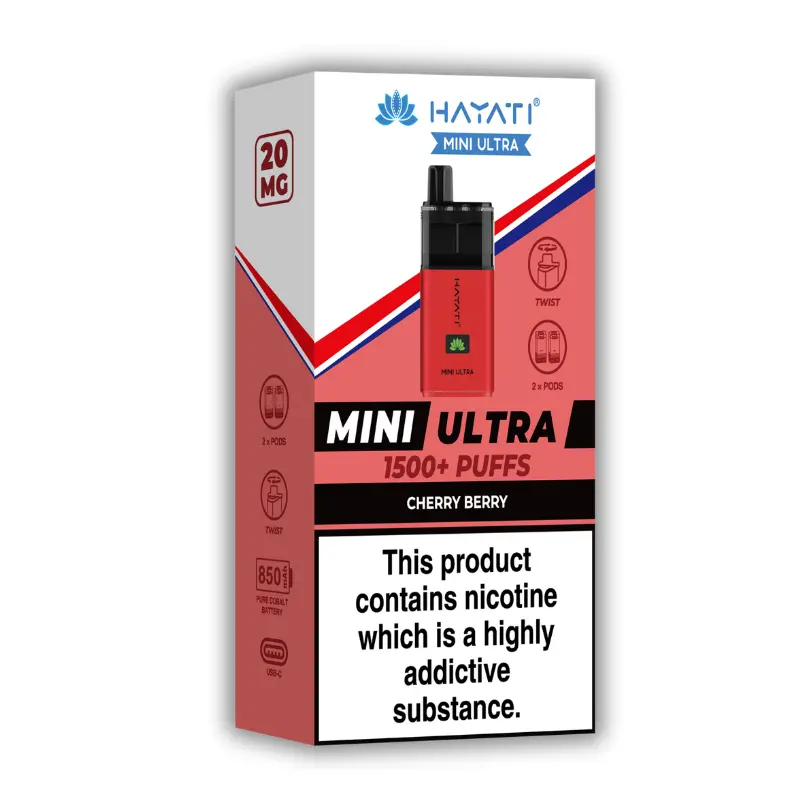
Hayati · Mini Ultra
Cherry Berry Hayati Mini Ultra Pod Kit
£3.99
✔ In stock — ready to ship
Genuine Hayati
Free over £20
Same-day dispatch
Secure checkout
Four millilitres of prefilled liquid, one flavour, one small body, £3.99. That is the Cherry Berry Hayati Mini Ultra Pod Kit in full, and the first number is the one worth holding onto. Every listing on the Mini Ultra shelf carries the same 4ml, all fifty of them, and eleven of those fifty divide that 4ml between two flavours chosen by turning the mouthpiece. This one does not. It spends the whole four millilitres on a single red-fruit blend. That sounds like a trivial distinction on a product grid, and it is actually the main thing this page has to say.
The liquid itself is cherry in front and a mixed-berry bed underneath, at 20mg nicotine salt, with no cooling anywhere in Hayati's description of it. Hayati rate the pod by laboratory test at up to 1,500 puffs, and the cell behind it is listed at 850mAh. The box contains the body and the prefilled pod system together, and a separate Cherry Berry pod is listed for restocking at £3.49.
Cherry Berry already has a page on this site that takes the liquid apart draw by draw. The Cherry Berry Hayati Pro Max Nic Salts bottle page covers the cherry's almond-kernel chemistry, the way a mixed-berry accord is assembled so that no single fruit can be named, the sweetness level, and how the profile shifts as a coil tires. That analysis holds for this liquid and there is no reason to rewrite it here, so this page cites it and goes somewhere else.
Where it goes is the volume. Two millilitres a side is roughly a day or two of a flavour. That is long enough to form a genuine opinion and short enough that you never get bored of it, which is precisely the window someone testing a flavour wants and precisely the wrong window for anyone who has already decided. So the divided format is excellent at exactly one job and poor at every other, and an undivided 4ml of Cherry Berry sits on the other side of that line. Below: the counts that back this up, what four millilitres of one liquid can and cannot teach you, why a shared vapour path costs more when each side is short, and whether a rotating collar buys you anything at all on a pod this small.
The Mini Ultra shelf, counted
Rarity claims about a range are worth checking rather than repeating, so here is the shelf as the catalogue actually has it, not as the marketing implies.
There are fifty Mini Ultra listings. Twenty of them are kits at £3.99, and every one of those twenty has a slug ending in pod-kit. Thirty are bare replacement pods at £3.49. Of the twenty kits, eleven carry two flavour names separated by an oblique. Of the thirty bare pods, none does. Not one.
That zero is the interesting figure. On this shelf the divided pod exists only as a first purchase. It is never sold as a refill. If you buy Cherry Ice / Peach Mango Hayati Mini Ultra Pod Kit and get to the bottom of it, there is no Cherry Ice / Peach Mango pod to reorder. What exists instead is a Cherry Ice pod and a Peach Mango pod, sold separately, each holding the full 4ml.
Check that against the whole eleven and the pattern holds without exception. Every half of every divided Mini Ultra kit is available on its own as a single 4ml pod. Both halves of Blueberry Cotton K / Raspberry Cotton K Hayati Mini Ultra Pod Kit. Both halves of Grape GB / Strawberry GB Hayati Mini Ultra Pod Kit. Both halves of Straw’ Guava / Dragon Berries Hayati Mini Ultra Pod Kit, both halves of Blackcurrant Lemonade / Straw’ Lemonade Hayati Mini Ultra Pod Kit, both halves of Blueberry Straw’ Menthol / Blueberry Raspberry Menthol Hayati Mini Ultra. The single apparent exception is the watermelon bubblegum side of Fruit Bomb / Straw’ Watermelon B’Gum Hayati Mini Ultra Pod Kit, and that turns out to be an abbreviation rather than a gap: the pod exists under the unshortened name. Twenty-two halves, twenty-two single pods.
Why the absence of a divided refill matters
A catalogue is a set of decisions about what people will buy twice. Hayati have decided, on this shelf, that nobody buys a divided pod twice. You buy it once, find out which side you preferred, and then restock the side you preferred as a single. The structure of the shelf is an argument about what the divided format is for, made in inventory rather than in copy, and inventory is harder to fake than copy.
The contrast with the larger platform is what makes this specific rather than generic. Fifty-one listings in the whole Hayati catalogue carry two flavour names. Forty of them are Pro Ultra Plus, and on that platform fifteen of the forty are bare pods rather than kits. The Straw’ Cranberry Cherry and Cherry Ice pairing is one of the fifteen, listed there both as a kit and as a pod on its own. So on the larger platform the divided pod is something you rebuy. Some pairings run across both platforms in the divided form, Blue Razz Pineapple / Strawberry Ice Hayati Pro Ultra Plus 25000 Prefilled Pod Kit being the 22ml version of a combination the Mini Ultra shelf also sells at 4ml, which makes the difference in how they are restocked a decision about the platform rather than about the flavours. The other eleven dual listings are the Mini Ultra kits, and none of them is. Nothing else in the catalogue is divided at all. The Pro Max Plus range, which is the largest single platform Hayati run, has no divided listings whatsoever, and neither does the Rubik.
So the narrow, true version of the claim is this: Mini Ultra is the only platform where a divided pod appears exclusively as a kit and never as a refill. That is worth more than a vague statement about how unusual the format is, because it tells you what Hayati expect the buyer to do next.
Four millilitres, halved
Now the arithmetic, with its assumption stated out loud. Hayati publish 4ml for all fifty Mini Ultra listings, divided or not. They publish the same laboratory rating of up to 1,500 puffs for all fifty as well, which is corroboration of a sort: if a divided pod held 4ml per side the rating would presumably not be identical to a single pod's. So 4ml is the total in both cases.
What Hayati do not publish anywhere in those fifty descriptions is a per-side figure. The string does not appear. They say the flavours are kept separate and that turning the rotating mouthpiece selects which one you draw from, and all eleven divided listings say some version of that. They say nothing about how the reserves are proportioned. An even split is the obvious reading and it is how anyone would design it, but it is a reading, not a published fact, and a page that states two millilitres a side as though it were printed on the box has told you something nobody told it. Take it as about two millilitres a side, with the emphasis on about.
Two millilitres is not an arbitrary quantity. It happens to be the standard fill of a refillable pod, which means most experienced vapers already have an intuition for it: it is one tank, one session's worth of carrying something around, the amount you would put in to try a new bottle before committing to the rest of it. Hold that up against the same liquid in its other formats. Cherry Berry exists as the Cherry Berry Hayati Pro Max Plus Pod Kit at 12ml, and it exists on the Pro Ultra Plus at 22ml. The range therefore offers this one flavour at roughly two, four, twelve and twenty-two millilitres. Those are not four sizes of the same purchase. They are four completely different relationships with a liquid.
What four millilitres can tell you, and what it cannot
The useful question about a small pod is not whether it is small. It obviously is. The useful question is what a given quantity of liquid is capable of teaching you, because that is what you are actually buying when you buy a 4ml pod of something you have not committed to.
What it settles
Four millilitres of one liquid, drawn on over a few days, settles a surprising amount. It settles whether the sweetness is at a level you can live with, and on a cherry-led sweet red that is the first thing most people want to know. It settles whether the kernel note that comes with every cherry flavour reads to you as depth or as marzipan, which is an entirely individual reaction and cannot be predicted from a description. It settles whether you want cooling in a red fruit, because this one has none and the absence is conspicuous once you have had a few days of it. It settles whether you like the structure, which is one clear lead note sitting on a sweet base you cannot itemise, as against a mix where every fruit is nameable.
All of those are first-order judgements and they arrive early. You will have most of them inside the first millilitre, and the remaining three confirm them.
What it does not settle
Four millilitres does not settle whether you will still want it in a fortnight. Flavour fatigue on a sweet layered fruit is a slow effect and it needs volume to show itself. The bottle page makes the point that this profile holds up better than most at its sweetness level, and that is a judgement formed across repeated fills, not across one short pod. A 4ml pod is finished before the question arises.
It does not settle how the flavour behaves on a tired heating element. A sweet red liquid loses its top end first, the cherry's brightness going before the berry bed does, and on a larger pod you experience that arc as part of owning the flavour. On 4ml you may never reach it. Whatever you taste on your last draw is close to what you tasted on your first, which is a pleasant way to meet a liquid and a misleading one if you are about to commit to a 22ml version of it.
It does not settle batch consistency, because you have one pod and nothing to compare it against. It does not tell you how the flavour sits in a rotation, because a rotation judgement needs you to leave and come back, and there is not enough liquid here to leave and come back to. And it does not tell you what the liquid is like at the point where the pod is nearly empty and the last of it is being drawn through warm cotton, because that phase is compressed into a handful of draws rather than a day.
Set those two lists side by side and the shape of the format becomes clear. Four millilitres answers the questions that are about your palate and leaves open every question that is about time. That is not a defect. It is a specification, and it happens to match one particular buyer almost exactly.
Who that buyer is, and who it is not
The buyer this suits is someone deciding about Cherry Berry. They want to know whether the cherry lands for them before they put money on a bigger pod of it, and four millilitres is enough to know. They finish it with an opinion they can act on, and the opinion is worth having because the liquid did not change underneath them while they were forming it.
The buyer this does not suit is the one who already knows. If Cherry Berry is a flavour you have had and liked, a 4ml pod is a tease and there is no polite way to put it. You will reach the bottom of it in a couple of days and be ordering again, which is a worse experience than simply having bought more liquid in the first place. For that buyer the honest recommendation is the Cherry Berry Hayati Mini Ultra Pods refill if you want to stay on this body, or a move up to the 12ml pod on the Pro Max Plus if you do not. The Mini Ultra is not built to be the format you settle into.
The shared path, and why it costs more on a short side
This is the part of the divided-pod argument that most descriptions skip, and it is the part that decides whether the format does the job it looks like it does.
First, a caveat that has to come before the reasoning. Hayati publish no coil detail for the Mini Ultra. The word does not appear in any of the fifty descriptions, in either direction. What they do publish is that the two flavours are kept separate inside the pod and that a rotating mouthpiece selects which one you draw from. A single mouthpiece and a single airway strongly imply a single heating element and a single vapour path, and that is how these pods are generally built, but it is an inference from the described geometry rather than a published specification, and it is being flagged as one. The arithmetic that follows is conditional on it.
If the two sides do share a path, then every switch carries residue. The last flavour you drew is still in the wick and on the element and along the airway, and the first draws after you turn the collar are a blend rather than a reading. Anyone who has run two liquids through one tank knows the effect. It takes some number of draws for the previous flavour to clear, and the number is not small.
Here is why that matters more on a short side than a long one. Call the clearing cost some fixed number of draws, whatever it is for your device and your patience. On a 22ml side, a handful of contaminated draws is a rounding error against the thousands of draws that side contains. You will never notice it as a proportion of the whole. On a side holding around two millilitres, the same fixed cost is a measurable slice of everything that side has to offer. And the cost is paid once per switch, not once per pod, so someone who switches five or six times a day is spending a meaningful fraction of a small reserve on draws that taste of neither flavour cleanly.
Follow that through and you reach something genuinely awkward about the divided format on a small pod. The format's obvious purpose is sampling: two flavours, one purchase, find out what you like. But the mechanism that makes it two flavours is also the mechanism that degrades each sample, and the degradation is proportionally worst exactly where the reserves are smallest. A divided 22ml pod is a poor sampling tool for a different reason, namely that you are stuck with both halves for weeks. A divided 4ml pod is a poor sampling tool because neither half ever gets a clean read.
Which brings the argument back round to this listing. An undivided 4ml of Cherry Berry has no switch, no carryover and no contaminated draws. Every millilitre in it tastes of the thing you bought. If your purpose is to find out whether you like a flavour, the undivided pod is the better instrument, and it holds twice as much of the liquid you are trying to judge. That is the opposite of how the shelf reads at a glance, where the divided kits look like the sampler and the single ones look like the plain option.
What the collar is worth at this size
A rotating collar earns its keep by being an escape hatch. You are three hours into a flavour, you have had enough of it, and you can move without opening a drawer. On a large pod that is worth a great deal, because the alternative is being stuck with one liquid for a fortnight. The value of the collar scales with how long you are committed to the pod.
On a pod you might finish inside a week, the escape hatch is open for a very short time. You are not trapped in the first place. The thing the collar is rescuing you from barely exists at this volume, which makes it a solution sized for different hardware.
There is a second and less obvious cost. A collar makes indecision cheap. When switching is free and instant, the natural behaviour is to switch whenever the current flavour is slightly less appealing than the idea of the other one, which on a small pod means switching often. The result is that you spend a two-millilitre reserve in short scattered bursts rather than in the sustained run that would actually tell you something about it. People who buy a divided pod to find out which of two flavours they prefer frequently finish it without a firm view on either, and the collar is why. It removed the friction that would otherwise have made them sit with one long enough to decide.
None of which makes the divided kits bad. Straw’ Cranberry Cherry / Cherry Ice Hayati Mini Ultra Pod Kit puts a layered tart-sweet red alongside a chilled single cherry, and for someone who already knows they like both and wants both in one pocket, that is a genuinely good purchase. Variety on demand is a real want and the collar serves it well. It is just a different want from finding out what you think of a flavour, and the same object is good at one and bad at the other.
The liquid, and what seven listings say about it
Cherry Berry is sold seven times over in the Hayati catalogue, across four formats, and Hayati wrote fresh copy for each one. Lining those seven descriptions up against each other produces better evidence about the liquid than any single one of them does, because the things all seven agree on are close to facts and the things they disagree on are information about how the copy was written.
What all seven assert
Cherry leads. Every listing puts it at the front, in those words or near ones. The berries sit behind it and fill in. The structure is described as layered or stacked rather than blended, with nothing competing for the top position. The blend is sweet, and every listing says so directly. And no listing mentions ice, menthol or any cooling agent, which across seven independently written descriptions is about as close to confirmation of an absence as this kind of evidence gets.
Those five points are the floor. If a description of this liquid contradicts any of them, be suspicious of the description.
Where they split, and the split is by platform
The interesting disagreement is about where the acidity lives, and it does not fall randomly. It falls along platform lines, cleanly.
Both Mini Ultra listings, this kit and its refill pod, attach the tartness to the cherry. The kit describes a deep, slightly tart sweetness at the front of the draw and a sharpness from the cherry that stops the blend turning cloying. The pod says the same thing in different words.
Both Pro Max Plus listings attach it to the berries instead. There the cherry is dark and rich and the berries supply the brighter, tangier notes. Same liquid, opposite attribution.
Both Pro Ultra Plus listings attach it to nothing at all. Neither uses a tart word anywhere. What they spend their words on instead is stating that there is no ice and that there is no second flavour to switch to, and the phrase about nothing to switch appears on exactly five listings in the whole catalogue, all of them Pro Ultra Plus, two of them Cherry Berry.
The bottle page, which is the seventh listing, sides with the Mini Ultra pair and puts the tang on the cherry.
Two conclusions follow, and only one of them is about the liquid. The one that is not: these descriptions were written in platform batches by whoever had that platform's spreadsheet open, and the vocabulary clustered accordingly. That is worth knowing because it means a difference between two listings of one flavour is evidence about authorship, not evidence about two recipes. Anyone comparing the Pro Max Plus wording with this one and concluding that the Mini Ultra version is a tarter mix has over-read the copy.
The conclusion that is about the liquid: acidity is definitely present, the writers disagree only about which component is carrying it, and a blend where four separate writers could not agree whether the tang belongs to the cherry or the berries is a blend where the two are well integrated. If the cherry's acid stood clearly apart from the berry bed, nobody would have mislaid it. That is a real, if modest, finding about how the profile is put together, and it is more informative than either attribution taken on its own.
The one thing only the Pro Ultra Plus listings say
Worth a moment, because it demonstrates how much of a product description is written about the shelf rather than the product. The two Pro Ultra Plus Cherry Berry listings both go out of their way to say there is no ice and nothing to switch. Neither Mini Ultra listing says either thing.
Yet the Mini Ultra shelf also has divided pods and also has iced flavours, including Strawberry Raspberry Ice Hayati Mini Ultra Pod Kit sitting a few rows away. The disambiguation would be just as useful here. It is absent because the Pro Ultra Plus copy was written by someone with forty divided listings in front of them and the Mini Ultra copy was not. So when you read a product description, some of what is in it is about the liquid and some of it is about what the liquid is shelved next to, and the two are not marked differently. This page is making the divided-pod contrast explicit precisely because the listing does not.
Spending four millilitres to learn something
The bottle page offers the standard advice for judging a new liquid, which is to wait for the second pod because the first fill on a fresh wick is never representative. That advice cannot be followed here. You have one prefilled pod, there is no second fill, and there is no priming step to get wrong or right because the pod arrives wet. Most of the levers the bottle page describes are also absent: no wattage to lower, no airflow to close, no bottle to shake.
What remains is draw length and sequencing, so use them deliberately rather than drifting through the pod.
Spend the first half of the pod on short draws and the second half on long ones, rather than mixing them. The reason is specific to this profile. The cherry's bright top material comes off readily and dominates a short draw, while the heavier sweet berry base and the kernel note need a longer, warmer draw to show up. Running the two styles in separate blocks rather than alternating gives you two clear readings instead of one averaged one, and on a layered liquid the difference between them is large enough to change what you think you bought.
Taste it against something, not in isolation. Palates calibrate to whatever they have been doing, so a sweet red judged after a week of another sweet red will read as unremarkable. If you have a sharp blue or a citrus to hand, a few draws of that first gives the cherry something to be measured against.
And form the view early rather than late. On a pod this size the useful evidence is front-loaded, and there is no long tail in which your impression will be revised. Whatever you think at the halfway mark is very likely what you will think at the end.
The kit itself
What arrives is the Mini Ultra body and the prefilled pod system together, at £3.99, ready to draw on. There is nothing to fill, nothing to assemble and nothing to prime.
Hayati publish an 850mAh capacity for this listing and nothing else about the power side of the device. No connector, no charging behaviour, no indicator. That gap is not this page's to fill, and a specification taken from a retail page is not a specification, so the number is stated and the subject is closed. The same goes for the heating element, which is not described anywhere in the fifty Mini Ultra listings, and for how the pod is held in the bay, about which Hayati publish no parts breakdown at all.
The pod is prefilled and there is no published refill route, so treat it as sealed and do not try to open it. When the liquid is gone the sensible reading is that the pod's useful life is over. A replacement Cherry Berry pod for this body is listed separately at £3.49, which is the mechanism by which you keep a flavour going without buying another body, and it is the reason the divided kits have no equivalent: there is no divided pod to reorder.
One sentence on fitment and then it is dealt with. Hayati publish no cross-range compatibility for any of their hardware, so check the range name printed on your device against the range name in the product title before you order a pod, and do not take a fitment answer from any retail page including this one.
On disposal, this is a small device containing a cell and the residue of a fruit liquid, so it does not go in a household bin. Electrical take-back points accept it, as do local recycling facilities set up for battery-containing equipment, and the pod goes with the body rather than into recycling on its own. That matters slightly more on a 4ml format than on a large one for the obvious arithmetic reason: the same quantity of liquid consumed produces more discarded hardware here than it does on a bigger pod, and anyone using Mini Ultra kits as their standard purchase will accumulate bodies quickly.
The Mini Ultra shelf, and the question of what the format costs per millilitre against the rest of the Hayati range, is covered properly on the Hayati Mini Ultra Prefilled Pod Kit shelf page. That argument belongs there rather than here, and this page has deliberately stayed off it.
Specifications
| Nicotine | 20mg nicotine salt |
| Liquid volume | 4ml, prefilled, undivided |
| Flavour count in the pod | One. No rotating collar on this listing |
| Manufacturer puff rating | Up to 1,500, a laboratory estimate |
| Cell capacity | 850mAh |
| Supplied as | Body plus prefilled pod system |
| Cooling | None described by Hayati |
| Matching refill | Cherry Berry Mini Ultra pod, £3.49 |
| Price | £3.99 |
| Flavour type | Cherry Berry |
| Brand | Hayati |
| Listed on | Hayati Mini Ultra Prefilled Pod Kit, Hayati Mini Ultra, Hayati Pod Kits, Hayati Prefilled Pod Kits, Berry Vapes, Cherry Vapes, New Products |
Two rows in that table do real work and the rest is inventory. The volume row decides what the purchase is for, which is the whole argument above. The flavour-count row is there because on this shelf it is a genuine variable rather than a given, and a buyer scanning twenty kits at an identical price has no way of telling from the price which ones are divided.
The strength row is a plain statement of what is in the pod. Twenty milligrams per millilitre is the maximum permitted concentration for a nicotine-containing liquid sold in the UK, so it is not a choice Hayati made so much as a ceiling they sat on, and it is the same across all fifty Mini Ultra listings. There is no strength option on this product and no page should be telling you which number suits you.
The puff rating deserves its hedge. Up to 1,500 is what Hayati rate the pod at under laboratory conditions, and laboratory conditions are a machine drawing consistently on a fresh device. Real draws vary in length, in frequency and in how hard they are pulled, and the rating is a comparison figure between products rather than a promise about yours. Its one genuine use here is as a cross-check: the identical rating on divided and undivided listings is part of why 4ml is clearly the total rather than the per-side volume on the divided ones.
The cooling row is blank on purpose. An absent property is information when a good part of the shelf has it, and twelve of the fifty Mini Ultra listings carry an ice or menthol word in the title. A blank here tells you this is a room-temperature red fruit.
How it compares
The comparison that matters is not Cherry Berry against other cherries. It is Cherry Berry against the divided kit sitting next to it at the same price, because that is the choice the shelf actually presents.
Against the divided kits at the same money
Eleven of the twenty Mini Ultra kits are divided and all twenty cost £3.99. So the real question at the point of purchase is whether you want four millilitres of one thing or roughly two millilitres each of two things, and the answer depends entirely on which of the two jobs you are doing.
If you want to know what you think of a specific flavour, take the undivided one. You get twice the liquid of the thing you are judging, no carryover on the first draws, and no temptation to bail out at the first slightly dull moment. Cherry Berry is a good candidate for this because it is a blend with a clear lead and a base you cannot itemise, which is a structure that either suits you or does not, and four uninterrupted millilitres is enough to find out.
If you want variety in your pocket for a few days, take a divided one, and pick a pairing with real contrast rather than two versions of the same idea. Cherry Ice / Peach Mango Hayati Mini Ultra Pod Kit works on that basis, pairing a chilled red against a warm tropical, and the two are far enough apart that carryover between them is obvious rather than confusing. Blackcurrant Lemonade / Straw’ Lemonade Hayati Mini Ultra Pod Kit is the opposite case, two lemonades that differ only in the fruit, and on a shared path those two will blur into each other more than either would on its own.
That is a general point about choosing a divided pod, and it is worth stating plainly: the closer the two halves are, the more the shared path costs you, because carryover you cannot distinguish from the flavour is carryover you cannot correct for. Blueberry Cotton K / Raspberry Cotton K Hayati Mini Ultra Pod Kit pairs two versions of the same confectionery idea, which makes it a pleasant pod and a poor comparison tool.
Against the other cherries on this shelf
Blue Razz Cherry Hayati Mini Ultra Pod Kit is the nearest single-flavour neighbour and it is a different proposition despite sharing a fruit. Blue raspberry is a loud, sharp partner and it takes the top of the profile, so cherry ends up supporting rather than leading. If you want cherry to be the thing you taste first, this listing is the one that does that and the blue razz pairing is not.
Straw’ Cranberry Cherry / Cherry Ice Hayati Mini Ultra Pod Kit is the cherry-heavy divided kit, and it is the most direct alternative to this page's product for anyone whose interest is specifically cherry. It offers a complex tart-sweet red on one side and a stripped-back chilled cherry on the other. What it cannot offer is four millilitres of either. If your question is which style of cherry you prefer, that kit poses the question well and answers it badly, for all the carryover reasons above. If your question is whether you like Cherry Berry, it does not address it at all.
Outside the cherries, Blue Sour Raspberry Hayati Mini Ultra Pod Kit is the shelf's clearest contrast in the acid direction, with a deliberate sour edge this blend has no interest in. Blueberry Raspberry Hayati Mini Ultra Pod Kit is the two-named-fruit alternative for anyone who wants both components identifiable rather than one lead over an anonymous base. Mr Blue Hayati Mini Ultra Pod Kit is on the shelf too and its name tells you nothing about the fruit, which makes it a poor use of a format whose value is in producing a clear judgement.
Against the same flavour in bigger formats
If the four millilitres has done its job and the answer was yes, the sensible next purchase is not another Mini Ultra kit. The Cherry Berry Hayati Pro Max Plus Pod Kit at £7.99 carries 12ml of the same profile, which is the volume at which the questions four millilitres could not answer start to become answerable: how it holds up across a week, how it changes as the element tires, whether you tire of it first.
Above that the Pro Ultra Plus sits at 22ml, and the divided listings on that platform are where the collar argument genuinely earns itself. Straw’ Cranberry Cherry / Cherry Ice Hayati Pro Ultra Plus 25000 Prefilled Pod Kit and Straw’ Cranberry Cherry / Strawberry Raspberry Ice Hayati Pro Ultra Plus 25000 Prefilled Pod Kit are both £11.99 for a pod you may be living with for weeks, and at that duration an in-session escape hatch is worth paying for. The same collar on a 4ml pod is solving a problem you would not have had.
Other formats are worth a glance if the Mini Ultra body is not what you want. The Blueberry Raspberry Hayati Rubik Prefilled Pod Kit and Blue Razz Cherry Hayati Rubik Prefilled Pod Kit at £5.99 sit between the Mini Ultra and the Pro Max Plus, and neither the Rubik nor the Pro Max Plus offers any divided listing at all, so on those platforms the question this page is about simply does not arise. On the Pro Max Plus itself, Blackberry Raspberry Hayati Pro Max Plus Pod Kit is the darker berry alternative to a cherry-led red, and Berry Lemonade Hayati Pro Max Plus 6000 Pod Kit takes a similar berry accord and frames it with a lemonade top that adds acidity.
For browsing rather than deciding, the Cherry Vapes shelf collects seventy-two cherry-containing listings across every format Hayati make, Berry Vapes is the much larger red and blue shelf around it, and the full Hayati Mini Ultra range is the fifty listings this page has been counting. The complete Hayati catalogue runs to several hundred entries if none of the above is landing.
Getting the best from it
A prefilled 4ml pod removes most of the things you could get wrong, so this is a short list and everything on it is specific to this format rather than general vaping advice.
Do not save it. A 4ml pod bought to answer a question should be used to answer the question, and a pod that sits in a drawer for two months while you work through something else is a pod whose cherry top notes have quietly faded before you ever drew on it. Bright fruit aromatics are the fragile part of a red blend and they are the part this purchase is testing.
Keep it out of direct sunlight and off warm surfaces. A windowsill, a car dashboard or the top of a radiator will dull the fruit and darken the liquid, and on a small pod there is no later phase in which you would notice it had happened, because you have nothing to compare the taste against. Keep it out of reach of children and pets.
Stand it upright when you are not using it. This is more useful on a small pod than it sounds. With only four millilitres in there, the liquid sits low, and leaving the device on its side for long periods lets it pool against the mouthpiece end, which produces a wet first draw and occasionally a mouthful of liquid rather than vapour.
Take shorter breaks than you think you need. Sweet layered fruit coats the palate, and a run of quick draws on a warm element pushes the sweetness forward and takes the cherry's brightness out first. That is the same effect the bottle page describes, and on a small pod it is more consequential, because the draws you spend in a fatigued state are a larger share of the total. If the flavour goes flat, put it down for ten minutes rather than concluding the pod has turned.
Judge it before the last few draws. The final portion of any prefilled pod is drawn from a reserve that is no longer keeping up, and it tastes thinner and warmer than the pod did in the middle. On a 12ml pod that phase is a small percentage of the experience. On 4ml it arrives much sooner in proportional terms, so form your opinion of the flavour while there is still a clear reserve left, not on the last mouthful.
Do not try to refill it. Hayati publish no refill route for a Mini Ultra pod, the pod arrives sealed and prefilled, and forcing liquid into something not designed to take it gets you leaks rather than value.
Write down what you thought. This sounds fussy and it is the single most useful habit for anyone using small pods as a way of surveying a range. Four millilitres produces one clear impression and then it is gone, and three pods later you will remember that you liked the cherry one without remembering why or how it compared. A line in your phone is enough.
Questions buyers ask
Is this a two-flavour pod?
No. This listing is a single flavour across the whole 4ml. Eleven of the twenty Mini Ultra kits are divided into two flavours selected by a rotating mouthpiece, and their titles show both names separated by an oblique. This title carries one name, so there is no collar to turn and nothing to switch between.
How much liquid is in each side of a divided Mini Ultra pod?
Hayati do not publish a per-side figure. What they publish is 4ml as the total for every Mini Ultra listing, divided or single, along with the same laboratory puff rating for both, which indicates the 4ml is the whole pod rather than each half. An even split would put roughly two millilitres a side, but that is a reading of the numbers rather than a stated specification.
Can I buy a divided Mini Ultra pod as a refill?
Not on this shelf. All thirty Mini Ultra replacement pods are single flavours. Every half of every divided kit is available on its own as a full 4ml pod, so the way to continue with a flavour you met in a divided kit is to buy that flavour as a single.
Is there any ice or cooling in Cherry Berry?
None is described. Seven separate Hayati listings of this flavour exist across four formats and not one of them mentions menthol, ice or any cooling agent, and the name carries no cooling marker. Treat it as a room-temperature red fruit. If you want a chilled cherry on this shelf, the iced flavours say so in their titles.
Which berry is in the berry part?
None of them individually. Hayati describe a mixed-berry blend behind the cherry without naming components, which is a deliberate construction rather than an omission. The bottle page on this site goes into how that kind of accord is assembled and why nothing in it is meant to be nameable.
Is four millilitres enough to decide whether I like a flavour?
For the questions that are about your palate, yes. Sweetness level, whether the cherry's kernel note suits you, whether you want cooling, and whether the lead-plus-base structure appeals are all settled early and four millilitres is comfortably enough. For the questions that are about time, no. Nothing here will tell you whether you would still want it in a fortnight.
What do I do when the pod is empty?
A matching Cherry Berry pod is listed at £3.49 for this body, so the flavour continues without another kit. If four millilitres has convinced you, the 12ml Pro Max Plus version of the same flavour is the format that suits a settled preference better than repeated small pods do.
Does the tartness come from the cherry or the berries?
Hayati's own descriptions disagree. The two Mini Ultra listings put it on the cherry, the two Pro Max Plus listings put it on the berries, and the two Pro Ultra Plus listings do not mention tartness at all. The disagreement is about how the copy was written rather than about two recipes, and the useful inference is that the acid is well integrated rather than sitting apart from the fruit.
Why does the same flavour come in four different sizes?
Because they are four different purchases. Roughly two millilitres as a side of a divided pod, four as a single Mini Ultra, twelve on the Pro Max Plus and twenty-two on the Pro Ultra Plus. The small ones answer whether you like something and the large ones assume you already do.
What strength is it, and is there a choice?
Twenty milligrams per millilitre of nicotine salt, with no strength options on this product. That figure is the maximum concentration permitted for a nicotine-containing liquid sold in the UK and it is the same on all fifty Mini Ultra listings, so it is a constant of the range rather than a property of this flavour.
Is the pod refillable?
No refill route is published and the pod arrives prefilled and sealed, so treat it as a single-use pod and replace it rather than attempting to top it up.
How should I dispose of it?
It contains a cell, so it does not belong in a household bin. Electrical take-back points and local recycling facilities that handle battery-containing equipment will accept the whole device with the pod still attached.
The short version
Cherry Berry on the Mini Ultra is £3.99 for a body and a 4ml prefilled pod at 20mg nicotine salt, rated by the manufacturer at up to 1,500 puffs under laboratory conditions, with an 850mAh cell and no cooling in the blend. The liquid is cherry in front, an unnamed sweet berry bed underneath, and its full draw-by-draw analysis lives on the nic salt bottle page rather than here.
What is particular to this listing is the undivided four millilitres. Eleven of the twenty kits on this shelf split the same volume between two flavours behind a rotating mouthpiece, and none of those eleven is sold as a refill, which tells you Hayati expect the divided pod to be a first purchase and the single pod to be the thing you come back to. Around two millilitres a side is a fine amount of liquid for carrying variety about and a poor amount for reaching a verdict, because a shared vapour path takes a proportionally larger bite out of a short reserve and a collar makes it too easy to move on before you have decided anything.
So buy this one if you want to find out what you think of Cherry Berry, and buy it knowing it will answer that and nothing slower. Buy a divided kit if you already know what you like and want two of them at once. And if you have had Cherry Berry before and liked it, skip both and go to a larger pod, because four millilitres of a flavour you have already chosen is a purchase that ends just as it gets going.
Strictly for adults aged 18 and over. Nicotine is an addictive substance.
You might also like


