
Home / Hayati Mini Ultra Prefilled Pod Kit / Blueberry Cotton K / Raspberry Cotton K Hayati Mini Ultra Pod Kit
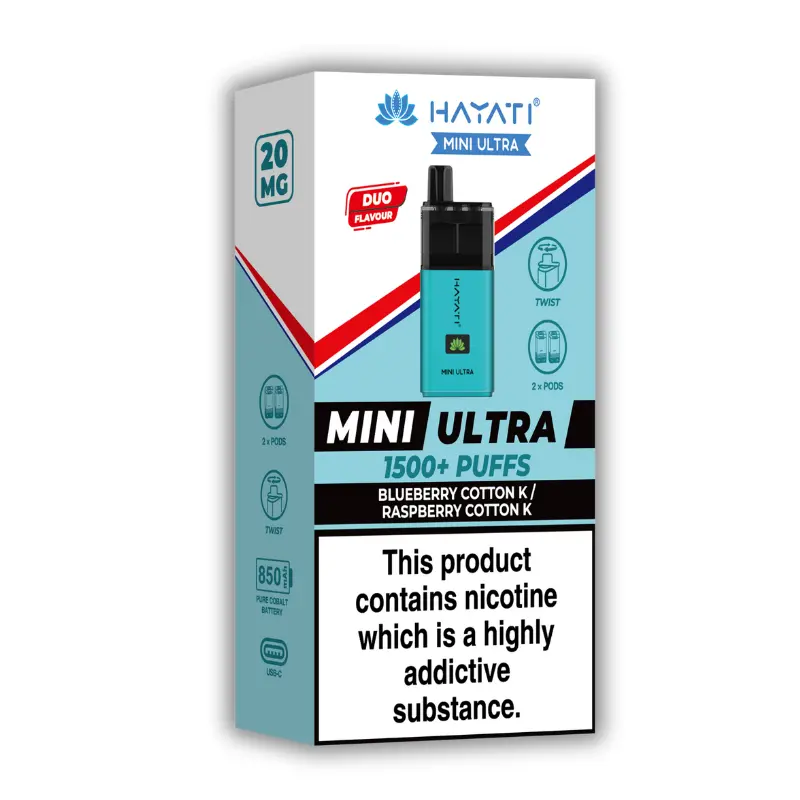
Hayati · Mini Ultra
Blueberry Cotton K / Raspberry Cotton K Hayati Mini Ultra Pod Kit
£3.99
✔ In stock — ready to ship
Genuine Hayati
Free over £20
Same-day dispatch
Secure checkout
Three pounds ninety-nine buys the whole thing: a Hayati Mini Ultra body with an 850mAh cell in it, and a prefilled pod holding 4ml of 20mg nicotine salt liquid with Blueberry Cotton K on one side and Raspberry Cotton K on the other. Hayati rate the pod at up to 1,500 puffs, which is a laboratory figure and not a forecast of your week. The listing says in its own words that the two flavours stay apart and that a twist of the rotating mouthpiece moves between them, so this is one divided pod rather than two pods in a box, and that is stated on the product itself rather than inferred from the oblique in the title.
Cotton K means candy floss. Both sides carry it. That is the whole design, and it is a more interesting design than it looks, because of what candy floss is made of.
Almost nothing. Sugar spun into threads, a trace of colour, and a faint edge of caramelisation from the melt. No fat, no dairy, no roasting, no fermentation, none of the processes that generate the aromatic compounds a flavour is built out of. A stick of it is mostly air by volume and mostly sucrose by weight. Set that against the other confections Hayati borrow names from and it stands out as the emptiest of them, which means putting it on both sides of a divided pod is the opposite bet from putting a heavy one there.
That contrast is the subject of this page. A sibling listing in this catalogue runs the same structure with a bubblegum accord as the fixed treatment, and the page written for it concluded that the two fruits underneath converge into something close to one flavour. This pod is the mirror image of that experiment, and the prediction here runs the other way: the two berries should stay distinguishable, and the candy floss should read as a shared backdrop rather than a shared mask. What follows argues that properly, tests the claim against every Cotton K listing Hayati publish, asks the harder question of what a treatment that barely covers anything is actually for, and then works out which of two very similar dark berries survives better underneath it.
The mirror image of an argument already made here
Two pages in this corpus have already done work this one depends on, and it would be dishonest as well as wasteful to rebuild either.
The first is the Watermelon B'Gum / Strawberry B'Gum replacement pod. It took the same structural idea, a confectionery treatment held constant while the fruit varies, and reasoned it through on the assumption that perceived flavour arrives on several loosely independent channels at once. Its finding is that a treatment flattens the channels it occupies and leaves alone the ones it does not, that a bubblegum accord occupies most of them because it was assembled out of a dense stack of fruit esters with a floral signature and a sweet base, and that the two fruits it chose had almost nothing left to differ on once the gum had taken its share. It also counted the structure properly, establishing that a pairing holding a named confection fixed across two fruits exists only a handful of times in 492 listings, and this pairing is one of them. I take all of that as settled and I am not recounting it.
What that page could not do is test its own general claim, because it only had one treatment to work with. The claim was that a treatment flattens what it covers and leaves what it does not. A gum accord covers nearly everything, so on that pod the two halves of the claim could not be separated. It needs a thin treatment to come apart, and that is this pod. Its own page even named this pairing as the case that would run the other way, and reasoned from the fruit list rather than from anything tasted. So this page is the other half of the same investigation, argued from the inside, with the maker's own descriptions of seven listings as evidence rather than one.
The second page is the Sour Apple / Juicy Peach Mini Ultra kit, which owns a finding about size that decides whether this pod is worth buying at all. Its arithmetic is that the cost of turning the collar does not shrink when the pod does. The residue in the shared path takes the same number of draws to clear whether there are 4ml behind it or twenty-two, and the perceptual after-effect of an acid side takes the same number of minutes to pass. The benefit of switching, on the other hand, is protection against getting tired of one flavour, and that protection scales with how long you are exposed. Cut the reserve by a factor of five and you cut the exposure by a factor of five, so you are paying an undiminished charge for a shrinking service.
The conclusion it draws is the one that matters here. At 4ml an opposed pairing, where the two sides differ on temperature or on acid, is the weaker buy, because the reset it sells you was never going to be needed and the switch costs full price. A pairing of relatives, where the two sides are two treatments of one idea, is the stronger buy, because you can turn the collar as often as you like for almost nothing. That page names this Cotton K pairing as one of the relatives pairings that gains from being small. I am citing that rather than deriving it again, and it is worth knowing that two separate lines of reasoning, one about treatment thinness and one about pod volume, arrive at the same recommendation for this particular box.
What Cotton K is, counted rather than asserted
Before any of that can be argued, the constant has to be characterised, and the honest way to do it is to look at what Hayati write about it across every listing that carries the name rather than to describe a confection from memory.
Seven listings in a catalogue of 492 use Cotton K. Five of them are the Blueberry and Raspberry pairing in its various formats, including this kit, the 22ml Blueberry Cotton K / Raspberry Cotton K Pro Ultra Plus kit, its matching replacement pod, and two single-flavour Mini Ultra pods that sell the halves separately. The other two are a Blackcurrant Cotton K pairing that puts the treatment on one side only and an untreated blue raspberry on the other, which makes it the odd one out structurally and a useful reference point later.
Now the vocabulary. This is where the evidence is, and it is unusually clean.
The word "airy" appears in exactly seven of the 492 product descriptions in this catalogue, and every one of those seven is describing a Cotton K liquid. Six of them carry the name in the title and the seventh is a replacement-pod listing for one of the Cotton K pairings. The word "spun" appears in exactly three descriptions, all three of them Cotton K. The word "fluffy" appears in exactly one, and it is a Cotton K. There is no other product family in this range that Hayati describe with any of those three words. That is not a house adjective being sprinkled about, which is the caution to apply before treating a word as meaningful. It is a vocabulary reserved for one treatment.
Run the same test on the gum family for contrast. Eighteen listings carry a gum name in one spelling or another. Not one of them uses "airy". Not one uses "spun" or "fluffy". What they use instead is "soft", in fourteen of the eighteen, "sugary" in thirteen, and "rounded" in nine, with phrases like softening every edge and wrapping the fruit in a smooth sweetness. Those are weight words. They describe something with mass that sits over the top of something else. The Cotton K words are weightlessness words, and two of the Cotton K listings go further and explicitly rule weight out, one saying the sweetness is light rather than syrupy and the other saying it stays light and fluffy rather than thick. No gum listing raises the question of weight at all, which makes sense, because nobody writing about a bubblegum flavour feels any need to promise it is not heavy.
The second finding from the same set is the one that actually carries the argument, and it is a negative. Across all seven Cotton K listings, Hayati attribute no aroma whatever to the treatment. Not vanilla. Not caramel or toffee or burnt sugar. Not floral, not fruity, not creamy. Every single mention of Cotton K in this catalogue describes it as sweetness, as sugar, or as a texture, and never once as a smell. Compare that with what the corpus has established about the gum accord, which is a whole inventory of aromatic material: a stack of loud fruit esters, a rosy floral note on top and a vanilla-ish rounding underneath. One of these treatments is an aroma with sugar attached. The other is sugar with a texture attached and no aroma named anywhere.
I should be careful about how much that negative can carry. Absence in a product description is weaker evidence than presence, because copy is short and a writer may simply not have mentioned something. But seven independent descriptions, written across three platforms and at least two batches, all reaching for the same three or four words and none of them reaching for an aroma word, is a pattern rather than an oversight. And it agrees with what candy floss physically is, which is the point at which two independent lines meet.
The rarity claim, narrowed until it is true
It is tempting to say flatly that candy floss is the thinnest confectionery accord in the range, and that is roughly the claim this page is built on, so it deserves a proper test rather than a confident assertion.
The confectionery families in this catalogue, counted by title, are Cotton K at seven listings, B'Gum at seven, H'Bubba at nine, spelled-out Bubblegum at four, GB at twenty-seven, Rocky Candy at three and a gummy reference at four. GB has to be set aside rather than folded in, for a reason the B'Gum page established and I have no wish to relitigate: the letters are never expanded in a title and the retail copy glosses them inconsistently, so nobody outside Hayati knows with certainty what treatment a GB listing carries. That leaves gum in three spellings, a hard-boiled candy, a gummy sweet and candy floss.
Can I rank those for thinness? Not by tasting them, and not from anything Hayati publish about concentration. What I can do is rank the confections the names point at by how much aromatic material they contain, which is a fact about food rather than about this catalogue. Bubblegum is a manufactured flavour accord with a documented ester profile and a floral top. A gummy sweet carries fruit flavouring plus a gelatine body. A hard boiled sweet carries fruit flavouring plus a caramelised sugar note from the boil, which is a real aroma and a stronger one than a candy floss melt produces because the sugar is taken further. Candy floss is the only one of the four whose defining characteristic as a confection is that there is almost nothing in it besides sugar and air.
So the claim survives, narrowed. Of the confectionery treatments Hayati name, candy floss points at the confection with the least aromatic material in it, and it is the only one whose listings describe it exclusively in terms of sweetness and texture. I cannot tell you the flavouring concentration in this pod, nobody publishes it, and a heavy-handed formulation could in principle make a candy floss note loud. What I can tell you is that the target it is aiming at is the emptiest one available, and that Hayati's own copy behaves exactly as though it hit that target.
A treatment that adds a register without occupying a channel
Here is the mechanism, and the contribution this page makes to it rather than the part it borrowed.
The borrowed part is that a treatment flattens the channels it occupies. The part nobody has written down yet is what happens when a treatment occupies channels that are not flavour channels at all.
Sweetness is not a fruit identifier. Two berries can both be pushed to the top of the sweetness range and remain completely distinguishable, because nothing about how sweet a thing is tells you which fruit it is. The same goes for the sensation of weight or lightness in a draw. These are real perceptual properties and they matter enormously to whether you enjoy something, but they are close to useless for telling two fruits apart. What tells two fruits apart is aroma, and secondarily acid.
A bubblegum accord raises sweetness and occupies the aroma channel, because it is itself a construction of fruit aromas. That is why it masks. A candy floss treatment raises sweetness and shifts the perceived texture, and by every indication available it puts almost nothing into the aroma channel. So it changes the register of the draw without competing with the fruit for the one resource the fruit needs in order to be identifiable.
The prediction follows directly and it is the opposite of the one the gum pod reached. On this pod the two sides should remain nameable, not merely distinguishable. A person handed the device without being told which position they were on should be able to arrive at blueberry and at raspberry, rather than only being able to say that one is somehow different from the other. The candy floss should read as something both sides sit on rather than something both sides hide behind.
Which makes this pod the better version of the design, and that is worth stating plainly because it is a recommendation. A treatment-constant pairing is only worth building if the constant leaves the variable room to vary. Hold a loud thing constant and you have built a listing that promises two flavours and supplies one with a decorative modification. Hold a quiet thing constant and you have built the thing a tasting flight is supposed to be, where the shared element is the glassware and the fruit is the sample. The gum pairing is that design failing. This one is that design working, and it works for a reason you can check against the ingredient rather than having to trust anybody's palate.
Tagged for confidence, since the corpus rightly insists on it:
- Reasonably confident: the treatment is the same on both sides and contributes sweetness and a textural impression rather than an identifying aroma. Seven listings describe it that way and the confection it names contains very little aromatic material.
- Reasonably confident: the two berries remain separately identifiable. Hayati's own copy gives them different characters on every listing where both appear, which it conspicuously stops doing under a gum treatment.
- Probable: most people will be able to name the fruit on each side without being told, which is a harder task than merely noticing a difference and one the gum pod's page predicted would fail on its own product.
- Unknown: the flavouring concentrations. Nothing published says how much candy floss or how much berry is in either side, or whether the two sides carry equal fruit loads. This page infers a direction and not a magnitude, and anyone quoting you a magnitude is guessing.
- Unknown: how the 4ml divides between the two sides. An even split is the obvious reading and it is the one used throughout this page, but Hayati publish a total and nothing else, and that is a reading rather than a fact.
The harder question: if it barely covers anything, what is it for?
A page that argues a treatment is almost empty has an obvious problem to answer, and answering it honestly is more useful than skipping past it. If Cotton K contributes no aroma, why is it in the pod, and what exactly are you paying for?
The answer is sweetness and texture. Not flavour. That is a real thing to buy and a legitimate thing to want, but it is not what most buyers assume a flavour name is selling them, and the gap between those two is worth closing before you spend the money.
Sweetness, which is straightforward
The treatment raises the sugar floor on both sides. One of the two single-flavour Cotton K pods in this range is described as being among the sweeter things Hayati sell, and that description is attached to the raspberry version, which is the sharper of the pair. So the sweetness is doing real work and it is not subtle. If you want a berry that reads as a confection rather than as fruit, this supplies that without any of the weight a gum or a dessert note would bring with it. There is a genuine gap in most ranges between fruit that tastes of fruit and fruit that has been buried under a heavy sweet, and a thin treatment is the only way to sit in the middle of it.
Texture, which is not straightforward at all
The airiness is the part that needs picking apart, because it cannot mean what it literally says.
Candy floss is airy because of its physical structure. Molten sugar is thrown through small holes and solidifies into threads, and the resulting mass is mostly empty space. It collapses on your tongue because the threads are thin enough to dissolve on contact. None of that can survive into a liquid. A pod contains a homogeneous solution, it vaporises into an aerosol, and there is no structure in it at any scale you could perceive. Whatever "airy" means here, it is not the physical property of the confection.
Three things could produce the impression, and they are worth separating because they have different consequences:
- A lower total flavouring load. A draw with less dissolved material in it feels thinner in the mouth, more like vapour and less like syrup. If the candy floss note is simply a small amount of sweetener and very little else, the whole liquid could be less dense than a comparably sweet gum liquid.
- Sweetness that arrives early and leaves quickly. A heavy sweetener with a long finish coats and stays. Something that peaks fast and fades reads as light regardless of how sweet it was at the peak. One of the Cotton K listings says the sugar melts away on the finish, which is exactly what that would feel like.
- The absence of the base notes that make a flavour feel thick. Vanilla, caramel, cream and anything roasted all add perceived body. A treatment with none of them can be intensely sweet and still feel like nothing is sitting on your tongue afterwards.
All three are consistent with everything published, none of them is published, and they are not mutually exclusive. I am flagging them as a reading rather than stating one, because the difference between reasoning from a name and stating a finding is the difference this corpus keeps having to correct.
So is it worth it?
A qualified yes, and the qualification matters.
It is worth it if what you are shopping for is a sweetness level and a mouthfeel rather than a taste. There are plenty of people for whom the deciding question about a liquid is how sweet it is and how heavy it feels, and who then want the fruit to be legible underneath that rather than smothered. This treatment is unusually well suited to that, and there is not much else in the range doing the same job, because the normal route to a sweet listing is to add a confection that brings its own flavour along with the sugar.
It is not worth it if you expected candy floss to taste of something. It does not taste of much. If you buy this hoping for a distinct confectionery note you can point at and name, you will most likely find a sweet berry and wonder where the candy floss went, and the answer is that it was never really there as a flavour in the first place. That is not a fault in the product. It is what the name honestly denotes, and Hayati's copy does not oversell it.
The price makes the question easier than it would otherwise be. At £3.99 for a complete kit you are not paying a premium for the treatment, and the cheapest possible way to find out exactly what Cotton K contributes is to buy this alongside the Blueberry Raspberry Mini Ultra kit, which is the same two berries with nothing on them at all, on the same hardware, at the same price. Two boxes, £7.98, and you have isolated a single variable properly. That is a better use of eight pounds than most of what this shelf sells, and it is the comparison I would make first.
Blueberry against raspberry, once both are heavily sweetened
The other half of the design is the pair of fruits, and Hayati have chosen two close relatives. Both are dark-ish berries, both sit in the same corner of the range, and the listing for this kit says as much in its own words, calling them close relatives and saying the switch feels like changing the fruit rather than the style. That is the only one of the seven Cotton K listings to make that observation, which makes it either the most interesting sentence attached to this product or a copywriting variant, and the rest of this section is an attempt to decide which.
Being relatives means the differences are fine, so the useful question is precise: what actually separates a blueberry from a raspberry once both have been pushed to the top of the sweetness range?
Working it through
Strip out everything the treatment has already equalised. Both sides are sweet, both sit on the same textural base, neither is cooled. What remains for the fruits to differ on comes down to three things.
Aroma. Blueberry is aromatically quiet. Its volatile profile is diffuse, with no single compound that says blueberry the way a lemon says lemon, which is why blueberry so often reads as a general dark-sweet impression rather than as a specific fruit. Raspberry is the opposite case and is one of the more distinctive aromas in soft fruit, carrying a specific note that most people recognise immediately even when they cannot name it. Counterintuitively, that means raspberry has more to lose to a masking treatment. Under a gum accord, which is itself built from fruit esters, a raspberry note would be walking into a crowd. Under candy floss it is walking into an empty room.
Body. Blueberry reads heavier. Its sugars sit high relative to its acids, its character is more jam-like than fresh, and it fills the middle of a draw rather than announcing itself at the front. Raspberry is structurally lighter and its impact is concentrated near the start.
Acid. This is the decisive one. Raspberry carries considerably more acid than blueberry, and it carries it as a sharpness that registers along the sides of the tongue rather than as a taste. Blueberry has some, but not enough to cut through anything. And acid is the one property in the entire list that spun sugar cannot supply, because sucrose is not an acid and adding more of it moves the balance in the opposite direction.
So the prediction, and it is specific enough to be wrong: the raspberry side carries the edge and the blueberry side carries the body. Turning the collar to raspberry should give you a draw that arrives earlier and with a tightening at the sides of the mouth before the sweetness settles. Turning it to blueberry should give you a draw that is rounder, later, and fuller through the middle, with nothing that cuts. The candy floss sits under both of them at roughly the same height and does not choose between them.
The catalogue agrees, and it agreed before anyone asked
That is reasoning. Here is evidence, and it is stronger than the reasoning because it comes from copy written for other products entirely, by people who were not thinking about this question.
Eighteen listings in this catalogue name blueberry without naming raspberry. Forty-six name raspberry without naming blueberry. Run the descriptive vocabulary across both sets and the split is not subtle. The word "soft" appears in 94 per cent of the blueberry-only descriptions and 26 per cent of the raspberry-only ones. "Mellow" appears in 56 per cent against 9 per cent. "Rounded" appears in 39 per cent against 9 per cent. Going the other way, "bright" appears in 63 per cent of the raspberry descriptions against 44 per cent of the blueberry ones, "tang" in 70 per cent against 50 per cent, "sour" in 33 per cent against 17 per cent, and "juicy" in 41 per cent against 28 per cent.
Tighter still, look only at listings that name both berries in the same product, which forces the copy desk to distinguish them in a single sentence. Setting the Cotton K listings aside so the test is independent, twenty-five listings do this. In nineteen of them, blueberry is given a body word and raspberry is given an edge word: soft blueberry and tart raspberry, rounded blueberry and sharp raspberry, blueberry for depth and raspberry for the spark. Four describe only one of the two in those terms. Two read as reversed under a loose keyword match, and both turn out on inspection to be doing something else with the sentence rather than genuinely swapping the roles.
That division of labour holds across every platform in the range. It is there on the Blueberry Raspberry Pro Max Plus kit, on the Blueberry Raspberry Rubik kit, on the Blueberry Raspberry Pro Ultra Plus kit and on the untreated Mini Ultra version of the same blend. It survives the addition of a third fruit, holding in the Blueberry Raspberry Cherry kit where blueberry is the base and raspberry the middle, and in the Blackberry Raspberry kit where a different dark berry takes the body role and raspberry keeps the edge unchanged. Blueberry is the floor, raspberry is the lift, every time.
The finding that settles it
Now apply that to the Cotton K set, and this is the part worth the whole census.
The four listings that describe this pairing all preserve the split. The blueberry side is mellow and rounded in one, soft and rounded in another, gentler in a third, and this kit's own description has the sweetness wrapping around a mellow berry. The raspberry side is brighter and tangier, livelier, keeps more tang, and on the single-flavour version is credited with a proper dose of sharpness that stops the sugar from becoming cloying. Four descriptions, written at different times for different formats, and the two berries keep separate characters in all four.
Compare what the corpus found happening under a gum treatment. There, the berries became interchangeable in description. The same words did the same job whether the fruit was strawberry or blueberry, because the treatment had absorbed the material that distinguished them, while the one fruit that stayed described consistently was the one contributing a property the gum did not touch. Under candy floss, nothing becomes interchangeable. Both berries keep their own vocabulary, and the vocabulary they keep is exactly the house-wide one they have everywhere else in the catalogue.
That is as direct a confirmation as this kind of evidence can give. A treatment that flattens fruits shows up as flattened copy. A treatment that does not, does not. The copy desk, writing without any theory about masking, produced exactly the pattern the mechanism predicts in both cases.
The caution the corpus rightly insists on applies here too, and I will not skip it. This is evidence about how descriptions were written, not a taste test. A copywriter reaching for different words for two berries is reporting an impression at best and following a house convention at worst. It would be possible for the convention to be so strong that it survives a flattening the palate would not. But the convention breaking under one treatment and holding under another, in the same catalogue by the same team, is harder to explain away than the convention itself, and it points the same way as the ingredient reasoning does.
What you will actually hear
Putting the mechanism and the evidence together, here is the expectation to hold going in.
On the raspberry position, the draw should open with the berry rather than with the sugar. There should be a short sharp moment near the front, felt as much as tasted, and then the sweetness closing over it. The finish should be sweet and should not last long. The overall impression is a sweet raspberry rather than a candy floss with raspberry in it, and the fruit should be nameable on its own.
On the blueberry position, the sugar and the fruit should arrive together rather than in sequence, because there is no acid event to get there first. The draw should feel fuller through the middle and rounder at the edges, with the berry reading as jam-adjacent rather than fresh. The finish is the same sweetness fading at the same rate, since that part is the treatment and the treatment does not change.
The difference between the two, then, is mostly a difference in the first second of the draw and in how much structure the middle has. That is a real difference and a noticeable one. It is also a smaller difference than switching between a cold side and a warm one, and anybody expecting the collar to change the whole character of the session should buy a contrast pairing instead. The Blue Razz Pineapple / Strawberry Ice kit puts a warm tangy side against a cold one, and the Straw' Cranberry Cherry / Cherry Ice kit does the same with a layered red-fruit side against an iced single fruit. Those are wider switches. Whether a wider switch is worth its cost at this volume is the question the Sour Apple page answers, and it answers no.
What this is not
Four things to rule out, because a page that only says what something is leaves the reader guessing.
It is not cooled. Neither side carries ice or menthol, and the listing names no coolant for either. If you want these berries with a chill on them, the Blueberry Straw' Menthol / Blueberry Raspberry Menthol kit keeps blueberry on both sides and puts menthol over the top, and the Blueberry Raspberry Menthol Mini Ultra pods do the same for the plain blend as a replacement pod at £3.49.
It is not sour. The raspberry side has an edge to it, which is a different thing from a deliberate sour note. For an actual sour treatment on this hardware, the Blue Sour Raspberry Mini Ultra kit is the one, and it leads with the tang rather than tucking it under sugar.
It is not a dessert. No cream, no custard, no bakery note, nothing roasted. A candy floss reference points at a sugar confection and not at a pudding, and none of the seven Cotton K listings suggests otherwise.
It is not restrained. Both sides are sweet, and there is no low-sweetness position anywhere on this pod. If a long session on an unbroken sweet register tires you, this is a pod that will do that, and the treatment being thin does not make it less sweet. Thin and sweet are independent properties, which is the entire point of the argument above.
A way to test the claim on your own pod
Everything above is reasoning from ingredients and from counting words in a spreadsheet. Here is how to find out whether it is right, using nothing you do not already have in the box.
The test that matters is naming, not noticing. The gum pod's page predicted that its two sides could be told apart but not identified, and it built a protocol around scoring perceptual channels precisely because naming was expected to fail. My prediction for this pod is the stronger one: that naming succeeds. Which means the test is simple. Have another adult turn the collar out of your sight, then say which berry you are on. Do it six times. Five or six correct means you named them, which is the outcome this page predicts. Four is suggestive. Three is chance, and if you land on three the argument above is wrong for your pod and you should believe the pod.
Two things to get right before that result means anything.
Clear the path first, and count how many draws it takes. The two sides share one coil, one wick and one airflow path, so whatever you were just vaping is still in the way of whatever you turned to. Turn the collar, then take slow draws until the taste stops moving, and note the number. Every reading after that starts with that many discarded draws. This step is more important on this pod than on most, for a reason set out in the next section.
Ask when the sweetness arrived rather than how much there was. This is the check that distinguishes a thin treatment from a heavy one, and it is better than trying to rate sweetness, which everybody does badly. Take a draw and pay attention to the order of events. If the sugar arrives first and the fruit comes up behind it, the treatment is sitting in front of the fruit and the masking model applies. If they arrive together, or if the fruit gets there first on the raspberry side, the treatment is underneath rather than in front, which is what this page claims. That ordering question is answerable on a single draw and it does not require you to have any vocabulary for flavour at all.
The external control, if you want one, is the untreated blend at the same price on the same device, and it needs to be tasted in the same session rather than remembered from a fortnight ago. Flavour memory degrades within minutes, so a comparison across days measures your expectations rather than the liquids.
One thing not to bother with. The gum pod's page recommends repeating the whole exercise at day five to watch the difference shrink as the coil ages. That advice is sound on a 22ml pod and it does not transfer here, because 4ml does not have a day five in it for most people. The compressed life of a small pod is one of the reasons this size suits this pairing, and it is covered below rather than here.
One coil, two flavours, and a carryover problem that hides itself
The hardware section on a £3.99 kit does not need to be long, and the shelf page for Hayati Mini Ultra Prefilled Pod Kits carries the general account. What follows is the one property that changes what this page has argued, plus the practical consequences of it.
What arrives is the small body with an 850mAh rechargeable cell, and a prefilled pod holding 4ml at 20mg nicotine salt with both flavours in it. Nothing needs filling and nothing else needs buying first. Check the range name printed on your device against the range name in this title before ordering a replacement, since Hayati run several pod formats that look similar in a photograph.
The listing states that the two flavours are kept apart and that turning the rotating mouthpiece moves from one to the other. That is stated on this product rather than assumed from the slash in the title, which matters because at least one Mini Ultra listing with an oblique says nothing about switching at all. What Hayati do not publish is how the division works. No account of valves, seals, or how the two reserves are arranged, and no per-side volume. So the honest description is that the collar selects a side, and anything beyond that is not on the record.
Three things follow from one coil serving both.
The contaminated draw does not announce itself
This is the practical finding that is specific to a treatment-constant pod, and it cuts against the argument this page has been making, which is why it belongs here rather than buried.
On a contrast pairing, carryover is loud. Turn from a cold sharp side to a warm sweet one and the first draws taste like neither. They taste wrong, obviously and immediately, and the wrongness is the signal telling you the switch has not finished. You wait it out without having to think about it, because nobody carries on tasting something that is plainly a muddle.
On this pod the contaminated draw tastes correct. It is candy floss over a berry, which is what both sides taste like. The only thing wrong with it is which berry is in the mix and in what proportion, and the berry difference is the fine one. So the alarm that would normally tell you the switch is incomplete has been removed by the very thing that makes the comparison worth making. You will believe you are on the new side several draws before you actually are.
The consequence is that every casual reading you take on this pod is biased toward convergence, because you are sampling a blend and calling it a side. Which is to say it is biased against the conclusion of this page, and anyone who turns the collar, takes two draws and decides the two halves taste the same has not tested anything. That is why the clearing count is the first step of the test above and not an afterthought. Count it once, deliberately, and then apply the number rather than trusting yourself to notice. If you have parked the collar in one position for a couple of days, expect the count to be higher than your first-day figure rather than the same.
One budget, and an escape hatch this platform has
The 4ml is a single reserve between the two sides, so liquid left in the half you stop using is discarded with the pod when the other half runs out. The halves are not separable purchases and there is no gauge for either of them, so you cannot manage the split even if you want to. An even division is the sensible assumption and it is a reading, not a published figure.
What the Mini Ultra has that the larger platform does not is a way out of that problem on the second purchase. Both halves of this pairing exist as separate single-flavour Mini Ultra replacement pods at £3.49 each, one Blueberry Cotton K and one Raspberry Cotton K. On the Pro Ultra Plus, Cotton K is only sold divided, so a buyer who wants one side is stuck buying both forever. Here the divided pod is a one-off.
That reframes what this kit is for, and it is the most useful practical point on the page. For £3.99 you get the device, both flavours, and the information about which one you actually want. Everything after that is a £3.49 single pod of the side you chose, with no stranded liquid and no collar to manage. The kit is not really a two-flavour product you live with. It is a decision procedure with a device attached, and at fifty pence more than a single pod costs on its own, it is a cheap one.
Shared ageing, and why 4ml suits this argument
There is one coil, so both sides age together and at the same rate. On a large pod that matters a great deal, because a coil working through 22ml has time to accumulate enough residue to change what it delivers, and what it stops delivering first is the light volatile material. On the gum pod that was fatal to the comparison, since the entire distinction between its two sides was a faint aromatic edge that the ageing coil removes early.
Two things make this pod's position better. The first is volume: a coil working through 4ml does far less work before the pod is finished, so the last draws are closer to the first and there is less of an arc to meet. The second is more interesting and it is a genuine prediction of the model in this page. Part of what separates these two sides is not aromatic at all. The raspberry's acid edge is a non-volatile property and it does not evaporate off a warm coil the way an aroma compound does. So the distinction between these halves should hold up better across the life of the pod than the distinction on a pod where the only difference is a light top note. The two sides of this pairing should still be separable on the last day, and I would expect the blueberry side to lose slightly more of its character than the raspberry side, since the blueberry's contribution is the more aromatic and the less structural of the two.
The numbers, and the one that decides the argument
Everything Hayati publish about this product, ordered by how much it bears on the case above rather than by convention.
| Treatment on each side | Cotton K, a candy floss reference, applied identically to both flavours |
| The variable | Blueberry on one side, raspberry on the other |
| Selecting a side | A rotating mouthpiece. Hayati state it moves between the two and publish nothing about how the reserves are arranged |
| Coil | One, shared. Resistance not published |
| Cooling | None named on either side |
| Liquid, both sides together | 4ml. No per-side figure published |
| Nicotine | 20mg/ml nicotine salt |
| Battery | 850mAh, rechargeable, built into the body |
| Manufacturer rating | Rated by the manufacturer at up to 1,500 puffs, measured in laboratory conditions |
| Price | £3.99 for the complete kit, device included |
| Refilling | The pod is prefilled and not refillable; liquid and coil finish together |
| Shelves | Hayati Mini Ultra, Blueberry Vapes, Raspberry Vapes and the wider berry shelf |
The row that decides this page is the 4ml, and it decides it in an unexpected direction. Small is usually the weaker option on a divided pod, because you pay for two flavours and get very little of each. Here the small volume is an advantage for the specific thing this pod is good at, which is comparison. A coil that never has to work through more than 4ml stays close to how it started, so the two sides you compare on the last day are close to the two sides you compared on the first, and the comparison is not quietly degrading underneath you. The same pairing at 22ml, which is what the Pro Ultra Plus version of this kit offers for £11.99, has weeks of coil ageing in it and a distinction that erodes across them.
The 20mg is the UK maximum for this kind of product and is unremarkable on this shelf. The only thing worth adding, and it is a description of the draw rather than a recommendation about strength, is that a sweet uncooled liquid carries its nicotine with less physical sensation attached than a cold or a sour one does, because neither a coolant nor a strong acid is contributing anything of its own. That is true of both sides here, though marginally less so on the raspberry.
The puff rating is a laboratory estimate produced under controlled conditions and is useful for ranking listings against each other rather than for planning a week. A rating of up to 1,500 sits at the low end of this catalogue, which is what a 4ml pod should look like.
Where this sits among its neighbours
The useful comparisons split by what you actually wanted from the two names in the title.
You wanted the berries and the sugar was incidental
Then the treatment is the thing to remove, and the Blueberry Raspberry Mini Ultra kit is the same two fruits with nothing over them, on the same body, at the same £3.99. Its own description gives blueberry the rounded sweetness and raspberry the tart lift, which is the split this page has been arguing survives the treatment, so you can test that directly by owning both. If you want more of it, the same blend runs up the range: the Rubik version at £5.99 and the Pro Ultra Plus kit at £11.99 are the obvious steps, and the Pro Max Plus kit sits between them.
You wanted sharper rather than sweeter
Candy floss adds sugar and supplies no acid, so if the raspberry edge is the part you liked, there are listings that lead with it instead of tucking it underneath. Blue Sour Raspberry on this same hardware puts the tang at the front of every draw, and the Pro Ultra Plus version of it does the same at 22ml. For something that keeps the two berries but hangs a citrus frame on them, Blueberry Raspberry Lemon adds a third term whose only job is to sharpen. And the Blackcurrant Lemonade / Straw' Lemonade kit is the structural cousin of this pod on the Mini Ultra shelf, holding a drink treatment constant instead of a confection, with the difference that a lemonade base supplies acid rather than withholding it.
You wanted cold
Nothing in the Cotton K family is cooled. The Blueberry Straw' Menthol / Blueberry Raspberry Menthol kit is the closest relative that is, keeping blueberry on both sides and varying the partner berry under a menthol finish, which makes it a treatment-constant pairing of a different kind. Strawberry Raspberry Ice keeps the raspberry and swaps the dark berry for a red one under a cold finish.
You wanted a heavier confection
If the appeal was the sweet-counter register and you would rather it had more presence, the gum and gummy families are where that lives. Grape GB / Strawberry GB is the other treatment-constant pairing on this shelf and is described as confectionery takes on fruit rather than fresh profiles. Blue Razz GB is the single-flavour version of the same register, and the Red Razz GB / Blue Razz GB kit runs two raspberries under it at 22ml. One warning attached to all three, established elsewhere in this corpus and worth repeating in a sentence: the GB letters are never expanded in a title and the copy glosses them inconsistently, so a listing that spells its confection out is a surer bet than an abbreviation if the treatment is what you are buying.
You wanted a third fruit in it
Two berries under one treatment is a narrow proposition by design. If you want more going on, Blue Razz Cherry puts a bright berry against a dark cherry on this hardware, Cherry Berry leads with ripe cherry over a mixed berry base, and the Rubik version of Blue Razz Cherry runs the same idea on a higher-rated pod. Further up, Blueberry Raspberry Cherry adds a dark finish to this exact pair, and Blackberry Raspberry keeps the raspberry edge and swaps a deeper hedgerow berry into the body role.
You wanted the same pairing but more of it
The Blueberry Cotton K / Raspberry Cotton K Pro Ultra Plus kit at £11.99 is the same two flavours at 22ml with a higher rating. It is the right buy if you already know you want this pairing and will work through it, and the wrong one if you are still deciding, because the sums on a large divided pod only work when you are confident you want both halves. The £3.99 box is the one that answers that question, and the single-flavour Mini Ultra pods are what you buy afterwards if the answer is one of them. For the rest of the shelf, the full Mini Ultra range runs to fifty listings and the whole Hayati catalogue to 492.
Living with it
Practical handling, anchored to what this pod actually is rather than to pod kits in general.
Do the clearing count on the first day. Everything else here follows from it. Turn the collar, take slow draws until the taste settles, and remember the number. On a pod where both sides share a backdrop, this is the only reliable way to know when a switch has finished, because the half-finished draw tastes plausible rather than obviously wrong.
The audition is fine on this pod, which is unusual. The general advice on a divided kit is not to try both halves in the first hour, because you spend an expensive switch before you know anything. That advice was worked out on an opposed pairing where turning in one direction costs several minutes of a flattened palate. Here there is no acid side to flatten anything, so a switch in either direction costs you nothing beyond the clearing draws. Trying both early is cheap, and on a 4ml pod where you may want to know quickly which single pod to reorder, it is the sensible thing to do.
Draw slowly and keep the draws short. A sweet liquid with a thin treatment gives you less to hide behind if the coil is pushed, because there is no heavy base note to cover a hot draw. There is no output control on this device, so draw length is the variable available to you, and chain-vaping a sweetened liquid on a small coil is the fastest route to a flat pod.
Expect residue and know what it takes first. Sweeteners do not vaporise cleanly and a fraction bakes onto the coil, which slows the feed and eventually adds a note of its own. What goes first is the volatile material. On this pod that means the blueberry's aroma is the more exposed of the two, since the raspberry's contribution is partly structural and acid does not evaporate off a warm coil. If one side seems to fade before the other, that is the expected direction rather than a fault.
Do not judge it in the middle of a long session. A constant sweet stimulus flattens perceptually after a while, which is a fact about attention rather than about the liquid, and it is the commonest reason somebody decides a sweet pod has gone off. If the two sides stop seeming different halfway through an evening, put it down for twenty minutes and check again before concluding anything.
Storage. A sweet liquid left somewhere warm darkens faster than a sharp one, and with no acid or coolant on the blueberry side there is nothing to mask a stale note if it develops. Cool, dark, upright, not a car in summer, and out of reach of children and pets. A part-used pod picked up after a few weeks reads duller on the first draws; the question is whether it recovers after a dozen or stays flat.
Charging and end of life. The cell is 850mAh and built into the body, and the specification names no connector, so match whatever the box supplies rather than assuming. When the pod is finished it still contains a coil and a little liquid, so it goes to a retailer take-back scheme or a local authority electrical collection rather than into household waste, and the same applies to the device itself once the cell stops holding charge, because there is a battery inside it.
Questions this pod raises
Is this two separate pods in the box?
No. It is one pod with both flavours held apart inside it, and the rotating mouthpiece decides which reaches the coil. The listing states that directly rather than leaving it to be inferred from the oblique in the title. The 4ml is a single shared budget rather than two, so whatever is left in the side you abandon goes out with the pod.
What does Cotton K actually taste of?
Sweetness and a light texture, more than a flavour in its own right. It refers to candy floss, which is spun sugar with very little aromatic material in it, and all seven Cotton K listings in this catalogue describe it in terms of sugar, airiness and lightness rather than in terms of any smell. If you expect a distinct confectionery note you can name, this page's honest answer is that there is not much of one to find.
Will I be able to tell the two sides apart?
This page argues yes, and further than that, argues you should be able to name which berry you are on. That is a stronger claim than it sounds, and it rests on candy floss contributing sweetness rather than aroma, which leaves the fruits' identifying material untouched. The blind test described above is the way to settle it for your own pod, and if you cannot manage better than chance, trust the pod over the argument.
Which side is sharper?
The raspberry. Raspberry carries meaningfully more acid than blueberry, and acid is the one property a spun-sugar treatment cannot supply, so it comes through more or less unopposed. Expect a short tightening near the front of the raspberry draw and a rounder, fuller, later-arriving blueberry with no equivalent moment in it.
Is there any cooling on either flavour?
No. Neither side names ice or menthol, and no listing in the Cotton K family carries a coolant. Both positions on the collar are warm and sweet, so if a cold finish is part of what you want, this pairing will not supply it at any setting.
How sweet is it?
High on both sides. The treatment's main contribution is sugar, and one of the single-flavour Cotton K listings is described as being among the sweeter pods in the range despite carrying the sharper of the two berries. Being a thin treatment does not make it a restrained one; thinness and sweetness are separate properties and this liquid is thin on the first and not on the second.
Can I buy just the side I like?
On this platform, yes. Both halves exist as single-flavour Mini Ultra replacement pods at £3.49 each, which is not true of the same pairing on the larger range where Cotton K is only sold divided. That makes this kit a reasonable way to find out which berry you want before committing to restocking one of them, and it means the shared-budget problem is a one-time cost rather than a recurring one.
How many draws should I discard after turning the collar?
Count it yourself on the first day, because it varies with how hard you draw and how long the previous side has been in use. Turn, take slow draws, and note where the taste stops changing. This matters more here than on a pairing with a cold or sour half, because a half-cleared draw on this pod still tastes like a plausible version of the product rather than announcing itself as a muddle.
Is the 22ml version the same liquid?
Hayati describe both listings as the same two flavours, and the wording differs between them in the way two pieces of copy differ rather than in a way that indicates two recipes. The larger kit is £11.99 with a higher rating. The case for the small one is that a coil working through 4ml barely ages, so the difference between the two sides stays close to how it started, and the case for the large one is simply that there is more of it.
Does the difference between the sides fade as the pod ages?
Less than it would on a bigger pod, and less than on a pairing distinguished only by aroma. Coil residue takes volatile material first, so the blueberry side is the more exposed of the two, while the raspberry's acid edge is structural and does not evaporate. Combine that with a reserve small enough that the coil never does much work and the two halves should stay separable to the end.
Can the pod be refilled?
No. It arrives prefilled and the coil is finished at the same time as the liquid, so the whole unit is replaced. On this range that means either another £3.99 kit, which is wasteful once you own the device, or a £3.49 replacement pod, which is the sensible route.
The short version
Blueberry Cotton K / Raspberry Cotton K is a £3.99 Hayati Mini Ultra kit: the device with an 850mAh cell, a single 4ml prefilled pod at 20mg nicotine salt holding both flavours apart, a rotating mouthpiece to choose between them, no cooling on either side, and a manufacturer rating of up to 1,500 puffs measured in laboratory conditions.
What makes it worth an argument is the treatment. Candy floss is the emptiest confection Hayati borrow a name from, essentially spun sugar and a faint melt, and Hayati's own copy across all seven Cotton K listings describes it only as sweetness and texture and never once as an aroma. That is the mirror image of the bubblegum pairing this corpus has already examined, where a dense aromatic accord swallowed the fruits underneath it. A treatment flattens what it occupies. This one occupies sweetness and mouthfeel, which are not channels a fruit uses to identify itself, so both berries should come through nameable, with the candy floss reading as a shared floor rather than a shared lid.
Between the two berries, the separator is acid, and acid is precisely what sugar cannot add. Expect the raspberry side to carry the edge and the blueberry side to carry the body, which is how Hayati describe the pair in nineteen of the twenty-five listings that name both, and how they describe it on all four Cotton K listings too. The treatment did not disturb the split, which is the clearest evidence available that it is not masking much.
The honest caveat is that a treatment this thin is mostly selling you a sweetness level and a textural impression rather than a taste, and you should know that is what you are paying for. The practical caveat is that a shared coil means carryover at every switch, and with a common backdrop the contaminated draw still tastes right, so you will under-count your clearing draws unless you measure them once on purpose. Buy it if you want two legible berries under a lot of sugar and very little else. Buy the untreated blend at the same price if the sugar was never the point. And if you run the blind test and cannot name the sides, believe your own pod, because a measurement beats an argument.
Strictly for adults aged 18 and over. Nicotine is an addictive substance.
You might also like


