Home / Hayati Pro Max 70-30 E-Liquid / Rainbow Hayati Pro Max 70/30 E-Liquid
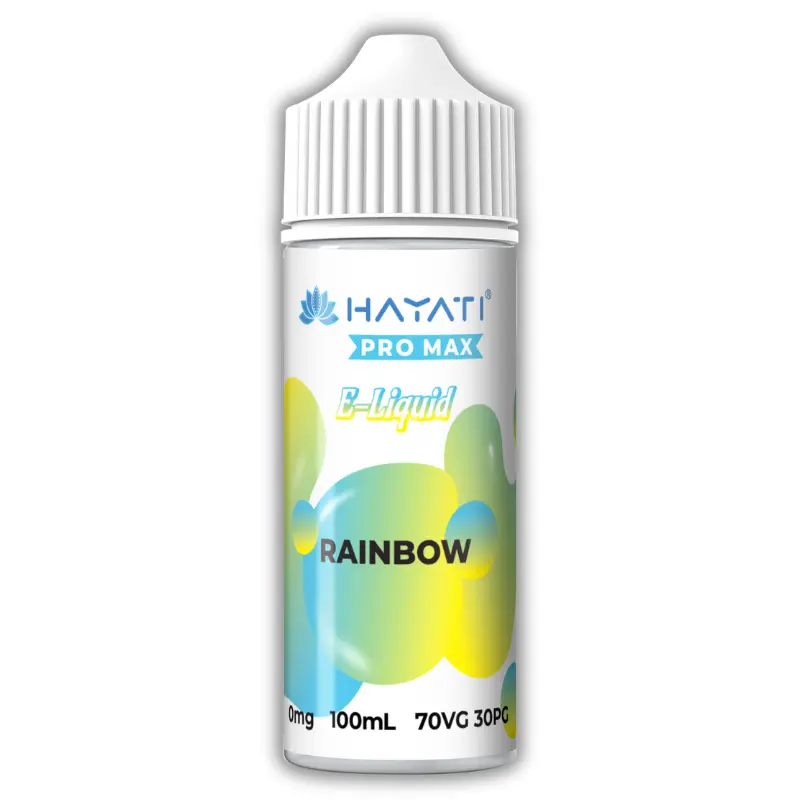
Hayati · Pro Max
Rainbow Hayati Pro Max 70/30 E-Liquid
£6.99
✔ In stock — ready to ship
Genuine Hayati
Free over £20
Same-day dispatch
Secure checkout
Rainbow arrives here as 120ml of Hayati Pro Max liquid in a base weighted seventy parts vegetable glycerine to thirty parts propylene glycol, listed at 0mg, priced at £6.99. Those are all four of the numbers, and none of them is the interesting part of this listing. The interesting part is the word at the front, because Rainbow is the only flavour name Hayati use that refers to a set of colours rather than to a fruit, a plant, a confection, a drink or a single hue, and working out what that name is actually promising takes more argument than any of the numbers do.
The obvious reading is that it promises nothing. A name that points at every colour excludes no colour, and a description that excludes nothing describes nothing. On that reading Rainbow belongs at the bottom of a league table of unhelpful names, below the mood titles and below the colour nicknames, because at least those narrow the field. That reading is where this page starts and it is not where it finishes, because it turns out to be wrong for a specific and rather satisfying reason, and the reason is the whole subject of the first third of what follows.
There are two further things worth flagging at the top. The first is that an assortment is a strange thing to ask a liquid to be. A bag of differently coloured sweets works by succession: you eat one, then a different one, and the variety lives in the gaps between pieces. A bottle has no pieces. Hayati's own copy for this listing says so outright, describing every exhale as arriving with the whole mixture together rather than one note at a time, and that sentence is the only one of its kind in 492 listings. It is presented as a feature. Whether it can be one is a real question and the middle of this page works through it.
The second is the base. The glycerine-weighted version of a busy multi-fruit confection is not the same bet as the glycerine-weighted version of a single mango, and the difference runs against this flavour rather than with it. That argument comes last and it reaches a verdict rather than shrugging. Nothing below is a tasting note dressed up as analysis. Where a conclusion goes beyond the four published numbers and the paragraph of description that comes with them, it is labelled as reasoning and graded.
The one name in the range that points at every colour at once
Counting the names that tell a buyer nothing
Before making a claim about where Rainbow sits, it is worth establishing that there is a league table at all, and how crowded it is. The shop carries 492 listings. Nineteen of those are hardware with no flavour in the title. The rest resolve into 173 distinct flavour-name strings, of which 39 are dual titles joined by an oblique and 134 are single names. That set of 134 is the population.
Run the whole 134 against a list of fruits, botanicals, confections and drinks, and 111 of them name at least one. Blueberry Cherry Cranberry names three. Blue Razz Gummy Bear names a berry and a sweet. Peach Green Tea names a stone fruit and a brew. Even the abbreviated ones give you something to work with once you know the house shorthand, since GB resolves to a gummy bear and B'Gum to bubblegum. That leaves 23 names in the whole catalogue that identify no edible thing whatsoever, and they sort into groups more neatly than you would expect:
- Four mood titles: Galaxy Aura, Midnight Dream, Summer Dream, Sunset Aura. Note that the Aura family has a fourth member, Peach Aura, which does name a fruit, so the convention is not absolute even inside its own set.
- Five single-colour names: Blue Frozen, Blue Fusion, Mad Blue, Mr Blue, Mr Pink.
- Five clipped proper nouns: Bru Ice, Hubba Bubba, H'Bubba, Vim Ice, Vimbull Ice. Each is a truncation of something Hayati cannot print in full.
- Three category names: Fruit Bomb, Fruit Twist, Tropical Sour Juice. These name a family and a loudness or a taste, but no member of the family.
- Two drink forms: Caribb Crush and Pipeline Punch, both of which describe a vessel and a region rather than contents.
- Two format words: Ice Cold, which names only a temperature, and Ice Pop, which names a kind of frozen sweet.
- One creature: Black Mamba.
- And Rainbow.
Twenty-three out of 134 is a little over seventeen per cent, which is a high enough proportion to be a naming habit rather than an accident, and low enough that the habit has not taken over. Most Hayati flavours still say what is in them.
Where Rainbow sits, on the literal reading
Sorted by how much each of the 23 narrows the field, the literal ranking puts Rainbow at the bottom, and the handed-down version of this argument is easy to state. Midnight Dream and Summer Dream evoke something. Midnight suggests dark, deep and purple; summer suggests bright, light and warm. Neither is a fruit but both are a direction, and Hayati's own copywriter leans on exactly those directions when describing them, reaching for night-time and golden-hour imagery in place of a recipe. Sunset Aura and Galaxy Aura do the same trick with a different scene. All four are vague, and all four point somewhere.
The colour nicknames point somewhere more precisely still. Mr Blue and Mad Blue and Blue Fusion each pick one hue, and in this trade one hue narrows the field to about two candidates. Mr Pink picks another and lands in red and pink fruit. On the Hayati Pro Max 70-30 E-Liquid shelf, Mr Blue Hayati Pro Max 70/30 E-Liquid is the nearest comparison to this bottle in that respect: no fruit in the title, one colour, and a listing that admits the colour is the whole of the instruction.
Against that, Rainbow looks empty in a way none of the others manage. It is not a colour, it is the complete set of colours. Every fruit in the catalogue has a colour and the rainbow contains all of them, so as a filter it removes nothing. Mr Blue at least excludes mango. Rainbow excludes nothing at all, and a term that excludes nothing carries no information in the ordinary sense. That is the argument, and on its own terms it is sound.
Why the argument breaks, which is the useful part
The argument breaks because it treats colour as decoration, and in confectionery colour is not decoration. It is an index.
Consider how a bag of assorted fruit sweets is actually organised. The pieces are not labelled. Nobody prints "lemon" on a yellow one. The colour carries the flavour information, and it does so by a convention so settled that a shopper can predict what a green piece will taste like without ever being told. Red is strawberry or cherry. Orange is orange. Yellow is lemon. Green is lime or green apple. Purple is blackcurrant in this country, grape in the American versions. The mapping is not universal and not legally fixed, but it is consistent enough across manufacturers that it functions as a shared code, and confectioners rely on it because it saves them printing anything.
Once you notice that colour is the index, the meaning of "all colours" changes completely. In a domain where each colour denotes a flavour, naming the whole spectrum is not naming nothing. It is naming the entire standard set. Rainbow is a specification, and the fact that it specifies by reference to a code rather than by listing members does not make it vague, any more than a recipe that says "mixed herbs" is vague to somebody who has a jar of it.
So the literal reading and the conventional reading point in opposite directions, and both are correct within their own frame. To a reader who takes the word at face value, Rainbow is the emptiest name in the catalogue. To anyone who has spent five minutes in a British sweet aisle, it is more specific than Mr Blue, because blue in confectionery indexes two quite different things: blue raspberry, which is a wholly invented flavour with no fruit behind it, and blueberry, which is a real one that tastes nothing like it. Hayati's own description of Mr Blue hedges between the two. Nothing in the Rainbow listings hedges at all.
The convention, and how settled it is
It is worth being precise about the claim, because "everyone knows what rainbow sweets taste like" is the kind of thing that sounds obvious and can still be false. The claim is narrow: in British confectionery, "rainbow" is a productive descriptor that attaches to a sweet format and denotes an assortment of differently coloured pieces of that format, and the flavour set it implies is reasonably stable across manufacturers.
The evidence for it is that the word attaches promiscuously and always means the same thing. Rainbow belts, rainbow sours, rainbow laces, rainbow twists, rainbow sherbet, rainbow dust and rainbow bites are all in common trade use, and in every case the noun supplies the format and the adjective supplies the assortment. None of them is a single flavour called rainbow. All of them are a set. The most famous fruit chew in the category built an entire advertising line around the word, which is not a name this page will print for the same reason it will not print the two drink names hiding inside the Vimbull listing on the same shelf, but the fact that the line worked at all is evidence that the word already carried the meaning before anybody advertised it.
Two qualifications keep this honest. The purple slot is genuinely unstable between markets, blackcurrant here and grape there, and a factory producing for both will sometimes split the difference or use whichever concentrate is cheaper. And the red slot moves between strawberry and cherry with no pattern anyone has ever identified. So the set is stable in shape, five slots across the warm and cool halves of the spectrum, and slightly unstable in two of its five members. That is still a great deal more than a mood name gives you.
The test that settles it: what Hayati's own copy does
A convention that only exists in a copywriter's head is not much use to a buyer, so the reading above needs checking against the source. The way to check it is to compare how Hayati write about the names that have no convention behind them with how they write about this one.
For the mood titles the copy is visibly stuck. Midnight Dream is described as one of the more mysterious names in the range, to be approached with an open mind, with the darker tones only suggested by the theme. Sunset Aura is a title that sets a scene rather than listing fruits, best treated as warm-toned. Galaxy Aura is about atmosphere rather than a spelled-out recipe, and the copy goes as far as calling it a wildcard. Summer Dream is a mood sold in place of a recipe. Four listings, four admissions that the writer does not know either.
Now the three Rainbow listings, which are this bottle, the 50/50 shortfill of the same flavour and Rainbow Hayati Pro Max Nic Salt. Not one of them hedges. All three assert a sweet multi-fruit medley with a small amount of tang. All three place it in the confectionery register rather than the fresh-fruit one, reaching independently for the image of a handful of mixed sweets. All three tell the reader it suits somebody who prefers sugary profiles over sharp or cold ones. There is no open mind, no wildcard, no atmosphere. The copywriter who could not say what Midnight Dream was had no trouble at all saying what Rainbow was.
That is the strongest available evidence that the name is doing real work. Hayati treat Rainbow as self-explanatory and treat the mood names as not, and they are right to, because one of those categories has a trade convention behind it and the other has a copywriter's imagination. The angle this page was handed, that Rainbow is the most information-free name in the range, survives as a statement about the word and fails as a statement about the listing. The word is empty. The name is not.
The profile this actually predicts, graded
Working from the convention plus the three listings plus the shelving, here is what can be said and how much weight each part will bear.
Reasonably confident. This is a sweet liquid in the confectionery register rather than the fresh-fruit one. All three Rainbow listings say so and this one says it most explicitly, setting an image of assorted sweets against the alternative of fresh fruit in a bowl. There is no cold element: the title carries no cooling word, and the copy positions the flavour away from icy profiles rather than towards them. There is some acid, described consistently as a little tang and never as sour or sharp. No single fruit leads, which all three listings state in almost the same breath. And the filing agrees, since Rainbow is one of only three bottles on the twenty-strong 70/30 shelf that Hayati also file under Sweet Vapes, the other two being Triple Mango Hayati Pro Max 70/30 E-Liquid and Blue Razz Gummy Bear Hayati Pro Max 70/30 E-Liquid. Of those three, Rainbow is the only one whose name identifies neither a fruit nor a sweet.
Probable. The five-slot spectrum set: a red berry, an orange, a lemon, a green note that is either lime or green apple, and a dark purple note that is most likely blackcurrant given the market. A shared candied sweetness that sits under all five and does more to define the liquid than any of them. A finish weighted towards the heavier end of that set, because the citrus components are the most volatile and the dark fruit the least, which means the order in which they arrive across a draw is partly decided by physics rather than by the recipe.
Unknown. How many fruits are actually in it. Whether any of the five is legible as itself in the finished liquid. Which one, if any, has been pushed forward. Whether the tang is citric, malic or something else, which matters because those behave differently against sweetness. The flavour concentrate percentage, which is published for nothing in this range. And whether the concentrate here is the same one used in the 50/50 bottle and the 10ml nic salt, which Hayati never state for any flavour they sell in more than one format.
The honest summary of that grading is that you can predict the register with confidence and the roster only by convention. If what you want is a sweet fruit-candy liquid, the name is telling you the truth. If what you want is to taste five identifiable fruits, the name is not a promise anybody has made.
What it is not
Four exclusions, all of them supported rather than guessed. It is not cold. Nothing in the title or the description points at a coolant, and Hayati are consistent about declaring one in the name when there is one, a finding established elsewhere on this site by a census of the range's cooling vocabulary rather than asserted here. It is not sour: the tang is described as small and as a corrective to flatness, which is a different thing from the declared sour profiles like Blue Sour Raspberry Hayati Pro Max 70/30 E-Liquid. It is not a fresh-fruit blend, which is the one thing this particular listing goes out of its way to rule out. And it is not tropical, since the spectrum convention is built on temperate fruit, with mango and pineapple and passion fruit sitting outside the standard colour code entirely.
An assortment is a sequence, and a bottle cannot dispense one
What a bag of mixed sweets is actually doing
Having established what the name denotes, the next question is whether the thing it denotes can be put in a bottle, and the answer is more complicated than it looks.
A bag of assorted sweets is a delivery mechanism with a specific structure. The set is the product but the piece is the serving, and each piece carries one flavour at full strength. Nothing is diluted. A green one tastes exactly as green as a bag of nothing but green ones would, and the reason the assortment feels varied is that you get a full-strength lime, then a full-strength lemon, then a full-strength blackcurrant, in whatever order your hand finds them.
Two properties of that arrangement matter and both are easy to miss. The first is that the variety is between servings, not within one. The second is that a palate is far better at detecting change than at detecting level. Present five flavours in succession and each one arrives as a difference from the last, which is the condition under which a palate is most sensitive. Present the same five simultaneously and there is no difference to detect, only a composite to resolve, and resolving a composite is the harder task by a wide margin. That is why a wine taster swills and spits between samples rather than mixing them.
A chord is not an arpeggio
A liquid cannot be dispensed in pieces. A draw is a draw, and whatever is in the bottle is in every draw in the same proportions. The assortment therefore has to arrive together, which is exactly what Hayati's copy for this bottle says happens and exactly what it presents as the attraction.
Simultaneous delivery of five flavours is not a weaker version of sequential delivery. It is a different sensation with a different character, and the musical analogy is close enough to be useful. Five notes played one after another are heard as five notes. Played together they are heard as one chord, with a quality of its own that none of the five has, and most listeners cannot name the members without training. Flavour behaves similarly. Sum five fruit accords and what reaches the palate is a single composite impression that tastes of no particular fruit, with the members recoverable only by somebody paying deliberate attention and often not even then.
So there is a genuine tension in the product idea. The name promises an assortment, and the format can only supply a blend, and those are different things. A blend of five fruits is not five fruits. It is a sixth thing.
What a formulator can do about it, which is more than nothing
There are four available responses, and a real product usually uses some of each.
The first is to accept the composite and aim for it deliberately, tuning the five so that the sixth thing they add up to is pleasant. This is what most mixed-fruit liquids do and it is why so many of them read as generically fruity. The trade-off is well understood and has been worked through on this site already, on a pod named for its own loudness, which found that a blend smoothing out its internal contrasts gives up one of the main ways a liquid announces itself. That conclusion is not being re-derived here.
The second is to cheat by building a hierarchy: push one fruit forward and let the others sit behind it as a chord. This produces a legible liquid, but it stops being an assortment, because an assortment with a leader is just a flavour with backing. Hayati's copy rules this out for Rainbow in all three listings, insisting that no single note is meant to dominate.
The third is the interesting one, and it exploits the fact that a draw does have a timeline after all.
Three seconds is not much, but it is not nothing
A draw takes somewhere between two and four seconds and the sensation does not arrive all at once inside that window. Aroma compounds differ enormously in volatility, and volatility decides both how quickly a compound reaches the receptors and how quickly it clears. The light, small, fast molecules that carry citrus character arrive early and leave early. The heavier compounds behind dark berry and behind the caramelised, slightly vanillin quality of a sugar shell arrive later and linger after the exhale is over.
That gives a formulator a crude running order to work with, and it is what every inhale-and-exhale description in this trade is actually describing. Load the front of the draw with the citrus slots, let the red and purple fruit occupy the middle, and let the candied register carry the finish. The assortment then arrives in something like an order, and a determined palate can pick out a sequence inside three seconds that it could never pick out from a single instant.
The limits of the technique are real, though. Three seconds supports perhaps three distinguishable stages, not five, so the spectrum set has to be collapsed into groups: the bright ones, the red ones, the dark ones. And the stages overlap heavily, because nothing switches off. What you recover is a gradient rather than a sequence, which is closer to an assortment than a flat composite is, and still a long way from a bag.
The shell is what unifies a bag, and it is what unifies a bottle
The fourth response is the one that makes the whole idea work, and it comes from looking harder at the confectionery original.
Ask why five different sweets in one bag read as one product rather than as five products sold together. It is not the fruit, because the fruit is the thing that differs. It is everything else: the same sugar shell, the same chew or crunch, the same acid dusting, the same manufacturing character. The pieces are identical in every respect except the flavour slot, and that shared body is what makes the bag a bag.
A liquid can reproduce the shared body exactly. The candied sweetness, the slightly synthetic rounded quality, the faint acid prickle: all of that carries across intact, because none of it depends on being divided into pieces. What cannot carry across is the discreteness. So the translation is faithful in one dimension and impossible in the other, and a Rainbow liquid is best understood as the shared register of an assortment with the individual members averaged rather than as the assortment itself.
So does it work
Yes, but not at the thing the name literally promises, and it is worth being clear about which half you are buying.
If what you liked about the sweets was the register, the sugar-shell character and the bright synthetic fruit and the small acid edge, then a liquid reproduces that very well indeed, and arguably better than a bag does, because a liquid can hold the register steady for hours. If what you liked was the variety, the liquid cannot give you it, because variety was a property of the sequence and the sequence has been removed. Hayati's copy for the 50/50 version of this flavour makes the variety claim explicitly, suggesting the blend is less likely to become repetitive over a large bottle than a single-note flavour would be. That claim deserves a little scepticism. A composite does not stop being one composite just because it was built out of five parts, and the palate adapts to composites at much the same rate as it adapts to anything else.
The fair verdict is that Rainbow is a confection flavour rather than a variety pack, and it is a decent one. Anyone who wants genuine variety across a session gets it the way a liquid can actually deliver it, which is by owning two bottles and switching, not by owning one bottle with five things in it. A second tank holding something structurally opposite, Fresh Mint Hayati Pro Max 70/30 E-Liquid or Lemon Lime Hayati Pro Max 70/30 E-Liquid, restores the sequence the format took away and does it far more effectively than any amount of internal complexity.
The base, and why this is the flavour it suits least on the shelf
What is already settled, and is not being rebuilt here
The physics of the carrier split has been worked through properly on this site by the Vimbull Ice bottle, which sits on the same shelf at the same price in the same size, and there is nothing to gain from doing it twice. Four of its findings are taken as read below.
Vegetable glycerine is viscous where propylene glycol is thin, which makes the ratio a hardware question before it is a taste question: wide feed channels and a lot of wick cope with it, narrow ones sized for a thin liquid do not. It produces more aerosol per millilitre, which spreads a fixed dose of flavouring across a larger volume of vapour and lowers the flavour concentration in any given mouthful even though the dose per millilitre has not changed. It is faintly sweet in its own right, before any flavouring goes in. And it carries coolant compounds less efficiently than propylene glycol does, so a cold profile in this base reads softer and more diffuse, a point that page cites in turn from the Blue Frozen work rather than claiming as its own.
That page also established the piece of range structure that makes this bottle possible to reason about at all. Hayati sell twenty large bottles at 50/50 and twenty at 70/30, and the two sets are the same twenty flavours, with nothing available in one ratio and missing from the other. Same names, same 120ml, same 0mg, same £6.99. Every variable is held constant except the base, which makes the range a controlled experiment rather than a catalogue.
Here is the new part, and it is a small addition to that finding rather than a restatement. If those forty bottles are an experiment, Rainbow is its most sensitive instrument. The effect of a base on a flavour depends on how much structure the flavour has to lose, and by the convention established above Rainbow has more components than anything else in the set of twenty. Triple Mango has one fruit three ways. Blueberry Cherry Cranberry names three. Rainbow implies five. Whatever a base does to internal structure, it should do most visibly here.
One limb of the argument does not apply at all
Start with the honest subtraction, because carrying over an argument that does not fit is how errors propagate between pages.
The coolant-solubility point is irrelevant to this bottle. Rainbow has no cooling. There is no coolant in it to be carried inefficiently, so a third of the case against the 70/30 base on a cold flavour simply does not arise, and anybody transferring the Vimbull reasoning wholesale would be counting a cost this product does not pay. The same goes for the cordial argument that page builds its verdict on. Rainbow is not a concentrate designed around water dilution. It is a confection profile, which is a different formulation problem with a different relationship to its base.
What remains is viscosity, vapour volume and base sweetness, and two of those three behave differently on a five-component confection than they do on anything else in the range.
Dilution does not weaken a blend evenly, it removes members
The aerosol-volume effect is usually described as though it turned the volume down, and for a single-fruit liquid that is roughly what it does. Dilute a mango and you get a quieter mango. The identity survives, because there is only one identity and reducing its level does not make it stop being mango.
A multi-component blend does not behave that way, and the reason is that detection and identification have different thresholds. A flavour compound can be present clearly enough to contribute to an overall impression while being nowhere near clear enough to be named. The gap between those two levels is wide, and every component of a blend sits somewhere in it.
Now apply a uniform reduction. The five components are not equally loud to begin with, because concentrates differ in strength and because some fruits are simply more assertive than others. Lower them all by the same proportion and they do not all cross the same line at the same time. The quietest one drops below identification first, then the next, while the loudest two carry on being recognisable. The blend does not get quieter. It loses members, from the bottom up, and what survives is a two or three fruit liquid that happens to be called Rainbow.
That is a genuinely different failure from the one a single-fruit bottle risks, and it is specific to a flavour built from many parts. It is also worth noting that the parts most likely to go first are the citrus slots, because they are the lightest and the most volatile and they have the least mass to defend themselves with. The dark purple note, which is the heaviest thing in the set, is the one most likely to still be standing. A diluted rainbow tends towards a berry.
The base sweetness attacks the one term all five share
This is the mechanism that matters most and it is the reason the verdict below goes the way it does.
Split the flavour into what its components have in common and what distinguishes them. The common term is the candied register: the sugar-shell sweetness, the rounded synthetic quality, the body. The distinguishing terms are the five fruit accords sitting on top of it. The common term is what makes the liquid feel like one product. The differences are what make it an assortment. That division is not a metaphor, it is how the confectionery original is built.
Vegetable glycerine's own faint sweetness is not noise scattered across the blend. It adds to the common term and only to the common term. It makes the shared body larger while leaving the differences exactly where they were, and since what a palate perceives is closer to the ratio between the differences and the background than to their absolute size, raising the background shrinks the perceived variety without touching a single fruit.
Put the two mechanisms side by side and they run in the same direction, which is what makes this case firmer than a judgement call. The vapour-volume effect lowers the fruit terms. The base sweetness raises the shared term. One lever, two dials, and both of them narrow the gap that the entire flavour idea depends on. On a single fruit those two effects partly cancel, since a slightly sweeter background is a reasonable trade for a slightly quieter mango. On a five-slot assortment they compound, because the assortment is the gap.
A coating mouthfeel carries the last draw into the next one
One more effect is worth adding because it bears on the sequence argument rather than on the blend. A glycerine-heavy liquid coats. The mouthfeel is thicker and it persists after the exhale, which is the sensation people are describing when they call this ratio rich.
Persistence is normally a small matter of preference. On a flavour whose only remaining route to variety is the three-second gradient inside a draw, and the difference between one draw and the next, it costs something specific: the palate does not reset cleanly between draws. Whatever running order the formulator managed to build out of volatility is partly smeared by the residue of the draw before it. The gradient survives, but it is a shallower gradient than the same recipe would produce in a thinner base.
Hayati argue both sides of this on the same shelf
There is a piece of evidence sitting in the source data that is worth reporting, with the caveat that it is evidence about how the copy was written rather than about how the liquids were formulated.
Seventeen of the twenty descriptions on the 70/30 shelf mention the dense vapour. Seven of those twenty frame it as something the flavour has to survive: citrus that cuts through it, cranberry tartness that stops big clouds turning syrupy, a sour edge that still comes through clearly, two berries whose contrast comes across rather than blurring together. In those seven the copywriter's implicit model is exactly the one argued above, that this base threatens definition and that the flavours worth buying in it are the ones with enough structure to resist.
The Rainbow listing inverts it. Rather than treating simultaneity as a hazard, it treats it as the point, and the sentence saying so is unique in the catalogue: no other listing anywhere in 492 describes an exhale as delivering the whole mixture together. That is either a genuine formulating intention or a copywriter turning a weakness into a feature, and there is no way to tell which from the outside. What can be said is that the same shelf's copy, applied to flavours with more structure, argues the opposite case.
The verdict, stated plainly
Of the twenty flavours Hayati offer in both ratios, Rainbow is the one with the weakest case for the glycerine-weighted version, and it is not a close call.
The ratio adds body, density and a heavier mouthfeel. This flavour did not need any of those, because a confection profile arrives with body already built in. What it needed was definition between its parts, and definition is precisely what the base takes away, by two independent routes that both point the same way. A blend already fighting for internal contrast is the worst possible candidate for a base whose main effect is to round edges and raise the floor.
So the honest recommendation is that the 50/50 version of this flavour, which exists in the same 120ml at the same 0mg for the same £6.99, is the one that presents it. If your hardware takes both and the flavour is what you are buying, that is the bottle. The nic salt in Rainbow Hayati Pro Max Nic Salt is the same idea again in 10ml at 10mg on an even base for small pods.
The verdict has a second half and leaving it out would be dishonest. Blurring only costs you something if you were going to listen. A large proportion of the people buying a sweet fruit-candy shortfill for an open tank are not auditing the roster, they want a pleasant sugary cloud that does not demand attention, and for that use the blunting is invisible and the extra body is a real gain. Nothing above says the 70/30 Rainbow is a bad liquid. It says it is a worse Rainbow, which is a narrower complaint. If the assortment was never the point for you, buy this one and enjoy it.
And if you run narrow restricted-draw pods rather than an open tank, the question does not arise. Hayati's own listing places this ratio with sub-ohm tanks and direct-to-lung kits and sends pod owners to the thinner versions, and putting a liquid this viscous into hardware sized for a thin one produces problems that get blamed on the flavour.
Three ways this reasoning could be wrong
All of the above is derived from published properties and from how the two carriers behave. It is not a tasting report and should not be read as one.
The concentrate dose may not be the same in both bottles. Lifting the flavouring percentage in a glycerine-heavy mix to offset the dilution is standard practice, and if Hayati have done it here then the member-loss argument is weaker or absent. No flavour percentage is published for any bottle in this range, so there is no way to check.
The two bottles may not share a concentrate at all. This shop has already caught cases where Hayati's descriptions of one flavour disagree between formats, which is usually a sign of separate copywriting rather than separate recipes, but it does mean a shared name guarantees nothing. The three Rainbow listings agree closely on substance, which is mild evidence in the other direction.
And the convention could simply not be what Hayati built to. Everything in the first third of this page infers a roster from a trade term. If their Rainbow concentrate is a tropical blend, or a three-fruit one, or a red-only one, the analysis of what the base does to it still holds but the description of what is in it does not. That inference is graded probable rather than confident for exactly this reason.
The bottle, the numbers, and what each one governs
The physical product is a bottle of liquid and nothing else. No coil, no device, no parts, no wear. Everything in the table below comes from this listing's own data, and where Hayati publish nothing the row says so rather than borrowing from a sibling.
| Listed name | Rainbow Hayati Pro Max 70/30 E-Liquid |
| What the name denotes | A confectionery assortment, by trade convention rather than by any statement from Hayati |
| Base | 70 vegetable glycerine to 30 propylene glycol |
| Nicotine | 0mg |
| Volume on the listing | 120ml |
| Price | £6.99, which is 5.83p a millilitre at the stated volume |
| Cooling | None declared, and no cooling word in the title |
| Acid | Described as a small tang, not as sour |
| Hardware Hayati place it with | Sub-ohm tanks and direct-to-lung kits |
| Shop tagging | Shortfill e-liquid, sweet |
| Brand and line | Hayati, Pro Max 70/30 bottles |
| Shelves | Hayati Pro Max 70-30 E-Liquid, Hayati E-Liquids, Sweet Vapes, New Products |
| Not published | Which fruits, how many, their proportions, the flavour concentrate percentage, coil resistance, and whether 120ml is the fill or the container |
The name row is at the top because on this particular product the name is the specification. Every other line in the table is shared with nineteen other bottles on the same shelf.
The strength row states 0mg and that is the whole of what Hayati publish about nicotine in this listing. This page takes no view on strengths, offers no comparison between them, and gives no guidance about what anybody should do with a bottle listed at zero.
The volume row carries an ambiguity worth flagging rather than smoothing over, since it decides how much liquid is in the package. Hayati state 120ml without saying whether that figure describes the liquid supplied or the capacity of the container, and every large bottle in this range carries the same figure with the same silence. Comparing listings does not resolve it, because they all say the same thing. Treat 120ml as the published number and nothing more.
The price row matters mainly as a warning about scale. 5.83p a millilitre is the cheapest liquid this shop sells by a wide margin, which sounds like an argument for buying and is really an argument for caution. Twelve times the volume of a small bottle for under three times the money means the penalty for being wrong is paid in weeks of ownership rather than in pounds. On a flavour whose roster is inferred rather than published, and whose only real risk axis is sweetness tolerance, that is a live consideration. The 10ml Rainbow nic salt exists partly as a way of finding out first.
The final row is the important one. Four of the things a buyer might most want to know about a multi-fruit blend, which fruits, how many, in what proportion and at what concentrate strength, are simply not in the data, and the third of those would settle most of the argument on this page one way or the other. Anyone stating them with confidence has got them from somewhere other than Hayati.
How it sits against everything near it
The same flavour twice more
Rainbow exists in three forms and choosing between them is a hardware question first and a flavour question second. The 50/50 shortfill is the same 120ml at the same 0mg for the same £6.99 on an even base, which is the version this page argues presents the blend with its parts furthest apart. Rainbow Hayati Pro Max Nic Salt is 10ml at 10mg on an even base at £2.49, sized for small refillable pods rather than tanks. This bottle is the one for open hardware. Nothing else separates them, and the three descriptions agree with each other more closely than most flavours in this range manage.
The other confectionery builds, which are the real neighbours
The flavours Rainbow actually competes with are not the fruit bottles it shares a shelf with. They are the sweets, and there are a good number of them across the range.
Gummy Bear Hayati Pro Max Nic Salt is the closest thing in the catalogue to a direct alternative in concept, and its description reaches for the same image of a handful of assorted sweets. The difference is that a gummy bear names the sweet and leaves the fruit roster open, while Rainbow names the assortment and leaves the sweet open, which is the same information gap approached from opposite ends. Anyone comparing the two is really choosing between a chew texture and a shell.
Blue Razz Gummy Bear Hayati Pro Max 70/30 E-Liquid is the version of that idea with a fruit bolted on, and it is the single most useful comparison on the shelf, because it is a confection build in the same base at the same price. Everything argued above about the base raising the shared sweet term applies to it as well, with one important difference: it has a named lead. The blue raspberry gives the liquid something to be, so when the base rounds the edges there is still an identity underneath. That is the structural advantage a named confection has over an anonymous one, and it is a good reason to prefer it if the glycerine base is fixed and legibility is what you want. The same flavour is also sold as Blue Razz Gummy Bear Hayati Pro Max 50/50 Shortfill E-Liquid and as a 10ml nic salt, so all three routes exist there too.
Further along the same line, Strawberry GB Hayati Pro Max Nic Salts and Grape GB Hayati Pro Max Nic Salts apply the initials shorthand to a single slot each, which is close to buying one colour out of the rainbow on its own. Grape in particular is the purple slot isolated, and tasting it is a cheap way of finding out whether the heaviest member of the set is one you like, since it is the member most likely to dominate a diluted blend.
At the bubblegum end, Bubblegum Ice Hayati Pro Max Nic Salt and Strawberry Watermelon Bubblegum Hayati Pro Max Nic Salt occupy a register next door: the same synthetic sweetness with a different shared body under it. The bubblegum accord is more distinctive than a sugar shell, which makes those two easier to recognise and harder to use all day.
The named-fruit bottles on the same shelf
Among the twenty 70/30 bottles, the useful sorting question is how much structure each flavour has to lose, because that decides how the base treats it.
The ones with the most to gain are the ones carrying real acid. Blue Sour Raspberry Hayati Pro Max 70/30 E-Liquid has a declared sour backbone with enough left over to survive a sweeter background. Lemon Lime Hayati Pro Max 70/30 E-Liquid carries no sugar weight of its own and its own listing points out that citrus copes with dense vapour well. Fizzy Cherry Hayati Pro Max 70/30 E-Liquid uses a sparkling sharpness for the same purpose.
The ones with a single strong identity are next, because a dilution that removes members cannot remove a member from a flavour that only has one. Triple Mango Hayati Pro Max 70/30 E-Liquid is the clearest example on the shelf, three treatments of one fruit with nothing competing, and it is also filed under Sweet Vapes alongside Rainbow, which makes it the fairest sweet-to-sweet comparison available. Banana Ice Hayati Pro Max 70/30 E-Liquid is a single fruit with a coolant, where the base costs the cooling something and leaves the fruit alone. If the mango is what you want without the viscosity, Triple Mango Hayati Pro Max 50/50 Shortfill E-Liquid is the same flavour in the other base.
The multi-fruit bottles are where the argument of this page transfers directly. Blueberry Cherry Cranberry Hayati Pro Max 70/30 E-Liquid is a three-part blend, so it faces a mild version of the same member-loss problem, but it has a defence Rainbow does not: the cranberry is genuinely dry and sits against the sweetness rather than adding to it. That makes it the most interesting rival on the shelf for anybody who likes the idea of a multi-fruit liquid but wants the parts to stay apart, and it exists as Blueberry Cherry Cranberry Hayati Pro Max 50/50 Shortfill E-Liquid as well. Blueberry Raspberry Hayati Pro Max 70/30 E-Liquid is a two-part blend built on contrast between a tart berry and a mellow one, which is the smallest assortment that still counts as one. Blue Razz Cherry Hayati Pro Max 70/30 E-Liquid pairs a sugar-bright accent with a dark juicy core and keeps more acid in reserve than Rainbow does.
The small bottles, for placing your own sweetness tolerance
Sixty-five listings in this shop are 10ml bottles on an even base carrying nicotine, and they are not competitors to a 120ml shortfill so much as a cheap way of establishing what you like before committing to a large one. Blueberry Raspberry Hayati Pro Max Nic Salt is the small-bottle version of the two-berry contrast. Berry Lemonade Hayati Pro Max Nic Salt is a diluted-drink build rather than a confection one, which puts the same berry material in a thinner, more spread-out shape and is a useful contrast for understanding what the candied register actually contributes. Black Mamba Hayati Pro Max Nic Salts sits at the dark end with a late cooling twist, and is worth naming here as the other kind of opaque title in the range: a name that tells you nothing while sounding as though it tells you something.
If you do not own a tank
A bottle is no use without hardware that takes liquid, and most of what this shop sells is prefilled. If that is you, the 120ml economics are not available and the comparison to make is between prefilled formats. Blueberry H'Bubba / Watermelon H'Bubba Hayati Pro Ultra Plus Pods is an example of the confectionery register on that side of the catalogue, where a rotating mouthpiece selects between two reserves feeding one coil, which is the only format in the range that restores anything like the sequential variety a bag of sweets has. The broader Hayati E-Liquids heading holds 105 listings and mixes both bottle ratios in with the small ones, which makes it a poor place to shop if the base is what you are deciding on, and the full Hayati range runs to 492.
Living with 120ml of a five-part confection
Most of the practical notes for this bottle follow from two facts, that it is thick and that there is a lot of it, and the flavour makes each of them behave slightly differently than it would on a simpler liquid.
Thickness first, because it changes filling. This liquid pours slowly and settles into a wick slowly once it is in there. Allow longer than you would for a thin liquid before the first draw on a new coil, and allow noticeably longer if the bottle has been somewhere cold, since vegetable glycerine thickens appreciably as the temperature drops and a bottle left in a car overnight is sluggish for reasons that have nothing to do with the liquid being wrong. A couple of minutes in the hand brings it back. The same property makes overfilling easy, because the level climbs behind where you expect it.
The second point is the one worth reading carefully, because it is specific to this flavour and it is the practical consequence of everything argued above. A coil ages by accumulating residue, and residue does not degrade all flavour notes equally. It buries the light, volatile ones first and leaves the heavy ones standing, which is why a tiring coil makes a complex liquid taste flat long before it tastes burnt.
On a five-slot assortment that produces a measurable, predictable decline with a shape to it. The citrus slots go first, so the bright front of the draw disappears within days of the rest still working. The red fruit follows. What lasts longest is the heavy purple note and the candied sweetness underneath everything, which are exactly the two components with the most mass. So a Rainbow coil does not fade evenly. It subtracts the assortment from the top down and leaves you with a sweet dark liquid that is technically still working, and it applies precisely the same subtraction the glycerine base already applied, which means the two effects stack and the decline starts from a shorter position than it would in the even-ratio bottle.
The practical upshot is worth stating as a test rather than as a rule, since coil life depends on your hardware and your power rather than on the liquid. Take a draw on a fresh coil and pay attention to the first half-second, the bright part before the sweetness arrives. That is your reference. When the first half-second stops happening, the coil has consumed the top of your assortment, and you have lost the thing you paid for even though the liquid still tastes of something. That point arrives well before the point at which anybody would call the coil spent.
Sweet liquids build that residue faster than dry ones do, so on 120ml of this you will be working through more coils than the same volume of a citrus or a mint would ask for. That is not a defect of the bottle, it is the price of the register, and it is worth budgeting for at the point of purchase rather than discovering in week three. If you run one tank for several liquids, expect a confection build to leave more of itself in the wick and the airflow than a plain fruit would, and plan the changeover accordingly.
Storage is straightforward. Light and heat degrade flavour compounds, and a bottle this size stays open long enough for that to matter in a way a 10ml bottle never does, so a cupboard rather than a windowsill and the cap fully seated between fills. Refrigeration does nothing useful and makes a thick liquid thicker. A bottle this size belongs somewhere that children and pets cannot get into, along with anything else you would store that way.
One last note on commitment. Three weeks into a large bottle of a sweet confection is when people find out whether they actually like sweet confections, and the cheapest insurance against that discovery is to have something structurally opposite already in rotation from day one. A mint or a bare citrus in a second tank costs very little and keeps this liquid tasting like a decision rather than like the background.
Questions this listing tends to raise
Which fruits are actually in Rainbow?
Hayati do not say, on this listing or on either of the other two Rainbow products. The trade convention the name invokes points at a five-slot spectrum set, conventionally a red berry, orange, lemon, a green note and a dark purple one, but that is an inference from how the word is used in confectionery rather than a statement from the manufacturer. Treat the register as confident and the roster as probable.
Does Rainbow have any cold element to it?
No cooling is declared. The title carries no cooling word, and Hayati are consistent about putting one in the name when a coolant is present. The description also positions the flavour away from icy profiles rather than towards them, so both the title and the copy point the same way.
What does 70/30 mean here, and what does it change?
Seventy parts vegetable glycerine to thirty parts propylene glycol in the base the flavouring is dissolved in. Glycerine is the thick component that makes most of the visible vapour and is faintly sweet on its own. Propylene glycol is thin and carries flavour compounds and wicks quickly. Weighting towards glycerine gives a more viscous liquid, a denser cloud, a slightly sweeter background and slower wicking.
How is this different from the 50/50 Rainbow?
Same flavour name, same 120ml, same 0mg, same £6.99, different base. The even-ratio bottle is thinner, produces less vapour, adds less background sweetness and suits narrower hardware. This page argues the even-ratio version presents a multi-fruit blend with its parts further apart, which on this particular flavour is the property that matters most.
Will it work in a small refillable pod?
Hayati place this ratio with sub-ohm tanks and direct-to-lung kits, and point pod owners at the thinner versions instead. The reason is wicking rate: a thicker liquid travels through cotton more slowly, and feed channels sized for a thin liquid cannot keep a coil supplied. The specific device decides the answer, but the direction of the effect is not in question.
What nicotine strength is this?
0mg. That figure is the whole of what Hayati publish about nicotine in this listing.
Is it sweeter than the other bottles on this shelf?
Almost certainly, and by two routes rather than one. It is a confectionery profile rather than a fruit one, and the glycerine-weighted base contributes a faint sweetness of its own on top. It is also one of only three bottles on the twenty-strong 70/30 shelf that Hayati file under their sweet heading. No sweetness figure is published for anything in this range, so that is a structural reading rather than a measurement.
Will I be able to pick out individual fruits?
Probably not more than two or three, and that is inherent to the format rather than a failing of the recipe. A liquid cannot present an assortment in sequence the way a bag of sweets does, so everything arrives together as a composite. A determined palate can sometimes read a running order inside a draw, because lighter compounds arrive before heavier ones, but that gives you a gradient rather than a list.
Does the tang make it sour?
No. All three Rainbow listings describe a small amount of tang whose job is to stop the sweetness reading as flat, which is a different thing from a sour profile. If sourness is what you want, the declared sour bottles on the same shelf are built for it and this one is not.
Is 5.83p a millilitre as good as it sounds?
It is the cheapest liquid in the shop by volume, and the figure is real. The qualification is that the large bottles are 0mg while the prefilled products are not, so a per-millilitre comparison across formats measures volume rather than equivalent products. The other qualification is that cheap per millilitre means expensive to be wrong about, since a bottle you dislike is weeks of ownership rather than a small loss.
Why does the coil seem to stop tasting of anything while the tank is still full?
Residue from a sweet liquid buries the lightest flavour notes first and leaves the heaviest standing, so on a multi-fruit confection the bright front of the draw disappears while the sweetness and the dark fruit carry on. The liquid still tastes of something, which is what makes the change easy to miss. Watching the first half-second of a draw is the earliest reliable signal.
Is Rainbow a good name for a vape liquid?
Better than it looks and worse than a fruit list. Taken literally it names every colour and therefore excludes nothing, which is the definition of an uninformative label. Taken as trade shorthand it names a specific and reasonably stable confectionery assortment, which is more than the mood names in this range manage. Hayati's own copy treats it as self-explanatory, and unlike their mood-named products they never once hedge about what it is.
The short version
Rainbow at 70/30 is 120ml of a sweet multi-fruit confection at 0mg for £6.99, in a base weighted heavily towards vegetable glycerine and placed by Hayati with sub-ohm tanks. Read literally the name is the emptiest in a catalogue holding 23 that identify nothing edible, since pointing at every colour excludes none of them. Read as confectionery shorthand it is among the more informative, because in that trade colour is a flavour index and the whole spectrum names the whole standard set. Hayati's own writing settles which reading they meant: they hedge openly about their mood-named products and never once about this one.
The format cannot deliver the assortment as an assortment, because variety lived in the gaps between pieces and a bottle has no pieces. What it reproduces faithfully is the shared sugar-shell register, which is what makes a bag feel like one product in the first place. The base then works against what is left, by spreading a fixed flavour dose across more aerosol until the quietest members drop below the line where they can be named, and by adding its own sweetness to the single term all five parts already share. That is the verdict: this is the wrong version of this particular flavour, and the 50/50 in the same size at the same price is the one that presents it. None of which makes it a poor bottle. If you wanted a sugary cloud rather than five identifiable fruits, the blurring costs you nothing you were going to notice. Buy it for the register, not for the roster.
Strictly for adults aged 18 and over. Nicotine is an addictive substance.
You might also like