
Home / Hayati Pro Max Nic Salts / Grape GB Hayati Pro Max Nic Salts
Hayati · Pro Max
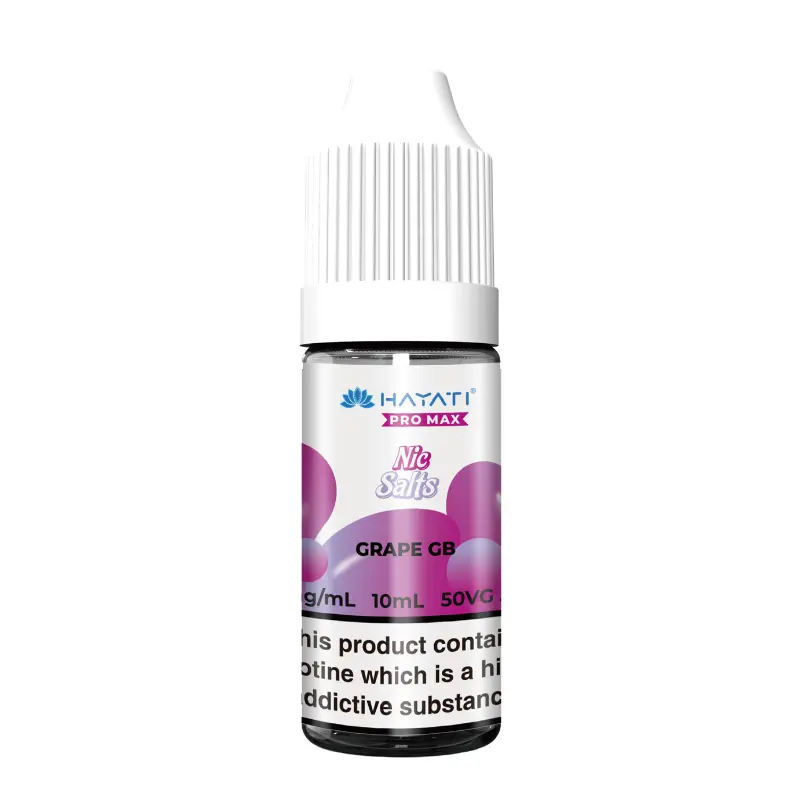
Grape GB Hayati Pro Max Nic Salts
£2.49
✔ In stock — ready to ship
Genuine Hayati
Free over £20
Same-day dispatch
Secure checkout
Grape GB is the purple entry in Hayati's Pro Max nic salt line, priced at £2.49 for a 10ml bottle, mixed at 10mg in a nicotine salt base and split evenly between vegetable glycerine and propylene glycol. The profile Hayati publish for it is grape with a confectionery finish, and on the face of it that reads as a routine addition to a shelf already crowded with sweet fruit. It is not routine. Of every flavour category sold in a UK vape shop, grape is the one most likely to produce a flat refusal from the person tasting it, and the reason has almost nothing to do with the skill of the blender.
The short version of the argument this page makes is that grape in an e-liquid is a chemistry decision before it is a fruit decision. The purple grape note that runs through grape sweets, grape soda and grape vape juice is built on a single dominant aroma compound, and that compound divides people. Some palates read it as fruit. Others read it as the inside of a medicine cabinet, and once a palate has filed it that way it very rarely refiles it. Grape GB then compounds the split, because pairing that note with a sugared confectionery finish pushes the liquid further away from anything that resembles actual fruit rather than closer to it.
That makes this a high-conviction bottle rather than a safe one. If purple grape flavouring already works for you, this is a well-judged example of it with a thick sweet tail and no cooling to interrupt the sugar. If purple grape has never worked for you, nothing in this formulation is designed to change that, and a £2.49 experiment is likely to end in a bottle you do not finish. What follows sets out why the note behaves as it does, walks a single puff from first contact to aftertaste, explains what a 50/50 carrying this much sweetener asks of a coil, and then places the bottle honestly against its neighbours on the Hayati Pro Max Nic Salts shelf so the decision can be made before the seal comes off rather than after.
Why grape flavouring tastes the way it does
Start with a problem that has nothing to do with vaping. Buy a bag of grapes from a UK supermarket and eat one. It is watery, faintly sweet, mildly acidic, and almost entirely without aroma. Now taste anything labelled grape that came out of a factory. The two have no obvious relationship. That gap is not laziness on the part of flavour houses. It is a botanical accident, and understanding it explains most of what people argue about when they argue about grape e-liquid.
One compound doing nearly all of the work
Table grapes sold in Britain are overwhelmingly varieties of one species, and that species produces very little volatile aroma. The grape that manufactured flavouring is modelled on is a different species entirely, the North American type grown for juice and jelly rather than for the fruit bowl. Its defining aroma compound is methyl anthranilate, an ester with a heavy, sweet, faintly floral character that is often described as musky or foxy. It is intensely powerful at low concentrations, it is cheap to make synthetically, and it is instantly recognisable. Put a trace of it in a liquid and the liquid reads as grape to anyone who has met it before, with no supporting cast required.
That efficiency is exactly why grape flavourings converge. A blender building a strawberry has dozens of levers to pull and can produce a jam strawberry, a green strawberry, a syrup strawberry or a freeze-dried strawberry that taste meaningfully different from one another. A blender building a grape has one compound that defines the category and a handful of supporting esters that adjust its weight. The result is that grape liquids across the whole market sit far closer together than, say, mango liquids do. Hayati do not publish the flavouring composition of this bottle and this page is not claiming to know it, but the note on the tongue is unmistakably the anthranilate profile rather than anything resembling fresh fruit, and that is a statement about the category as much as about this product.
The medicinal reading, and why it is not a mistake
Here is the part most product pages skip. A large number of British adults taste methyl anthranilate and think of medicine rather than fruit. That reaction is consistent, it is not snobbery, and it is not a failure of the palate. Grape flavouring is culturally embedded in North America in a way it never has been here. Purple grape is a default sweet flavour there and a default soft drink flavour, so the association is laid down early and reinforced constantly. In Britain the same note turned up mostly in pharmacy products, in suspensions and linctuses, where a heavy sweet flavour was needed to carry something unpleasant. Two populations, same molecule, opposite filing systems.
This matters commercially because it is close to binary. People who like grape tend to like it a lot and buy it repeatedly. People who do not like it usually cannot be argued round by a better example, because the objection is to the base note rather than to the execution. There is very little middle ground, which is unusual. Most flavour arguments in vaping are about degree, whether something is too sweet or too cold or too thin. Grape is an argument about identity.
Why the confectionery half pushes the same direction
Adding a sugared confectionery finish to a grape base does not soften the divide. It widens it. Bubblegum and similar sweet-counter profiles are themselves built from esters chosen for their impact rather than their realism, which is why nobody has ever mistaken a bubblegum flavour for a specific fruit. Stacking that construction on top of anthranilate produces a liquid where nothing on the palate is pretending to be an ingredient you could buy. It is a flavour about flavouring.
Some people find that honest and enjoyable. A blend that makes no attempt at naturalism cannot disappoint you by failing at naturalism, and there is a real appeal in a profile that is simply bold and legible from the first puff to the last. Others want their fruit liquids to gesture at fruit, and for them this bottle removes the last handhold. Either way, the useful thing to know before buying is that Grape GB does not hedge. It commits to the synthetic reading of grape and then adds sugar to it. If you were hoping the confectionery element might dilute a note you are unsure about, it does the opposite. The rest of the Grape Vapes shelf is where to look if you want the note buffered by other fruit instead.
A single puff, in order
Below is the flavour described as a sequence rather than as a list of adjectives, because the order is where the character actually lives. Timings are approximate and assume a moderate mouth-to-lung draw of two to three seconds in a pod running the sort of higher-resistance coil this liquid is built around.
First contact
The opening is grape and it is immediate. There is no ramp. Within the first half-second the whole anthranilate profile is present at full strength, wide across the tongue rather than concentrated at the tip, and already sweet. The texture reading is syrupy rather than juicy, closer to the consistency of cordial than to the snap of biting fruit. Anyone expecting a brief neutral moment before the flavour arrives will not get one, and that front-loading is a fair part of why the bottle registers as sweeter than its actual sugar content might suggest.
There is no acid in the opening. None. Real grapes carry tartaric acid and a fair amount of it, and a blender who wanted a more convincing fruit would put a sour edge in at the front to mimic it. This one does not, and Hayati's own tasting note says as much. The absence is the single most consequential decision in the whole formulation, and it echoes through everything that follows. Without an acid spine there is nothing to cut the sugar, nothing to make the mouth water, and nothing to reset the palate between draws.
The middle, and the handover
Somewhere around the midpoint of the draw the grape stops climbing and a second note comes up underneath it. It arrives from below rather than beside, which is the right way to describe it, because it does not compete with the fruit so much as thicken the floor the fruit is standing on. The character of that second note is chewy and sugared, the sort of soft confectionery sweetness that has a slightly powdery edge to it and no identifiable fruit of its own.
The handover is smooth and there is no seam. That is worth crediting. Layered sweet blends often produce a visible join where one flavour hands off to the next, and a clumsy version of this pairing would leave a gap in the middle of the puff where the grape has faded and the confectionery has not yet landed. Grape GB does not have that gap. The two notes overlap for long enough that the draw reads as one continuous thing that gets heavier as it goes, rather than two flavours taking turns.
Exhale and aftertaste
On the way out the grape recedes faster than the confectionery does, so the exhale is dominated by the sweet chewy note with purple fruit behind it rather than in front. The finish is long. This is not a liquid that clears the palate quickly, and the residue that stays behind is sugar-shaped rather than fruit-shaped. Five or six minutes after a draw you can still tell what you were vaping.
Whether that persistence is a feature depends on how you use a bottle. If you pick up a pod every twenty minutes, a long finish means the flavour is still faintly present when you return, which some people find pleasant and continuous. If you chain several draws together the residue accumulates, and by the fourth or fifth puff the palate has stopped registering detail and is reporting sweetness and little else. Grape GB rewards spacing more than most bottles on this shelf.
Where the sweetness actually sits
Rating sweetness honestly is more useful than calling something sweet, so here is a placement. On a ten-point scale where an unsweetened menthol sits at one and a heavily sugared dessert liquid sits at ten, Grape GB lands around eight. It is one of the sweeter bottles Hayati make in this line, though not the outright sweetest. Rainbow and Rocky Candy Orange are in the same territory and arguably edge past it. What lifts Grape GB up the scale is not more sugar than those two but less contrast. The confectionery bottles with a citrus component have something working against the sweetness. This one has nothing.
The practical consequence is palate fatigue. A liquid with an acid edge or a cooling element can be run all day because each puff partially undoes the last. A liquid with neither accumulates. Most people who use this bottle heavily report that it tastes progressively less distinct across a long session, not because the liquid changes but because the tongue stops discriminating. Running it as one of two rotating pods solves the problem entirely, and given the price of a 10ml bottle on the Hayati E-Liquids range, rotating is cheap.
No cooling, and what that changes
There is no coolant listed in this flavour and none is detectable in use. That is a straightforward fact with several knock-on effects, and it separates Grape GB sharply from a large part of the shelf.
- The vapour feels warmer in the mouth. Nothing is pulling the perceived temperature down, so the draw reads as soft and thick rather than crisp.
- The sweetness has no counterweight. Coolant does not remove sugar but it distracts from it, and without that distraction the sugar is the loudest thing in the room.
- The finish lasts longer. Menthol and synthetic coolants scrub residue off the tongue on the exhale. Nothing scrubs here.
- Nothing masks a tired coil. On an iced liquid the cooling is the last element to fade and it papers over a coil past its best. This bottle offers no such cover.
If a cold finish is what you were after, the answer is not this bottle with a coolant imagined onto it. Bubblegum Ice takes the confectionery half of this profile and puts frost behind it, and Blue Frozen goes further still in the same direction.
What Grape GB is not
Listing the misreadings is quicker than describing the flavour a second time.
- It is not a wine or a dark grape. There is no tannin, no depth, no skin character and nothing vinous. The colour reference in the profile is about the sweet purple note, not about anything fermented.
- It is not sharp. People who enjoy a tart fruit finish will find this closed and heavy, and should look at Blackberry Raspberry instead.
- It is not complex. Two elements, clearly arranged, no third act. That is a design choice rather than an oversight, but a shopper hunting for a layered blend should know it in advance.
- It is not subtle at the front. The opening arrives at full volume, so this is a poor choice for anyone who likes a liquid that reveals itself gradually.
- It is not a fruit-salad mix. Single-fruit plus confectionery is the whole architecture. Kiwi Grape Raspberry is the multi-fruit approach to the same base note.
A note on what GB means here
Across the Hayati range the GB suffix is the brand's shorthand for a gummy bear profile, and it appears on several bottles. On this one, Hayati's own tasting note describes the confectionery half as bubblegum rather than as a gelatine sweet. Those are not the same thing. A gummy character is dense and chewy with fruit esters pushed hard through it, while a bubblegum character is softer, powdery, and carries a faint creamy backbone underneath the fruit.
What you get in practice sits closer to the bubblegum description than the suffix implies, which is worth knowing if you were buying on the strength of the letters. Anyone who specifically wants the gelatine-sweet reading of this brand's confectionery work will be better served by Gummy Bear or Blue Razz Gummy Bear, where the profile is named plainly and delivered as named. The parallel Strawberry GB bottle applies the same suffix to a red fruit and is the natural comparison point for anyone trying to work out how consistently Hayati use the abbreviation.
The bottle, the ratio and the coil
The format section on most e-liquid pages says the same handful of things, so this one takes a single angle and goes into it properly: what a thin, evenly balanced base does when it is asked to carry a heavy sweetener load, and why that question matters more on this bottle than on most of its neighbours.
A thin base carrying a thick flavour
Propylene glycol is the lighter of the two carriers. It is runny, it wicks into cotton quickly, it carries flavour compounds efficiently and it produces relatively little visible vapour. Vegetable glycerine is heavy and viscous, produces the cloud, and dulls flavour slightly by comparison. An even split between the two is the standard base for pod liquids because it wicks fast enough to keep up with a small coil while still producing something worth exhaling.
The interesting part is what the flavouring does inside that base. Sweeteners used in e-liquid, typically sucralose or ethyl maltol or a combination, do not evaporate the way the aromatic compounds do. They sit in the wick and on the coil and they caramelise under heat. A liquid at the sweetness level of Grape GB is carrying a meaningful load of them, and a thin base moves that load to the coil faster than a thicker one would. Thin liquid plus heavy sweetener is the combination that produces a darkened coil quickest. That is not a fault in the product, it is arithmetic, and it applies to every heavily sweetened 50/50 on the market.
The upside of the same arithmetic is flavour delivery. The mix reaches the coil promptly, which is why the opening of the puff is as immediate as it is, and why the grape reads at full volume from the first instant rather than building. A thicker base would soften that entry and lose some of the character that makes the bottle worth buying. The tradeoff is real and it is weighted towards flavour.
What a tired coil does to this flavour specifically
Here is the part that is genuinely particular to Grape GB rather than generic coil advice. The two halves of this profile do not degrade at the same rate, and the way they fail tells you exactly where you are in the life of a coil.
Anthranilate is a top note. It is volatile, it carries in the vapour easily, and it is the first thing to go when a coil starts to foul. The confectionery element is heavier, sits lower, and hangs on. So the failure mode is not that the liquid gets quieter. The failure mode is that the grape drops out and the bubblegum stays, and you end up vaping a generic sweet note with a faint purple ghost behind it. It is a genuinely distinctive symptom, and once you have noticed it once you can read a coil's condition in a single draw.
That sequence has a practical use. On an iced or a citrus liquid the signal that a coil is finished is usually a flat, slightly burnt edge that only appears once things are already bad. On this bottle the warning comes early and it comes as a change in balance rather than a change in quality. If the grape has gone quiet while the sweetness has not, the coil is past its best and the flavour will keep sliding from there. Change it at that point rather than waiting for the liquid to turn harsh.
Hardware, stated plainly
A 10ml bottle of nicotine salt at this ratio is intended for low-power mouth-to-lung use. In practice that means a small pod device running a coil in the higher resistance bracket, drawn on slowly and with the mouth doing the work rather than the lungs. Hayati do not publish a recommended wattage for the liquid and this page will not invent one. What can be said usefully is directional: the higher the resistance and the lower the power, the more restrained the sweetness reads, and the lower the resistance and the higher the power, the more the sugar dominates and the faster the coil fouls. On a bottle already sitting at eight out of ten for sweetness, erring towards the restrained end of that range is the sensible default.
Nothing about the liquid stops it working in a larger device, but the results get worse rather than better. Salt nicotine at 10mg pushed through a low-resistance coil produces a great deal of vapour carrying a great deal of nicotine, and the flavour itself loses definition because the confectionery note smears across everything at high power. The bottle is built for a small pod and it behaves best in one. If refilling is the part you would rather avoid, the same flavour pairing exists as a prefilled option in the Pro Ultra Plus 25000 kit at £11.99, covered further down.
The numbers, and what they cost per millilitre
| Product | Grape GB Hayati Pro Max Nic Salts |
| Brand | Hayati |
| Range | Pro Max Nic Salts |
| Flavour profile | Grape with a sweet confectionery finish |
| Nicotine strength | 10mg/ml |
| Nicotine type | Nicotine salt |
| Base ratio | 50% VG / 50% PG |
| Bottle size | 10ml |
| Intended use | Mouth-to-lung, higher-resistance coils |
| Cooling | None listed |
| Price | £2.49 |
Most pages explain a spec table by defining each term. The more useful exercise on this particular bottle is division, because the Hayati range sells the same flavour ideas in three formats at three very different prices, and the gap between them is larger than people assume.
At £2.49 for 10ml this works out at just under 25p per millilitre of finished, nicotine-bearing liquid that is ready to use with no mixing and no waiting. Compare that with the shortfill route. Blue Razz Gummy Bear in the 50/50 shortfill format is £6.99, and a shortfill needs nicotine shots added before it can be used, so the true cost per millilitre depends on how many shots go in and what they cost. The prefilled hardware route sits higher again: £11.99 buys the Grape GB / Blue Razz GB Hayati Pro Ultra Plus 25000 Prefilled Pod Kit, liquid and device together, which is a different purchase with a different logic.
Two of the table rows deserve a sentence each beyond the number. The 10mg strength is a plain statement of concentration and nothing more; nicotine is an addictive substance and the figure is there so you can match it to what you already use, not as a recommendation. The 50/50 ratio is the reason the bottle suits a small pod, and the reason a sub-ohm tank would make a mess of it. Everything else on the table is either self-explanatory or covered above.
One absence is worth flagging rather than glossing. Hayati do not publish the flavouring composition, the specific sweetener used, or a steep date for this liquid, and none of those numbers appear anywhere in the product's own specification. Where this page has described the chemistry of grape flavouring it has been describing the category, not reading Hayati's recipe. Where something is not published, it is not stated here as fact, and any page that tells you otherwise is guessing.
Placing it against the neighbours
The shelf this bottle sits on runs to sixty-five flavours, which is far too many to compare exhaustively. What follows groups the useful comparisons by the question a shopper is actually asking.
If you want grape but less of it
The closest relative in the range is Kiwi Grape Raspberry, and the two are instructive precisely because they take opposite approaches to the same base note. Kiwi Grape Raspberry surrounds the grape with two other fruits, one green and slightly acidic, one red and tart. Those additions do exactly what the confectionery finish here declines to do: they give the palate somewhere else to go, and they pull the whole blend towards a recognisable fruit reading. If the purple note is something you enjoy in moderation but find heavy on its own, that bottle is the buy and this one is not.
The reverse also holds. If you have tried grape in a mixed-fruit setting and wished it were louder, Grape GB is the version with nothing in the way. Most of the Grape Vapes shelf takes the blended approach, which makes this bottle unusual within its own category rather than typical of it.
If the confectionery half is what drew you in
Several bottles in the range lead on sweet-counter character rather than on fruit, and they are meaningfully different from one another. Bubblegum Ice is the most direct comparison because it isolates the confectionery note and then puts a cold finish behind it, producing something far brisker on the exhale. Strawberry Watermelon Bubblegum keeps the sweet base but swaps the purple note for two red fruits, which lands softer and rounder. Rainbow is the fruit-medley take on the same sweet-counter idea, and Rocky Candy Orange is the one with a citrus edge cutting the sugar.
Ranked by how sweet they read across a session rather than on a first puff, Grape GB and Rainbow sit at the top, Strawberry Watermelon Bubblegum a little below, and the two with a cold or citrus element noticeably lower despite carrying similar sugar. That ranking is more useful than the sweetness of any single draw, because it predicts which bottles you will still be enjoying an hour in. The wider Sweet Vapes shelf collects the rest of them.
If you want the same suffix on a different fruit
Strawberry GB is the sibling bottle and the obvious side-by-side. Strawberry is a far less divisive base note than grape, which alone makes it the lower-risk purchase, and the confectionery element has an easier job because strawberry and sweet-counter flavours have been paired for decades. Choose that one if you want the format without the argument. Choose this one if the purple note is specifically what you are after. Gummy Bear and Blue Razz Gummy Bear complete the group, the first as a mixed-fruit version of the idea and the second as the blue raspberry version.
If grape is the problem
Assume you have read this far, recognised the medicinal description and realised the note has never worked for you. The honest recommendation is to spend the £2.49 elsewhere, and the range has plenty of dark and sweet options that scratch a similar itch without the anthranilate.
For depth without the purple note, Black Mamba is a dark berry blend with a cold finish, and Blackberry Raspberry gives you the same dusky weight with an acid edge that Grape GB deliberately omits. Cherry Berry is the sweet-and-tangy red equivalent, and Cherry Ice is the same fruit with cooling. On the blue side, Mr Blue and Blue Razz Mojito both use confectionery construction openly without asking you to accept a polarising base. For something entirely off this axis, Triple Mango and White Peach Raspberry sit in stone-fruit territory, and Cola Lime is the closest the shelf gets to a soft-drink profile with a sour finish.
If the format is the question rather than the flavour
Three other formats carry Hayati flavours and each answers a different problem. The Rainbow 70/30 e-liquid at £6.99 is the thicker, more vapour-heavy build for larger hardware, which is the opposite end of the scale from this bottle. Hayati Pro Max Shisha Nic Salts is a different flavour family within the same salt format. And the general Hayati Pro Max Nic Salts listing at £2.79 is the place to browse the salts as a group rather than one flavour at a time.
For anyone tracking what has landed recently, the New Products shelf is the fastest way to see additions, and the full Hayati catalogue covers everything across every range and format.
Practical handling for a heavy sweet bottle
Generic advice about priming and slow draws applies to every liquid ever made and is not worth your reading time. These points are the ones that change specifically because this bottle is sweet, thin and uncooled.
Rotate rather than persist
The palate fatigue described earlier is the single biggest practical issue with Grape GB, and it has an easy fix. Keep a second pod loaded with something that has either acid or cooling in it, and alternate. Going back to the grape after twenty minutes on something colder restores most of the detail you had stopped noticing. Persisting through fatigue does not, and it wastes liquid you are no longer tasting properly.
Expect coil life to be shorter than on a plain fruit
Sweetener residue is the main thing that ends a coil in a pod device, and this bottle carries more of it than a plain unsweetened fruit would. Budget accordingly. The specific marker to watch for is the one described above: the grape thinning out while the sweetness holds. Pulling a coil at that point rather than at the point of obvious harshness keeps the last few millilitres of the bottle tasting the way the first few did.
Do not let the pod run dry
A wick that is short of liquid heats past the point where the sweetener merely caramelises. On a heavily sweetened liquid that produces a sharp, scorched note far faster than it would on a light one, and once a wick has been taken there it does not recover. Topping up at the quarter mark rather than the empty mark costs nothing and avoids the problem entirely.
Storage
Keep the bottle closed, upright, out of direct sunlight and away from heat. Light and warmth degrade the aromatic compounds in any flavoured liquid, and given that the grape note here is the fragile half of the pairing, a bottle left on a sunny windowsill will lose its fruit and keep its sugar. That is the same failure the coil produces, arrived at by a different route. Store it in a drawer and it will hold its character for as long as you need it to. Keep it out of reach of children and pets, and keep the cap on between refills.
Give a new pod a moment
Fill it, wait, then draw. Cotton takes a minute or two to saturate properly and a 50/50 saturates faster than a thick liquid does, but faster is not instant. The first few draws on a fresh pod will also read slightly muted while the wick equilibrates, which on this bottle shows up as the grape seeming quieter than expected. Give it half a dozen puffs before judging it.
A note on staining
Darkly coloured sweet liquids discolour a clear pod faster than pale ones, and the tint has no bearing on how the liquid tastes. A pod that looks stained after a day of use is not spoiled. Judge by flavour, not by the colour of the plastic.
Questions worth asking before you buy
Does this taste like real grapes?
No, and it is not trying to. The grape note used in flavoured products is modelled on a different species from the table grapes sold in British supermarkets, and it carries a much heavier, sweeter aroma than any fresh grape has. If you are expecting the fruit you eat, you will be surprised.
What does GB stand for on this bottle?
It is Hayati's shorthand for a gummy bear profile, used across several flavours in the range. On this particular bottle, Hayati's own tasting note describes the confectionery half as bubblegum rather than as a gelatine sweet, so expect something softer and more powdery than the suffix suggests.
Is there any cooling in it?
None is listed and none is detectable in use. The vapour reads warm and the finish is long because there is no menthol or synthetic coolant scrubbing the palate on the exhale. Bubblegum Ice is the cold version of a similar confectionery idea.
How sweet is it compared with the rest of the shelf?
Around eight out of ten, which puts it among the sweeter bottles Hayati make in this line. What pushes it up the scale is the lack of any contrast rather than an unusual amount of sugar. There is no acid and no cold to offset it.
What sort of device should this go in?
A small mouth-to-lung pod running a higher-resistance coil. The even base ratio wicks well in a narrow chamber, and the flavour holds together better at low power. Larger, lower-resistance hardware blurs the two notes together and fouls the coil faster.
Will it kill a coil quickly?
Faster than a plain unsweetened fruit liquid, yes, because sweetener residue caramelises on the coil and this bottle carries a fair amount of it. The useful early warning on this flavour is the grape fading while the sweetness stays put.
How does it differ from Strawberry GB?
Same range, same format, same confectionery treatment, very different base note. Strawberry GB uses a fruit almost nobody objects to, while grape is one of the most divisive notes in vaping. The strawberry version is the lower-risk purchase of the two.
I have never got on with grape. Is this one different?
Almost certainly not. The objection most people have is to the base aroma compound itself rather than to any particular blend, and this bottle presents that compound at full strength with sugar behind it rather than fruit around it. Kiwi Grape Raspberry buffers the note with other fruit and is the better test.
What strength does it come in?
10mg/ml in a nicotine salt base, stated as a plain specification. Nicotine is an addictive substance, and the figure is published so it can be matched against what you already use.
Can I mix it with another bottle?
Nothing stops you, though the result is unpredictable and the grape note tends to dominate whatever it is put next to. If a mixed result is what you want, the blended options already on the shelf have been formulated deliberately rather than improvised.
Is the 10ml bottle the only size?
In the nic salt format, yes. The same flavour family appears in a larger prefilled hardware format in the Pro Ultra Plus 25000 kit, which is a different purchase with different economics.
Why does it taste weaker after a week?
Two likely causes. Either the coil has fouled, which on this liquid shows up as the fruit fading before the sweetness does, or the palate has acclimatised to a bottle with no contrast in it. Changing the coil rules out the first, and rotating to a different flavour for a day rules out the second.
Summing up
Grape GB is a competent, decisive execution of a flavour that will never be for everyone. The grape arrives immediately and at full volume, the confectionery note comes up underneath it around the midpoint, and the two run out together on a long sugared finish with no acid and no cooling anywhere in the picture. At £2.49 for 10ml at 10mg in an even base split, it is priced as a routine restock rather than as an occasion, and it behaves best in a small pod on a higher-resistance coil with a second flavour in rotation alongside it.
The buying decision is simpler than the flavour description suggests. This is not a bottle that will convert a sceptic, because the thing sceptics object to is exactly what this bottle leads with. It is a bottle for people who already know the purple note works for them and want a straightforward, generously sweet version of it without other fruit getting in the way. Read against its neighbours on the Pro Max nic salt shelf, it is one of the least hedged things on there, and that is either the recommendation or the warning depending on which side of the grape argument you fall.
Strictly for adults aged 18 and over. Nicotine is an addictive substance.
You might also like


