
Home / Hayati Pro Ultra Plus Pods / Blueberry H’Bubba / Watermelon H’Bubba Hayati Pro Ultra Plus Pods
Hayati · Pro Ultra Plus
Blueberry H’Bubba / Watermelon H’Bubba Hayati Pro Ultra Plus Pods
£7.99
✔ In stock — ready to ship
Genuine Hayati
Free over £20
Same-day dispatch
Secure checkout
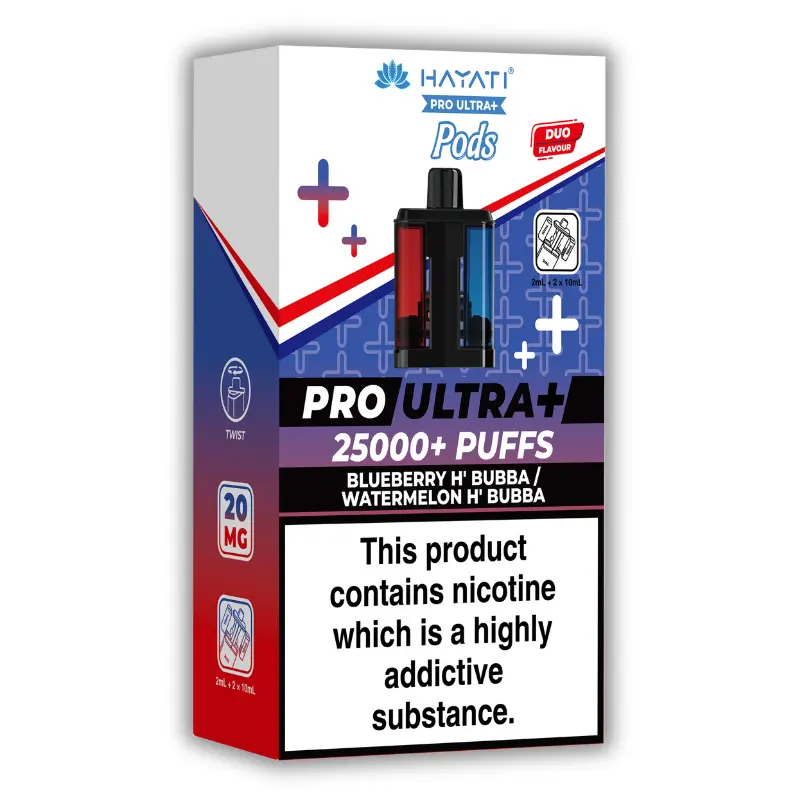
Blueberry H’Bubba / Watermelon H’Bubba is one replacement pod for the Hayati Pro Ultra Plus, £7.99, carrying 22ml of 20mg nicotine salt liquid, sold with no device in the packet. Two fruit bubblegums live inside it, held apart from each other, and a rotating mouthpiece decides which of them reaches the coil. Hayati place an upper bound of 25,000 puffs on the pod, which is a laboratory estimate produced on a draw rig and not a forecast of anybody's month. All 52 listings on the Hayati Pro Ultra Plus Pods shelf carry that identical price, so the ticket is not telling you anything either.
What is worth noticing sits in the title, printed twice. H’Bubba appears on the left of the oblique and again on the right, which is about as plainly as a product name can say that the gum is the fixed term here and the fruit is the variable. That would be unremarkable if H’Bubba were the only word Hayati used for the confection. It is not. The same catalogue has a second marker doing the same job, applied the same way, on the same kind of divided pod, at the same price, a row away. Watermelon B’Gum / Strawberry B’Gum is built to precisely this pattern: one gum word repeated on both sides of the slash, one fruit exchanged for another.
So a buyer looking at the two of them is entitled to ask what the difference between the markers is meant to be, and whether there is one. That question is what this page spends itself on. It is not the question of whether the two halves of a divided pod stay distinguishable from each other, which the Watermelon B’Gum / Strawberry B’Gum pods page has already worked through and answered, and which is not reopened here. It is not the question of what a bubblegum accord is assembled from and what a fruit can get past it, which belongs to our Blueberry B’Gum pages on the Pro Max Plus. The question here is narrower and nobody in this corpus has put it: which fruits get which marker, what appears to decide it, and what a buyer is entitled to read into the choice. The short form of the answer, argued below, is that the marker tracks the hardware rather than the liquid, that one fruit out of three breaks the pattern, and that the fruit which breaks it is the only place in 492 listings where the two markers can be set against each other at all.
The claim this page began with, and what was left of it after counting
This page was commissioned on a specific proposition, and the standing rule here is that a claim of that shape gets checked against the catalogue before anything is built on it. The proposition was that this £7.99 pod is the single listing which puts both of its fruits into their H’Bubba form while both fruits also exist in B’Gum form elsewhere. Three parts of that did not survive.
The first failure is the obvious one and it is the one the house rules warn about loudest. The matching Blueberry H’Bubba / Watermelon H’Bubba complete kit at £11.99 does exactly the same thing with exactly the same two names. One recipe, two SKUs, and the naming claim is a property of the recipe rather than of the packaging. So the count is two listings, not one, and any sentence beginning "the only listing" was wrong before it finished.
The second failure follows from it. Watermelon H’Bubba was said to appear only here. It appears twice, on this pod and on that kit, and nowhere else in the range.
The third is subtler and more interesting. Watermelon B’Gum was said to appear only in the Watermelon B’Gum / Strawberry B’Gum pairing. As a standalone flavour name that is right, and it accounts for two listings, the pod and its kit. But the string also appears inside a compound on three further listings, in the flavour Straw’ Watermelon B’Gum, which is a strawberry and watermelon gum sold as one name on the Pro Ultra Plus pod, on its matching kit, and on a Mini Ultra kit. Five listings carry the letters, two of them mean a watermelon bubblegum on its own.
What survives is narrower than the original and, I think, worth considerably more, because it is a statement about the whole naming system rather than about one listing's bragging rights. Here it is, and everything after this section is built on it. Three fruits in this catalogue are given a gum marker. All three of them are given both markers. Not one fruit in 492 listings carries B’Gum and not H’Bubba, or H’Bubba and not B’Gum. This pod is where two of those three doubled fruits are put behind one collar, and the reason that matters is not rarity. It is that a naming system in which every category is filled offers no evidence at all that the categories mean different things.
Six cells, and every one of them occupied
The gum family has been counted before and there is no sense counting it again from scratch. Our Blueberry B’Gum Pro Max Plus pod page established the family: four separate spellings mean chewing gum in this range, twenty listings out of 492 carry one of them, roughly four in every hundred products. The Strawberry H’Bubba pod page went wider and counted every shortened element in every title, finding nine markers across 77 listings, 35 of them with a literal apostrophe. Those are cited and taken as given. What nobody has done is break the two gum markers down by the fruit attached to them, which takes about ten minutes and produces a grid with no holes in it.
B’Gum appears on seven listings. H’Bubba appears on seven. Set out by fruit, they look like this.
| Fruit | Under B’Gum | Under H’Bubba |
|---|---|---|
| Blueberry | 2 listings, a Pro Max Plus pod and its 6000 kit | 2 listings, this pod and its 25000 kit |
| Watermelon | 2 listings as a standalone name, plus 3 as part of a strawberry and watermelon compound | 2 listings, this pod and its 25000 kit |
| Strawberry | 2 listings, plus the same 3 compound listings | 2 listings, a Pro Max Plus pod and its 6000 kit |
| No fruit named | none | 3 listings, a Pro Ultra Plus pod, its kit and a 10ml bottle |
Six fruit-and-marker combinations are possible from three fruits and two markers. All six exist. There is no fruit that Hayati thought belonged to one marker and not the other, and no marker that reaches a fruit the other does not. If the two words denoted two different confectionery targets, you would expect at least one fruit to suit one target and not the other, because that is how flavour ranges usually behave: a fruit that works against a candy floss base does not necessarily work against a boiled sweet. Nothing like that shows up. The markers cover identical ground.
The bottom row is the one genuine asymmetry the grid throws up, and it cuts the other way. Three of the seven H’Bubba listings name no fruit at all and sell the gum on its own. None of the seven B’Gum listings does. B’Gum always arrives with a fruit bolted to the front of it; H’Bubba is allowed to stand by itself and be the whole flavour. That is a real difference in how the two words are used, though it is a difference in grammar rather than in what is in the bottle, and it fits the reference structure our Blueberry B’Gum kit page set out, where one marker clips a particular branded gum and the other abbreviates the generic category. A name that points at a specific confection can carry a listing alone. A name that only says "this is gum-shaped" needs a fruit to become a product.
Worth saying what the grid does not show, since a table invites over-reading. It does not show that the six cells contain six different liquids, and it does not show that they contain three. Hayati publish no formulation detail for any of them, so nothing in this section is evidence about recipes. It is evidence about naming, which is a different thing, and the rest of the page keeps the two apart.
The marker follows the hardware, not the fruit
Now the part the grid above hides, which only appears once you add the platform column.
Blueberry carries B’Gum on two listings and both of them are Pro Max Plus products, a £5.49 replacement pod and a £7.99 complete kit. Blueberry carries H’Bubba on two listings and both of them are Pro Ultra Plus products, this £7.99 pod and its £11.99 kit. The fruit never meets the two markers on one piece of hardware. Cross the platform boundary and the word changes.
Strawberry does the same thing in reverse, which is the detail that makes it a pattern rather than a coincidence. Strawberry carries H’Bubba on two Pro Max Plus listings, a pod and its kit. Strawberry carries B’Gum on two Pro Ultra Plus listings, the divided pod next to this one and its kit. Blueberry is B’Gum on the small platform and H’Bubba on the large one. Strawberry is H’Bubba on the small platform and B’Gum on the large one. Two fruits, four pairs of listings, perfectly inverted.
Our Blueberry B’Gum kit page found that the apostrophe as a typographical habit is distributed by hardware rather than by meaning, counting all 35 apostrophe titles and noting that the commonest clipping in the catalogue never touches the Pro Max Plus even once in 179 listings. That finding is cited, not rebuilt, and this is its sharper local case. Of those 35 titles, four sit on the Pro Max Plus, and all four are gum. They are the two blueberry listings and the two strawberry listings, which is to say they are the two halves of the mirror. On the one shelf where both markers are present in the flesh, they are kept scrupulously apart, one to each fruit.
This is an inference and it is tagged as one. Nothing Hayati publish says the marker is chosen by platform. What the title data shows is a distribution that would be very odd if the word were reporting a formulation, and entirely ordinary if it were a labelling decision taken per shelf, perhaps by different people, perhaps at different times, perhaps for nothing more than the reason that a Pro Ultra Plus title has to fit two flavour names and a separator into the space a Pro Max Plus title gives to one. Label pressure is a real constraint and the Strawberry H’Bubba page documents it properly. The point here is only that the pattern of use is the pattern you would predict from a naming convention and not the pattern you would predict from two recipes, and a buyer should weight it accordingly.
There is a practical edge on this that has nothing to do with linguistics. If you learned the range on a Pro Max Plus, you learned that the blue gum is called B’Gum and the red one is called H’Bubba. Both halves of that lesson are wrong on the Pro Ultra Plus shelf, where the blue gum is H’Bubba and the red one is B’Gum. A reader who searches for what they remember will not find it, and a reader who finds the other word will reasonably assume it is a different product. It is the same trap the shorthand pages describe, arriving by a route they did not cover.
Watermelon breaks the pattern, and the break is the only test there is
Two of the three fruits behave as described. The third does not, and the exception is more useful than the rule.
Watermelon carries both markers on the same platform. Watermelon H’Bubba is half of this pod and half of its kit, both Pro Ultra Plus. Watermelon B’Gum is half of the neighbouring pod and half of its kit, also Pro Ultra Plus. Same shelf, same £7.99 for the pod and £11.99 for the kit, same 22ml, same 20mg, same 25,000-puff rating, same divided format with a collar, and no cooling word in either title. Set the two pods side by side and the only thing that differs, other than the second fruit in each, is which of the two gum words Hayati printed on the watermelon.
That makes it the one controlled comparison the catalogue offers. Blueberry cannot supply one, because to taste blueberry under both markers you would have to buy a Pro Max Plus as well as a Pro Ultra Plus, and then you are comparing two devices, two pod volumes and two coils rather than two words. Strawberry cannot supply one either, for the same reason in mirror image. Watermelon can, because Hayati happened to put both of its gum versions on one shelf, and as far as the title data shows, they did it without noticing.
So if the question of whether B’Gum and H’Bubba are two accords or one accord under two labels is ever going to be settled by anybody outside Hayati's flavour house, it will be settled on watermelon, and it will cost £15.98 to try, since neither watermelon is sold on its own. You would be buying this pod and the B’Gum pod, and the blueberry and the strawberry would arrive as by-products. On the Watermelon Vapes shelf, which runs to 29 listings, nine carry a gum word of some kind, so a watermelon buyer meeting this family is not in an obscure corner. A blueberry buyer is: of the 90 listings on Blueberry Vapes, four are gum, and all four are the two pairs described above.
Be honest about what that test can and cannot deliver, because it is not clean. Each watermelon sits behind a collar with a different partner, so the coil each one is feeding has recently been carrying either a blueberry gum or a strawberry gum, and the carryover across a switch is real. The Watermelon B’Gum / Strawberry B’Gum page has already set out why the first draws after turning a collar are not a fair reading of the new side, and that mechanism applies here without modification. The comparison is therefore only as good as your discipline about running each pod on its watermelon side for long enough that the other fruit has stopped contributing. What the test can do is rule something in or out at the coarse level: if two watermelons under two markers taste materially different, the markers are doing work. If they do not, you have the strongest evidence available that they are two spellings of one intention.
The three sentences in 492 listings where Hayati relate one marker to another
There is one more source of evidence and it is better than the title data, because it is Hayati writing prose rather than filling in a label. Every listing in this catalogue carries its own description, and a handful of those descriptions point the reader at a different product. Read all 492 and count the ones that cross from one gum marker to another. There are three.
- The Blueberry B’Gum replacement pod, a Pro Max Plus product, recommends the Strawberry H’Bubba pod by name to a reader who likes that style of flavour and wants a darker fruit. A B’Gum listing pointing at an H’Bubba listing, on the explicit basis that they are the same kind of thing with the fruit changed.
- The Hubba Bubba complete kit, which prints the gum brand in full rather than clipping it, tells a reader who wants fruit in the mix that Strawberry H’Bubba is also stocked. The unclipped brand and the clipped one, offered as the plain and fruited versions of one idea.
- The Bubblegum Ice bottle, which spells the generic word out, offers itself to anyone who finds H’Bubba too rich. A third spelling, treating H’Bubba as the reference point for how a plain gum in this range tastes.
Three sentences, and all three of them point at H’Bubba. Not one of the seven H’Bubba listings points outward at a different gum marker. The traffic runs one way. Whatever else is going on, the copy desk treats H’Bubba as the anchor of the family and the other spellings as things that need to be located relative to it, which is consistent with it being the marker that names something specific and the others naming a category.
This needs a correction attached, made carefully, because it contradicts a sibling page and the rule here is to count before repeating a claim and count again before challenging one. Our Blueberry B’Gum Pro Max Plus 6000 kit page states that no B’Gum listing mentions either of the other spellings. That clause is wrong, and the counter-example is the first bullet above: the Blueberry B’Gum pod, the matching replacement pod for that very kit, names Strawberry H’Bubba. The rest of the surrounding passage holds up on checking. The brand's first word really does appear in exactly two descriptions and both are the two listings that already carry it in their titles. No H’Bubba listing really does gloss itself against the unclipped brand. And it remains true, on a strict reading, that no description anywhere says the three spellings refer to the same thing. What three descriptions do instead is recommend across the boundary as though they did, which is weaker evidence than a statement and much stronger than silence.
What that is evidence of, stated precisely. It is evidence about how the copy was written, not proof about what is in the pods. A copywriter recommending Strawberry H’Bubba to a Blueberry B’Gum buyer is telling you that the two are close enough to substitute in the writer's mind. That is a fact about the writer's mental model of the range. It is not a laboratory report, and if the two markers really do point at different flavour houses' interpretations of gum, a copywriter would very likely still cross-recommend them, because at the level a recommendation operates they are both sweet pink confectionery. So the honest weight to put on it is moderate. Combined with the six-cell grid and the platform inversion, though, three independent signals all point the same way, and none points the other.
The reading I would defend, tagged as inference rather than fact: the two markers are a labelling difference with a residual reference difference behind it. H’Bubba gestures at a particular famous chew and can therefore stand alone as a flavour. B’Gum names the category and always needs a fruit. But the catalogue's own behaviour, in where the words are applied and in how its copy cross-recommends, gives a buyer no basis for expecting two distinguishable liquids.
What that means if you already own a Pro Max Plus and liked Blueberry B’Gum
This is where the argument cashes out, and the answer is deliberately unflattering to the listing.
If you have been buying the Blueberry B’Gum Pro Max Plus pod and you are looking at this one because the name looks like a relative, the position is as follows. There is nothing published anywhere in this range that gives you a reason to expect Blueberry H’Bubba to taste different from Blueberry B’Gum. No specification distinguishes them. No description contrasts them. The marker that differs between them is the marker this page has just spent four sections showing is allocated by shelf. Hayati's own copy, on the one occasion it relates the two words at all, relates them as a substitution. If a difference exists, you would be discovering it, not confirming it.
What does reliably change is everything except the flavour name, and it is a substantial list.
- The platform. This is a Pro Ultra Plus pod. It will not go into a Pro Max Plus, and buying it as a refill for a device you already own only works if that device is the right range. Check the range name printed on your device against the range name in this title before ordering.
- The volume. 22ml here against 12ml on the Pro Max Plus pod, which is a different unit of commitment. You are buying nearly twice as much of a flavour you are not certain about.
- The collar, and the second fruit. The Pro Max Plus blueberry is one flavour with no escape from it. This pod has a watermelon gum on the other side of the mouthpiece, available at any moment. For some buyers that is the whole reason to move; for others it is a second flavour they did not want, paid for out of one 22ml budget.
- The price and what it buys. £7.99 against £5.49, for 22ml against 12ml.
- The puff rating. 25,000 against 6,000, both manufacturer figures from laboratory conditions, and neither a promise.
Put those together and the sensible framing is that this is a platform purchase with a familiar-looking name on it, rather than a flavour purchase. If you want to move to the larger hardware and you liked a blueberry gum, this pod is a reasonable landing place and the name is at worst harmless. If you are hoping the different marker signals a reformulated or better-targeted blueberry gum, you are paying £7.99 to test a hypothesis the catalogue does not support.
Confidence, tagged, so the page is not pretending to more than it has:
- Reasonably confident. Both sides are sweet, confectionery-led and built on a gum base, with the fruit as the differentiating term. Hayati say so on this listing and again on the kit, in close agreement.
- Reasonably confident. Neither side carries a coolant. No cooling word appears in the title, and across all twenty gum listings in the catalogue exactly one carries a cooling term, a 10ml bottle. Warmth is the default for this family rather than a decision taken about these two fruits.
- Probable. The watermelon side reads lighter and the blueberry side darker, because both listings for this recipe say so and because that is the ordinary behaviour of those two fruits.
- Unknown. Whether the gum base under Blueberry H’Bubba differs in any perceptible way from the gum base under Blueberry B’Gum. This is the axis the marker appears to promise and it is the one axis nothing published can settle.
- Unknown. Relative sweetness against other sweet pods, since Hayati publish no sweetener figure for anything, and every listing in this corner describes itself as sweet.
If that last unknown is the axis your purchase turns on, the honest advice is that watermelon is the fruit to test it on and not blueberry, for the reason given two sections up.
What the two sides are, on the record and off it
Having spent the page on naming, it would be poor form to leave the liquid undescribed. Two things constrain how much can honestly be said. The chemistry of a gum accord, what it is built from and why it survives being vaporised with unusually little loss, is set out on our Blueberry B’Gum pod page and is not re-derived here. The question of how much two fruits can still differ once a heavy treatment is laid over both of them is worked through on the Watermelon B’Gum / Strawberry B’Gum pods page, which reaches a verdict on it, and that verdict stands rather than being reopened. What is left, and what belongs here, is the record: what Hayati actually assert about these two sides, what they conspicuously do not, and how you would find out the rest yourself.
On the record, across the two listings for this recipe, four things are asserted and both listings assert all four. The gum is the constant and the fruit is what varies. The blueberry side takes the gum towards a soft, dark berry sweetness. The watermelon side takes it lighter and juicier. Both sides are sweet and confectionery in character rather than sharp. The kit listing puts it in very nearly the same words as the pod listing, which our Blueberry B’Gum kit page noted when it compared the four fruit-and-gum flavours that exist as both a pod and a matching kit: this pairing is one of the two where the two descriptions agree, and it attributes the agreement to the architecture of a divided pod, which forces a copywriter to name the shared background before they can explain what the mouthpiece switches between. That is a good reason to treat the agreement as weaker evidence than it looks. Two listings agreeing because the product structure obliged them to is not two independent confirmations.
Off the record, the list is longer. There is no sweetness figure, no indication of how the two sides compare in intensity, nothing about which arrives first across a draw, no statement of whether one side is more heavily flavoured than the other, and no formulation detail of any kind. There is also nothing at all about the relationship between this blueberry gum and the other blueberry gum in the range, which is the gap this page exists to name.
The one negative fact worth stating plainly, because buyers ask it constantly and because an absence is easy to miss, is that no cooling agent is named anywhere on either listing. No ice, no menthol, no frozen or chilled term in the title or the body text. The cooling-vocabulary census run on our Blue Frozen pods page established that the ice family and the mint family never combine in a Hayati title and that the cooling words are not graded against each other, so the absence of any of them here is as close to a clear signal as this catalogue gives. Both sides arrive warm.
Characterising it on your own first pod
Rather than manufacture tasting notes for a liquid, here is a method that works on a divided pod and produces answers you can trust, because it uses the pod against itself.
Run the blueberry side alone for the first day, without touching the collar. What you are building is a reference, and the reference is worthless if it has watermelon in it. On the second day switch to the watermelon side and leave it there. Do not attempt to compare them by alternating: a shared coil and a shared airflow path mean the first several draws after a switch are carrying both, and the impression you form in those draws is an artefact of the switch rather than a reading of the new side.
Once you have both references, three questions are answerable and they are the three that decide whether the pod was worth £7.99 to you. First, can you name the fruit on each side blind, without looking at which way the collar is turned? If you can, the fruits are carrying real information and the pod is two flavours. If you cannot, it is one flavour with a decorative variation and you would have done as well with a single-fruit gum. Second, is the difference in the aroma or in the body of the draw? A difference you can smell on the exhale behaves differently over the life of a pod than a difference you feel as weight or thinness in the mouth. Third, does the gap between the two sides narrow between the first day and the second week? That one takes patience and it is the most informative of the three, because whatever is carrying the difference is the thing a tiring coil will take away first.
If you also own the B’Gum pod, add a fourth. Run its watermelon side for a day and this one's watermelon side for a day, a week apart, with a fresh palate each time and nothing in between. That is the comparison nobody in this corpus has been able to make, and it is the one that would answer the question this page has had to leave open.
The pod, in brief
The hardware discussion on this platform is largely spent and there is no value in a ninth version of it, so this is short. What you receive is one sealed, prefilled pod holding 22ml of liquid at 20mg per millilitre, with the coil built into the pod rather than into the device. There is no device in the packet, no charging accessory, and nothing to assemble. When the pod is finished the coil goes with it, which is the trade the format makes: you never clean or replace a coil, and you never get to keep a good one.
The single specification that matters for this particular liquid is that both reserves feed one coil through one airflow path. That is not a general remark about the format, it is the thing that governs how you should use a gum pod specifically, because a heavily sweetened liquid leaves more residue on a coil than a thin citrus does, and here the residue from one side is the surface the other side arrives across. It also means both halves age on the same clock. There is no scenario in which you preserve the watermelon by only using the blueberry, because the wear belongs to the coil and the coil is shared. Hayati publish that the mouthpiece rotates to select a side and nothing further about the internal arrangement, so nothing further is asserted here.
For the rest of the platform, including what the complete kits contain and how the range is laid out, the Hayati Pro Ultra Plus Prefilled Pod Kits and Pods shelf carries all 104 listings, and the Hayati Prefilled Pods and Refills shelf carries the 201 refill listings across every platform Hayati make.
The published figures, with the unusual ones first
| Marker printed in the title | H’Bubba, twice, once on each side of the oblique |
|---|---|
| Fruits | Blueberry and watermelon, one to each reserve |
| Cooling term in the title or copy | None |
| Liquid volume | 22ml, prefilled, shared between the two sides |
| Nicotine | 20mg per millilitre, the maximum a nicotine-containing pod may carry for sale in the United Kingdom |
| Preparation | Nicotine salt. Hayati's own bottled line is sold as salts and this is the standard preparation for a prefilled pod at this strength, though this listing does not itself specify it |
| Manufacturer puff rating | Up to 25,000, a laboratory estimate for the whole pod across both sides |
| Price | £7.99 |
| Device included | No. A compatible Hayati Pro Ultra Plus is required |
| Shelves it is filed on | Nine, including Blueberry Vapes, Watermelon Vapes and Sweet Vapes |
Two rows deserve a note. The 20mg is a ceiling rather than a choice Hayati made about gum: no nicotine-containing pod sold in this country may exceed it, so every prefilled pod in the range sits at the same figure and the number cannot differentiate anything. If a lower strength is what you want, the prefilled format cannot give it to you and a bottle can.
The puff rating is for the pod, not for a side. A pod divided between two flavours does not produce 25,000 from each reserve, and the figure would be the same if you never turned the collar. It is worth holding on to that when comparing this listing against a single-flavour pod carrying the same number, because the same number is describing a different thing: there, one flavour for the whole rating; here, one rating split between two in whatever proportion you happen to use them.
The filing is worth a line too, because it is the only place the catalogue quietly agrees with this page. All twenty gum listings in the range, every spelling of them, are filed on Sweet Vapes, and there are 61 listings on that shelf in total. Whatever the markers are supposed to mean, the shop treats every product carrying any of them as one thing.
What sits near it, and who should take which
The neighbours divide up by what you were actually after, so they are grouped that way rather than by price.
If you want the same experiment with the other marker
Watermelon B’Gum / Strawberry B’Gum at £7.99 is the pod this page has been measuring itself against throughout. Same shelf, same money, same volume, same structure of one gum word held across two fruits, and the only shared fruit between the two pods is the watermelon. If the marker question interests you as much as the flavour does, this is the second half of the only controlled pair the catalogue contains. If it does not interest you at all, the practical difference is simply that you are choosing a strawberry rather than a blueberry as the second fruit, and strawberry is the more heavily used of the two across the range.
If the confectionery register is right but gum specifically is not
Blueberry Cotton K / Raspberry Cotton K at £7.99 is the same architecture with candy floss in place of gum, and it keeps the blueberry, so it is the closest thing on the shelf to a like-for-like test of the treatment rather than the fruit. Spun sugar is a lighter and less aromatic construction than a gum accord, so the fruit has more room in it, which makes this the better pick if what you liked about the idea was the blueberry and not the sweet-shop framing.
The GB listings are the other confectionery family and they need a caveat before you reach for them. Grape GB / Strawberry GB, Blue Razz GB as a single flavour, and Grape GB / Blue Razz GB all sit at £7.99 on this shelf, and the abbreviation in their names has been examined twice in this corpus with the same result: it is glossed inconsistently across listings, one Hayati description goes out of its way to separate a GB product from the bubblegum elsewhere in the range, and the letters are never expanded in any title. Those pages own that finding and it is cited rather than re-argued. The practical upshot is that GB is not a reliable route to a gum flavour even though some of the copy attached to it mentions one. If the gum register is what you want with certainty, buy a name that says gum. The same abbreviation on the smaller hardware, as Blue Razz GB Pro Max Plus pods at £5.49, carries the identical ambiguity at a lower price.
If the blueberry was the point and the sugar was not
This is the largest group of defectors and the range serves them well. Blueberry Raspberry at £7.99 is the straightforward answer: the same berry with a sharper one beside it and no confection anywhere in the name, which means the acid channel a gum accord leaves empty actually gets used. Blueberry Raspberry Lemon pushes that further by adding a citrus, and is the pick if what you disliked about a gum pod was that nothing ever cut through. Blueberry Raspberry / Blueberry Raspberry Cherry keeps the divided format but makes the two sides differ by an added berry rather than by a fruit swap, which is a smaller step across the collar and a more useful one if you want variation without a change of mood.
Two blue names commit to less than they appear to. Mr Blue names no fruit at all, and Blueberry Raspberry / Mr Blue puts a named blend on one side of the collar and an unnamed one on the other, which is the arrangement that lets you work out what the unnamed one is by comparison. Neither is a gum listing and neither pretends to be.
If the watermelon was the point
Watermelon Fruit Twist at £7.99 is the shelf's watermelon without a confectionery treatment over it, and given how small the watermelon presence is here, at 29 listings across every format Hayati make, the choice is not wide. Nine of those 29 involve a gum of some kind, which is a striking proportion and says something about how the trade tends to use melon: as a light, watery note that sits well under something sweeter. If you want it doing the opposite job, leading rather than supporting, the untreated listings are the place to look.
If what you actually wanted was something sharp
Blue Sour Raspberry at £7.99 is the direct opposite of this pod on the one axis a gum accord cannot occupy, and it stays in the blue family while doing it. It is the listing to take if you came to a confectionery pod hoping for sweet-shop sourness rather than sweet-shop sweetness, which is a confusion the naming makes easy.
If you want cold
Nothing in the gum family will give it to you except a bottle, so the switch has to be to a different family entirely. Fresh Mint / Blue Razz Mint keeps the divided format and puts a cooling term on both sides. Strawberry Ice / Strawberry Raspberry Ice does the same with an ice term instead of a mint one, and the two words are not a grading of each other. On the smaller platform, Blue Frozen at £5.49 is the page that ran the cooling-vocabulary census this page cited earlier.
If £7.99 is more than you want to commit
Blueberry Raspberry Mini Ultra pods at £3.49 are the cheapest way into a blueberry on a smaller device, though they are a different platform and not a refill for anything you may already own. And for something genuinely unlike everything above, Hayati Pro Ultra Plus Shisha 30000 pods at £7.99 sit on this shelf at this price with a completely different reference behind the name. The full range, all 492 listings, is on the Hayati shop page.
Living with a pod that is sugar on both sides
Everything here is aimed at this pod specifically rather than at prefilled pods in general, because general advice is available everywhere and is worth what you pay for it.
The first point concerns the collar and it is the one most people get wrong. If you intend to use both sides, use them in long stretches rather than alternating. Not for any reason to do with the liquid, but because a shared coil carries the last flavour into the next several draws, so frequent switching means a large share of your pod is spent tasting a blend of the two rather than either of them. Half a day on one side is a reasonable minimum. If you find yourself turning the mouthpiece every few draws, you have bought a blend at a premium and you would be better served by a single-flavour pod.
The second concerns residue, and a gum pod is where it matters most. Heavily sweetened liquids leave more behind on a coil than thin, sharp ones do, and what goes first as that builds up is the light aromatic material. On this pod the light aromatic material is precisely what distinguishes the watermelon from the blueberry, because the sweetness and the gum base are common to both. So the two sides can be expected to converge as the pod ages, and the practical advice follows directly: if you want to know whether these are genuinely two flavours, decide it in the first few days rather than in the third week, because the pod will be less informative later.
The third is about pacing. A sweet, dense liquid builds up on the palate faster than a sharp one, and the usual experience is that a gum pod tastes best with gaps in it and flattest during a long unbroken run. If the flavour has gone muted, putting the pod down for an hour will usually tell you whether the pod has changed or you have. Turning the collar will not, because the new side shares the same sweetness load and will taste just as muted.
Keep the pod upright and somewhere that does not get hot. Warmth thins the liquid and a warm sealed pod is the usual cause of liquid where you do not want it, which on a divided pod means the mouthpiece. If you carry a spare, carry it in its wrapper rather than loose, since a bare pod in a pocket picks up lint on the contact face and that is a genuinely annoying way to ruin £7.99. Pods should be stored away from children and animals, like any nicotine product.
When it is finished, do not put it in the household bin. There is a coil and a small amount of residual liquid inside it, which puts it under the electrical waste rules rather than the general rubbish, and most vape retailers and many supermarkets run a take-back point. On a divided pod there is an additional wrinkle worth naming: whatever is left in the side you liked less goes in the bin with the side you liked more, because the two share one 22ml budget and neither is separable from the other. That is an argument for choosing a pairing where you would be happy with either half, and it is the strongest practical argument this page can make for thinking about the second fruit before you buy rather than afterwards.
Questions this listing actually raises
Is Blueberry H’Bubba the same liquid as Blueberry B’Gum?
Nobody outside Hayati can answer that, and this page has spent most of its length explaining why the catalogue gives you no way to work it out. Nothing published distinguishes the two, the marker that differs between them is allocated by platform rather than by recipe, and the one place Hayati's own copy relates the two markers, it relates them as substitutes. Treat them as indistinguishable until something suggests otherwise.
Does the pod contain two pods, or one?
One. It is a single 22ml pod divided into two reserves, and the rotating mouthpiece selects which reserve is feeding the coil. You are not getting two separate pods for £7.99, and the two sides draw on one shared liquid budget.
Is either side cooled?
No cooling agent is named on the title or in the description of either this pod or its matching kit, and no ice, menthol or frozen term appears anywhere on the listing. Across the twenty gum-flavoured listings in the range, exactly one carries a cooling word and it is a 10ml bottle rather than a pod.
Can I use this pod with a Hayati Pro Max Plus?
No. This is a Pro Ultra Plus pod and the two platforms use different pods for different hardware. Match the range name printed on your device to the range name in this title before ordering.
Which side should I start on?
Whichever you expect to prefer, and then stay on it. The reason is not flavour theory, it is that a first impression formed while alternating is contaminated by carryover across the shared coil, so a clean read of either side requires leaving the collar alone for a while.
Why is the same flavour called two different things in this shop?
Because Hayati use four separate spellings for chewing gum across twenty listings and publish no key to any of them. On the Pro Max Plus a blueberry gum is labelled B’Gum and a strawberry gum is labelled H’Bubba. On the Pro Ultra Plus those labels are the other way round. The inference this page draws, tagged as an inference, is that the marker is a shelf-level labelling decision rather than a statement about what is in the pod.
How sweet is it compared with other pods on this shelf?
Hayati publish no sweetener figures for anything, so a precise answer is not available from the listing. What can be said is that both sides are described as confectionery-led and sweet rather than sharp, that no sour or citrus term appears, and that a gum accord is a construction with a high sweetness load by design. If sweetness is the axis you are sensitive to, this pod is at the upper end of the shelf rather than the middle of it.
Is the 25,000 figure per side or for the whole pod?
For the whole pod. It is a manufacturer's laboratory estimate covering the full 22ml, and it does not change depending on how you split your use between the two reserves. A single-flavour pod quoting the same number is describing one flavour across the whole rating, which is not the same offer.
What happens to the liquid in the side I stop using?
It is discarded with the pod. The two reserves share one 22ml budget and there is no way to separate them, so an unloved half is money spent. That is the main reason to consider the second fruit carefully before buying a divided pod rather than treating it as a free extra.
Is there a version of this that comes with a device?
Yes. The Blueberry H’Bubba / Watermelon H’Bubba complete kit at £11.99 is the same pairing with a Pro Ultra Plus device included. This listing is the replacement pod on its own, which is the right purchase only if you already own a compatible device.
Which of the two fruits survives the gum treatment better?
That question has been worked through properly on the Watermelon B’Gum / Strawberry B’Gum pods page, which builds a model of how a strong treatment affects different components of a flavour and reaches a verdict that surprised its own author. It is not re-argued here. What that page found does apply to the watermelon on this pod, since it is the same fruit under the same kind of treatment, and it is the better read on that specific question than anything this page could add.
The short version
Blueberry H’Bubba / Watermelon H’Bubba is a £7.99 replacement pod for the Hayati Pro Ultra Plus holding 22ml of 20mg liquid, divided between two fruit bubblegums, rated by the manufacturer at up to 25,000 puffs as a laboratory estimate, with no device included and no coolant on either side. As a product it is exactly what it looks like: a sweet, confectionery-led pod for somebody who already owns the device and wants two versions of the same idea behind one mouthpiece.
As a listing it is more interesting than that, because it is where the catalogue's two words for bubblegum finally collide. The page began on the claim that this pod uniquely puts both its fruits into their H’Bubba form, and counting cut that down: its own £11.99 kit does the same, so it is a pairing rather than a listing, and the string Watermelon B’Gum turns up in three more places than the claim allowed. The narrowed version is stronger. Three fruits in 492 listings are given a gum marker, all three are given both markers, and the choice between the markers tracks the hardware rather than the liquid, with blueberry and strawberry perfectly inverted across the two platforms. Watermelon is the sole exception, carrying both markers on one shelf at one price, which makes it the only controlled comparison anyone could run. And in three sentences across the whole catalogue, Hayati's own copy crosses from one marker to another, always in the direction of H’Bubba, always as a recommendation rather than a distinction.
So the practical advice for a Pro Max Plus owner who liked Blueberry B’Gum is unglamorous. Buy this because you want the larger platform, the 22ml, and a watermelon gum on the other side of a collar. Do not buy it expecting the different marker to have bought you a different blueberry, because nothing published supports that, and the one fruit that could settle the question is not the one in the name you recognise.
Strictly for adults aged 18 and over. Nicotine is an addictive substance.
You might also like


