
Home / Hayati Pro Max Nic Salts / Rainbow Hayati Pro Max Nic Salt
Hayati · Pro Max
Rainbow Hayati Pro Max Nic Salt
£2.49
✔ In stock — ready to ship
Genuine Hayati
Free over £20
Same-day dispatch
Secure checkout
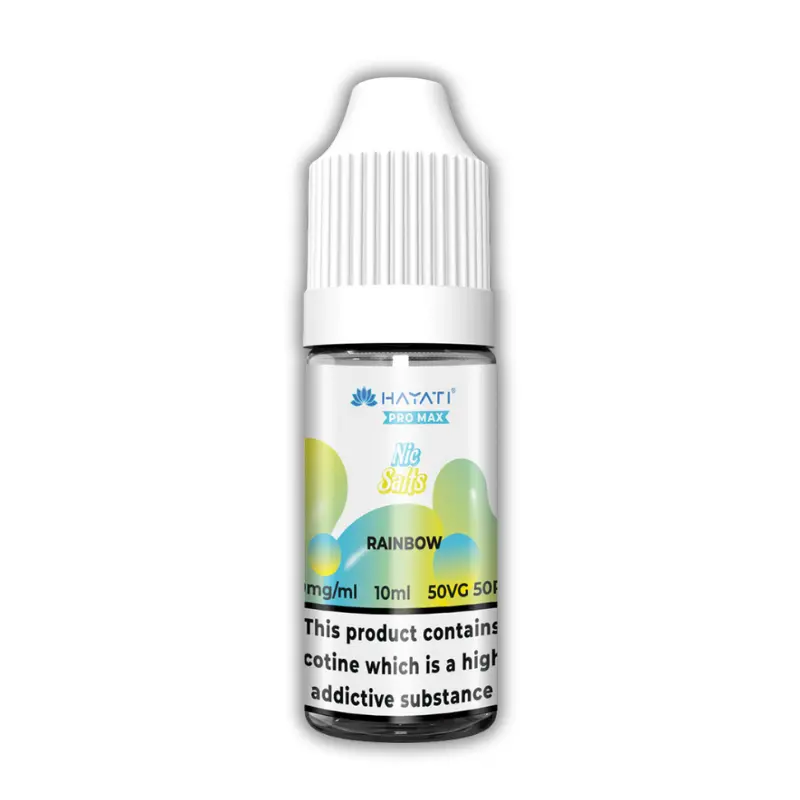
Rainbow Hayati Pro Max Nic Salt is a 10ml bottle of sweet multi-fruit liquid, carrying nicotine at 10mg as a salt, mixed on an even split of the two carrier fluids, and priced at £2.49. Those are the published numbers and they are the same numbers as the sixty-four bottles filed beside it on the Hayati Pro Max Nic Salts shelf. Nothing in that paragraph tells you anything about the liquid, which is the ordinary condition of a bottle page and not the subject of this one.
The subject is a single sentence that Hayati wrote about Rainbow, and did not write here. Rainbow exists three times in this catalogue and nowhere else. This bottle is one. Rainbow Hayati Pro Max 50/50 Shortfill E-Liquid is the second, 120ml at 0mg. The 70/30 bottle of the same name is the third. Line the three descriptions up and they agree almost completely, which is unusual in itself, and then one of them adds a clause the other two do not have. The 120ml even-ratio bottle says that because no fruit takes the lead, the liquid should feel less repetitive across a large bottle than a flavour built on one note would.
That is a claim about time. It says the blend resists something, and the something it resists is the reader getting tired of it. It is the only sentence in the whole Rainbow set that asserts a consequence rather than a character, and it sits on the biggest bottle in the set, where a buyer has the most to lose by being wrong about it. It is also, on inspection, probably built on a mistaken model of how a palate tires. This page tests it, reaches a verdict, says what would overturn the verdict, and then works out what any of that means for the smaller bottle in front of you, which is the one Hayati chose not to make the claim about.
Three descriptions of one liquid, and what the agreements are worth
Hayati write fresh copy for every listing, so a flavour sold three times produces three independent accounts of itself. Comparing them is the nearest thing to a controlled reading of the maker's own intentions that a retailer has access to, and on Rainbow the three accounts line up closely enough that the one disagreement stands out.
What all three assert
Four properties appear in every one of the three. The blend is sweet and sits in the confectionery register rather than the fresh-fruit one. No individual fruit is allowed to lead. There is a small amount of acid, described each time with the same mild vocabulary and never as sour. And the reader who wants this is positioned away from sharp profiles and away from cold ones.
Two of those four are worth something and two are not, and separating them matters before anything gets built on top.
The dominance property is worth something, because it is unusual to state and Hayati mostly do not bother. Some form of the words no single fruit dominating appears in nine of the 492 listings in this catalogue. On a range this size that is a deliberate editorial choice rather than a stock phrase, and all three Rainbow listings make it.
The absence of named fruit is worth a great deal, because it is an absence rather than an assertion and absences are harder to fake. Across three descriptions of one liquid, running to several hundred words in total, Hayati name zero fruits. Not one. They name the colour set, the sweet register and the sensation, and at no point does a lemon or a berry or an apple appear. The bottle's filing agrees: its only flavour-descriptive shelf is Sweet Vapes, with no fruit heading attached anywhere. The Gummy Bear bottle's page has already counted how rare that filing is across the range and there is no point running the count again, but Rainbow belongs to the same small set and for the same reason.
The tang agreement is worth nothing at all, and this is the sort of thing that gets mistaken for evidence. Some form of the word tang appears in 225 of the 492 listings in this catalogue. That is very nearly half the range. A property asserted on half of everything is house vocabulary, not a description, and three Rainbow listings all reaching for it tells you about the copywriter's habits and not about the liquid. Any argument resting on the tang is resting on nothing.
The positioning against sharp and iced profiles is a weaker version of the same problem. It is a negative, it is cheap to write, and it follows automatically from having already said the liquid is sweet. It does confirm there is no coolant, which is useful, and the title confirms it too since Hayati are consistent about declaring cooling in a name when there is any. That consistency was established elsewhere on this site by a full census of the range's cooling words, and it is cited here rather than recounted.
The sentence only one of the three carries
Here is the clause in full, from the 120ml even-ratio bottle: because no single fruit dominates, it is less likely to feel repetitive over the course of a big bottle than a one-note flavour might.
Read it slowly, because it is doing several things. It states a mechanism, which is the absence of a dominant component. It states an outcome, which is reduced repetitiveness. It attaches a timescale, which is the length of a large bottle. And it hedges twice, with less likely and with might, which is the copy of somebody who knows they are on soft ground.
It is the only sentence across the three Rainbow listings with a clock in it. Everything else the three of them say is about what happens inside one draw: what arrives, in what order, how sweet, how acidic. This clause alone makes a claim about what happens across weeks of ownership, which is a completely different kind of statement and a much harder one to support.
The brief that produced this page described it as the only benefit Hayati assert for Rainbow anywhere. That is slightly too strong and it is worth correcting rather than repeating. The tang is also given a job in all three listings, which is to stop the blend reading as flat, and preventing flatness is a benefit. The 70/30 listing adds a fit claim about dense vapour suiting a blend that arrives whole. So the narrowed and accurate version is this: the repetitiveness clause is the only claim in the Rainbow set that concerns duration, the only one attributing an outcome to the number of parts in the recipe, and the only one carried by a single listing rather than all three. Three different kinds of singularity in one sentence is more interesting than a vague claim about it being the only benefit, and unlike the vague version it survives being checked.
How often Hayati make this argument anywhere
Counting it across the full catalogue sharpens the picture considerably, because the result is not what the sentence's confident tone suggests.
The word repetitive appears in two listings out of 492. The phrase over the course appears in one. So the specific wording is close to unique in the range. But wording is not argument, so the better question is how often Hayati anywhere attribute resistance to monotony to the number of components in a blend, whatever words they use.
The answer is twice. Once here. And once on a three-fruit prefilled kit, where the copy says that because three fruits share the space none of them dominates, which suits anybody who tires of single-note flavours quickly. That is the same argument with the same structure. Two instances in 492 listings.
The interesting part is the contrast between the two. The kit names its three fruits and describes what each one contributes, so a reader can at least check the premise: three things are claimed to be present, and they are identified, and their roles are given. Rainbow names nothing. The component count that the entire claim depends on is never disclosed, in any of the three listings, in any form. You are asked to accept that the liquid has enough parts to avoid becoming boring, without being told how many parts there are or what they are.
Widen it once more. Nine listings assert that no single fruit dominates. Only two of those nine go on to draw any consequence from it at all. The other seven state the property and stop, which is the correct handling of a property whose consequences are not obvious. Hayati's normal move when they want to explain why something does not become tiresome is contrast, not count: an acid that cuts the sugar, a cool finish that resets the mouth, a sharper fruit playing against a rounder one. That reasoning runs through dozens of listings on this shelf alone. The count argument runs through two.
A correction to the range structure, because the version handed over did not survive counting
The brief for this page asserted that Rainbow is one of four flavours Hayati make on every bottle format and on no device, the other three being Watermelon Lemon Burst, Vimbull Ice and Blue Razz Gummy Bear. Counted against the catalogue as it stands, that is wrong in both directions, and the corrected figure is more striking than the original.
Hayati sell liquid in bottles in three formats: the 10ml salt bottles, of which there are 65, and two sets of 120ml shortfills, twenty flavours at an even carrier split and the same twenty at the glycerine-weighted split. Everything else in the catalogue is a device or a prefilled pod.
Eighteen flavour names in this catalogue appear only in bottles and never on a device. Of those eighteen, fourteen exist solely as a 10ml salt bottle with no large version at all. Two exist solely as the pair of 120ml shortfills with no 10ml version: those are Watermelon Lemon Burst and Vimbull Ice, which means neither of them is sold on every bottle format, and neither of them is sold with nicotine in it anywhere in the range. And exactly two names occupy all three bottle formats while appearing on no device: Rainbow and Blue Razz Gummy Bear.
Blue Razz Gummy Bear comes with an asterisk that removes it. The same flavour reaches the devices in quantity under the abbreviated spelling GB, on pods and kits across several hardware lines, so its absence from the device catalogue is a fact about a label and not about a liquid. The spelling question there is settled on the Gummy Bear bottle's page and is not reopened here. Rainbow has no abbreviation, no alternative spelling and no device version under any name.
Which leaves the count at one. Rainbow is the only flavour in this catalogue that Hayati make in all three bottle formats and in nothing else whatsoever. It is a liquid that exists exclusively for people who own hardware they fill themselves, and it is the only such liquid the range offers at every size it sells liquid in.
Two consequences follow, and the second is the one that matters for the rest of this page. The first is that there is no prefilled Rainbow to try, so nothing about this flavour can be sampled without owning a refillable device. The second is that of the three Rainbow listings, this 10ml bottle is the only one supplied with nicotine in it. Both 120ml bottles are listed at 0mg, with headroom for a shot the buyer adds. So the one Rainbow Hayati chose not to make the anti-monotony claim about is the only Rainbow that arrives ready to be somebody's daily liquid. Hold that thought, because the test below eventually runs into it.
Does the number of parts change the rate at which a flavour tires you?
That is the whole question, stripped of the copy. Hayati say more parts means slower fatigue. Testing it needs a clear statement of what is already settled, because three other pages on this site have done most of the groundwork and rebuilding any of it here would be waste.
Three findings taken as read
First, the 70/30 Rainbow bottle's page established what happens when a many-part blend is delivered by a liquid rather than by a handful of separate sweets: the parts cannot arrive one at a time, so they arrive together, and what the palate receives is a single composite impression with a character of its own rather than a set of recoverable members. That page works the argument through properly and also flags, in passing, that the repetitiveness claim deserves scepticism. It flags it and moves on. This page picks up exactly there and does the work that sentence gestured at.
Second, the Strawberry Watermelon Bubblegum bottle's page established that a sweet liquid wears on two separate clocks, and that they are genuinely two things rather than one. One is perceptual: the percept itself weakens, quietly, without announcing that it has. The other is hedonic: the percept stays exactly as loud as it ever was and you simply stop wanting it, which announces itself unmistakably. That page also shows that the two failures have opposite economics, because one of them you notice and one of them you keep paying for. All of that is settled and none of it is re-argued.
Third, the Gummy Bear bottle's page established what wear looks like specifically on a blend with no dominant component. On a liquid with a named lead, fatigue shows up as the loss of that lead: the strawberry stops reading and you notice, because you know what should be there. With no lead there is no reference note to lose, so the same decline arrives as a loss of definition instead, the components collapsing into undifferentiated sweetness with no single moment at which anything obviously stopped working.
The question those three leave open
None of them asks whether the number of components changes the rate. The first says what the components add up to. The second says there are two clocks. The third says what the failure looks like on a lead-less blend. Hayati's claim is narrower and more specific than any of them: hold the register constant, hold the sweetness constant, and ask whether five parts fatigue a palate more slowly than one part does.
Answering it properly means putting the best case for Hayati first, because there is one and it is not stupid.
The strongest case for the claim
Sensory adaptation is not one process applied to one signal. It happens at the level of the receptors and the pathways that carry a particular stimulus, and different aroma compounds recruit different populations. Adapting to one compound does not fully adapt you to another. Cross-adaptation between unrelated odours is partial at best, which is well established, and it is why a person who has stopped registering the smell of their own kitchen will still notice a new smell walking into it.
Apply that to a blend. If a liquid contains five distinct aroma structures rather than one, then each is being carried by a partly separate route, and each fatigues on its own schedule rather than all of them dropping together. A single-component liquid puts the entire signal through one channel and adapts that channel hard. A five-component liquid spreads the load. On that model, more parts genuinely should buy you a slower decline, and Hayati's sentence would be not just defensible but correct.
There is a second supporting mechanism worth naming. In a mixture, components suppress one another: the perceived intensity of a blend is less than the sum of its parts, because loud components mask quiet ones. As the loud ones adapt, the quiet ones are released from suppression and become more audible. So a blend under adaptation does not simply go quiet. It can reveal material that was there all along and inaudible, which feels, from the inside, like the liquid changing rather than the liquid fading.
That is the case, put as strongly as it can honestly be put. It is a real mechanism and it is not what Hayati's sentence describes.
Where it fails on the first clock
Both mechanisms above produce drift, not persistence. Neither of them keeps a flavour the same for longer. They change what it turns into on the way down.
That distinction is the whole argument. A one-part liquid under adaptation gets quieter and stays itself. A many-part liquid under adaptation becomes a different balance of itself, because its members fade at unequal rates and the ones that survive are not the ones that led. Both are changes. Hayati's claim is that the second is less repetitive, and the reader who buys on that sentence is not expecting a flavour that shifts. They are expecting a flavour that keeps rewarding attention. Those are different products.
Worse, the drift has a direction, and the direction is not towards variety. The 70/30 Rainbow page worked out, for a different cause, which parts of a many-fruit blend go first and which survive: the light, fast, bright material at the front of a draw is the least defended, and the heavy material underneath is the most. Adaptation has a different cause but the same ordering, because it acts hardest on what is loudest and clearest, and what is loudest and clearest in a confection build is the shared sweetness rather than any of the fruit sitting on top of it. So the blend does not fan out into five recoverable parts as it wears. It converges on the common term. Which is to say it becomes more one-note under adaptation, not less.
And there is a precondition the release-from-suppression mechanism cannot do without. For quieter components to emerge as louder ones fade, the quieter components have to be capable of being perceived separately when they emerge. Hayati rule that out for Rainbow in every listing they have written about it. No fruit is allowed to lead, no fruit is named, and the filing agrees there is no fruit to name. A blend deliberately built so that nothing can be picked out has nothing to reveal when the front of it recedes. The one mechanism that could have supported the claim is closed off by the same design decision the claim is derived from.
That is the tight version of the problem. The sentence argues from lack of dominance to resistance to monotony. But lack of dominance is precisely the condition that prevents the components from being separately perceptible, and separate perceptibility is what the anti-fatigue mechanism runs on. The premise does not support the conclusion. It undermines it.
Where it fails on the second clock
The second clock is easier and the failure is simpler. Getting tired of a flavour across weeks is not sensory adaptation at all. It is a change in what you want, and what you want attaches to the thing you experience.
The thing you experience here is one composite. Not five fruits. The ingredient list is not available to the part of you that decides it has had enough, because the ingredient list is not published, not perceptible, and not, on Hayati's own account, separable. You cannot be separately bored of five things you have never distinguished. You get bored of the one thing you actually taste, on whatever schedule that one thing earns, and the number of items on the recipe sheet behind it is invisible to the process.
Note that Hayati pitched their claim at exactly this clock. Over the course of a big bottle is a timescale of weeks and months. It is not a timescale on which sensory adaptation, which resets within minutes of putting a device down, has anything to say. The one mechanism that could have helped them operates on a clock of seconds and minutes. They attached the claim to the clock where it has no mechanism at all.
The reversal
So far the finding is that the claim is unsupported. It is worse than unsupported, and the third of the cited pages is what makes it worse.
Take the Gummy Bear finding seriously: on a lead-less blend, decline arrives as a loss of definition with no identifiable moment. Now put it next to the Strawberry Watermelon Bubblegum finding: of the two ways a sweet liquid fails, the expensive one is the one you cannot see, because a failure you can see costs you a fortnight off the flavour while a failure you cannot see costs you repeat purchases of something that has stopped delivering.
Component count, in a build where nothing leads, removes the instrument. A named single fruit tells you when it has gone, because you know its name and you notice its absence. An anonymous composite of many parts has nothing whose absence you could name. So the effect of raising the component count is not to slow the decline. It is to make the decline harder to detect.
Which means Hayati's sentence may be describing a real observation and misattributing its cause. People who buy multi-part blends probably do report getting bored of them less often. That is consistent with the blends actually lasting better, and it is equally consistent with their owners being less able to tell when they have stopped working. From the buyer's chair those two feel identical, and only one of them is worth paying for.
The verdict, and the narrower claim that might be true
The claim as written does not survive. Component count does not slow fatigue by any mechanism the liquid makes available, the mechanism that could have supported it is foreclosed by Rainbow's own design, and the direction of the one real effect runs the other way, towards concealment rather than resistance.
But there is a narrower version that probably is true, and it is worth stating because it recommends the bottle to a completely different person.
Averaging many parts produces something less distinctive than any of the parts. That is arithmetic before it is sensory: combine five characters and the result has the features they share and lacks the features that set any one of them apart. And distinctiveness is what hedonic wear acts on. A flavour with a strong identity is one you can get sick of, precisely because there is a specific thing to have had enough of. A flavour with a weak identity sits in the background and does not accumulate against you. The Gummy Bear page reaches the same place from the other end, observing that a flat build which demands nothing is exactly what some people want and that they are badly served by pages treating development as the only measure.
So Rainbow probably does wear slowly over a large bottle. Not because it has five things in it, but because averaging five things produced something without much of a profile, and unremarkable flavours wear out slowly. That is the same prediction Hayati make, from a mechanism that is not a compliment, and it points at a different buyer. Somebody who reads the sentence as a promise of ongoing variety will be disappointed within a fortnight. Somebody who wants a constant sweet background that does not ask for attention will get precisely what was advertised and will keep getting it for a long time.
Four things that would change this verdict
The reasoning above is derived from published copy, from category filing and from how adaptation is understood to work. It is not a tasting report and it should not be read as one. Four things would overturn it, and none of them can be checked from outside.
If Hayati published the recipe and the components turned out to be dosed at deliberately unequal levels, with some sitting near the threshold of identification rather than all being blended flat, then the release-from-suppression route reopens and the claim becomes arguable. Nothing in the range publishes a flavour composition, so this cannot be settled.
If the claim were reattached to the short clock, meaning variation within a session rather than across a bottle, the mechanism would at least be the right one for the timescale, and the argument would become a question of degree rather than of kind. As written it is attached to the long clock and that is a category error, not a small one.
If the three Rainbow listings turned out not to share a concentrate, the diff that this page is built on loses its force, because then the 120ml even-ratio bottle would be making a claim about a liquid that is not this liquid. Hayati never state whether formats of one flavour share a recipe, and the three descriptions agreeing as closely as they do is weak evidence that they do.
And if the composite turns out to have a genuine internal structure that a careful palate can resolve, despite the copy insisting nothing dominates, then the blend is not the flat average this page has assumed and much of the reasoning weakens. That is the most likely of the four to be true, and the only one you can check yourself, which is dealt with below.
What the rest of the shelf claims, and what this bottle claims instead
There is one more count worth running, because it puts the claim in the company of its neighbours and the company is unflattering.
Of the 65 bottles on the Pro Max Nic Salts shelf, five assert in Hayati's own words that their components stay separable, meaning the copy says in some form that the parts can still be told apart in the finished liquid. Three of the five put it beyond argument: one says each fruit stays identifiable rather than blurring into a generic mix, one says that with only two fruits involved both remain easy to pick out from the first draw to the last, and one says each berry plays a distinct role. Two more say it in softer terms, that each fruit gets its moment or that both linger together at the end. Every one of the five names its fruits, which is the part that matters. Strawberry Cherry Cranberry is the clearest, with the cranberry given the explicit job of keeping the other two honest. Blackberry Raspberry makes the point structurally, arguing that a two-fruit blend is small enough for both halves to stay legible throughout.
Separability is the condition under which component count could buy a buyer something. If the parts stay apart, there is a case that the palate has more to work with over time, and those five listings are at least arguing from a premise that matches the conclusion. They do not draw the anti-fatigue conclusion, incidentally. They state the property and let the reader decide what it is worth, which is the restrained handling.
Rainbow states the opposite premise and draws the conclusion anyway. It is the listing on this shelf least entitled to the argument, and it is the only bottle on the shelf making it.
The comparison that sharpens it most is Blueberry Cherry Cranberry, which is a three-part blend where Hayati identify what each part does and name the tart component as the thing keeping the mix from turning syrupy. That is a contrast argument: the blend holds up because one part opposes the others, not because there are three of them. Double Apple runs the same logic with two treatments of one fruit, a ripe side and a crisp side, where the point is explicitly that neither takes over and the liquid therefore avoids feeling one-dimensional. White Peach Raspberry does it with two: a soft stone fruit and a bright berry cutting across it, with the copy saying in terms that the berry is what keeps the peach from going flat through a full pod.
Three listings, three different fruit counts, one consistent mechanism, and it is opposition rather than number in every case. Hayati know how to argue this and they argue it well. They just did not argue it for Rainbow, because Rainbow has nothing to oppose anything with, and so they reached for the count instead.
What follows for the 10ml bottle you are actually looking at
Everything above is about a claim printed on a different bottle. The practical question is what a buyer of this one should take from it, and there are four things.
The first is that Hayati's silence here is appropriate and should be read as such rather than as an omission. The claim is pitched at the course of a big bottle. This bottle is 10ml. The other is 120ml. A twelvefold difference in volume is a twelvefold difference in how long the liquid is in your life, and a claim about slow wear across months has very little to say about a bottle that will be gone in days or a week or two depending on your hardware. Withholding it here is correct. If the claim appeared on both, the copy would be less careful than it is.
The second is a consequence of that, and it cuts against the first. The clock that matters is not the life of a bottle. It is the life of a flavour in your rotation, and that runs across however many bottles of it you buy. A flavour you reorder four times has been in your mouth for as long as a large bottle would have kept it there. So the fatigue question is not irrelevant to a 10ml buyer. It is simply deferred, and it becomes live at the third or fourth reorder rather than in week three of one purchase.
The third is the awkward one. Of the three Rainbow listings, only this one arrives with nicotine in it. Both 120ml bottles are supplied at 0mg. Whatever else is true, this is the Rainbow that can be somebody's ordinary everyday liquid without anything being added to it, and everyday use is the condition under which wear actually happens. The anti-fatigue claim is attached to the bottle where the question is least urgent and withheld from the bottle where it is most.
The fourth is the useful one, and it follows from the verdict rather than from the numbers. If you want to know whether Rainbow wears, this format is the only one in which you can find out cleanly, and the reason has nothing to do with size. A 10ml bottle lets you fit a fresh coil and run the same liquid on it, which separates the liquid's decline from the hardware's. That argument belongs to the plain bottle's page and is cited rather than restated. What this page adds is what to measure once you have the clean setup, and the answer is not what most people would measure.
Do not try to check whether you can still taste the individual fruits. You never could, that was never on offer, and setting yourself that test guarantees a false positive for decline. Check instead whether the composite still registers as anything at all. The Gummy Bear finding says that on a lead-less build the failure is quiet, so you will not be handed a moment. You have to manufacture one, and the cheapest way is to keep a structurally opposite bottle in rotation and draw on it deliberately once a week. Spearmint is the obvious partner, since Hayati describe it as something that resets the mouth between fruitier bottles and it costs the same £2.49 as everything else on the shelf. Black Mint does the same job with more weight behind it. Blue Sour Raspberry does it with acid rather than cold, which is the sharper instrument of the two because acid measures sweetness directly.
The reading works like this. Draw on the contrast bottle, then immediately on the Rainbow. If the Rainbow still arrives as something with a shape to it, the liquid is fine and you are fine. If it arrives as sugar with a fruit shadow behind it, you have your answer, and you got it weeks before you would have got it by waiting for the flavour to announce its own decline, which on this construction it will not do.
The numbers Hayati publish, and the ones they do not
This is a bottle of liquid. There is no device in the box, no coil, no charging, no parts and nothing that wears out except the liquid itself and whatever hardware you put it in. The table below is ordered by how much each line actually decides, which puts the price near the bottom where it belongs on a shelf where every bottle costs the same.
| What the name denotes | A multi-fruit sweet blend with no fruits specified, in the confectionery register |
| Number of components | Not published, in this listing or in either of the other two Rainbow listings |
| Which components | Not published, and no fruit shelf is attached to the product |
| Cooling | None declared, and no cooling word in the title |
| Acid level | Described as small, and never as sour or sharp |
| Nicotine | 10mg per millilitre, as a salt. Nicotine is addictive |
| Carrier split | Even, 50 vegetable glycerine to 50 propylene glycol |
| Volume | 10ml |
| Price | £2.49 |
| Stock code | HPM-NS-RAINBOW |
| Hardware Hayati specify | Refillable pod kits and other devices run at low power with a restricted draw |
| Shelves | Hayati Pro Max Nic Salts, Hayati E-Liquids, Sweet Vapes, New Products |
| Other formats of this flavour | Two 120ml shortfills at 0mg, one at each carrier split |
| Coil resistance | Not published, and it is a property of your hardware rather than of this bottle |
The top three rows are the ones carrying weight, and all three of them are the same row in different clothes: the flavour is unspecified and the listing says so by saying nothing. That is not a criticism of the listing. A maker who declines to name fruits they have not built a legible version of is being more honest than one who lists five and delivers an average. It does mean the buyer's information is thinner here than on a named bottle, and it means the anti-fatigue claim on the large bottle is asking for trust on a premise it withholds.
The strength row states the figure and nothing more. This page offers no view on what strength anybody should use and makes no comparison between strengths.
The carrier row is worth one sentence of interpretation rather than a section, because the shelf makes it uninformative. Every bottle here is split evenly, so the ratio decides nothing about which bottle you pick. What it decides is that the liquid is thin enough for a small wick to keep up with, which matters for a sweet liquid specifically, because a thin base carries a heavy sweetener load onto hot metal quickly and that is a mixed blessing rather than a plain advantage.
The last row is there because it is the one people expect to find and it is not available. Coil resistance is set by whatever you screw into your own device, and no bottle can tell you it.
Where it sits among its neighbours
Rainbow's real competition is not the fruit bottles it shares a shelf with. It is the other liquids built as confections, and the choice between them is mostly a choice about how much identity you want the sweetness to have.
The other anonymous builds
The Gummy Bear bottle is the closest relative in the range and the comparison is already drawn on the 70/30 Rainbow page, which observed that the two approach the same information gap from opposite ends: one names the sweet and leaves the fruit open, the other names the assortment and leaves the sweet open. That framing is not re-derived here. What is worth adding is that the two bottles are the range's two purest cases of a blend with no component allowed to lead, which makes them the two most exposed to everything argued above about quiet decline. If you are choosing between them you are choosing a texture, and if you want either of them to last you will need the contrast bottle either way.
Blue Razz Gummy Bear is the version of the same idea with a named lead bolted on, and it is the single most useful bottle to put beside this one. Same shelf, same price, same size, same strength, same base, same confectionery register. The only difference is that a specific fruit has been given the front of the draw. That makes it the natural control for the argument on this page: if you run both and find the Blue Razz one announces its own decline while the Rainbow slides quietly, the reasoning above has been demonstrated on your own hardware. It is also, structurally, the only other flavour name in the catalogue sold in all three bottle formats, although as noted it reaches the devices under an abbreviation.
The named single slots
Strawberry GB and Grape GB are each one fruit inside the same sweet-shop treatment, which is close to buying a single colour out of the set on its own. Both are relevant to this page for a specific reason: they are the cheapest way to find out whether a confectionery build without any opposition suits you at all, before you commit to one where you also cannot tell what is in it. Grape in particular is heavy and purple and finishes on soft gum, and heavy purple material is exactly what a fading multi-fruit blend tends to leave standing.
H’Bubba takes the gum accord on its own with no fruit attached, which makes it the most single-minded sweet bottle on the shelf. Bubblegum Ice is the same register with a coolant over it, and the coolant does the job that Rainbow's tang is asked to do and cannot: it provides a genuine second sensation, on a different channel, that does not adapt at the same rate as the sweetness.
If you want the fruit to stay visible
Triple Mango is the useful opposite case. Three treatments of one fruit, nothing competing, and Hayati say plainly that the flavour therefore holds steady from first draw to last. It is the shelf's clearest example of the design Rainbow is defined against, and it is the bottle to pick if the argument above has convinced you that an average is not what you want.
Blue Razz Mojito layers a cool thread under a sweet berry, which is two channels rather than one and therefore a slower-wearing construction for reasons that have nothing to do with how many fruits are listed. Berry Lemonade is a drink build rather than a confection, which spreads the same berry material into a thinner, brighter shape and is a useful thing to taste if you want to understand what the candied body in Rainbow is actually contributing. Cherry Berry is worth naming here because it is the one bottle on the shelf whose copy explicitly promises freshness through a whole pod without fatigue setting in, and it attributes that to a tang, not to a count. It is Hayati arguing the mechanism this page thinks is the right one.
If it turns out you wanted something colder or sharper
Cherry Ice is one fruit done plainly with a cool finish that lifts rather than buries it. Banana Ice is a mellow single fruit with a coolant over the top, which is about as far as you can get from an anonymous multi-part blend while staying on the same shelf at the same money.
The other opaque titles
Black Mamba and Blue Fusion are the other bottles whose names withhold the fruit, and they are instructive because they withhold less than Rainbow does. Black Mamba at least tells you the berries are dark and that something cold arrives late. Blue Fusion narrows the field to one colour family. Rainbow narrows nothing, which is why the count in the earlier section matters: it is the only listing here where the name, the description and the shelf filing all decline to identify a fruit, and the anti-fatigue claim on its large sibling is asking you to trust a component count under exactly those conditions.
The full Hayati E-Liquids heading holds 105 listings and mixes the 10ml bottles in with both shortfill ratios, so it is a poor place to browse if the format is what you are deciding. The complete Hayati range runs to 492 listings, of which three are Rainbow.
Running a bottle whose failure is quiet
Most handling advice on a bottle page is the same advice, so this section covers only the parts that change because of what this liquid is.
Start with the coil, because the usual instruction about letting a new one soak matters more here and for a specific reason. A confection build carries a heavy sweetener load, and a dry or half-wetted wick concentrates that load against hot metal in the first few draws. On a named fruit you would notice the resulting harshness and back off. On an anonymous composite you have nothing to compare against, so the damage is done before you have any evidence it is happening. Give a new coil several minutes wet and take the first three or four draws gently. That is not a general rule dressed up. It is the consequence of buying a liquid with no reference note in it.
The second point is the one worth reading properly, because it is the practical form of the whole argument above. You have no decline signal. A citrus liquid tells you a coil is finished by losing its zest and a cooled one tells you by losing its chill. This liquid has neither instrument, so a tiring coil produces a general thinning that is indistinguishable from your own adaptation, and a tiring you produces a general thinning that is indistinguishable from the coil. Two silent failures with the same symptom is a bad position to be in, and it is worth arranging the equipment so it does not arise.
The arrangement is cheap. Write the date on the coil, not on the bottle. Keep the contrast bottle mentioned earlier. When the Rainbow reads thin, change the coil first and draw again before changing anything else. If the liquid comes back, it was the coil. If it does not, it is you, and the answer is a fortnight on something else rather than a new bottle. Most people run this diagnosis the wrong way round and buy a replacement liquid to solve a hardware problem, which on a shelf of sixty-five bottles at the same price is an easy mistake to keep making.
On sweetener and coil life, the honest position is that this liquid is harder work than a plain fruit and easier work than a liquid with a declared gum accord in it, and no page can give you a figure because it depends entirely on the power your device runs at. What can be said is that the residue does not build up evenly in its effects. It buries light material before heavy material, so what a gunked coil takes from Rainbow first is whatever brightness the blend had at the front of the draw, leaving the sweet body intact and the liquid still tasting of something. Still tasting of something is the trap. It is the condition in which people carry on for weeks.
Storage is short. Light and warmth degrade flavour compounds and a 10ml bottle in a pocket gets warm, so a drawer is better than a windowsill and a bag is better than a dashboard. The cap wants to be properly seated rather than resting, because a partly open bottle loses its lightest material first and that is the same material the coil takes first, so the two losses stack and the liquid ages towards the same flat sweetness from both directions. Keep it out of reach of children and pets, as with anything else containing nicotine.
A last note on part-used bottles. Ten millilitres of anything is a small enough quantity that people hang on to the last two or three, and a confection blend is the worst candidate for that habit, because the thing it loses in storage is exactly the thing it has least of. A six-month-old Rainbow with a centimetre left in it is not the liquid you bought, and it will read as a disappointing flavour rather than as an old bottle, which is an unfair result for the flavour.
Questions this bottle tends to raise
Which fruits are actually in it?
Hayati do not say, in this listing or in either of the two 120ml bottles of the same flavour. Between them the three descriptions name zero individual fruits. The product also carries no fruit shelf in the shop's own filing, only Sweet Vapes, which suggests whoever categorised it could not assign one either. Anybody stating a specific fruit list has it from somewhere other than Hayati.
Is there any menthol or ice in it?
No. There is no cooling word in the title and none of the three descriptions mentions a coolant. Hayati are consistent about naming cooling in a product title when it is present, which was established across the range by a census of their cooling vocabulary. If you want the sweet register with cold on it, Bubblegum Ice and Cherry Ice are on the same shelf.
Hayati say the blend is less likely to get repetitive. Is that true?
They say it on the 120ml even-ratio bottle and not on this one. The argument is that having no dominant fruit makes the liquid wear more slowly, and this page concludes that the mechanism does not work as stated: what a palate adapts to is the single impression the blend produces, not the ingredient list behind it. A narrower version is probably true, which is that averaging several parts makes something with little profile, and things without much profile do wear slowly.
So will I get bored of it or not?
Probably more slowly than of a strongly characterised flavour, and for a reason that is not flattering. What you should expect is not ongoing variety but a steady, undemanding sweetness. If you want a liquid that keeps rewarding attention, this construction cannot supply it and Triple Mango or a named blend will serve you better.
How will I know when the coil has gone rather than my palate?
You will not, from this liquid alone, which is the main practical finding on this page. There is no named note whose absence would tell you. Keep a sharper or cooler bottle in rotation, draw on it and then on this one, and change the coil before you change the liquid. Spearmint and Blue Sour Raspberry both work as the reference.
How does this compare to the 120ml Rainbow bottles?
Same flavour name, and the three descriptions agree closely enough to suggest a shared recipe, although Hayati never state that for any flavour sold in more than one format. The practical differences are size, strength and carrier split. Both 120ml bottles are supplied at 0mg with room for a shot, and this 10ml is the only Rainbow that arrives with nicotine in it.
Is Rainbow sold as a prefilled pod anywhere in the range?
No. It is the only flavour in this catalogue sold in all three bottle formats and on no device at all, which makes it a liquid exclusively for people who fill their own hardware. There is no way to try it without a refillable device.
What hardware does it want?
Hayati specify refillable pod kits and other low-power devices with a restricted draw, which is the standard placement for a 10ml bottle at this carrier split. Check the fitment guidance for your own device rather than taking a compatibility decision from a retail page, this one included.
Is it sweeter than the gum-flavoured bottles?
Differently sweet rather than more so. A gum accord has a distinctive top to it that announces itself, where this one is broader and flatter with nothing sticking out. People who find H’Bubba or Strawberry GB too insistent often get on better with this, and people who find this vague often get on better with those.
How much acid is in it?
A small amount, on Hayati's account, and described in the same mild terms across all three listings. It is not a sour liquid and it should not be bought as one. Blue Sour Raspberry is the shelf's declared sour bottle if that is what you want, and Strawberry Cherry Cranberry carries real tartness inside a fruit blend.
Why does the page spend so long on a sentence printed on a different bottle?
Because it is the only claim Hayati make about what this liquid does for you over time, and because a buyer of the 10ml will read it while comparing formats and reasonably assume it applies here. Testing it is more useful than describing a blend whose contents are not published.
What is the strength and the size?
10ml at 10mg per millilitre, as a nicotine salt, on an even split of the two carrier fluids, at £2.49. Nicotine is addictive.
Where this leaves it
Rainbow is a sweet, unspecified, multi-part confection liquid with no cooling and very little acid, sold in a 10ml bottle at 10mg for £2.49 alongside sixty-four other bottles at the same price and on the same base. It is the only flavour Hayati sell in all three bottle formats and in no device, and this bottle is the only one of the three that arrives carrying nicotine.
The claim that brought this page into being turns out not to hold in the form it was written. Having many parts does not slow the rate at which a liquid tires you, because what tires you is the single impression the parts add up to, and the number behind that impression is invisible to the process. The one mechanism that could have supported the claim needs the components to be separately perceptible, which is precisely what Rainbow's design rules out. What component count does achieve, on a build where nothing leads, is to remove the signal that would tell you the liquid had declined, and a decline you cannot see is the more expensive of the two failures.
There is a narrower claim underneath that probably is true and sells the bottle to a different person. An average of many things has less character than any of them, and flavours with little character wear slowly. If a constant, undemanding sweetness in the background is what you want, Rainbow delivers it and will keep delivering it for a long time. If you wanted variety in the sense of a liquid that keeps giving you something new, a blend is the wrong place to look for it and a second bottle is the right one.
Strictly for adults aged 18 and over. Nicotine is an addictive substance.
You might also like


