
Home / Hayati Nicotine Pouches / Strawberry Lychee Hayati Nicotine Pouches
Hayati
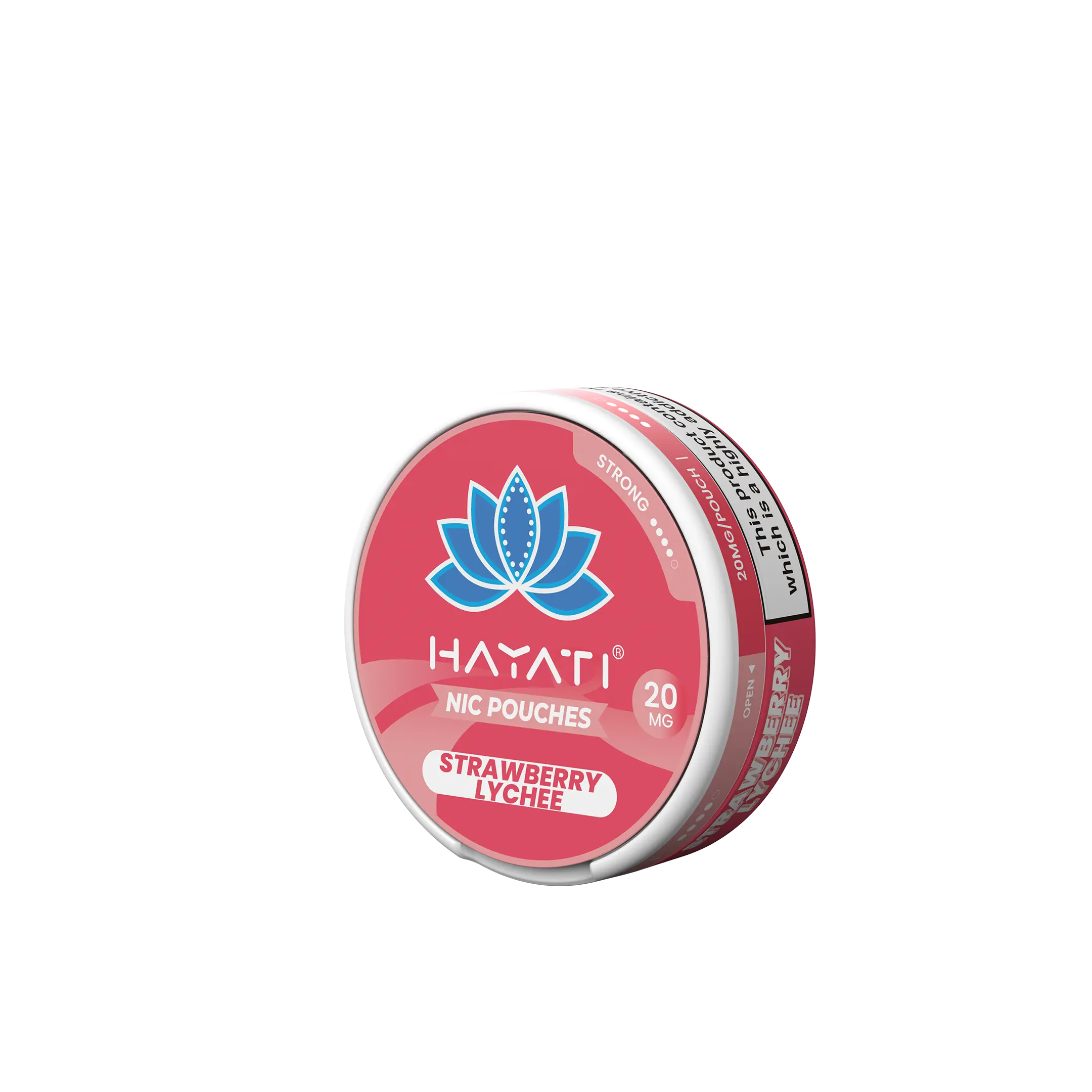
Strawberry Lychee Hayati Nicotine Pouches
£4.49
✔ In stock — ready to ship
Genuine Hayati
Free over £20
Same-day dispatch
Secure checkout
Strawberry Lychee is one of eleven cans on Hayati's pouch shelf, priced at £4.49, listed at 12mg, and containing no tobacco. A pouch is a small white sachet, roughly fingertip sized, holding flavouring and nicotine in a fibre carrier behind a wrapper that stays intact in the mouth. It goes up at the front, tucked in the gap between the upper lip and the gum, and then it stays where you put it. Nothing here is powered, filled, charged or lit. Nothing travels to the lungs. When you have finished, the pouch comes out in one piece and goes in a bin.
All eleven cans work that way, so the format is not what makes this listing worth an argument rather than a description. The second fruit in the name is. Two pages on this site have already established what an oral format does to a flavour, and their joint finding is that a pouch is a very good delivery route for anything the mouth can report and a poor one for anything the nose has to read. Fruit identity lives almost entirely on the nose side. Every fruit can on this shelf therefore starts at a disadvantage.
Lychee starts at the worst one available. Across a catalogue of 492 listings it is the fruit whose character is most completely aromatic and least propped up by anything else. There is no acid in it worth naming, no body, no bitterness, nothing at all that the tongue could report unaided except sugar. Remove the aroma from a strawberry and you still have a sweet, faintly tart red thing on your tongue. Remove it from a lychee and you have sweetened water. Hayati have taken the one fruit in the range with nothing underneath it and put it into the one format that removes what sits on top.
That reads as a complaint and it is not meant as one. It is the sharpest test of the earlier argument that this shelf is ever going to offer, and it is a real test because it can come out either way. If lychee is recognisable in a pouch, then the aroma route survives better than those pages concluded, and a model that predicted otherwise needs loosening in public. If it is not recognisable, the model holds on the hardest case anyone could set it. Either result is worth having. What follows sets out the format briefly, credits the arguments this page is standing on, explains why lychee is the extreme case and why it is also the one format in which lychee cannot possibly go soapy, works out what the strawberry is doing and why it should lead more than the name suggests, describes what twenty minutes does to a floral note in particular, states my prediction with its confidence marked, and ends with a test you can run for the price of one can.
The format, kept short because it is not the interesting part
A nicotine pouch contains no tobacco leaf, stem or dust, which Hayati state for this product directly, and the fibre inside is a carrier rather than a plant with a flavour of its own. One pouch goes between the lip and the gum at the front of the mouth. Saliva wets the fibre, the soluble contents begin to come out of it, and what dissolves spreads across the surfaces it touches. That process runs the whole time the pouch is in position and tails off as the contents are used up. The pouch is not chewed and it is not swallowed. Nothing is heated at any stage, no smoke or vapour is produced, and there is no inhaling involved.
Because there is no hardware, almost the entire practical vocabulary of this site is irrelevant on this page. No priming, no wicking, no coil, no airflow, no charging, no resistance to match and no compatibility question to answer. That is why the format section you are reading is four paragraphs rather than the eight hundred words a pod listing needs, and why the rest of the page is about the liquid contents rather than the container.
The strength is 12mg and it is not a choice. Every pouch Hayati sell carries that figure and nothing else in the 492-product catalogue does, so within this shelf you are picking a flavour and nothing else. The number is quoted flat, with nothing said about what it is measured against, and this page will not supply a denominator Hayati did not print. Nicotine is addictive, which is a property of the substance and not a claim about the product.
What the listing does not publish is longer than what it does: no count of pouches in the can, no weight per pouch, no intended wear time, no ingredient list, no moisture description, and no statement of pouch size. Those gaps have consequences further down, the missing count most of all, because it removes any possibility of working out what one pouch costs. Where a figure would help and is not on the record, this page says so rather than borrowing one from how the format behaves elsewhere.
Whose argument this is, and exactly what it claims
Two pouch pages came before this one and between them they built the mechanism that the rest of this page uses. Neither is re-derived here, because a mechanism explained twice on one site is a mechanism explained badly.
The Mango Ice Hayati Nicotine Pouches page owns the route argument. Its finding, in one sentence, is that a vape moves aroma by evaporating it into an aerosol and then pushing that aerosol past the olfactory receptors on the exhale, giving a fast, dense, concentrated burst read from behind the palate, while a pouch has no heat, no carrier gas and no exhale, and so can only leak a thin, slow, passive trickle of aroma upward while delivering the basic tastes perfectly well by dissolution. It also works out the consequences: a pouch flavour is simpler, arrives later, has no bright opening, and cannot deliver a top note at all. That page reaches its conclusion through mango, whose identity sits in a heavy, poorly water-soluble compound family, and it is careful to tag its own inferences as inferences.
The Frosted Mint Hayati Nicotine Pouches page owns two further things. The first is the cooling exception: a coolant works by binding a receptor in tissue the pouch is pressed against, so it needs no carrier and no airflow, which makes cooling the one property an oral format arguably delivers better than a pod rather than merely as well. The second is the adaptation curve, which matters here even though this product has no cooling in it. Continuous stimulation of a sensory channel reduces the size of the sensation that channel reports, a pouch delivers continuously rather than in pulses, and so a whole adaptation curve that a vaper meets over weeks gets compressed into one sitting, with recovery slower than onset, so the second and third pouch of a day start from a reduced baseline.
The Frosted Mint page also contributes the formulation this page leans on hardest, which is that when you weaken the route the aroma molecules travel by, you do not get a quieter version of the same fruit. The identity is the first casualty, not the intensity. What is left is sweetness, a bit of acid, and a hint of something that could be several fruits.
Take all of that as given. What neither of those pages had to face is a fruit with no taste-side signature whatsoever. Mango at least has a recognisable register and a great deal of sugar. Mint has two components out of three that do not need the nose. Coffee, which the mint page flags as the most exposed flavour on the shelf, has bitterness holding it up. Lychee has nothing. That is the gap this page is for.
Why lychee is the extreme case, and the count that supports it
Three listings in 492 name lychee. Two of them are the vape pair, the Lychee Ice Hayati Pro Max Plus 6000 Pod Kit at £7.99 and the Lychee Ice Hayati Pro Max Plus Pods at £5.49, and the third is this can. So lychee is not a house flavour that turns up everywhere, it is a rarity, and the one place Hayati have taken it outside the vape range is the format least suited to carrying it. That is the fact the rest of this section is about.
What the kit page established, which is not repeated here
The Lychee Ice Hayati Pro Max Plus 6000 Pod Kit page did the chemistry properly and its findings stand. Lychee's aroma is carried largely by rose-family aromatics, the same class of molecule at the centre of rose oil, Turkish delight and muscat grapes, and a nose cannot tell a molecule in a fruit from the identical molecule in a bottle on a bathroom shelf. What does the telling is the company the molecule keeps. Wrapped in a large sugar load and a soft watery flesh, the aroma gets filed as food. Strip the sugar away and the identical aroma gets filed as fragrance instead, which is the whole explanation for every complaint anyone has made about a lychee liquid tasting of soap. That page also records the structural facts: lychee has almost no acidity, which is unusual for a fruit, and almost no body either, no fat, no starch, nothing creamy. Its floor is made of sugar, which works right up until something suppresses sweetness. And it notes that people split three ways on the opening, hearing rose, or white grape and muscat, or a very ripe pear with the grain and the acid taken out, with the ones who hear rose first being the ones at risk.
The matching pods page carried one conclusion forward: because the identity and the perfume hazard are carried by the same molecules, losing them removes both in a single movement, which is why that pod arguably improves into its run for a floral-wary vaper and declines for everyone else.
All of that is theirs and none of it needs redoing. What it gives this page is a fruit already taken apart into its parts, which makes it unusually easy to predict what an oral format will do to it.
Subtract the aroma and check the residue
Run the two earlier pouch findings against those two lychee findings and the result falls out almost mechanically.
The pouch weakens the aroma channel and serves the taste channels fully. Lychee's identity is entirely in the aroma channel. Lychee's taste-side contribution is sugar and water. Therefore what a lychee pouch can deliver, on this reasoning, is sugar, plus whatever fraction of the aromatics manages to seep upward over twenty minutes without a carrier to move them.
The important word in that is residue, and it is the part the earlier pages did not need. Every flavour on this shelf loses its volatile fraction. What distinguishes one from another afterwards is not how much it lost but what it has left, and whether what it has left is different from what the other ten have left. Sugar is not a distinguishing residue. All eleven cans are sweet. A lychee pouch stripped of its aromatics does not merely become a weak lychee, it becomes indistinguishable in principle from any other sweet thing in the range, because the only surviving component is the one component every can shares.
Compare that with a fruit that keeps something. Acid survives dissolution intact, so a blend carrying real acid keeps a structural fingerprint the tongue can read on its own. Bitterness survives for the same reason. Astringency survives. A trigeminal effect survives, which is the mint page's whole argument. Even a heavy, sweet, low-register fruit keeps a recognisable weight to it. Lychee keeps sugar, and only sugar, and sugar is the one thing on this shelf that carries no information.
The mint page ranked coffee as the most exposed, and I would change the axis rather than the answer
The Frosted Mint page surveyed the shelf and nominated the Coffee pouch as the most exposed of the eleven, on the grounds that roast coffee is almost entirely an aroma phenomenon with bitterness underneath it, and bitterness without the aroma is not coffee. It did not consider this can, which is one of the two on the shelf it does not name. The brief for this site says to count a rarity claim before repeating it and to count it before contradicting it, so here is the check.
On its own axis the mint page is right. If the question is what proportion of a flavour's information is carried by volatiles, coffee scores very high, probably higher than lychee, because a roast profile has hundreds of aroma-active compounds doing fine-grained work and lychee's signature is comparatively narrow.
But that axis measures the size of the loss, not the state you are left in, and the state you are left in is what a buyer is actually choosing between. On the residue test, coffee is in much better shape than its aroma dependence suggests, and I do not have to argue that, because the Coffee Hayati Nicotine Pouches page has since been written and argues it at length. Its findings are that bitterness is a basic taste delivered by dissolution, that the format serves it fully, that a bitter signal is slow to build and slow to clear and therefore suits a twenty minute contact better than a two second exhale, and that bitterness is effectively unique in this catalogue, with nine descriptions in 492 mentioning it and only that one presenting it as a property of the flavour rather than as an edge on a fruit. That page accepts the mint page's ranking on aroma dependence and simply points out what is left standing afterwards.
Which is the distinction this page needs. A coffee pouch that has lost its aroma is a bitter, faintly sweet thing that is unmistakably not the Bubblegum, not the Cola and not any of the fruits. Its identity degrades and its category does not. The buyer who wanted a dark register in the mouth has got one, even if they have not got coffee exactly.
A lychee pouch that has lost its aroma has lost both. That is the difference, and it is why I would put this can below coffee rather than above it. The mint page's ranking is sound for the question it asked. The question that decides a purchase is a different one, and on that question the fruit with no acid, no bitterness and no body is the one at the bottom, which is this listing's lychee half.
One qualification, since three pages of this site now have a view on which can is worst off and disagreements between pages have caused trouble here before. This is not a factual contradiction. All three statements hold at once because they measure different quantities: the mint page ranks by how much of a flavour is aroma, the coffee page shows what survives when the aroma has gone, and this page points out that surviving is only useful if what survives is different from what everything else on the shelf has. Nothing needs correcting anywhere. I am adding a third axis rather than overturning the first two, and a reader should know that every ranking in this exchange is reasoned rather than measured, and that none of the three pages has published a tasting.
The inversion: this is the one format where lychee cannot go soapy
Everything above is bad news for the fruit. Here is the part that runs the other way, and it is genuinely surprising, because it follows from the same mechanism.
The vape pages' central problem with lychee was the coolant. Coolants suppress perceived sweetness, sweetness is the only floor lychee has, and icing a floral fruit therefore thins the support that keeps the aroma reading as food rather than as fragrance. The kit page's verdict is that Hayati got away with Lychee Ice by keeping the coolant dose small on purpose, which makes the chill load-bearing rather than decorative, and that the margin between elegant and floral-sickly on this fruit is narrower than anywhere else in the range.
Now look at what this can does to both sides of that equation. There is no cooling word in the title, and Hayati's description names no chill of any kind. Five of the eleven pouches do carry a cooling word and this is not one of them, so on the evidence available there is no coolant here suppressing anything. Meanwhile the sweetness, which is the floor, arrives through the exact channel this format serves best, since a sweetener only has to dissolve and land on the receptors that report it. And the aromatics, which are the hazard, arrive through the exact channel this format serves worst.
So the perfume failure mode is structurally disarmed. In the pod, the sugar is under attack and the rose note is exposed. In the pouch, the sugar is intact and amplified in relative terms while the rose note is the thing being starved. Whatever else is wrong with lychee in a pouch, going soapy is close to the least likely outcome, and anyone who has previously written lychee off because a cooled version read as toiletries is looking at a version of the fruit that cannot fail the same way.
The sting is that this is not a separate piece of good news. It is the same piece of news wearing a different hat. The pods page already made the point in a pod context: the identity and the hazard are carried by the same molecules, so removing them removes both at once. What that page describes as the last third of a twelve millilitre pod, reached after a week or two of use, this format supplies from the first minute of the first pouch. A pouch is the late stage of a Lychee Ice pod, available immediately, at £4.49, without having to travel through twelve millilitres to get there. If the floral note is the part you were wary of, that is a real offer. If the floral note is the part you were buying, you are being sold the ending.
Two honest limits on that. Absence of a cooling word in a title is not the same as absence of a coolant in the recipe, and Hayati publish no ingredient list, so the right way to hold this is that no cooling is declared rather than that none exists. And the earlier census of Hayati's cold vocabulary, which the mint page re-ran and confirmed, found those words are not a graded scale, so the absence of one is weaker evidence than its presence would be. On the balance of what is published, no chill is the sensible reading, and it would take a tasting rather than a listing to settle it.
The strawberry, which is doing something specific
The name puts strawberry first, and my expectation is that the product puts it further forward still. Not because it is listed first, and not because of anything Hayati have said about the ratio, which they have not. Because of what each fruit has left after the format has taken its cut.
What strawberry keeps that lychee does not
Strawberry is not an acidic fruit and nobody should oversell it as one. The corpus has already been careful about this: the Smooth Strawberry Ice pages describe a trace of fruit acidity that stops the liquid turning syrupy, while making clear that nobody hoping for a bright sharp berry will find one, and that the recipe's real defence is a low creamy base rather than any tartness. That base is a property of that recipe and there is no reason to assume it exists here, so it is not part of this argument.
The trace of acid is. Against almost any other fruit in the catalogue, a trace is nothing. Against lychee, which the kit page establishes has effectively none, a trace is the only structural cue in the entire blend. And a structural cue in an otherwise unstructured sweetness is worth far more than its size suggests, because it is the only thing the palate has to attach to. The rest of what arrives is sweetness, and sweetness alone cannot tell you which fruit you are holding.
Strawberry also has a wider taste-side footprint than lychee in ways that do not depend on acid. A strawberry flavouring typically carries a jammy, slightly cooked weight to it, and weight is a mouth sensation rather than an aroma. Lychee is watery by construction. Whatever body the blend has, the strawberry brought it.
Note carefully what this does not claim. It does not claim that the strawberry survives as a strawberry. Strawberry's identity is aroma-borne too, and the mint page's rule applies to it exactly as it does to everything else: what you lose first is the ability to name it, not the ability to detect it. The claim is narrower and it is about proportion. Of the two fruits in this can, one leaves a taste-side trace and the other leaves nothing distinguishable from sugar, so the balance a taster perceives should tip towards the one that left a trace, and it should tip a good deal further than it would in a vape of the same blend, where both fruits would be competing on the aroma channel with all their aromatics present.
The mechanism, rather than the assertion
It is worth spelling out why an advantage in one channel should translate into perceived dominance, because the step is not automatic.
The kit page's framing is the useful one and it belongs to that page: a palate has no fruit detector, it has a pattern matcher, and the pattern it matches on includes far more than aroma. Sweetness is part of the evidence, so is temperature, so is thickness, so is what you consumed an hour ago. When the evidence is rich, the match is specific and you name the fruit. When the evidence is thin, the matcher still returns something, because that is what it does, but it returns the nearest common candidate rather than the correct one.
Apply that here. The evidence reaching the matcher from this pouch is a large sweet signal, a faint sour one, some body, and a weak, slow aroma fragment. Against that evidence, a red-fruit reading fits comfortably and a lychee reading does not, because a lychee reading requires the aroma to be doing most of the work and the aroma is the part that did not arrive. The matcher has been handed strawberry's kind of evidence and none of lychee's, so it should return strawberry, and it should keep returning strawberry even if the actual blend is weighted the other way.
There is a second, weaker reason pointing the same way, offered as a lesser consideration rather than a plank. Familiarity biases an ambiguous reading towards the commoner candidate, and these two fruits are not remotely equally common. Eighty of Hayati's 492 titles name a strawberry. Three name a lychee. Whatever a shopper's palate has been trained on, it has met the red fruit hundreds of times more often, and an underdetermined signal tends to resolve towards the thing you already know.
Hayati's own filing says the same, which is worth something and not everything
The Frosted Mint page established a test worth reusing: a product's tags and shelf assignments are the seller's own reading of their own name, recorded for internal purposes with no intention of being read by a buyer, which makes them unusually honest evidence. On that page the test showed a frost word generating no cooling tag. Here it shows something sharper.
This listing carries the tags berry and strawberry, and it sits on Berry Vapes, Strawberry Vapes, Hayati Nicotine Pouches and New Products. There is no lychee tag. There is no exotic tag. It is not on the exotic shelf. Both of the other lychee listings in the catalogue are tagged exotic and both sit on that shelf, so the classification of lychee exists in Hayati's system and was not applied to this product.
Whatever process assigns these read the first half of the name as a flavour family and did not register the second half as anything at all. Two of the four shelves this can appears on are strawberry or berry shelves. None of them is lychee's. By the seller's own filing, this is a strawberry product with a modifier, and the modifier is not one their system recognises.
The caveat the mint page attached to its version of this test applies here in full and I will not skip it. This is evidence about how Hayati name and file things, and it is good evidence for that. It is not a measurement of what is in the can, and no amount of reading a database can become one. It supports the prediction. It does not settle it.
One thing that cuts against me
The honest counterweight is Hayati's own flavour copy, which gives the lychee more space than the strawberry and reaches for three separate words to describe it. Of the eleven pouches, this is the only one whose description uses any fragrance vocabulary at all. That is a real signal and it is not nothing: somebody writing the copy thought the floral quality was the point of difference and said so.
It is weaker than it looks, for two reasons. Fragrance words are not rare in this catalogue, appearing on 44 of the 492 listings, so their presence is partly house style rather than a considered observation. And the site has caught more than once that Hayati's copy describes the name rather than the liquid, which is exactly what a description would do if it were written from a flavour title and a product photograph. A copywriter told to write up something called Strawberry Lychee will write about lychee whether or not the can delivers any.
So the copy is a point against the prediction and I am recording it as one. It is not enough to reverse it.
What twenty minutes does to a floral note in particular
Rose-family aromatics are polarising in a way that fruit esters are not. Nobody has a settled position on ethyl butyrate. A great many people have a settled position on the smell of roses in something they are about to consume, and the kit page explains why: the same molecules occur in things you eat and things you wash with, so the filing is personal and arrives fast. Put a polarising note into a format that holds it in your mouth for twenty or thirty minutes and the exposure stops being a detail.
The adaptation work is the mint page's and it is not being redone here. Its findings are that continuous stimulation reduces the reported size of a sensation, that a pouch delivers continuously and so compresses the whole curve into one sitting, that recovery is slower than onset, and that the second and third of a day therefore start lower. Take all of that as established. What it does not cover, because a cooling agent is not a flavour anyone dislikes on principle, is what a long exposure does when the thing being sustained is a note some people actively do not want.
Adaptation to something unwanted is relief, not loss
The mint page treats the adaptation curve as a cost, and for a cooling sensation somebody bought the can for, it is. Flip the sign of the note and the same curve flips with it. If the floral quality is the part you were wary of, then a mechanism that quietly reduces its perceived size over the first ten minutes is doing you a favour, and the pouch that reads most floral in minute two is not the pouch you will be holding in minute twenty.
That is a small finding but it is a genuinely different one, and it matters on this product more than on any other can in the range, because this is the only can whose signature note divides opinion. Nobody is wary of blueberry. The upshot is that the thing the mint page warns you about is, on a floral, an argument for staying with it a bit longer before deciding.
Volume adapts, categorisation does not
Here is the offsetting consideration, and it is the more important of the two.
Adaptation reduces magnitude. It does not reverse a judgement about what something is. Deciding that a smell belongs to soap rather than to fruit is a recognition event, and recognition does not need volume, only pattern. A faint rose note is still identifiably a rose note, in the same way that a quiet voice on the other side of a room is still identifiably a particular person's voice. So the format cannot rescue anyone who has that filing. What it can do is make the thing they have filed as fragrance quieter, which is a different and much smaller benefit than making it go away.
The two effects therefore point in opposite directions and they resolve differently depending on which sort of reader you are. If your objection to lychee is one of degree, a pouch should suit you considerably better than any cooled pod could, because the offending fraction is both starved at source and then adapted to on top of that. If your objection is categorical, the reduction will not help, because nothing about a smaller signal changes which box it goes in.
The crowding problem, which is specific to a long hold
One more thing a sustained exposure does to a floral that it does not do to a fruit. Over twenty minutes, most of what is in your mouth becomes unremarkable. Sweetness in particular disappears into the background very quickly, because it is ordinary and because there is a great deal of it. What stays noticeable is whatever is unusual, and in this blend the only unusual component is the floral one. So even as its absolute intensity falls, its share of your attention can rise, because everything competing with it has faded faster.
That is why a note which is pleasant for one minute has time to become tiring over twenty, and it is not the same thing as the note getting stronger. It is the note becoming the only thing left worth noticing. On a vape this never arises, because a session is a string of short events with the mouth clearing in between, and because there is always another draw to move past it with.
The control available here is blunt, and the Mango Ice page states it already: taking the pouch out is the only adjustment you have. There is no collar, no airflow ring and no setting. That is worth knowing in advance on a divisive flavour rather than discovering it in minute fifteen, and it is an argument for a short first session rather than a long one.
The prediction, with its confidence marked
The reasoning above points somewhere and it would be cowardly not to say where. These are predictions from mechanism, not tasting notes, and this site does not publish tasting notes for products nobody on the page has tried. Each is tagged.
Reasonably confident: the can reads strawberry-led, and more so than the name implies. The strawberry is the only half that leaves a taste-side trace, the pattern matcher is being handed strawberry's kind of evidence and none of lychee's, and Hayati's own filing came to the same conclusion without being asked to. If a friend handed you this pouch and asked which fruit it was, strawberry should be the answer most people give.
Probable: nobody names lychee blind. Naming a fruit requires a fairly complete aromatic pattern and this format supplies a fragment of one at best. Told the name in advance you will very likely find the lychee, because knowing what to look for is most of finding it, but that is not the same test and it does not settle anything.
Probable, and this is the refinement that matters: something non-strawberry is detectable even though it cannot be named. The earlier pages treat the aroma channel as passing or failing. I think it degrades in two stages rather than one. Identification goes first, because it needs the whole pattern. Categorisation survives longer, because a fragment is enough to tell you that a smell belongs to the floral family without telling you which flower or which fruit. Rose-type volatiles are distinctive enough as a class to be sorted at low intensity. So my expectation is a middle outcome that neither of the two possible verdicts in my brief quite describes: not a recognisable lychee, and not nothing either, but a perfumed edge sitting on a sweet red fruit, clearly present and hard to put a name to.
Unknown: how large that edge is. Flavour houses can weight a concentrate towards its more soluble and less volatile components precisely so it survives in cold applications, and a formulator who knows the pouch trade may well have done that here. If they have, there is more lychee in this can than the pure route argument predicts. Hayati publish nothing about the concentrate and this cannot be settled from a listing.
Unknown, and it is the axis that decides the purchase: whether the floral edge is one you enjoy. That is personal, the kit page's rosewater question answers it better than anything on this page can, and no amount of mechanism gets you to it.
What would prove me wrong, stated plainly so it cannot be quietly dropped later. If a reasonable number of people who have not been told the name pick lychee out of this can and say so unprompted, then the aroma route carries far more than the Mango Ice page concluded, and the model this shelf has been described with needs rebuilding rather than adjusting. That would be a more interesting result than the one I am predicting, and it would make this can the most informative purchase on the shelf. I do not expect it. I would rather be told it happened than not.
A test you can run, and what to ask at each stage
The prediction above is checkable, it costs one can, and the design matters because the obvious version of the test answers the wrong question. Asking yourself whether you can taste lychee, while holding a pouch you know is called Strawberry Lychee, tests your suggestibility and nothing else.
Run it in three stages instead, and run it as the first nicotine of a day, which is the mint page's rule and applies to any comparison on this shelf.
Stage one, around the two minute mark. Do not ask whether there is lychee. Ask whether there is anything at all that is not the sweet red fruit. A yes or no here separates two of the three outcomes on its own. If the answer is no, and stays no at five minutes, the aroma route has failed completely on its hardest case and the earlier pages were right without qualification.
Stage two, if the answer was yes. Ask what family the extra thing belongs to, without trying to name it. Floral, green, spiced, creamy, citrus, or none of those. If floral comes back easily while a name does not, that is the two-stage degradation this page predicts, and it is the result I expect. If you find yourself naming it without effort, the prediction is too pessimistic and the format is carrying more than I have credited it with.
Stage three, the only version that is properly blind. Have somebody else hand you one pouch from an unmarked container, choosing between this can and the plain Blueberry Hayati Nicotine Pouches at £4.49, which is the best control on the shelf because it is a single fruit with no cooling and no second component. Say what you are holding. Then repeat it with Ruby Berry Hayati Nicotine Pouches in the mix, which is the shelf's mood-named red fruit and therefore the hardest thing to distinguish this from if the strawberry really is doing all the work. Three cans at £4.49 each is not a large outlay for settling an argument that two other pages on this site have been making on reasoning alone.
One control that would be better is not available. There is no lychee-only pouch and no strawberry-only pouch, so you cannot isolate either half of this blend within the format. Comparing the can against the Lychee Ice pods is not the same test either, because it changes the fruit pairing and the delivery route at once, and a result that has two variables in it explains nothing. The nearest thing to a clean cross-format reading on this site remains the one the Mango Ice page identified for its own fruit.
Specifications, and the two absences that matter
The table below is short because the listing is, and the unpublished rows are in it deliberately rather than quietly left out, since on a product like this the gaps decide more than the figures.
| Name on the can | Strawberry Lychee |
| Seller | Hayati |
| What it is | Oral nicotine pouches, sold in a can |
| Published strength | 12mg |
| Tobacco | None. Hayati state the pouches are tobacco-free |
| Cooling | None declared, and no cooling word in the title |
| Equipment required | None |
| End of use | Pouch comes out whole and goes in a bin |
| Price | £4.49, the same as all eleven pouches |
| Filed by Hayati under | berry, strawberry |
| Filed under lychee or exotic | No |
| Hayati listings naming strawberry | 80 of 492 |
| Hayati listings naming lychee | 3 of 492, this being the only one that is not a vape |
| Pouches in a can | Not published |
| Weight of a pouch | Not published |
| Intended wear time | Not published |
| Ingredients | Not published beyond the tobacco-free statement |
The strength row is the only quantitative thing on the listing and it is less informative than it looks, because it is fixed. Twelve milligrams is what every pouch in the range carries and nothing else in the catalogue carries it, so it functions as a marker of the format rather than as a position on any scale. There is no stronger or milder Strawberry Lychee to buy, the figure is quoted without a denominator, and comparing it with the 10mg on a bottle or the 20mg in a pod would be comparing numbers that describe different things arriving by different routes.
The two absences that actually cost you something are the pouch count and the wear time. Without a count, £4.49 is a price and not a rate, so no cost per pouch exists and any page that gives you one has invented the denominator. Within the shelf that does not matter, since all eleven cans are the same money and the choice is purely which flavour. Against anything else on this site it matters a great deal, and the correct answer is that the comparison cannot be made rather than that it comes out favourably.
The two counting rows are there because they carry the argument. Eighty listings naming strawberry against three naming lychee is not a trivia item. It is the reason a shopper's palate arrives at this can already trained on one of its two components and almost untrained on the other, and it is part of why I expect the familiar half to win the reading.
What else to buy, and who each one is for
Nothing else in the range is this pairing, in this format or any other. So the comparison is not like for like, and the useful question is which axis you came for. Three groups, and they want different things.
If you want strawberry with structure
The honest reading of this page is that the structural cue in this can is small. If structure is the thing you actually want, the vape side of the catalogue sells it properly, and the way to get it is to add a fruit that brings acid rather than to look for a sharper strawberry.
Strawberry Raspberry Ice Hayati Pro Max Plus Pods at £5.49 is the standard answer, with the raspberry supplying the brightness strawberry does not have, and the same blend exists as a bottle in Strawberry Raspberry Ice Hayati Pro Max 70/30 E-Liquid at £6.99 for anyone who refills rather than buys pods. Strawberry Cherry Cranberry Hayati Pro Max Plus Pod Kit at £7.99 goes further, since cranberry pulls the sugar down harder than anything else Hayati use, and the smaller Straw' Cranberry Cherry Hayati Mini Ultra Pods at £3.49 is the cheap way to find out whether that suits you before committing to a larger pod. The same three fruits with a cooled cherry alongside them sit in Straw' Cranberry Cherry / Cherry Ice Hayati Mini Ultra Pod Kit at £3.99.
For citrus rather than berry acid, Straw' Lemonade Hayati Mini Ultra Pods at £3.49 puts the sourness in the carrier rather than in a second fruit. And Strawberry Kiwi Hayati Rubik Pods at £3.99 takes a different route again, with kiwi adding a green, slightly seedy edge that changes the character more than it changes the sweetness.
If you want the sweet end rather than the sharp one
Several strawberry listings go the other way and lean into confectionery, which is the register this pouch's sweetness is closest to even though its flavour brief is a fruit. Strawberry Jelly Beans Hayati Pro Max Nic Salt at £2.49 is the cheapest entry to that idea. Strawberry GB Hayati Pro Max Plus Pods at £5.49 puts the berry into a bubblegum frame, and the same treatment appears alongside a grape in Grape GB / Strawberry GB Hayati Pro Ultra Plus Pods at £7.99 and in the smaller Grape GB / Strawberry GB Hayati Mini Ultra Pod Kit at £3.99. Fruit Bomb / Straw' Watermelon B'Gum Hayati Mini Ultra Pod Kit at £3.99 stacks the same idea on a watermelon.
Those are all vapes, and the point of naming them is not that they substitute for a pouch. It is that the confectionery register is the one that suffers least in an oral format, on the reasoning the mint page set out, so anyone who finds they enjoy this can mostly for its sweetness is better served by the plainly sweet cans on this shelf than by chasing a fruit.
If the floral note is what you came for
Then the pod versions are the ones built to deliver it and this can is not competing with them on that axis. That is the same conclusion the Mango Ice page reached about its own fruit and for the same structural reason, and it is worth repeating here only because lychee is the fruit where the gap should be widest.
Within the strawberry set, the nearest thing to a floral partner is guava, which is the other fruit in this catalogue whose descriptions reach for fragrance words. Straw' Guava / Dragon Berries Hayati Pro Ultra Plus Pods at £7.99 pairs it with a strawberry on one side and a berry blend on the other, which is close to the structure of this can with the volume turned up and an acid source added.
The rest of the strawberry shelf, briefly
Strawberry appears on 82 listings filed under Strawberry Vapes and exactly one of them is not a vape, which is this can. Most of the rest are dual-flavour pods where a strawberry sits opposite something else: Strawberry Ice / Strawberry Raspberry Ice Hayati Pro Ultra Plus 25000 Prefilled Pod Kit at £11.99 and its pod-only version Strawberry Ice / Strawberry Raspberry Ice Hayati Pro Ultra Plus 25K Pods at £7.99 put two versions of the same fruit against each other, while Blue Razz Pineapple / Strawberry Ice Hayati Pro Ultra Plus 25000 Prefilled Pod Kit at £11.99 and Blue Razz Pineapple / Strawberry Ice Hayati Pro Ultra Plus 25K Pods at £7.99 set it against a sharper blue fruit.
Softer pairings exist too. Kiwi Banana / Straw' Banana Hayati Pro Ultra Plus Pods at £7.99 and the complete Kiwi Banana / Strawberry Banana Hayati Pro Ultra Plus 25000 Prefilled Pod Kit at £11.99 weight the blend downwards with a banana, and Blueberry Straw' Menthol Hayati Mini Ultra Pods at £3.49 takes the opposite route and puts a mint over the top of it. For a plain multi-berry with no strawberry lead at all, Mixed Berries Hayati Pro Max Plus 6000 Pod Kit at £7.99 sits on the same Berry Vapes shelf. The whole range, pouches and vapes together, is on all Hayati products.
Handling one of these, and the one thing specific to this can
There is very little to do with a pouch and the little there is has been covered on the two earlier pouch pages, so this section sticks to what is different here.
One pouch, placed at the front. Hayati's instruction is to sit it between the gum and the upper lip and leave it alone. Nothing in the listing suggests using more than one at a time, and this page will not invent a practice the seller does not describe.
Give it longer than you think before judging it. Dissolution is slow at the start and the first half minute is mostly the fibre getting wet. On this product that matters more than on a plainly sweet can, because the sweetness will establish itself first and the aromatic fragment, if there is one, will be the last thing to become apparent. Judging this at thirty seconds guarantees a strawberry-only verdict whether or not that verdict is correct, which would make the test on this page return the answer it predicts for the wrong reason.
An old can should read differently from a fresh one, and in a predictable direction. Keep the lid on, for the ordinary reason that a flavoured product keeps better closed. What is specific here is which half is at risk. The volatile fraction is the part that walks off in an open can, the volatile fraction is where the lychee lives almost exclusively, and the strawberry's taste-side contribution is far more stable. So a can left open degrades this blend asymmetrically rather than evenly, pushing it further towards the reading this page already predicts. That is also a small extra test: if you buy two cans and open the second one weeks later, the older one should read more strawberry-led than the fresher one did, and if it does not, something in this argument is off.
What you consumed beforehand counts for more than it would with a vape. A pouch shares a mouth with whatever was last in it, and a sweet drink in particular will flatten the perceived sweetness of the pouch by comparison. On this blend, where sweetness is carrying most of the delivery, that is a bigger effect than it would be on something with more structure.
Disposal takes one sentence. The used pouch comes out whole and goes in a bin rather than down a sink or onto the pavement. There is no battery, no circuit and no electrical component, so none of the end-of-life handling the devices on this site need applies to a can of these. Store the can somewhere children and pets cannot get at it, as with anything containing nicotine.
Questions worth asking about this one
Is this a vape?
No. There is no device, no liquid and no vapour anywhere in it. It is a small pouch that sits between the gum and the upper lip and releases its contents into the mouth while it is there, and nothing is heated or burned at any point. It appears alongside vapes here because it is a Hayati nicotine product, not because it behaves like one.
Will I actually taste the lychee?
Probably not as lychee, on the reasoning this page sets out, though probably as something. A pouch delivers taste well and aroma poorly, lychee is almost entirely aroma, so the most likely outcome is a perfumed edge you can detect but not name sitting on a sweet red fruit. That is a prediction from how the format works rather than a report of a tasting, and the page gives you a three-stage test for checking it.
Which fruit leads?
The strawberry, by some distance, is my expectation. It is the only half of the pairing that leaves anything the tongue can read on its own, a faint acidity and some weight, while lychee's only taste-side contribution is sugar, which every can on the shelf has. Hayati's own product data files this under berry and strawberry with no lychee classification at all, which is not proof of anything about the contents but does show the seller's system reading the name the same way.
Is it cooled?
Nothing in the listing says so. There is no cooling word in the title and the flavour description mentions no chill, which in this range is as close as you get to a statement that a product is uncooled. Five of the eleven pouches do carry a cooling word and this is not one of them. Hayati publish no ingredient list, so the accurate way to hold it is that no cooling is declared.
Could this taste soapy the way a cooled lychee can?
It is close to the least likely place for that to happen. The perfume problem on the vape versions comes from a coolant suppressing the sweetness that keeps the floral aromatics reading as food, and this product declares no coolant while delivering sweetness through the channel the format handles best. The floral fraction is also the part an oral format starves. Both effects point away from the soap outcome rather than towards it.
What strength is it?
12mg, as Hayati publish it. Every pouch in the range is the same figure and nothing else in the catalogue is, so there is no strength choice on this shelf and the number is better read as a property of the format than as a rung on any scale. The listing gives it without saying what it is measured against and this page will not fill that in.
Does it contain tobacco?
No. Hayati state that the pouches are tobacco-free, which is a statement about what is in them: no leaf, no stem, no plant material. The fibre inside is a carrier for the flavouring and the nicotine rather than an ingredient with a taste of its own.
How many pouches come in a can?
Hayati do not publish it and this page will not estimate. That also rules out any cost per pouch from the £4.49, so the price is directly comparable with the other ten cans, which are all the same, and not comparable with anything else on this site.
Why does the floral part seem to fade partway through?
Two things are happening together. Sustained exposure reduces the size of a sensation your senses report, and the release rate from the pouch falls as its contents are used up, so the fragile part of the flavour recedes on both counts. If the floral note is the part you were unsure about, that works in your favour, and it is a reason to give the pouch a few more minutes before deciding you dislike it.
Is it a good first pouch if I have only used vapes?
It is a poor one for judging the format, whatever you think of the flavour. This is the can with the most to lose in translation, so a disappointing result here tells you about lychee in a pouch rather than about pouches. A single fruit with no second component gives a much clearer reading of what the format does.
How does it compare with the Lychee Ice pods?
They are not the same proposition and the comparison changes two things at once, the fruit pairing and the delivery route. The pods are built to carry the floral note and this can is built in a format that starves it, so the closest the two get is that a pouch may resemble the late stage of a pod, after the fine aromatics have thinned out. If you want the fruit at full volume, the pods are what that is for.
How long should one stay in?
Hayati publish no wear time and no figure will be guessed here. What is worth knowing on this particular can is that the first couple of minutes deliver comparatively little, so a very short session gives an unrepresentative reading, and that the only adjustment available at any point is taking the pouch out.
The short version
Strawberry Lychee is a tobacco-free oral nicotine pouch at 12mg, £4.49 a can, one of eleven flavours that all carry the same strength and the same price. It goes between the gum and the upper lip, it releases while it sits there, nothing is inhaled or heated, and the used pouch goes in a bin.
What makes it worth reading about is that it is the hardest case this shelf can present. Two earlier pages established that an oral format delivers taste well and aroma badly, and that what a fruit loses first is its identity rather than its intensity. Lychee is the fruit in this catalogue with the least to fall back on when that happens: no acid, no body, no bitterness, nothing but sugar and a set of rose-family aromatics that need a route this format does not provide. Strawberry, by contrast, leaves a faint acidity and some weight behind, which is small in absolute terms and decisive in a blend where the other half leaves nothing.
So the prediction is a strawberry-led sweet red fruit with a perfumed edge that is detectable and hard to name, and the useful refinement is that the aroma channel does not simply pass or fail. Identification goes first and categorisation survives longer, which is why the answer to "can you taste lychee" is probably no while the answer to "is there something else in there" is probably yes. The one clear piece of good news is that the soap risk which shadows every cooled lychee is structurally absent here, because the format starves the aromatics and leaves the sugar intact, and those two facts are the same fact.
Buy it if a sweet red fruit with an unusual edge appeals and you are curious about what the format does to a difficult flavour. Buy a single-fruit can instead if you want to understand pouches rather than this argument. And if the lychee itself is the thing you want, it lives on the pod side of the range, where it has the delivery route it needs.
Strictly for adults aged 18 and over. Nicotine is an addictive substance.
You might also like


