
Home / Hayati Pro Ultra Plus Pods / Kiwi Banana / Straw’ Banana Hayati Pro Ultra Plus Pods
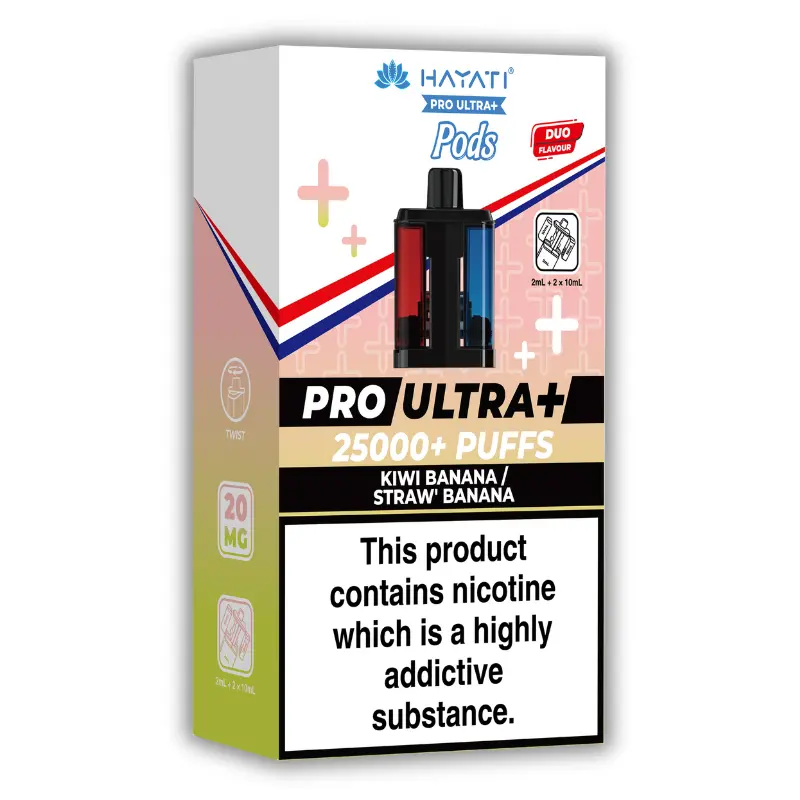
Hayati · Pro Ultra Plus
Kiwi Banana / Straw’ Banana Hayati Pro Ultra Plus Pods
£7.99
✔ In stock — ready to ship
Genuine Hayati
Free over £20
Same-day dispatch
Secure checkout
Kiwi Banana / Straw’ Banana is one 22ml prefilled pod for the Hayati Pro Ultra Plus, sold on its own at £7.99 with no device in the pack, filled at 20mg nicotine salt. The manufacturer's rating on it is up to 25,000 puffs. That figure comes off a drawing rig running evenly spaced puffs under laboratory conditions, so it is useful for ranking listings against each other and close to useless as a forecast of your own fortnight.
The title carries an oblique, and this listing spells out what the oblique means rather than leaving you to guess. Hayati state that the two flavours are held apart inside the pod and that turning the mouthpiece selects which one you are drawing on. That makes it one pod with a collar, not a box containing two pods, and it is worth saying that the confirmation comes from this product's own text rather than from the punctuation in its name. Other listings in this catalogue use an oblique and say nothing at all about switching, and reading a collar into those would be inventing hardware.
What makes this particular pod worth more than a scroll past is the thing the listing puts in its own opening line: banana is on both sides. Kiwi Banana and Straw’ Banana are not two flavours that happen to sit next to each other. They are one fruit given two different partners, and the collar changes the partner rather than the subject. Almost every other dual pod on this shelf is a choice between two profiles. This one is a choice between two treatments of the same profile.
That would be a mildly interesting structural observation on most fruits. On banana it is the whole page, because banana does not behave like the other fruits in this range. It is carried by one compound to a degree that nothing else here matches, and three consequences follow from that fact, all of which change what you should expect from a pod with banana on both halves of the collar. This page spends its length on those consequences, on which of the two partners actually survives next to the banana, and on what a shared coil does to a pairing built this way. The hardware gets a short section because the hardware has been described at length across this catalogue already and the liquid has not.
Counting the banana before claiming anything about it
A page that is about to call an ingredient unusual owes you the count first, because the vague version of a rarity claim is wrong roughly as often as it is right. Here are the numbers, pulled from the catalogue rather than from an impression.
Banana appears in twelve of Hayati's four hundred and ninety-two listings. That is a fraction under two and a half per cent, and Hayati file the twelve under Banana Vapes, a shelf you can read end to end in about a minute. Twelve is the same total as Kiwi Vapes, which makes banana and kiwi joint smallest among the single-fruit shelves here. Set that against Strawberry Vapes at eighty-two and the scale of the difference is obvious before anybody tastes anything.
The twelve are less various than twelve sounds. Eight of them are Banana Ice, which is one recipe sold as a bottled salt twice, as a shortfill, as a pouch, as two Rubik listings and as two Pro Max Plus pod listings. Two are Mango Banana, a kit and its matching pod. The remaining two are this pod and the kit that shares its liquid. So the twelve listings resolve into four distinct banana recipes: Banana Ice, Mango Banana, Kiwi Banana and the strawberry pairing.
Two of those four exist nowhere except inside this pod and its Kiwi Banana / Strawberry Banana kit at £11.99. There is no standalone Kiwi Banana listing anywhere in the range and no standalone strawberry and banana listing either. Half the banana recipes Hayati sell are only obtainable behind a collar, which is a genuinely odd piece of catalogue construction and a real fact about what you are buying: you cannot have either of these two blends on its own at any price.
The rarity claim, narrowed until it is true
It is tempting to write that banana is the only fruit in this range carried by a single dominant compound. Checked properly, that overstates it, and the narrowed version is more useful.
Banana aroma is dominated by isoamyl acetate, an ester that reads as banana to almost everybody with no supporting cast required. But it is not alone in having a character compound. Cherry has benzaldehyde, which is why cherry sweets and almond essence smell like relatives, and cherry appears in sixty-two listings here. Grape of the Concord type has methyl anthranilate, which is the reason grape sweets taste nothing like a table grape, and grape appears in seventeen. Both of those are single compounds doing a lot of identifying work.
The honest narrowing is about completeness rather than about being alone. Benzaldehyde gives you an almond-cherry direction that still needs fruit acid and some fruity esters around it before anyone calls it cherry. Methyl anthranilate gives you a grape-sweet direction that needs sugar and a little tannic dryness to land. Isoamyl acetate needs nothing. Put it in a base at a sensible concentration and the fruit is named instantly and unanimously. Of the three, banana is the one where the single compound is not the lead of a committee but very nearly the entire committee, and that is the version of the claim this page is prepared to defend.
The contrast that matters is not with cherry and grape anyway. It is with the fruits this catalogue actually leans on. Strawberry, the range's most used fruit, is a composite of a great many volatiles with no single one in charge, which is precisely why strawberry liquids differ so widely between makers. Watermelon rests on a handful of nine-carbon aldehydes and alcohols that are fragile and short-lived, which is why watermelon flavours so often taste correct for half a second and then vanish. Mango is a blend of lactones and terpenes with the balance shifting by cultivar. Those three are assemblies. Banana is a single loud signal.
The word Hayati's own copywriters reach for, and how often
There is a piece of evidence for banana's singularity sitting in the catalogue that nobody set out to produce, which is the best kind. Count the product descriptions that use a cream word: creamy, cream, creaminess. Across four hundred and ninety-two listings, twenty descriptions use one.
Eighteen of the twenty mention banana. The other two are T-Misu, a tiramisu profile, where the word is describing an actual dairy element that the flavour is supposed to contain. So in this entire catalogue, the cream vocabulary is applied to exactly two things: a dessert, and a fruit.
That is not a small pattern. The descriptions were written at different times, for different platforms, by people describing one product at a time and not building an argument. Nothing in a banana is creamy. A banana is starch, sugar, water and a little pectin, and no part of it resembles dairy. Yet eighteen separate writing passes produced the same word. This listing does it too, attaching a cream word to the banana while attaching a green word to the kiwi and neither to the other.
Compare that with how the range talks about sharpness. Tangy turns up in a hundred and four descriptions and tart in the high hundreds, which tells you those are house vocabulary and carry almost no information. Creamy turns up twenty times and is almost entirely about one fruit. When a word is that concentrated, it is usually tracking something real, and what it is tracking here is the subject of the next section.
One compound, and the three things that follow
The baseline, which is settled elsewhere
The chemistry itself is already worked out on the Mango Banana Hayati Pro Max Plus 6000 Pod Kit page in this catalogue, and there is no point rebuilding it here. That page establishes that isoamyl acetate carries banana almost single-handedly, that the same ester is the lead note in pear drops and in the banana flavouring used by pharmacies, and that a good part of what makes a real banana read as banana is textural rather than aromatic, so the half that survives a coil is the loud aromatic half and the quiet structural half is left behind. It also sets out the two-camps problem: people whose nose filed that molecule under confectionery first will keep reading it that way, and no amount of blending will move them.
Take all of that as given. This page starts one step further on, at the question that page could not ask because it had only one liquid in front of it. Granted a fruit with a dominant lead, what happens to whatever you put beside it? That question needs a pod with the same lead and two different partners, which is what this one is.
Consequence one: easy to render convincingly, hard to render subtly
The first thing that follows is a paradox that sits underneath every banana liquid ever made, this one included.
Banana is the easiest fruit in this range to get recognisably right. A flavour house does not need to balance a dozen esters against each other and hope the assembly reads as the intended fruit. It needs one compound at a workable concentration and the job is done. That is why banana turns up across formats here that nothing else does: it survives as a bottled shortfill, as a nic salt, as a prefilled pod and as a nicotine pouch, and the pouch is the telling one, because a pouch has no vapour and no coil and still manages to read as banana. Very few fruits would.
The same fact makes banana the hardest fruit here to render quietly. The compound that identifies the fruit is the compound that dominates it, so there is no dial marked banana that goes down. Reduce the ester and you do not get a gentler banana, you get a base that has stopped being banana and is on its way to being nothing in particular. There is no equivalent of the light touch a formulator can apply to strawberry, where you can pull back a few of the top esters and still have a recognisable if quieter berry, because strawberry's identity is distributed across the assembly and no single removal destroys it.
This has a direct consequence for what you are holding. Neither side of this pod contains a small amount of banana. Both contain enough banana to be banana, which is roughly the same amount, because that is the only concentration available. The two sides are not a strong banana and a weak banana. They are one banana with two different things standing next to it.
Consequence two: the sweet-shop reading is chemically earned
A sizeable number of experienced vapers will tell you that every banana liquid they have tried tastes like a sweet rather than a fruit. That reaction is usually filed under fussiness or under a flavour house cutting corners. It is neither, and the reason is worth stating plainly because it changes how you should read the objection when you meet it.
Banana confectionery and banana fruit are not an imitation and an original. They are two delivery systems for the same molecule. The foam banana in a sweet shop and the ripe fruit in a bowl both announce themselves through isoamyl acetate, and there is no second signal available to tell them apart once texture is removed. With a strawberry sweet you can hear the gap immediately, because the sweet uses a handful of the loudest strawberry esters and the fruit uses dozens, so the sweet sounds like a caricature. With banana there is no caricature to be made. The sweet is already using the whole vocabulary.
So when somebody says a banana liquid tastes artificial, they are not describing a fault in the formulation. They are describing the accurate rendering of a fruit whose aroma signature was long ago annexed by the confectionery aisle. There is a widely repeated story that banana flavouring was modelled on an older commercial cultivar and only came to seem wrong when the fruit on sale changed underneath it. Treat that as an anecdote rather than a fact, because it is disputed and nobody has settled it, and note that it would not alter anything above if it were true. The ester is the ester either way.
The practical upshot for this pod: if banana has previously read as sweet-shop to you, both halves of this one will do the same, because both halves are built on the same lead. The partner changes what surrounds it and cannot change what it is. Anyone who wants to test their own reaction cheaply should do it on a single-flavour listing before committing to a 22ml pod where the fruit is unavoidable on both settings. There is no version of this pod that leaves the banana out.
Consequence three: a partner next to banana is not competing on equal terms
The third consequence is the one that decides what this pod actually tastes like, and it follows from the first two.
Put two composite fruits together and they negotiate. Strawberry and raspberry, say, or mango and peach: both are assemblies of many compounds at moderate individual concentrations, both occupy overlapping perceptual space, and the result is genuinely a blend in which each fruit gives up some definition and the mixture lands somewhere between them. Neither fruit had a single indispensable signal to protect, so the negotiation is roughly symmetric.
Banana cannot negotiate, because it has nothing to give up short of ceasing to be banana. A partner placed beside it is therefore not blending with it in the ordinary sense. It is doing one of two other things. Either it operates in a perceptual channel the banana does not occupy, in which case both are audible and you get two things at once, or it operates in the same channel, in which case the banana wins and the partner is heard as a modification of the banana rather than as a fruit in its own right.
That is the test this pod runs twice, with two different partners, and it is the reason the listing is more interesting than the sum of its two halves. One of the partners is a green, seedy, acidic fruit. The other is the softest and most used red in the range. They are not in the same position at all, and the section after next works out which one survives.
The case for a dominant lead being a feature
Before going further it is worth putting the other side of this properly, because a page that only lists the awkward consequences of a fact has not been honest about it.
A dominant compound makes a flavour predictable, and predictability is genuinely valuable on a repeat purchase. Strawberry's dependence on an assembly is exactly why one maker's strawberry disappoints you after another maker's did not, and why two pods of the same nominal flavour from different production runs can differ enough to notice. Banana has far less room to vary. The ester is stable, it is cheap, it is easy to dose accurately, and the perceptual result is nearly the same every time. If you buy this pod again in four months, the banana in it will be the banana you remember to a degree that a composite fruit cannot promise.
That stability also makes it an unusually reliable reference point. A repeat buyer who knows what this pod tastes like new has a fixed marker against which to judge a tiring coil or an odd batch, because any change they detect in the banana is much more likely to be the hardware than the liquid. On a composite fruit that inference is unavailable, since the fruit itself could have moved.
And a dominant lead is easy to return to. The reason banana is described as comfortable across nearly every listing in the catalogue is not marketing, it is that a single familiar signal with no sharp edges asks nothing of your attention. Some rotations want a flavour that does exactly that, and a pod that does it in two variations rather than one is a sensible way to buy it.
The two partners, and which one survives
What each side is bringing, in channel terms
Set the two partners out by what they contribute rather than by how they taste, because the channel is what decides the outcome.
Kiwi brings three things, and only one of them is aroma. It brings green, leafy, faintly starchy notes from short-chain aldehydes of the hexanal family, which sit in a completely different aromatic register from fruity esters. It brings acid, and acid is not an aroma at all but a taste, registered on the tongue rather than in the nose. And it brings a faint dry bitterness that in the fruit comes from the seeds. Three contributions across three separate perceptual systems, and none of them is an ester competing for the same ground as the banana.
Strawberry brings one thing, very well. It brings a large assembly of fruity esters, with methyl and ethyl butanoate and hexanoate among the loudest, plus a caramel-sweet furanone that gives ripe strawberry its jammy depth. What it does not bring is much acid, because strawberry is one of the lower-acid fruits in common use, and it brings no green note and no bitterness. The Strawberry Kiwi Hayati Rubik Prefilled Pod Kit page in this catalogue counted this properly and found that not one strawberry listing anywhere in the range presents the berry as the sharp element in a blend. It is always the floor.
Read those two descriptions again with the banana in mind. Kiwi contributes in three channels the banana does not occupy. Strawberry contributes principally in the one channel the banana already owns.
Why the kiwi side holds together
The kiwi survives, and it survives for structural reasons rather than because it is louder.
The green aldehydes are the key. They are not in competition with isoamyl acetate because they are not the same kind of smell: one is a fruity, solvent-bright ester and the other is the cut-grass, unripe-stem register, and your nose treats them as separate events rather than as two candidates for the same slot. So the green reads over the top of the banana rather than through it, and neither has to give way.
There is a neat piece of fruit chemistry underneath that which makes the pairing less arbitrary than it looks. A green banana is itself dominated by aldehydes of that same family, and the characteristic ester production only ramps up sharply as the fruit ripens and the green notes fall away. So the kiwi side is, in effect, putting back the green top that a ripe banana has already lost. It is not an outside imposition on the fruit, it is the earlier version of the same fruit reintroduced from another source. Whether Hayati intended that or simply put two things together that work, the result is a pairing that sounds coherent rather than stuck together.
The acid does the second job, and it is the more important one for a 22ml pod. Acid is registered by taste rather than by smell, so it cannot be masked by an aroma compound however dominant. This matters because banana's failure mode across a long session is accumulation: a sweet, low-acid, coating flavour with nothing to cut it builds a residue, and by the fourth or fifth draw in quick succession you are tasting the residue as much as the draw. Acid clears that. The kiwi side therefore has a brake on it that the strawberry side does not.
Two prior pages in this catalogue establish the character of the fruit itself and are worth reading if the kiwi is the part you care about, because neither is rebuilt here. The Kiwi Cooler pages set out that kiwi's tartness is structural rather than applied, present even in ripe fruit, so sweetening a kiwi does not mellow it but erases it. The Guava Kiwi Passion Fruit Hayati Pro Max Plus Pods page works out why kiwi functions as a referee among louder fruits, holding similar-smelling things apart instead of blurring into them. Both findings point the same way here. A fruit whose acid is load-bearing and whose green note occupies ground nothing else touches is close to the ideal partner for something that dominates by aroma alone.
Why the strawberry side does not
The strawberry does not survive as a separate fruit, and the honest description of that side is banana with a red weight underneath it rather than strawberry and banana.
The mechanism is straightforward once the channel argument is in place. Strawberry's contribution is a set of fruity esters. Banana's contribution is a fruity ester at a concentration high enough to be recognised on its own. They are in the same family, they arrive at the same point in the draw, and your nose does not have the resolution to separate a loud single ester from a quieter assembly of related ones sitting behind it. What it does instead is hear one fruity thing with more body than a single ester would have, and it attributes the extra body to the loud signal it has already named. The strawberry becomes an adjective applied to the banana.
The low acid completes it. If the strawberry brought a real sour edge it would have a second channel to work in, the way the kiwi does, and the pairing would separate. It does not, so it has only the channel the banana already fills. This is also why the same berry works perfectly well opposite fruits that do not dominate: on Strawberry Watermelon Hayati Pro Ultra Plus Pods the melon has a watery, fresh, faintly cucumber-adjacent top that the strawberry does not, so the two hold apart. Put strawberry against a dominant ester and the same berry has nothing to hold apart with.
Hayati's own copy arrives at the same conclusion without meaning to. The strawberry side is described as the rounder, richer, smoothie-style one. A smoothie is a thing in which the components have been deliberately merged. Nobody describes a two-fruit blend as a smoothie when they want you to hear both fruits. The listing has told you what happened.
The verdict, stated plainly
Kiwi wins. On the kiwi setting you are tasting two things, arranged one above the other, with the green and the acid audible over a banana base that stays where it is. On the strawberry setting you are tasting one thing with more weight, and the strawberry is best understood as a sweetener and a body-thickener rather than as the second fruit the name promises.
That is not a ranking of which side is nicer, and it should not be read as one. It is a statement about how many things are happening. Plenty of buyers want one thing rather than two, and the strawberry side is a competently made version of that one thing.
Being fair to the side that loses
The strawberry half deserves a proper defence, because the argument above can be read as a criticism and it is not one.
Merging is what a smoothie profile is for. If the appeal of banana to you is its roundness, its lack of edges and the fact that it asks nothing of you, then a partner that adds body without adding a second thing to attend to is doing exactly the right job. Adding acid to that would be working against the reason you chose it. The kiwi side has a brake; the strawberry side does not want a brake.
There is also a sequencing argument for the pairing as a whole that is stronger than either half alone. A single-flavour banana pod gives you nothing to do when the accumulation sets in, which is the problem the Juicy Peach Hayati Pro Ultra Plus 25K Pods page works through for single-flavour pods generally. Here the escape is a quarter turn away. Run the strawberry side while it is pleasant, turn to the kiwi when the sweetness starts stacking, and the acid resets you. That is a genuine use for a collar and it is the one this listing implicitly proposes when it says the pairing suits somebody who likes banana but finds it heavy on its own.
Where this reading could be wrong
The argument above is reasoning from the chemistry and from Hayati's own descriptions, not a measurement, and it should be flagged as such. Here is what would show it wrong and how you would know.
If the strawberry in this recipe is dosed unusually high, or if the formulation leans on the furanone rather than on the esters, the berry could hold its own position after all, because the caramel-sweet furanone is not in the ester channel and would register as a separate layer. The tell would be a distinctly jammy, cooked-fruit note arriving after the banana rather than alongside it. If you get that, the strawberry is doing more than this page credits it with.
Equally, if the kiwi is dosed timidly, the green could fall below threshold and the acid alone would not be enough to make the side read as two things. The tell there is a kiwi setting that tastes like banana with a faint sourness and no green at all. That would be a formulation choice rather than a refutation of the channel argument, but it would make the two sides much harder to tell apart than this page suggests.
Hayati publish no coil resistance, no wattage and no flavour concentrations for this pod, so nothing in the specification settles either question. The pod in your hand settles both, and the method for reading it is in the section on the collar.
What arrives, side by side
The kiwi setting, front to back
The opening is green and high in the mouth. The first thing forward is not the banana, which is mildly surprising the first time and is a consequence of where the two sit rather than of their relative strength: the green aldehydes are lighter and reach you earlier, while the ester is denser and arrives fractionally behind. There is a thin, bright quality to the first part of the draw that no other banana listing in this range has.
The banana comes in under it, not through it, and once it is there it stays for the rest of the draw. That is the signature of the pairing working. You are aware of two levels rather than one profile, and the levels do not swap positions. The green sits on top and the banana holds the floor.
The acid registers in the middle of the draw and slightly to the sides of the tongue. It is moderate. Nothing in this pod is sour in the way a declared sour listing is sour, and nobody should expect a pucker. What the acid does is stop the banana from coating, which you notice most in the gap between draws rather than during them.
The exhale is where the balance is clearest. The green thins out first, the banana fills the exhale, and there is a dry edge behind it that is probably the seed character kiwi carries into most of its renderings. That dry edge is worth knowing about for a practical reason: a lightly scorched wick produces a bitterness that can be confused with it. A dry tail that was there from the first draw of the pod is the recipe. A flat, papery bitterness that appeared after you chained through a session is something else.
The finish is shorter than you would expect from a banana, which is the acid doing its job, and it is the main reason this side is the one to run when you intend to keep drawing.
The strawberry setting, front to back
The opening is immediately fuller and lands lower in the mouth. There is no green and no lift at the front, and the draw arrives already at full weight rather than building. Coming to it straight off the kiwi side, the first impression is of something thicker and quieter.
Through the middle the two components are not separable, and that is the finding rather than a failure of description. What you get is a rounder, sweeter banana with a red-fruit depth underneath it that has no clear boundary of its own. If you concentrate you can locate the strawberry as a weight rather than as a flavour with a shape.
The exhale is where the cream impression sits, and it is worth understanding what that impression actually is. The Mango Banana page in this catalogue makes the point that certain esters and lactonic notes are so strongly associated with soft, thick foods that the nose supplies a mouthfeel the vapour does not physically have. That is what is happening here, and the eighteen listings counted earlier are eighteen independent confirmations that it happens reliably. Nothing in this pod is dairy. The creaminess is an inference your nose is making, and once you have noticed that, some people find the side thinner than they first thought.
The finish is long and stays sweet. There is nothing to cut it, so it accumulates across a sitting in the way a low-acid sweet profile always does. Twenty minutes of steady use on this side is a different experience from three draws on it, and the difference is not subtle.
Sweetness, placed honestly
Both sides are sweet. The strawberry side is one of the sweeter things on this shelf, and it gets there partly through actual sweetener load and partly by removing its own reference point, since perceived sweetness is relative and a blend with no acid in it reads as more sugar than the same sugar would in a blend that had some.
The kiwi side sits noticeably lower, not because it contains less sweetener but because the acid gives you something to measure it against. Placed among neighbours on the same shelf, the kiwi side lands somewhere near Strawberry Raspberry Ice Hayati Pro Ultra Plus 25K Pods, where the berry acid does a similar job, while the strawberry side sits above most of the fruit listings and below the confectionery ones such as Watermelon B’Gum / Strawberry B’Gum Hayati Pro Ultra Plus Pods, which are sweet by design rather than by omission.
What is not in this pod
A flat list, because half the questions any listing generates are answered by what the name leaves out.
- No declared cooling. Neither side carries an ice, frozen, cooler, mint or menthol word, and the Blue Frozen pods page in this catalogue counted the range's cooling vocabulary properly and found the terms are not graded but are consistently present when a coolant is. Expect a warm draw on both settings.
- No dairy, custard or bakery element. The creaminess is aroma implying texture, discussed above.
- No citrus. The only acid in the pod is the kiwi's, and it is on one side only.
- No confectionery accord. Neither side is a gum, a cotton candy or a sweet-shop construction in the way that several of its shelfmates openly are.
- No third fruit anywhere. Both sides are two-component blends, which is unusual on a shelf where three-fruit recipes are common.
The collar, and the carryover you will struggle to hear
Everything below follows from one fact about the format: the two sides share a coil, a wick and an airflow path. Hayati publish that the mouthpiece selects which flavour you are drawing and they publish nothing whatsoever about how the two are held apart inside the pod, so this page describes what the collar does and makes no claim about how it does it.
What a shared wick means is that the first draws after a switch are not a clean reading of the new side. There is liquid already in the wick and residue already on the coil from the side you were just on, and it has to work through before you are tasting only the new one. That is true of every dual pod on this shelf and it is not a defect.
What is specific to this pod is that you will find it much harder to detect than usual, and the reason is the whole argument of this page. On a pairing with two genuinely different profiles, carryover announces itself: switch from a mint side to a berry side and the mint in the first two draws is unmistakable, because it has no business being there. Switch sides on this pod and the dominant thing in your mouth before the switch is banana and the dominant thing after it is also banana. The largest single component of the carryover is identical to the largest single component of the destination, so it does not stand out as contamination. It just sounds like the pod.
The carryover here is asymmetric, and only one direction is readable
Working it through gives an asymmetry that is worth knowing before you try to form a view of either side.
Turning from the strawberry side to the kiwi side, the carryover is close to undetectable. What is arriving from the previous side is banana plus a set of fruity esters with no green and no acid. Both of those disappear under the banana that the kiwi side is also serving. There is no green in the carryover to contradict the green that is coming, and no acid to contradict the acid. So the first draws on the kiwi side taste like a slightly softer, slightly sweeter kiwi side, which is exactly what a correctly working kiwi side might taste like anyway. You cannot tell the difference by listening.
Turning the other way, from the kiwi side to the strawberry side, the carryover is readable, because now the residue contains two things the destination does not have. Green notes and acid arriving in a draw that should have neither are conspicuous. The first few draws on the strawberry side after a switch taste brighter and thinner than that side actually is, and if you form your opinion of the strawberry half in those first draws you will overrate its separation and think the berry is holding its own better than it does.
The practical instruction that falls out of this is short. Do not judge the strawberry side immediately after the kiwi side. Judge it after it has been running for a while, or first thing on a session. The kiwi side, by contrast, can be judged whenever you like, because the thing contaminating it is invisible.
A tasting method that accounts for it
The usual way to know a switch has cleared is to wait until the previous flavour has gone. That signal is unavailable here, because the previous flavour's loudest component has not gone and is not going to: it is in the new side too. Using the banana as your marker will tell you nothing at all.
Use the partner as the marker instead. Going to the strawberry side, the switch has cleared when the green has stopped arriving and the draw has stopped feeling bright at the front. Going to the kiwi side, the switch has cleared when the draw stops feeling heavy and the green is fully present rather than half present. Both are judgements about the thing that differs, which is the only axis carrying information.
Give it a handful of draws rather than one. If you want a properly clean reading of either side, the reliable version is to leave the collar alone for an evening and read it the following day, which removes the residue question entirely at the cost of some patience.
What the shared budget means
The two sides draw on one 22ml fill. Liquid left in the half you turn out to dislike leaves with the pod when the pod is finished, so the halves are not separable purchases and there is no way to buy more of one. Coil wear is shared too, which means the side you use less is ageing at the same rate as the side you use constantly, and it will not be fresh when you come back to it.
That last point lands harder here than on most pairings, and the reason is the convergence effect described in the handling section below. On this pod, an ageing coil does not just make the neglected side tired. It makes it more similar to the side you have been using.
The pod as an object, and the numbers on it
One pod arrives and nothing else. No device, no charger, no spare, no adapter. The liquid is already in it, there is no fill port and it is not intended to be topped up, so the pod is a consumable that is finished when the liquid is finished. Check the range name printed on your device against the range name in this title before ordering, because Hayati run several pod formats that do not interchange.
The single specification that matters most for this particular liquid is not the volume and not the nicotine. It is the absence of a published coil resistance, because the two sides of this pod age at different rates and the rate at which a coil dulls delicate aromatics is the mechanism behind that. Hayati publish nothing about it, and neither should a retail page.
| Catalogue reference | kiwi-banana-straw-banana-hayati-pro-ultra-plus-pods |
| Sides selectable at the mouthpiece | Two: Kiwi Banana and Straw’ Banana |
| Shared between the two sides | One coil, one wick, one airflow path, one liquid budget |
| Liquid | 22ml, prefilled, no fill port |
| Nicotine | 20mg nicotine salt, the UK maximum for a prefilled pod of this kind |
| Declared cooling | None on either side |
| Manufacturer puff rating | Up to 25,000 for the pod as a whole, a laboratory estimate covering both sides together |
| Platform | Hayati Pro Ultra Plus |
| In the pack | The pod only |
| Price | £7.99 |
| Not published by Hayati | Coil resistance, wicking arrangement, how the two reserves are divided, flavour concentrations |
Two of those rows deserve a note. The puff rating covers the pod, not each side, so a buyer who intends to use one side heavily and the other rarely should read it as a single budget spent unevenly rather than as two allowances. And the 20mg figure is the ceiling the UK allows in a pod of this type, which means it is not a choice Hayati made about this flavour and carries no implication about how the liquid is meant to be used.
One further row is absent by design. Hayati say the collar selects a side and stop there. Anyone stating how the two reserves are kept apart, in either direction, is filling a gap with a guess, and this catalogue has already recorded what happens when two pages guess opposite answers to the same unpublished question.
What sits near it, and who should take which
If the kiwi half is the reason you are here
Kiwi is thin on the ground, and that is a real cost rather than a talking point. Twelve listings and, by the count on the Strawberry Kiwi Rubik kit page, five actual recipes is the whole of it. If this is the fruit you want, your options are close to exhausted at the point of purchase.
Within them, Strawberry Kiwi Hayati Pro Max Plus Pods at £5.49 gives you the fruit against a partner that does not dominate, which is the fairest hearing kiwi gets anywhere in the range: both fruits are audible and the strawberry actually sits underneath rather than being absorbed. The same liquid on a smaller and cheaper platform is Strawberry Kiwi Hayati Rubik Pods at £3.99, which is the least expensive way to find out whether you like the fruit at all. Guava Kiwi Passion Fruit Hayati Pro Max Plus Pods puts it among two assertive tropicals and is the busiest of the three. The whole shelf is short enough to read in one sitting.
If the banana is the reason you are here
This is the awkward branch, because the range gives you very little. Four recipes, two of which are only available behind this collar. The Kiwi Banana / Strawberry Banana Hayati Pro Ultra Plus 25000 Prefilled Pod Kit at £11.99 is the same liquid with a device in the box and is the route for anybody not already on the platform. Beyond that, the Banana Vapes shelf holds the cooled single-fruit version and the mango pairing and that is the lot. If you settle on this fruit, expect to run out of places to go.
If the strawberry half is the reason you are here
Then you are spoiled, and you should probably not be buying this pod for it. Strawberry is the most used fruit in the range and it has partners that let it lead instead of supporting something louder. Strawberry Ice / Strawberry Raspberry Ice Hayati Pro Ultra Plus 25K Pods runs the berry on both sides with a coolant and a second berry as the variable. Straw’ Guava / Dragon Berries Hayati Pro Ultra Plus Pods gives it two tropical settings. Grape GB / Strawberry GB Hayati Pro Ultra Plus Pods takes it in a confectionery direction. And Straw’ Grapefruit / Straw’ Dragonfruit Hayati Pro Ultra Plus Pods is built on exactly the same structure as this pod, one constant fruit and two partners, with the constant being the strawberry instead. It is the natural comparison if the structure interests you more than the fruit. The full Strawberry Vapes shelf runs to eighty-two listings.
If you want a pairing where both sides genuinely separate
The lesson of this page transfers. Look for pairings whose two sides differ in channel rather than only in fruit. Fresh Mint / Blue Razz Mint Hayati Pro Ultra Plus 25K Pods is the cleanest example on the shelf, because menthol works on a receptor rather than on the nose and cannot be masked by anything. Cherry Ice / Peach Mango Hayati Pro Ultra Plus 25K Pods puts a cooled stone fruit against a warm tropical pair, which separates on temperature as well as on fruit. Blackcurrant Cotton K / Blue Raspberry Hayati Pro Ultra Plus Pods sets a confectionery accord against a fruit accord, which is a different axis again.
For the opposite lesson, Blueberry Raspberry / Blueberry Raspberry Cherry Hayati Pro Ultra Plus 25K Pods is a nested pairing where one side is the other side plus a fruit, and its own page works through how hard that is to hold in memory. The Blueberry H’Bubba and Watermelon H’Bubba pairing shares a confectionery base and varies the fruit, which is the mirror image of what this pod does.
If you would rather not have a collar at all
Single-flavour pods on this platform remove the switching question entirely and the decision becomes a straightforward one about a liquid. Cherry Ice Hayati Pro Ultra Plus 25K Pods and Blue Razz Cherry Hayati Pro Ultra Plus Pods are both on the same shelf at the same price. Blueberry Raspberry Lemon Hayati Pro Ultra Plus 25K Pods is a three-fruit single with real citrus acid in it, which is one way to get the brake without the mechanism. The trade is stated properly on the Juicy Peach page: no collar means no in-session escape when a flavour starts to tire.
If it is the platform rather than the flavour you are deciding about
The whole of Hayati Pro Ultra Plus Pods runs to fifty-two listings and the wider Hayati Pro Ultra Plus Prefilled Pod Kits & Pods shelf to a hundred and four, kits included. If you want the same collar idea on a different platform, Lemon Lime / Lemon Blueberry Hayati Pro Ultra Plus 25000 Prefilled Pod Kit is the citrus equivalent of this pod's structure, one constant and one variable, and its page works out what a permanent running order does to a shared coil. For browsing rather than deciding, Hayati also file this pod under Exotic Vapes, a shelf of fifty-five, and under Berry Vapes, which runs to two hundred and twenty-five.
Two more worth naming
Anyone who liked the idea of a soft fruit given a sharp partner but does not want banana should look at Straw’ Cranberry Cherry / Cherry Ice Hayati Pro Ultra Plus Pods, where the cranberry supplies the acid instead. And for a red fruit with an unusual top note rather than a dominant one, Dragon Berries Hayati Pro Max Plus Pods is the nearest thing on the Pro Max Plus shelf, at £5.49.
Living with a pod that has the same fruit on both settings
The two sides will converge, and here is the reasoning
This is an inference rather than a measurement, flagged as one, with the argument shown so you can disagree with it.
A coil working through a sweetened liquid accumulates a film, and that film costs the lightest and least concentrated aromatics first. Apply that to the two halves of this pod and the effects are wildly uneven. The kiwi side's distinguishing feature is a set of green aldehydes present in small quantity, which is precisely the material a tiring coil takes earliest. The strawberry side's distinguishing feature is extra body from an ester assembly sitting under a louder ester, which is far more robust, partly because there is more of it and partly because it was never doing delicate work. And the component both sides share is the most durable thing in the pod, because isoamyl acetate is present in bulk and remains detectable at trace levels.
Subtract the same proportion from everything and you have taken most of what makes the kiwi side different, some of what makes the strawberry side different, and almost none of what they have in common. The prediction is therefore that the two settings move towards each other across the life of the pod rather than simply both getting weaker. By the last few millilitres you should expect a collar that changes the draw slightly rather than changes the flavour, with banana carrying both positions and the kiwi reduced to a faint sourness with the green gone from over the top of it.
What would show this wrong: if the acid holds up better than the green does, the kiwi side keeps a real point of difference to the end, because acid is a taste rather than an aroma and a coil film has less purchase on it. That is genuinely possible and this page does not claim to have settled it. Watch for whether the green disappears before the sourness does. If it does, the convergence is happening. If both fade together, it is not.
Either way the practical advice is the same and slightly counter-intuitive. The window in which the two sides are most clearly two different things is the first third of the pod, so that is when it is worth switching deliberately and paying attention. Leaving the exploration until you have used half of it means doing the comparison on the least informative part of the pod.
Which side to leave it on
Because the banana is common to both, you cannot tell by tasting which setting the collar is on after a break. That sounds trivial and it causes a specific annoyance: you pick the pod up the next morning, take three draws, decide the flavour has faded, and you are in fact on the side you did not intend and comparing it against a memory of the other one. Either look at the collar before the first draw of a session or settle on a habit of always parking it on the same side when you put it down.
If you know you strongly prefer one side, there is an argument for running that side almost exclusively rather than alternating out of a sense that you paid for both. Alternating does not preserve the neglected half: the coil ages with total use, not with per-side use, so the side you save is not being saved. What alternating does buy you is the acid reset described earlier, which is a real benefit for a low-acid sweet profile, and that is the reason to do it rather than any notion of using the pod fairly.
Draw style, and why one side punishes chaining more
A slow, unhurried draw suits both settings and a long one suits neither, since a dense sweet liquid on a warm coil gives you more of what you already have rather than more definition. The difference between the two sides shows up in the gaps rather than in the draws.
Chain-drawing the strawberry side stacks residue, because there is nothing in that half to clear the palate between draws. Three in quick succession and the fourth is landing on top of the third. The kiwi side tolerates the same pattern considerably better, since the acid does some of the clearing for you. If you know you draw in bursts rather than singly, the kiwi setting is the one that will stay legible through a burst, and the strawberry setting is the one to save for the spaced-out part of the day.
Storage, and a specific vulnerability
Heat is the enemy of this pod more than of most, for a reason particular to its chemistry. Esters are volatile and will degrade with sustained warmth, and the aroma of this liquid rests on esters to an unusual degree on both settings. A pod left on a dashboard through a warm afternoon has had a worse day than a mint pod in the same place, because the mint's cooling agent is far more robust than an ester is. Keep it somewhere cool and dark, stood upright, and give a pod that has come in from the cold a few minutes to reach room temperature before drawing, since cold liquid wicks sluggishly and the first draws will read thin.
A part-used pod keeps perfectly well for weeks if it is stored properly, and the thing most likely to spoil it is not time but repeated large temperature swings. Store any spare you are holding somewhere children and pets cannot get to it, as you would with any nicotine product.
When it is finished, and what to do with it
You will know because the draw turns thin and hot and the banana, which has been the most durable thing in the pod throughout, finally loses its body. On a pod with a dominant lead that is a clearer signal than it would be on a composite fruit, where the profile degrades unevenly and the end is a gradual disappointment rather than an event. Once it goes, it goes, and there is nothing to be gained by pushing on.
The spent pod contains a coil and a residue of nicotine-bearing liquid, which makes it electrical waste rather than general rubbish. Most vape retailers and many council sites will take it, and the practical thing is to keep finished pods together somewhere until you have a few and deal with them in one go rather than making a separate trip for each one.
Questions this listing raises
Is banana in both halves, or only in one?
Both. That is the defining fact about this pod and the listing states it in its first line. Kiwi Banana and Straw’ Banana are the same fruit with two different partners, so turning the collar changes what is beside the banana and never removes it.
Can I buy just the kiwi and banana side on its own?
No, and this is unusual. There is no standalone Kiwi Banana listing anywhere in the four hundred and ninety-two products in this range, and no standalone strawberry and banana listing either. Both recipes exist only inside this pod and the kit that shares its liquid.
Does either setting have a coolant in it?
Neither does. Hayati signal cooling in the product name when it is present, and no cooling word appears in this title on either side, so both settings are warm draws. The freshness on the kiwi half comes from acid and green notes, which is a different sensation entirely from menthol.
How do I know when the changeover has finished after I turn the collar?
Do not use the banana as your signal, because it is present in both sides and will not tell you anything. Watch the partner instead: the switch to the strawberry side has completed when the green has stopped arriving, and the switch to the kiwi side has completed when the draw has stopped feeling heavy and the green is fully there rather than half there.
Is this the same liquid as the £11.99 kit?
It appears to be, with one oddity worth knowing. The kit is titled Kiwi Banana / Strawberry Banana and this pod is titled Kiwi Banana / Straw’ Banana, which is the same recipe written two ways. Hayati use the shortened form on twenty-two titles across the catalogue and the full word on rather more, with no discernible rule, so a difference in spelling between two listings of one liquid is a copywriting variant rather than evidence of two recipes.
Do the two sides stay as different as they start?
Probably not, and the reasoning is set out above. The kiwi side's green notes are the most delicate material in the pod and the banana is the most durable, so a tiring coil is expected to erode the difference between the settings faster than it erodes either setting. Judge the two against each other in the first third of the pod if you want a fair comparison.
What does the 20mg figure mean in practice here?
It is the maximum nicotine strength permitted in a prefilled pod of this kind in the UK, supplied as a nicotine salt, which is the standard preparation for a pod at this strength. It is not a choice made for this flavour and there is no lower-strength version of this particular pod listed.
Is there a device in the pack?
No. The pack holds the pod and nothing else, which is why it is £7.99 rather than the £11.99 of the kit version. It is intended for somebody who already owns the matching hardware.
I have never got on with banana liquids. Will this one be different?
Almost certainly not, and it would be dishonest to suggest otherwise. Banana in a liquid is carried by a single compound, that compound is the same one in every banana flavour you have tried, and both halves of this pod are built on it. The partner changes the setting it appears in and cannot change the fruit.
Why do so many descriptions call banana creamy when there is nothing creamy about it?
Because the aroma implies a texture the vapour does not have. Certain esters are so strongly associated with soft, thick foods that the nose supplies a mouthfeel on its own. The pattern is remarkably consistent in this catalogue: of the twenty product descriptions that use a cream word, eighteen are describing banana and the other two are describing a tiramisu profile.
What happens to the liquid in the side I end up not liking?
It is discarded with the pod. The two settings draw on one 22ml fill and there is no way to buy or use them separately, so a strong preference for one side means paying for liquid you will not use. That is the main argument for deciding quickly which side suits you rather than alternating out of habit.
Which side should I start on?
The kiwi one, for a practical reason rather than a preference. Carryover from the strawberry side into the kiwi side is almost impossible to detect, because the two share their loudest component, whereas carryover in the other direction announces itself. Starting on the kiwi side and moving to the strawberry side later gives you one clean reading before any residue is in the wick.
The short version
One 22ml pod at £7.99, no device in the pack, 20mg nicotine salt, a collar that selects between two settings, and the same fruit underneath both of them. Banana is carried almost entirely by one compound, which makes it the easiest fruit in this range to render recognisably and the hardest to render quietly, and it means a partner placed beside it is not competing on equal terms.
Applied to this pod, the kiwi wins and the strawberry does not. Kiwi contributes green aldehydes, acid and a dry seed edge, none of which occupy the ground the banana holds, so that setting reads as two things stacked. Strawberry contributes fruity esters into the channel the banana already fills, so that setting reads as one thing with more weight, which is exactly what the word smoothie in the listing is telling you. Neither outcome is a fault. One gives you contrast and a brake on the sweetness, the other gives you depth and no interruptions, and which you want is a real preference rather than a mistake.
The collar is worth having here for the acid reset rather than for variety, and the carryover at every switch is harder to notice than on any other pairing on this shelf, because the thing carrying over is the thing you were going to taste anyway. Buy it if banana is a fruit you already like and you want two ways of taking it. Do not buy it expecting the partner names to describe two different flavours, and do not buy it hoping the banana will be kept out of the way, because on this pod there is nowhere for it to go.
Strictly for adults aged 18 and over. Nicotine is an addictive substance.
You might also like


