
Home / Hayati Nicotine Pouches / Ruby Berry Hayati Nicotine Pouches
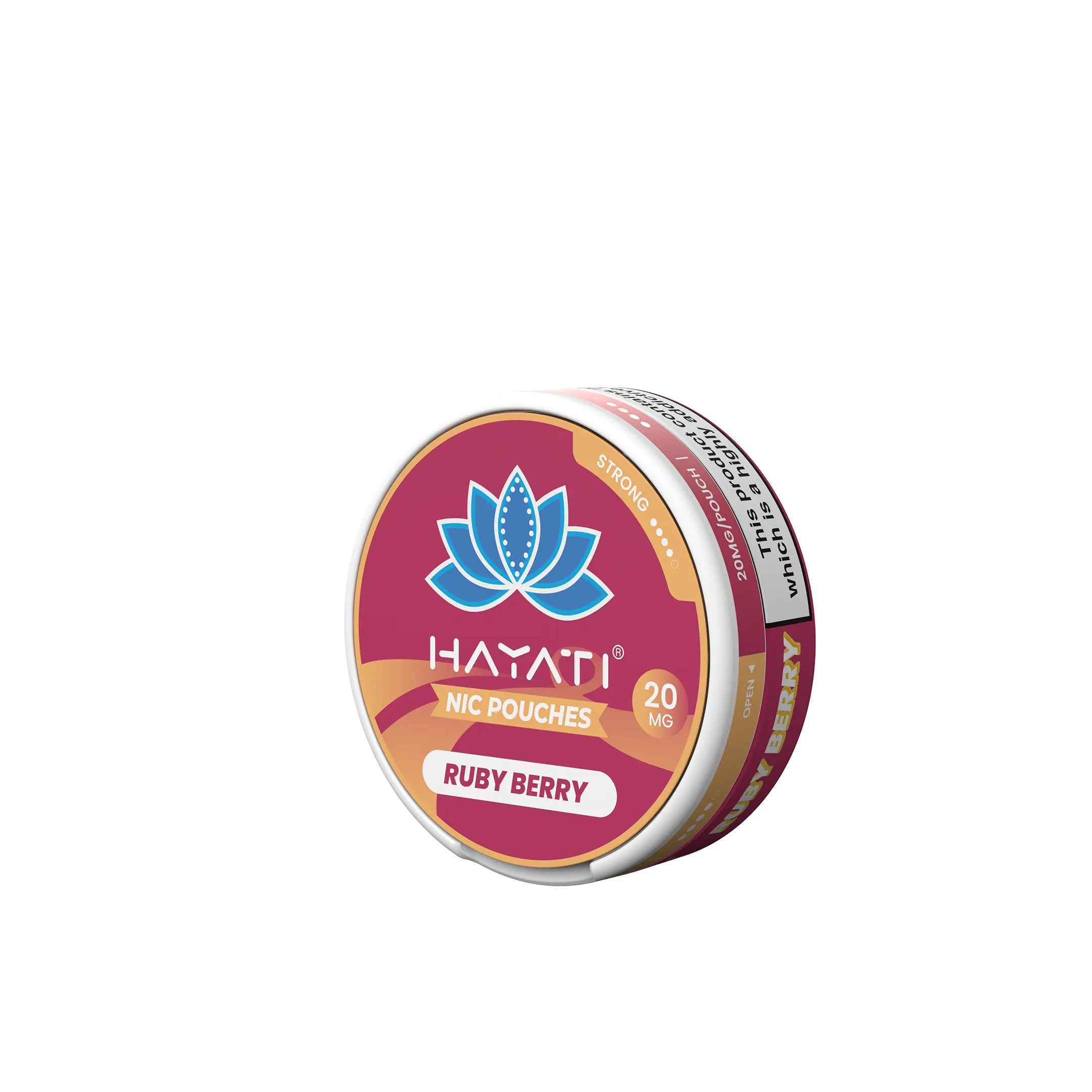
Hayati
Ruby Berry Hayati Nicotine Pouches
£4.49
✔ In stock — ready to ship
Genuine Hayati
Free over £20
Same-day dispatch
Secure checkout
Ruby Berry Hayati Nicotine Pouches sells for £4.49, carries 12mg of nicotine, and contains no tobacco. The format has almost nothing in common with the rest of this site. No device is involved. Nothing is charged, filled or heated, and nothing travels past the back of the mouth. A pouch is a small sachet of white fibre with flavouring and nicotine held inside a wrapper that stays whole, set in the fold of tissue at the front of the mouth above the top teeth, releasing into saliva for as long as it stays there. At the end it is lifted out intact and binned. That is the entire operation and there is nothing else to learn about it.
All eleven cans on the Hayati Nicotine Pouches shelf work that way, and four of them have already been written up here at length. What is specific to this one begins in the title and is finished off by the container.
Read the name literally. Berry is a category and not a fruit. Hayati file 225 listings under Berry Vapes, and that shelf holds strawberry, raspberry, blueberry, blackberry, blackcurrant, cranberry and cherry, none of which taste like each other. Ruby is a colour. Put the two words together and a buyer knows they are being sold red fruit, sweetened, and knows nothing beyond that. No individual fruit is named anywhere on the listing, in the title, in the tags or in the flavour copy.
Now add what the earlier pages on this shelf established about the format, which is that a pouch is a poor route for the aroma compounds that distinguish one fruit from another and a good route for anything the tongue reads unaided. The label withholds the fruit's name. The container withholds the evidence that would let a taster recover it. Those are two independent failures and they point the same way, which is the argument of this page. A buyer cannot learn from the label what is in the can, and on the reasoning this shelf has already built, probably cannot learn it from the can either. What survives is sweetness and whatever acid the blend carries, and that is a description which fits a great many things.
Whether that counts as a fault depends on what you came for, and the middle of this page argues seriously that for some buyers it does not. The last third argues something more useful: precisely because it has the least to distinguish it, this is the one can on the shelf that anybody testing the shelf's claims should be buying.
What the name specifies, and exactly where it stops
Start by taking the title apart, because the title is the only description most buyers will read and it is doing less work than it appears to.
Two words, one of which is a class and one of which is a colour
Berry is a grouping term. In Hayati's own system it is the widest flavour grouping there is. Of 52 shelves on the site, Berry Vapes is the largest by flavour at 225 listings, which is 46 per cent of everything they sell. Under it sit narrower shelves for raspberry at 119 listings, blueberry at 90, strawberry at 82 and cherry at 72, plus blackcurrant and a couple of pairings that are common enough to have earned their own page. So the range is perfectly capable of naming a berry. It does it constantly, and it maintains the filing structure to support it.
Ruby is the other half, and it is a shade rather than a fruit. Nothing about a colour word tells you about a taste unless a convention has grown up attaching the two, and the section after next is about whether one has. What can be said immediately is that a colour is an appearance, appearance is read with the eyes, and the eyes are not involved in this product at any point. The pouch is white, it is out of sight the whole time it is in use, and whatever colour the contents are, nobody consuming one will ever see it. That is not a clever observation so much as a plain one, but it is worth registering: the single property the name commits to is the only property of a fruit that this format definitionally cannot deliver.
The count, because a claim of rarity should be counted
The claim handed to me was that this is an unusual sort of name, and the house rule here is to count that before repeating it rather than after. The count holds, and it is narrower and more useful than the vague version.
Across the 492 listings Hayati sell there are 192 distinct flavour names. Running every colour word in the catalogue against every generic fruit-category word produces three names: Blue Razz Fruit Twist, Red Berry Ice and Ruby Berry. The first of those does not qualify, because Razz names a fruit, so the colour in it is attached to something identifiable and Fruit Twist is a separate mood-name sitting alongside. That leaves two names in 192 that pair a colour with a fruit category and stop there. Both appear on exactly one listing each, so it is two listings out of 492.
The other one is Red Berry Ice, a 10ml nic salt at £2.49 and 10mg on the Pro Max line. It is not sold as a pouch and there is no pouch equivalent of it, so it is a naming twin rather than a purchasing alternative, and I raise it here for what its copy does rather than for what is in the bottle. More on that in a moment.
It is worth separating this from a different pattern that several pages on this site have already handled. Seven flavour names in the catalogue carry a colour word and name no fruit at all: Black Mamba, Black Mint, Blue Frozen, Blue Fusion, Mad Blue, Mr Blue and Mr Pink. Those are mood names, and the established reading of a mood name is that it promises nothing and the honest page says so. This is not that. A category name is a different and slightly worse kind of gap, because it does make a promise. It commits to a family and then declines to say which member of the family you are buying, which leaves a buyer with a real expectation and no way to check it. Nobody opens Black Mamba Hayati Pro Max Plus Pods expecting a specific fruit. Somebody opening a can called Ruby Berry reasonably expects a red one.
Hayati's own filing agrees, and filing is honest evidence
An earlier page on this shelf established a technique worth reusing: shelf assignments and product tags are the seller's reading of their own name, recorded for internal purposes and never intended to be read by a buyer, which makes them unusually candid. Run it here and the result is sharp.
This listing sits on three shelves. One is New Products, which the entire catalogue is on. One is the format shelf. The third and only flavour shelf is Berry Vapes, which is the broadest flavour grouping in the system. Its tags are two: berry, and ruby berry, the second of which is the self-tag every product carries and which is attached to nothing else in 492 listings. So Hayati's classification system, given this product, found exactly one usable descriptive word for it, and the word it found was the most general one available.
Compare the neighbours. Blueberry Hayati Nicotine Pouches is filed on berry and on blueberry. Strawberry Lychee Hayati Nicotine Pouches is filed on berry and on strawberry. Both of those pick up a narrowing shelf on top of the broad one. Every other pouch with a named ingredient does the same: the grape can lands on grape, the banana can on banana, the mango can on four shelves at once. This is the only fruit pouch in the range that acquires no narrowing shelf, because there is no shelf for it to acquire.
There is a second number in that. Of 492 listings, exactly one sits on two shelves and eight sit on three. This can is one of the eight, and five of the eight are pouches, which mostly reflects a new format having fewer places to be filed. Read that carefully rather than dramatically: the thinness is partly a format artefact and it is not a scandal. What is not a format artefact is which of the three shelves is missing. Blueberry, sold in the same format on the same day at the same price, found a fourth.
The copy describes the name rather than the contents
Hayati's flavour text opens by announcing that the name sets the tone, and then offers berries described as ruby-coloured, with sweetness, juiciness and a mild tartness at the edges. That is a definition built out of the term being defined. The hyphenate ruby-coloured appears in exactly one description across all 492 listings and it is this one, which sounds like a distinctive touch until you notice what it is distinctively doing, which is repeating the title back at you.
The rest of the vocabulary is the most ordinary in the range. Sweet appears in 394 of the 492 descriptions. Juicy appears in 162. The tang and tartness family appears in 156. Rich appears in 101. Every substantive flavour word in this listing's copy is drawn from the top of that frequency table, and the only two rare words in it are ruby and ruby-coloured. The copy is not bad copy. It is copy written from a title, which is a thing this site has caught before and which a name like this makes almost unavoidable, because there is nothing else for a copywriter to work from.
Set it beside Red Berry Ice, the one other listing built the same way. That description says the blend draws on the red end of the berry spectrum rather than the deeper tones of blackcurrant or blackberry, and then positions it directly against Black Mamba as the lighter and redder of the two. Whatever else that is, it is information. It tells a buyer what the colour word excludes and what other product sits on the other side of it. The Ruby Berry copy performs neither operation. Two listings in 492 are built on the same construction, one of them explains the construction and one of them repeats it, and the one that repeats it is the one in the format least able to explain itself.
What Ruby is doing that Red would not
The range uses plain colour words heavily, so the substitution here is a choice rather than a default, and it is worth working out what the choice buys.
Blue appears in 83 titles across 26 distinct flavour names. Red appears in 12 titles across five names, black in four, white in three, pink in four, green in two. Plain colour words are ordinary house vocabulary. Ruby is not: it appears in exactly one title out of 492, and no other gemstone word appears in any title at all. There is no Emerald, no Amber, no Sapphire, no Jade. One product in the range reaches for a mineral and this is it.
So what does the mineral add? Three things, and they are worth separating because two of them are real and one of them is not.
It narrows the shade, and that is genuine information. Ruby is not any red. It is a deep, saturated red with a faint blue cast to it, and it excludes the pale and the orange end. Applied to fruit it points away from a pale pink strawberry or a bright cranberry and towards the dark end of the red range: black cherry, a fully ripe raspberry, redcurrant, a dark strawberry. The listing's own opening sentence supports the reading, describing the flavour as deep-red, a hyphenate that occurs in three descriptions in the catalogue. So the word does narrow, and a page that said the name means nothing would be overstating it. The honest version is that it narrows from all berries to dark red ones, which is a real cut and still leaves several fruits standing.
It carries a suggestion of depth and worth, and that is a claim about character rather than content. A gemstone is valuable, cut, and associated with richness. Attach it to a fruit blend and you are saying something about how the blend is meant to feel rather than about what is in it. Red says a colour. Ruby says a colour plus an attitude to the colour. That is a legitimate thing for a name to do and most brand names do it, but it should not be mistaken for a specification, and the risk with an evocative word is exactly that it feels like more information than it is. A buyer who reads Ruby as promising a deeper or better berry than Red would is reading a connotation as a fact.
It refers to something nobody has ever eaten, which is unusual in this catalogue. Nearly every descriptor Hayati use points at something edible or drinkable: a fruit, a sweet, a drink, a herb, a preparation. A mineral has no taste at all and cannot acquire one. That is not a criticism of the word so much as a note on which sensory channel it addresses, and the answer is that it addresses the visual one, on a product that is never seen.
Why blue became a flavour in this range and red never did
There is a neater way to put all of this, and it comes out of the blue count above.
Hayati's copy on Mad Blue says openly that the name does not list its fruits, and then explains that blue usually signals the blue raspberry and blueberry family. That is the seller stating a naming convention in their own words. Blue, in the sweet and vape trades, has become a flavour concept in its own right. Blue raspberry does not correspond to any raspberry that grows, it is a confectionery colour that acquired a taste, and by now a buyer who reads blue on a label knows roughly what is coming: sweet, sharp, slightly synthetic, a bit of tang. That is why Blue Razz GB Hayati Pro Max Plus Pods and the Blue Fusion pods alongside them can put a colour in the name and still be describing something.
Red never went through that process, and the reason is straightforward. Red fruits all have names. Strawberry, raspberry, cherry, cranberry and redcurrant are common, familiar and individually recognisable, so the trade never needed to invent a generic red flavour to stand in for a gap, because there was no gap. Blue had one fruit and an enormous appetite for blue sweets, so the gap got filled with an invention.
Which means the two colour constructions in this catalogue are not parallel, even though they look it. Blue Razz is a colour word standing in for a flavour concept that genuinely exists and that buyers genuinely recognise. Ruby Berry is a colour word standing in front of a category whose members all have names, withholding a name that was available. A reader can decode the first and cannot decode the second, and the difference is not about how well the names were chosen. It is about whether the colour has a referent.
Two limits on that, because it is reasoning about naming conventions and not a measurement of anything. It says nothing about what is in the can. And a colour word that fails to specify is not the same as a colour word that misleads: nothing here suggests the contents are not red fruit, and the description and the shelf both point the same way. The complaint is about resolution, not accuracy.
What the format does to fruit identity, which is settled and not being rebuilt
Four pouch pages precede this one and between them they have built the mechanism. Repeating it at length would be both a waste of your time and a collision, so here is what each one established, credited and taken as given.
The Mango Ice page owns the route argument. Its finding is that flavour reaches a person by two separate systems and that the two formats load them oppositely. A vape evaporates a liquid, the aerosol carries aroma compounds in bulk, and the exhale drives a dense burst of them up behind the soft palate to the olfactory tissue, where the identity of a named fruit is actually read. That is retronasal olfaction, and it is quick, concentrated and weighted towards whatever leaves a liquid most readily. Strip out the heat, the carrier and the exhale, which is what an oral sachet does, and all that remains is a faint unassisted seepage upward across a long window, with the basic tastes meanwhile arriving in full by dissolution. Four consequences are drawn there: simpler, later, longer, and no bright opening whatsoever. That page also owns the contrast between coolant arriving as repeated pulses from a pod and as one uninterrupted contact from a sachet, which are two quite different exposure curves.
The Frosted Mint page owns the cooling exception and the adaptation curve. A coolant acts on a receptor in whatever tissue it is resting against, which requires neither a carrier nor moving air, and mint therefore comes through the change of container with most of its components intact. The adaptation finding on that page bears on this can even though nothing in it is cooled. Keep a sensory channel stimulated without a break and the size of what it reports falls away; a sachet stimulates without a break where a pod stimulates in bursts; so a decline a vaper would discover across weeks is squeezed into a single sitting, and because coming back takes longer than going down, each successive use that day begins from a lower point. That page also supplies the sentence this one leans on hardest: weaken the road the aroma travels by and what you lose is not volume but identity, because identity is what goes first.
The Coffee page owns the second exception and it is the one that keeps this page honest. Bitterness is a basic taste read by receptors in the mouth, it needs no aroma route, and a flavour built substantially on it therefore survives the format in a way a fruit does not. Its wider point is the one to carry forward: the format is not uniformly destructive, it is selectively destructive, and what it removes is specifically the channel that carries identity. A flavour with a real taste component underneath the aroma arrives with that component intact.
The Strawberry Lychee page owns the refinement that matters most here. Its finding is that the aroma channel does not simply pass or fail, but falls away in two stages. Putting a name to a fruit needs close to the whole aromatic pattern, so that goes first. Placing it in a family needs only a fragment, so that holds on for longer. That page also introduces the residue test, which asks not how much a flavour has lost but what remains standing and whether the remainder tells it apart from anything else. And in laying out a blind trial of its own, it points at this can as the one its product would be hardest to separate from, should the strawberry turn out to be carrying the whole blend.
Running the residue test on a name that is already a category
Here is the one piece of mechanism this page adds, and it comes from applying the Strawberry Lychee tool to a product that page did not analyse.
That test found lychee in the worst possible position because its only taste-side contribution is sugar, and sugar is the one component every can on the shelf shares, so a lychee stripped of aromatics leaves a residue that carries no information at all. Red fruit is not in that position. Strawberry, raspberry, cherry and cranberry all carry real acid, and acid survives dissolution intact and lands on the tongue without help. Several of them carry a little astringency from skin and pip. So on the residue test a red-fruit blend comes out better than lychee did and better than the aroma-dependence ranking alone would suggest, which is exactly the correction the coffee page made in its own case.
And then it fails anyway, for a different reason, which is the useful part. A residue is only diagnostic if it maps to one candidate. Sweetness plus a moderate acid plus a little body is not a signature of any particular red berry, it is a description of all of them. Strawberry, raspberry, cherry and redcurrant differ from each other almost entirely in their aromatic fraction, which is the fraction the format withholds. The lychee half of the Strawberry Lychee blend fails because nothing survives. This can fails because what survives is shared by every fruit the name still permits.
That is a third failure mode alongside the two already on the shelf, and it is worth stating as a general rule rather than as a fact about one product. A blend can be well served by the residue test and still be unidentifiable, if the residue is common to the whole set of things it might be. The narrower the name, the less this matters: a can labelled Blueberry hands you the answer, so the residue only has to be pleasant. The wider the name, the more it matters, because the residue is being asked to do the identifying work the label declined to do.
Two failures pointing the same way
Put the two halves together formally, because the compounding is the whole argument and it deserves a paragraph that states it without hedging.
The name narrows a buyer to red fruit and no further. The format removes most of the aroma that would tell one red fruit from another. A buyer therefore arrives at the can knowing the category and not the member, and leaves the can, on this reasoning, knowing the category and not the member. The information the label withheld is precisely the information the container cannot supply. It is not that the product performs badly. It is that the two things a buyer could learn from, the writing and the tasting, have the same blind spot.
Look at how the rest of the shelf avoids this, because the contrast is what makes the point real rather than rhetorical.
- Named fruit, format degrades it. Blueberry, Banana Ice Hayati Nicotine Pouches, the grape can and the mango can. The aroma loss is the same as it is here, but the label has already told you the answer, so the loss costs you vividness rather than knowledge. You know what you are holding because it says so.
- Named flavour, format delivers it. Frosted Mint and Coffee, on their own pages' arguments, plus Ice Cold, which is the purest case since it names a sensation the format handles directly.
- Named and undeliverable, but only half of it. Strawberry Lychee, where one fruit leaves a taste-side trace and the other does not, and the page predicts a strawberry-led reading with an unplaceable perfumed edge. Even there, half the name survives.
- Named nothing, promised nothing. Ice Cold again, from the other side. It commits to no flavour and is therefore completely accurate about itself.
- Named a category, cannot demonstrate membership. This can, alone in the range.
The comparison with Ice Cold is the sharpest of those and it is slightly uncomfortable. A name that says nothing about flavour turns out to be more honest than a name that says almost something, because the first sets no expectation and the second sets one it cannot settle. That is not an argument for worse names. It is an argument that a name should either identify the thing or admit that it is not going to.
Anonymity is a property, not automatically a fault
Everything above reads as a complaint and the page would be dishonest if it stopped there, because there is a real case for a product like this and Hayati have made it themselves elsewhere in the catalogue.
The phrase all-rounder appears on nine listings, so it is house vocabulary and its presence proves nothing. But the argument behind it appears on exactly one: the Berry Lemonade Hayati Pro Max Nic Salt description says the blend is less specific than the blackcurrant and blue razz lemonades, and that this is what makes it a good all-rounder if you like the style but do not want one fruit leading. That sentence occurs once in 492 descriptions. It is Hayati arguing openly that a blend can be better for being unnamed, and it is the best defence of this can available, even though it was written about a different one. The same flavour idea runs across Berry Lemonade Hayati Pro Max Plus Pods and the complete Berry Lemonade Hayati Pro Max Plus 6000 Pod Kit.
The case, stated properly, runs like this.
A flavour that makes no demand on your attention is a legitimate thing to want. A pouch is not a two second event. It is an unbroken twenty or thirty minutes of the same taste against the same tissue, and that is a long time for anything to be interesting. The Strawberry Lychee page found something directly relevant while examining a floral note: over a long hold, ordinary components fade into the background faster than unusual ones, so the unusual component can end up commanding more of your attention as the session goes on, even while its absolute intensity drops. A flavour with a distinctive edge therefore has time to become tiring in a way it never would on a pod, where the next draw moves you past it. This can has no distinctive edge to become tiring. That is the same property the first half of this page treated as a deficiency, seen from the other side, and it is not a rhetorical trick: it is the identical fact producing an advantage instead of a cost.
What it delivers is what the format delivers best. A blend whose whole content is sweetness plus a moderate acid is asking the pouch for two things it supplies fully by dissolution and nothing it supplies badly. Every other fruit can on the shelf is asking for something the format will not give it and then falling short of its own name. This one has a name so undemanding that the gap between the promise and the delivery is almost closed, which is an odd sort of achievement but a real one. The product and the label agree at the level of category, and the category is all either of them claimed.
It suits a specific person and that person is easy to describe. Somebody who wants nicotine with a mild agreeable taste attached, who is going to be reading or working or driving while the pouch is in, and who does not want a flavour asking to be thought about. Somebody who has found the named cans on this shelf either too loud or too disappointing against their labels. Somebody restocking rather than exploring, for whom the question is not which fruit but whether the can is pleasant for half an hour, which is a perfectly sensible question and the one the format actually puts to you.
It does not suit somebody shopping for a fruit. If a particular red berry is what you want, the vape side of the catalogue names them and this can does not, and no amount of goodwill closes that.
The control can, which is the useful finding
Now the part that earns the page its length, because it turns the whole problem into an instrument.
Four pages on this shelf have made substantial claims about what an oral format does to flavour, and all four are explicit that their claims are reasoned rather than measured. Nobody has tasted anything. Each page proposes a test: a cross-format comparison against the one flavour sold in both containers, a first-pouch-of-the-day rule so the reading is not taken on adapted tissue, a three-stage blind protocol that asks for a category before it asks for a name. Those tests are good. They share a weakness, and this can fixes it.
Positive controls and negative controls are different instruments
The Strawberry Lychee page nominates Blueberry as the best control on the shelf, on the grounds that it is a single fruit with no cooling and no second component. That is right for the question it is asking. A single named fruit is a positive control: it checks that your test can detect a signal at all. If a taster cannot identify Blueberry blind, the test is too insensitive to tell you anything about a harder case, and every result from it should be thrown out.
A positive control does not catch the opposite error, and the opposite error is the likelier one here. Palate testing fails overwhelmingly in the direction of false positives. People taste what they have been told to taste, they resolve an ambiguous signal towards a familiar candidate, and they produce confident names out of very little evidence because producing a name is what the pattern matcher does. The Strawberry Lychee page sets that out at length in its account of why the strawberry half should dominate the reading. What guards against it is a negative control: a sample that ought to produce no specific answer, included so that you can see whether your method invents one.
This can is the best negative control the shelf offers, and it is the best one for exactly the reason the first half of this page treated as a problem. It has the least to distinguish it. Its name supplies no candidate to be suggestible about beyond a category. Its contents, on the shelf's own reasoning, supply sweetness and acid, which every candidate shares. If your test produces a confident fruit name out of this can, your test is manufacturing names, and the answers it gave you on the other ten cans are not worth keeping.
The protocol, assembled from the tests already on the shelf
Nothing here is new machinery. It is the existing tests with a baseline added.
Use three cans, not two. Blueberry as the positive control, since it is a single named fruit that the shelf predicts should remain recognisable. Ruby Berry as the negative control. And whichever can you actually wanted to test, which for most readers will be Strawberry Lychee, since that page has an open prediction on the record and explicitly asks to be checked. Three cans at £4.49 is £13.47 to settle an argument four pages have been conducting on reasoning alone.
One pouch per morning, first nicotine of the day. This is the Frosted Mint rule and it is not optional. Adaptation compresses into a single sitting in this format and recovery is slower than onset, so a second pouch is being read by a partly adapted mouth and a comparison inside one session measures your own state rather than the two products. The Coffee page adds the corollary that a sweet drink beforehand skews the reading too, which on a can carrying this much of its identity in the sweetness channel matters more than it would elsewhere.
Have somebody else hand them over unmarked, and take the questions in order. Ask for a category first: red fruit, dark fruit, tropical, sweet-shop, something else. Then ask for a fruit. Then ask how sure you are, on a scale you set in advance rather than afterwards. Taking them in that order is what lets the two-stage degradation show up, because a category answer can be right while the name answer is guesswork, and if you ask for the name first you will never see the difference.
Read the result against the baseline, not against your expectation. The interesting number is not whether you named Ruby Berry. It is the gap between your confidence on Blueberry and your confidence on this can. A large gap means the method is behaving and the shelf's predictions can be tested with it. A small gap in either direction is the finding. If you are equally confident on both and equally right, the format carries far more than four pages here have concluded. If you are equally confident on both and wrong on this one, you have caught your own pattern matcher in the act, which is worth knowing before you form a view about anything else on the shelf.
What would prove this page wrong
Put on the record here so that nobody has to go looking for it afterwards. If tasters reliably pull a specific fruit out of this can without being prompted, and agree with each other on which one, then it is not a negative control, it is an unnamed fruit that happens to be identifiable, and the interesting question becomes why Hayati did not put the name on the tin. That result would be more useful than the one predicted here and it would need the format model on this shelf loosened rather than adjusted. I do not expect it. Somebody should check.
One limit worth naming, because the shelf has a habit of promising tests it cannot deliver. There is no red-fruit vape and pouch pair in the range, so the cross-format comparison the Mango Ice page identified is not available for this flavour and Banana Ice remains the only listing that permits it. Nothing here substitutes for that, and any comparison against a berry pod changes the recipe and the delivery route at the same time, which answers nothing.
Predictions, with the confidence marked
These follow from the mechanism the shelf has built. None of them is a tasting note, nobody writing this page has tried the product, and each is tagged rather than asserted flat.
Reasonably confident: sweetness leads and carries most of the delivery. It is the channel a pouch serves best, it needs only solubility, and Hayati's own copy puts sweet and juicy at the front while offering the tartness as an edge rather than a structure.
Reasonably confident: nothing declares a coolant. There is no cooling word in the title, the description mentions no chill, and five of the eleven cans do carry a cooling word while this is not one of them. The accurate way to hold that is that no cooling is declared rather than that none exists, since no ingredient list is published.
Probable: no individual fruit is identifiable blind. This is the whole argument of the page, and it rests on the aroma channel supplying at best a fragment while every candidate the name permits shares the same taste-side residue.
Probable: the category reading is correct and arrives easily. Following the two-stage degradation, a fragment of aroma plus a sweet and mildly acidic base should place this as red fruit without difficulty. That produces a symmetry worth noticing. The name claims a category and the can delivers a category, so the label and the product agree exactly, at exactly the level of resolution where neither of them can be wrong.
Probable: it reads at the dark end of red rather than the bright end. That is inferred from the name and from the word deep-red in the copy, and it is inference from writing rather than from chemistry, which is a weaker basis than most of the claims above. Treat it as the least secure item on this list.
Unknown: whether there is a distinguishing note in there. Flavour houses can weight a concentrate towards its more soluble and less volatile fractions precisely so it survives in an unheated application, and a formulator working on pouches has every reason to do so. If Hayati's supplier did, there is more definition in this can than the route argument predicts. Nothing on the listing settles it.
Unknown, and it is the axis that decides the purchase: whether you want a flavour to be identifiable at all. Some buyers want a flavour to be a specific thing and will find this thin. Others want twenty minutes of something pleasant that does not ask for attention and will find a named can tiring by minute fifteen. No page can tell you which of those you are, and the honest thing is to say that the question the product actually puts to you is that one rather than a question about fruit.
Specification, with the counting rows included deliberately
The listing publishes four facts and withholds a longer list, so the blanks are in the table rather than quietly left out. The counting rows are there because on this product the arithmetic is the argument rather than trivia.
| Fruit identified anywhere on the listing | None, in the title, the tags or the copy |
| Titles in the catalogue using the word ruby | 1 of 492 |
| Other gemstone words in any title | 0 of 492 |
| Titles pairing a colour with a fruit category | 2 of 492, this being one |
| Flavour shelves it is filed on | One, and it is the widest one there is |
| Size of that shelf | 225 listings, 46 per cent of the catalogue |
| Descriptive tags applied to it | Two, one of them the listing's own name |
| Flavour as printed | Ruby Berry |
| Brand | Hayati |
| What arrives | A can of oral pouches, no device involved |
| Nicotine figure on the can | 12mg, with no denominator given for it |
| Any tobacco in it | No, and Hayati say so explicitly |
| Chill | Not declared, and no cold word in the name |
| Anything to charge, fill or light | Nothing at all |
| Cost | £4.49, matching every can on the shelf |
| Units inside the can | Unpublished |
| Mass of one pouch | Unpublished |
| How long one is meant to stay in | Unpublished |
| Full ingredient list | Unpublished |
The strength is the only number on the listing and the contrast it makes with the name is worth a sentence. Twelve milligrams is exact, unambiguous and identical across every can Hayati sell in this format, so there is no strength decision to make here and no sense in which the figure is a rung on a ladder. Nothing else in the 492-listing catalogue carries it, which makes it a marker of the format rather than a position on a scale, and it is not comparable with the numbers printed on the bottles and pods, which describe a concentration in a liquid arriving by an entirely different route. Nicotine is addictive in any format. What is striking is that the one quantity on the label is stated to the milligram while the flavour is stated to the nearest category, which is a strange distribution of precision for a product whose flavour is the only thing a buyer is choosing.
Hayati quote the 12mg without saying what it is measured against. Milligrams per pouch is the trade convention and very probably the intention, but a convention is not a manufacturer's statement and this page will not convert one into the other.
Of the blanks, the pouch count is the one with a practical cost, and it is the same cost on every can. A price without a count supports no arithmetic, so £4.49 compares directly against the other ten cans and against nothing else on this site, where the pod and bottle pages lean heavily on cost per millilitre. Reconstructing a denominator from what the format usually does elsewhere would be inventing the load-bearing number, which is how this corpus has previously put a wrong figure on a page and then had other pages cite it back.
Where it sits, and what to buy instead
Inside the shelf
Eleven cans, all £4.49, all 12mg, so flavour is the only variable and the choice is unusually clean. Ranked by what the shelf's own pages predict, the cooled and the mint cans are the best matched to the container, the coffee can is the second exception on a taste channel of its own, the loud constructed flavours like the bubblegum and the cola sit in the middle, and the faithful fruits are under the most pressure.
This can does not fit that ranking, because the ranking sorts by how much a flavour loses and the interesting thing here is what the name failed to supply in the first place. Against Blueberry it is the same fruit family with the identification removed, which makes Blueberry the obvious purchase for anyone who wants a red or blue berry they can be sure of. Against Strawberry Lychee it is the same berry base with the difficult second fruit removed, which makes this the plainer of the two and that page the more interesting read. Against Banana Ice it is uncooled, and Banana Ice remains the one can in the range with a vape counterpart, so it is the listing to buy if the question you care about is what the format does rather than what this flavour is.
The unnamed berry blends, which are a small family
Hayati have more than one product built on a berry blend that names no berry, and they are worth seeing together because Hayati position them against each other on colour.
Black Mamba is the dark one, described as a deep mixed berry leaning towards the darker end with a cooling note arriving late, and it exists across the range as Black Mamba Hayati Pro Max Nic Salts at £2.49 and the complete Black Mamba Hayati Pro Max Plus 6000 Pod Kit at £7.99. Red Berry Ice is the light one, and its copy names Black Mamba directly as the product it is the lighter and redder alternative to. So there is already a colour axis in the catalogue running from dark to red across two unnamed berry blends, and this can lands between them at deep red. None of the three names a fruit. Hayati are using colour as a positioning device for the berry blends specifically, and it works reasonably well on a vape, where the aroma arrives and fills in the detail the name left out. It works considerably less well in a container that does not deliver aroma.
Berry Lemonade is the fourth member and the instructive one, because it shows what a second word can buy. It names no berry either, but it names a preparation, and a lemonade supplies acid, a carbonated frame and a familiar shape. A buyer who reads Berry Lemonade knows more than a buyer who reads Ruby Berry, despite both being equally vague about the fruit, because the non-fruit half of the name is doing real descriptive work. That is the cheapest available lesson about what this name is missing: not a fruit necessarily, but a second word that specifies something.
If you want the berry named
The vape side of the catalogue is where the naming happens, and the dark red and black end of it is the nearest neighbour to what this can is pointing at.
Blackberry Ice Hayati Pro Max Plus Pods at £5.49 names its fruit and its cooling and leaves nothing to interpretation, with the same blend available as Blackberry Ice Hayati Pro Max Nic Salts at £2.49 for anyone refilling and as the complete Blackberry Ice Hayati Pro Max Plus 6000 Pod Kit at £7.99. For two named berries instead of one, Blackberry Raspberry Hayati Pro Max Plus Pods at £5.49 puts a bright tart berry against a darker one, which is the structure a red-fruit blend usually has and which this can's name declines to describe, and it is sold as a bottle in Blackberry Raspberry Hayati Pro Max Nic Salts at £2.49 and as the Blackberry Raspberry Hayati Pro Max Plus Pod Kit at £7.99.
Those are vapes and they are not substitutes for a pouch. The point of naming them is narrower: they are the products that answer the question this can leaves open, and a buyer who finds the anonymity frustrating should know that the frustration has a cure and the cure is on a different shelf.
The blue construction, for comparison rather than for purchase
If the naming argument on this page interests you, the blue listings are where to see the same device used on a colour that has a referent. Blue Razz GB Hayati Rubik Prefilled Pod Kit at £5.99 and Blue Razz Cherry Hayati Mini Ultra Pod Kit at £3.99 are the cheapest entries to it, the second of those pairing the blue concept with a fruit that is unambiguously named. Blue Razz Blackcurrant Hayati Pro Max Plus Pod Kit at £7.99 does the same with a darker one, and Blue Razz Mojito Hayati Pro Max Plus 6000 Pod Kit at £7.99 attaches it to a drink name whose defining component cannot be in the pod at all, which its own page works through.
Colour without a fruit attached is also available: Blue Frozen Hayati Pro Max Plus 6000 Pod Kit at £7.99 and Blue Frozen Hayati Pro Max Nic Salts at £2.49 pair the colour with a cooling word and nothing else. The dual-flavour listings take it further still, with Blue Razz Cherry/Blue Razz GB Hayati Pro Ultra Plus 25K Pods at £7.99 putting two versions of the same colour concept on either side of one collar, while the Blue Razz GB and Lemon Lime pairing and the Blue Razz Pineapple and Strawberry Ice pairing, both at £7.99 on the same platform, set the colour against named fruit. Blackcurrant Cotton K / Blue Raspberry Hayati Pro Ultra Plus 25000 Prefilled Pod Kit at £11.99 spells the blue fruit out in full rather than abbreviating it, which is the same concept wearing its proper name. The whole catalogue, pouches and vapes together, sits under all Hayati products.
Using one, and the handling notes that are specific to this can
The handling list for this format is short, the four earlier cans have been through most of it, and what follows sticks to the parts that behave differently when the blend has no name to live up to.
One pouch, at the front, and then leave it. Hayati's instruction is to set it in the gum line under the upper lip. Nothing on the listing contemplates using more than one at a time and no routine will be invented here that the seller has not described.
Wait, but know what you are waiting for. Release ramps rather than switching on, and the opening thirty seconds are mostly the sachet getting wet, which holds for every can in the range. What is particular to this one is that people spend the wait looking for the wrong thing. If you spend the opening minutes trying to work out which fruit has arrived, you will keep waiting past the point where the can has already given you everything it holds, and you will conclude it is empty when in fact it is finished announcing itself. The question that gets an answer here is whether the sweetness and the acid sit at a level you want for half an hour. The question that does not get an answer is which berry.
Do not run the naming game for long. This follows from the point above and it is worth stating on its own, because the temptation is strongest on precisely the can least able to reward it. Hunting for an identity in an ambiguous signal is what produces a confident wrong answer, which is the whole reason this can makes a good control and the whole reason it makes a bad guessing game. Decide whether you like it, which is a judgement the format can support, and let the fruit go.
Do not judge it in the same session as another can. The adaptation argument belongs to the Frosted Mint page and the version that applies here is that sweetness adapts as readily as anything else, so a pouch following a sweet one is being read by a mouth already set up to under-report exactly the channel this blend leans on hardest. The Coffee page's note about a sweet drink beforehand applies for the same reason and with more force, since this can has less structure than most to defend a comparison with.
An open can costs this product less than it costs any other on the shelf. Keep the lid on, for the ordinary reason. What is specific here is the shape of the loss. On a can with a fruit to live up to, what escapes from an unsealed tin is the light, mobile end of the recipe, and that end is where the fruit's identity is stored, so the damage falls precisely where the product has the least room for it. This can has very little identity in the first place. The sweetener and whatever acid is present are stable, they are carrying most of the delivery, and they are not the part that leaves. So an older can should read nearly the same as a fresh one, and of the eleven cans this is the one where neglecting the lid does the smallest amount of damage. That is a small, real and slightly ironic advantage of having nothing to lose.
Placement is worth a glance if it seems thin. Taste receptors are spread across the tongue and the surrounding surfaces rather than gathered in one place, so a pouch that has drifted is presenting itself to less of them. Check where it has ended up before concluding anything about the can.
Getting rid of it is one movement. Out in one piece, into a bin, and not into a sink or onto a pavement. Nothing electrical is involved at any point, so every disposal instruction this site attaches to its devices is beside the point on a can of these. Store it cool and dark, and out of reach of children and pets, as with anything holding nicotine.
Questions worth asking about this one
Which berry is it?
Hayati do not say, anywhere. The title names a colour and a category, the flavour copy adds ruby-coloured and deep-red without naming a fruit, the product tags are berry and the listing's own name, and the single flavour shelf it sits on is the broadest one in the system. No fruit is identified at any point on the listing, and this page is not going to guess one on Hayati's behalf.
Will I be able to tell from tasting it?
Probably not to the level of a specific fruit, on the reasoning four pages on this shelf have built. An oral format delivers the basic tastes fully and the aroma compounds poorly, and aroma is what separates a strawberry from a cherry. What you should be able to do easily is place it as red fruit, which is exactly what the name already told you.
Is this a vape?
No, and it does not work like one in any respect. Nothing is heated, nothing is burned, nothing enters the lungs, and there is no device, liquid, coil or battery involved. A pouch rests in the mouth against the gum, releases while it is there, and is taken out and binned. It sits alongside vapes on this site because Hayati sell it, not because the two behave alike.
Does ruby mean it is stronger or richer than a red berry flavour?
There is nothing behind the word to support that reading. Ruby appears in one title out of 492 and no other gemstone word appears in any title, so there is no family of ruby products for it to be graded within. What the shade does is narrow the colour towards the darker end of red, which is a small genuine cut. The suggestion of depth and richness that comes with a gemstone is a connotation rather than a specification.
What strength is it?
12mg, printed flat. Every can in the pouch range carries the same figure and nothing else in the 492-listing catalogue does, so there is no stronger or milder version to move to and no choice to make on this axis. The number is quoted without saying what it is measured against, and it is not comparable with the strengths printed on the bottles and pods, which describe a concentration in a liquid arriving by a different route.
Is there any chill in it?
Nothing on the listing says so. The name carries no cold word, and the flavour copy mentions no coolant, which in a range that labels its chilled products fairly reliably is the strongest negative signal available. Five cans on this shelf are named for cold and this is not among them. Since the ingredients are unpublished, the correct way to put it is that no cooling has been declared rather than that none is present.
Is there tobacco inside?
None, and that is one of the few things the listing commits to outright. Tobacco-free means no leaf, stem or dust of that plant is in the sachet. What is in there is a fibre carrier, which contributes no taste of its own, holding the flavouring and the nicotine.
What does a can hold?
Hayati never say, and nothing will be estimated on their behalf. The consequence is that £4.49 is a price rather than a rate: with no unit count there is no arithmetic to do, so the figure lines up against the other ten cans at the same money and against nothing else in the catalogue.
Is it worth buying if I cannot identify the flavour?
That depends on what you wanted the flavour for. A pouch sits in your mouth for tens of minutes rather than seconds, which is a long time for anything to hold your interest, and a blend with no distinctive edge has nothing in it to become tiring over that stretch. If you want a mild agreeable taste alongside the nicotine and do not want it asking for attention, the anonymity is the feature. If you are shopping for a particular fruit, it is not.
How does it compare with the Blueberry pouch?
Same format, same price, same strength, and the difference is entirely in how much the label commits to. Blueberry names one fruit and is filed on a blueberry shelf as well as a berry one, so you know what you have bought whatever the format does to it. This can names a colour and a category, so the format's weakness and the label's vagueness land on the same axis. Blueberry is the better purchase for anyone who wants certainty about what is in the can.
Why do people say this is the can to use as a control?
Because it has the least to distinguish it, which makes it the right sample for checking whether a blind tasting is producing real answers or invented ones. If a taster confidently names a specific fruit out of this can, the method is manufacturing names and its results on the other cans should be discarded. Include it alongside a single named fruit, which checks the opposite failure, and the pair of them will tell you whether the test is worth anything.
Why does it seem to fade partway through?
Two things run together. Release from the fibre slows as the contents are used up, and continuous exposure to any taste reduces how strongly your senses report it, so a long hold flattens the reading on both counts. Nothing changes inside the pouch. On a blend carrying most of its delivery in the sweetness channel, that flattening is the main thing you will notice.
The short version
This is a can of oral pouches with no tobacco in them, sold at £4.49 and printed 12mg, on a shelf of eleven where both of those figures are fixed and the only thing a buyer picks is a flavour. A single pouch is set in the gum line at the front, it works while it sits there, nothing anywhere in the process is heated or drawn inwards, and what comes out at the end goes straight in a bin.
What is worth knowing before buying it is that the name and the container have the same blind spot. The title pairs a colour with a fruit category, which is a construction Hayati use on exactly two listings in 492, and the other one explains itself where this one restates its own name. Ruby narrows the shade towards the darker end of red and carries a suggestion of depth, which is a claim about character rather than about contents, and a colour is in any case the one property of a fruit that a white sachet held out of sight cannot deliver. Meanwhile the format, on the reasoning four pages on this shelf have built, strips out the aroma that separates one red berry from another while delivering sweetness and acid in full. So a buyer cannot learn the fruit from the label and probably cannot recover it from the can, and what is left is a sweet, mildly tart red something.
That is not automatically a fault and the page has tried to be fair about it. A flavour with no distinctive edge has nothing in it to become tiring across twenty or thirty minutes of unbroken contact, it asks the format for only the two things the format supplies well, and Hayati themselves argue elsewhere in the catalogue that a less specific blend makes a better all-rounder. If you want nicotine with a mild agreeable taste attached and no flavour making demands on your attention, this is a reasonable purchase and an unusually well-matched one.
The genuinely useful finding is the last one. Because it is the can with the least to distinguish it, it is the natural baseline for anybody testing whether the claims on this shelf hold. A single named fruit checks that a blind tasting can detect a signal. This can checks that the tasting is not inventing one, which is the likelier error and the one nobody has been guarding against. Buy Blueberry to find out whether you can identify a pouch flavour. Buy this alongside it to find out whether the answer means anything.
Strictly for adults aged 18 and over. Nicotine is an addictive substance.
You might also like


