
Home / Hayati Pro Ultra Plus Pods / Straw’ Guava / Dragon Berries Hayati Pro Ultra Plus Pods
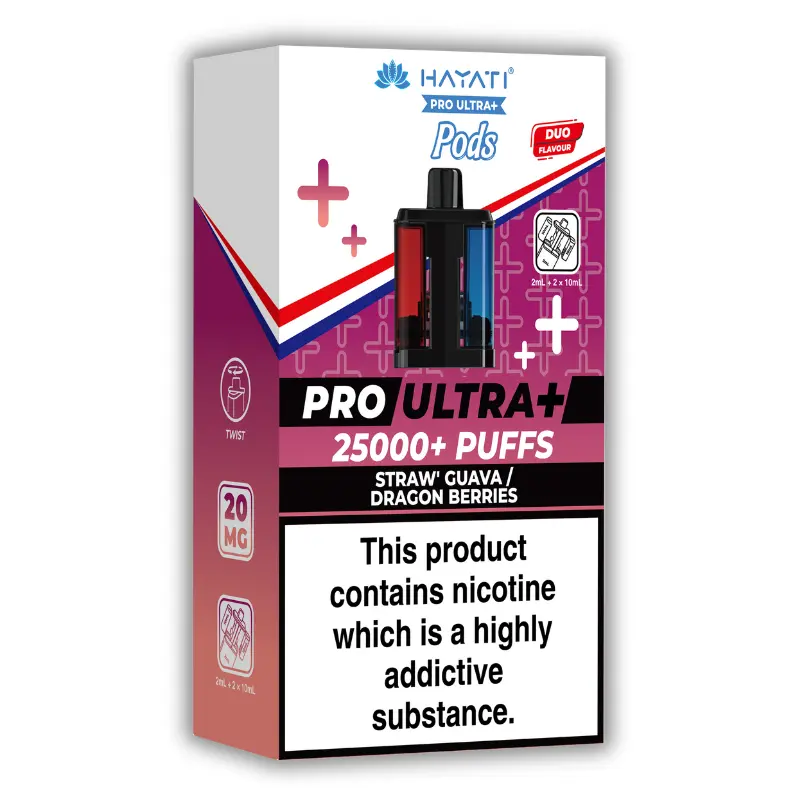
Hayati · Pro Ultra Plus
Straw’ Guava / Dragon Berries Hayati Pro Ultra Plus Pods
£7.99
✔ In stock — ready to ship
Genuine Hayati
Free over £20
Same-day dispatch
Secure checkout
This is the replacement pod for the Hayati Pro Ultra Plus at £7.99: one housing, 22ml of 20mg nicotine salt carried as two separate liquids, and a collar on the mouthpiece that picks the one feeding the coil. Nothing else is in the packet, so the device is a separate purchase. The complete version, body included, is the Straw’ Guava / Dragon Berries Hayati Pro Ultra Plus 25000 Prefilled Pod Kit, four pounds dearer. Hayati's stated ceiling is 25,000 puffs, produced by apparatus drawing to a timer, which makes it a way of ranking listings rather than a forecast of anybody's month. Check the range name printed on your device against the range name in this title before ordering either.
Hayati's own words for the two halves are worth setting side by side before anything else. The guava side gets fragrant. The berry side, on the sibling listings that bother to explain it, gets mild, subtle and softens. That is not a coincidence of copywriting, and it is not a small difference. Counted across all 492 listings in this catalogue, those are the house's loudest and quietest words for what a fruit smells of, and this pod is one of very few places where they meet behind a single mouthpiece.
So the argument of this page is about intensity rather than taste. One side of the collar carries a fruit that is detectable at concentrations most fruits could not dream of, that lingers, and that leaves a mark on everything downstream of it. The other carries a fruit that several pages in this catalogue have already concluded contributes almost nothing. That is a legitimate way to build a pod, and it is defended properly further down. But it makes the order in which you use the two sides a mechanical requirement rather than a matter of mood, and it makes the penalty for getting the order wrong larger here than on any pod whose halves are evenly matched.
Counting the claim before making it
An angle that says "the loudest fruit against the quietest" is the sort of thing that sounds good and falls over on inspection, so it was counted first. The counting survived, in a narrower and more interesting form than the slogan.
Guava appears in eight product titles out of 492. Two of those are Guava Kiwi Passion Fruit across a kit and a bare pod, two are Strawberry Guava across the same pair of formats, one is a Mini Ultra pod sold as Straw’ Guava on its own, and three are this pairing, on three platforms. Dragon fruit, in one spelling or another, also appears in eight titles. Three of those are Dragon Berries by itself, two are the grapefruit pairing, and three are this pairing again. So the two fruits have identical footprints in the catalogue, and three of the sixteen appearances are the same three listings, because this recipe is the only place in the range where the two are sold together.
Footprint is not intensity, though, so the useful count is a vocabulary count. Here is what it turned up.
Every single guava listing carries an aroma-intensity word, without exception. The word fragrant appears in 30 of the 492 descriptions, and eight of those thirty are the eight guava listings. Guava is 1.6 per cent of the range and 27 per cent of the range's use of that word. Not seven of the eight. Eight of the eight, with no exception anywhere. One of them, the Strawberry Guava replacement pod on the older platform, then piles heady on top, a word that occurs exactly once in the whole catalogue and is spent on this fruit. The Mini Ultra pod goes further again and says the fruit is hard to mistake for anything else, a phrase that also turns up precisely once in 492 listings and is also spent on this fruit. Five of the eight add floral and two add perfumed.
Now the other side. The word mild appears four times in the catalogue. Two of those four describe dragon fruit; the other two describe a double menthol and a cooled dark-fruit pod, where mild is a statement about the chill rather than about a fruit. Subtle turns up on the Dragon Berries kit. Where the copy goes on to explain the fruit's role, the verbs are all of one kind: it softens, it is light, it is gently sweet, and on one listing the berries are said to be doing the heavy lifting, a phrase that occurs four times in the catalogue and once for this fruit.
The single best piece of evidence is on the Mini Ultra version of this exact pairing, because it puts both habits in one paragraph. Guava is given a fragrant, slightly floral tropical character. Dragon fruit, three sentences later, is called mild and gently sweet, and the copy says it tends to soften the berries rather than compete with them. The word compete appears three times in 492 listings. One of those three is a denial that this fruit does any competing, written about the recipe in your hand.
So the narrowed, survivable version of the claim is this. Across the whole catalogue, guava is the only fruit Hayati never describe without reaching for an intensity word, and dragon fruit is the fruit they most consistently describe by saying how little it does. No other pairing in the range puts those two habits on either side of one collar. That is a statement about the house's vocabulary rather than about a gas chromatograph, and it is stated as such, but a copy department that has written about guava eight times and never once managed to leave out the word fragrant is telling you something about the liquid.
One honest complication, because the listing set does not agree with itself. Hayati are unanimous that guava is loud and they are not unanimous that it dominates. The Guava Kiwi Passion Fruit copy says guava leads. The Strawberry Guava copy for the same fruit says the blend is seamless rather than contrasting and that no single fruit fights for attention. Those pull in opposite directions, and the tidy explanation is that both are true of different recipes: guava leads when it is set against kiwi and passion fruit, and it merges when it is set against strawberry, which is the case here. Loudness and dominance are separate properties. Something can be impossible to miss and still be underneath.
What guava's loudness actually is, and why it is the awkward kind
Two pages in this catalogue have already done the chemistry on this fruit and there is nothing to gain from doing it again, so their findings are cited here and built on rather than rediscovered.
The Guava Kiwi Passion Fruit kit page established that guava is not chemically independent of passion fruit: it carries some of the same sulphur-bearing material alongside its own esters, and the compounds in that family are detectable at concentrations several orders of magnitude below ordinary fruit esters, with a character that inverts as the dose climbs. That page also found that guava is among the hardest fruits to render convincingly in vapour, and that what the trade builds instead is a pink, perfumed, faintly pear-adjacent sweetness with a floral top.
The Strawberry Guava kit page took the same fruit apart from the other direction and found four components: a warm, low, slightly animal musk unlike anything else on that shelf, a thin powdery perfume hovering above it, a faint sulphurous edge that the palate files as ripeness at low concentration and as savoury then stale as it rises, and a grainy broad-band sweetness with essentially no acid in it. It also found that the musk outlasts the fruit on the finish by a couple of seconds, and that the whole charm of the fruit lives inside a narrow window on that dial.
Take those two findings together and the thing worth adding is about dose rather than character, and it is the hinge of this page.
A compound audible in parts per billion is a compound you can put into a recipe at a vanishing fraction of the total and still taste at full strength. That is a different sort of loudness from the one most people picture. Mango is loud by mass: there is a lot of it, it fills the mouth, and diluting it by half genuinely halves it. Menthol is loud by a route that is not smell at all, since a coolant acts on the nerve rather than the nose. Guava is loud by threshold. It does not need volume to be heard, which means that halving it does not halve it, and that a quantity small enough to be invisible in a recipe is still comfortably above the point at which a person notices it.
Three consequences follow, and all three bear directly on a pod with two sides and one coil.
It survives dilution. Mix a guava accord into something at a few per cent and it is still guava. Mix it at a few tenths of a per cent and it is still detectable. There is no dose at which it politely disappears; there is only a dose at which it stops being the headline and starts being an unexplained heaviness.
It survives being carried. A residue of an ordinary fruit ester left in a wick is inaudible after a couple of draws because the concentration reaching you has dropped below the level at which you can hear it. A residue of sulphur-bearing material does not drop below that level nearly as quickly, because the level is so much lower to begin with.
And it survives being misread. Because the character of the compound family shifts with concentration, a small residue does not taste like a small amount of guava. It tastes like something else entirely: a warm savoury weight with no obvious source, exactly the sort of thing a person blames on whatever they think they are drinking at the time.
None of that makes guava a bad fruit to build a pod around. It makes it a fruit that has to be placed carefully in relation to everything else, which is precisely what a collar does and precisely what a shared coil undoes.
The quiet half, taken from the pages that settled it
Relative to how little it does, dragon fruit is the most heavily analysed fruit in this catalogue, and none of that work is redone here. Two pages carrying the Dragon Berries name on the older platform settled the following, and this page treats their conclusions as fixed.
There is no character compound. Banana has one, peach has one, raspberry has a molecule named after itself, and this fruit has no equivalent, which is why every attempt to describe it ends up leaning on a different fruit, pear or melon or kiwi or lychee, and why none of those loans quite fits. Its volatiles are largely green, grassy and faintly fatty, with small amounts of floral terpene alcohol sitting behind them. The pleasures of eating one are colour, texture, chilled water and a mild clean sweetness, and only the last of those four can be put into vapour. So any flavour sold under this fruit's name is an assembled impression rather than an extract, and set beside a sweet berry base it behaves as a modifier and never as a lead.
The bare-pod page went one step further and reached a verdict: the modifier is probably real and it is close to worthless as a reason to buy, which are compatible positions and the distinction is the point. And the Straw’ Grapefruit / Straw’ Dragonfruit Hayati Pro Ultra Plus Pods listing, which is the only other dual on this shelf carrying this fruit, adopted those findings and drew the conclusion that the dragon fruit half of a pod is quiet by design rather than weak by accident, functioning as a rest from the demanding side rather than as a second flavour.
All of that is accepted here. What this page does with it is different, and the difference is mechanical.
On the grapefruit pod, the demanding half is demanding because of a taste. Bitterness is detected in the mouth, it adapts in your receptors with repeated exposure, and the thing it does to the quiet half is limited by how much bitter material can sit in a wick. On this pod, the demanding half is demanding because of an aroma, and an aroma detectable at parts per billion behaves nothing like a taste detectable at parts per thousand. It travels in the liquid, it clings to the wick, it evaporates into the next draw, and your nose adapts to it in a way that raises your threshold for everything faint for a good while afterwards. Same structure, different physics, and the practical advice that falls out is not the same advice.
That is the gap this page fills. The rest-half argument was made on the grapefruit listing and is not re-argued. What has not been worked out anywhere is what a rest-half costs when the thing you are resting from is an aroma rather than a taste, and the answer turns out to be a specific number of draws.
Both halves lead with strawberry, and only one of them admits it
The title names strawberry once. On the evidence, it belongs on both sides.
The guava side states it: Straw’ Guava is strawberry and guava, with the berry in the head position, and the clipped form is ordinary house practice rather than a signal. Strawberry appears in eighty of the 492 titles in this catalogue, which makes it the default base of the entire range and the obvious anchor for anything unfamiliar.
The berry side does not state it, and the sibling pages give good reason to think it is there anyway. The Dragon Berries kit page found that an unqualified "berries" accord in this format is most probably strawberry-forward with raspberry behind it and something dark underneath for depth, and it flagged that as the most probable composition rather than a confirmed one. The same hedge applies here and is repeated deliberately: Hayati name no species for the berry half of this pod, and nothing on this page pretends otherwise. What can be said is that if the sibling reading is right, both halves of this pod open on the same fruit, one of them on the label and one of them anonymous, and the pod is considerably less varied at the front of a draw than its title suggests.
Which raises the question of what a strawberry is actually for in each position, and the two answers are not the same.
Beside the guava
Not contrast. The Strawberry Guava kit page established that the two fruits occupy the same aromatic register instead of complementary ones: strawberry's identifying aromatics already carry a floral, faintly green facet over a soft low base, guava turns up with a floral top of its own and a musk pitched in the same warm low register, and neither supplies what the other lacks. That page's conclusion, which is not re-derived here, is that the two stack rather than complement, and whether the stack reads as a deeper strawberry or as a vague pink smear comes down to heat and draw length.
Accepting that, the strawberry's job here is identification. Most people buying this pod in Britain have not eaten a guava recently and could not pick one out of a fruit bowl by smell. What they can do is recognise a strawberry instantly, and a recognisable fruit at the front of a draw gives the unfamiliar one somewhere to attach itself. Take the strawberry away and you would have a pink, musky, perfumed, faintly savoury liquid with nothing in it that a British buyer has a name for. The berry is the handle on the door.
Does it survive the guava? As a shape, yes. As an identity, only at the start. The strawberry owns the entry and the first part of the draw, and the musk comes up behind it and outlasts it, which means that what you are left with at the end of each exhale is guava and what you begin each draw with is strawberry. The pairing therefore reads as one fruit at the front and another at the back rather than as two fruits side by side, and anybody expecting a berry pod with a tropical note woven through it will find the weighting shifts as the draw goes on. That reading is built on the sibling pages' tasting plus the vocabulary evidence above, and it is offered as a reading.
Beside the berry mix
Here the strawberry is not a partner at all, it is the floor. Nobody names it, Hayati do not itemise it, and its job is body rather than identity. The exotic element threaded through it is, by the sibling pages' account, doing almost nothing beyond lightening the whole thing very slightly and stopping it reading as jam.
Which produces the genuinely odd shape of this pod, and it is the shape a buyer should know about. The collar changes the finish, not the entry. Both sides open sweet and red. One of them then goes somewhere and the other does not. That is a smaller difference than two flavour names on a box imply at the beginning of a draw and a larger one at the end of it, and it explains why some people report the two sides as barely distinguishable while others find them unmistakably different: the first group is judging the inhale and the second group is judging the finish.
The running order is a requirement, not a preference
Everything above converges on one practical decision, and unusually for a dual pod it has a correct answer.
Two things carry across a switch of the collar. The first is whatever the wick is still holding. Hayati state that the two liquids are kept apart inside the housing and that turning the mouthpiece selects which of them feeds the coil, and they publish nothing whatsoever about how the separation works, so this page describes the outcome and declines to invent a mechanism. The outcome, whatever the plumbing, is that both liquids arrive at the same wick and the same coil, and material from the side you just left does not vanish when you turn the collar. It gets vaporised into the first draws of the side you just joined.
The second thing that carries across is you. Your nose adapts to a sustained aroma by raising its threshold for it, and the adaptation is not confined neatly to the one compound that caused it. Spend a stretch on a high-intensity musk and your sensitivity to faint aromatic material is depressed for a while afterwards, which is a problem when the next thing you intend to taste is, by three pages' worth of prior analysis, the faintest fruit anybody names a product after.
Both of those losses run the same way, and they compound. That is the whole argument, and it gives a direction.
Use the Dragon Berries side first and the Straw’ Guava side second, in stretches, and not the other way round.
Three reasons, in ascending order of how much weight they bear.
The first is about the wick. Residue of the berry side left in the wick when you turn to guava is completely inaudible, because it is a sweet red accord sitting under a fruit that is loud at a thousandth of its concentration. Residue of the guava side left in the wick when you turn to berries is the loudest thing in the pod, and it is arriving on top of a liquid whose distinguishing note, on the corpus's own account, is barely there when the coil is clean. The contamination is trivial in one direction and decisive in the other.
The second is about you. After a stretch on the quiet side, your sensitivity is intact and you can read anything, including a musk. After a stretch on the loud side, you cannot read the quiet one. There is no symmetry here either.
The third is corroboration, and it is worth setting out because nobody designed it. Two pages in this catalogue, written independently and neither of them about this pod, each reached a rotation conclusion about one of these two liquids. The Dragon Berries kit page concluded that its liquid gets more out of going first in a session, because a delicate floral top note stands no chance against a residue, and that it should be followed by something loud rather than preceded by one. The Strawberry Guava kit page concluded, separately, that its liquid flattens whatever comes after it for a good half hour and therefore belongs after something sharp rather than before it. Two writers, two liquids, two arguments, and the conclusions fit together without a seam: berries first, guava last.
Both of those were written about a rotation between two separate devices, where the only thing carrying material from one flavour to the next is your own palate. Put the same two liquids in one housing over one wick and the conclusion holds with more force rather than less, because a second carrier has been added and it is the one you cannot rinse.
What it costs to get it backwards
The failure here is not that the berry side tastes bad. If it tasted obviously wrong the problem would announce itself and correct itself. The failure is that a contaminated draw on the berry side tastes like something, and the something is plausible.
Walk through it. You have been on the guava side for an hour. You turn the collar, draw, and get a sweet red berry blend with a warm, faintly savoury heaviness sitting behind it that does not quite belong. You have no reason to suspect the wick. You have every reason to suspect the liquid, because the liquid is the thing with a name on it. So you conclude that Dragon Berries is heavier and stranger than you wanted, you turn the collar back, and you never use that half again.
The Dragon Berries bare-pod page worked through a related mechanism from the other end, finding that buyers credit whatever they enjoyed to the unusual word on the box because the unusual word is the only element specific enough to name. This is the same machinery running in reverse: blame rather than credit, attached to the same half, for the same reason. The berry side is the anonymous one, so it is the one that absorbs any oddity you cannot place.
The financial version of that is straightforward. Twenty-two millilitres is one budget. Hayati do not publish how it is divided between the sides, which is the most consequential blank on the listing. Retire one half early and you reach the end of the pod with liquid in it that you paid for, cannot decant, cannot use and cannot separate from the housing. A pod abandoned on one side is not half a pod at half a price. It is a whole pod at a whole price with part of it discarded, and the trigger for that outcome can be four contaminated draws on your first evening.
A clearance rule, with a count rather than a judgement
The obvious instruction would be to wait until the berry side tastes clean. That instruction is useless here for the reason just given: the contaminated draw already tastes clean. It tastes like a coherent, sweet, slightly heavy berry liquid. There is no ragged edge to notice and no obvious fault to wait out, so a judgement has nothing to act on and a count is the only workable form of the rule.
Here is how the number was arrived at, since a number pulled out of the air is worth no more than a judgement.
Clearing a wick is not a linear process. Each draw removes some proportion of what is in there and replaces it with the incoming liquid, so the residue falls by roughly a constant fraction per draw rather than by a constant amount. That means the number of draws you need is governed by how far down the residue has to go before it stops being audible, and how far down that is depends entirely on your detection threshold for the thing in question. Fall by a factor of ten and you need a certain number of draws. Fall by a factor of a thousand and you need roughly three times as many.
Most switches on this shelf are between two liquids built from ordinary fruit esters with broadly similar thresholds, so the residue only has to drop an order of magnitude or so before it is gone, and a handful of draws does it. That is why the standard advice across the dual listings on this shelf runs to three, four or five draws, and on a pairing of two comparable fruits that advice is right.
It is not right here, and the reason is the threshold finding cited earlier. Sulphur-bearing aromatic material is audible at concentrations several orders of magnitude below the esters it is sitting among. The residue therefore has to fall a great deal further before it drops out of hearing, and since each draw only takes a fixed proportion, further means more draws, not stronger ones.
The rule, then. When you turn the collar from Straw’ Guava to Dragon Berries, put the device down for two minutes, then take eight unhurried draws and form no opinion whatsoever about the berry side until the ninth.
The two minutes are for you rather than for the pod: aromatic adaptation recovers on roughly that timescale, and there is no point flushing a wick while your own sensitivity is still depressed. The eight draws are for the wick. Count them rather than estimating, because the whole difficulty is that the contaminated draws give you no signal to estimate from.
Turning the collar the other way needs nothing at all. Switch to guava and draw; whatever the berry side left behind is beneath notice within one pull. Write that asymmetry down, because it is the practical heart of this listing: one direction of the switch is free and the other costs eight draws.
Which in turn settles how the pod should be used. In stretches, not in alternation. Every return to the berries costs eight readable draws out of that half's share of the 22ml, and every move in the other direction costs nothing at all. Come back to the quiet side six times in a day and forty-eight of its draws have gone on clearance, all paid for and none worth having. Come back twice and the overhead is sixteen. One side in the morning and the other in the afternoon charges you eight a day, which is as low as the bill goes.
One refinement for anyone who wants to test the rule rather than take it on trust. Fit the pod, run the berry side first from new so you know what it tastes like off an uncontaminated wick, and only then go near the guava. That single ordering decision on day one gives you a reference you can never get back afterwards, because once the guava has been through the coil the clean version of the berry side is gone for the life of the pod.
In defence of a quiet half
It would be easy to read all of the above as a complaint that half this pod is filler, and that reading is available. It is not the one this page takes, and the reasons matter.
A quiet half beside a loud one is a real design and not a shortfall. The grapefruit pairing on this shelf made that case first and made it properly, arguing that at this volume a difficult flavour is better served by somewhere restful than by a rival, and that the worth of a switch depends on what you are switching away from. That reasoning stands and is not rebuilt here. The addition is that this pod puts the idea to a harder test, because what you are resting from is a different order of thing.
Bitterness tires you by adaptation, which means the demanding side of the grapefruit pod partly solves its own problem: draw on it often enough and it stops being demanding. A heavy aroma does not work like that. Olfactory fatigue sets in, but the liquid keeps depositing material, the mouth keeps reporting a broad unpunctuated sweetness, and the Strawberry Guava kit page found that the sweetness on this particular blend is broad rather than pointed and accumulates across a session with no acid and no chill available to clear it. That is a flavour you genuinely want to step away from, and stepping away without changing pods has an obvious value.
So who is this pairing actually right for?
It suits somebody whose day comes in long stretches rather than constant small dips, because the clearance overhead is charged per switch and not per hour. It suits somebody who already knows that rich, sweet, uncooled fruit stops registering for them after half an hour, and who would rather have somewhere to go than carry a second device. It suits somebody who wants one flavour with real character and is content for the alternative to be undemanding, which is a perfectly ordinary preference and not a lesser one.
It does not suit somebody who wants two flavours of comparable interest for their £7.99, and they are better served by a pairing built from two fruits of similar weight. Blueberry Raspberry / Blueberry Raspberry Cherry Hayati Pro Ultra Plus 25K Pods varies one term against a shared base and keeps both sides at the same volume. Straw’ Cranberry Cherry / Cherry Ice Hayati Pro Ultra Plus Pods sets two assertive halves against each other with a coolant marking the difference.
It also does not suit somebody who intends to live almost entirely on the guava side. That person is paying for a divided pod and using an undivided share of it, and the Hayati Pro Ultra Plus Pods shelf carries plenty of single-flavour listings with no collar at all, where nothing is stranded. Straw’ Guava exists on its own on the Mini Ultra range if the guava is all you want, on smaller hardware and at a much lower price, which is the cheapest way to find out whether the fruit suits you before committing 22ml to it.
The object, kept short
The packet contains a pod. That is the inventory. Twenty-two millilitres at 20mg in salt form, split between two liquids, fitted to a Pro Ultra Plus that is already yours. Turning the collar picks which liquid the coil is fed, and because Hayati describe the selection without describing the plumbing, this page does the same and invents nothing to fill the gap.
Sharing one coil between two liquids has three effects, and this pairing feels all three harder than most. Contamination at the switch is the first and by some distance the biggest, for the reasons argued at length above. Ageing is the second, and it is joint: every millilitre from either half crosses the same mesh, so neither side can be given a fresh start while the other carries on. A guava side that has begun to turn sits on exactly the same worn coil as a berry side you have hardly opened.
Third is the money. One tank, one price, and no published figure for how the 22ml is apportioned, which means anything you leave behind in the half you stop using departs inside the housing. Neither half can be bought, topped up or retired on its own. For how the rest of this platform is organised, the Hayati Pro Ultra Plus Prefilled Pod Kits & Pods shelf holds both formats together.
The record, sorted by which half it describes
The table is arranged around the asymmetry this page is about, because on this listing the interesting question is what Hayati commit to for each side rather than what the pod weighs. Rows recorded as unpublished are absent from Hayati's data for this product, not omitted here.
| Line | What the listing gives |
|---|---|
| Intensity word attached to the guava half | Fragrant, as on all eight guava listings in the range |
| Intensity word attached to the berry half | None. The siblings give mild, subtle and softens |
| Fruits named on the guava side | Two, strawberry and guava, no ratio |
| Fruits named on the berry side | None. A category noun and an exotic slant |
| Product type recorded in the data | Dragon Berries. The guava half is missing from the field |
| Selection between the halves | A collar, turned. The internals are not described anywhere |
| Share of the liquid each half gets | No figure given |
| Chill declared | Nothing in the name, nothing in the copy |
| Tartness declared | Nothing, on either half |
| Volume in the housing | 22ml across both liquids |
| Strength as supplied | 20mg salt, with no alternative on this listing |
| Puff ceiling quoted | 25,000, taken from bench apparatus |
| Hardware included | Nothing. The body is bought separately |
| Ratio of the two base liquids | Not recorded against this product |
| Resistance at the coil | Not recorded against this product |
| Shelf filings | Eight, of which Berry, Exotic and Strawberry say anything |
| Catalogue code | straw-guava-dragon-berries-hayati-pro-ultra-plus-pods |
| Brand | Hayati |
| Asking price | £7.99 |
| Kit version of the same recipe | £11.99 |
Six of those rows want a note, and the fifth is the one nobody expects. Where the data records a product type, this listing says Dragon Berries and stops. The guava half, which carries the unusual fruit and every intensity word on the page, does not appear in the field at all. Nothing sinister is going on; it is what happens when a recipe with two names is dropped into a slot built for one. The consequence is still worth knowing, which is that every filter, lookup and category surface in this catalogue identifies this pod by its quiet half.
The missing split is the row that could change a decision. Somebody buying this because of the guava, and the guava is the reason anybody would, has no way of finding out what fraction of the 22ml they are actually being sold. Budget for discarding part of the berry half and nothing about the pod will disappoint you.
Twenty milligrams states a concentration and claims nothing beyond it. It happens to be the legal ceiling for a consumer e-liquid sold here, so the number is a limit rather than any sort of suggestion, and nicotine is addictive irrespective of the fruit surrounding it. Given how much liquid this housing holds, the figure deserves a deliberate second look at reorder and not only at first purchase.
The pair of empty technical rows are the ones most often borrowed from a neighbour, and a borrowed number quickly starts to look like a measured one. The first of them determines vapour density and the speed at which liquid moves through the wick, which on a pod with a contamination problem would have been genuinely worth knowing. Hayati record neither, so neither appears here as a value.
As for 25,000, it was obtained by machinery pulling to a fixed timetable, a pattern no person reproduces, and on a two-sided pod it says even less than usual because one total is covering two liquids in an undisclosed ratio. Longer pulls and more frequent ones shift the real count, always downwards. Twenty-two millilitres is the sounder planning figure, and even that assumes you know which half you will mostly use.
What else is on the shelf, and who should take which
What follows all sits on the Pro Ultra Plus, and where no other figure is given the price matches this one. The headings sort by the shape of pairing you are after rather than by which fruits are involved, because shape is the thing this listing is genuinely selling.
If the guava is the reason and you want the whole device to arrive with it. The kit twin, linked at the top, is the same recipe with a body in the box for £11.99. The four pounds is hardware, bought once, and there is no flavour difference between the two listings. If you want the same pairing on smaller hardware to try it cheaply first, the Mini Ultra version exists at a fraction of the price with a much smaller pod, and it is the least expensive route to an answer.
If it is the other dragon fruit pairing you are weighing this against. The Straw’ Grapefruit / Straw’ Dragonfruit pod linked above is the direct comparison and the two are more different than their shared fruit suggests. That pod's loud half is loud by taste, this one's is loud by smell, and the practical consequences diverge completely: there, the advice is to space your draws so the bitterness stays legible; here, the advice is to run the sides in long stretches so the quiet one stays readable. If you want to know which kind of demanding flavour suits you, owning both in succession is a genuinely informative pair of purchases.
If the strawberry underneath is what you were really after. It is available all over this shelf without a difficult partner attached. Take Strawberry Watermelon Hayati Pro Ultra Plus Pods, one liquid, no collar, the base set against a watery fruit that demands nothing from you. Or Strawberry Raspberry Ice Hayati Pro Ultra Plus 25K Pods, which brings in a second red fruit and a chill. Strawberry Ice / Strawberry Raspberry Ice Hayati Pro Ultra Plus 25K Pods takes that to a collar and keeps the two halves deliberately close together, which is precisely the opposite wager to the one in your hand. Eighty-two listings sit on Strawberry Vapes if none of the three lands.
If tartness is the thing you were missing. Anybody who has found a guava liquid hard going over a long stretch is usually short of punctuation rather than short of flavour, and this is the likeliest misreading of the complaint. Straw’ Lemonade Hayati Pro Ultra Plus 25K Pods holds the base steady and exchanges the fragrant partner for a citrus one, about as clean a single-variable comparison as this platform allows. The same trick over a darker fruit is Blackcurrant Lemonade Hayati Pro Ultra Plus 25K Pods. Drop the berry altogether and you are at Lemon Lime Hayati Pro Ultra Plus Pods. Keep the two-sided format but give the second side teeth with Blue Razz GB / Lemon & Lime Hayati Pro Ultra Plus 25K Pods.
If you would rather the contrast came from cold. Chill clears a palate more dependably than any soft fruit manages, though it swallows whichever half is carrying it. The uncomplicated version is Cherry Ice Hayati Pro Ultra Plus 25K Pods. Behind a collar, Straw’ Cranberry Cherry / Strawberry Raspberry Ice Hayati Pro Ultra Plus 25K Pods stands a drying half against a cooled one, while Blue Razz Pineapple / Strawberry Ice Hayati Pro Ultra Plus 25K Pods hangs the chill on the strawberry. Pushed to its limit, Fresh Mint / Blue Razz Mint Hayati Pro Ultra Plus 25000 Prefilled Pod Kit is minted on both sides and arrives with a body for £11.99. Worth noting for this page's purposes: a coolant works on the nerve rather than the nose, which makes it the one sensation in the range a musk is incapable of burying.
If the confected corner is where you normally shop. Moving from a sweet-counter profile to a musky perfumed one is a wider step than the word "fruit" on both boxes would lead you to think, and it goes better when taken deliberately. Blue Razz GB Hayati Pro Ultra Plus Pods and Blue Razz Cherry Hayati Pro Ultra Plus Pods mark out that register. Deeper into it sits Blackcurrant Cotton K / Blue Raspberry Hayati Pro Ultra Plus Pods, and Watermelon B’Gum / Strawberry B’Gum Hayati Pro Ultra Plus Pods runs a chewing-gum treatment across both halves. Arriving here from any of them, expect the guava to register as peculiar rather than fragrant for a day or so until your expectations move, which is a recalibration and not a defect in anything.
If you want both halves undemanding. Kiwi Banana / Straw’ Banana Hayati Pro Ultra Plus Pods is built from soft low fruit throughout, and the contamination problem barely arises there for the simple reason that neither side is capable of shouting down the other. Cherry Berry Hayati Pro Ultra Plus Pods has one liquid and no collar to think about. Grape GB / Strawberry GB Hayati Pro Ultra Plus Pods sets two sweet confected halves of roughly equal weight beside each other.
If you are browsing rather than deciding. The Exotic Vapes shelf collects 55 listings across every format, which is where the guava and dragon fruit builds all end up, and Berry Vapes runs to 225 if the quiet half is closer to what you want. The whole Hayati range is 492 listings if none of the above is close.
Handling a pod with a threshold problem in it
The usual pod housekeeping applies here as it does anywhere and gets no space. Everything below exists because one of the two liquids contains a fruit audible at concentrations nothing else in this catalogue comes near, and several of these instructions would be actively unhelpful on an evenly matched pairing.
Run the berry side first from new. This is the one instruction on this page that cannot be recovered later. A wick that has never carried guava is a resource you have exactly once, and spending it on the quiet half gives you a clean reading of the only side you will never get a clean reading of again. Ten minutes on the berries before you turn the collar costs nothing and settles what that half actually tastes like.
Prime it, and be aware that a dry pull hides here. Stand the pod upright for a couple of minutes after fitting and keep the opening draws short. The reason is specific: a scorched wick produces a note that is savoury and slightly stale, and the Strawberry Guava kit page found that exactly that character is what guava produces at the wrong concentration. Cook the wick in the first thirty seconds and you will attribute the result to the recipe, which several people have done to that liquid already.
Draw shorter than feels natural on the guava side. The sibling pages established that this blend's two fruits separate by heat, that the layered version and the shapeless version are a second or two of draw length apart, and that most complaints about it are complaints about technique. That finding is theirs and it applies unchanged here. What is worth adding is that a long hot draw on this pod costs you twice, because it also loads the wick more heavily with the material you will be trying to clear when you switch.
Space the draws. There is no acid and no coolant in either half, which means nothing in the pod punctuates anything and your own palate is the only reset available. Three draws in thirty seconds and three across five minutes are, for flavour purposes, two different pods.
Keep it somewhere cool and dark. Heat drives off the lightest aromatic material first, and on the berry side the lightest material is precisely the exotic note the corpus has already judged marginal, so a pod that has spent an afternoon on a warm windowsill will answer your questions about that half wrongly and will not tell you it has. Upright, out of direct sun, never a parked car, and somewhere children and pets cannot get to it.
Know the direction of decline. Residue on a coil takes the most volatile material away first, so the sequence here runs: the berry half's faint exotic edge, then the strawberry brightness common to both, and the musk outlasting everything. Which means the signal that this pod is finished is not a fading flavour. It is the guava turning, ripe to overripe to plainly tired, a marker the Strawberry Guava kit page identified for that liquid and which transfers intact to this housing. Once you are getting the tired version, the whole pod is done whatever the berry half is doing, since one worn coil cannot be replaced under one half and kept under the other.
Disposing of it. A coil and some unreachable liquid remain inside when you are finished, which rules out the kitchen bin. Hand it to a vape shop that runs a collection box, or to the small electricals point at your local tip.
What buyers want to know about this one
Am I buying one pod here, or two?
One. Twenty-two millilitres in a single housing, the two liquids held apart inside it, and a collar choosing which one the coil draws from. The change takes effect immediately and can be made as often as you like, so nothing is being saved for later. The order you use them in, on the other hand, matters a great deal, which is most of what this page is about.
Which side should I use first?
Dragon Berries, then Straw’ Guava, in long stretches rather than alternating. Guava is detectable at concentrations far below ordinary fruit material, so residue of it in the shared wick is clearly audible on the berry side, while residue of the berry side is inaudible under the guava. Your own sensitivity runs the same way. Both losses point in one direction and there is no offsetting advantage to the reverse order.
How long does it take to clear the guava out after switching?
Two minutes with the device down, then eight draws before you judge anything. The two minutes let your own sensitivity recover; the eight draws flush the wick. Three or four draws is the usual figure on this shelf and it is not enough here, because the material you are clearing is audible at a much lower concentration and therefore has much further to fall.
Will I actually detect the dragon fruit?
Not as a fruit you could put a name to, on the balance of what has already been established here. Two pages worked it out and a third has since adopted their conclusion: the fruit lacks any identifying molecule, that its volatiles are mostly green with a little floral material behind them, and that the qualities people like in the fresh fruit cannot be put into vapour at all. What to expect from the berry half is a sweet red blend running slightly lighter than a plain one. That is the fruit's limitation rather than the pod's.
Is the guava side actually strawberry, or actually guava?
Both, in sequence rather than side by side. The strawberry owns the entry and the first part of the draw, and the guava musk comes up behind it and outlasts it on the finish. The practical result is that the two halves of this pod are more alike at the beginning of a draw than the title suggests and much less alike at the end of one.
Has it got a chill in it?
Neither the name nor the copy points to a coolant, and Hayati put cooling words into a product name whenever a coolant is present. On a title with no such word, expecting no chill is the sensible reading. Nobody publishes cooling strength for anything in this catalogue, so what you have there is an inference from a naming habit rather than a measured figure.
How sweet is it, and does it get harder to taste over a session?
Sweet on both sides and unpunctuated, since neither half carries declared acid or a coolant. The Strawberry Guava analysis found that this kind of broad sweetness accumulates rather than clearing between draws, which is a large part of why a second side is worth having. A break restores it; drawing harder does not.
Which berries are in the Dragon Berries half?
Hayati do not say, on this listing or on any of the others carrying that name. The sibling pages' best reading is that an unqualified berry accord in this format is most probably strawberry-led with raspberry behind it and something dark underneath, offered as a probability rather than a fact. If knowing matters to you, an itemised listing is the better purchase.
What happens when one half empties before the other?
You reach the end of the pod, because nothing can be refilled on either side. The 22ml total is published; the division of it is not. Anyone who ends up living mostly on the guava should therefore expect to bin the housing with a quantity of the berry liquid still sealed inside it. That is a genuine cost of this format and the listing says nothing about it.
Can you tell me the carrier ratio or how many ohms the coil is?
No, because Hayati record neither against this product, and nothing invented gets printed here. Any figure you have seen for either one on a different listing was not drawn from this pod's specification, and repeating it would dress somebody's assumption up as evidence.
Am I better off with the kit?
Only if there is no Pro Ultra Plus body in the house. What the extra four pounds buys is the device, and a device is a one-off purchase. Order this listing without something to fit it to and you are left holding a sealed pod you cannot use.
Can I plan around the 25,000 rating?
Barely. That ceiling came from apparatus pulling on a fixed cycle, so it characterises the equipment far better than it characterises a person, and here it is even less use than usual because one number is covering two liquids split in an undisclosed way. Longer and more frequent draws pull the real total down from it.
The short version
Seven pounds ninety-nine, one housing, 22ml at 20mg in salt form, two liquids kept apart with a collar choosing between them, and no hardware in the packet. The maker's bench figure is 25,000 puffs.
What makes it worth thinking about is the gap between the two halves. Counted across 492 listings, guava is the one fruit Hayati have never managed to describe without an intensity word, appearing in all eight of its listings with the catalogue's only use of "heady" among them, while dragon fruit collects the diminutives: mild, subtle, softens, and an explicit statement on the Mini Ultra version of this very recipe that it does not compete. That gap is real, and because guava's loudness comes from a detection threshold rather than from volume, it does not wash out of a shared wick the way an ordinary fruit residue does.
So the order is not a preference. Berries first, guava second, in stretches, with two minutes and eight draws between the switch and any opinion about the quiet side. Get it backwards and the berry half tastes plausibly but wrongly of something heavy and savoury, you will blame the liquid rather than the wick, and you will retire half of a pod you cannot separate or refill.
Buy it if you want one fruit with genuine character and somewhere to put it down without changing pods, and if your day comes in stretches rather than constant small dips. Buy something with two evenly weighted halves if you want the collar to be a real choice, and buy the Mini Ultra version of this pairing first if you have never met a guava liquid and would rather find out cheaply whether the loudest fruit in the range is one you want to live with.
Strictly for adults aged 18 and over. Nicotine is an addictive substance.
You might also like


