
Home / Hayati Pro Max Nic Salts / Strawberry Jelly Beans Hayati Pro Max Nic Salt
Hayati · Pro Max
Strawberry Jelly Beans Hayati Pro Max Nic Salt
£2.49
✔ In stock — ready to ship
Genuine Hayati
Free over £20
Same-day dispatch
Secure checkout
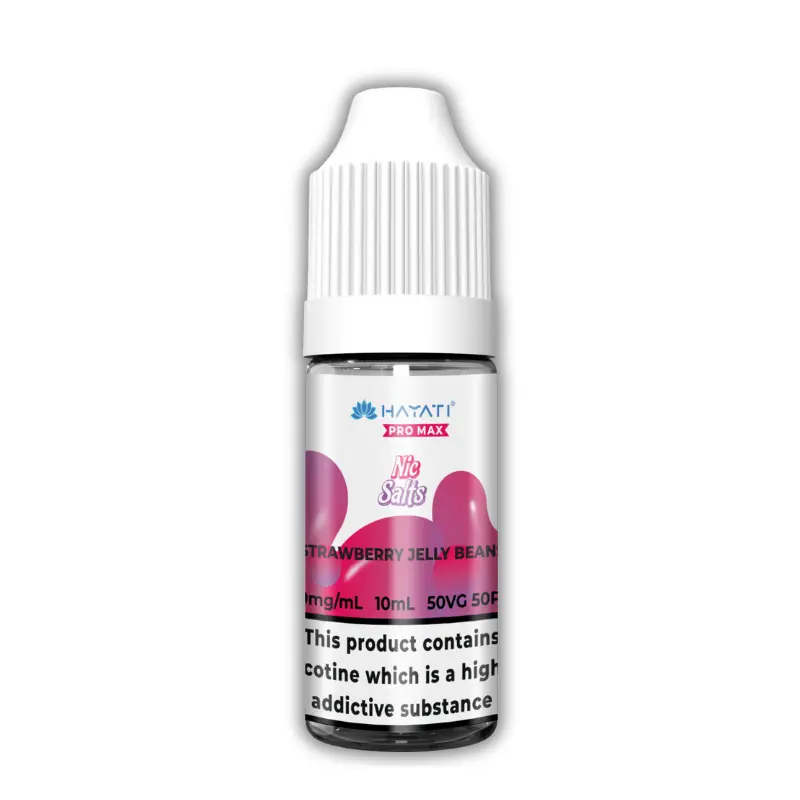
Strawberry Jelly Beans is a 10ml nicotine salt from the Hayati Pro Max bottle line, sold at £2.49, mixed at 10mg on an even split of vegetable glycerine and propylene glycol. On the face of it that puts it among the sweeter entries on a shelf that already runs to sixty-five bottles, and a buyer skimming titles would file it next to the other confectionery names and move on. The interesting thing about it is the name, and specifically the fact that the sweet it names is built differently from every other sweet in this catalogue.
A jelly bean is two things at once. There is a hard sugar shell, thin, glossy and brittle, and inside it there is a soft fruit centre. Those two materials behave differently in the mouth, they arrive at different moments, and they are made from different stuff. Take the shell away and what remains is a small soft fruit gel, which is to say a gummy. The shell is the entire difference between the confection in this title and the confection in the title of the bottle sitting next to it on the same shelf at the same price.
An e-liquid is one material. There is no shell, no centre and no boundary between them, because an aerosol has a single phase and nothing in it can be layered around anything else. So a flavourist asked to render a two-part sweet in a liquid has to pick a part. This page is about which part Hayati picked, what the shop's own copy says about it, and what happens to a prediction that another page on this site has already published about this exact bottle. The short version is that the evidence available before purchase says the shell did not make it into the liquid, that the copy for this bottle and the copy for Strawberry GB Hayati Pro Max Nic Salts say close to the same six things, and that a sibling page which reasoned from the shape of a jelly bean and predicted a crisper, brighter liquid is not supported by any of it.
That is a correction to something already shipped, so the page states it plainly rather than burying it, and then does the more useful job: setting out what actually remains to choose between two bottles of sugary strawberry at the same price, including the one difference that is a matter of record rather than of tasting.
Two materials, one of which is not a flavour
Start with the object, because the argument depends on what a jelly bean physically is and most descriptions of the sweet skate over it.
What the shell is for
The outer layer of a jelly bean is built up in a rotating drum over several passes, sugar syrup applied and dried, applied and dried, until a shell of crystallised sucrose has formed around the centre. A final glaze goes on top to give it the sheen. The shell has three jobs and none of them is flavour. It keeps the soft interior from sticking to its neighbours in the bag. It carries the colour, which is why the same centre can be sold as a dozen different beans. And it supplies the initial resistance, the small crack, the change in sound conducted up through the jaw, that makes eating one feel different from eating a soft sweet of the same size.
Sweetness is the only chemical signal the shell contributes, and it is plain sucrose sweetness with no character of its own. There is no fruit in it. There are no volatile aromatics in it worth speaking of, because the drum process and the drying that follows are hostile to anything volatile. A shell tastes of sugar and of nothing else, and it would taste of sugar and nothing else whether the bean inside it were strawberry, liquorice or lemon.
What is left when you take it off
The centre is where the identity lives. It is a starch or pectin gel loaded with a fruit essence, a little acid, and enough glucose syrup to keep it soft. That gel is the part that tells you which bean you have. It is also, in every respect that a flavouring chemist would care about, the same class of material as a gummy sweet: a sugared gel carrying an artificial fruit note, giving that note up slowly because the gel has to soften before it releases anything.
So the honest statement of what a jelly bean is, from a flavour point of view, is a gummy with a sugar coat and a crack. Remove the coat and the crack and you have not lost a flavour. You have lost a texture and a delivery mechanism.
Why a liquid cannot keep both
That aerosols cannot carry hardness is settled on this site and this page will not argue it again. The Strawberry Watermelon Bubblegum Hayati Pro Max Nic Salt page and the Rocky Candy Orange Pro Max Plus pods page between them have already established the position: vapour reaches the nose and the tongue and the trigeminal nerve, and it has no access at all to the receptors that report force, fracture and resistance, because there is no solid in it to apply force with. The Rocky Candy page works through the four sensory streams properly and also runs the census that places this very bottle among the fourteen or so Hayati flavour names, out of roughly a hundred and ninety, that report a physical state rather than an ingredient. Both of those findings are taken here as given.
This page is making a different claim, and the difference matters because otherwise it would simply be repeating a neighbour. The Rocky Candy argument is about one property, hardness, being untransmittable. The argument here is about what happens when a confection has more than one phase and a formulator has to collapse them into one.
Work it through. Faced with a jelly bean, the formulator has a shell that offers hardness, colour and plain sweetness, and a centre that offers a fruit essence. Hardness cannot be carried. Colour is irrelevant in a clear liquid drawn through an opaque pod. Plain sweetness can be carried, but every sweet liquid on the shelf already carries it, so building a recipe around it produces nothing that distinguishes the bottle from any other sugary bottle. The centre, meanwhile, offers the one thing a flavouring is actually for: a recognisable fruit character with a particular artificial bent to it.
The choice is not really a choice. Three of the shell's four contributions are unusable and the fourth is generic, so the recipe collapses onto the centre. And the centre of a strawberry jelly bean, considered as a flavour rather than as an object, is a soft sugared strawberry gel. Which is what a strawberry gummy is.
The rule this gives you, and its limits
Generalise it and you get something worth carrying to other listings. Reasoning from the shape of a sweet to the shape of a liquid works for single-phase confections and fails for composite ones, because the phase that survives the translation is always the centre. A boiled sweet is one material throughout, so a boiled-sweet flavouring can be judged against the sweet it names. A chewing gum is one material, so is a gelatine bear, so is an ice lolly. In each of those cases the thing on the label and the thing in the bottle are the same substance minus its physical state, and a reader who knows the sweet knows roughly what the liquid is aiming at.
Put a shell round it and that stops working. The name now points at two substances, only one of which can be rendered, and the one that cannot be rendered is the one that made the sweet distinctive in the first place. Anybody predicting the taste of the liquid from the name is predicting from a property that was discarded before mixing began.
Two limits on that rule, stated up front rather than left for someone to find. It is a claim about what a flavourist has available to work with, not a claim that every formulator behaves this way; a house could in principle build an attack into a liquid to gesture at a shell, with a sharp acid spike in the first instant, and nothing here rules that out as a technique. And it is a claim about flavour rather than about aroma in full: the confectioner's glaze on a real bean has a faint waxy character, and in principle somebody could chase it, though nothing in this listing or any other in the range suggests that anybody has. What the rule says is that the shell gives a formulator almost nothing to work with, so the default outcome is the centre, and the default outcome is what you should expect absent evidence of something else.
Counting the sweets, because a claim about a catalogue needs a denominator
The argument above is only interesting if the composite case is genuinely unusual here, so it needs counting rather than asserting. The counts below come from the product data as it stands, not from any shelf description.
The confection names, and how many phases each one has
Hayati's full range across every format runs to 492 listings carrying 184 distinct flavour names once the hardware suffix is stripped off each title. Search those names for a confection rather than a fruit, a drink or a state, and you get twenty distinct names spread over fifty-five listings: thirteen single-flavour names and seven dual ones.
Sort those twenty by how the sweet is built and the split is lopsided. The gummy bear family is the largest, appearing both spelled out and clipped to two letters, and a gelatine bear is one material all the way through. The bubblegum family runs to six names across the catalogue, and a piece of gum is likewise one material. Rocky Candy Orange names a boiled sweet, crystallised sugar throughout. Ice Pop names a frozen liquid, uniform by definition. Fizzy Cherry names a sensation rather than a structure.
That leaves one name in the twenty that points at a sweet with two distinct phases, and it is this one. Nineteen single-phase confection names, one composite. The angle handed to this page said the shell is the only thing separating a jelly bean from a gummy, and that survives counting: within this catalogue, it is also the only shell there is.
One narrowing is due, because the count is about titles and the copy is a little richer than the titles. Composite sweets do get referenced twice more in Hayati's own descriptions, just never in a name. The Fizzy Cherry bottle's copy reaches for a sour-coated sweet as one of two images for its tingle, and the Blue Sour Raspberry Hayati Pro Max Nic Salt flavour has a shortfill sibling whose copy opens on the same picture. So the correct statement is that Strawberry Jelly Beans is the only listing in 492 whose title names a two-phase confection, and that two other listings gesture at one inside their prose. Both of those gestures are to a sour dust on the outside of a soft sweet, which is a real composite and a different one, and in both cases the sourness is the point, which is precisely the property this bottle's copy says it does not have.
The shell has no vocabulary in this catalogue
If Hayati ever wanted to describe an outer layer as a thing you taste separately, there would be words for it in the copy. There are not. Run the vocabulary of shells across all 492 product descriptions and the result is close to empty.
- The word "shell" appears zero times in 492 descriptions.
- "Outer" appears zero times.
- "Brittle" appears zero times.
- "Crack" and "shatter" appear zero times each.
- "Coated" appears four times in total. One is this bottle's opening line. One is the Fizzy Cherry simile. One is the Blue Sour Raspberry shortfill simile. The fourth is the Grape GB pod kit, where the phrase is describing a rounder, sugared version of the fruit rather than a layer on anything.
Four uses of one word across nearly five hundred listings, three of them adjectival and none of them describing a structure inside a liquid. Whatever else Hayati's copywriters do, they do not write about sweets as things with an inside and an outside. That is not proof that no recipe in the range has a two-stage build, but it is a strong indication that nobody was briefed to write about one, and it is the whole of the evidence a buyer has access to.
Two words that look like evidence and are not
Two cautions before the copy comparison, because a word census is easy to over-read.
The first is that "candied" appears in twenty-eight of the 492 descriptions. It is house vocabulary. Its presence in this listing tells you nothing that its absence from another listing would not equally fail to tell you, and no argument here rests on it.
The second cuts the other way and is worth more. "Punnet" appears exactly three times in 492 descriptions. One of those three is this bottle, which sets itself against a punnet of berries and beside a jelly bean instead. Another is the Strawberry GB pod listing for the Mini Ultra, which places that flavour closer to a strawberry sweet than to a punnet of fresh fruit. The third is Black Mamba Hayati Pro Max Nic Salts, on a different subject entirely. Two of the three uses of a rare word in this catalogue belong to the two flavours this page is comparing, deployed in the same sentence position to make the same move. That is not a coincidence about the recipes. It is a fingerprint of the copy, and it is the first sign that these two descriptions came out of the same drawer.
Reading the listing against its nearest neighbour
Now the substance. The listing for this bottle has three parts: a framing sentence, a flavour paragraph and a handling paragraph. All the sensory content is in the middle one.
Where the shell does appear, and the narrowing that forces
The brief that commissioned this page said Hayati's description mentions no shell at all. That is very slightly overstated and the correction is worth making, because it makes the finding sharper rather than weaker.
The shell is mentioned once. The framing sentence says the bottle captures a jelly bean’s sugar-coated chew. So "sugar-coated" is there, in the first line, in the sentence whose job is to say what the confection is.
Two things about that appearance. First, look at what the phrase is grammatically. The head noun is "chew". "Sugar-coated" is an adjective hung on it. What Hayati say the bottle captures is a chew, which is a property of the centre, and the coating is a modifier on the thing being chewed rather than something being captured in its own right. Second, and more to the point, that is the last you hear of it. The flavour paragraph runs to five sentences and not one of them mentions a coat, a crust, an opening crack, a first-instant sugar hit, or any stage before the fruit.
So the narrowed claim, which is the one this page will argue, is that the shell survives in the listing as a label and nowhere as a tasting note. It is named where the confection is named and it is absent from every sentence that describes what the liquid does. Given that the framing sentence is doing nothing except explaining the title, the shell's only appearance in this listing is inside an explanation of the title.
Six claims, set side by side
Here is what the flavour paragraph actually asserts, and here is what the flavour paragraph for Strawberry GB asserts, matched claim to claim. Both are Hayati's own copy for two bottles on the same shelf at the same £2.49.
| Axis | Strawberry Jelly Beans says | Strawberry GB says |
| Fruit or sweet | Think strawberry sweets, not fresh fruit | A familiar fruit turned into chewy candy |
| Sharpness | Little sharpness to interrupt it | Very little sharpness here |
| Sweetness level | Sweetness is high | Unapologetically sweet from start to finish |
| Shape of the profile | Soft and rounded | The confection softens the edges |
| Finish | A lingering candy-strawberry note | An aftertaste of pure strawberry gummy |
| Who it is for | Prefers sweet treats to tart or iced ones | Anyone who reaches for sweets more often than tart fruit |
Six axes, six agreements, no disagreement anywhere. Two of the pairs are near-paraphrases at the level of the sentence rather than merely the claim: the sharpness line and the buyer line could be swapped between the listings and nobody would notice. Add the punnet fingerprint from the section above and you have seven points of contact between two descriptions that are supposed to be selling different liquids.
What is not in either column is as telling as what is. Neither listing mentions an attack, an onset, a first instant, a crispness, a snap or a change of state. Neither mentions two components arriving in sequence with a boundary between them. If Hayati believed one of these two liquids opened harder than the other, this is where they would say so, because it is exactly the sort of thing the rest of their copy says elsewhere.
The staging count, which points the same way
That last point can be counted rather than asserted, and the count is the strongest single piece of evidence on this page.
Of the sixty-five bottles on the Hayati Pro Max Nic Salts shelf, forty-one have copy that locates something on the inhale or the exhale. Staging a flavour across a draw is the normal thing for this copywriter to do, and it is done on nearly two-thirds of the shelf. Strawberry GB is one of the forty-one: its copy has ripe strawberry opening the puff, then the confection taking over, then an aftertaste. Three stages, explicitly ordered.
Strawberry Jelly Beans is one of the twenty-four that do not. Its flavour paragraph names no inhale, no exhale and no handover between components. It gives one impression, which is candied and sugary with strawberry at its heart, and then a finish. "Heart" is the only positional word in the entire listing, and it is a position inside the flavour rather than a position in time.
Eighteen of the sixty-five bottles go further and describe an actual handover, one thing arriving and a second taking over underneath it. Strawberry GB is in that eighteen. This bottle is not. So on the copywriter's own conventions, the bottle whose name points at a two-part sweet is described as a single undifferentiated impression, and the bottle whose name points at a one-part sweet is the one described in stages. That is the exact inverse of what the names would lead you to expect, and it is the pattern you would predict if the jelly bean's structure had been discarded and the gummy's had not.
What this evidence is and is not
An honest statement of the limits, because this page is correcting somebody and has no business being sloppier than the thing it corrects.
Two descriptions agreeing is evidence about how the copy was written. It is not proof that two recipes are the same. This site has established the reverse case already, that a disagreement between two listings of one liquid tells you about the copywriting rather than about two formulations, and the principle runs symmetrically. Hayati write fresh copy for every listing, a copywriter working from a name and a flavour category can easily produce two similar paragraphs for two genuinely different mixes, and nothing here has been tasted side by side under controlled conditions.
What the evidence does establish is narrower and still useful. Everything a buyer can check before spending £2.49 says these two bottles occupy the same position on every axis the shop describes. If a difference exists, Hayati have not described it, have not hinted at it, and have not used any of the vocabulary they would need to describe it. And the listing's own closing line is quietly revealing on this point: it tells a reader who likes Strawberry GB that this is worth a try for a slightly different candy angle, and then declines to say what the angle is. A copywriter with a difference to sell names the difference.
A shipped prediction, and what the evidence does to it
This is the part that concerns another page on this site, and it is stated openly because a buyer reading both should know they disagree and should know which one to weight.
What the sibling said
The Strawberry GB bottle page, which is the closest neighbour to this one by some distance, discusses this bottle directly in its comparison section. It reasons from the morphology of the confection: a bean with a hard outer layer and a more concentrated centre, with the flavouring reflecting that structure, and it concludes that this bottle should have "a crisper attack and a shorter finish". Set side by side, it says, the jelly bean version is "the brighter and more clipped of the two".
That is a specific, falsifiable prediction about a liquid, published in good faith, and it was made from the shape of the sweet.
Why the reasoning was sound and the input was wrong
The inference is not careless. It runs: this confection has a structure, structures produce characteristic flavour arrivals, therefore the liquid should arrive characteristically. That is how anybody sensible reasons about a named flavour, and it is the same reasoning this site uses productively on single-phase sweets all the time.
Where it fails is at the first step, on the assumption that the shell is a flavour-bearing phase whose character would be carried across. It is not. It bears sugar and hardness, and a formulator cannot use either to make a liquid distinctive. The prediction treated the shell as the interesting half of the sweet when it is the disposable half, and having granted the shell a flavour it then derived a whole profile from it.
There is a second, subtler problem. The prediction also says the centre of a bean is more concentrated and slightly sharper than a gummy. That may well be true of the sweets. It does not follow that a liquid built from that centre would be sharper than a liquid built from a gummy, because a flavourist is not scaling a real sweet down; they are building a target profile from aroma chemicals, and the concentration of fruit essence in a physical gel has no bearing on how much of a given aroma compound goes into a bottle. The chain from confection to liquid breaks twice, once at the shell and once at the concentration.
And the copy points the other way on the very axis the prediction picks. The prediction says this bottle should be the brighter of the two. Strawberry GB's copy opens with ripe strawberry leading the puff before the confection arrives. This bottle's copy never gives the fruit a lead at all: the strawberry is at the heart of a candied, sugary character rather than in front of it. If you ranked the two on fruit-forwardness using nothing but Hayati's descriptions, this one would come second. Not by a wide margin, and not on evidence anybody should bet heavily on, but in the opposite direction from the prediction.
Where the correction leaves both pages
Nothing else on the Strawberry GB page is affected, and it is worth saying so clearly rather than leaving a shadow over a page that does its main job well. Its account of what a gelatine flavouring does in a liquid, its three sensory consequences of that texture, its placement of the bottle on a sweetness scale against the rest of the shelf, its rule-outs and its account of what a long session does, are all its own work and all stand. This page has deliberately not re-derived any of them, and a reader who wants the texture analysis should go there for it.
What is corrected is one paragraph, and the correction is a narrow one: the prediction it makes about this bottle was derived from a property that does not survive into a liquid, and the shop's own copy does not support it. That is not the same as saying the two liquids are identical. It is saying that nobody, on either page, currently has grounds for claiming a difference, and that the grounds offered were the wrong kind.
The general lesson is the one worth taking away to other listings in the range. Predict a liquid from the shape of a sweet only when the sweet has one phase. When it has two, work out which phase carries the flavour identity, assume that is the one in the bottle, and say so as an assumption.
The draw, as far as the evidence licenses
A page that has spent this long on what cannot be known owes the reader a straight account of what the liquid is likely to do, marked for confidence.
Reasonably confident: it is sweet, it is strawberry, and the strawberry is the artificial kind rather than the fruit kind. Hayati say so, every listing in the confectionery group says so of itself, and the flavour category leaves little room for anything else. Expect the strawberry to read as the essence used in sweets, which is a fairly narrow, fixed, slightly perfumed note with none of the green or the acid that a real berry carries.
Reasonably confident: there is no cooling in it. Nothing in the title or the description names ice, frozen, menthol or mint, and the copy specifically positions it away from iced profiles. The cooling vocabulary question has been settled elsewhere on this site by the Blue Frozen bottle page, which counted the terms across the catalogue and found them ungraded, so there is no need to hedge about whether an unnamed coolant might be hiding in a title. If you want the cold, Red Berry Ice Hayati Pro Max Nic Salt and Blue Frozen Hayati Pro Max Nic Salts are on the same shelf.
Probable: the sweetness sits high on the shelf rather than in the middle. Hayati say sweetness is high, and there is no acid, no citrus and no coolant named to hold it in check, which is the same structural situation the Strawberry GB page describes for its own bottle. That page's sweetness placement is the reference point to use, and this bottle has no feature that would move it materially away from where that page puts its subject.
Probable: the finish is long. The listing says it ends on a lingering candy-strawberry note, and a sugared gel flavouring with nothing sharp in it is the sort of build that persists. Whether it persists in exactly the way the Strawberry GB page describes for its own subject is not something this page can settle, and that page's account should be read as an account of that bottle rather than transferred wholesale to this one.
Unknown, and this is the axis that decides the purchase for most people who get this far: whether it differs perceptibly from Strawberry GB in a blind comparison. Nothing published settles it. The copy says no. The names say yes. The copy is the better evidence, and it is still only copy. Anyone for whom that distinction matters should buy one bottle rather than both, spend a week on it, and then decide whether the second is worth 24.9p per millilitre to find out.
What it is not: it is not sour, it is not iced, it is not a bakery or dessert flavour with any dairy or pastry weight to it, and it is not a fruit-salad blend with several fruits jostling. One fruit, one sweet, one register. If you wanted several fruits, Strawberry Raspberry Blueberry Hayati Pro Max Nic Salt and Strawberry Cherry Cranberry Hayati Pro Max Nic Salts stack three each.
The bottle, the base and the coil
Very little needs saying about the format, and most of what could be said has been said better on other bottles in this range, so this section is short by design.
Ten millilitres, 10mg nicotine salt, an even split of vegetable glycerine and propylene glycol. The even split is the reason this goes in a pod. A thin base wicks into a narrow, high-resistance coil without starving it, and 10mg in a salt preparation is mixed for the modest vapour a low-power mouth-to-lung setup produces. It is not a mix for a sub-ohm tank, where the volume of vapour and the strength together would be unpleasant, and the thin base would be inclined to leak out of a large airflow anyway.
The coil consequence specific to this liquid is worth one paragraph because it interacts with the argument above. A heavily sweetened liquid leaves residue on a coil as the sugars and the glycerine caramelise, and residue dulls a flavour from the top down, taking the light aromatic notes first and leaving the heavy ones. On a bottle with an acid edge or a citrus lift you notice this early, because the bright part goes and the loss is obvious. On this one you will notice it late, because the bright part is minimal to start with and what remains after the aromatics fade is sugar, which is the least distinctive component of the profile. The failure mode here is not that the flavour disappears. It is that the strawberry quietly recedes and the bottle drifts towards plain sweetness, which is to say it drifts further in the direction this page has been arguing the recipe already went. The coil economics of a sweet bottle are set out in full on the Strawberry Watermelon Bubblegum page and there is no point restating them.
The published numbers, ordered by what this page argues
The table below leads with the two figures that carry the argument, the format and the flavour category, rather than opening on the nicotine strength as most spec tables do.
| Flavour category | Confectionery, strawberry-led, uncooled |
| Sold as | 10ml bottle, one SKU, no device |
| Product name | Strawberry Jelly Beans Hayati Pro Max Nic Salt |
| Nicotine | 10mg per millilitre, salt preparation |
| Base | 50:50 vegetable glycerine to propylene glycol |
| Price | £2.49 |
| Cost per millilitre | 24.9p |
| Intended hardware | Refillable pods and other low-power mouth-to-lung devices |
| Brand | Hayati |
| Product code | HPM-NS-STRAWBERRY-JELLY-BEANS |
| Shelves | Pro Max Nic Salts, Berry Vapes, Strawberry Vapes, Hayati E-Liquids, New Products |
Two of those rows deserve a sentence each. The 10mg figure is what this bottle is supplied at and it is the only strength listed for it, so a reader comparing strengths across the range should note that this one offers no choice. The 24.9p per millilitre is identical to every other 10ml bottle on this shelf, which is worth knowing because it removes price from the decision entirely: choosing between this and Strawberry GB costs exactly the same either way, and so does choosing Strawberry Kiwi Hayati Pro Max Nic Salt instead of both.
Nicotine is an addictive substance and 20mg per millilitre is the legal ceiling for a bottle of this size in the UK, so 10mg is half of what the format is permitted to carry. That is a fact about the regulation rather than a recommendation, and nobody should choose a strength from a product page.
Choosing between the two bottles, and against the rest of the shelf
Everything above says the two confectionery strawberries are hard to separate on flavour evidence. That leaves a real question about what you should actually decide on, and there is a clean answer to it.
The one difference you can verify before you buy
Strawberry Jelly Beans exists once. It is a 10ml bottle and there is nothing else. No pod carries it, no kit carries it, it appears behind no rotating collar on a dual listing, and it has no shortfill or higher-VG version. One SKU, one format, one price.
Strawberry GB exists seven times. It is a 10ml bottle at £2.49, a Pro Max Plus replacement pod at £5.49, a Pro Max Plus 6000 pod kit at £7.99, a Mini Ultra replacement pod at £3.49, and it occupies one side of three dual listings paired with Grape GB: a Mini Ultra kit at £3.99, a Pro Ultra Plus pod at £7.99 and a Pro Ultra Plus 25000 kit at £11.99.
Count before calling that rare, because this site has been wrong about rarity before. Fifteen of the 184 flavour names in the catalogue exist only as a bottle, so being bottle-only is a normal condition here rather than an oddity, and Gummy Bear is in that fifteen too. What is not normal is the gap between these two particular neighbours. One appearance against seven is the widest asymmetry you will find between two liquids that the shop's own copy describes in the same six terms.
That gap has a practical shape. If you settle on the gummy bear flavour, the flavour travels with you: onto prefilled hardware, onto a smaller and cheaper platform, onto a dual pod where it shares a collar with a darker fruit. If you settle on the jelly bean flavour, you are committing to refilling a pod from a bottle indefinitely, because there is nowhere else for it to go. For a buyer who refills and intends to keep refilling, that is worth nothing at all and the two bottles are interchangeable on this axis. For a buyer who thinks they might move to prefilled pods later, it is the only difference between the two that is a matter of record rather than of taste, and it points one way.
There is a second-order version of the same point. A flavour that exists on seven listings has been through seven rounds of copy, which is seven chances for the descriptions to disagree with each other and give you something to read. A flavour that exists once has exactly one description, and when that description turns out to be a paraphrase of its neighbour's you have no further evidence to work with. That is not an argument for buying either bottle. It is an explanation of why this page could not settle the question and why nobody else will be able to either, until somebody buys both.
The other confectionery bottles
The sweet-shop corner of this shelf has more in it than the two strawberries. Strawberry Watermelon Bubblegum Hayati Pro Max Nic Salt puts the same strawberry over a gum base with watermelon between them, and its page already groups this bottle, Gummy Bear and Strawberry GB together as the same register at the same price, which is a grouping this page's evidence supports rather than contradicts. The plain Gummy Bear bottle is the interesting one for anybody persuaded by the argument here, because it is the same category with no fruit named at all, and its own page works through what a draw does when nothing in the blend has been given the lead; it also runs the census of how Hayati spell this confection, which is a separate finding from anything on this page and should not be confused with it.
Bubblegum Ice Hayati Pro Max Nic Salt is the confectionery register with a coolant bolted on, which is the most direct answer to anybody who likes the sweet-shop idea and finds an uncooled version heavy going. And Blue Razz Lemonade Hayati Pro Max Nic Salt is a useful contrast rather than a sibling: a sweet blue build with a drink construction under it, so the sugar has somewhere to sit.
If you wanted the fruit rather than the sweet
The fastest way to find out whether the confectionery framing is what you actually want is to hold this bottle against a plain fruit pairing from the same shelf at the same money. Strawberry Watermelon Hayati Pro Max Nic Salt is the cleanest test, because it takes the same fruit and gives it a juicy partner rather than a sugared one. Strawberry Kiwi does the same job with a tarter partner, and kiwi brings a genuine acidity that a candy build cannot. Strawberry Mojito Hayati Pro Max Nic Salt goes further again, putting the berry in a drink with citrus and mint around it.
Outside the strawberry group, Blackberry Raspberry Hayati Pro Max Nic Salts and White Peach Raspberry Hayati Pro Max Nic Salts are both straightforward fruit pairings with no confection in them, and Double Apple Hayati Pro Max Nic Salts sits well away from the berry end altogether.
If the sweetness is the problem
The corrective a sugary bottle needs is acid, and this shelf has several. Blue Sour Raspberry Hayati Pro Max Nic Salt is the direct one, with the sourness stated in the title. Blackcurrant Lemonade Hayati Pro Max Nic Salts and Berry Lemonade Hayati Pro Max Nic Salt both put a lemonade under a dark berry, which gives you sweetness with a citrus floor rather than sweetness on its own. Cherry Berry Hayati Pro Max Nic Salts sits in between.
The other approach is rotation rather than substitution, and it is the one most people end up on. Keep this as one of two bottles and keep something sharp or cold as the other, and the sugary one stays interesting for far longer than it does as a sole liquid.
If cold is what you were after
Strawberry Raspberry Ice Hayati Pro Max Nic Salt is the obvious move for anybody who likes red fruit but wants the finish cut short, and the same flavour exists as a larger bottle in Strawberry Raspberry Ice Hayati Pro Max 50/50 Shortfill E-Liquid at £6.99 for anyone who has already settled on it. Cherry Ice Hayati Pro Max Nic Salt and Blackberry Ice Hayati Pro Max Nic Salts are the darker versions of the same idea.
If you are open to leaving bottles behind, Blue Razz Pineapple / Strawberry Ice Hayati Mini Ultra Pod Kit at £3.99 puts an iced strawberry on one side of a divided pod, which is a different proposition entirely: prefilled, no refilling, and two flavours selected by a rotating mouthpiece. Check the range name on your device before ordering any prefilled pod.
Names that tell you nothing
Worth a line, since this page is about what a name can and cannot promise. Some titles on this shelf name a mood rather than an ingredient, and they sit at the opposite end of the spectrum from a jelly bean. Blue Fusion Hayati Pro Max Nic Salt and Mad Blue Hayati Pro Max Nic Salt tell you a colour family and stop. This bottle's problem is the opposite one: the name is precise, it points at a specific object, and the precision turns out to be about the object rather than about the liquid. A vague name leaves you with no expectation. A precise name for a composite sweet leaves you with the wrong one, which is arguably worse.
The shelves
For browsing rather than comparing, the Strawberry Vapes shelf runs to 82 products across every format and is the fastest way to see how many strawberry variants exist. Berry Vapes is much larger at 225. Hayati E-Liquids collects 105 bottles including the shortfills and the higher-VG mixes, New Products carries the full 492, and the whole Hayati range is the same 492 without a filter on it.
Running a bottle with nothing to interrupt it
Practical handling, anchored to what this particular liquid does rather than to what any bottle does.
Prime a fresh pod and wait. A 50:50 base soaks a cotton wick quickly, but quickly is not instantly, and the specific penalty for firing early on a sugary liquid is that scorched sweetener tastes considerably worse than scorched fruit and does not clear from the coil afterwards. Five minutes with the pod full and upright is enough. The same applies after a long gap: if a filled pod has been sitting in a drawer for a fortnight, the wick is fine but the liquid will have settled, so a gentle turn of the bottle before refilling is more useful than shaking it, which only introduces bubbles into a mix that wicks better without them.
Draw slowly. This bottle has no acid spike and no coolant, which means it also has no obvious cue telling you the draw is long enough. On a cold or sour liquid you feel the peak arrive. Here the profile is described as one continuous sweet impression, so the tendency is to keep pulling past the point where the coil is still keeping up, which produces a dry, faintly burnt edge that people then mistake for the flavour being poor. Three or four seconds is plenty at this kind of resistance.
Expect the palate to give out before the bottle does. Sweetness adaptation and the way a sweet liquid gets less sweet across a session while the desire for sweetness climbs are worked through properly on the Strawberry Watermelon Bubblegum page, which covers both the short clock within a session and the long one across a rotation. Nothing here needs adding to it except the specific note that this bottle has less to fall back on than most, because when the sweetness fades there is no second element underneath. On a lemonade build the citrus is still there. On an iced build the cold is still there. On this one, what is left when adaptation sets in is a thin strawberry, and the honest response to that is to put it down for an hour rather than to keep going.
Change the pod or the coil on taste rather than on a schedule. The signal for this particular liquid is subtle for the reason given above, so the thing to watch for is not a burnt note but a flattening, the point at which the strawberry stops being identifiable as strawberry and the draw becomes generically sweet. That is the coil telling you it has taken the aromatics and left the sugar. If you keep a second pod in rotation with something sharper in it, the contrast makes the flattening far easier to spot, which is a practical reason to rotate quite apart from the palate argument.
Storage is ordinary. Upright, capped, out of direct sun and away from anything warm, because heat drives the light aromatic notes off first and those are the ones already in short supply here. A bottle kept in a car through a hot week will read noticeably flatter than one kept in a cupboard, and no amount of shaking brings the top notes back. Keep it somewhere children and pets cannot get to it, and do not decant it into an unlabelled container.
Buy one bottle at a time until you know. This applies with more force than usual given everything above: if you already own Strawberry GB, the case for buying this alongside it is weaker than the two names suggest, and the sensible order is to finish what you have and then try this on its own rather than running both and hoping to spot a difference you have primed yourself to find.
Questions this listing raises
Does this actually taste different from Strawberry GB?
Nothing published settles it, and this page is careful not to claim it has. Hayati's descriptions of the two bottles agree on all six axes they both address, including two sentences that are near-paraphrases of each other, so there is no documented difference to point at. A difference may exist in the mix; if it does, the shop has not described it.
Can I taste the sugar shell?
Almost certainly not, and the argument for that is the substance of this page. A shell contributes hardness, colour and plain sweetness, and an aerosol cannot carry the first two while the third is common to every sweet liquid on the shelf. Hayati's flavour paragraph for this bottle describes no shell, no crack and no opening stage of any kind.
Is there any cooling in it?
No. The title names none, the description names none, and it explicitly positions the bottle away from iced profiles. If you want the same fruit family with cold in it, Red Berry Ice and Strawberry Raspberry Ice are on the same shelf at the same price.
Is it sour at all?
No. Hayati say there is little sharpness to interrupt it, and there is no acid, citrus or sour element named anywhere in the listing. Blue Sour Raspberry is the shelf's direct answer if sourness is what you were after.
What strength does it come in?
10mg per millilitre, as a nicotine salt, and that is the only strength listed for this flavour. The listing offers no alternative, so a reader who wants a different figure needs a different flavour rather than a different option on this one.
What hardware does it go in?
A refillable pod or another low-power mouth-to-lung device with a higher-resistance coil. The even glycerine and glycol split is thin enough to wick into a narrow coil without starving it, and it is not mixed for a sub-ohm tank.
Is this available as a prefilled pod or a kit?
No. Strawberry Jelly Beans appears once in the whole catalogue, as this 10ml bottle. Strawberry GB, by contrast, appears seven times across bottles, pods, kits and dual listings, which is the one hard difference between the two flavours and the only one you can check before buying.
Will it wreck a coil faster than a plain fruit?
Heavily sweetened liquids leave more residue on a coil than plain ones, so expect a shorter working life than you would get from a simple fruit pairing. The particular thing to watch for here is a flattening rather than a burnt note, because the light strawberry aromatics go first and the sugar stays behind.
How sweet is it compared with the rest of the shelf?
High rather than moderate. Hayati state the sweetness is high, and there is nothing in the build to check it: no acid, no coolant, no citrus. The Strawberry GB page places a bottle in this position on a sweetness scale measured against the rest of the range, and that placement is the reference to use.
If I only buy one confectionery strawberry, which one?
Buy Strawberry GB if there is any chance you will move onto prefilled hardware later, because that flavour exists on six other listings and this one exists on none. Buy this one if you refill from bottles and intend to keep doing so, in which case the choice is genuinely a coin toss on the published evidence and you may as well try the one you have not had.
Why does the name point at a jelly bean if the shell is not in it?
Because a name has to name something, and "strawberry gummy with a coat you cannot taste" is not a title. The name is an accurate description of the confection being referenced and a poor guide to the liquid, which is a distinction worth carrying to other listings in this range whenever the sweet on the label has more than one part to it.
Where this leaves it
Strawberry Jelly Beans is a 10ml, 10mg nicotine salt at £2.49 on an even base, sweet, uncooled, strawberry in the confectionery sense rather than the fruit sense, and sold in one format only. That much is on the record and none of it is in dispute.
What this page adds is that the confection in the title is built from two materials and only one of them can be put in a bottle, that the one which can is the soft centre, and that a soft strawberry centre is what a strawberry gummy is made of. The catalogue supports this: of twenty distinct confection names across 492 listings, nineteen name single-phase sweets and this is the only composite one, the word "shell" appears nowhere in any description, and forty-one of the sixty-five bottles on this shelf stage their flavour across a draw while this one does not. The copy supports it too, agreeing with the copy for Strawberry GB on every axis both of them address.
That contradicts a prediction already published on this site, which reasoned from the shape of a jelly bean and expected a crisper, brighter liquid, and the contradiction is reported here rather than quietly worked around. The narrowing this page made along the way is that the shell is not entirely absent from the listing: it appears once, in the sentence explaining the title, and never in a sentence about the liquid. The general point survives the narrowing, and it is the thing worth keeping. Reason from a sweet's shape to a liquid's behaviour only when the sweet has one phase, because the phase that survives the translation is always the centre.
For the buyer, that leaves two bottles at the same price that the published evidence cannot separate on flavour, and one difference that is a matter of record: this flavour exists once, and its neighbour exists seven times. Decide on that, or decide on which name you would rather see on the bottle, and do not pay twice to find a difference nobody has been able to describe.
Strictly for adults aged 18 and over. Nicotine is an addictive substance.
You might also like


