
Home / Hayati Pro Ultra Plus Pods / Sour Apple/Juicy Peach Hayati Pro Ultra Plus 25K Pods
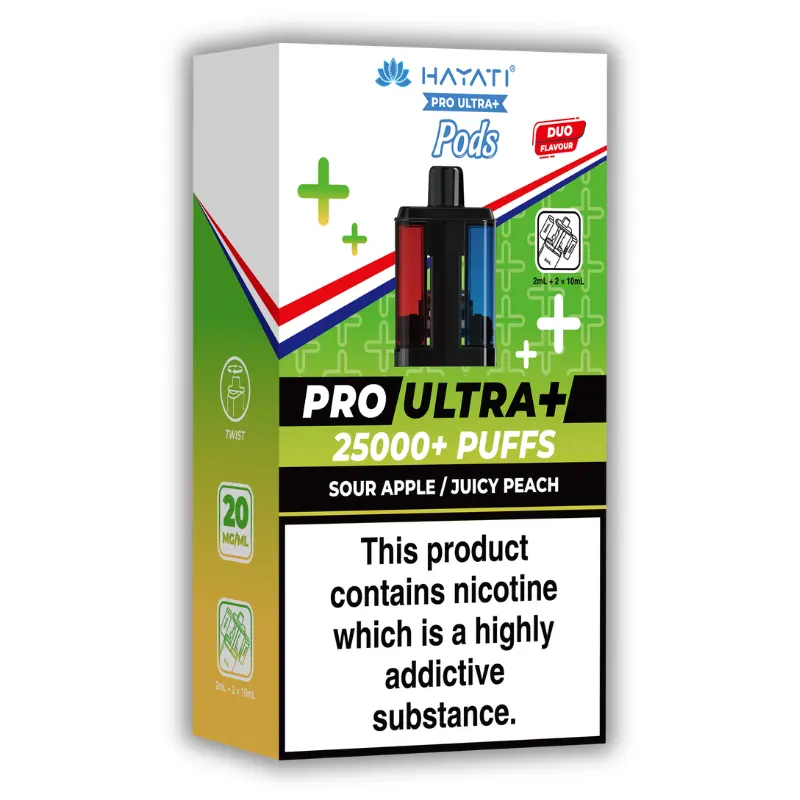
Hayati · Pro Ultra Plus
Sour Apple/Juicy Peach Hayati Pro Ultra Plus 25K Pods
£7.99
✔ In stock — ready to ship
Genuine Hayati
Free over £20
Same-day dispatch
Secure checkout
One pod, £7.99, arriving prefilled with 22ml of liquid at 20mg nicotine and carrying Sour Apple in one reserve and Juicy Peach in the other. Hayati put a laboratory rating on it of up to 25,000 puffs, a bench number from test equipment running a fixed cycle, useful for lining products up beside each other and close to worthless as a forecast of your own fortnight. The packet holds the pod and nothing besides, because the £7.99 assumes a Pro Ultra Plus body already in your possession. Anyone who has arrived here without one wants the same pairing sold as a complete kit at £11.99 instead.
Read the oblique in the title carefully, because it causes more confusion on this shelf than anything else. This is not a box with two pods in it. It is one pod, with both liquids held inside it and a rotating mouthpiece selecting which of them feeds the coil. The choice between apple and peach happens in your hand, between two draws, dozens of times across the life of the pod.
What makes the listing worth a second look is the pairing rather than either flavour alone. Most paired pods in this format put two relatives either side of the collar: two berries, two versions of one confectionery base, a fruit with and without a cherry over it. This one does the opposite deliberately. A sharp, green, acid-forward apple sits against a soft, low-acid, heavy stone fruit, about as far apart as the Hayati fruit range gets without reaching for a coolant. That is not a coincidence of stock. It is one flavour chosen to be the other's opposite.
Deliberate opposition buys something real and costs something almost nobody mentions. It buys each half staying legible longer than it would running alone. It costs you this: the two directions of the swap are not worth the same, so the order you turn the collar in changes what you get for the same £7.99. This page argues both, and ends with a running order and a plain statement of who should leave the listing alone.
One pod, two reserves, and a pairing picked for distance
What the arrangement is, and what Hayati do not describe
The physical facts first, because several questions this listing attracts are really questions about the housing. One pod body holds 22ml split between two flavours that Hayati state are kept apart inside it. Turning the mouthpiece chooses which one is live. There is one coil, fitted at manufacture, processing every millilitre whichever reserve it came from, and it retires when the pod does.
Beyond that, the specification stops. No valve, seal or internal arrangement is described anywhere in this product's data, so this page tells you what the collar does and not how it does it. Anyone quoting you a mechanism is guessing. The same applies to the division of the 22ml: Hayati publish it as one undivided total, so an even split of somewhere around eleven millilitres a side is a working assumption on this page and not a figure from the sheet.
Two consequences follow at once and they pull against each other. Changing flavour costs nothing and takes no time, because both liquids are installed and already paid for. But you cannot buy them in different quantities. Whatever ratio is in there is the ratio you own, and if you only want one of the two, roughly half the pod is a sunk cost.
Where this sits in the range's pairing grammar
Read down the Pro Ultra Plus pods shelf and the paired listings sort into two families that look identical in the title format and are genuinely different products.
The first pairs relatives. Blue Razz Cherry / Blue Razz GB keeps blue raspberry on both sides and varies the treatment. Blueberry Cotton K / Raspberry Cotton K holds a spun-sugar base constant and moves the berry under it. Blueberry H'Bubba / Watermelon H'Bubba repeats the trick with bubblegum, and Grape GB / Strawberry GB runs two chewy sweet-shop fruits sharing a register and a sugar level. Those offer variation rather than contrast: turning the collar produces a change you notice rather than one that interrupts you.
The second family pairs strangers. Blue Razz GB / Lemon & Lime sets sugared confectionery against straight citrus, Blue Razz Pineapple / Strawberry Ice divides on temperature, and Lemon & Lime / Summer Dream puts a sharp half opposite a rounder one.
This listing belongs to the second family and separates on the axis that matters most over hours, which is acid. It does not use cold to do it, which is unusual, since cold is the easy way to build a contrast. Neither liquid here carries any cooling description. The whole distance is sourness against ripeness, and that has consequences a cooled pairing does not share.
The two liquids, taken one at a time
Sour Apple
Hayati describe this side as tart and crisp, an apple with a sharp sour edge. Accurate as far as it goes, and it leaves the important question open, so here is the reading with the reasoning attached rather than presented as a finding. Apple flavourings divide roughly into two camps: a red reading that is softer, rounder and tilted towards sweetness and skin, and a green one that is thinner through the middle, drier and built around acid. A liquid described as sour and crisp, with the sourness promoted into the product name rather than left as a footnote, is almost certainly the second. That is an inference from the naming rather than a confirmed recipe, but a confident one, and what follows rests on it.
In use it produces a front-loaded draw. The acid arrives early, before the fruit has fully identified itself, and it arrives as a sensation rather than a taste: a tightening at the sides of the tongue and a salivation response that no sweet liquid produces. Apple identity fills in immediately behind it. The finish is short and stops rather than fading, because there is little sugar and no heavy body to carry it. Sweetness exists to keep the acid civil rather than to lead, which puts this side low on the sweetness scale of a shelf that also sells candyfloss and bubblegum profiles.
Its most important behavioural property is that it is an event. Something happens at a fixed point in every draw, and that is what makes it re-readable: your attention has something to catch on each time. The cost is that acid tires you in a way sweetness does not, and the appetite for it usually runs out well before eleven millilitres do.
What it is not: no dessert construction, no pastry, no cinnamon, no baked warmth. No fizz or soft-drink treatment of the kind Blackcurrant Lemonade uses to read drier than its sugar level suggests. And no cooling, so the crispness is entirely acid rather than temperature.
Juicy Peach
The long-form account of what this liquid does across a full pod is set out on the Juicy Peach single-flavour pods listing, which carries the identical peach filling the whole 22ml and no collar to turn. No sense writing that twice. What matters here is the shape, because the shape is what makes it the right opposite number for the apple.
Ripe rather than fresh, mellow rather than bright, sweet in a way that reads as fruit flesh rather than sugar sitting on top. The draw opens sweet and stays sweet, fruit identity constant front to finish, the only movement a modest thickening towards the back as the body fills in. No acid anywhere to cut across it, and nothing cold to terminate the finish, which fades rather than stopping.
Where the apple is an event, the peach is a gradient. That one distinction explains nearly everything about how the pair behaves together. A gradient is comfortable and easy to live with for a long time, and it is also the thing most vulnerable to a palate that has stopped paying close attention, because no moment in it demands that you come back. The peach does not lose to the apple on quality. It loses on legibility, and only under conditions the next two sections set out.
What the halves share, which is almost nothing
The common ground is short. Both are single fruits rather than blends, both are warm with no coolant declared, and both sit at 20mg in one housing. On sweetness they are far apart, the peach comfortably above the middle of this shelf and the apple well below it. On acid they are at opposite ends, which is the deliberate part. The peach is thick and filling where the apple is thin and quick, and the peach trails where the apple stops. First-time buyers react to the size of the gap before they react to either flavour.
Blue Razz Pineapple / Strawberry Ice achieves a comparable distance by putting cold on one side, and cold is a blunter instrument. It changes the temperature of a draw without changing what the draw is made of, and it leaves a sensation behind that outlasts the flavour carrying it. Acid does not work like that. It leaves your palate in a different state rather than leaving a residue on it, and that difference is why the running order on this pod behaves as it does.
What opposition actually buys
Adaptation, and why it is the whole argument
The case for a contrast pack rests on one property of perception, and the imprecise version of it leads people to the wrong running order, so it is worth stating properly.
A palate tires of a sustained stimulus far faster than of an alternating one. Hold any flavour constant long enough and your reading of it degrades, not because the liquid changed but because your sense of where the middle of the scale sits drifts towards whatever you have been feeding it. It is the effect that makes a room stop smelling of anything ten minutes after you walk in. Alternate two genuinely different stimuli and the drift is much slower on both, because neither gets long enough to become the new baseline.
Applied here the consequence is specific. Eleven millilitres of sour apple run continuously would exhaust its own welcome, because acid is tiring. Eleven millilitres of peach run continuously would go quietly invisible, because a gradient cannot hold attention against a drifting baseline. Set against each other, each protects the other from its own failure mode. The apple stays interesting because you are never on it long enough to be worn out by it, and the peach stays legible because you keep arriving at it from somewhere that has reset your scale. That is a larger claim than two flavours for the price of one, which is only arithmetic. It says the pair is worth more than the sum.
Why a narrow pairing does not do this
The mechanism also explains why the first family of pairings gives you less than its name implies. Adaptation attaches to properties, not to product names. After an hour on a heavily sweetened blue raspberry, turning the collar to a differently flavoured but equally sweetened blue raspberry does nothing to your sweetness baseline, because the property you adapted to is still there. You changed the label on the stimulus without changing the stimulus.
That is why Grape GB / Blue Razz GB and the other confectionery pairs work as variety and fail as a reset. A reset needs the new stimulus to differ on the axis you adapted to, and on this pod it does, because acid and sweetness are separate dials and this pairing moves both a long way at once.
One adjacent argument belongs elsewhere and is cited rather than rebuilt. How one pod alters your reading of the next across a whole drawer, on two clocks running at different speeds, is worked out on the Strawberry Raspberry Mojito Hayati Pro Max Plus Pods listing, and its conclusions hold whatever hardware you are on. That page is about scheduling between separate pods over days. This one is about the far shorter cycle inside a single pod, between two positions of one collar, over minutes.
The cost nobody prices in: the two directions are not worth the same
The asymmetry, stated plainly
Turning from the peach to the apple is a gain, immediately and every time. You have been on a sweet liquid that coats, your sweetness baseline has drifted upwards, and acid arrives into that state as an unmistakable event. It cuts the residue rather than covering it, it produces a physical response the peach was not producing, and it reads sharper than it actually is because of where you were standing when it arrived. Nothing about this transition needs managing. It is the best the apple side ever gives you.
Turning from the apple to the peach is a loss for the first several minutes. Your palate is in a worked, sharpened state, and a soft low-acid fruit arriving into that condition has almost nothing to register against. It does not taste bad. It tastes like very little: sweet in a general way, with the specific peach character that is the entire point of it flattened out of recognition. Several minutes later it comes back and reads normally. During those minutes it reads flat and characterless, and a buyer who happens to make their first swap in that direction concludes the peach side is weak.
It is not weak. It was measured with an instrument that was still sharpened.
Why the penalty runs one way
Three things stack in the same direction, which is why the effect is bigger than any one of them would suggest. The baseline shift comes first: acid exposure moves your reading of sweetness downwards for a while, so anything sweet met shortly afterwards reads as less sweet than it is, and on a liquid whose appeal is a moderate rounded sweetness, subtracting from that reading removes the main thing it has.
The second is structural and is the part most often missed. Events survive a disturbed palate; gradients do not. The apple's appeal is concentrated in one moment near the front of the draw, and a moment of that kind punches through almost any state you are in. The peach's appeal is spread evenly across the draw with no moment anywhere, so nothing in it is sharp enough to cut through interference. The same disturbance that barely dents one half effectively deletes the other.
The third is physical. Both liquids pass through one wick and one element, so every turn of the collar leaves a trace of the previous side in the path of the next one, and the first draws after a switch are not a clean read of what you have just selected. How that carry-over behaves in general, and why it runs more strongly in one direction than the other, is worked out on the Lemon Lime / Lemon Blueberry Hayati Pro Ultra Plus 25K Pods listing and is not rebuilt here. What is specific to a pairing of opposites is that the carry-over and the perceptual penalty point the same way rather than cancelling. A trace of sour apple sitting in a peach draw is exactly the wrong thing for a low-acid fruit to be read through, while a trace of peach in an apple draw is simply overwritten. That alignment is inference from the structure of the two liquids rather than a published finding, so treat it as a reasonable expectation.
Instant reversal is not a fix, and that is the trap
Here is where the collar misleads. Because the switch is always available, a bad draw looks like a problem correctable in about a second, and the instinct on meeting a flat peach is to turn straight back to the apple. Turning back does not repair the peach. It abandons it. The flat window is a state in you rather than a fault in the liquid, and the only things that shorten it are time, water and a pause. Instant reversal buys you the ability to walk away from a bad reading, which is not the same as fixing it. You flick back, wait a few minutes, flick forward, find the peach flat again because you have just topped up the acid, and conclude within an afternoon that half the pod is a dud.
Chasing novelty by flicking back and forth is the characteristic failure mode of this format, and it is worse on an opposed pairing than on a matched one precisely because the gap is worth having. You pay the cost on roughly half your turns and never stay anywhere long enough to accumulate the adaptation that makes a turn worth making.
How long the flat window lasts
Nothing in the specification addresses this and no honest page gives a figure to the minute, but the shape can be described. It runs in minutes rather than hours, it is shorter than it feels while you are inside it, and it is longer the deeper into the apple you were: a handful of apple draws barely registers, while forty minutes on it produces a peach that needs a noticeable stretch to come back.
The implication is that the same pod, run two ways, is two different products. One way gives a series of free improvements and a flavour that always arrives at its best. The other gives a recurring dead patch landing on the half you probably bought the pod for. The liquid is identical in both cases. The variable is the order.
The running order, and where to put the expensive turn
The recommendation
Run the peach as your base and the apple as the interruption. Not the other way round.
In practice: settle into the peach, stay on it until you notice it has gone quiet, turn to the apple for a short block, and come back across a break rather than immediately. Long peach stretches, short apple stretches, the return handled on purpose.
The reasoning is simple once the asymmetry is on the table. One of your two turns is free and one is expensive, and you make both repeatedly over 22ml. Take the free one often and the expensive one rarely, at a time you choose. Most people default to the opposite, because the apple is the more exciting half and the instinct is to start there.
Two patterns that fail
Turning every few draws. Almost everybody does this on a first pod and it is the worst available use of the format, for the reasons above. It is also the pattern the hardware quietly encourages, the collar being right under your thumb and costing nothing to move.
Apple all morning, peach all afternoon. This looks disciplined and is upside down. It contains only one handover, which is good, but that handover is the expensive one and lands at the start of the longer block. You spend the opening of your afternoon on a peach that is not reading properly and carry that judgement into your next order. Invert it and the same handover becomes the best moment of the day.
Managing the return
Since you will come back to the peach many times, the return is worth doing deliberately. Three things help and none of them costs anything.
Put the return at a natural gap. Overnight is ideal, a meal is very good, and ten minutes with the device down does most of the work. The break does not need to be long, it needs to exist. Where no gap is available, put plain water through first, because a good part of what you are waiting out is acid still present rather than adaptation itself.
Discount the first few draws after any turn. They carry a trace of the side you just left and are not evidence about the side you have just chosen. This matters far more on the return to the peach than on the way out to the apple, and it is the commonest reason a perfectly good peach half gets written off in its first thirty seconds.
Then give it a dozen draws before forming a view. If you turn the collar and immediately decide the peach has faded, you have learned nothing about the peach.
If you bought it for the apple
The order inverts, and it inverts badly. Someone whose base is the apple makes the expensive turn every time they come back from the peach, and makes it into the flavour they actually want rather than the one they are tolerating. If that describes you, keep the peach blocks short and use the break every time.
The better answer may be an apple-led pod with no peach in it. The apple vapes shelf collects every apple listing across all the Hayati formats, bearing in mind that different formats are different hardware and a pod from one range is not a refill for another. Match the range name on your device to the range name in the title before ordering from a mixed shelf.
Specification, and the line the sheet does not divide
| What you pay | £7.99 |
| What arrives | One prefilled pod, on its own |
| What you must already own | A Hayati Pro Ultra Plus device |
| Liquid on board | 22ml, filled before despatch |
| The sharp reserve | Sour Apple: tart, crisp, acid at the front |
| The soft reserve | Juicy Peach: ripe, mellow, gently sweet |
| Choosing between them | Rotating mouthpiece |
| Division of the 22ml | Not published. An even split is an assumption, not a figure. |
| Nicotine | 20mg. No alternative strength listed for this pairing. |
| Cooling | Neither reserve is described as cooled |
| Hayati's puff rating | Up to 25,000, from laboratory measurement |
| Coil | One only, built in and retired with the pod |
| Listing reference | sour-apple-juicy-peach-hayati-pro-ultra-plus-pods |
| Brand | Hayati |
Most of that repeats across the format, so take the row that is unusual on a contrast pod: the division.
Hayati give 22ml as an undivided quantity. On a pairing of relatives that hardly matters, since an uneven split between close cousins would go unnoticed. On a pairing of opposites it matters, because you will use the sides at different rates. The order recommended above consumes peach steadily and apple in bursts, so the peach empties first for most people running the pod sensibly. What is left is a sour apple single at whatever point the coil has reached, with no way to rebalance it and no warning in advance.
The nicotine row is fixed at 20mg with nothing else offered for these flavours, the ceiling permitted in the United Kingdom. The listing gives a strength and does not state a formulation, so this page does not either. Nicotine is addictive, and what strength suits any individual is a matter for them rather than for a retailer's description.
What the price works out at per millilitre, and what happens to it once you count liquid you never draw, is done properly on the Grape GB / Blue Razz GB pods listing. The point specific to a contrast pack is that stranded liquid is structurally worse here than on a matched pairing, because the design itself invites you to prefer one side. A pod whose halves are near-identical gets finished. A pod whose halves are opposites frequently does not.
Coil resistance, airflow, the wattage the device runs at, the split between the reserves and any measure of how sour the sour side is are all absent from this product's specification and so are absent here. Numbers for some of them circulate elsewhere as inferences dressed up as specifications.
How it compares, and who should buy something else
If you want one of these flavours and not the other
This is where the money gets wasted, so it comes first. Someone who wants peach and only peach should buy Juicy Peach Hayati Pro Ultra Plus 25K Pods at the same £7.99, which puts the identical liquid across the full 22ml: twice as much of what you wanted for the same outlay, at the cost of the reset. If hardware is due for replacement too, the Juicy Peach kit at £11.99 bundles a device with the same pod.
Someone who wants apple and only apple has a harder time here, because the Pro Ultra Plus kits and pods range does not list a standalone sour apple the way it lists a standalone peach. The nearest sharp singles are Blue Sour Raspberry, a deliberate pucker at the front of every draw in a berry register, and Blue Razz GB, which keeps a sour edge under a confectionery treatment. Neither is an apple.
Put plainly: if you want two versions of the same pleasure, do not buy this pod. Half of it will be wasted, and wasted in the most irritating way available, sitting there fully paid for while you work around it. A contrast pack only earns its money if you genuinely want both ends of the contrast.
Against the other ways of getting variety
A blend is not a pairing and the two get confused constantly. Mango Peach Pineapple puts three fruits into one liquid, so there are events in every draw but you cannot select them and cannot turn any of them off. A blend gives complexity without control; a pairing gives control. A blend is the better purchase for anyone who found choosing a side tiresome.
Contrast built on temperature behaves differently enough that the running-order rule does not transfer. Cherry Ice / Peach Mango and Cherry Ice use cold as their sharp element. Cold resets a palate faster than acid, a genuine advantage, but it leaves a sensation on the surfaces of the mouth for some minutes rather than simply moving your baseline, which makes the flat window after a cooled half longer and more stubborn. Acid clears itself. Cold waits you out.
A second pod is the wider change and the more flexible one, at the cost of having to carry it. Fresh Mint is the standard partner for that job, and Cola Ice is the listing on this shelf that is not a fruit at all, which makes it the largest register change the format offers.
Other opposed pairings
Blue Razz GB / Lemon & Lime is the closest structural relative, dividing on acid rather than temperature: a sugared confectionery half against a dry citrus one. Everything above about running order applies to it, with citrus in the apple's role. Its sweet half is considerably sweeter than this peach, so the gap is wider and the flat window after the citrus is correspondingly worse. Lemon & Lime / Summer Dream pairs a sharp half with a deliberately vague mixed fruit, harder to characterise but in the same structural position.
Against both, the case for this pairing is that its halves are single fruits with clear identities and neither is a confectionery construction. That keeps the soft side's sweetness moderate, which keeps the flat window shorter, and it keeps both halves legible enough that you taste a fruit rather than a treatment.
Peach across the rest of the range
Everything peach-flavoured in any Hayati format sits on the peach vapes shelf, thirty-two listings and short enough to read end to end, while this specific profile in each format carrying it is gathered under Juicy Peach vapes. Juicy Peach Hayati Rubik Pods at £3.99 is the shortest commitment available if 22ml is more than you want to promise to one decision, though the Rubik is separate hardware rather than a refill for this device, so check what is in your hand first. The prefilled pods and refills shelf sets out every Hayati product that works this way, sorted by how the liquid gets replaced rather than by flavour.
Getting the best out of a contrast pod
General pod handling applies here as anywhere. What follows is the part specific to owning two opposed liquids and one shared coil.
Decide which half is your base before you fit the pod. Not after a week of drifting. The running order is the single decision that most changes what this purchase is worth, and making it on day one costs nothing, while making it on day twenty means you spent a third of the pod learning the wrong habit.
Do not chain-draw the apple. Acid-led liquids punish rapid repeated draws more than sweet ones, because the drying, tightening sensation accumulates faster than the flavour does. Three quick pulls give less apple than one slow one and leave your mouth in a state that makes the next twenty minutes worse whichever side you are on.
Expect the halves to grow further apart late in the pod. As a coil works through 22ml its behaviour shifts, and here the shift is uneven. Acid is durable, being no kind of aromatic. The peach's appeal is exactly the soft ripeness that goes first, leaving sweetness with the fruit character behind it contracted. The likely late-pod picture is a still-recognisable apple opposite a peach that has become mostly sugar. That is a prediction from the structure of the two liquids rather than a published specification, and it is the reverse of what happens on pairings whose halves are relatives.
Read a quiet peach as a question, not a verdict. Three things make it go flat and only one means the pod is done. You may be inside the window after an apple block, in which case waiting solves it. You may have been on the peach for hours, in which case turning the collar solves it. Or the coil may be late in its life, in which case nothing does. Work through them in that order, because the first two are free.
Give a rested pod a few draws before judging it. Any pod left standing part-used sits with liquid against a wick that has not moved, and the first pulls come through heavy. On the peach that reads as syrup, which is the least attractive version of this profile and is not what the pod has become.
Keep it cool, dark and out of the way. Warmth and light work on the reserve you are not drawing as much as on the one you are, and here the unused side may sit for weeks. Store spares, and anything else containing nicotine, where children and pets have no access. A spent pod holds a coil and a film of liquid, so it belongs at a retailer's collection point or a local recycling facility rather than in household waste.
Questions this listing gets asked
Is this two pods, one of each flavour?
No. It is a single pod holding both liquids, kept apart inside it, with a rotating mouthpiece that selects which one is feeding the coil. You fit one pod and switch between the flavours in your hand. The 22ml figure is the total across both sides, not per side.
Is a device included at £7.99?
It is not. The packet contains the pod alone, which is what separates a £7.99 listing from an £11.99 one on this shelf. The complete kit version of this same pairing includes a Pro Ultra Plus body and is the order to place if you do not already own the hardware.
Which side should I start on?
Start on the peach and treat it as your base, turning to the apple in short blocks when the peach goes quiet. Coming back from apple to peach is the direction that costs you something, so make that turn rarely and across a break. The reverse order works, but you will meet a flat peach every time you return to it.
Why does the peach taste like almost nothing straight after the apple?
An acid-led liquid leaves your palate sharpened, and a low-acid soft fruit arriving into that state has very little to register against. Part of it is the trace of apple still sitting in a shared wick. It passes in a few minutes, water shortens it, a proper break removes it. The peach has not faded, your reading of it has.
Is the apple genuinely sour, or a sweet apple with a name?
Hayati describe it as tart and crisp with a sharp sour edge and put the sourness in the product name, which points strongly to a green apple reading rather than a soft red one. That is an inference rather than a confirmed recipe, and nothing in the specification quantifies how sour it is.
Does either side have ice or menthol in it?
Neither reserve is described as cooled and nothing in the listing mentions a coolant. The contrast is built from acid against ripeness rather than temperature, which is unusual for a widely separated pairing and is what distinguishes it from the cold-versus-warm pods on the same shelf.
Do the two reserves hold exactly 11ml each?
Hayati publish 22ml as a total and do not break it down, so an even split is a working assumption rather than a specification. Since most people use the two sides at different rates anyway, the practical question is not how the pod was filled but which reserve you empty first.
What happens when one side runs out before the other?
It becomes a single-flavour pod for whatever is left, with the coil already part-way through its life. There is no way to rebalance it and no refill arrangement described in this product's specification. If you consistently finish one side and abandon the other, a single-flavour listing at the same price matches how you actually use the format.
Does the first draw after turning the collar taste right?
Usually not quite, because both liquids share one wick and one element and a trace of the side you just left is still in the path. Give it several draws before judging what you have switched to. It matters most on the return to the peach, where the leftover acid works directly against the flavour you are trying to read.
What is the 25,000 figure actually good for?
Ranking listings against each other, and little else. Hayati generate it in a laboratory using equipment that draws to a fixed pattern, which makes it fair for comparison and a poor forecast of anybody's week. Read as workload rather than duration, it describes what one non-serviceable coil is expected to process across the full 22ml.
I turn the collar constantly. Is that wrong?
Nothing breaks, but it is the least rewarding way to run this particular pod. Frequent switching means you never build enough adaptation for the apple to arrive as a genuine change, while still paying the cost on every return to the peach. A pairing of relatives, where both halves share a register, suits constant switching far better because neither direction costs anything.
The short version
A replacement pod for a Pro Ultra Plus you already own, £7.99, holding 22ml at 20mg nicotine divided between a tart, crisp, acid-forward Sour Apple and a ripe, mellow, low-acid Juicy Peach, selected by turning the mouthpiece. Hayati rate it in the laboratory at up to 25,000 puffs. One pod, two liquids, one coil, no device in the packet.
The pairing is not arbitrary. These two were chosen to be opposites, and what opposition buys is that each half holds up better inside the pairing than it would alone, because a palate tires of a sustained flavour much faster than of an alternating one. Eleven millilitres of apple alone would wear you out. Eleven millilitres of peach alone would go unnoticed. Set against each other, both stay legible.
The cost is that the two directions are not worth the same, and you choose between them dozens of times a pod. Apple after peach is a free improvement every time. Peach after apple is a flat, characterless few minutes while your palate comes back from the acid and the last of it clears the wick, landing on the half most people bought the pod for. So run the peach as your base, take the apple in short blocks, and return across a break with water in between. Turning straight back because the peach read badly guarantees it reads badly again.
Leave it alone if what you want is two versions of the same pleasure. Half a contrast pack is wasted on a buyer who only wants one end of it, and the peach is available on its own at the same price with twice as much in the pod. This pairing earns its money only if you genuinely want both the sharp thing and the soft one, and will run them in the right order.
Strictly for adults aged 18 and over. Nicotine is an addictive substance.
You might also like


