
Home / Hayati Pods / Juicy Peach Hayati Rubik Pods
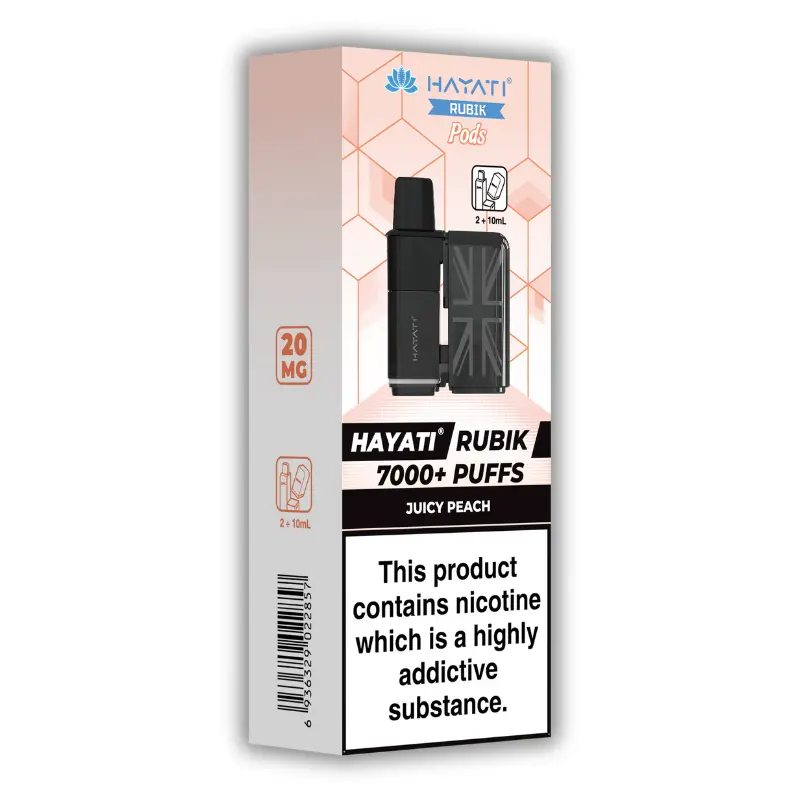
Hayati · Rubik
Juicy Peach Hayati Rubik Pods
£3.99
✔ In stock — ready to ship
Genuine Hayati
Free over £20
Same-day dispatch
Secure checkout
Three pounds ninety-nine buys one sealed Hayati Rubik pod holding twelve millilitres of Juicy Peach at 20mg nicotine salt. There is no body in the pack, so this is a refill and behaves like one: it does nothing at all until it is seated in a Rubik you already own. Hayati's own figure for a full pod is up to 7,000 puffs, which came off bench equipment drawing to a fixed pattern and is a way of ranking two products against each other rather than a forecast about anybody's month. At twelve millilitres for £3.99 the liquid works out at 33.3p a millilitre, which the Hayati Rubik Pods shelf establishes is the floor for prefilled liquid anywhere on this site.
That is the entire specification, and it is identical to the other eighteen listings on the same shelf. What separates this one is not the sheet. It is a question that only arises once you own the device, have settled on the flavour, and are buying the liquid again: when do you replace the pod, and what does getting that decision wrong cost you.
The complete kit version of this product has already worked out why the question is hard on this particular liquid, and a neighbouring kit on the same shelf has already worked out the arithmetic of replacing a pod before it is empty. Both pieces exist. Nobody has put them together, and when you do, something slightly surprising falls out: the two flavours share a price list down to the penny, they share a pod volume, they share a platform, the sums transfer with nothing changed, and they still end up needing opposite policies. That is what this page is for.
What is already on the record, and where
Four pages carry work this one depends on. Each gets a sentence or two and no more, because rebuilding any of it would waste your reading time and would tell you nothing you could not get by following the link.
The Juicy Peach Hayati Rubik Prefilled Pod Kit holds the central finding about this liquid, which is that a gradient cannot report its own decline: every state this pod can reach still reads as a plausible peach, so there is no point at which it starts tasting broken, and memory fails to catch the drift for three separate reasons, because it holds categories rather than magnitudes, because the daily increment sits under the smallest change a palate can register, and because the reference you are comparing against quietly updates itself. That page also establishes that a fade here has two possible causes, the coil or the person drawing on it, that they produce a single identical symptom, and that nothing available from inside the pod separates them.
The same page supplies every instrument this one uses. The tail count, which is the number of seconds between the end of an exhale and the moment what is left in your mouth stops being specifically peach, taken on day one as a median of several tries and repeated until it has roughly halved. The landmark pod, which measures you rather than the coil, and answers the only question the count cannot answer on its own. The sealed reference pod, bought early at £3.99 and kept closed, which is a physical zero you can taste against in the same minute rather than a remembered one. And the three lines to write down on the day you open a pod. All of that is theirs. Everything on this page assumes you have read it.
Two further findings from that page are load-bearing here and are taken as settled: the lactone chemistry that puts this flavour's whole identity in the heaviest and quietest material in the recipe, so that the tail goes first rather than the front, and the reconciliation of that account with Triple Mango Hayati Rubik Pods, which fails from the opposite end of the draw for the same underlying reason. The value framing is theirs too, and it is worth restating only as a pointer: the cheapest platform is the wrong place to meet this flavour and the right place to keep it, with the 49.9p and 33.3p arithmetic behind it cited from the Vim Ice Rubik listing rather than derived again.
The Juicy Peach Hayati Pro Ultra Plus 25K Pods page owns the argument about what a single-flavour pod withholds, which is an in-session escape hatch, and it sets out the three exits available when a solo liquid stops holding you and what each of them costs. It also makes the point about evening judgement that this page will lean on once and not repeat.
The Hayati Rubik Pods shelf owns the 33.3p figure and the cross-platform table that puts it next to every other prefilled pod Hayati make, along with the honest correction that bottled liquid is cheaper still and always has been.
The fourth is the one this page is built on. The Lemon Lime Rubik kit listing, on this same shelf at £5.99, worked out the cost of retiring a pod before it is empty and produced the apparatus: cost per millilitre actually drawn rather than per millilitre bought, run across all four platforms that sell the same liquid, with three crossover points marked on it. I am citing that table and those crossovers rather than deriving them a second time. What that page did not do, because it had no reason to, is ask whether the policy it recommends survives being pointed at a flavour with a different kind of signal.
One figure from the twin has moved, and one from the shelf does not add up
Two corrections before anything is built on top, both found by counting rather than by reading.
The kit page reports that Juicy appears in thirteen titles, all of them this flavour, and in the description text of 129 listings, from which it concludes that the word is an index entry in a title and filler in prose. The thirteen still holds exactly, and so does the conclusion. The 129 does not. Counting against the catalogue as it stands today, the word appears in 162 descriptions, 149 of which have no Juicy anywhere in their title, which is nearly a third of the 492 listings rather than a quarter. The finding is unchanged and in fact strengthened, but the number has drifted, and a figure quoted from a sibling page is worth recounting before it is repeated.
The second is arithmetic. The Rubik Pods shelf, in a passage about the sweeter blue entries, says that a pod abandoned at nine millilitres cost you 53p a millilitre rather than 33.3p. Divide £3.99 by nine and the answer is 44.3p. The figure 53p corresponds to seven and a half millilitres, not nine. The shelf page's general point is sound, and the Lemon Lime table on this same shelf gets every equivalent figure right, so this reads as one slipped division rather than a broken method. It matters here because the whole of this page is that division, done over and over, and a reader who carries the wrong constant into it will overestimate the cost of every early retirement by about a fifth.
Testing the premise: four platforms, two flavours, one price list
The claim this page was handed is that Juicy Peach is sold on the same four prefilled platforms as Lemon Lime at identical prices and volumes, so the Lemon Lime arithmetic transfers with no number changed. That is a rarity claim of the kind that is worth counting before it is spent, so here is the count.
At the refill tier it holds exactly, on all four. A Rubik pod of either flavour is £3.99 for 12ml. A Pro Max Plus pod of either is £5.49 for 12ml. A Pro Ultra Plus pod of either is £7.99 for 22ml. A Mini Ultra pod of either is £3.49 for 4ml. Eight listings, four prices, four volumes, no divergence anywhere. The kit tier matches on price too: £5.99 on the Rubik, £7.99 on the Pro Max Plus, £11.99 on the Pro Ultra Plus, £3.99 on the Mini Ultra, the same figures for both flavours on all four platforms.
One thing is not identical and it is worth narrowing the claim to say so. Lemon Lime has a solo Mini Ultra kit of its own. Juicy Peach has no solo Mini Ultra kit at all: the only Mini Ultra kit carrying this peach is the paired Sour Apple / Juicy Peach listing, at the same £3.99. So the correct version of the premise is that the prices and volumes are identical across all eight refill and kit listings on four platforms, and that the single asymmetry is what the Mini Ultra kit contains rather than what it costs. The bare Juicy Peach Hayati Mini Ultra Pods refill is a solo peach, so the asymmetry disappears again the moment you already own the hardware, which is the situation this page is written for.
A second divergence is cosmetic and will cost somebody a wrong click. The Pro Ultra Plus refill for this flavour has a slug ending in 25k-pods and the Lemon Lime one ends simply in pods, two different endings for one product line at one price for one volume. Nothing in either title predicts which. Copy the address rather than reconstructing it.
With the premise narrowed and confirmed, the Lemon Lime table applies here in full. Every crossover it marks, every per-millilitre figure in it and the £1.33 of liquid binned per pod retired at eight millilitres are all correct for this pod on this platform, unchanged, because the two flavours are buying exactly the same volume at exactly the same price. The rest of this page takes those numbers as given and asks a different question of them.
The same arithmetic produces the opposite policy
Here is the finding, before the working.
Lemon Lime retires on a yes or a no. Its distinguishing note is a faint bitter edge at the close of the draw, and the question is whether that edge is still arriving. One reading answers it. There is no magnitude to hold, no baseline to have taken, no history required, and a person halfway through a pod they have never thought about can start applying the rule this afternoon.
This liquid cannot retire on a yes or a no, because there is nothing in it that is either present or absent. It can only retire on a number, and the number is the twin's tail count. That difference looks like a difference of convenience and it is not. A policy triggered by a continuous measurement has a completely different error structure from one triggered by a categorical signal, and once you work the error structure through, the rational threshold moves later on the same platform at the same price for the same volume of the same-priced liquid.
The two ways of being wrong, and what each one costs
Any replacement rule can fail in two directions. Retire a pod that was fine, or keep one that had gone. On Lemon Lime those two failures are roughly symmetrical: the bitter edge either arrives or it does not, the reading is close to unambiguous once the two confounds that page names are ruled out, and the cost of being wrong in either direction is small because you are rarely wrong.
On this pod the two failures are not symmetrical at all, and the asymmetry is large.
A false positive is a cash loss and it is permanent. You take a reading, the count looks halved, you bin a pod that still had good liquid in it. The money is gone in two places at once: the millilitres in the bin at 33.3p each, and the earlier purchase of the next pod. At a retirement point of eight millilitres that is £1.33 of liquid discarded per pod, which is the Lemon Lime page's own figure and holds here without adjustment. Nothing recovers it. The pod is in a take-back bin and the liquid went with it.
A false negative costs nothing visible and undoes itself. You take a reading, it does not look halved, so you carry on. If the pod really had gone, what have you lost? Some draws that were duller than they could have been, on liquid you had already paid for and were going to draw anyway. Your cost per drawn millilitre went down rather than up. And the mistake does not persist, because the underlying quantity only moves in one direction. A coil does not recover. Whatever you failed to detect on Tuesday will be more detectable on Friday, and your next scheduled reading will catch it without you doing anything differently.
That last property is the one that settles the argument. One of these two errors is corrected by the passage of time and requires no action. The other is terminal at the moment you commit it. Any decision rule facing that structure should be reluctant to act, and reluctance in this context means one thing only: waiting longer before you pull the trigger, which is to say retiring later in the pod.
Why the count can be trusted as a trigger at all
An obvious objection: if the measurement is noisy enough to make false positives a real risk, why trust it?
Because of what the twin designed it to defeat. The reason ordinary attention fails on this liquid is that your reference point walks along with the decline, so today is always being judged against yesterday and yesterday has already moved. The count does not have that problem, because it is a number in seconds written on a piece of paper on the day the pod was opened, and a number on paper does not drift. Whatever else is wrong with it, it is the one reading available on this liquid that is not systematically biased towards missing a fade.
That is worth being precise about, because it changes what kind of caution is appropriate. If the instrument leaned towards false negatives, the right response would be to compensate by acting earlier. It does not lean that way. The day-one count removes the bias and leaves only scatter, and scatter is symmetrical, which means the direction you should lean is decided purely by the costs. The costs say late. So the answer is late, and it is late for a clean reason rather than as a hedge against a wonky instrument.
Two sources of scatter are worth naming so they can be handled rather than feared. The first is your palate on the day, which the twin's landmark pod resolves in a single draw and which needs no further method here. The second is the time of day, which the Pro Ultra Plus pods page covers properly: a low-contrast liquid reads thin by evening on a palate that has had nothing else to measure it against, and a great many pods get retired on the strength of a nine o'clock judgement that a nine o'clock in the morning reading would have contradicted. Take the count early, on a rested palate, as the twin says, and take it at the same time of day every time. A standard taken at varying hours is not a standard.
What later means, in millilitres
An argument for waiting is worthless without a quantity attached, so here is the quantity, worked against the crossovers the Lemon Lime page already published.
The practical form of waiting is a confirmation requirement. Instead of retiring on the first reading that crosses the halving line, retire on the second consecutive one, taken on your normal schedule, with the landmark passing on both occasions. One further reading interval is all the delay this needs, and it converts into millilitres straightforwardly. If you read every third day and a pod lasts you N days, one interval is thirty-six divided by N millilitres.
| Days a 12ml pod lasts you | Millilitres in one three-day reading interval | Where an 8ml first crossing moves to |
|---|---|---|
| 15 | 2.4ml | 10.4ml |
| 20 | 1.8ml | 9.8ml |
| 25 | 1.4ml | 9.4ml |
| 30 | 1.2ml | 9.2ml |
So later means between one and two and a half millilitres later, and on a pod that lasts three weeks it means very close to two. That is a small number and it is doing a great deal of work, which becomes clear the moment it is priced.
Pricing the delay against the published crossovers
The table below is £3.99 divided by the millilitres you actually drew. Nothing in it is new arithmetic, it is the Rubik column of the Lemon Lime table read at a finer resolution, and I am setting it out because the interesting region for this liquid sits between two of their rows rather than on one.
| Retired after | Cost per millilitre drawn | Left in the pod | Value binned each time | Spent per 100ml actually drawn |
|---|---|---|---|---|
| 7ml | 57.0p | 5ml | £1.66 | £57.00 |
| 8ml | 49.9p | 4ml | £1.33 | £49.88 |
| 8.7ml | 45.9p | 3.3ml | £1.10 | £45.86 |
| 9.5ml | 42.0p | 2.5ml | 83p | £42.00 |
| 10ml | 39.9p | 2ml | 67p | £39.90 |
| 11ml | 36.3p | 1ml | 33p | £36.27 |
| 12ml, drained | 33.3p | none | none | £33.25 |
Two of those rows are the Lemon Lime page's marked crossovers. At 8.7ml an early-retired Rubik pod costs the same per drawn millilitre as a Juicy Peach Hayati Pro Max Plus Pods refill drained to the last drop, which is 45.8p. At 11ml it draws level with a 22ml Juicy Peach Hayati Pro Ultra Plus 25K Pods refill drained completely, at 36.3p. Below the first line the policy is costing you more than simply buying a dearer pod and finishing it, which is the point at which a replacement rule stops being clever and starts being expensive.
Now put the confirmation interval next to those two lines, and the whole argument lands in one observation. A first crossing at eight millilitres puts you at 49.9p, which is on the wrong side of 8.7ml. One reading interval of delay puts you at somewhere between 9.2ml and 10.4ml, which is 43.4p at the near end and 38.4p at the far one, comfortably on the right side of it. The asymmetry is not a philosophical refinement. On the numbers the Lemon Lime page published, a single three-day confirmation window is the difference between a policy that pays and a policy that does not.
Priced per hundred millilitres actually drawn, that window is worth about £8. Moving from an eight-millilitre retirement to a nine-and-a-half-millilitre one takes the spend from £49.88 to £42.00 for the same hundred millilitres drawn. There is a convenient property of this table worth pointing out, which is that the cost per millilitre in pence and the spend per hundred millilitres in pounds are the same number, so you only have to read one column.
What a wrong early call costs, exactly
The angle for this page asked what a premature retirement costs at 33.3p. The direct answer is 33.3p for every millilitre you were early by, on that pod. The useful answer is the one that treats it as a policy rather than an incident, because a rule applied every pod repeats its bias every pod.
Read the last column of the table as a running cost and the marginal figures fall out. Moving the threshold from eight to nine millilitres saves £5.55 per hundred drawn. Nine to ten saves £4.43. Ten to eleven saves £3.63. Eleven to twelve saves £3.02. So in the region where this decision actually sits, a systematic bias of one millilitre costs somewhere between £3.60 and £5.55 for every hundred millilitres you get through, which is between eight and eleven per cent of the money. A two-millilitre bias, which is exactly what a missing confirmation step produces, costs around ten pounds in the same hundred.
Against that, price the opposite mistake. Suppose you were too cautious, held the pod for one extra reading interval that it did not deserve, and drew another two millilitres through a coil that had genuinely gone. You spent less. You drew two millilitres of a duller peach, which is not nothing, but it is two millilitres of a liquid whose entire failure mode is being a quieter version of itself rather than becoming something unpleasant. And you found out at the next reading. The two errors are not close to being the same size, and everything in this section is just that fact expressed in money.
The crossover this liquid cannot reach
The Lemon Lime page marks a third line at 4.6ml. Below it the Mini Ultra becomes the cheaper way to keep a young element under your liquid, because a 4ml pod never gets old enough for the question to arise. That branch is a live recommendation on that flavour. On this one it is unreachable, and the reason is instructive rather than a technicality.
To land below 4.6ml you would have to establish that your count halves inside four and a half millilitres. You cannot establish that on a 4ml pod, because the pod ends first. You also cannot establish it comfortably on a 12ml pod without noticing that the twin's day-one procedure already consumes some of the first two days in taking a median of several readings, so the earliest honest second reading is already a meaningful way into the pod. The instrument needs a run long enough to hold both a baseline and a comparison, and four millilitres is below that length.
Which produces a small circularity worth stating plainly: the format that would be cheaper if your signal came early is the one format on which an early signal cannot be demonstrated. On a categorical trigger there is no circularity at all, because you can tell whether a bitter edge is arriving inside the first mouthful of a 4ml pod and act on it immediately. A continuous trigger needs room. So the 4.6ml branch is not available here and the decision collapses to the two crossovers above it.
None of that is an argument against the smaller format on its own terms. Juicy Peach Hayati Mini Ultra Pods at £3.49 for 4ml is 87.3p a millilitre, which is two and a half times this pod, and what you are buying at that rate is a permanently young element and no decision to make. That is a legitimate purchase for somebody who wants the peach at its most legible and does not want to run a measurement at all. It is simply not reachable by the route the Lemon Lime page describes, because the route requires evidence the format cannot produce.
A cadence consequence the cost table implies and does not state
One more thing falls out of the same numbers, and it belongs to this frame rather than to the one that built the table.
Coil fouling is a function of how much liquid has crossed the element, not of what fraction of the pod has been used. That is the structural fact the Lemon Lime page opens its arithmetic with. Follow it into the cadence question and you get a result that nobody has written down: under a retirement policy triggered by millilitres drawn, the interval between changeovers is set by your threshold and by nothing else. It is the same interval on a 12ml pod and on a 22ml one.
Which means the main non-financial reason people give for buying the larger format, that it interrupts them less often, evaporates the moment they adopt a measurement-triggered cadence. Retire at ten millilitres and you change pods every ten millilitres whether the pod held twelve or twenty-two. The 22ml version simply arrives with twelve millilitres you will throw away instead of two, at £7.99 instead of £3.99. A Juicy Peach Hayati Pro Ultra Plus 25000 Prefilled Pod Kit at £11.99 is the right entry to that platform for somebody who intends to drain every pod, and the wrong one for somebody who intends to run a schedule.
The honest limit on this, and it is a real one: at a confirmed retirement of around ten millilitres this pod comes out at 39.9p, and a 22ml pod drained to the bottom comes out at 36.3p. On price per millilitre swallowed, the big pod still wins by three and a half pence. What it does not give you is any way of knowing what you are swallowing, because twenty-two millilitres through one element is twice the exposure to precisely the confound the twin identified, on a liquid that cannot report its own condition. Cheaper per millilitre, and a longer stretch of those millilitres spent on a coil you have no standard to measure. Whether that trade is worth three and a half pence is a genuine question and I am not going to pretend it has an obvious answer.
The precondition nobody mentions
Everything above assumes a day-one count exists. If it does not, there is no trigger, and no amount of attention manufactures one.
This is the sharpest practical difference between the two flavours and it deserves stating on its own. The Lemon Lime rule is retroactive. You can read that page today, pick up a pod you have been using for a fortnight, take one draw, and know whether the bitter edge is still arriving, because the question needs no baseline. This rule is not retroactive. A count taken in week three is a number with nothing to be compared against, and by then the thing it would have been compared against is unreconstructable, for exactly the three reasons about memory the twin sets out.
So the honest advice for anyone who did not take a count on day one is to run this pod out. Not as a consolation, as the correct decision. Draining it costs 33.3p a millilitre with nothing wasted, it is the cheapest prefilled millilitre on the site, and it is strictly better than guessing, because a guess has the error structure described above with no measurement anywhere in it to constrain the false positive. Somebody binning four millilitres on a hunch has paid £1.33 for a feeling. Do that every pod and it is £16.63 per hundred millilitres drawn for no information at all.
There is one way to manufacture a baseline late, and it is the twin's sealed reference pod used for a purpose that page does not claim for it. Seat a fresh pod, let it settle for a few draws, count on it, then count on the old one. Two numbers twenty seconds apart on the same tongue. That costs nothing extra because the reference pod is your next purchase regardless, so it is not a spend, it is a reordering of a spend.
Be clear about what it does and does not buy, because the distinction matters for this page's frame specifically. A ratio against a fresh pod gives you a verdict on the pod in your hand right now. It does not give you a rate. Two readings taken at known points in one pod's life tell you how fast this liquid ages on your device, which is what lets you predict where the next pod will land, how many you will get through in a month, and whether the whole policy is worth the bother on your usage. A day-one count buys a retirement decision and a cadence forecast. A late reference pod buys only the first of those. Most people think they are buying the same thing twice.
The figures, ordered by how much each one moves the decision
The rows below are arranged by relevance to a replacement schedule rather than in the order a specification sheet would print them.
| Ticket price of this refill | £3.99 | The numerator of every calculation on this page |
| Liquid in the pod | 12ml, sealed at the factory | The denominator only if you drain it |
| Rate if drained | 33.3p per millilitre | The floor, and the price of each millilitre you discard |
| Rate at a confirmed 10ml retirement | 39.9p per millilitre | What the policy actually costs to run |
| Flavour arrangement | Juicy Peach from first draw to last | Nothing to select, so nothing to strand |
| Nicotine | 20mg salt, the UK maximum | A concentration, nothing more. Nicotine is addictive |
| Hayati's puff figure | Up to 7,000, laboratory bench | Read as workload for one element, not as a duration |
| Coil | One mesh element, sealed in the pod | Cannot be changed without changing the liquid. This is why the policy costs anything |
| What is in the pack | The pod alone | A Rubik body is required and is not included |
| Cooling | None named anywhere for this flavour | Nothing cold sitting over the fade to disguise it |
| Sharpness | Low, on the kit page's count of eight descriptions | No categorical note, which is why the trigger has to be a number |
| Not published by Hayati | Coil resistance, wick material, airflow, carrier ratio | Why the retirement point cannot be quoted as a figure and has to be measured |
Two of those rows carry most of the weight. The sealed element is the reason an early retirement costs money at all, because the liquid and the coil arrive and leave as one object and no part of the format lets you refresh one without discarding the other. And the blank row at the bottom is why this page gives you a procedure rather than a number: nothing in Hayati's data would let anybody state the millilitre at which a Rubik element stops carrying a lactone tail, and anybody quoting one has taken it from somewhere other than the manufacturer.
Hayati publish nothing about fitment between their ranges, so match the range name on your device to the range name in this title and do not take a compatibility decision from a retail page, this one included.
The same peach on other platforms, read as a schedule
Comparisons on this shelf are usually run on flavour. Run on cadence they sort differently, so this section takes the liquid as decided and asks what each alternative does to the rhythm of buying.
The Juicy Peach Hayati Rubik Prefilled Pod Kit at £5.99 is the same twelve millilitres with a body attached, and it is a one-off rather than a cadence. Two pounds of the ticket is hardware you keep, recovered on your first reorder. There is one circumstance in which buying a second kit rather than a second refill is defensible on this liquid, and it is specific to running a schedule: a charged spare body with a fresh pod already seated turns a retirement into a swap you can make in the moment the reading tells you to, rather than one that waits until you are next at the drawer. Whether two pounds is worth that is a question about your day rather than about the peach.
Juicy Peach Hayati Pro Max Plus Pods at £5.49 holds the identical twelve millilitres, so the policy discards exactly the same number of millilitres and each one costs 12.5p more. There is no version of the argument on this page that makes it the better purchase for the schedule. Its case is the platform's flavour library, which runs to eighty-five names against nineteen here, and if the rest of your rotation already lives there then carrying one body rather than two has a value that this page cannot price for you.
Juicy Peach Hayati Pro Ultra Plus 25K Pods at £7.99 for 22ml is the platform where an early-retirement policy is least affordable, for the reason set out above: the same interval between changeovers, twelve millilitres in the bin each time instead of two, and £5.08 of discarded liquid per pod at an eight-millilitre threshold on the Lemon Lime page's own figure. Its compensation is the lowest rate available if you drain every pod. Choose it if you intend to drain, and not if you intend to measure.
Juicy Peach Hayati Mini Ultra Pods at £3.49 for 4ml removes the decision entirely at 87.3p a millilitre. It is the honest option for somebody who has read all of this and concluded they will not keep a log, because a format with no old element in it needs no policy, and a policy you will not follow is worth less than no policy at all.
The complete spread of this profile across every Hayati format sits under Juicy Peach Vapes, which runs to thirteen listings, and the wider stone-fruit field under Peach Vapes, which runs to thirty-two and is short enough to read end to end.
What to keep beside it, chosen for the job rather than for variety
The twin establishes that a landmark pod measures you rather than the coil, and that the whole value of carrying one is telling apart a bad pod from a bad afternoon. On a schedule that habit stops being optional, because every reading you take is only as good as your confidence that your palate was working when you took it.
Fresh Mint Hayati Rubik Pods is the cleanest choice on this shelf, being the only one of the nineteen with no fruit in it at all, and a mint reads at full strength or it does not. Lemon Lime Hayati Rubik Pods is the other obvious one and comes with a bonus, which is that its own bitter-edge signal is categorical, so a single pod does double duty as a check on your palate and as a thing you can read without a baseline. Blue Sour Raspberry Hayati Rubik Pods keeps a sour layer arriving on every draw, and Lemon Cola Ice Hayati Rubik Pods puts cold and citrus together, which is about as unmissable as this shelf gets.
What does not work as a standard is another quiet fruit, and the shelf has several. Blueberry Raspberry Hayati Rubik Pods is the warm uncooled all-day entry and is the nearest like-for-like swap if the peach stops suiting you, which makes it a poor reference and a good successor. Summer Dream Hayati Rubik Pods and Mr Blue Hayati Rubik Pods both name a mood rather than an ingredient, so neither gives you a property you could check the arrival of. Pairing two unreadable liquids leaves you with two pods and no instrument.
Among the cooled entries, Pineapple Ice Hayati Rubik Pods carries real tang under its chill and Watermelon Ice Hayati Rubik Pods is the least demanding of them over a long pod. Banana Ice Hayati Rubik Pods is the most instructive listing on the shelf for anyone reading this page, because it is a soft low-acid heavy fruit in exactly this liquid's position with a coolant bolted on to give it a terminating edge, which is the same problem solved by a different route. If your objection to the peach turns out to be that nothing ends the draw, that pod has already answered it and needs no measurement to manage.
Blue Razz Cherry Hayati Rubik Pods keeps two fruits separable a long way into a pod, which makes it a reference with two channels rather than one, and Blueberry Cherry Cranberry Hayati Rubik Pods binds three fruits with a dry cranberry astringency that you notice the loss of. At the other end, Blue Razz GB Hayati Rubik Pods is the most sugar-forward thing here, and if residue tracks sweetener load then it is the entry whose own element works hardest, which is an inference from the mechanism rather than a published figure and cuts the opposite way for this peach.
Off the platform, three listings are worth naming for anyone whose real question is whether they want a solo peach at all. Peach Mango Hayati Mini Ultra Pods at £3.49 puts this fruit against a heavier tropical one in four millilitres, which is a cheap way to find out whether peach alone is what you want. Cherry Ice/Peach Mango Hayati Pro Ultra Plus 25K Pods brings a cold register alongside stone fruit, and Mango Peach Pineapple Hayati Pro Ultra Plus 25K Pods is a three-fruit blend rather than a pairing, so the events in it are not selectable. For something structurally opposite, Blue Frozen Hayati Pro Max Plus Pods leads with cold and Blackcurrant Mango Hayati Pro Max Plus Pods puts a dark tart berry under a soft tropical fruit, which gives the finish something to arrive at.
Everything Hayati sell that is replaced by swapping a sealed pod sits together under Hayati Prefilled Pods & Refills, the bodies and their pods together under Hayati Rubik, and the unfiltered catalogue at all Hayati products.
One shelf caveat that decides whether the policy exists
The twin flags this and it is worth carrying forward because it is structural rather than about peach. Nineteen bare pods sit on this shelf against twenty kits, and Fizzy Cherry is the flavour with a kit and no matching refill. Anyone running that liquid cannot buy a £3.99 replacement at all, so every retirement is another £5.99 and a spare body accumulating in a drawer. Juicy Peach is not in that position, its refill is this listing, and the whole of the above is therefore available to you. Check the same thing before adopting a schedule on any flavour, because the policy rests entirely on the cheap pod existing.
Running this pod to a schedule rather than to empty
General handling belongs on the shelf pages and the twin covers everything that is about the liquid. What follows is only the part that changes because you are buying on a rhythm.
Read at the same hour, on a rested palate, and never in the evening. Two readings taken at different times of day are not comparable, and the difference between them will be larger than the thing you are trying to detect. This is the single cheapest way to avoid a false positive, and false positives are the error that costs money.
Write the open date on the pod itself, not in a notebook. The twin's three lines are the record; the date on the object is what tells you, three weeks later, which of two part-used pods in a drawer is the one your numbers belong to. A log that has come loose from the thing it describes is worse than no log, because it invites you to apply week-one figures to the wrong pod.
Order the spare on the day you open the current pod. Under a schedule this is not tidiness, it is what makes the schedule executable: a rule whose action is unavailable at the moment it fires does not fire, and what happens instead is that you keep drawing on the pod and quietly revert to draining it. The sealed spare is also your reference, which is the twin's point and does not need making twice.
Keep the sealed spare cool, dry and dark, and treat that as more important than where you keep the one you are using. Heat lifts the light volatile material out of a pod, and a reference pod that has been degraded by a warm drawer does not give you a slightly wrong reading, it corrupts the standard you are measuring everything else against. A bad sample costs you one pod. A bad standard costs you every pod after it.
Buy one spare, not six. A cheap refill makes stocking up feel sensible and it commits you to seventy-two millilitres of one flavour before you have any rate data. One is what the rule needs. The second pod is the one that tells you how fast this liquid ages on your device, and buying five more before that number exists is a bet placed before the card is turned.
Do not go back to a retired pod. If you retired it on a reading, it has not improved on the shelf, and returning to it means you have paid the waste and collected nothing. If you find yourself doing that repeatedly, the policy is not for you and the right move is to drain every pod at 33.3p and stop keeping records.
A schedule puts more pods through your hands, so make disposal a habit. A finished pod holds an element and a film of nicotine-bearing liquid, so it goes back to a vape retailer's take-back point or to a household recycling centre that accepts electricals rather than into a bin at home. Anything containing nicotine belongs stored out of reach of children and pets, and a drawer of sealed spares is a larger quantity in one place than most people picture.
Questions a repeat buyer asks
What exactly is the trigger for replacing this pod?
The tail count described on the kit page: seconds from the end of the exhale until what remains stops being specifically peach, taken as a median on day one and repeated on a schedule. Retire when it has roughly halved on two consecutive readings rather than on the first one that crosses. The second reading is what keeps the policy on the right side of the point where it starts costing more than simply buying a dearer pod and finishing it.
Why wait for a second reading? Lemon Lime does not.
Because that flavour's signal is a yes or a no and this one is a number. Acting wrongly on a number bins liquid you paid for and nothing gets it back; failing to act costs you a few duller draws on liquid you were going to draw anyway, and the next reading catches it without you doing anything. When one error is permanent and the other undoes itself, the sensible threshold sits later.
I never took a count on day one. What should I do?
Run this pod to the bottom. That costs 33.3p a millilitre with nothing wasted and it is a perfectly good way to buy the flavour. Guessing is worse than draining, because a guess carries all the cost of a false positive and none of the information that would justify one. Take the count on the next pod instead, on the day you open it.
Can a fresh pod give me a baseline after the fact?
Partly. Seating a sealed refill and counting on both pods in the same minute gives you a verdict on the old one, and it costs nothing extra because you were buying that pod anyway. What it cannot give you is a rate, because you do not know how long the old pod took to get there. A verdict tells you what to do today; a rate tells you what your next month looks like.
How much does retiring a pod too early actually cost?
33.3p for each millilitre you were early by, and roughly £1.33 per pod at an eight-millilitre threshold, which is the figure the Lemon Lime Rubik page worked out for this same volume at this same price. As a standing policy, being one millilitre early every time costs between £3.60 and £5.55 for every hundred millilitres you get through, which is eight to eleven per cent of the money.
Would the 22ml pod mean fewer interruptions?
Not if you are running a schedule. A coil ages with the liquid that has crossed it rather than with the fraction of the pod used, so if you retire at ten millilitres you change pods every ten millilitres whatever size the pod is. The larger format gives you the same interval, twelve millilitres in the bin each time instead of two, and a higher ticket. It is the better buy only for somebody who drains every pod.
Is the 4ml Mini Ultra version the cheap way round all this?
It is a way round it rather than a cheap one. At £3.49 for 4ml the rate is 87.3p a millilitre, two and a half times this pod, and what you buy is an element that never gets old enough to need watching. The Lemon Lime page's 4.6ml crossover, which is where a small pod starts winning, cannot be reached on this flavour because you cannot demonstrate an early signal on a pod that ends before the measurement moves.
Is this the same liquid as the kit at £5.99?
Same flavour, same twelve millilitres, same 20mg, without the body. The kit is a one-off purchase and this is every purchase after it. Buying a second kit costs two pounds more for hardware you already own, which is only worth it if you specifically want a charged spare body ready to take a fresh pod the moment a reading says to swap.
Does the 7,000 figure tell me when to replace it?
No, and it is worth being clear why. It is a bench estimate produced by machine at a fixed draw length, so it moves with how you actually use the device and cannot be divided into a date. Read as workload rather than as time it says the useful thing: one sealed element is expected to process all twelve millilitres, which is the arrangement that makes a retirement decision necessary in the first place.
Is there any ice or sour edge in this pod?
Neither, and that absence is the reason this page exists rather than a flavour footnote. No cooling word appears anywhere in the range text for this liquid, and the kit page counted eight separate descriptions denying sharpness. With nothing categorical in the pod, there is no property whose disappearance you could notice, which is exactly why the trigger has to be a measurement.
How many Rubik flavours can I rotate through?
Nineteen bare pods at £3.99, all 12ml of 20mg, sitting on the Hayati Rubik Pods shelf. Eight of the nineteen carry a cooling or mint word in the name, which is a high proportion for a short list and means a landmark partner is easy to find. Twenty flavours exist as kits, the extra one being Fizzy Cherry, which has no matching refill.
What if I just want to enjoy the peach and not run a spreadsheet?
Then drain every pod and pay 33.3p a millilitre with nothing wasted, which is the cheapest prefilled liquid on the site. The honest consequence is the one the kit page sets out: the later part of a pod will be a quieter peach than the early part and you will probably attribute that to the flavour rather than to the element. If that trade sounds acceptable, it is acceptable, and nothing on this page applies to you.
Where this leaves the decision
Three pounds ninety-nine for twelve millilitres of 20mg Juicy Peach in a sealed Rubik pod, at 33.3p a millilitre drained, which is the lowest rate for prefilled liquid Hayati sell. A body is required and is not in the pack. Hayati's bench figure is up to 7,000 puffs for a full pod.
The flavour question was answered on the kit page and this page has not reopened it. What it has done is take an arithmetic built for a different liquid on the same shelf at the same price and find out what happens when it is pointed here. The answer is that the sums transfer exactly, all four platforms, both tiers, not a penny different, and the policy comes out inverted. A yes-or-no signal can be acted on the first time it fires, from a standing start, on a pod you have never thought about. A measurement cannot, because the two ways of being wrong about a measurement are not the same size: binning a good pod is money you never see again, while carrying a tired one for another three days is a slightly duller peach and a mistake that corrects itself. So you wait for a second reading, and on this platform that single reading interval is worth about eight pounds per hundred millilitres and moves the policy from the losing side of the 8.7ml line to the winning side of it.
The precondition is the part to take away if you take away one thing. Without a count from day one there is no trigger here at all, and the right response to not having one is to drain the pod rather than to guess. Which is the genuinely different thing about restocking a gradient. On a flavour that announces its own decline you are reacting to something you noticed. Here you are acting on a number you decided to own, on a day when nothing was wrong, before there was anything to notice.
Strictly for adults aged 18 and over. Nicotine is an addictive substance.
You might also like


