
Home / Hayati Rubik Prefilled Pod Kit / Juicy Peach Hayati Rubik Prefilled Pod Kit
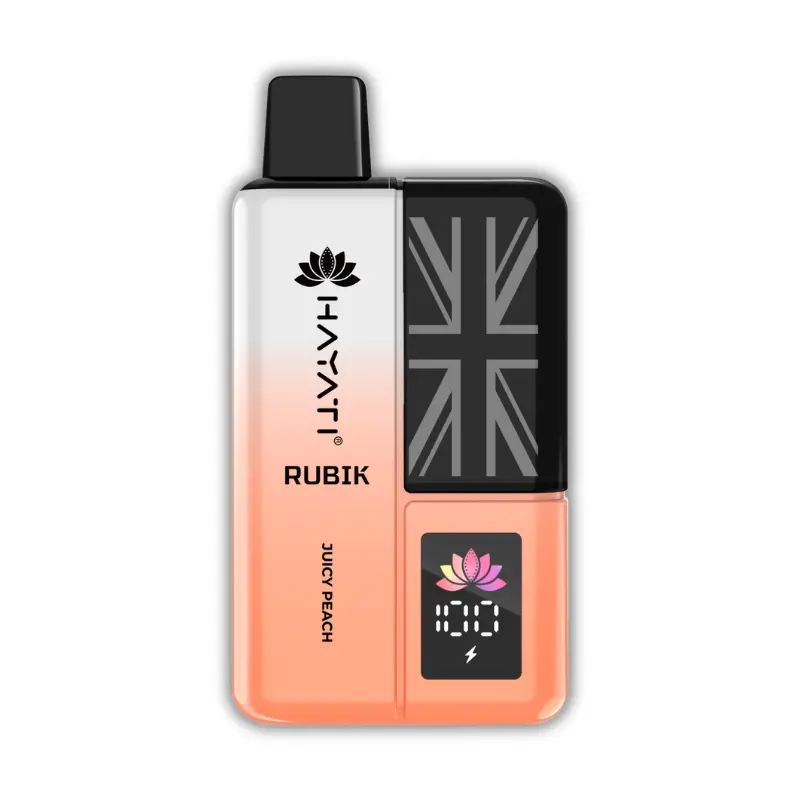
Hayati · Rubik
Juicy Peach Hayati Rubik Prefilled Pod Kit
£5.99
✔ In stock — ready to ship
Genuine Hayati
Free over £20
Same-day dispatch
Secure checkout
Five pounds ninety-nine puts a Rubik body and a filled Juicy Peach pod in the same box. The pod carries 12ml of 20mg nicotine salt, the body carries an 850mAh rechargeable cell, and Hayati rate a full pod at up to 7,000 puffs, a figure produced on laboratory test equipment to a fixed draw schedule rather than by anybody using one. Nothing needs assembling and nothing needs measuring. Seat, draw, and that is the whole of the setup.
The flavour is a warm, ripe, single-fruit peach with no acid in it, no cooling agent and no second fruit arriving late. That much is settled and this page does not re-argue it. What this page is about is a consequence of that shape which nobody has drawn yet, and it is the most practically useful thing anybody can tell you about buying this particular liquid on this particular platform.
Here it is in one line. A flavour with a sharp identifying feature has a signal that either turns up or does not, so the moment something goes wrong you know. A flavour that is a smooth build with no single landmark in it degrades without ever announcing that it has, because every stage of the decline still tastes like a perfectly plausible peach. This liquid will get worse and it will not tell you. Your memory of yesterday is not a good enough instrument to catch it, and the rest of this page is about what to use instead.
The second thing worth knowing before you spend the money is that you are meeting this flavour on the cheapest liquid in the prefilled range, which sounds like an unambiguous good and is not. Twelve millilitres through one sealed coil at 33p a millilitre on the refill is an excellent way to keep a flavour you already know. It is a poor way to find out whether you want one that fades invisibly, and the reason is specific rather than general.
What the corpus has already settled about this peach, taken as settled
Juicy Peach is one of the better-documented liquids Hayati sell, because they sell it many times over and write new copy for each listing. Somebody has already done the work of lining those descriptions up, and repeating it here would waste your time and mine.
The finding, established on the Sour Apple / Juicy Peach Hayati Mini Ultra Pod Kit page: setting the paired listings aside, Hayati sell this flavour on its own ten separate times, and eight of those ten deny sharpness outright. The wording varies across the eight but the property asserted does not, and eight independent assertions of the same thing is about as close to a published fact as an unpublished formulation gets. The two dissenters both allow a small tang at the close, and both are Pro Max Plus listings, so the disagreement falls exactly along a platform line. That pattern has turned up on other flavours in this catalogue, and the reading it supports is that a split of that shape is evidence about which copywriter had the brief, not evidence of two recipes. Anyone comparing the Juicy Peach Hayati Pro Max Plus Pod Kit against this one and concluding that the 12ml Pro Max Plus version is the tangier mix has over-read a spreadsheet.
So: a peach with essentially no flavour acid. That premise is load-bearing. Several arguments in this catalogue about where a liquid belongs in a rotation rest on it, and it is worth knowing that it is supported by eight separate descriptions rather than by one confident sentence.
The second settled thing is the shape of the draw. Where the sour apple beside it in the Mini Ultra pairing is an event, this is a gradient. It opens sweet, stays sweet, keeps one fruit identity from front to back, and the only movement in it is a modest thickening towards the finish as the body fills in behind the opening sweetness. Nothing cuts across it, so nothing catches. Nothing terminates it, so it fades instead of stopping. That distinction has been used in this catalogue to explain running order within a session, which is where it was first needed: an event punches through a palate that has been worked on and a gradient does not, so a gradient belongs early.
The running-order consequence is real and it is not what this page is for. There is a second consequence of the same distinction, it operates over weeks rather than over an afternoon, and it is worse.
"Juicy", counted before it is trusted
Before building anything on the name, it is worth asking whether the first word in it carries any information. The catalogue answers that, and the answer has two halves that pull in opposite directions.
Thirteen of the 492 listings have Juicy in the title. Every single one of them is Juicy Peach. There is no Juicy Mango, no Juicy Berry, no Juicy anything else. As a title word it is not a modifier that Hayati apply across the range to mark out a property; it is a fixed component of one flavour's proper name, in the same way that GB or Ice are not.
Now look at the body copy rather than the titles. The word turns up in the description text of 129 listings, and 116 of those have no Juicy in their title at all. Roughly a quarter of the catalogue is described as juicy somewhere in its prose. It is house vocabulary, in exactly the sense this catalogue has flagged before with words like jammy: a term so widely applied that its presence tells you nothing about the liquid carrying it.
Put the two counts together and the position is clear. The word narrows nothing about the fruit. Earlier pages in this catalogue reached the same verdict from a different direction, noting that juicy describes a ripeness and a texture that applies to any peach of any flesh colour at the right moment in its week. The counts support that and add a detail: it is not that the word is a weak discriminator, it is that it is not being used as a discriminator at all. In titles it is an index entry. In prose it is filler.
That is not a complaint. A name that acts as an index entry is doing something useful, and thirteen listings across seven different formats is a large footprint for one liquid, all of it findable under Juicy Peach Vapes, which is where to look if you want this profile on hardware you already own.
But it matters for the argument of this page in a way that is easy to miss. A name that carries no checkable property also hands you no baseline. If the pod were called Sour Peach you would have something to test on day one and something to notice the absence of in week four. Compare Mr Blue Hayati Rubik Prefilled Pod Kit on the same shelf, whose name names nothing and where the whole page is about the gap: at least the gap is visible. Here the name looks like a description, reads like a description, and is not one. You arrive with no reference point supplied by the label and no reference point supplied by the liquid, because the liquid has no landmark in it either. Two absences, and they compound.
The argument: a gradient cannot report its own decline
A signal and a slope are different kinds of thing
A sharp identifying feature behaves like a switch. The sour seam in Blue Sour Raspberry Hayati Rubik Prefilled Pod Kit is either cutting across the sugar or it is not. The cold on Pineapple Ice Hayati Rubik Prefilled Pod Kit either arrives on the exhale or it is missing. The citrus bitterness on Lemon Lime Hayati Rubik Prefilled Pod Kit is present or absent, and a half-strength version of it still registers as the same event, only smaller. Features of that sort survive an inattentive palate, they survive a bad day, and when they finally fail they fail conspicuously. A pod that has lost its acid tastes broken. Broken is a very easy thing to notice.
A gradient has no switch in it. It is a quantity that arrives smoothly and departs smoothly, and it can be reduced by any amount at all without producing a moment at which the liquid stops being a recognisable version of itself. Take twenty per cent off the tail of this peach and you have a peach. Take forty off and you have a peach. Take seventy off and you have a slightly boring peach, which is a description most people will apply to any liquid they have been running for five weeks regardless of its condition.
That is the whole problem in one sentence: there is no state of this pod that reads as faulty. Every point on the decline reads as a plausible peach, and a plausible peach is indistinguishable, from the inside, from a good peach met by a tired person.
Why yesterday is the wrong thing to compare against
People assume they will catch a fade because they will remember what it used to taste like. They will not, for three separate reasons, and all three of them apply here at once.
The first is that memory for intensity is bad in a way memory for presence is not. You can reliably remember whether a liquid was sharp. You cannot reliably remember how sharp, and a fade on this profile is entirely a question of how much rather than whether. Ask yourself now to recall the exact loudness of something you drank this morning and you will find the recollection has a category in it and no magnitude.
The second is that the daily increment is below the threshold at which you could notice it even in principle. A coil does not lose a third of its output overnight. It loses a fraction of a per cent, repeatedly, and each day's difference from the day before sits under the smallest change a palate can register. The sum of thirty such differences sits well above it. A decline assembled out of steps you cannot individually perceive is, by construction, a decline you cannot perceive by paying attention. Attention is not the missing ingredient.
The third is the nastiest. Your reference updates itself. Whatever you tasted yesterday becomes the standard against which today is judged, so the standard tracks the decline rather than staying put. The catalogue has already documented a same-day version of this on a large single-flavour pod, where a peach that was legible in the morning reads as thin by evening because the palate has nothing left to measure it against. Stretch that mechanism across five weeks instead of one day and you get a reference point that has quietly walked the entire distance with the liquid.
Two causes, one symptom, and no way to tell them apart from inside the pod
Suppose you do notice, on a Thursday, that the peach seems less peachy than it was. There are two explanations and they are completely different.
One is that the coil has moved on. The other is that you have: a cold, a session that has already run long, coffee twenty minutes ago, something sweet and heavy before it, or simply the ordinary adaptation that sets in when a soft flavour has been the only thing in your mouth since breakfast. On a liquid with a landmark, the two are separable in a second, because the landmark either arrives or it does not and a blocked nose does not make a sour note vanish while leaving sugar intact. On a gradient the two produce a report that is word for word the same: it is not as good as it was.
This is the actual reason "just pay attention" fails as advice here. The signal is not faint. The signal is ambiguous, and no amount of concentration disambiguates it, because both causes push the single available reading in the same direction. Solving it requires bringing in something from outside the pod, and that is what the method section below is for.
What a wearing coil takes first from this particular liquid
Peach owes its identity to lactones, principally gamma-decalactone and delta-decalactone, which is a point this catalogue has established at length elsewhere and which I am taking as given rather than rebuilding. Two properties of that family matter here, and they have been documented separately on different pages without anybody putting them together for a solo peach.
The first is weight. Lactones are the heaviest aromatic material in a stone-fruit recipe. They volatilise slowly, they sit at the back of a draw, and they persist in the mouth after the vapour itself has gone. On a three-band blend that puts them last in the queue to arrive. On a liquid where they are the only thing carrying the flavour, it puts the whole of the flavour's identity in the part of the draw that needs the most heat to get out of the wick.
The second is volume, and it runs the other way. A lactone is quiet. It is perceived at a lower intensity than a bright aldehyde or a light terpene even when it is present in comparable quantity. Peach does not compete on loudness anywhere in this catalogue. It competes on duration, and duration is a weaker position to hold.
Now add what residue does to a mesh element. As sweetener polymerises onto the surface, the element transfers less heat into less liquid per draw. The material that suffers is the material that needed the most help to volatilise in the first place, because there is now less help available and it is being rationed by boiling point. On this liquid that is the lactone tail, which is to say all of the peach.
The prediction, stated in the order it should happen: the tail shortens first. Draws start finishing abruptly instead of leaving something soft behind. Next the faint floral thread that sits where the under-skin layer of the fruit would be thins out, and the catalogue has already put that one first in its own account of this liquid's decay over a much larger pod. What survives longest is sweetness, warmth and vapour volume, because sweetener rides in the liquid fraction and does not depend on the coil lifting a high-boiling aromatic out of a wick. The end state, which earlier pages predicted from a different direction and which I am agreeing with rather than discovering, is sweet, warm, and no longer specifically peach.
The corpus contains two accounts of this, and both are right
Worth flagging honestly, because a reader who has been through these pages will have noticed. Triple Mango Hayati Rubik Prefilled Pod Kit, on this same shelf and this same hardware, says that a residue-loaded coil takes the bright just-ripe opening first, which is the light end. The peach analysis on the Pro Max Plus side says heavy material goes first. Those look like a contradiction and they are not.
Both resolve if the rule is stated as: what you lose first is whichever component sits closest to your detection threshold, and volatility decides which component that is for a given recipe. Triple Mango is top-light, so its identity lives in a quiet bright opening and that is what goes. This liquid is tail-led, so its identity lives in a quiet heavy finish and that is what goes. Same rule, opposite ends of the draw, and the reason it is worth spelling out is that it means the habit that protects a Triple Mango does not protect this pod, even though the two sit on the same shelf at the same price on the same body.
One thing makes this pod's case firmer than most. Usually the two mechanisms point in different directions and you have to pick. Here the lactone tail is both the quietest component and the highest-boiling one, so the threshold argument and the volatility argument nominate the same casualty. That is unusual, and it is why I am willing to state the prediction with a reasonable amount of confidence while still being clear about what it is. Hayati publish a capacity, a strength, a cell size and a puff rating for this kit. They publish nothing about the coil, nothing about the carrier ratio and nothing about the flavour formulation. This is reasoning from what compound classes do, not a reading off a specification.
A method for catching a decline you cannot feel
Everything above is diagnosis. This is the part to actually use, and it is built on one principle: do not ask your memory to hold a magnitude. It will not, and the failure is silent.
Point the instrument at the finish, not at the front
The front of a draw on this liquid is sweetness, and sweetness is the last thing to fail. Monitoring the opening therefore monitors the one component that will still be reporting normally long after the flavour has gone. That is precisely backwards, and it is what most people do, because the opening is the loudest part and loudness attracts attention.
The diagnostic sits in the seconds after the exhale. Finish the draw, close your mouth, and attend to what is still there at second three and second five. On a fresh pod there is something soft and recognisably stone-fruit sitting in the mouth after the vapour has cleared. On a tired one there is sweetness that stops when the vapour does. That transition is the entire signal, and the catalogue has used the same five-second wait for a different purpose on a three-fruit blend, to work out whether a cherry and a peach had merged. Pointed at a solo peach it answers a different question: not what is in the pod, but how much of it is still getting out.
Count, do not describe
The Peach Aura pod page made an important point about record-keeping that deserves extending rather than repeating: a written description drifts, takes its colour from whatever you read last, and two of them a week apart cannot usefully be compared, whereas a yes or no can. That is right, and it is the right instrument for the question that page was asking, which was whether a property is present at all.
A binary cannot track a quantity that shrinks. Decline is a quantity. Ask "is there a tail" in week four and the answer will be yes right up until the pod is finished, because something always lingers. The question has to have a number in it, and the only number available without instruments is time.
So: on the first day, on a rested palate, early in a session, take one slow draw and count the seconds from the end of the exhale to the moment when what is left in your mouth stops being specifically peach and becomes generic sweetness. Three seconds, five, eight, whatever it honestly is. Write the number down with the date you opened the pod. You now own something a description cannot give you, which is a reading from week one that is directly comparable with a reading from week four, because both of them are numbers produced by the same procedure.
Take the reading three or four times across the first two days and use the middle value, because a single count on a distracted palate is worth very little. When the count has roughly halved, the pod has done most of what it is going to do. That is a retirement signal you arrived at by measurement rather than by mood, and it is available on a liquid that offers no other signal at all.
The landmark, and the one question it actually answers
Running something with a hard edge alongside this pod is good advice, and it is worth being precise about why, because the usual reason given is not the main one.
Fresh Mint Hayati Rubik Prefilled Pod Kit is the obvious partner on this shelf, being the only entry with no fruit in it whatsoever. Lemon Cola Ice Hayati Rubik Prefilled Pod Kit works too, and so does anything with a genuine sour layer. What such a pod does for you is not to reveal the condition of your peach pod's coil, and this is where people get it wrong. Each pod on this platform carries its own sealed element. A mint pod knows nothing about a peach pod's mesh and cannot report on it.
What a landmark measures is you. Take a draw on the mint. If the cold and the herbal edge arrive at full strength, your palate is working normally this afternoon, which means that the flatness you noticed in the peach is in the peach pod. If the mint is also muted, the problem is upstream of both pods and today's reading on the peach should be discarded rather than acted on.
That single discrimination is the whole value of carrying a landmark, and it is worth considerably more than the palate-resetting effect it is usually recommended for. It converts an ambiguous symptom into an answer. Without it you have a suspicion you cannot act on; with it you have a fact about which of two things changed.
Triple Mango, on this same shelf, already prescribes a daily unrelated reference for a comparable reason, and it is worth saying plainly that the habit transfers while the target does not. On that pod you are listening for the return of a bright opening. Point the same habit at this one and check the opening and you will learn nothing, because the opening here is sweetness and sweetness is fine. Same procedure, different place in the draw.
The reference pod, which is the cheapest true zero in the range
Comparison against a memory is unreliable. Comparison against a physical sample, in the same minute, is the one perceptual task a palate is genuinely good at. On this platform that comparison costs £3.99.
Buy a Juicy Peach Hayati Rubik Pods refill early rather than when you run out, and leave it sealed. It is a duplicate of the exact liquid you are running, attached to an element that has done no work. When your count has dropped and you want to know whether to retire the current pod, seat the fresh one, give it four or five draws to settle because a new pod runs wetter than it will, and then take the count again. Two readings twenty seconds apart, on the same tongue, in the same room, with the same nose. There is no version of this comparison that your memory can compete with.
You lose nothing by doing it, which is the part that makes it practical rather than fussy. You were going to buy the refill anyway. The only change is when you bought it and that you kept it closed until you had a use for it. On the 22ml platform the same reference standard costs £7.99 and commits you to a much longer run behind it. Here it is the cheapest sealed millilitre Hayati sell in a prefilled pod, which is the one respect in which the cheap platform genuinely helps with the problem this page is about.
One shelf-specific caveat that has nothing to do with peach and everything to do with whether the method is available at all: the kit list and the refill list are not the same length. Fizzy Cherry Hayati Rubik Prefilled Pod Kit is currently a kit with no matching standalone pod, so anyone running that flavour has no cheap reference to buy. Juicy Peach is not in that position and its refill is listed, so the whole method above is open to you. Check before assuming it is open on whatever you buy next.
What to write down on day one
Three lines, and it takes a minute. The date you opened the pod. Your tail count in seconds, as a median of a few tries. And the name of the landmark you have decided to carry, so that future readings are taken against the same one rather than against whatever happened to be in the bag. A landmark you swap around is not a standard.
If you want a fourth line, note whether the tail on day one is recognisably peach or merely soft and sweet. That is the binary the Peach Aura page was right about, and it complements the count rather than replacing it. When the count is short and the tail has also stopped being identifiably fruit, both instruments agree and the pod is finished.
The Rubik, briefly
The hardware section here is short on purpose, because the shelf pages cover it properly and because the flavour is where this page earns its place.
The box holds the Rubik body with its 850mAh rechargeable cell and a pod already carrying its twelve millilitres. There is nothing to fill, no soak time and no part to fit. The Hayati Rubik shelf sets out what the shaped body does in the hand and in a pocket, which is the range's actual point of difference, and the Hayati Rubik Prefilled Pod Kit shelf lists the twenty complete kits on their own.
One line on the sheet matters for this liquid and it is not the cell. A single mesh element sits inside the pod, processes the entire twelve millilitres, and cannot be reached, rewicked or replaced. Its condition at any given moment simply is the condition you are vaping in, and it retires when the pod does. Twelve millilitres is a long run for one element, and on a liquid whose identity rides on the hardest material in it to volatilise, that length is the single specification most likely to affect what you actually taste in week four. Everything in the argument above follows from this row and no other.
Hayati publish no fitment statement covering Rubik pods and pods from their other ranges, so match the range name printed on your device against the range name in this title, and do not take a compatibility decision from a retail page, this one included.
The numbers, and the ones that are blank
| What £5.99 buys | Complete kit: Rubik body plus one filled pod |
| Liquid on board | 12ml, sealed at the factory |
| Flavour arrangement | Juicy Peach throughout. One liquid, nothing to select |
| Strength | 20mg nicotine salt, the maximum concentration permitted in the UK |
| Cell in the body | 850mAh, rechargeable |
| Manufacturer's rating | Up to 7,000 puffs for a full pod, measured in laboratory conditions |
| Coil | Fixed inside the pod. Not serviceable, retires with the pod |
| Cooling | None stated anywhere in the range for this flavour |
| Sharpness | Low, on eight independent descriptions of this liquid |
| Refill | Juicy Peach Rubik pod, £3.99 |
| Not published | Coil resistance, airflow, wicking material, carrier ratio, dimensions |
The two price rows are the ones people reason from and they have already been worked through properly on the Vim Ice Rubik listing, which tested the claim that this is the cheapest way to buy Hayati liquid instead of repeating it. The short version, cited rather than rebuilt: £5.99 across twelve millilitres is a little under 50p a millilitre for the first fill, £3.99 across the same volume is a little over 33p for every fill after that, and on that measure the Rubik refill is the cheapest prefilled millilitre on the shop, ahead of the 22ml platform by roughly three pence and ahead of the Pro Max Plus pod by twelve.
Two honest narrowings of that. It is the cheapest prefilled millilitre, not the cheapest millilitre. A 10ml bottle of Hayati salts at £2.49 works out under 25p and a 120ml shortfill at £6.99 works out under 6p, because a bottle is not paying for a sealed pod and an element every time. Those are a different purchase requiring different hardware and no prefilled format competes with them on unit price, nor is it meant to. And the Rubik's lead over the Pro Ultra Plus refill is three pence a millilitre, which is a margin a single price change would erase rather than a structural advantage.
The 20mg figure is a concentration and nothing more. Nicotine is addictive, the number is stated here as a property of the product, and what concentration suits any individual is not something a product page should have a view on. The 7,000 figure is a comparison tool between products rather than a forecast about your fortnight, because it comes from a machine drawing to a fixed pattern. Read as workload rather than as duration it says something more useful: one non-serviceable element is expected to process the whole twelve millilitres, which is exactly the fact the flavour argument above turns on.
The cheapest platform is the wrong place to meet this flavour and the right place to keep it
The value case for the Rubik is made properly on the Hayati Rubik shelf, including the arithmetic on why a kit followed by refills beats buying kits repeatedly, and it is not worth restating. What follows is a narrower point that the shelf page could not make because it applies to one kind of flavour rather than to the range.
The Rubik reaches its low rate the only way a prefilled format can, by selling more millilitres in one sealed unit. Cost per millilitre is the right measure of value and, as the Vim Ice page put it, the wrong measure of risk. That framing is already in the catalogue. The narrower thing is what "risk" consists of, and it is not the same risk for every liquid.
For a flavour with a landmark, a twelve-millilitre first meeting is a bounded experiment. You find out inside the first week whether you want a sour layer, or a cold exhale, or an astringent edge, and the answer does not change as the coil ages, because a landmark that is present at millilitre two is still identifiably present at millilitre ten even when it is quieter. The verdict you reach is a verdict about the flavour.
For a gradient, the same twelve millilitres hands you a rigged verdict. The question you are actually trying to answer is whether this liquid stays legible to you over a long run, and the single wearing element underneath it is a confound that pushes the answer in one direction the entire time. Your pod's second half is a measurably worse peach than its first half, and there is nothing in the liquid to tell you which of the two things changed, so you will attribute it to the flavour. People decide they have gone off Juicy Peach at around millilitre eight, and a fair proportion of them have not gone off Juicy Peach at all. They have finished a coil.
That is the real cost of meeting a gradient on the cheap platform, and it is not measured in money. The cheap platform is cheap because the commitment is large, and a large commitment is exactly the wrong shape of experiment for a liquid whose decline is invisible and whose decline is the thing you are trying to measure.
There are two ways round it and they are both easy. Either take the day-one count described above, in which case the confound stops being a confound because you can separate the coil's contribution from your own, or meet this flavour somewhere the run is shorter. The Sour Apple / Juicy Peach Hayati Mini Ultra Pod Kit at £3.99 carries this exact peach in a four-millilitre pod split with a genuinely tart green apple, which is a short enough run that coil wear does not dominate the reading, and which puts an event directly alongside the gradient so you can hear both. That page works through the arithmetic of a two-millilitre side and is the right place to read about it.
Now turn it round. Once you know the flavour, everything that made this platform a poor place to meet it makes it a good place to keep it. You are no longer running an experiment, so a large sealed unit is not a risk, it is just the cheapest available millilitre. The confound stops mattering, because you already know what the liquid does and can attribute the fade correctly. And the £3.99 refill, which is the thing that makes the running cost low, is also the calibration standard that solves the detection problem. The same property, cheap high-volume sealed units of one liquid, is a liability at the meeting and an asset at the keeping. Which side of that you are on is a question about what you already know, not about the hardware.
Where it sits among the other nineteen
The Hayati Rubik Prefilled Pod Kit shelf holds twenty flavours, and the useful way to sort them for this decision is not by fruit family but by whether a flavour has a landmark in it or not.
The closest structural relative is Triple Mango Hayati Rubik Prefilled Pod Kit. Warm, uncooled, unsharpened, lactone-carried, and it will present the same category of problem at the opposite end of the draw. Its identity is a bright just-ripe opening, so it fails from the front and its finish outlasts it. This one fails from the back and its opening outlasts it. Anyone who found Triple Mango went flat and could not say when should expect the same experience here with the location moved, which is worth knowing before treating one as an escape from the other.
For a landmark to carry alongside it, the shelf offers a decent spread. Fresh Mint is the cleanest, having no fruit in it at all. Lemon Lime Hayati Rubik Prefilled Pod Kit is straight citrus with no sugar behind it, sour from one and faintly bitter from the other, which makes it an unusually unambiguous reference. Blue Sour Raspberry keeps a sour layer resetting the palate throughout, and Blue Razz Cherry Hayati Rubik Prefilled Pod Kit keeps two fruits separable to the end of a pod, which makes it a reference with two channels rather than one.
Among the cold entries, Red Apple Ice Hayati Rubik Prefilled Pod Kit and Strawberry Raspberry Ice Hayati Rubik Prefilled Pod Kit both put a chill across the finish, which is the most durable landmark type available, and the raspberry in the second is doing structural work that stops the sweetness stacking. Pineapple Ice carries genuine tang on the inhale under its cold. Banana Ice Hayati Rubik Prefilled Pod Kit is the most instructive comparison of the lot: a soft, low-acid, heavy fruit in exactly this liquid's position, with the problem solved by importing a coolant. If your objection to the peach turns out to be that it has nothing to end it, that pod is the same objection already answered.
Two more worth naming for contrast. Blue Razz GB Hayati Rubik Prefilled Pod Kit is the sweetest thing on the shelf by the shelf page's own account, and if residue tracks sweetener load then it should be the hardest of the twenty on its own element. That is an inference from the mechanism rather than a published figure, and it cuts the opposite way for this peach, which sits well below the sweet-shop entries on that measure. Blueberry Cherry Cranberry Hayati Rubik Prefilled Pod Kit goes the other way, using a dry astringent cranberry edge to bind three fruits, and astringency is a structure you notice the loss of. Blueberry Raspberry Hayati Rubik Prefilled Pod Kit is the shelf's warm all-day option and is the nearest thing to a like-for-like swap if the peach turns out not to suit you.
Off this platform, the same liquid exists at £7.99 as the Juicy Peach Hayati Pro Max Plus Pod Kit, which is the same twelve millilitres at the same strength on a different body, and which is also one of the two listings in the ten whose copy allows a tang at the close. On the reading set out earlier, that difference is about the copy desk rather than about the mix, and it is not a reason to pay the extra. The complete peach range across every Hayati format is collected under Peach Vapes, which runs to thirty-two listings and is short enough to read end to end.
If what this page has convinced you of is that you want structure rather than softness, the options are elsewhere in the catalogue rather than on this shelf. Blackcurrant Lemonade Hayati Pro Max Plus 6000 Pod Kit uses a soft-drink construction to read drier than its sugar level implies, which is a landmark built out of acid. Black Mamba Hayati Pro Max Plus 6000 Pod Kit is a dark low-acid blend for anyone who likes the round register but wants more weight behind it, and Banana Ice Hayati Pro Max Plus Pod Kit repeats the soft-fruit-plus-coolant answer on the larger body. Everything that arrives sealed and prefilled, sorted by how the liquid gets replaced rather than by flavour, sits under Hayati Prefilled Pod Kits, and the whole catalogue is browsable at the full Hayati range.
Living with twelve millilitres of a quiet fruit
General pod advice is on the shelf pages. What follows is the part that behaves differently because of what is in this pod rather than because of the format.
Take the count on the first day, not when you start to worry. This is the only item on the list that cannot be done retrospectively. A reading taken in week three has nothing to be compared against, and by then you have already lost the ability to reconstruct what week one was like. It takes one draw and five seconds of attention, and it is the difference between having a measurement and having an opinion.
Draw length selects how much of the fruit you get. On a blend with three components in three weight bands, a short brisk pull brings the light material forward and leaves the heavy behind, which changes the balance. On a liquid whose only aromatic material is heavy, a short brisk pull does not rebalance anything, it simply leaves out the part you paid for and hands you sweetness. A slower pull of around three seconds moves more liquid across an element that has been at temperature longer, which is what the lactones need. If the pod has started reading as generic, lengthen the draw before concluding it is finished.
Chain-drawing costs you the tail specifically. Back-to-back draws leave the wick short and the element hotter than it should be, and a warm sweetened liquid caramelises on a hot dry surface. That residue is permanent rather than a session effect, and on this liquid the thing it takes is the finish. Two or three draws and a pause is not fussiness here, it is the difference between the peach lasting to millilitre ten and the peach lasting to millilitre six.
Heat in storage attacks the opposite end, and this gives you a second diagnostic. A pod left on a dashboard or a sunny sill loses light volatile material, which on this liquid is the faint floral lift at the front. A fouled element loses heavy material, which is the tail. So the two failure modes have opposite signatures and you can tell them apart. If the peach has gone thin at the front while the finish still lingers, suspect where you have been keeping it. If the front is unchanged and draws have stopped leaving anything behind, suspect the element. That is not a distinction anyone can make on a busy blend, and it is one of the few advantages of a liquid with only one thing in it.
Discount the first draws after a pod has stood. Liquid sitting against a wick that has not moved for a fortnight comes through heavy and slightly stewed, which on a peach reads as syrup and is the least attractive version of this profile. Pull through three or four and judge it on the fifth. This matters more here than elsewhere because syrupy is also what a genuinely tired pod tastes like, so a rested pod can be mistaken for a spent one.
Run it early in a rotation rather than late. A liquid with no coolant, no acid and no dark weight is the one most easily flattened by whatever preceded it, and if you meet it after something sharp you will blame the pod. This is established advice for quiet peaches in this catalogue and it holds exactly as written on a smaller pod.
Charge on a rhythm rather than on a warning. An 850mAh cell paired with twelve millilitres means the body will need the cable many times over before the pod is done, which is the ordinary arrangement for a large-fill prefilled device and is covered on the shelf page. The practical version is to leave a cable wherever you already stop moving for twenty minutes.
Buy the refill when you open the pod, not when you finish it. On a twelve-millilitre run the changeover arrives rarely enough that you will have stopped thinking about it, and on this flavour the refill has a second job as your reference sample, which only works if it is already in the drawer and still sealed.
Storage and disposal. Anything containing nicotine belongs where children and pets cannot get to it, and height works better than a closed lid. A finished pod has a heating element and a film of liquid inside it, so it goes to a vape retailer's take-back point or a household waste recycling centre rather than into the bin at home. The body is rechargeable and is not the part you throw away.
Questions this listing raises
How sweet is it, and does the sweetness fade too?
Above the middle of the range and well below the sweet-shop profiles, and the sweetness reads as fruit sugar rather than as a sweetener sitting on top. It is also the component least likely to fade, because sweetener rides in the liquid rather than depending on the element to lift a heavy aromatic out of the wick. That is why a late pod tastes sweet and vague rather than weak.
Is there any ice, menthol or sour edge in it?
None of the three. Eight independent descriptions of this liquid across the catalogue deny sharpness and no cooling word appears in the name or the range text. The temperature impression stays warm from the opening to the end of the finish, and nothing terminates the draw, so it fades out rather than stopping.
Why does my pod seem weaker than it did a fortnight ago?
Two candidates and they need separating before you act. Take a draw on a pod with a hard edge in it, mint or citrus. If that arrives at full strength, your palate is fine and the peach pod has moved on. If that is also muted, the change is in you today and the reading should be discarded. This is the single most useful habit on this liquid because a gradient gives you no other way to tell.
What exactly should I be listening for as the pod ages?
The length of the finish rather than the strength of the draw. Count the seconds from the end of the exhale until what is left stops being specifically peach. Take that count on day one and again later. When it has roughly halved, the pod has given you most of what it has, regardless of how much liquid you can still see.
Can I replace the coil when it tires?
No. A single mesh element is sealed inside the pod, handles the whole twelve millilitres, and retires with it. That is the arrangement across every prefilled format Hayati make, and it is the reason a twelve-millilitre run is a long single stretch for one element rather than several short ones.
Is the £3.99 pod the same thing as this listing?
It is the same liquid in the same quantity at the same strength, without the body. This listing at £5.99 includes the Rubik device; the refill does not, and a pod on its own will not produce anything without a body to seat it in. Buy the kit once and refill afterwards. Buying a second kit means paying £2 for hardware you already own.
Does "Juicy" tell me anything about the flavour?
Very little. Thirteen listings carry it in the title and all thirteen are this one flavour, so it works as an index entry rather than as a description. The same word appears in the description text of 129 listings across the catalogue, most of which have no Juicy in the name, which means it is house vocabulary and not a property claim. What it does not do is narrow down what kind of peach this is.
Will twelve millilitres of one soft fruit get boring?
Less often than people expect, because fatigue tracks intensity and sweetener load more closely than it tracks repetition, and this is a quiet liquid on both counts. The honest caveat is different from boredom: it will narrow as the element ages and you will not notice it happening, so what feels like boredom at millilitre eight is frequently a coil rather than a preference. That is what the count is for.
What should I carry alongside it?
Something with a hard edge, and the same one each time so that it functions as a standard. Mint, citrus or a genuine sour layer all work. Another warm soft fruit does not, because two quiet liquids give you nothing to calibrate against and you end up with two pods that feel like one.
How does the 7,000 figure relate to how long a pod lasts?
It does not, directly. It is a manufacturer's laboratory estimate produced by machine at a fixed draw length and interval, which makes it a fair way to compare two products and a poor way to plan a month. Read as workload it says something more relevant: one sealed element is expected to process the full twelve millilitres with no way to service it partway.
Will a Rubik pod fit anything else I own?
Every pod on the Rubik shelf seats into every Rubik body and the flavour makes no difference to fit. Between ranges, Hayati publish nothing, so the range name on the device is the thing to go by rather than the shelf you found the pod on.
Where this lands
Five pounds ninety-nine for a Rubik body with an 850mAh cell and a sealed twelve-millilitre pod of 20mg nicotine salt, filled with a warm, ripe, low-acid peach, rated by the manufacturer at up to 7,000 puffs in laboratory conditions. Refills are £3.99, which is the cheapest prefilled millilitre Hayati sell.
The flavour is easy to describe because it does one thing from the front of the draw to the end of the finish, and the catalogue has already established that it does so with no sour edge, no cold and no second fruit, on eight independent accounts rather than one. What has not been said before is the consequence of that shape for the person who owns the pod rather than the person choosing it. A liquid with a landmark tells you when something is wrong. This one cannot, because there is no state it can reach that does not still taste like a peach, and the two things that could be causing a fade produce an identical report.
So the honest recommendation comes in two parts. If you already know this flavour and want a lot of it cheaply, this is the right listing and the right platform, and the only thing to add to the order is a sealed refill to keep as your reference. If you are meeting the peach for the first time, either take a tail count on day one so that you can tell the coil apart from the liquid, or meet it on a four-millilitre pod first, because a twelve-millilitre run through one element will answer the question you are asking with an answer to a different question and you will not be able to tell.
Either way, watch the finish rather than the front, count rather than describe, and keep something with an edge in your pocket so you have a way of asking whether the problem is the pod or the day.
Strictly for adults aged 18 and over. Nicotine is an addictive substance.
You might also like


