
Home / Hayati Mini Ultra Prefilled Pod Kit / Sour Apple / Juicy Peach Hayati Mini Ultra Pod Kit
Hayati · Mini Ultra
Sour Apple / Juicy Peach Hayati Mini Ultra Pod Kit
£3.99
✔ In stock — ready to ship
Genuine Hayati
Free over £20
Same-day dispatch
Secure checkout
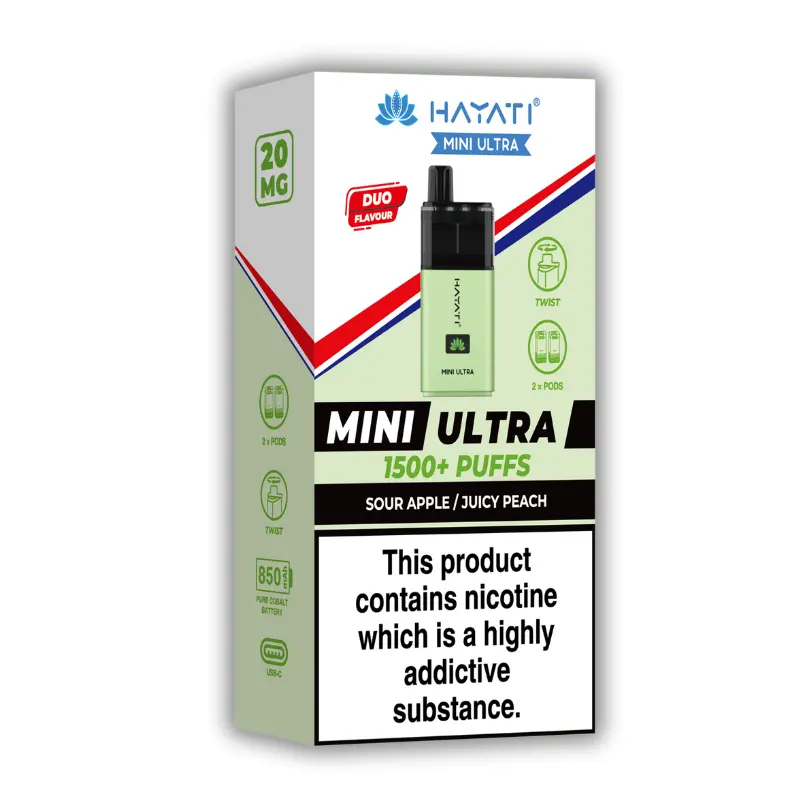
Three pounds ninety-nine buys a complete Hayati Mini Ultra: the small body, an 850mAh cell inside it, and a prefilled pod carrying 4ml of liquid at 20mg nicotine salt with a sharp Sour Apple held on one side of it and a soft Juicy Peach on the other. A rotating mouthpiece decides which of the two reaches the element. Hayati's laboratory figure for the pod is up to 1,500 puffs. Nothing needs filling, nothing else needs buying first, and the oblique in the title means two liquids inside one pod rather than two pods inside one box.
This exact pairing is also sold at 22ml. The Sour Apple / Juicy Peach Pro Ultra Plus kit puts the same two flavours behind the same kind of collar at £11.99, and the pod listing behind it spent several thousand words building a careful running order for them: peach underneath as the base, apple taken in short blocks on top, the return to the peach handled deliberately because it is the expensive direction. That advice is good and it was argued properly. It was also argued on a pod holding five and a half times what this one holds.
So there is a real question here that no amount of flavour writing answers, and it is the question this page is for. Was that advice about the apple and the peach, or was it about twenty-two millilitres? Those are not the same thing, and only one of them travels down to a 4ml pod.
The answer, given up front because burying it would waste your time: the direction survives and the schedule does not. Apple after peach is still free and peach after apple still costs you a flat few minutes, because that is a fact about two liquids meeting a palate and it has nothing to do with how much of them you bought. Everything built on top of that finding, though, the base and the interruption, the long stretches, the managed handover repeated dozens of times, was a policy for living with a pairing for weeks. At roughly two millilitres a side you are not living with anything. The correct pattern here is not a schedule at all. It is one switch, in the free direction, and then the pod is gone.
The same pairing, sold at two sizes
Before any of that is worth arguing, it is worth establishing that the comparison is even available, because most flavours do not offer it.
The structure of the Mini Ultra shelf has already been counted properly, and the Cherry Berry Mini Ultra kit page is where that work lives. Its finding, which I have checked against the catalogue rather than repeated on trust: fifty Mini Ultra listings, twenty of them kits and thirty of them bare replacement pods, with eleven of the twenty kits divided between two flavours and not one of the thirty pods divided at all. On this platform a two-sided pod is something Hayati expect you to buy once and never reorder. That page owns the argument and draws the right conclusion from it, so I will not rebuild it.
What nobody has counted is how those eleven line up against the larger platform, and that count is the one my question depends on. Eight of the eleven divided Mini Ultra kits exist as the same pairing on the Pro Ultra Plus. This one does. So do Cherry Ice / Peach Mango, Blue Razz Pineapple / Strawberry Ice, Blueberry Cotton K / Raspberry Cotton K, Grape GB / Strawberry GB, Straw' Guava / Dragon Berries, Fruit Bomb / Straw' Watermelon B'Gum, and the cranberry cherry pairing. Three do not: Cola Ice / Orange Lemon Lime, the two menthol blueberries, and the lemonade pair.
Eight identical decisions offered at two very different volumes, then. The catalogue poses the size question repeatedly and answers it nowhere, and the answer is not obviously the same for all eight, because the eight do not divide along the same axis. Most of them separate on temperature or on nothing very much. Reading the titles, the cold-against-warm pairs are the largest group, and the relatives, meaning two treatments of one idea, are the next. By the reading set out on the Pro Ultra Plus kit listing, which classified that shelf by what the names describe, exactly one of these eight divides on acid with no coolant declared on either side, and it is this one.
That matters because acid is the property that generated the running-order advice in the first place. A cold half and a warm half produce their own handover problem, and a pairing of relatives barely produces one at all. Only an acid contrast produces the specific asymmetry the 22ml page described, where one direction of the swap improves what you taste and the other flattens it. So of the eight pairings sold at both sizes, this is the one where the transfer question has actual consequences, and it is the only one where it can be asked.
How much smaller is it, exactly
By liquid, 4ml against 22ml is a little over eighteen per cent, so under a fifth. Applying the same reading to each half, about two millilitres a side against about eleven.
Both of those per-side figures are readings rather than published numbers. Hayati give the total and stop, on this shelf and on the larger one, and no description anywhere in the fifty Mini Ultra listings breaks a divided pod down by side. An even division is how anyone would build it and it is the obvious interpretation, but an interpretation stated in the voice you use for the price has misled somebody, so it is flagged here as a reading and treated as one throughout.
The two laboratory ratings tempt you into a second calculation and it should be resisted. Up to 1,500 for this pod against up to 25,000 for the 22ml one is six per cent, and six per cent is a third of the eighteen the liquid gives you. The two figures imply about three times as much liquid consumed per rated puff on the Mini Ultra as on the Pro Ultra Plus, and nothing in either listing explains the gap. It may be genuine, since these are different devices and a different airway and element will draw a different amount through per pull. It may equally be that the two numbers were generated under different conditions, or rounded to figures that look right on a box. Either way, arithmetic performed across two laboratory estimates from two ranges is not evidence about anything, so the volume ratio is the one this page reasons from and the puff figures are left where they belong, as a way of ranking listings against each other.
Which parts of the 22ml argument are about the flavours
Testing whether advice transfers means first sorting it into the parts that could transfer and the parts that could not. The Pro Ultra Plus pods listing makes a lot of separate claims and they are not all the same kind of claim.
One group is about two liquids and a human palate. The apple is an event, with something specific happening at a fixed point near the front of every draw. The peach is a gradient, sweet from the opening and constant to the finish, with no moment anywhere in it that demands attention. Acid exposure moves your reading of sweetness downwards for a while afterwards. Events punch through a disturbed palate and gradients do not. Both liquids run through one element and one wick, so a trace of whichever you just left is in the path of whichever you just chose. Add those together and you get the central finding, which is that turning from peach to apple is an improvement every time and turning from apple to peach costs you several minutes of a flavour reading flat and characterless.
Not one of those claims mentions a volume. They are indexed to time on a flavour and to the order of two events, and they would hold identically on a pod of any size, including one holding a thimbleful. The flat window after an apple block runs for some number of minutes, and a pod cannot shorten it by being small. So the direction survives intact and there is nothing more to say about it than that. It survives, it was correct, and it is cited here rather than re-derived.
The second group is different in kind. Settle into the peach and stay on it until it goes quiet. Take the apple in short blocks. Come back across a break with water in between. Decide which half is your base before you fit the pod, because getting it wrong means spending a third of the pod learning a bad habit. Expect the halves to grow further apart late in the pod as the element works through 22ml. Discount the first draws after every turn, because you will be making dozens of turns.
Every one of those is denominated in duration or in repetition. A long stretch is long relative to something. A base is a base because you keep returning to it. A habit worth correcting on day one is worth correcting because there are nineteen days left. Advice of that shape cannot be volume-neutral, and the honest thing is to work out what happens to it rather than to reprint it under a smaller headline, which is what a page written to look thorough would do.
The arithmetic of a two-millilitre side
Here is the reasoning in full, because the conclusion is the opposite of the advice on the larger listing and a conclusion like that has to show its work.
The cost of a switch does not shrink
Every turn of the collar on this pairing carries two charges, and they are separate things that happen to arrive together.
The first is physical. Residue of the previous liquid sits in the wick, on the element and along the airway, so the opening draws after a turn are a blend rather than a reading. Clearing it takes some number of draws. The Cherry Berry page costed that charge properly and made the point that a fixed number of contaminated draws is a rounding error against a long reserve and a measurable slice of a short one, so I am taking its arithmetic as given rather than doing it again.
The second charge is perceptual and it is not the same thing. It is the flat window: the state your palate is left in by the acid, which makes a low-acid fruit met shortly afterwards read as almost nothing. That charge is paid in minutes rather than in draws, it is paid in one direction only, and it is the charge the 22ml running order exists to manage. On a pairing of relatives it barely exists, because you have not moved the property you adapted to. On this pairing it is the main event.
Neither charge is denominated in millilitres. A pod cannot make the wick clear faster by holding less, and it cannot shorten a perceptual after-effect by being cheap. Whatever a switch costs on 22ml, it costs the same here.
The benefit of switching does shrink
Now the other side of the ledger, which is where the transfer actually fails.
The case for an opposed pairing rests on adaptation. Hold one flavour constant for long enough and your reading of it degrades, so alternating two genuinely different stimuli keeps both legible. The 22ml page put a specific number on what that protects you from: eleven millilitres of sour apple run straight through would exhaust its own welcome, because acid tires you, and eleven millilitres of peach run straight through would go quietly invisible, because a gradient cannot hold attention against a drifting baseline. Each half rescues the other from a failure that would otherwise arrive.
Ask the same question of two millilitres. Two millilitres of apple is a day, perhaps two. Does a day of an acid-led fruit exhaust your appetite for acid? Almost certainly not, and the larger page's own framing says as much, since it locates the problem in the eleven rather than in the apple. Two millilitres of peach is the same day or two. Does a soft fruit go invisible in a day? That effect needs sustained exposure, which is exactly what a small reserve cannot supply. Neither failure mode has room to arrive.
Which means the protection is protection against a problem you were never going to have. The benefit of alternating does not vanish at this size, but it falls roughly in proportion to the exposure it was insuring against, and the exposure fell by a factor of five.
Putting the two together
Fixed cost, shrinking benefit. The ratio moves against switching by about the factor the pod shrank by, and it moves furthest on precisely the pairing where the cost is highest, which is an opposed one.
That produces an inversion worth stating plainly, because it reverses a recommendation the corpus has already made. At 22ml an opposed pairing beats a pairing of relatives, and the Pro Ultra Plus pods listing is right about why: relatives give you variation without a reset, because turning from one heavily sweetened confection to another leaves your sweetness baseline exactly where it was. At 4ml the ranking flips. The reset you would be paying for was never available at this volume, and the charge you pay for it is undiminished. A relatives pairing at this size lets you turn the collar as often as you like for almost nothing, which is the behaviour a small pod actually invites. An opposed pairing at this size charges full price for a service it cannot deliver.
So the two Cotton K berries and the Grape GB and Strawberry GB pair, which are the weaker buys on the larger platform, are the stronger ones here. The two lemonades are the same case again. That is not a criticism of this box. It is a statement of what this box is good at, which turns out not to be the thing the 22ml version is good at.
The pattern that fits four millilitres
If the schedule does not transfer, something has to replace it, and saying so without replacing it would be half a page.
One switch, in the free direction
Run the peach first. Run it until you have had enough of it, or until you judge you are about halfway through the pod. Turn the collar once. Run the apple. Do not turn back.
That is the whole pattern, and its merit is arithmetical rather than aesthetic. You have two positions and a small reserve. Every switch costs you the clearing draws, and every switch in one particular direction also costs you the flat window. Make exactly one switch and you can choose which direction it is in. Peach to apple is the direction that costs nothing, so a single-switch pod run in that order pays the perceptual charge zero times across its whole life. The 22ml advice, properly followed, pays it dozens of times and manages each one. Here you can simply decline to pay it.
Note what has happened to the roles. On the larger pod the peach is the base and the apple is the interruption, because you keep coming back. Here the apple is not an interruption at all. It is the second half of the pod, and there is no coming back to interrupt.
A second reason that points the same way
Peach first is also right for a reason that has nothing to do with running order, and two independent arguments landing on the same answer is worth more than one.
The element ages as it works, and the two halves do not age symmetrically. Acid is durable, being no kind of aromatic. The peach's appeal is a soft ripeness carried partly by fragrance, and fragrance is the first thing a tiring element stops delivering, which leaves sweetness with the fruit character contracted behind it. That prediction belongs to the larger listing and it is reasoning from the structure of the two liquids rather than a published finding, so treat it as an expectation.
On 4ml that whole arc is compressed to the point where you may not meet it at all, and the Cherry Berry page makes the general version of that point: on a pod this small, the last draw is close to the first. Whatever little of the arc does run, though, runs against the peach. Putting the fragile half on the fresher element and the durable half on the older one is free, and it costs the apple nothing.
The part you cannot plan
Honesty about the limits of this. There is no gauge and no window. Hayati publish nothing about how the reserves are proportioned, and the device gives you no reading of either side, so "run the peach until it is done" is not something you can execute precisely. The practical version is time rather than volume: give the peach the first two or three days, then turn once and leave it turned.
If you do want to come back, and some people will, put the return across an actual gap. Overnight is the obvious one, a meal is nearly as good, and ten minutes with the thing put down does most of the work. Plain water helps, because part of what you are waiting out is acid still present rather than adaptation itself. That much of the larger page's handling advice does transfer, because it is about minutes. What does not transfer is the assumption that the return is worth making. On 22ml it obviously is, since there are weeks of peach left to protect. On 4ml you are spending a fixed charge to recover a reserve that may have a day in it, and the sums rarely work.
The pattern that fails, and it is not the one you would guess
On the larger pod the characteristic mistake is flicking the collar every few draws, chasing novelty and never accumulating enough adaptation to make a turn worth making. That is a mistake here too, and a worse one proportionally, but it is not the interesting failure.
The interesting failure at this size is the audition. A 4ml pod with two flavours in it invites you to try both in the first hour, to see what you have bought. It feels like the responsible thing to do. What it actually does is spend your one free switch inside the first hour and then immediately spend an expensive one turning back, and it does both before you know enough about either half for the readings to mean anything. The peach you meet on that return is the worst peach the pod will ever give you, and a great many people form their whole opinion of a pairing in that window. Resist the audition. Pick a side, stay on it, and let the switch happen when you have actually finished with the first one.
The two liquids, and what this platform's copy settles
The draw-by-draw account of this pairing is on the Pro Ultra Plus pods listing and there is no sense writing it twice. What follows is the part that listing could not do, which is read the two liquids against every other listing Hayati sell them in.
Sour Apple, and a question the larger page had to leave open
The Pro Ultra Plus page faced a real gap. Apple flavourings split roughly into a red reading, softer and rounder and tilted towards skin and sweetness, and a green one, thinner through the middle, drier and built around acid. Nothing in the Pro Ultra Plus copy says which this is, so that page reasoned from the sourness being promoted into the product name, concluded green, and flagged the conclusion as an inference rather than a finding. That was the right way to handle it.
The word is on this platform. This listing's own description calls the apple sharp and green, in those two words, and the standalone Sour Apple pod sold for this same body goes further and names a green apple outright. Neither Pro Ultra Plus listing of the pairing uses the word anywhere.
Two cautions before that gets treated as settled. The Cherry Berry page established that Hayati's descriptions cluster by platform, having been written in batches by whoever had a given spreadsheet open, which means a word appearing on one platform and not another is sometimes evidence about authorship rather than about liquid. That caution applies here and I am not setting it aside. The second caution is the standard one: check whether a word is house vocabulary before treating its presence as meaningful. Here it is not. The phrase naming a green apple appears in exactly two of the 492 descriptions in this catalogue, this pairing's own single-flavour sibling being one of them, so the word is doing work rather than filling space.
Weighing those against each other, the fair reading is that the inference was correct and the confirmation exists, but that it lives in copy written by the Mini Ultra batch rather than being stated anywhere on the range where it would have mattered most. Two routes to the same answer, one by reasoning from a name and one by a description that says it, is about as good as the evidence for a flavour ever gets.
What green means in the mouth is a front-loaded draw. Acid arrives before the fruit has identified itself and arrives as a sensation rather than a taste, a tightening along the sides of the tongue and a salivation response no sugar produces. Apple fills in immediately behind it, thin rather than juicy through the middle. The finish is short and stops rather than fading, there being neither the sugar nor the body to carry it. Sweetness is present as ballast. Against a shelf that also sells candyfloss and bubblegum constructions, this sits well below the middle.
What it is not: no pastry, no cinnamon, no baked warmth, nothing dessert-shaped, no fizz. And nothing cold, so the crispness is chemistry rather than temperature.
Juicy Peach, and ten listings that nearly agree
Peach is the better-documented half by a distance. Setting the paired listings aside, Hayati sell Juicy Peach on its own ten separate times across this catalogue, in pods, kits, bottles and shortfills, with fresh copy written for each. Lining those ten up produces better evidence than any one of them gives on its own.
Eight of the ten deny sharpness outright. The words vary, from low sharpness to no sour edge to nothing sharp competing with it, but the property asserted is the same and it is asserted independently eight times. That is close to a fact.
The two that dissent both allow a small tang at the finish, and they are the two Pro Max Plus listings, the kit and its refill pod. The dissent falls exactly along a platform line, which is the pattern the Cherry Berry page identified on a different flavour entirely. Seeing it reproduce here, on a liquid with no connection to that one, is decent corroboration that the pattern is real and that a disagreement between two Hayati listings of one liquid is usually evidence about who wrote the copy rather than about two recipes. Anyone comparing the Juicy Peach Pro Max Plus kit against this one and concluding that the 12ml version is the tangier mix has over-read a spreadsheet.
The safe reading, then, is a peach with essentially no acid in it. That happens to be exactly the premise the whole running-order argument rests on, so it is worth knowing that the premise is supported by eight independent descriptions rather than by one.
A second thread runs through all ten and it is textural. Fragrance is named or implied almost everywhere in the set, and this listing reaches for a word that appears in only two of the 492 descriptions in the catalogue, calling the fruit fleshy. That is a more precise claim than sweetness. It says the sweetness reads as the inside of a fruit rather than as sugar laid over the top, which separates this peach from the sweet-shop halves on several neighbouring duals, and it is the property most at risk from a tiring element.
In the mouth: the draw opens sweet and stays sweet, fruit identity constant front to back, the only movement a modest thickening towards the finish as the body fills in. Nothing cuts across it and nothing terminates it, so it fades rather than stopping. Where the apple is an event, this is a gradient, and that single distinction explains most of how the pair behaves together.
What the two share, and what a small pod can tell you about each
Common ground is short. Both are single fruits rather than blends. Neither declares any coolant, which is a real property rather than an omission on a shelf where a dozen of the fifty listings put an ice or menthol word in the title, Strawberry Raspberry Ice sitting a few rows away as the obvious example. Both sit at 20mg, and both live in one housing behind one collar.
Everything else is contrast. Sweetness far apart, acid at opposite ends, one thick and filling where the other is thin and quick, one trailing where the other stops.
Four millilitres will tell you a surprising amount about the apple and almost nothing about the peach, and the reason is structural. What you want to know about an acid-led liquid is where your own ceiling is, and a ceiling announces itself early. A day or two of a declared sour is enough to learn whether it belongs in your rotation, occasionally, or not at all, and that answer routes a great many later purchases. What you want to know about a soft gradient is whether it holds up, and holding up is a question about weeks. The pod is finished long before it is asked.
So the sample is lopsided in the same direction the pairing is. The half that is hardest to live with is the half a small pod reads best.
The kit itself
Two things arrive: the Mini Ultra body, with an 850mAh cell in it, and the prefilled pod seated in the bay. There is nothing to fill, no soak to wait out and no bottle involved.
The specification that matters most for a divided pod is what Hayati decline to describe. They state that the two flavours are kept apart inside the pod and that rotating the mouthpiece selects which one you draw from, and they stop there. Nothing about valves, seals or how the reserves are proportioned appears in any of the fifty Mini Ultra descriptions. Neither does any detail of the heating element, in either direction: the word is simply absent from the range. A single mouthpiece and a single airway point strongly to a single element and a single vapour path, which is the assumption the carryover reasoning above depends on, and it is an inference from the described geometry rather than something Hayati publish. Nor is there any parts breakdown covering how the pod is held in the bay, so this page describes what the collar does and not how it does it.
The pod arrives filled and sealed with no refill route published, so treat it as finished when the liquid is. One sentence on compatibility and then it is dealt with: check the range name printed on your device against the range name in this title before ordering anything, and do not take a fitment answer from a retail page, this one included.
The sheet, and the row that is missing from it
| What you pay | £3.99 |
| What arrives | Mini Ultra body plus its prefilled pod, ready to draw |
| Liquid on board | 4ml in total, divided between two flavours |
| Quantity per side | Not published. Roughly two millilitres each is a reading of the total, not a figure from Hayati |
| Choosing a side | Rotating mouthpiece |
| The sharp half | Sour Apple, described by Hayati as sharp and green |
| The soft half | Juicy Peach, ripe and mellow, fleshy rather than candied |
| Coolant declared | None, on either side |
| Nicotine | 20mg salt, the only figure offered for this listing |
| Cell | 850mAh |
| Hayati's laboratory figure | Up to 1,500 puffs |
| Heating element | Not described anywhere in the Mini Ultra range |
| Refill route | None published. The pod comes filled and sealed |
| Same pairing, larger | Pro Ultra Plus at 22ml, £11.99 |
| Catalogue reference | sour-apple-juicy-peach-hayati-mini-ultra-pod-kit |
| Brand | Hayati |
Most of that repeats across twenty identically priced kits, so take the two rows that are doing work.
The quantity row is blank on purpose, and on a divided pod a blank is more consequential than on a single one. You will use the two sides at different rates whatever you intend, which means one of them empties first and the pod becomes a single-flavour pod for whatever remains, with the element already part-way through its working life. There is no way to rebalance it and no warning before it happens. On the pattern this page recommends, the peach empties first for most people, and the tail of the pod is apple.
The strength row is the same on all fifty Mini Ultra listings because twenty milligrams per millilitre is the ceiling permitted for a nicotine-containing liquid sold in the United Kingdom, so it is a constant of the range rather than a property of this flavour. There is no option to select and no page should be telling you which figure suits you. Nicotine is addictive.
The laboratory figure has already had its caveat above and deserves one more. It is a comparison number produced by equipment drawing to a fixed pattern, and its most useful property on this shelf is that it is identical across divided and undivided listings alike, which is part of why the 4ml is clearly the whole pod rather than each half.
What to buy instead, and when
Twenty kits on this shelf cost the same £3.99, so price decides nothing and the whole comparison is one of fit.
If what you want is the pairing rather than the sample
Anyone who already knows they want both these flavours, and wants to run them together properly over weeks, should be on the 22ml version. The Pro Ultra Plus kit at £11.99 is where the running order becomes worth executing, because at that volume the failure modes the pairing protects against genuinely arrive and the handover is worth managing. Every argument this page has made against scheduling is an argument about four millilitres and none of it is an argument about the flavours.
That is the honest limit of this box. It is a sampler for a pairing rather than a way to live with one. It will tell you whether you like a sour green apple and whether you like a soft peach. It will not tell you whether the two of them together hold up across a fortnight, because holding up across a fortnight is a question this pod is physically incapable of posing.
If the sample comes back apple
Then something unusual about this catalogue becomes relevant, and it cuts against the platform you might expect.
Apple appears in fourteen listing titles across the whole range, in three distinct profiles. Red Apple Ice accounts for seven of them, a cooled red reading available in almost every format, of which the Red Apple Ice Pro Max Plus kit is the nearest large-format apple on a prefilled pod. Double Apple accounts for three, a shisha-style treatment rather than a fresh fruit, and the same register turns up inside the Pro Ultra Plus Shisha listings. Sour Apple accounts for the remaining four, and three of those four are this pairing in its three formats.
Which leaves exactly one standalone Sour Apple in 492 listings, and it is a 4ml Mini Ultra pod sold for this very body. The Pro Ultra Plus page was right that there is no sour apple on its own anywhere on that platform. What it could not see from where it was standing is that the standalone does exist, and that this shelf is the only place it exists. The apple shelf collects the lot if you want to read them end to end, bearing in mind that several are apple by way of a blend.
The consequence is worth being plain about. If this pod teaches you that the apple is the half you want, you can act on that, but only at this size and only on this hardware. Everything larger ties the apple to the peach.
If the sample comes back peach
The opposite situation entirely. Peach is available at every size Hayati make, so a peach verdict is the easier one to spend. The Juicy Peach Rubik kit at £5.99 and the Pro Max Plus kit at £7.99 both carry 12ml of it undivided, which is the volume at which the questions four millilitres could not answer start to become answerable. The Juicy Peach shelf gathers this specific profile across every format carrying it, and the wider peach shelf runs to thirty-two listings if you want the stone fruit generally, White Peach Raspberry being the obvious step sideways into a peach with a berry over it.
That asymmetry in the catalogue mirrors the asymmetry in the palate, which is a coincidence rather than a design, but it doubles the effect. The half that is harder to read is also the half that is harder to buy on its own.
Against the other divided kits at this price
The argument above already recommends the relatives pairings over this one for anybody whose main interest is turning the collar often, and the Cotton K, Grape and lemonade pairs are the clearest examples. The cold-divided pairs sit somewhere in between. Cherry Ice / Peach Mango puts a chilled red against a warm tropical, which is a genuine contrast and one where the two halves are far enough apart that carryover is obvious rather than confusing. Cold does leave a sensation on the surfaces of the mouth for some minutes rather than merely moving a baseline, so its handover is not free either, but it is a different charge from this one and it falls in both directions rather than one.
Against the undivided kits at this price
The Cherry Berry page argues, correctly, that an undivided 4ml is the better instrument if your purpose is reaching a verdict on one liquid, because you get twice the quantity of the thing you are judging and no contaminated draws at all. That applies here with force, and it is the reason the single-flavour kits deserve a look before you commit to a divided one.
Blue Sour Raspberry is the shelf's other declared sour and the direct alternative if the sharp half is what draws you, putting the same kind of pucker into a berry register and giving you four millilitres of it rather than two. Blue Razz Cherry and Blueberry Raspberry are the two-fruit singles for anyone who wants both components identifiable in one draw rather than selectable between draws, which is a genuinely different thing from a divided pod and gets confused with it constantly. Blue Razz GB is the confectionery reference point if you want to know where the sweet end of this shelf actually sits. Mr Blue is on the shelf too and its name discloses nothing about the fruit, which makes it a poor use of a format whose value is in producing a clear judgement.
The Mini Ultra kit shelf holds all twenty at one price, the full Mini Ultra range adds the thirty single pods behind them, and the wider Hayati pod kit shelf is where to go if the body itself is the open question rather than the liquid. If a four-step method for choosing a kit is what you want, the Blackcurrant Lemonade Pro Ultra Plus kit page sets one out and it holds on this platform as well as its own.
Handling four millilitres
A prefilled pod removes most of what you could get wrong, so this is short and everything on it is specific to a small divided pod rather than general advice.
Make the order decision before you turn it on, and make it once. Peach first, apple second, one turn. The whole argument above collapses into that sentence, and the cost of getting it wrong is not spread across weeks the way it would be on a larger pod. It is concentrated into a pod you will finish this week.
Skip the audition. The strongest temptation on a two-sided pod this size is to sample both within the first hour to see what arrived. That spends your one free turn and one expensive one before either reading means anything, and the flat peach it produces is the version most likely to be mistaken for the real thing.
Take the apple slowly. Rapid repeated pulls on an acid-led liquid accumulate the drying, tightening sensation faster than they deliver apple, and with only a couple of millilitres of it on board there is no surplus to spend on draws that give you sensation instead of fruit. Three quick pulls produce less apple than one unhurried one.
Form the peach verdict early. The peach is the fragile half and the first portion of the pod is where it reads truest, before any acid has been near the wick and before the element has done any work. Whatever you think of it in the first day is the most reliable reading you are going to get, so that is the one to keep.
Write the apple verdict down. This sounds fussy and it is the single most useful habit here, because the apple verdict is the one that routes later purchases and the only place it can be acted on undivided is a small pod on this same shelf. A line in your phone is enough, and three pods later you will remember that you liked the sharp one without remembering how sharp it was.
Keep it off warm surfaces and out of direct light. On a pod that lasts days rather than weeks this matters less than it would on a large one, but the fragrance carrying the peach is the fragile part and warmth works on the side you are not drawing just as much as on the side you are. Nicotine-containing kit belongs where children and pets have no access to it.
Stand it upright when it is idle. With four millilitres in there the liquid sits low, and long spells on its side let it pool towards the mouthpiece end, which buys you a wet first draw for no reason.
Do not judge it on the last few draws. The final portion of any prefilled pod comes from a reserve that is no longer keeping up and reads thinner and warmer than the pod did in the middle. On four millilitres that phase arrives proportionally sooner, so form your view while there is a clear reserve left.
Retire the whole thing together. A finished Mini Ultra is a small body with a cell in it plus a spent pod holding an element and a film of liquid, so it does not belong in a household bin. A retailer running an electrical collection scheme will take it, and so will a council site set up for equipment containing cells. Anyone using 4ml kits as a standard purchase accumulates bodies quickly, which is worth factoring in.
Questions this listing gets asked
Is this two pods, one of each flavour?
No. One pod holds both liquids in separate reserves, and rotating the mouthpiece selects which of them reaches the element. The 4ml figure is the total across both sides rather than the quantity of each. You fit one pod and change flavour in your hand.
Does the running order advice from the 22ml version apply here?
Half of it. The direction holds, because it is a fact about the two liquids: turning from peach to apple is free and turning from apple to peach leaves the peach reading flat for a few minutes. The schedule built on top of that, with long stretches and a managed return, assumes a pod you will own for weeks. On this one the sensible pattern is one switch rather than a rotation.
Which side should I start on?
The peach. That way the single switch you make is the one that costs nothing, and the more fragile of the two liquids meets a fresh element rather than a worked one. Turn the collar once when you have had enough of the peach, and treat the apple as the second half of the pod rather than as an interruption.
How much liquid is on each side?
Hayati do not say. They publish 4ml as the total for every Mini Ultra listing, divided or single, and never break a divided pod down. An even division puts roughly two millilitres a side, which is the obvious reading of the number rather than a published figure, and this page treats it as a reading throughout.
Why does the peach taste like almost nothing after the apple?
Acid leaves your palate in a sharpened state, and a soft low-acid fruit arriving into that state has very little to register against. Some of it is also a trace of apple still in the shared path. It passes in a few minutes, water shortens it, a proper break removes it. On a pod this small the better answer is to avoid the situation rather than to manage it.
Is the apple actually a green apple?
Hayati's copy for this kit calls it sharp and green, and the standalone Sour Apple pod for this body names a green apple directly. Neither Pro Ultra Plus listing of the same pairing uses the word, so the description that settles it lives on this platform. Nothing anywhere quantifies how sour it is.
Neither half is cooled. Is that unusual on this shelf?
It is not the norm but it is far from rare. A dozen of the fifty Mini Ultra listings carry an ice or menthol word in the title and the rest do not, and cooling is declared in a name when it is present, so a title tells you before you buy. The contrast here is built from sourness against ripeness rather than from temperature.
Can I reorder this pairing as a pod without the body?
Not as a pairing. Every divided kit on this shelf is a first purchase only, and the thirty replacement pods are all single flavours, which is a finding the Cherry Berry kit page sets out in full. What you can reorder is either half on its own as a full 4ml single pod, so the way to continue is to pick the side you preferred.
What is the 1,500 figure for?
Ranking listings against one another, and very little else. It is a laboratory estimate produced on equipment drawing to a fixed pattern, so it is consistent between products and a poor forecast of anybody's week. It is also identical across divided and undivided Mini Ultra listings, which is useful as a cross-check that the 4ml is the whole pod.
Is this a fifth of the Pro Ultra Plus pod, then?
By liquid, close to it: 4ml against 22ml is a little over eighteen per cent. By the two laboratory ratings it would be six per cent, which is three times smaller again, and nothing in either listing reconciles the two answers. Different devices may genuinely consume at different rates, so the volume figure is the one worth reasoning from and the puff figures are best left alone.
I want to switch constantly. Is that wrong?
Nothing breaks, but this is the wrong pairing for it. Every turn costs you some clearing draws, and on an opposed pairing half of the turns also cost you a flat window, which is a large charge against a two-millilitre reserve. A pairing of two related flavours lets you switch as often as you like for almost nothing, and on a pod this size that is the better buy.
What happens when one side runs out first?
It becomes a single-flavour pod for whatever remains, with the element part-way through its life and no way to rebalance the sides. On the order recommended here the peach goes first for most people, so the tail of the pod is apple. There is no gauge, so you find out when it happens.
The short version
A complete Mini Ultra at £3.99: the small body with an 850mAh cell, and one prefilled pod holding 4ml at 20mg nicotine salt, divided between a sharp green Sour Apple and a soft, fleshy Juicy Peach with a rotating mouthpiece choosing between them. Hayati's laboratory figure for it is up to 1,500 puffs. No coolant is described on either side.
The same pairing exists at 22ml, and its page built a careful running order for it. Tested against a pod holding under a fifth as much, half of that advice transfers and half does not. The direction is a fact about the liquids and holds everywhere: apple after peach is free, peach after apple costs you several flat minutes. The schedule around it was a policy for weeks of ownership, and at roughly two millilitres a side there is no long stretch to build and no adaptation to protect, because neither half is on for long enough to tire you or to disappear. What does not shrink is the price of a switch, so the sums invert: the opposed pairing that earns its money at 22ml is the one that earns it least at 4ml, and a pairing of relatives is the better small pod.
Which gives one instruction instead of a rotation. Peach first, one turn of the collar, apple second, no coming back. That pays the expensive charge zero times and puts the fragile half on the fresher element.
Buy it to find out what you think of a sour green apple and a soft peach, which it will answer within a few days. Do not buy it to find out whether you can live with the pairing, because it will be gone before that question arrives. And if the answer comes back apple, note that the only standalone Sour Apple in this catalogue is a 4ml pod on this same shelf, so the verdict you can act on most easily is the peach.
Strictly for adults aged 18 and over. Nicotine is an addictive substance.
You might also like


