
Home / Hayati Pro Max Plus Pods / Juicy Peach Hayati Pro Max Plus Pods
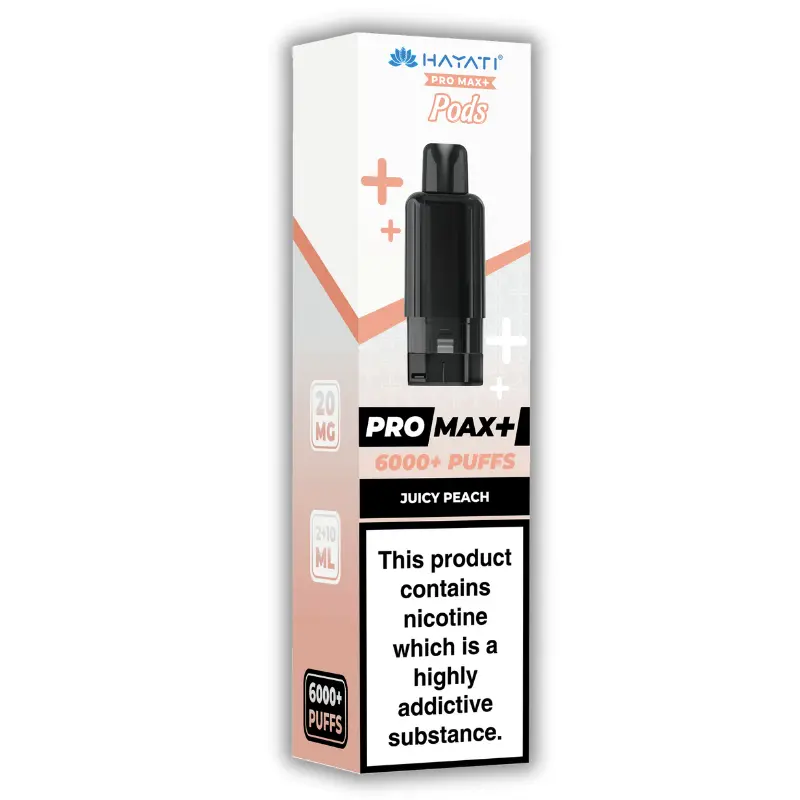
Hayati · Pro Max Plus
Juicy Peach Hayati Pro Max Plus Pods
£5.49
✔ In stock — ready to ship
Genuine Hayati
Free over £20
Same-day dispatch
Secure checkout
Five pounds forty-nine buys one sealed prefilled pod for the Hayati Pro Max Plus, carrying 12ml of liquid at 20mg nicotine salt, all of it peach. Hayati put a figure of up to 6,000 puffs against a full pod, produced on bench equipment running a fixed draw schedule rather than by anyone holding the device, so treat it as a way of ranking listings against each other and not as a forecast for your fortnight. There is no body in the pack, no cable and no spare part. Anyone who does not already own the hardware wants the Juicy Peach Hayati Pro Max Plus Pod Kit at £7.99, where the same liquid arrives with a rechargeable device attached, and the £2.50 between the two listings is the one-off cost of the body.
That is the transaction. What follows is not about the transaction, because three pages on this site have already taken this liquid apart and a fourth description of a peach would waste your time.
Here is what those three have in common, and it is worth seeing before you read any further. Every one of them is about detection. The Juicy Peach Hayati Pro Ultra Plus 25K Pods page asks whether there is any internal event in this liquid to detect at all. The Juicy Peach Hayati Pro Ultra Plus 25000 Prefilled Pod Kit page works through the draw in detail and asks what odds a quiet profile has of holding your attention across a very large pod. The Rubik kit page asks how you would notice this liquid getting worse, given that it declines without announcing anything. Three pages, one shared premise: this is a flavour that refuses to declare itself, and the interesting problem is perception.
They are right, and they all stop one step short of the question that follows from them. A liquid that never asserts itself also never generates a reason to buy it again. Detection is a problem for the first pod. The second, fifth and twentieth pod raise a commercial problem instead, and it is the one this page is for: restocking a quiet single fruit is the hardest reorder decision on this shelf, harder than restocking anything loud, and it is hard for a reason that has nothing to do with quality. There is no craving pulling you towards it. Nothing has gone wrong that would push you away from it. And the 89 listings on the Hayati Pro Max Plus Pods shelf are priced, sized and specified identically, so the default at the point of reorder is not to rebuy this pod. It is to buy whatever is next to it.
What the earlier pages settled, taken as settled
Four arguments about this liquid are finished and are not reopened here. Naming them properly is more useful than summarising them badly.
The Pro Ultra Plus pods page owns the reading that there is no internal event in Juicy Peach: nothing in it arrives, peaks or terminates, so no single moment in a pod demands that your attention comes back to it. That page also owns the fairest defence of the profile, which is that being unobtrusive is a feature if you went looking for an unobtrusive liquid and a fault only if you did not. Both of those are load-bearing for this page and both belong there.
The Pro Ultra Plus kit page owns the draw itself: which part of the fruit the blend is built from, where the sweetness sits across an inhale and an exhale, and the case for a quiet profile having the better odds of surviving a very large pod. If you want to know what the liquid tastes like, that is the page. Nothing here re-describes it.
The Rubik kit page owns the method. It sets out why a gradient cannot report its own decline, why your memory of yesterday is the wrong instrument, what a wearing coil takes from this liquid first, and the practical device of keeping a reference pod as a cheap true zero to measure against. That page also reached the verdict about which platform is the right place to meet this flavour and which is the right place to keep it. All of that is cited here and none of it is rebuilt.
The Rubik page also did the listing diff, and its finding matters for the specification table further down. Setting the paired listings aside, Hayati sell this flavour on its own ten times over, and eight of those ten deny sharpness outright. The two that allow a small tang at the close are both Pro Max Plus listings, which is to say this one and its kit twin. That split falls along a platform line rather than a recipe line, and the reading it supports is that a copywriter had a slightly different brief, not that Hayati mix a tangier version for this hardware. If you are holding this pod and looking for the tang the listing mentions, know that eight other descriptions of the same liquid say it is not there.
One more page is directly relevant and it is not a Juicy Peach page. The Peach Green Tea Hayati Pro Max Plus Pods listing works through the reorder arithmetic for a flavour you only reach for at particular moments: how slowly 12ml disappears at that pace, how many pods to hold, and why a slow line never triggers an order by itself. That page is about cadence and stock. This one is about the decision, and it applies to the opposite kind of buyer. Peach Green Tea is a slot. Juicy Peach, for the people who buy it repeatedly, is the whole day. The two pages reach opposite conclusions from the same shelf and both are correct, because they are describing different consumption patterns.
A reorder with nothing behind it
The two things that make anyone buy a pod again
Strip a repeat purchase down and there are only two engines driving it. One is appetite: you want that specific thing, you can taste it in your head before you order it, and the purchase feels like acquiring something. The other is depletion: you have run out, the device does not work without a pod in it, and the purchase feels like maintenance.
Loud flavours run on both engines. A sour listing, a heavily cooled one, a confectionery one, all of them leave a specific impression that can be wanted later. You can crave the cold on Blackberry Ice Hayati Pro Max Plus Pods in the way you can crave a cold drink, because the sensation is distinct enough to be remembered as a sensation rather than as a category. You can crave the acid seam on Blue Sour Raspberry Hayati Pro Max Plus Pods. Those pods generate their own demand.
Juicy Peach runs on one engine. It is pleasant, it is coherent, and it does not leave behind an impression sharp enough to be wanted specifically. What it leaves behind is a general sense that things were fine. Nobody has ever been sitting on a train wanting the exact texture of a mid-sweet stone fruit with no acid in it, because that is not the kind of thing a palate stores as a target. So every purchase after the first is driven by depletion alone.
That sounds like a weakness and in the short run it is the opposite. Depletion is a reliable engine. It fires on schedule, it does not depend on mood, and it produces a very high repeat rate for exactly as long as nothing interrupts it. Quiet single fruits are bought again and again by people who have never once thought about buying them again. The vulnerability is not that the engine is weak. It is that the engine is silent, and a silent process does not get reviewed.
The pod that triggers every order is the pod nobody examines
The Peach Green Tea page makes an observation worth inverting. For most people the prompt to place an order is not a date or a stock check but the physical event of a pod thinning out, and the pod that generates that prompt is always the fastest-consumed one. That page draws the pessimistic conclusion for a slow flavour: it never triggers anything, so it gets forgotten and you find yourself without it.
Turn it round and the consequence for a daily liquid is stranger. If Juicy Peach is what you have fitted most of the time, it is the pod that empties, which means it is the reason you are at the checkout in the first place. It is not a candidate in the order. It is the cause of the order. And a cause does not get evaluated the way a candidate does. You open the basket because the peach ran out, you put peach in the basket, and then you spend whatever attention you have on the rest of the list: whether to try the Fizzy Cherry Hayati Pro Max Plus Pods someone mentioned, whether to have a cold one in the drawer, whether £5.49 on something new is worth it this month. Every one of those gets a decision. The peach gets a keystroke.
Multiply that by pace. A pod that is in the device for most of a day empties in well under a week for most people, which puts a daily user somewhere in the region of fifty to seventy purchases of the same listing in a year. Fifty to seventy decisions, none of which was actually a decision. Compare that with the seventeen or so reorders the Peach Green Tea page calculates for a three-week pod, each of which is conspicuous enough that you notice you are making it. The fast line is bought far more often and considered far less, and the two facts are the same fact.
Nothing has gone wrong, and that is the difficulty
Most products get reviewed when they fail. You reconsider a pod because it started tasting flat, or because the sweetness got sickly by the third day, or because you kept reaching past it. Failure is the trigger for thought.
This liquid does not produce failures of that kind. It has no acid that could turn harsh, no coolant that could feel wrong on a cold morning, no confectionery top note that could tip into cloying. The Rubik page establishes that it does decline, and that the decline is invisible because every stage of it still tastes like a plausible peach. The same property that hides decay hides dissatisfaction. There is never an afternoon where the pod annoys you enough to make you think about it.
So you are left in an unusual position for a consumer. You hold a product you cannot fault, that you are not enthusiastic about, that you will buy again in four days unless something intervenes, and that nothing is going to intervene on. It is not that the decision is hard to make. It is that the decision never presents itself as a decision at all.
What "whatever is next to it" actually means on this shelf
Now look at the structure of what you are choosing inside, because it explains why the default matters so much.
The Pro Max Plus Pods shelf carries 89 listings. Four of those are strength-only entries with no flavour in the title. The remaining 85 are flavours, and every single one of those 85 has a matching complete kit on the Pro Max Plus kit shelf, which itself carries 85 flavour listings and three generic ones. Eighty-five out of eighty-five, with no orphans in either direction. That is not an accident of merchandising. It is a shelf designed so that every device sold has a refill waiting for it, in perpetuity, at one price.
And one price is the operative phrase. Every flavoured pod on that shelf is £5.49. Every one holds 12ml. Every one is 20mg. Every one carries the same manufacturer's rating and fits the same body. Put Cherry Berry Hayati Pro Max Plus Pods next to Blackcurrant Mango Hayati Pro Max Plus Pods next to this one and there is not a single number that differs. The only variable on the entire shelf is the name.
Work out what that does to a substitution. Normally you stay with a product partly because moving costs something: a different price, a different size, a bit of learning, a risk that the new thing does not fit. Here the cost of moving is zero. Same money, same volume, same hardware, same strength, no adjustment. The cost of staying is also zero. When both sides of a choice cost nothing, the choice gets decided by salience, which is to say by which name catches your eye while the basket is open.
A quiet flavour is by definition the one that does not catch your eye. Blue Razz GB Hayati Pro Max Plus Pods announces a sugared confectionery idea in its name. Double Menthol Hayati Pro Max Plus Pods announces a quantity of cold. Fruit Twist Hayati Pro Max Plus Pods announces a mystery, which is its own kind of pull. Juicy Peach announces a peach, which you have had, and which you know is fine.
The result is a product with an extremely high passive repeat rate and an extremely low defended one. It is bought again by almost everyone who is not thinking, and abandoned quickly by almost anyone who starts. Neither outcome is a judgement on the liquid. Both are consequences of a shelf where the only difference between listings is how loudly they describe themselves.
What to put in place of a craving
Judge the job, not the impression
If appetite cannot tell you whether to rebuy this, something has to. The instinct is to interrogate the experience harder: pay closer attention to the next session, work out whether you actually enjoy it. That instinct is wrong, and the Rubik page explains why in the context of spotting decline. A gradient liquid is low-information per session by construction. There is no landmark in it, so a single session gives you a blurry reading, and a blurry reading interrogated harder just gives you a confident blurry reading.
The right instrument is a longer one. Stop asking what the pod is like and start asking what job it did. A job is visible over a week even when a taste is not visible over a draw, because a job shows up in behaviour rather than in sensation, and behaviour is something you can actually observe about yourself.
Four questions that are answerable at week scale
These are worth running once, at the end of a pod, and then not thinking about again for a month.
- How often did you fit something else while this pod still had liquid in it? This is the single most informative number available to you, and it is a count rather than an opinion. Nobody swaps away from a pod they are enjoying. If you defected twice in a week, the pod is doing its job. If you defected most days, you are not running a peach liquid with occasional exceptions, you are running something else with a peach fallback, and you should reorder accordingly.
- Did you finish it? A pod retired with a third of its liquid in it is a verdict, whatever you tell yourself about the coil. Finishing is the normal outcome for a liquid you want. Not finishing, repeatedly, is a preference expressing itself through your hands rather than your palate.
- Did anything taste worse after it? Sweetness with no acid and no coolant behind it accumulates on the tongue rather than resetting between draws, which means a peach-heavy day can flatten whatever you fit next. If your other pods have been reading duller than you remember, this one may be the reason, and that is a cost you are paying without attributing it.
- When the pod ran out, did you have to think about what to fit next? Hesitation is information. A pod that is genuinely your default gets replaced with the same pod without a pause. A pause means there is a live alternative in your head that you have not yet acted on.
Why the week and not the session
Two reasons, and the second is the one people miss.
The first is statistical and obvious. One session is one observation of a liquid that produces small differences, taken by a palate that is affected by what you ate, how tired you are and how cold the room is. Seven days of behaviour is dozens of observations and the noise cancels.
The second is about where in a pod your judgement actually gets formed. The last third of any pod is the part you have spent the most consecutive time with, it is the part where the coil has done the most work, and on this particular liquid it is the part where the faint aromatic thread at the top has thinned out most. It is also, inconveniently, the part you are living through at the exact moment you place the reorder, because the reorder is prompted by the pod running low. So the impression driving your purchase is formed from the least representative portion of the product. Judging across a whole week dilutes that; judging in the moment of reordering concentrates it. This is a small effect and it points consistently in one direction, which is why it is worth knowing about.
Keeping a record without turning it into a hobby
Two lines per pod is enough, and it takes about ten seconds. On the day you break the seal, write the date. On the day you bin it, write the date and a single digit: how many days out of that pod's life you fitted something else instead. Nothing else. No tasting notes, no scores.
After four or five pods you have a defection rate, and a defection rate is a genuine answer to a question that no amount of introspection will settle. A number like one day in seven says you have a daily liquid. A number like four days in seven says you have a habit and a preference pointing in different directions. At the pace this pod is consumed, four or five pods is a month, which is a reasonable amount of time to spend finding out whether something you buy sixty times a year is the right thing to buy sixty times a year.
The Rubik page recommends keeping an unopened reference pod as a fixed comparison point for detecting decline, and if you are already doing that, the record above costs you nothing extra. The two techniques answer different questions. The reference pod tells you whether the liquid has changed. The defection count tells you whether you have.
When the honest answer is to stop rebuying it
"I still quite like it" is not sufficient
Here is the sentence that keeps this pod in baskets: I still quite like it. It is true, it is the most common thing anyone says about a quiet single fruit, and it does not answer the question being asked.
The question at a reorder is not whether you like the thing. It is whether this is the best use of the next £5.49 and the next five days of your vaping. Liking is a necessary condition and it is nowhere near a sufficient one, because on an 89-listing shelf where every option costs the same, there are dozens of things you would also quite like. Quite liking something establishes only that it clears the floor. It says nothing about where it sits relative to everything else that clears the floor.
Loud products are protected from this logic because they generate a preference as well as a tolerance. Quiet ones are not. The honest position for a large number of people buying this pod is that they would quite like it, would quite like nine other pods on the same shelf, and are choosing this one for no reason other than that they chose it before.
Three signs you are buying out of momentum
None of these is decisive on its own. Two together is a strong signal.
You cannot remember the last time you noticed it. Not the last time you enjoyed it, the last time you noticed it at all. If you cannot place a specific draw in the past fortnight, the liquid has stopped registering, and a product that does not register is not being consumed so much as processed.
You have started keeping something else nearby for when you want to taste something. People do this without labelling it. A cold pod in the drawer, a sour one in a jacket pocket, something reached for at the end of the day. The moment that arrangement exists, the peach has quietly been demoted from your flavour to your background, and background is a job that can be done by anything, including nothing.
You ordered it in the same basket as something you were actually interested in. Notice which item you thought about. If the peach went in on autopilot while the real attention went to whether to try Blue Razz Mojito Hayati Pro Max Plus Pods, the peach was not a purchase. It was a subscription you never signed up for.
The old decision does not renew itself
There is a quiet trap in repeat buying that has nothing to do with this product specifically, and everything to do with how people treat their own past choices.
You picked Juicy Peach once, deliberately. You probably compared it against a few things, thought about it for a minute, and were right at the time. That decision then gets treated as permanent, as though it were a fact about you rather than a conclusion reached on one afternoon with the information available then.
Three things have changed since. The comparison set has grown, and the Juicy Peach Vapes shelf alone now carries thirteen listings of this flavour across seven different formats, while the shelf you are buying from carries 89 alternatives. Your palate has moved, because palates do, particularly under a liquid with accumulating sweetness. And you now have something you did not have when you chose: several weeks of actual evidence, which is worth more than the guess you made at the point of purchase and which almost nobody goes back and applies.
The original decision was about a liquid you had not tried. Every decision since has been about a liquid you know well. Those are different decisions and they deserve different answers, yet they are being made with the same keystroke.
What stopping costs, which is close to nothing
The practical case for changing your mind here is unusually strong, and it is worth laying out because people overestimate the cost.
You are buying a refill. The device is yours, it is unaffected, and it will take any of the 85 flavoured pods on the shelf without any adjustment whatsoever. There is no hardware to strand, no platform to leave, and nothing to relearn. The entire exposure of trying something else is £5.49 and about five days. If it does not suit you, the peach is still there next week at the same price and you have lost one pod's worth of time.
Contrast that with the kit buyer, whose £7.99 includes a body, and whose mistake therefore has a small piece of hardware attached to it. A refill buyer has the cheapest possible option to change course of anybody in this range. The irony is that refill buyers exercise it least, precisely because the automatic nature of restocking is what makes the option invisible.
The fair case for carrying on
All of the above cuts one way, so here is the other side of it stated properly rather than as a formality.
Some people want a background liquid, and they want it on purpose. If your vaping is something you do while doing other things, and you have no interest in it being an experience, then a liquid that never demands attention is doing exactly the job you hired it for. The Pro Ultra Plus pods page puts this well and it is the correct defence: unobtrusiveness is a feature if you asked for it. There is nothing thin about preferring a product that stays out of the way.
There is also a real cost to churn that the enthusiasm for variety tends to skip. Every new pod is five days of mild adjustment, some proportion of which will be spent on something you turn out not to like. A settled default removes a recurring small decision from your week, and for some people that is worth more than the upside of finding a marginally better flavour.
The test that separates the two cases is not about the liquid at all. It is whether you asked for an unobtrusive pod or drifted into one. Someone who deliberately chose a background flavour can answer why in a sentence. Someone who drifted cannot, and will usually find themselves explaining that it is fine.
The dependability vocabulary, counted
Hayati's own copy for this listing says the pod suits people who want something gentle and dependable. That phrasing gets quoted back in reviews and it reads like a characterisation, so it is worth establishing whether it carries any information.
It does not, and the count is small enough to state exactly. Across all 492 listings in the catalogue, the word dependable appears in 12 descriptions, easy-going in 27, and uncomplicated in 15. Allowing for the three listings that use two of them, 51 listings in total reach for one of that family. That is roughly one listing in ten, applied to products with nothing in common except a copywriter's need for a reassuring adjective. A word used on one listing in ten does not distinguish the listing it appears on.
Two details are worth adding because they change the shape of the finding. This page was briefed with the figure 53 and a fourth word, unobtrusive. Counting it produced 51, and the fourth word turned out to appear in exactly zero of the 492 descriptions. So the claim is narrowed here: three of those four words are house vocabulary and the fourth is not Hayati's vocabulary at all. It is a word this site's own writers reached for when analysing the flavour, which is a reasonable thing to do and a different thing from something the manufacturer published.
The practical upshot is narrow and useful. When you are standing at a reorder trying to work out whether to buy this again, do not let the word dependable on the listing do any of the work. It is a slot in a template, filled 12 times across the range. The behavioural questions above are worth something. The adjective is not.
One related figure, since it points the same way from the opposite direction. Twenty-four of the 492 listings describe themselves as an all-day flavour, and three of those sit on this shelf of 89. This listing is not one of them, although four other Juicy Peach listings on other formats do make that claim. So the flavour is repeatedly sold as an all-day liquid elsewhere in the catalogue and never on the page you are reading. That is almost certainly copywriting variance rather than a considered distinction, and it is a decent illustration of how little weight the descriptive language on any single listing will bear.
The pod, which is the short part
One sealed prefilled pod arrives and nothing else. No body, no cable, no spare, no documentation beyond what is printed on the pack. The 12ml sits in a single undivided reservoir over one coil, and neither the coil resistance nor a carrier ratio appears anywhere in this product's data, so neither is stated here. No charging connector is named in the specification for this product, so none is named on this page either.
Before ordering, match the range name printed on your device against the range name in this title, because Hayati sell several pod formats that look similar and are not interchangeable.
The one specification that changes how this particular liquid behaves is the undivided 12ml. There is no collar on this pod and no second liquid behind one, which means there is no way to interrupt the peach from inside the product. The Pro Ultra Plus pods page works through what that absence costs and what the three ways out of it are, and that argument applies here at 12ml exactly as it does at 22ml, only over a shorter commitment. A daily user is signing up for somewhere around five days at a time rather than several weeks, which is the single biggest advantage this format has over the larger one for anybody uncertain.
Everything else about the hardware is shared with the rest of the range and is covered on the shelf page for the Pro Max Plus pods. There is no ninth thing worth saying about a device that 89 listings have in common.
The numbers, arranged around the decision
The table below is ordered by what each figure does to a repeat purchase rather than by the usual hardware sequence, because on a restock page the hardware sequence is the least useful order available.
| What this listing is | A repeat purchase for a device you already own |
| What you pay | £5.49 |
| Cost of the same liquid with a body attached | £7.99, so the device costs £2.50 once |
| How long one pod covers a daily user | Under a week for most people, so roughly fifty to seventy purchases a year |
| Liquid supplied | 12ml, prefilled and sealed at the factory |
| Reservoirs | One, undivided, with no selector of any kind |
| Strength | 20mg nicotine salt, the only figure published for this pod |
| Hayati's puff figure | Up to 6,000 per pod, a laboratory estimate rather than a promise |
| Flavour components named | One: peach |
| Coolant | None named anywhere in the listing |
| Sharpness | A touch of tang at the close per this listing, denied by eight of the ten solo listings of the same liquid |
| Fits | Hayati Pro Max Plus, and nothing else is claimed |
| Where it is filed | Pro Max Plus Pods, Hayati Pods, Prefilled Pods and Refills, Juicy Peach Vapes, Peach Vapes, New Products |
| Listing code | hpm-plus-6k-pods-juicy-peach |
Two rows deserve a note. The strength is 20mg because that is the ceiling for a prefilled pod sold in the United Kingdom, which means it is not a choice Hayati made for this flavour and not a property that distinguishes this pod from any other on the shelf. If you are comparing listings, the strength row is not a variable and you can ignore it.
The puff figure is the row most likely to be misread on a restock page specifically. Up to 6,000 is a bench number produced on test equipment to a fixed schedule, and its only legitimate use is comparing one listing against another that was measured the same way. It is not a planning tool, and your own consumption is the figure that governs how often you order. If you have been buying this pod for a while, you already have a far better number than Hayati's: count the days between your last four orders.
The sharpness row is the one place where this listing disagrees with the rest of the catalogue, and the Rubik page's count is the reason it is written the way it is. Two Pro Max Plus listings mention a tang at the close and eight other solo listings of the same liquid say there is nothing sharp in it. Reporting the disagreement is more honest than picking a side.
What your next £5.49 is actually competing with
Every listing below costs the same as this one and fits the same device, which is precisely why the comparison is worth making deliberately rather than by eye.
Peach, reshaped
If the fruit is what you want and the flatness is the problem, the shelf offers several ways to keep peach and add an edge to it. Cherry Peach Lemon Hayati Pro Max Plus Pods is the most direct answer, putting citrus acid behind the stone fruit so the profile has a top and a bottom rather than a single plateau. White Peach Raspberry Hayati Pro Max Plus Pods changes the peach itself to the paler, more floral variety and lets a berry supply the tartness. Mango Peach Pineapple Hayati Pro Max Plus Pods keeps the softness and buries the peach in the middle of a tropical stack, which suits people who like the fruit but not being able to name it. Peach Green Tea Hayati Pro Max Plus Pods goes the other way entirely, dropping the sweetness and adding an astringent base, and it is the one to look at if the accumulating sugar is what has worn you down.
Then there is Peach Aura Hayati Pro Max Plus Pods, which names a peach and then a word that names nothing. Its own page works through what the second half of that title could be doing and does not settle it. As a candidate for your next order it is the highest-variance option in the peach family, which is either interesting or annoying depending on what you want from a reorder.
The same peach, cheaper or larger
Four other formats carry this exact profile. Juicy Peach Hayati Rubik Pods at £3.99 hold the same 12ml on a smaller, lower-priced platform, which makes them the least expensive way to keep this liquid running if you own or are willing to own that body. Juicy Peach Hayati Mini Ultra Pods at £3.49 carry 4ml, a third of the volume, and are the smallest commitment to this flavour anywhere in the range. In the other direction, Juicy Peach Hayati Pro Ultra Plus 25K Pods at £7.99 hold 22ml, and the Juicy Peach Hayati Pro Ultra Plus 25000 Prefilled Pod Kit at £11.99 bundles that pod with its device.
Read against this page's argument, the volume direction matters more than the price. Everything above is about a reorder decision being made too automatically. A 22ml pod cuts the number of those decisions you make by roughly half, which sounds like an improvement and is the opposite: it means each unexamined default lasts twice as long. If you suspect you are on autopilot, the 4ml format is the one that puts the decision in front of you most often. If you are certain you are not, the larger pod is the sensible economy. The Rubik kit page reaches a compatible conclusion by a different route, arguing that the cheapest platform is the wrong place to first meet this flavour and the right place to keep it once you know you want it.
Buying an event on purpose
If the defection count said what you suspected it would, the useful move is not another quiet fruit. It is something with a feature in it, and the shelf is full of them at the same price. Blue Sour Raspberry Hayati Pro Max Plus Pods puts an acid seam through the sugar. Fizzy Cherry Hayati Pro Max Plus Pods adds a sherbet prickle to a stone fruit that is not far from peach in family terms. Kiwi Cooler Hayati Pro Max Plus Pods and Banana Ice Hayati Pro Max Plus Pods both take a soft fruit and put cold behind it, which is the closest structural comparison to what a cooled Juicy Peach would be if Hayati made one. Double Menthol Hayati Pro Max Plus Pods is the far end of that axis with no fruit involved at all. For a sugared rather than a cold contrast, Blue Razz GB Hayati Pro Max Plus Pods sits at the confectionery end of the range.
The Blue Frozen pods page has already counted the cooling vocabulary across this catalogue and established that Ice, Frozen and Cooler are not graded terms and that no listing mixes an ice word with a mint word. Worth reading before you assume one cooled listing is colder than another on the strength of its name.
Other quiet fruits, if quiet is what you actually want
Staying in the same register is a legitimate answer, and it is a different move from staying with the same pod. Blackberry Raspberry Hayati Pro Max Plus Pods is berry-led with no coolant and reads softer than most of the berry group. Blueberry Cherry Cranberry Hayati Pro Max Plus Pods adds a dry cranberry edge underneath two sweeter fruits, which gives you a floor without giving you a spike. Cherry Berry Hayati Pro Max Plus Pods is the simplest of the three and the closest in structure to what you have now. Blackcurrant Mango Hayati Pro Max Plus Pods pairs a dark berry with a soft tropical fruit and lands in a similar sweetness band.
Trying one of these settles a question the peach cannot settle on its own: whether you are tired of this liquid or tired of this kind of liquid. Those call for completely different next orders and there is no way to tell them apart from inside a peach pod.
The peach behind a collar
Two listings on the larger platform put this exact profile on one side of a divided pod. Sour Apple/Juicy Peach Hayati Pro Ultra Plus 25K Pods pairs it with a tart green apple, and Cherry Ice/Peach Mango Hayati Pro Ultra Plus 25K Pods puts a cooled cherry opposite a peach and mango blend. Both hold 22ml split between two reserves selected by a rotating mouthpiece, and neither is a two-pod pack.
For the argument on this page they are interesting for one reason. A divided pod removes the failure mode described above, because there is always a live alternative inside the product and you are therefore choosing between them dozens of times a session rather than never. It also removes the option of not deciding, which some people will regard as the opposite of an improvement. They are not available on Pro Max Plus hardware, so moving to one is a platform change rather than a flavour change, and the Peach Vapes shelf is the quickest way to see every peach listing across all the formats at once.
Living with a pod you buy sixty times a year
The handling advice that matters for this liquid is different from the general advice, because a daily user's problems are about volume and repetition rather than about a single pod.
Do not set your baseline on the first few draws. A freshly seated pod reads sweeter and more aromatic than that pod's own average, and on a liquid with no acid to anchor it the drop from that opening reads as a bigger change than it is. If you are trying to judge whether a batch is any good, give it half a day first.
Chain-drawing hurts this profile in a specific way. With no coolant and no acid, nothing resets the palate between draws, so sweetness stacks. Six draws in two minutes will leave the sixth tasting duller than the first, and the natural interpretation is that the pod is fading. It is not. Space them out and the flavour comes back, which is a test you can run in thirty seconds before concluding anything about a pod.
Spares sit for longer than you think. Anyone buying at this pace tends to hold two or three unopened pods, which means a sealed pod may wait several weeks before you break into it. Keep them somewhere dark, at room temperature, and flat rather than upright against a radiator or on a car dashboard. Warmth accelerates the change in a sweet liquid, and because this profile declines without announcing anything, a pod that has been cooking in a window will simply taste like a slightly worse peach rather than like a spoiled one. Store spares somewhere out of reach of children and pets, as with anything else containing nicotine.
Know what the end looks like on this liquid. A pod that is genuinely finished thins in body first and goes papery on the exhale, and on this profile the faint aromatic top disappears before the sweetness does, so the last draws read sweet and hollow rather than weak. Once you are getting that, further draws are not going to recover anything. The Rubik page sets out a proper method for distinguishing a worn coil from an emptying pod if you want to be rigorous about it.
Disposal, at volume. Sixty pods a year is sixty small units containing a coil and a residue, and none of them belong in a domestic bin. Take them to a shop that accepts electricals back or to a household recycling centre that handles them. It is a marginal chore per pod and a real quantity per year, which is a reason to have a box for them somewhere rather than dealing with each one individually.
Questions that come up on the tenth order rather than the first
I have bought this pod repeatedly and I am not sure why. Is that a problem?
Not automatically, but it is worth resolving. Run the defection count described above for four or five pods: note how many days out of each pod's life you fitted something else instead. A low number means you have a genuine default. A high number means the purchase and the preference have come apart, and the fix costs £5.49.
Is there any cooling in this pod?
None is named anywhere in the listing and no menthol or coolant appears in the description. The profile is a warm stone fruit with no chill component. If you want the same softness with cold behind it, the closest structural equivalents on the shelf are the cooled soft fruits rather than anything in the peach family, because Hayati do not currently sell an iced version of this flavour.
How much liquid and how strong is it?
12ml prefilled, at 20mg nicotine salt. Twenty is the maximum strength permitted for a prefilled pod sold in the United Kingdom, so it is the same figure on every listing on this shelf and not a point of difference between them.
Will I really get 6,000 puffs?
That figure is Hayati's, produced on laboratory test equipment using a fixed draw schedule, and it is a laboratory estimate rather than a statement about your week. Draw length, frequency and how hard you pull all change the real number substantially. If you have bought this pod before, the interval between your own past orders is a far more accurate guide.
Is the Pro Max Plus pod version tangier than the other Juicy Peach listings?
Probably not. This listing and its kit twin both mention a touch of tang at the close, and eight other solo listings of the same liquid across other formats say there is no sharpness in it. The disagreement falls along a platform line rather than a recipe line, which the Rubik kit page treats as evidence about how the copy was written. Expect the same liquid.
Should I buy several at once?
If you are certain about the flavour, buying a few saves you nothing on price but removes the risk of running out, since there is no volume discount on a single-pod listing. If you have any doubt, buy one. Every extra pod you hold extends a commitment you are not sure about, and the argument on this page is that people buying quiet flavours are usually less sure than they think.
What is the difference between this and the kit?
£2.50 and a rechargeable device. The pod is identical. If you already own a Pro Max Plus body, the kit is the more expensive way to buy the same liquid; if you do not, this pod on its own will not work.
Can I refill it once it is empty?
No. It is supplied prefilled and sealed at the factory with a coil that is not replaceable, so when the liquid is gone the whole unit is finished and goes for electrical recycling. Nothing in the listing describes a refill route and opening a sealed pod is not one.
I like it but I am bored of it. Which should I believe?
Both, and they are not in conflict. Enjoyment and interest are separate measurements, and a quiet single fruit routinely scores well on the first and poorly on the second. The question to ask is which of the two you want from a pod that is fitted most of your day. There is a respectable answer either way, and the one that is not respectable is not choosing.
Does it work in any Hayati device?
No. It is made for the Pro Max Plus and the listing claims nothing beyond that. Hayati sell several pod formats with similar names and different fittings, so match the range on your device to the range in the product title before ordering rather than assuming a shared fit.
Why does this page spend so little time on how the peach tastes?
Because three other pages have done it thoroughly and repeating them would be both useless to you and a duplicate. The Pro Ultra Plus kit page has the draw-by-draw account, the Pro Ultra Plus pods page has the analysis of what the absence of any internal event means, and the Rubik kit page has the method for spotting the liquid declining. This page covers the question none of them asks, which is whether to buy it again.
Is "dependable" in the description telling me something?
Very little. Counting across all 492 listings, 12 use dependable, 27 use easy-going and 15 use uncomplicated, which is 51 listings in total once the overlaps are removed. It is house vocabulary applied to about one listing in ten, so it describes a copywriting habit rather than a property of this pod.
Where this leaves the decision
This is a refill for a device you already own: one sealed pod, 12ml, 20mg, peach and nothing else, £5.49, rated by the manufacturer at up to 6,000 puffs on a laboratory estimate. The flavour is soft, mid-sweet, warm rather than cooled, and thoroughly documented on three other pages that are linked above. None of that is in dispute.
What is in dispute, every time you reach the checkout, is whether to buy it again, and the honest position is that most people buying this pod have never actually answered that. There is no craving pulling you towards it and no fault pushing you away, so the purchase gets made by default on a shelf of 89 listings where every alternative costs the same £5.49 and fits the same device. Replace the missing craving with a count: how often you fitted something else while this pod had liquid in it. Four or five pods of that will tell you more than any amount of thinking about the taste.
If the count comes back low, buy it again without further thought and enjoy having a settled default, which is worth something in itself. If it comes back high, the right answer is to stop rebuying something you still quite like, and it costs one pod to find out you were right. That conclusion is uncomfortable to write on a page whose job is to sell the pod, and it is still the correct advice for a decent number of the people reading it.
Strictly for adults aged 18 and over. Nicotine is an addictive substance.
You might also like


