
Home / Hayati Pro Ultra Plus Prefilled Pod Kit / Blueberry Raspberry Hayati Pro Ultra Plus 25000 Prefilled Pod Kit
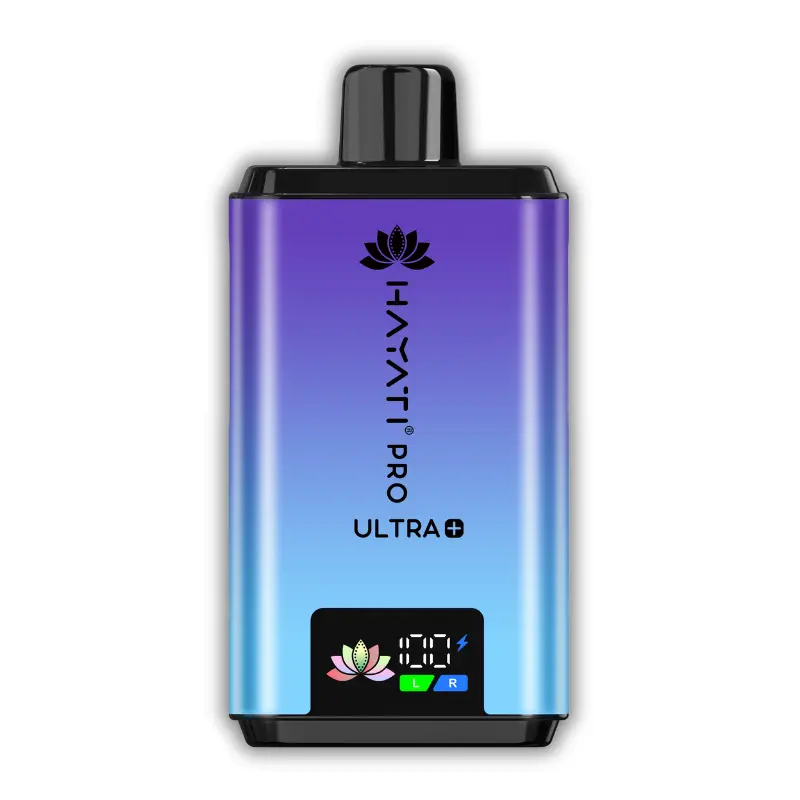
Hayati · Pro Ultra Plus
Blueberry Raspberry Hayati Pro Ultra Plus 25000 Prefilled Pod Kit
£11.99
✔ In stock — ready to ship
Genuine Hayati
Free over £20
Same-day dispatch
Secure checkout
£11.99 buys a complete Hayati Pro Ultra Plus setup in Blueberry Raspberry: the 850mAh body, and a prefilled pod holding 22ml of liquid at 20mg nicotine salt. One flavour, no collar to turn, no cooling in the recipe. Hayati's own figure for the pod is up to 25,000 puffs, produced on a test rig rather than by a person, and it should be read as a laboratory estimate rather than as a yield.
That is the listing. The difficulty is that the listing is called three different things by three different parts of this site, and only one of the three tells you that a device is included.
The product name at the top of this page reads Blueberry Raspberry Hayati Pro Ultra Plus 25000 Prefilled Pod Kit. The web address of this page ends at the number: blueberry-raspberry-hayati-pro-ultra-plus-25000, with nothing after it. The internal product code stored against the listing is blueberry-raspberry-hayati-pro-ultra-plus-25000-pod-kit, which puts two of the three missing words back and leaves out the third. So the object type is stated in full once, abbreviated once, and omitted entirely once, and the place it is omitted is the address bar, which is the only one of the three a person is guaranteed to see when they arrive from a link, a bookmark or a message from somebody else.
This page is about that. The flavour has been worked through at length elsewhere and is summarised below in the space it now deserves rather than re-argued. What follows instead is a count of how far the naming problem goes, which of the three identifiers is worth trusting for which job, and what actually separates this £11.99 listing from the £7.99 one beside it.
Three names for one box
Take them one at a time, because each fails in a different direction and the failures do not cancel out.
The title, which is complete and buried at the end
Read left to right, the product name gives up its information in a fixed order: flavour, brand, range, number, object. Everything a buyer came for is in the first two words. Everything that decides the price is in the last three. The words Prefilled Pod Kit are present, accurate and unambiguous, and they are the last thing on a string that runs to sixty-five characters.
Nothing about that ordering is a mistake, and the argument for why it is the right ordering for a browsing shopper is made properly on the Strawberry Raspberry Ice Pro Ultra Plus kit page, which takes the whole question of how two near-identical tiles get confused on a shelf as its subject. It is not rebuilt here, and this page is deliberately about something else: not two listings that resemble each other in a grid, but one listing that its own site names three ways.
The address, which drops the object entirely
The address of this page names the flavour, names the brand, names the range and then stops on a five-digit number. There is no word in it for what arrives. A reader who has only the URL has been told the recipe, the platform and a puff figure, and has not been told whether the parcel contains hardware.
That matters because of who reads an address rather than a title. Somebody who navigated here by clicking a tile has the title in front of them and the address is redundant. Somebody who was sent the link in a message, who is restoring a bookmark, who is looking at a browser history entry, or who is checking what they ordered against a link in an email, is reading the address first and sometimes only. For that reader the URL is the product name, and this one is silent on the single attribute that separates a £11.99 purchase from a £7.99 one.
Stating it plainly, because it is a standing instruction on this site and because it is true here: the address and the product name of this listing disagree, and the address is the shorter, less informative of the two.
The internal code, which restores two words out of three
Every listing in this catalogue carries an internal product code, visible in the specification table further down. On this one it reads blueberry-raspberry-hayati-pro-ultra-plus-25000-pod-kit. Set the three strings side by side and the disagreement is easy to see: the title says Prefilled Pod Kit, the address says nothing, and the code says pod kit without the prefilled.
Three renderings of one attribute on one product, and none of them is wrong. A prefilled pod kit is a pod kit, so the code is accurate as far as it goes. The address is not inaccurate either, since it makes no claim about the object at all. They are simply three different decisions about how much of the object's name to carry, taken at three different points in the same system, and a buyer who compares them has no way to know which one was taken last.
How far the problem goes, counted
An observation about one listing is an anecdote. The useful question is how many listings behave this way, and the catalogue answers it.
On this platform
The groundwork here is already done and is not repeated. The H'Berg / P'Man Pro Ultra Plus pods page went through all 104 listings on this platform and established that the range name finishes in seven different ways, four of them in common use: thirty titles ending in 25000 Prefilled Pod Kit, thirty in 25K Pods, twenty-one in nothing but 25000, twenty in nothing but Pods, and three one-offs. That census is correct, it holds on a recount, and it is the foundation this page builds on rather than a claim this page is making.
What that page did not do, because it was answering a different question, is line the endings up against the titles and the internal codes. Doing so produces a sharper figure. The Pro Ultra Plus kit shelf holds fifty-two listings. Every single one of them is titled Prefilled Pod Kit and every single one of them is £11.99, so on the title there is no ambiguity anywhere on that shelf. On the address there is ambiguity on twenty-one of them, because twenty-one of those fifty-two URLs end at the bare number with no word for the object, and this listing is one of the twenty-one.
Thirty of the fifty-two spell it out in the address. One is the Shisha listing, which sits outside the pattern on its own numbering. So the split is not a handful of stragglers against a settled convention. It is a forty per cent minority, large enough that a buyer who learns the rule from three listings will have learned the wrong rule about two-fifths of the time.
The internal codes then split those twenty-one again. Twenty of the twenty-one carry a code that is the address with pod-kit appended, which is the pattern on this listing. The twenty-first is the Blueberry Raspberry / Blueberry Raspberry Cherry kit, which instead carries an upper-case warehouse-style code beginning HPU-25K-KIT. So among the kits whose address omits the object, twenty use one repair and one uses a different system entirely, and the one that differs is a sibling of this flavour.
Across the whole catalogue
Widen it to all 492 listings and the shape holds rather than dissolving. Thirty listings have a product name that states what the object is and an address that does not.
- Twenty-two are pod kits. Twenty-one of them are the Pro Ultra Plus group described above. The twenty-second is the Strawberry H'Bubba Pro Max Plus 6000, whose title ends in Pod Kit and whose address ends at 6000, and whose internal code is the address with pod-kit added in place of the number. Same defect, same repair, different platform.
- Seven are bottles. All seven are Pro Max 50/50 listings whose titles say Shortfill E-Liquid and whose addresses carry at most the words e-liquid, losing shortfill. One of the seven, the Strawberry Raspberry Ice bottle, loses both and ends on the ratio, so its address finishes in a run of digits that looks exactly like a puff rating and is not one.
- One is the Quokka Pro. Its title ends in Pod Vape Kit, its address is three words long and ends on the model name, and its internal code is that address with pod-vape-kit added. The same three-way pattern as this listing, on hardware that shares nothing else with it.
Thirty out of 492 is six per cent, which is not an epidemic and is not a one-off either. What makes it worth a section rather than a footnote is that the six per cent is not scattered randomly. Twenty-one of the thirty sit on one shelf, which means a buyer who shops that shelf meets the defect constantly and a buyer who shops anywhere else may never meet it at all.
Testing the claim I was given, and narrowing it
The version of this argument handed to me said that the address of this listing cannot be told apart from a refill's by reading it. I counted, and that is too strong, so here is the corrected version.
Every refill address on this platform contains the word pods, either as the bare ending or in the 25K form. All fifty-two of them. No kit address on this platform contains the word pods at all. So the two populations are in fact separable by reading the URL, and the test that works is a negative one: if the word pods is absent, it is a kit.
Two things are worth saying about a test of that shape. The first is that a negative test requires you to already know the convention, and nothing on any page states it. You cannot derive it from one address, or from three; you can only derive it by looking at all 104 and noticing what is never there. The second is that the positive signal a buyer would reach for instead, the trailing number, is not reliable as a category marker. Twenty-three addresses in the whole catalogue end in a run of digits. Twenty-two of those runs are puff ratings. The twenty-third is that Strawberry Raspberry Ice bottle, where the digits are a VG/PG ratio. So a number at the end of an address usually means a kit's puff figure and occasionally means something else entirely.
The honest statement, then, is not that the address is indistinguishable from a refill's. It is that the address never says what it is, only what it is not, and it says that by omission in a system the reader has to reconstruct for themselves. That is a weaker claim than the one I was handed and it has the advantage of being true.
Which of the three identifiers to trust, and for what
Having three names is only a problem if you need to use one. Different jobs want different strings, and the sensible answer is not to pick a favourite.
The established advice, and the one place it needs qualifying
The H'Berg / P'Man pods page makes the case for the internal code as the identifier that does not move. A product name can be misremembered, an abbreviation can be unsearchable, a curly apostrophe can defeat a search box, and the code survives all of it. That argument is correct and this page does not dispute it.
It needs one qualification, which that page had no reason to make because it does not apply to its own listing. The codes in this catalogue are not all the same kind of string, and one kind is a trap.
Of the 492 internal codes, 240 are identical to the listing's own address, character for character. A further 141 are lower-case and hyphenated and look exactly like an address, but differ from the one they belong to. The remaining 111 are upper-case warehouse-style codes in three families, sixty-five beginning HPM-NS, twenty-six beginning HPM-6K, and twenty beginning HPU-25K. The H'Berg / P'Man pod carries one of that last group, which is why the advice reads so cleanly there: nobody is going to mistake HPU-25K-PODS-HBERG-PMAN for a web address.
The 141 in the middle are the problem, and this listing is one of them. Its code looks like a URL. It is not one. I checked every one of the 141 against the full list of addresses on the site and not a single one of them resolves. Zero out of 141. Paste any of them after the /product/ path and you get a page that does not exist, including this one's.
So the code is stable and quotable and worth keeping, exactly as that page argues. It is not navigable, and on 141 listings it is shaped precisely so as to suggest otherwise.
A rule for each job
Four situations cover almost everything a buyer actually does with a product identifier, and the right string differs in each.
- Telling a person which product you mean. Use the code. It is unambiguous, it contains no punctuation a listener can mishear, and it distinguishes this listing from the refill without either of you having to say the word kit out loud. It is also the only one of the three that will still mean something if the title is reworded.
- Finding the listing again yourself. Use the product name, and search on the flavour rather than the format. Blueberry Raspberry returns a manageable set; the range name returns 104 listings and the number returns a subset of them that does not correspond to anything you care about.
- Sending somebody a link. Copy the address and add a sentence saying what it is, because the address will not. This is the one case where the naming gap has a practical cost that falls on the recipient rather than on you, and it is fixed by seven words of covering text.
- Checking what you bought. Use the order confirmation, which records the title as it stood on the day, and cross-check the price. Nothing in this catalogue prices a kit and a refill the same, so a figure is a fast disambiguator even when a string is not.
One thing not on that list, because it belongs to another page: how to avoid clicking the wrong tile in the first place. The Strawberry Raspberry Ice Pro Ultra Plus kit page works through the shelf-level version of the problem in detail, including what the error costs and what to do if you have already made it. Its best check is to read the last word of the title rather than the first three, which is sound advice and worth taking. The qualification this page adds is narrow and specific: that check operates on the title, and on twenty-one of the fifty-two kit listings on this shelf there is no last word to read in the address. A reader who has arrived by link and has only the URL cannot run it.
One flavour family, all four endings, and the pair that crosses
The second half of the angle I was given concerned this flavour's own set of listings, and this one survives counting in a stronger form than it arrived in.
Eight listings on this platform begin with the words Blueberry Raspberry, and between them they use every ending the range has.
- This kit and the Blueberry Raspberry Pro Ultra Plus pods take the two short forms: the address ends at 25000 for the kit and at pods for the refill.
- The Blueberry Raspberry Lemon kit and its refill take the two long forms, ending in prefilled-pod-kit and 25k-pods respectively.
- The Blueberry Raspberry / Mr Blue kit and the matching Mr Blue refill pods do the same.
- The Blueberry Raspberry / Blueberry Raspberry Cherry pair takes one of each: the kit is on the short ending and the refill is on the long one.
The rarity claim, tested
The brief presented that last bullet as though a family using all four endings were remarkable. It is not, and saying so is the honest version. Grouping this platform's 104 listings by the flavour that leads the title gives forty-four families, and seven of the forty-four use all four endings. Blueberry Raspberry is one of seven, not one of one, and Blue Razz Cherry, Blue Razz GB, Fresh Mint, Grape GB, Lemon Lime and Straw' Cranberry Cherry do the same thing.
So that claim is narrowed. What replaces it is better, because it is about the pairs rather than the families.
Forty-five recipes on this platform are sold both as a kit and as a matching refill. In nineteen of them both halves use the short vocabulary, so the kit ends at the number and the refill ends at pods. In twenty-five of them both halves use the long vocabulary, ending in prefilled-pod-kit and 25k-pods. That is forty-four pairs where the two listings are at least internally consistent with each other, whichever convention they chose.
Exactly one pair crosses. The Blueberry Raspberry / Blueberry Raspberry Cherry kit is on the short ending and its refill is on the long one, and it is the only recipe in forty-five that mixes the two. One in forty-five is a genuine rarity claim rather than a vague one, and it happens to sit one click from this page, on the sibling this listing's own copy points at.
Eight edits, eight dead ends
The practical consequence is testable, so I tested it. A buyer who has one address from this family and wants another recipe in it will edit the address, because that is what the addresses invite: they share a stem and differ by a flavour word. I took the eight obvious edits, inserting or removing a flavour component while keeping the ending, and checked each against the full list of addresses on the site.
All eight fail. Adding lemon or mr-blue to this page's address while keeping the bare number produces nothing, because those two kits live on the long ending. Removing the extra component from either of their addresses while keeping the long ending produces nothing, because this kit lives on the short one. The same holds in both directions for the refills, and for the cherry pair in both of its mismatched halves. Eight edits, eight addresses that do not exist.
The fix is not to stop editing addresses, since it is a reasonable instinct and it works on plenty of sites. It is to know that on this one the ending is not a constant across a family, so an edited address is a guess rather than a construction. Use the Blueberry Raspberry shelf, which gathers forty-six listings carrying the pairing across every platform and format Hayati sell it on, and click rather than type.
A different defect, on a different set
This site has recorded one naming fault of this shape before, and it is worth distinguishing from the one above rather than lumping them together. The Strawberry Raspberry Blueberry nic salt page records two Mini Ultra listings whose address and product name disagree about the flavour: one drops a repeated menthol from the address, and the Blue Razz Pineapple / Strawberry Ice Mini Ultra kit has an address that opens with blueberry against a title that says Blue Razz.
Those are errors in the recipe half of the string, they affect two listings, and either one can put a reader in front of a liquid they did not mean to buy. What this page describes is the opposite kind of fault: the recipe half is perfect on all twenty-one, and it is the object half that goes missing. Nobody arrives at the wrong flavour because of it. They arrive not knowing whether there is a device in the box. Different half of the name, different consequence, different population, and neither finding covers the other.
What arrives for £11.99, and what sits beside it at £7.99
The hardware account can be short, because the platform has been described many times over on this site and nothing about this liquid changes it.
The box holds the Pro Ultra Plus body, rated at 850mAh, and a prefilled pod carrying 22ml of Blueberry Raspberry at 20mg. The pod is sealed and not intended to be refilled, so when the liquid is finished the pod is finished, and the body carries on to the next one. There is a single flavour in this pod and no rotating collar on it, which is worth saying explicitly because a good proportion of this shelf is dual-flavour and those listings do have one. Nothing here needs selecting, and there is nothing to turn.
The one specification that matters for this particular liquid is the 22ml, and it matters because the liquid has no coolant in it. A menthol-carrying pod gives you a second axis to get tired of; this one does not. Twenty-two millilitres is a large commitment to a single warm berry blend, and whether that reads as reassuring or as a lot depends entirely on how settled you already are on the recipe. The rest of the platform detail, the shared specifications and the other fifty-one kits, sits on the Pro Ultra Plus kits and pods shelf.
Beside this listing, at £7.99, is the bare Blueberry Raspberry pod. It is the same 22ml of the same liquid with no body in the pack. The difference between the two listings is a device and four pounds, and that is the whole of it: the liquid is not different, the volume is not different, the strength is not different.
Which of the two you want is a question with an easy answer if you know whether you own a Pro Ultra Plus body, and the decision does not need arguing here. What is worth noting is that the pod page has a substantial argument of its own that this page does not duplicate. It maps how Hayati's copy cross-references the eleven listings that carry this pairing under its plain name, counting which of them point at which, and it works through what it is like to live with twenty-two millilitres of a flavour you chose without having tasted it first. If you are weighing a refill rather than a kit, that is the page to read.
One housekeeping note, said once: Hayati publish no fitment chart, so match the range name printed on your device against the range name in this title before ordering a pod on its own.
The liquid, taken as settled
Eleven listings in this catalogue sell this recipe under its plain two-fruit name, and the Blueberry Raspberry Rubik kit page read all eleven descriptions against each other and settled what they agree on. All eleven assign the same roles, with blueberry supplying weight and sweetness and raspberry supplying tang and lift, and not one of them reverses it. That is about as close to a verified property as this catalogue produces, and it is taken here as established rather than re-derived.
The practical shape, from the same source: raspberry arrives first and is the most defined moment in the draw, blueberry builds underneath it and carries the middle, and the finish is warm and decays slowly because there is no coolant to cut it off. Sweetness sits clearly above the middle of what this range sells without reaching the confectionery end. As a pod tires, the raspberry's volatile top goes before the blueberry's body, so a late pod does not taste weak so much as anonymous.
That is the flavour, and this page has nothing to add to it. If you want the draw-by-draw account, the sweetness placement and the case for and against the recipe, the Rubik kit page is where they live. What this page can tell you that page cannot is which of the eight Blueberry Raspberry listings on this platform you are actually looking at.
The specification, including the two rows this page is about
The table below is ordered to put the identifiers first, which is the reverse of the usual arrangement on this site and is deliberate, because on this listing they are the contested material and the hardware figures are not.
| Product name | Blueberry Raspberry Hayati Pro Ultra Plus 25000 Prefilled Pod Kit |
| Web address ends | blueberry-raspberry-hayati-pro-ultra-plus-25000 |
| Internal product code | blueberry-raspberry-hayati-pro-ultra-plus-25000-pod-kit |
| Price | £11.99 |
| What is in the pack | Device plus one prefilled pod |
| Liquid volume | 22ml |
| Nicotine | 20mg nicotine salt |
| Battery | 850mAh |
| Manufacturer puff rating | Up to 25,000, a laboratory estimate |
| Flavour positions | One. No collar |
| Coolant | None stated |
| Range | Hayati Pro Ultra Plus |
Two rows in that table are the reason this page exists, and they are the second and the third. Everything below them is shared with fifty-one other kits and tells you nothing about which listing you are on. The address and the code are the only rows that identify this listing specifically, and they identify it differently.
The 20mg figure is the maximum nicotine strength permitted in a consumer product of this kind in the United Kingdom, so it is not a choice Hayati made for this liquid in particular; every prefilled pod on this shelf carries the same number, and none of them offers an alternative. Nicotine is addictive. The 850mAh figure is a property of the body rather than of the recipe, and it is the same body in every one of the fifty-two boxes on the kit shelf.
The puff rating deserves one sentence of caution rather than a paragraph, because the arithmetic has been done properly elsewhere. Dividing published ratings by published volumes across Hayati's four platforms produces four wildly different puffs-per-millilitre figures, a calculation set out on the Blue Sour Raspberry Mini Ultra kit page, and the conclusion there is the right one: compare formats in millilitres, which are measured, rather than in puffs, which are estimated under a test protocol.
Where this listing sits among its neighbours
Sorted by what you would be changing rather than by flavour similarity, since the flavour question is settled and the interesting question on this page is which listing to be on.
The same recipe, elsewhere in the catalogue
The pairing is unusually widely sold. Apart from the refill twin already mentioned, the Blueberry Raspberry Cherry Pro Max Plus 6000 kit at £7.99 takes the same two fruits and adds a third, on smaller and cheaper hardware, which is the least expensive way to find out whether the base suits you before committing twenty-two millilitres to it. Its address, incidentally, ends in pod-kit and says so plainly, which is the convention this listing does not follow.
The Blueberry Cotton K / Raspberry Cotton K kit takes the same two fruits and rebuilds them on a confectionery base, which is a genuinely different liquid rather than a variation. It also sits in the same address group as this one, ending at the bare number. Its smaller counterpart, the Cotton K Mini Ultra kit at £3.99, is the cheap way to test that direction.
The same two fruits with a third thing added
Three kits extend this base rather than replacing it, and all three are £11.99 with a device in the box.
The Blueberry Raspberry Lemon kit adds citrus to the position in the draw where the raspberry's acid has faded and the blueberry has not resolved. It is also the page that works through what buying a kit commits you to on this platform, so it is worth reading if this would be your first Pro Ultra Plus purchase rather than a replacement.
The Blueberry Raspberry / Mr Blue kit puts the base beside a second flavour rather than mixing something into it, with a collar to move between the two. Its refill, the Mr Blue pods, is the listing to note if you already have a body.
The cherry version, which pairs this base against itself with a third fruit on one side, is the crossed pair described above, and its two halves are the only kit and refill on this platform whose addresses use different conventions.
Blue berry flavours built a different way
If what appeals is the colour rather than this particular construction, the shelf offers several routes to it. Blue Razz GB is the sweeter, more confected reading of blue fruit and sits in the same bare-number address group. Blue Razz Cherry puts a red stone fruit under it. Blue Sour Raspberry adds a dosed sour layer, which is a different sensation from the fruit tang in this pod and the right choice if the tang here reads as too mild.
On smaller hardware the same territory is available for less. Blue Sour Raspberry on the Pro Max Plus is £7.99 with a device, Blue Razz GB on the same platform matches it, and Blue Razz GB on the Mini Ultra is £3.99. For an existing Pro Max Plus owner, Blue Razz Fruit Twist pods at £5.49 is a refill rather than a kit.
Two positions instead of one
Twenty-two millilitres of a single liquid is the thing most likely to be regretted about this listing, and the fix is to buy a divided pod instead. Blue Razz Cherry / Blue Razz GB keeps both halves inside the blue family, so the collar produces a small move. Blue Razz GB / Lemon Lime is a wider gap, berry against citrus. Fresh Mint / Blue Razz Mint puts a mint flavour on both sides, which is the furthest thing from this uncooled pod that the shelf sells.
If cooling is what you want on one side only, Blue Razz Pineapple / Strawberry Ice names the ice on one half, and Straw' Cranberry Cherry / Strawberry Raspberry Ice does the same on a red-berry base. For something with no berry in it at all, Watermelon B'Gum / Strawberry B'Gum and Fruit Bomb / Straw' Watermelon B'Gum are the confectionery corner of the shelf, and Blackcurrant Cotton K / Blue Raspberry sits between the two registers.
For browsing rather than choosing, the berry shelf holds 225 listings across every platform and format, which is the widest view of this territory the site offers.
Living with a single uncooled liquid, and when to stop
Handling advice for this pod is short, because most of what is usually said under this heading is generic and one item is not.
The item that is specific: on a liquid with no coolant, the first thing a tiring coil takes is the raspberry's aromatic top, which is also the only sharply defined event in the draw. On a cooled pod you would still have the chill to tell you the pod was working; here there is nothing else holding the draw together, so the decline is more noticeable and arrives as a loss of definition rather than a loss of strength. If the pod has stopped tasting of raspberry and started tasting like a general dark berry, that is the signal, and it is a better one than watching the liquid level.
The rest is brief. Draw at a steady pace rather than in fast succession, since a warm coil suppresses the aromatic material you are paying for and this recipe has less to spare than most. Leave a new pod to stand for a few minutes after unwrapping before the first draw, which costs nothing. Store it upright, away from direct sun and heat, and out of reach of children and pets. A partly used pod keeps perfectly well between sessions; a part-used one left for months will have lost the volatile top before it has lost anything else, which on this recipe means the raspberry.
When the pod is done, the pack contains electronics and a residue of liquid, so it does not belong in household waste. Take it to a retail take-back point or a local recycling facility that accepts small electrical items.
One decision worth taking deliberately rather than by default: whether you want twenty-two millilitres of this at all. The recipe is one that people either settle into as a daily liquid or find quiet by the halfway mark, and both reactions are to the same property. If you have never had it, the £7.99 route is the cheaper way to find out, and if you already know you like it, the four-pound premium here buys a body you will keep using long after this pod is gone.
Questions this listing actually raises
Is there a device in the box, or is this just the pod?
There is a device. The product name ends in Prefilled Pod Kit, which on this platform always means the body is included, and the £11.99 price confirms it. The web address does not say so, which is the subject of most of this page, but the title and the price both do.
Why does the address of this page not say "pod kit" when the title does?
Because twenty-one of the fifty-two kit listings on this shelf were given addresses that stop at the puff figure, and this is one of them. Nothing published explains why, and the thirty that spell it out are the majority rather than the rule. The internal product code for this listing does restore the words, in the shortened form pod-kit.
Can I paste the internal product code into the address bar to reach a listing?
No. It looks like an address and it is not one. There are 141 listings in this catalogue whose code is lower-case and hyphenated but differs from their own address, and not one of the 141 matches any real page on the site. Use the code for quoting and record-keeping, not for navigation.
How do I tell a kit address from a refill address by reading it?
Look for the word pods. Every refill address on this platform contains it, in one of two forms, and no kit address contains it at all. The test is reliable and it works by absence, so it only helps somebody who already knows the convention.
Is there any ice or menthol in this one?
No. Nothing in the title or the listing names a coolant of any kind, and the description states outright that there is no ice. The finish is warm and fades gradually rather than being cut off.
Does this pod have a collar to switch between two flavours?
It does not. This is a single-flavour pod, which the listing says explicitly. The divided pods on this shelf are the ones with two flavour names separated by an oblique in the title, and those do have a rotating mouthpiece; this one has nothing to select.
What is the difference between this and the £7.99 Blueberry Raspberry pod?
A device, and four pounds. The liquid, the 22ml volume and the 20mg strength are identical. If you own a Pro Ultra Plus body already, the refill is the listing you want.
Can I refill the pod when it runs out?
It is a sealed prefilled pod and is not sold as refillable. When the liquid is finished the pod is finished, and the body takes a new one.
Is the 25,000 figure something I can rely on?
Treat it as a laboratory estimate from the manufacturer rather than a yield. It is produced under a test protocol, and comparing it against ratings on other Hayati platforms produces figures that cannot all describe the same liquid. The 22ml is the measured number and the more useful one.
I edited the address to reach another Blueberry Raspberry listing and got an error. Why?
Because the ending is not constant across the family. Of the four Blueberry Raspberry kit and refill pairs on this platform, one uses the short address forms throughout, two use the long ones, and the cherry pair uses one of each, so an edited address only works if you happen to guess the right convention for the listing you are aiming at. All eight of the obvious edits within this family lead nowhere. Browse the flavour shelf and click instead.
Does this listing's address mean it is an older version of the product?
No. The bare-number ending carries no information about age, revision or specification. Every kit on this shelf is £11.99 and carries the same body and the same 22ml pod, whichever ending its address happens to use.
The short version
£11.99 for the Pro Ultra Plus body and one sealed 22ml pod of Blueberry Raspberry at 20mg, with no coolant and no second flavour position. The liquid itself is well documented and unremarkable in the useful sense: raspberry at the front, blueberry carrying the middle and the finish, sweet without reaching the confectionery end, and a recipe that either becomes a daily liquid or goes quiet on you depending on what you want a pod to do.
What is worth knowing before you order is the naming. This listing has three identifiers and they disagree about what it is: the title names the object in full, the address omits it, and the internal code restores two words of three. That is not unique to this product, and thirty listings across the catalogue do something similar, but it is concentrated on this shelf, where twenty-one of the fifty-two kits have addresses that do not say they are kits. Trust the title and the price when you are buying, trust the code when you are telling somebody what you own, and do not trust an edited address to reach a neighbour, because within this one flavour family all four of the range's endings are in use and every obvious edit leads to a page that does not exist.
Strictly for adults aged 18 and over. Nicotine is an addictive substance.
You might also like


