
Home / Hayati Pro Ultra Plus Prefilled Pod Kit / Blueberry Raspberry / Mr Blue Hayati Pro Ultra Plus 25000 Prefilled Pod Kit
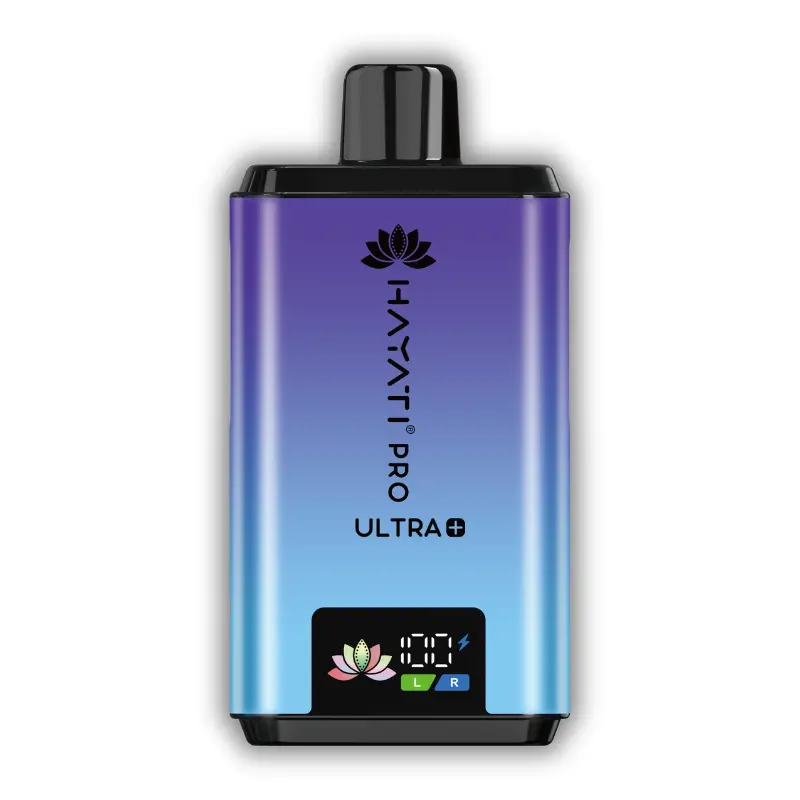
Hayati · Pro Ultra Plus
Blueberry Raspberry / Mr Blue Hayati Pro Ultra Plus 25000 Prefilled Pod Kit
£11.99
✔ In stock — ready to ship
Genuine Hayati
Free over £20
Same-day dispatch
Secure checkout
£11.99 buys the whole arrangement rather than a refill: a Hayati Pro Ultra Plus body with an 850mAh cell, and seated in it one pod carrying 22ml of 20mg nicotine salt across two reserves that Hayati keep apart from each other. A rotating mouthpiece decides which reserve reaches the coil, and the listing says so in as many words, which matters because the punctuation in a title is not by itself a promise of a collar. Hayati also put 25,000 puffs against the pod. That figure comes off test equipment under fixed conditions, so treat it as a workload expectation for one sealed coil rather than as a forecast of your month.
Nothing so far separates this listing from the fifty-odd others on the same shelf. What separates it is the pairing, and specifically a question the pairing raises that almost no other dual pod in the range can raise.
Read the two names again. Blueberry Raspberry is an ingredient list. Mr Blue is a colour with a courtesy title stuck on the front, and the corpus has established, at length and by counting, that a bare blue in this trade resolves into sweet blue-berry territory. Put those two findings next to each other and you get an uncomfortable implication: both halves of this pod are probably the same kind of thing. Possibly, on the evidence, very nearly the same thing.
That is a different question from the one the other flagship pairing on this platform asks. Lemon Lime / Summer Dream sets a declared citrus against an undeclared mood, and the pages for that pod and its bare-pod twin have worked through what the naming asymmetry is and is not, including the reading that an unnamed half is a commercial hedge, the counter-reading, the running order that follows, and the count establishing that it and this listing are the only two Pro Ultra Plus duals in which both halves reach every product line Hayati operate. All of that is settled and none of it is re-argued here. On a citrus and a mood you can at least assume the two sides are unlike each other. Here you cannot assume even that.
So the question this page takes on is narrower and, for anybody actually spending the money, more useful. Is there anything across the collar at all? Not whether the second half is good, and not whether you will get round to trying it, but whether turning the mouthpiece changes the drink or changes the label on the drink. The rest of this page answers that by putting every description Hayati have written of each flavour side by side and seeing how far apart they can be pushed. The short answer arrives with its confidence attached, and it is not the answer the product name implies.
The control sits inside your own listing
Before any counting, there is one observation available to anybody who reads the product description on this page slowly, and it is worth more than most of the arithmetic that follows because it holds every variable constant. Hayati's copy for this kit gives Blueberry Raspberry three taste words: sweet, bright, slightly tart. It then turns to the other reserve and gives it a statement about its own name. Not a taste, not a texture, not a temperature, not a comparison. One writer, one paragraph, one afternoon, describing two liquids that share a pod, and only one of them gets described.
That is not sloppiness. Widen it to the four listings in the catalogue where Mr Blue appears on this platform, meaning the two halves of this pairing sold as a kit and as a bare pod, plus Mr Blue sold on its own as a kit and as a bare pod. Across those four descriptions Mr Blue receives: blue-fruit territory, a different take on the same shade, an all-round blue profile, fruity, blue-leaning, blue-themed, takes its cue from its name. Seven phrases, and not one of them is a taste. No sweetness word. No acid word. No texture word. No cooling word, positive or negative. Four independent attempts to describe a liquid on the Pro Ultra Plus platform and the vocabulary never once arrives at the liquid.
The same four listings hand out taste words freely when the subject is the other half. Blueberry Raspberry collects sweet, brighter, tangier, more defined, a body, an edge. The information is not missing from the copy desk in general. It is missing from one side of this pod specifically.
Which sets the shape of the problem exactly. A diff needs two descriptions to compare. On the platform you are buying, only one of the two halves has ever been described, so the comparison has to be assembled from other formats, and every step away from this pod weakens it. That is the honest position before the work starts, and it is worth stating plainly rather than discovering halfway down.
Two censuses, laid against each other
Hayati write fresh copy for every listing, which means a flavour sold eleven times has been described eleven times by people not consulting each other. Lining those up is the closest thing to evidence available when a manufacturer publishes no ingredient list, and it has already been done once for one of these two flavours.
The side that has already been counted
The Mr Blue Hayati Rubik Prefilled Pod Kit page ran the full census of the thirteen listings carrying that name and its findings are cited here rather than repeated. In summary: thirteen of thirteen place the flavour in blue fruit and none places it anywhere else; no cooling word appears in any of the thirteen or in the title, which makes uncooled the one thing about it worth stating without a hedge; sweet appears in eleven, but sweet runs at ninety-four per cent across the whole catalogue and therefore carries no information; and on every acid word available the flavour's own copy runs at or below the catalogue base rate, with six of the eleven single-flavour listings mentioning acid at all and every one of those six qualifying it as slight, gentle or a streak. Three listings name blue raspberry and blueberry, all three are bottles, and all three phrase it as the territory the colour points at rather than as contents. That page also owns the honorific argument, the census of the four names in which blue stands alone as the entire flavour claim, and the finding that thirteen listings across seven product lines is evidence of sales rather than of quality. None of that is re-derived here.
The row in its confidence table that matters for this page reads: whether it is distinguishable from the other blues at this price, nothing published either way, unknown. That is the row this pod turns into a purchase decision, because on this listing the other blue at the same price is sitting in the same pod behind the same collar.
The side nobody has counted
Blueberry Raspberry appears on twenty-two listings, which is more than Mr Blue and makes it one of the most heavily described flavours Hayati sell. Nobody had lined those up, so here is what they say.
An architecture, twenty times out of twenty-two. Every listing that describes the flavour at all describes it as two parts doing opposite jobs. Blueberry is the floor: soft, mellow, rounded, dusky, jammy, carrying the sweetness. Raspberry is the line above it: brighter, sharper, tarter, a spark, a snap, a bite. The direction never reverses. In twenty-two attempts by different writers, nobody once puts raspberry underneath or blueberry on top. A property that every description asserts is the closest thing to a fact this method produces, and the fact here is not a taste. It is a shape.
A construction that barely exists elsewhere. Seven of the twenty-two go further and describe the two fruits as correcting each other: neither one dominates, nothing in it is overpowering, the blueberry stops the raspberry going too sharp and the raspberry stops the blueberry turning flat. Count that construction across the rest of the catalogue and it appears three times in four hundred and fifty-nine listings. Mutual correction between two named components is close to a Blueberry Raspberry signature in this range, and the reason is not mysterious: it is what you can write when you know both components and know what each is for.
Zero confectionery words. Not one of the twenty-two calls it candied, and no listing reaches for a sweet-shop reference. The catalogue uses candied on twenty-eight listings, so the word is available and the copy desk knows it. Blueberry Raspberry never gets it. Jammy appears on four, juicy on nine, and the Rubik kit asks you to picture a handful of fresh berries. The register is uniformly fresh fruit.
No talk about the name. One of the twenty-two mentions its own title. None uses the word colour to explain the flavour. The copy has no need to discuss the label because the label has already done the work.
What happens when you hold the two censuses side by side
Cross-tabulate and the two vocabularies barely touch. Denominators first, since two listings carry both names and belong to both sets: twenty-two Blueberry Raspberry descriptions against the eleven Mr Blue descriptions that are not this pairing, thirty-three distinct listings in all. Colour as an explainer: nil out of twenty-two on one side, seven of eleven on the other, against a catalogue rate of three per cent. Discussion of the product's own name: one of twenty-two against nine of eleven. Candied: nil against three of eleven. Jammy: four against nil. Juicy: nine against nil, which is the one worth pausing on, because juicy runs at a third of the whole catalogue and Mr Blue missing it eleven times in a row is a silence with some weight behind it. Mutual correction between named parts: seven against nil. Cohesive, meaning explicitly one thing rather than separable parts: nil against two, in a catalogue that uses the word five times in total.
Read quickly, that looks like a decisive result. Two flavours described in almost non-overlapping vocabularies ought to be two different liquids, and the direction of the difference is legible: one is a fresh two-fruit structure, the other a single sweet blue mass with no seams in it.
Read slowly, it is not a result at all, and this is the part the method demands you say out loud. A diff between listings is evidence about how the copy was produced. It becomes evidence about recipes only when both sides were produced the same way, and here they were not. One set of descriptions was written by people reading a name that states two fruits. The other set was written by people reading a name that states a colour. Everything in the vocabulary gap follows from that difference in input, without any difference in the liquid being required. A writer who is not told what is in the bottle will talk about the label, will decline to name components, will say the thing is cohesive and should be taken as a whole, and will reach for a register word rather than a fruit. That is precisely what the Mr Blue census records, and the Rubik page reached the same conclusion from its own side: the instruction to stop analysing appears eight times in eleven because there is nothing published to analyse.
So the vocabulary gap measures the information gap. It does not measure the flavour gap, and anybody who tells you otherwise has confused a copywriting artefact for a tasting note.
The three places the record actually touches, and what survives
If the bulk comparison cannot settle it, the question becomes where in four hundred and ninety-two listings the two flavours are described under conditions close enough to be worth something. There are three such places and they are all small.
The controlled pair, which is the best evidence available
Both flavours exist on the Pro Max Plus platform as a kit and as a bare pod. Four listings, one template, one house style, one period. Whatever else varies between a 10ml bottle blurb and a 22ml pod blurb is held constant here, which makes this the only near-controlled comparison in the catalogue.
What the four say, stripped down. Blueberry Raspberry: blueberry carries a soft, jammy, dusky sweetness, raspberry answers with a brighter, tarter note that adds bite, and the two hold each other in place. Mr Blue: sweet, berry-led and candied, with a tangy streak underneath, one cohesive blue sweetness from inhale to exhale, judged by feel rather than by picking out individual fruits.
Now look at what those two descriptions have in common, because it is more than the vocabulary suggests. Both are a sweet blue base. Both have something acid sitting on or under that base whose stated job is to stop the sweetness going flat over a long pod. Both are uncooled. The functional shape is identical. The only difference is how many parts are named: two on one side, an unnamed streak on the other.
And then the check that has to be run before that difference is taken seriously. The phrase about acid stopping a blend tasting flat is a house construction, appearing on twelve of four hundred and ninety-two listings, and two of those twelve are the Blueberry Raspberry Pro Max Plus kit and the Mr Blue Pro Max Plus kit. The same stock sentence, six words of it near enough identical, applied to a named fruit in one case and an unnamed streak in the other. Which means the tangy streak attributed to Mr Blue may be the template speaking rather than the liquid. It is exactly the kind of thing that looks like corroboration until you count it.
The controlled pair therefore delivers a smaller result than it first appears to. It establishes that on the same platform, to the same brief, the two flavours were assigned the same functional description with a different number of named components. That is compatible with two liquids that genuinely differ in construction, and it is equally compatible with one liquid being described twice by someone who had the recipe once and not the other time.
The two listings where Hayati rank them
This pairing and its bare-pod version are the only places in the catalogue where Hayati put both names in one sentence and say which is which. Both rank Mr Blue as the vaguer of the two: one calls Blueberry Raspberry the more defined of the pair, the other says Mr Blue is less a literal two-berry mix and more an all-round blue profile. The Mr Blue Rubik page treats that as a genuine contribution to the record and it is right to, because it is Hayati's own copy choosing a side when they have something to compare against.
But read what is actually being ranked. Defined is not a flavour. It is a property of the description. A manufacturer saying one of two liquids is less specific is telling you about their own labelling, and in the one place where they might have said what the difference tastes like, they said which of the two names says more. The bare-pod version of this pairing at £7.99 works through what that asymmetry costs a buyer in practice, and that argument is not repeated here.
The negatives, which are the strongest thing on the page
Agreements across both censuses are worth more than disagreements, because an agreement cannot be an artefact of one side having less information. Both flavours agree on four things.
- Neither is cooled. No cooling word in any of the thirteen Mr Blue descriptions or the twenty-two Blueberry Raspberry ones, except where a listing states outright that there is no ice. Hayati declare cooling in a title whenever it is present, so the silence is reliable. Both sides of this pod run warm from inhale to finish.
- Neither is sour. Sour is a word this range uses when it means it, and it appears in neither set. Both have acid and neither leads with it.
- Neither is a drink, a dessert or a confection with a named reference. No lemonade, no cola, no gum, no cotton candy. Two fruit profiles, whatever their internal construction.
- Both are sweet. True of both, useless as a discriminator, since nearly the whole catalogue says it.
Four agreements, all of them pointing the same way: whatever separates the two halves of this pod, it is not temperature, not acid direction, not category and not sweetness in kind. Every coarse axis on which two vape liquids usually differ is held constant across this collar by the published record. That is the finding, and it is the one that should change a purchase decision.
The verdict, with the confidence attached
Three readings were live at the start. Here is where the evidence leaves them.
That Mr Blue is something else entirely, and the inference is wrong. Rejected, and with more confidence than any other claim on this page. Thirty-three listings across the two flavours, described independently, and not one puts Mr Blue outside blue fruit. The caution that applies is real but does not rescue this reading: thirteen writers agreeing is not thirteen independent confirmations when all thirteen were reasoning from the same word. Still, nothing anywhere points at a non-blue, non-fruit or cooled reading, and a buyer planning for a surprise across the collar is planning for something the record gives no support to.
That the two are near-identical, making this close to a single-flavour pod at a divided price. Live, and better supported than the product name suggests. It rests on the four negatives above, on the identical functional shape in the controlled pair, on the shelf placement putting both flavours in the same berry and blueberry categories, and on the fact that nothing in thirty-five descriptions names a property one has and the other lacks. Held at probable rather than confident, because absence of a stated difference in copy that was never going to state one is weak.
That they are the same family but genuinely distinct builds. Also live, and this is where I come down, though not comfortably. The one difference that survives every deflation above is structural rather than gustatory: Blueberry Raspberry is described everywhere as two components moving against each other, and Mr Blue is described nowhere as having components at all, twice as explicitly cohesive, and repeatedly as something to take whole. Even allowing that a writer with no recipe would say that anyway, the consistency across eleven independent attempts is a pattern. A blend built to read as one thing and a blend built to read as two things are different products even when they are made of similar material.
| Question | Evidence | Status |
|---|---|---|
| Both halves sit in blue fruit | Thirty-five descriptions, no exceptions | Reasonably confident |
| Neither half is cooled | No cooling word anywhere in either set, and a range convention of declaring it in the title | Reasonably confident |
| Neither half leads with acid | Sour absent from both sets; every Mr Blue acid word qualified; raspberry's tartness always secondary to blueberry's body | Reasonably confident |
| Blueberry Raspberry reads as two parts | Twenty of twenty-two describe the same two-part structure in the same direction | Reasonably confident |
| Mr Blue reads as one part | Two listings call it cohesive, eight of eleven instruct the reader not to pick it apart, none describes a sequence | Probable, and possibly an artefact of having no recipe to describe |
| Mr Blue is sweeter than Blueberry Raspberry | Nothing. Neither flavour is placed on a scale anywhere, and the range has no sweetness vocabulary to place them with | Unknown |
| Mr Blue's register is confectionery rather than fresh fruit | Three of eleven say candied, zero of twenty-two say it of the other half, but candied is platform-correlated house vocabulary | Possible, weaker than it looks |
| The two are distinguishable blind, on this hardware, after a week | Nothing published, and it is the axis the purchase turns on | Unknown |
So, the buyer's question, answered as plainly as it can be. Is the second half a different drink or the same drink under a different name? On the evidence: most likely the same drink, poured differently. Same fruit family, same temperature, same acid direction, same sweetness class, probably a different construction, with the difference sitting in definition and separation rather than in subject. Turning the collar almost certainly does change something. It almost certainly does not change what you are drinking.
Confidence in that: moderate at best, and I would rather say so than dress it up. Two observations would move it. If you found a real acid difference between the halves, the near-identical reading collapses and the pairing becomes the finest-grained comparison on the shelf, which would be genuinely interesting. If you found the halves indistinguishable after three days each, the structural difference was a copywriting artefact all along and the collar is decoration. Both are settleable on one pod and neither is settleable by reading.
Why the difference, if it exists, has a short life
One consequence follows from the verdict and it is the part a buyer should weigh hardest, because it is specific to a pairing built this narrow and it works against you over the life of the pod.
The difference between these two halves, on the best reading of the record, is definition: whether the sweetness arrives with a separate bright line over it or as one mass. Definition is the most fragile property a liquid has. Sweetened liquid leaves residue on mesh with every heat cycle, and the quiet, high, volatile parts of a profile disappear under that residue before the heavy sugar body does. The Blueberry Raspberry / Blueberry Raspberry Cherry kit established this for its own pairing and drew the conclusion that a narrow pod collapses into a single flavour as the coil ages. That finding is cited rather than rebuilt, and the extension worth making is about detectability rather than about the collapse itself.
On that pairing the vanishing element is declared. You know a cherry was supposed to be there, so when it goes you can name what went and read it as a coil signal. Here you never knew what was on the other side to begin with. If the definition difference erodes in week two, nothing in your experience distinguishes that from the two halves having always been the same, and nothing in the published record lets you check. A pairing you cannot characterise is a pairing whose convergence you cannot date.
Which inverts the usual value of a dual pod. Ordinarily the collar earns its keep across the whole pod. Here it is worth most on day one, on clean mesh, when a fine-grained difference is still available to be found, and worth progressively less every day after that, with no reliable moment at which you can say it has stopped being worth anything. Twenty-two millilitres is a long run for a distinction that thin.
Twenty-two millilitres in one corner, and who should walk past
The other consequence is the one the contrast pairings do not have, and it is not about the coil. It is about you.
Palate adaptation to a repeated profile is well worked over elsewhere on this site, and the findings are cited rather than re-derived: adaptation is driven by repeated exposure in a short window, it works fastest on the qualities two liquids have in common, and the larger the pod the more it matters, because at 22ml you will not be through the liquid before your palate has recalibrated. The pages arguing for opposed pairings rest their case on exactly that, and they are right about it.
Apply it here. A contrast pairing gives you somewhere to retreat to. When the sugar stops registering you turn the collar and land somewhere structurally different, and the retreat resets part of the adaptation because the new side is not built out of what tired you. Blue Razz Pineapple / Strawberry Ice retreats into cold. Blue Razz GB / Lemon Lime retreats into citrus. Blackcurrant Cotton K / Blue Raspberry retreats from a spun-sugar treatment into a plainer fruit.
This pod has no retreat. Both reserves are warm, sweet and blue, and the qualities adaptation removes first are precisely the ones the two halves hold in common. Turn the collar when the sugar has stopped landing and you arrive at more sugar. The switch that was supposed to be the answer to the problem is made of the problem.
So, plainly, who should not buy this kit.
- Anyone buying a dual pod as insurance against tiring of a flavour. That is the main reason people pay the dual premium and this is the pairing least able to deliver it. A single-flavour kit plus a genuinely different second device does the job; one collar between two blues does not.
- Anyone who runs one device and nothing else. Continuous exposure to one accord over 22ml with no structural escape is the condition under which adaptation bites hardest, and here the escape hatch opens onto the same room.
- Anyone shopping for contrast. If the appeal of a two-sided pod is that the two sides argue, this one does not argue. Buy a pairing whose halves were designed to disagree.
- Anyone who needs to know what they are getting before paying. Half of this purchase cannot be resolved in advance by any amount of reading, including this page. If that is intolerable, a pod with the fruit printed on it closes the question at the checkout rather than a fortnight later.
- Anyone who wanted 22ml of Blueberry Raspberry. You are not getting 22ml of it. Hayati publish the total and not the division, and the reserve you did not come for is not separable from the one you did.
Who it does suit is narrower than the listing implies but real: somebody who already knows sweet uncooled blue is their corner, wants a large quantity of it, is not relying on the collar to solve anything, and finds a small amount of modulation within one register worth having. On that reading the pairing is not a failure. It is simply a smaller proposition than two flavour names in a title suggest.
The kit, kept short
You own none of this yet, which is the difference between £11.99 and £7.99, so the hardware is worth two paragraphs and no more.
In the box: the Pro Ultra Plus body with its 850mAh rechargeable cell, and a pod already filled with 22ml at 20mg nicotine salt. Nothing to prime, fill or assemble. The mouthpiece section rotates to select which reserve reaches the coil, and Hayati state the two are stored apart. How that separation is achieved inside the pod is not published, and this page assumes no mechanism for it. What is certain from the specification is that one coil serves both sides, which means coil condition is shared, wear is shared, and residue laid down while you are on one reserve is residue the other reserve will eventually have to be tasted through.
The specification that actually bears on this liquid is the single non-replaceable coil against a 22ml budget. Everything in the argument above about definition eroding runs through that one fact: there is no midpoint at which you can restore the conditions in which a fine distinction was audible. On fitment, once: check the range name printed on your device against the range name in this title before ordering replacement pods, because a retail page is not a hardware specification. Hayati publish no coil resistance, no wattage, no airflow figure, no carrier ratio and no division of the 22ml, and nothing here fills any of those gaps. The wider platform, kits and bare pods together, sits on the Hayati Pro Ultra Plus shelf.
The sheet, ordered by how much is known
| Field | Value |
|---|---|
| Price, complete kit | £11.99 |
| Supplied as | Device plus prefilled pod, ready to use |
| Cell | 850mAh, rechargeable |
| Liquid, total | 22ml, prefilled, across two reserves |
| Nicotine | 20mg salt, no alternative strength listed |
| Manufacturer puff figure | Up to 25,000, a laboratory estimate |
| Selecting a side | Rotating mouthpiece section |
| Coil | One, serving both reserves, not replaceable |
| Cooling on either side | None declared, and none in either flavour's full description set |
| Half one, published composition | Blueberry and raspberry, blueberry as the base |
| Half two, published composition | None. A colour and a courtesy title |
| Division of the 22ml between reserves | Not published |
| Stated difference between the two halves | That one is more defined than the other |
The last three rows are the page in miniature. Hayati tell you the total volume and not the split, tell you the contents of one reserve and not the other, and when asked to say how the two differ, describe the difference between their labels. A buyer comparing this against a single-flavour kit at the same £11.99 is comparing a known quantity against a known quantity plus an unknown one, and the price is identical either way.
Two rows deserve a note. The 20mg is the maximum permitted for a prefilled pod of this kind in the UK and it is the same figure across every prefilled listing in the range, so it does not separate this pod from any neighbour; what it does mean is that the strength is fixed and there is no lighter version of this pairing. Nicotine is addictive, and which strength anyone uses is a decision for the buyer rather than for a product page. The 25,000 figure comes off a machine drawing at a fixed rhythm, which makes it usable for ranking products against each other and close to useless for predicting a fortnight. Read as workload it says something real: one sealed coil is expected to process the whole 22ml, both reserves included.
Clearance has to be a number, because it cannot be a taste
Everything above says the two halves are probably close. That has an immediate practical consequence for anybody who wants to check it, and it is a measurement problem rather than a comfort one.
One coil and one chamber serve both reserves, so the draws immediately after a switch are pulling on what the previous side left behind. On a contrast pairing that is self-announcing. Switch from a mint to a fruit and the transitional draws are obviously transitional, and you know the chamber has cleared because the taste stops being a mixture. The signal is free and it is accurate. The bare pod for the cherry pairing makes the related point that on a narrow pairing the crossover draws are not unpleasant, which is true here too and is a real benefit in ordinary use.
Not unpleasant is not the same as not present. The carryover from one blue berry into another blue berry tastes like a blue berry, so you get no signal at all: the mixture is indistinguishable from either endpoint, and the moment of clearance passes without announcing itself. Which means a taste-based clearance rule, the thing every dual-pod user relies on without noticing, is simply unavailable on this pod. If you wait until it tastes clear you will wait forever, or more likely you will stop waiting at an arbitrary moment and call that the reading.
The replacement is a fixed count, decided before you start and applied identically both ways.
- Fix the number in advance. Ten unhurried draws discarded after every switch is a workable convention. Hayati publish nothing about how much liquid sits above the coil at any moment, so no count can be calibrated against the hardware and any figure is a convention rather than a measurement. That is fine. The point of the number is not accuracy. It is that it is the same number in both directions, which is the only way the two readings are comparable at all.
- Do not adjust it during the test. The temptation is to give the half you are less sure about a few extra draws to settle. Doing that means you have sampled the two sides under different conditions and the comparison is void. Whatever you would do for one reserve, do for the other.
- Discard on a consistent pace. Ten rapid pulls leave a coating that flattens the tail of whatever comes next, and the tail is where a fine distinction lives. Ten slow draws and ten fast ones are not the same clearance.
- Write the count down. This sounds excessive until you try to compare a reading taken today against one taken next Thursday and cannot remember whether you gave both sides the same run-up.
- Do the whole comparison early. Clean mesh is the only condition under which a difference this fine is available, and the pod never returns to it. A comparison run in the pod's last week is run through a filter, and on this pairing you cannot tell the filter from the result.
Read the outcome as a yes or no rather than as a ranking. The question is not which half is better, which is unanswerable and does not lead anywhere. It is whether, with the count held constant and without looking at the collar, you could say which side you were on. A yes means the pairing is doing something and the second reserve is worth the attention. A no means you have bought a single-flavour pod with a decorative switch, in which case a single-flavour kit at the same price puts the whole 22ml behind the profile you actually chose.
Where else £11.99 goes
Everything in this section sits on the Pro Ultra Plus kits shelf at the same price unless stated, so the choice is about what you want the pod to do rather than about money.
If you only ever wanted the berry mix
Blueberry Raspberry Hayati Pro Ultra Plus 25000 Prefilled Pod Kit is the same £11.99 with all 22ml behind the blend whose composition is published, no collar to think about and nothing left over at the end. Given that this page's verdict is that the second reserve is probably a variation rather than an addition, this is the honest default and the one to beat. The Blueberry Raspberry shelf collects every format the blend is sold in if you would rather compare sizes first.
If Mr Blue is the half you are curious about
Mr Blue Hayati Pro Ultra Plus 25000 Prefilled Pod Kit puts the whole volume behind it at the same price, which roughly doubles the quantity of the thing you are trying to evaluate and removes the shared coil from the picture entirely. That is a better instrument than a dual pod for answering what Mr Blue is, and it costs the same. The Mr Blue shelf holds all thirteen listings of the name in one place, and the Mr Blue Hayati Rubik Prefilled Pod Kit at £5.99 is both the cheapest complete kit carrying it and the page that took the naming question apart properly.
If you want a narrow pairing whose delta is declared
The interesting version of this pod is one where the two halves are close but you know exactly how they differ, which turns a vague purchase into a precise one. Blueberry Raspberry / Blueberry Raspberry Cherry is the same base with one named fruit added, and its page owns the analysis of what a third ingredient actually contributes. Blue Razz Cherry / Blue Razz GB holds the fruit constant and changes the treatment, which is the mirror image. Blueberry Cotton K / Raspberry Cotton K holds the treatment constant and changes the fruit, using the same two berries as this pod. Grape GB / Blue Razz GB does the same across a wider fruit gap, and Kiwi Banana / Strawberry Banana shares one fruit and swaps the other. All four give the collar a job you can state in a sentence.
If acid is what the blue corner keeps withholding
Both censuses above put both halves of this pod at the restrained end for sharpness, and that is the single most common complaint about sweet blues. Blue Sour Raspberry puts the word in the title on this platform, and this range uses sour when it means it. Blueberry Raspberry Lemon keeps the exact base this pod is built on and lays a declared citrus across the top, which is the most direct answer available to anybody who likes the berry blend and wants more lift out of it; the bare pod of the same blend is £7.99 once you own a body.
Cheaper ways to settle it before spending £11.99
Neither half needs a 22ml commitment to be met. Blueberry Raspberry Hayati Rubik Prefilled Pod Kit at £5.99 and Blueberry Raspberry Hayati Mini Ultra Pod Kit at £3.99 are complete kits carrying the named half at a fraction of the outlay, and Blueberry Raspberry Hayati Pro Max Plus Pod Kit at £7.99 is the listing used as the controlled comparison earlier on this page. Blue Razz GB Hayati Rubik Prefilled Pod Kit is useful for a different reason: GB declares the confectionery reading openly, which makes it a reference point for where the sweet-shop end of blue actually sits, and knowing that is most of what you need to place Mr Blue when you eventually meet it.
Leaving the blue corner
Sometimes the verdict on a pod like this is that the whole register has run its course. Strawberry Watermelon is lighter and more watery at the same volume and price. Raspberry Cola keeps a sharp berry and puts a drink profile underneath it, which is a genuinely different axis rather than another fruit. Blueberry H'Bubba / Watermelon H'Bubba moves to a shared confectionery treatment over two unrelated fruits. If the naming question is what caught your interest rather than the flavour, Blue Razz Fruit Twist is where the grammar of these titles is worked through, and the full Hayati range is there when nothing above fits.
Running a pod whose halves may be the same thing
General handling advice applies to everything ever sold and is not worth your time. These are the habits that change because of what is specific here.
Alternate on a schedule, not on a feeling. On a contrast pairing you switch when you want the other thing, and that works because you can tell when you want it. Here neither reserve produces a craving the other satisfies, so nothing ever prompts a turn and the collar sits where you left it. A fixed rotation, two or three days a side, is the only thing that keeps both reserves depleting together, and since they share one coil and one budget, a pod retired with one reserve barely touched has thrown away liquid you paid for.
Give each side long enough to be a reading. Flicking the collar every few draws adapts you to the qualities the two halves share and leaves you tasting nothing but those qualities, which on this pairing is nearly all of both. Whatever separates them needs a rested palate and an uninterrupted run.
Run your comparison in the first few days or not at all. This is the direct consequence of the definition argument above. A fine distinction between two similar liquids is only available on clean mesh, and the window does not reopen.
Treat a collar that stops changing anything as a coil signal, not a flavour signal. Because one element serves both reserves, a side going quiet is more often the mesh than the liquid. If turning the collar produces nothing in either direction and both sides read the same flat sweetness, the coil has reached the end of its working life and the pod is done, whatever remains inside. Continuing past that point only puts more heat through sweetened liquid.
Slow down the draws when you are trying to read the pod. A hot coil pushes sugar forward and shortens whatever sits above it, and what sits above it is exactly the thing that might separate these two halves. Rapid drawing is the surest way to conclude there was never a difference.
Keep the collar seam clean. Fruit liquid creeping around a rotating joint dries tacky, and a stiff collar undermines the only thing distinguishing this purchase from a single-flavour kit.
Store spare stock upright and dark, at ordinary room temperature, away from children and animals. Heat and light work on the delicate parts of a sweet profile first, and here that means the raspberry line and whatever quiet detail the other reserve turns out to hold. Those are the two things this pairing depends on for its distinction, so a pod that has spent a fortnight somewhere warm is a poor subject for the comparison this page recommends.
Retire the whole kit properly. The spent pod holds mesh and a film of liquid and the body holds a cell, so neither belongs in a household bin. Both go to a vape retailer that accepts returns or to a recycling point handling electricals.
Questions this pairing raises
Is this two pods or one?
One. The 22ml is divided between two reserves inside a single pod, and a rotating mouthpiece section selects which one reaches a shared coil. Hayati state the two flavours are kept separate and that a turn of the collar changes sides, and this listing's own text says so rather than it being inferred from the oblique in the title.
What actually is Mr Blue?
Hayati do not say, on any of the thirteen listings carrying the name. All thirteen place it in blue fruit and none names a component, three bottle listings mention blue raspberry and blueberry as the territory the colour points at rather than as contents, and on this platform specifically not one of the four listings that mention the name attaches a taste word to it. Anybody quoting you a fruit is inferring.
So are the two halves actually different?
Probably, but less than the two names suggest. The record shows both are warm, sweet, uncooled blue fruit with restrained acid, which removes every coarse axis on which two liquids usually differ. The one difference that survives scrutiny is structural: the named half is described everywhere as two components moving against each other, and the other is described as one thing to be taken whole. Whether that reflects the liquid or only reflects what could be written down is not settleable from the record.
Is one side sweeter than the other?
Unknown, and honestly so. Neither flavour is placed on a sweetness scale anywhere in the catalogue, and the range has no sweetness-level vocabulary to place them with. Both sets of descriptions call their subject sweet, but nearly every listing Hayati publish does, so the word separates nothing.
Is there any cooling in either reserve?
None is declared on either side, and none appears in any of the thirty-three listings carrying one or other of the two flavour names across the whole range. Hayati signal cooling in a title whenever it is present, so the silence is reliable. Both halves run warm from inhale through to the finish.
How many draws should I discard after turning the collar?
Pick a number, ten is workable, and use the same one in both directions. On most dual pods you can taste when the carryover has cleared, but the crossover between two similar blues tastes like a blue, so the usual signal is unavailable here. Hayati publish nothing about how much liquid sits above the coil, so no count is calibrated; what matters is that it is identical both ways, otherwise the two sides were not sampled under the same conditions.
Will the collar stop a flavour tiring me out?
Not on this pairing, and this is the main thing to understand before buying. A switch relieves fatigue by landing you somewhere structurally different, and both reserves here are warm sweet blue fruit. The qualities repeated exposure removes first are the ones the two halves have in common, so turning the collar moves you between two versions of what has already stopped registering. Pairings with cooling or citrus on one side are the ones built for that job.
Do I get 22ml of the flavour I prefer?
No. The 22ml is the total across both reserves and Hayati do not publish the division. Liquid in the side you do not use cannot be moved, kept back or bought separately, and it goes out with the pod when the shared coil is finished. A single-flavour kit at the same £11.99 is the only way to put the full volume behind one profile.
Is the Mr Blue in this pod the same as Mr Blue in other Hayati ranges?
Not stated anywhere. The name appears on seven product lines and nothing in the product data confirms that a liquid formulated for a 120ml sub-ohm bottle and one formulated for a 22ml prefilled pod at 20mg are the same recipe. A tasting note borrowed from another format is a guess in the clothes of a fact, which is why this page assembled its evidence from patterns across descriptions rather than from any single one.
Why is this filed under Blueberry Vapes if only one half names blueberry?
Because the named half does. Be careful with that tag on Mr Blue listings generally: the Mr Blue Rubik page established that most of the catalogue's unsupported fruit tags are the blueberry shelf being applied to anything with blue in the title, which is a rule operating on a word rather than a merchandiser disclosing a recipe. On this listing the tag is earned by one reserve and says nothing about the other.
What does the 25,000 figure mean in practice?
It is Hayati's own laboratory estimate, produced by a machine drawing at fixed intervals under standard conditions, which makes it reasonable for comparing products and poor for predicting your own weeks. Read as workload it says something more useful: one sealed, non-replaceable coil is expected to process the entire 22ml, both reserves included.
Should I buy this or the bare pod?
The kit at £11.99 includes the device and the bare pod at £7.99 does not, so the £4 gap is the body and nothing else. If you already own a compatible Pro Ultra Plus, the pod is the same two reserves without paying for hardware twice, and its page takes a different angle on the same pairing.
The position, plainly
A complete Pro Ultra Plus kit at £11.99: an 850mAh body and one pod holding 22ml of 20mg nicotine salt across two reserves selected by a rotating mouthpiece and served by a single sealed coil, rated by the manufacturer at up to 25,000 puffs as a laboratory estimate. One reserve is a published blend of blueberry and raspberry, described the same way in twenty of its twenty-two listings: a soft blueberry floor with a brighter, tarter raspberry line over it. The other is a colour and a courtesy title, described thirteen times without a single component being named, and on this platform without a single taste word being attached.
The work on this page was to find out whether there is anything across the collar. Diffing the two full description sets produces a striking vocabulary gap and then dissolves it, because one set was written from a recipe and the other from a name, and the gap measures that difference rather than any difference in liquid. What survives the deflation is a set of agreements: both halves are blue fruit, both uncooled, both sweet, neither sour, and every coarse axis on which two liquids normally differ is held constant across this collar by the published record. The one live difference is structural, that the named half reads as two parts and the other as one, and even that may be an artefact of having no recipe to describe.
The verdict, held at moderate confidence: the second half is most likely the same drink poured differently, not a different drink. Turning the collar probably changes the definition and not the subject, and definition is the first property a loading coil takes away, so whatever the collar is worth is worth most on day one and undateable thereafter. Buy it if sweet uncooled blue is already where you live and a small amount of modulation inside that register is worth having at no extra cost. Buy a single-flavour kit at the same price if you wanted all 22ml of something you chose, and buy a pairing with cooling or citrus on one side if what you actually wanted was somewhere to go when the sugar stops landing. The one thing this pod cannot give you is a way out of its own corner.
Strictly for adults aged 18 and over. Nicotine is an addictive substance.
You might also like


