
Home / Hayati Pro Ultra Plus Prefilled Pod Kit / Red Razz GB / Blue Razz GB Hayati Pro Ultra Plus 25000 Prefilled Pod Kit
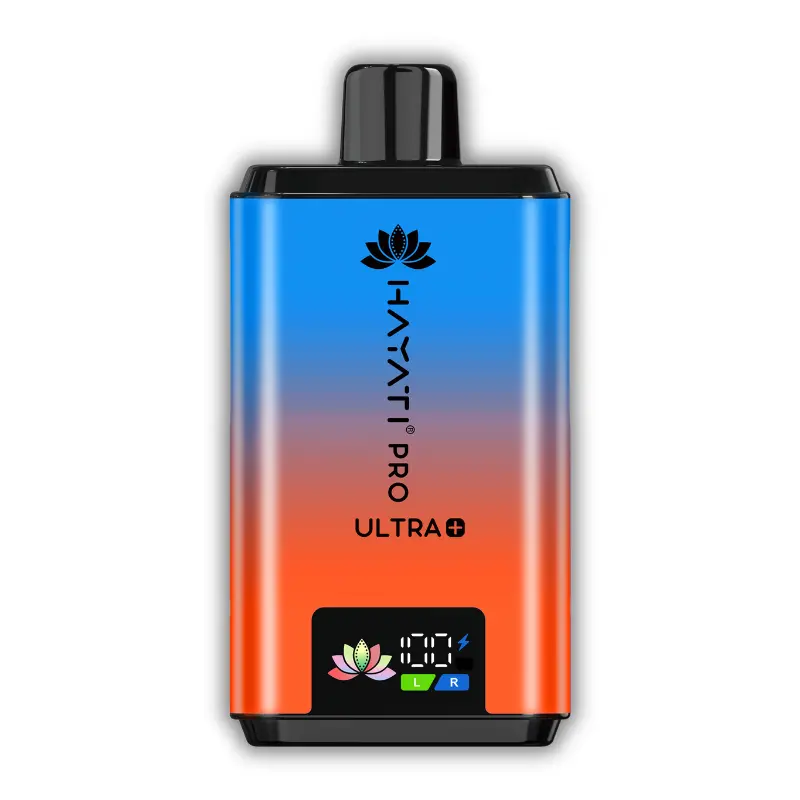
Hayati · Pro Ultra Plus
Red Razz GB / Blue Razz GB Hayati Pro Ultra Plus 25000 Prefilled Pod Kit
£11.99
✔ In stock — ready to ship
Genuine Hayati
Free over £20
Same-day dispatch
Secure checkout
Red Razz GB / Blue Razz GB arrives as a complete Pro Ultra Plus kit for £11.99. In the box is the 850mAh device and one prefilled pod carrying 22ml of 20mg nicotine salt, divided internally between two raspberries, with a rotating mouthpiece that decides which of the two reaches the coil. Hayati put a laboratory rating on the pod of up to 25,000 puffs. That number came off bench apparatus drawing at a fixed rhythm, so treat it as a measurement taken in a test house rather than a quantity you have purchased.
Most people reading a listing like this one are not choosing between it and nothing. They are choosing between it and the Hayati they already have in their pocket. A Mini Ultra, a Rubik, a Pro Max Plus: four ranges share this catalogue, they sit at four different prices, they hold four different volumes of liquid, and moving between them is the most common upgrade decision on the whole shelf. It is also the one nobody writes down. Every listing describes itself in isolation, as though the buyer had arrived with an empty drawer.
So that is what this page does. Not a pitch, a ledger. Below are the four platforms with their pod volumes, their pod prices, their kit prices, the size of the flavour library on each, and the pence per millilitre that falls out of the arithmetic. Then what changes when you move up, in both directions, because the gains get advertised and the costs almost never do. One of the costs is that liquid you already own does not travel with you. One of the gains turns out not to exist at all if you are coming from a particular direction, and the counting is what showed that, not an opinion.
The flavour matters too, and it gets its full section further down. Two gummy-style raspberries, one leaning natural and tart, one leaning bright and confected, sharing a 22ml budget. What this page will not do is re-argue how much genuine variety sits inside a pairing that keeps both the fruit family and the confectionery treatment fixed. The Red Razz GB / Blue Razz GB Pro Ultra Plus 25K Pods page, which sells the same pod on its own at £7.99, works that question through properly and concludes that the two halves move on acidity and on how naturalistic the berry reads, and on very little else. That verdict stands and is not repeated here. What is examined here is whether the platform underneath it is the right one for you.
Four platforms, counted rather than described
Every figure in the table below comes from the listings on this site. Volumes and puff ratings are Hayati's own published specifications for each range. Prices are the shelf prices we charge. Listing counts are the number of separate products on each shelf on the day this was written, which is worth saying because ranges grow.
| Range | Liquid per pod | Pod price | Pence per ml, pod | Kit price | Pod listings |
| Mini Ultra | 4ml | £3.49 | 87.3p | £3.99 | 30 |
| Rubik | 12ml | £3.99 | 33.3p | £5.99 | 19 |
| Pro Max Plus | 12ml | £5.49 | 45.8p | £7.99 | 89 |
| Pro Ultra Plus | 22ml | £7.99 | 36.3p | £11.99 | 52 |
Read the fourth column first, because it is the one that upends the usual story. Pro Ultra Plus liquid works out at 36.3 pence per millilitre. That is a long way below the Mini Ultra at 87.3 pence. It is comfortably below the Pro Max Plus at 45.8 pence. And it is above the Rubik, which lands at 33.3 pence and is, by this measure, the cheapest liquid Hayati sell in a prefilled pod anywhere in the catalogue.
That last line is not a rounding artefact. A Rubik pod holds 12ml for £3.99. Buying the same 12ml on this platform, as a fraction of a 22ml pod at £7.99, costs £4.36. Someone currently on a Rubik who moves to a Pro Ultra Plus is paying roughly nine per cent more for every millilitre of liquid they consume from that point on, not less. At ten millilitres a week, which is a fairly ordinary rate, that is about sixteen pounds a year going the wrong way. It is not a large sum and it is not nothing, and the point is that the headline reason people give for moving up does not apply to the one range where you would most expect it to.
The kit step, priced on its own
Kit prices tell a slightly different story from pod prices, because a kit bundles a device you only buy once with liquid you buy repeatedly. The honest way to price the step is to ask what the extra liquid costs on top of the cheaper kit.
- Mini Ultra kit at £3.99 for 4ml, against this kit at £11.99 for 22ml. Eight pounds more buys eighteen additional millilitres, which is 44.4 pence for each of them. Cheaper than any Mini Ultra liquid at any price on the range.
- Pro Max Plus kit at £7.99 for 12ml, against £11.99 for 22ml. Four pounds more buys ten additional millilitres, which is 40 pence each. The best marginal rate available on any step between these four ranges.
- Rubik kit at £5.99 for 12ml, against £11.99 for 22ml. Six pounds more buys ten additional millilitres, which is 60 pence each. That is worse than the Rubik's own kit rate of 49.9 pence per millilitre and worse than this kit's own average of 54.5 pence.
Three steps, three different answers. From a Mini Ultra the move is cheap on the margin and gets cheaper as you keep buying pods. From a Pro Max Plus it is the strongest value step on the shelf. From a Rubik it costs you money in both directions, on the kit and on every pod afterwards, and there has to be a non-financial reason for doing it.
Why the puff ratings cannot settle this
Anyone comparing ranges reaches for the big number on the front, and the big numbers are 1,500 on a Mini Ultra, 7,000 on a Rubik, 6,000 on a Pro Max Plus and 25,000 here. Divide each of those by the liquid it is attached to and the exercise falls apart.
- Mini Ultra: 1,500 across 4ml, which is 375 rated puffs for every millilitre.
- Pro Max Plus: 6,000 across 12ml, which is 500 per millilitre.
- Rubik: 7,000 across the same 12ml, which is 583 per millilitre.
- Pro Ultra Plus: 25,000 across 22ml, which is 1,136 per millilitre.
Two of those ranges hold identical volumes of liquid at an identical 20mg strength and carry ratings seventeen per cent apart. This platform is rated at three times the per-millilitre figure of a Mini Ultra. Nothing Hayati publish explains the spread, and it is not plausible that a millilitre of 20mg salt produces three times more vapour in one shell than another. What the spread shows is that each of these numbers is a property of a particular test run on a particular device, not a common currency you can convert between ranges.
The practical instruction follows directly. When you size an upgrade, size it in millilitres. Millilitres are a physical quantity, they are published for every range, they are consistent, and they divide cleanly into a price. The puff ratings are useful for nothing in this comparison and actively misleading if you take the 25,000 at face value against the 7,000 and conclude the gap is three and a half times. The gap in liquid is 22ml against 12ml, which is not the same shape of difference at all.
What you gain, itemised
Three things genuinely improve when you move onto this platform, and they improve by measurable amounts rather than vaguely.
More liquid inside one purchase
Twenty-two millilitres is five and a half Mini Ultra pods and just over one and five sixths of a Rubik or Pro Max Plus pod. Restated as errands: somebody getting through ten millilitres a week buys a Mini Ultra pod every two and a half days, a 12ml pod every eight or nine days, and a pod on this platform once a fortnight. Over a year that is about 130 Mini Ultra pods against about 24 here. The saving in money is one thing, but the saving in the number of times you have to think about it is the part people actually notice, and it is a factor of five.
On a dual pod the arithmetic sits differently and it is worth being precise. You are not carrying 22ml of one flavour. You are carrying two reserves of roughly eleven millilitres each, which is still two and three quarter Mini Ultra pods per side, and the reorder interval is set by whichever side runs out first rather than by the total.
A lower rate per millilitre, from two of the three starting points
From a Mini Ultra the drop is from 87.3 pence to 36.3 pence, a reduction of just under fifty-nine per cent. Somebody consuming ten millilitres a week spends about £454 a year on Mini Ultra pods and about £189 a year on Pro Ultra Plus pods for the identical volume of liquid. That is the single largest price difference available anywhere between these four ranges and it makes the £8 extra on the kit look like a rounding error.
From a Pro Max Plus the drop is from 45.8 pence to 36.3 pence, about twenty-one per cent, or roughly two pounds saved on every 22ml consumed. At the same ten millilitres a week that is a little under fifty pounds across a year. Real, useful, and not life-changing.
From a Rubik there is no drop. There is a rise of about three pence per millilitre. Whatever case exists for moving in that direction has to be made on flavour choice or on format, and the honest thing is to say so rather than to let the bigger pod imply a better price.
The library, and specifically the dual pods
Fifty-two separate pod listings sit on the Hayati Pro Ultra Plus Prefilled Pod Kit shelf, matched by 52 kits, for 104 products in the range altogether. Against a Rubik's nineteen pods and a Mini Ultra's thirty, that is a substantially wider field to choose from. Against the Pro Max Plus it is not. That range runs to 89 pod listings, seventy per cent more than this one. Moving up from a Pro Max Plus means giving up thirty-seven listings of choice, which is a loss and belongs in the other column.
Where this platform is genuinely alone is the dual-reserve format. Counting the four prefilled ranges, 25 pod listings carry two flavour names divided by an oblique, and all 25 of them are Pro Ultra Plus. The Rubik has none. The Pro Max Plus, across 89 pods, has none. The Mini Ultra has eleven dual kits at £3.99 but no dual pods at all, which means you can buy a Mini Ultra with two flavours in it once and then never restock that pairing without buying another whole device.
That is the real structural gain and it is bigger than the price gain. This is the only Hayati platform where a two-flavour pod is a repeatable purchase. If the rotating mouthpiece is what you want, and half the pairings on this shelf exist precisely because people do want it, then no amount of pence per millilitre elsewhere substitutes for it. A Rubik owner paying three pence more per millilitre to get access to Blue Razz Cherry / Blue Razz GB, Blue Razz GB / Lemon Lime or Straw' Cranberry Cherry / Strawberry Raspberry Ice is buying a format, not a discount, and that is a perfectly rational thing to buy.
What you lose, which the listings never mention
Four costs come with the move. None of them appears on a product page anywhere, including, until now, ours.
A longer commitment to one flavour
Volume is not only value. It is also a decision you have taken and cannot untake until the pod is finished. On a Mini Ultra you re-choose your flavour every four millilitres. Here you re-choose every twenty-two, or every eleven per side on a dual. At ten millilitres a week that is a fortnight on one purchase; at five millilitres a week it is four and a half weeks; at three millilitres a week it is over seven.
Scale the mistake accordingly. Order a Mini Ultra pod that turns out not to suit you and you have lost £3.49 and four millilitres, and you can put it right in a couple of days. Order a 22ml pod in a flavour that does not land and you have lost £7.99 and four to seven weeks of supply, or you throw it away and buy again. The wider the library, the more likely you are to try something unfamiliar, and the bigger the pod, the more each unfamiliar choice costs you when it misses. Those two pull against each other and the pull is strongest exactly on the platform with the most pairings.
There is a version of this that is specific to a dual pod and worth naming. Half of a two-flavour pod is eleven millilitres, so a pairing where you take to one side and not the other leaves you with roughly two and three quarter Mini Ultra pods' worth of liquid you will not choose to use. It does not survive the pod, because the coil retires with it. This particular pairing is unusually protected from that outcome, both halves being raspberry and both being sweet, and that protection is a real part of what makes it a sensible first dual pod. A pairing built on opposites, such as Blue Razz Pineapple / Strawberry Ice, offers far more contrast and correspondingly more exposure if one half is not for you.
More money per transaction
Cheaper per millilitre and dearer per purchase are both true at once, and the second is the one your bank sees. A Mini Ultra restock is £3.49. A restock here is £7.99, which is £4.50 more every single time. The kit is £11.99 against £3.99, three times the outlay on the day you buy it.
If money arrives in your account unevenly, or if you deliberately keep purchases small to keep track of them, the per-millilitre figure is arguing for something your budget may not want. A £3.49 pod bought eleven times is cheaper to absorb than a £7.99 pod bought five times, even though the same eleven purchases cost half as much again in total. That is not an irrational preference and it is not answered by arithmetic. It is a different question from the one the pence column asks.
Pods you already own do not come with you
This is the cost that catches people, because it is invisible until the new kit arrives. Every one of these ranges is sold with its own pods, at its own capacity and its own price: 4ml at £3.49 for a Mini Ultra, 12ml at £3.99 for a Rubik, 12ml at £5.49 for a Pro Max Plus, 22ml at £7.99 here. Hayati publish no fitment chart and no cross-range compatibility list of any kind, so the only prudent assumption is that you need the pods sold for the device you actually own, and that the ones in your drawer were bought for a different one.
Do not take a mechanical claim in either direction from a retail page, ours included. What can be stated is the commercial reality, which is that four separate pod ranges exist at four separate volumes and prices, and nothing in the catalogue offers a pod that is listed for more than one of them. Match the range name printed on your device to the range name in the title of whatever you buy, and go no further than that.
Price the stranding before you order. Three unopened Mini Ultra pods is £10.47 sitting idle. Three Rubik pods is £11.97, which is more than the extra you are paying for this kit over a Rubik one. Three Pro Max Plus pods is £16.47, more than the kit itself. The sensible move is to run your existing stock down to one spare before you switch, which costs nothing and removes the whole problem. The awkward move is to buy the new kit during a sale while a fortnight of old pods is still in the cupboard, which is how people end up feeling the upgrade was worse value than the numbers said.
Fewer, larger decision points
The last cost is subtler and it takes a few weeks to show up. A 4ml pod is a sample. A 22ml pod is a relationship. On a Mini Ultra you might pass through fifteen flavours in a season without especially trying, which is how most people find out what they actually like. Here you might pass through five.
That matters for someone still mapping the catalogue. It matters much less for someone who already knows that gummy-style berries are their register and has known it for a year. The library at Hayati Pro Ultra Plus Prefilled Pod Kits & Pods is wide, but a wide library you sample five times a year is narrower in practice than a small one you sample fifteen times. A dual pod partly answers this, since it doubles the flavours per purchase, and that is one more reason a pairing is a reasonable way to arrive on this platform rather than a single.
Red Razz GB and Blue Razz GB, and what 22ml of them is like
Everything above is about the platform. This is about the liquid, and specifically about what it means to have chosen this liquid as your supply for the next few weeks rather than as a four-millilitre trial.
The red half
Red Razz GB opens with something recognisably fruit-derived. There is a brief dry, faintly seedy quality at the very front of the inhale, the sort of edge a real raspberry has before anything is done to it, and a tartness that arrives with the fruit rather than trailing behind it. It lasts a fraction of a second and it is the most convincing moment in the pod.
Then the confectionery body comes up underneath and the register changes. Sweetness thickens across the middle of the draw, the tartness is folded into it rather than removed, and what was briefly a sharp berry becomes a berry suspended in syrup. There is a jammy weight at the bottom of it, closer to cooked fruit than to fresh. The exhale is warm and unhurried, sweetness outlasts the fruit, and the last thing on the tongue is sugar carrying a raspberry outline.
On a sweetness scale running from an unsweetened herbal profile up to a full bakery flavour, put it around six and a half. It is clearly sweetened. The natural tartness is doing measurable work holding it down, and that tartness is exactly why the red side is the better of the two to live with at volume.
The blue half
Blue Razz GB is the confectionery version of a berry rather than the berry, and it is unapologetic about that. The tang and the sugar arrive together instead of in sequence, which is why the opening reads as vivid rather than as merely sweet. Through the middle, the gummy body thickens beneath it and the acid stops leading, settling into a seam running through a chewy sugared fruit. The exhale is sweeter than the inhale and the berry identity holds to the end without collapsing.
Neither half has any cooling listed against it and none turns up in use. Both finish warm and both finish long. If you were hoping for a cold element somewhere in the pod to break up the sweetness, it is not here, and no amount of alternating will produce it.
The commitment question, which is the one that belongs on this page
A four-millilitre pod asks nothing of a flavour. Almost anything is tolerable for two days. Twenty-two millilitres asks a great deal more, and the property that decides whether a liquid survives it is not how good it tastes on draw one. It is how heavily it is sweetened and whether anything in the recipe interrupts the sweetness.
Both halves here are sweetened firmly and neither is interrupted. There is no cold, no bitterness, no salt, no fizz and no sour spike. The interruption on offer is the switch between the two sides, and since both sit in the same upper sweetness band, turning the collar relieves the sameness without clearing it. Over eleven millilitres per side that is a genuine consideration, and it is the reverse of the calculation you would make on a Mini Ultra where the pod is finished long before fatigue arrives.
So a fair prediction, stated as a prediction rather than a fact: if you already know that heavily sweetened confectionery flavours suit you across long sessions, this pod will hold up and the volume is an advantage. If your usual pattern on a smaller platform has been to rotate between a sweet pod and something sharper or colder, the volume here will expose that, and you would do better with a pairing that includes a cold side. Straw' Cranberry Cherry / Strawberry Raspberry Ice puts a warm half against a chilled one and gives you a proper reset inside the same purchase.
How to find out in the first week
You can answer this yourself early, and you should, because the answer determines what you buy next rather than what you do with this pod. Spend the first two days on the red side only. On day three, switch to blue, let five or six draws clear the shared chamber, then pay attention to the next two or three. That is the point of maximum contrast and the only honest read available.
If the change registers as a genuine lift, the dual format is working for you and the platform is a good fit. If it registers as the same flavour with the sharpness moved slightly, you have learnt that two halves inside one register are not enough separation for your palate, and the next purchase should be a pairing that varies temperature or fruit family rather than treatment. Either way you know before the coil ages, which matters, because the difference between the halves narrows as the mesh wears and a verdict formed in the final third of the pod is a verdict about the coil.
The kit, and what arrives in the box
Two items: the Pro Ultra Plus device with an 850mAh battery, and one prefilled pod already filled with both flavours. There is nothing to assemble, nothing to fill and no separate liquid to buy. The mouthpiece rotates to select the active reserve and that is the only control on the product.
Hayati state that the collar selects a side. They publish nothing whatsoever about how the two reserves are divided, what separates them internally, or how liquid reaches the coil, and this page will not fill that in. Nor do they publish a coil resistance for this pod, a parts breakdown, or any detail of how the pod is held in the device, so none of those appears below either.
The single specification that matters most for a liquid like this one is the 22ml, because it sets how long one sealed coil has to survive. A mesh that handles four millilitres of syrupy raspberry is barely tested. The same mesh handling twenty-two is working five and a half times as hard, and heavily sweetened liquid is what wears coils. Expect the fine top notes to dull before the power does. On this pairing that has a specific consequence, since the top notes are what separate the two halves, so the switch between them becomes less audible as the pod ages. That is the mesh reporting its age, not a fault in either flavour.
When the coil is finished the whole pod is finished, liquid or not, and a Pro Ultra Plus pod is not a refillable item. Nothing in the listing provides for opening it, topping it up or changing what is inside. It contains electronics and a battery is in the device, so neither belongs in a household bin at end of life; both should go to an electrical take-back service. A kit buyer has the device to keep, which is the whole point of buying a kit once and pods thereafter, and the pods sit at £7.99 on the Pro Ultra Plus kits and pods shelf from then on.
The numbers on this listing
Only what Hayati publish for this product appears here. Several rows that other retailers fill in are absent because the source is silent on them, and a silence is more useful to you than a guess.
| Sold as | Complete kit, device plus one prefilled pod |
| Price | £11.99 |
| Flavours inside | Red Razz GB and Blue Razz GB, one pod, two reserves |
| Selector | Rotating mouthpiece |
| Total liquid | 22ml |
| Strength | 20mg nicotine salt |
| Battery | 850mAh |
| Cooling | None listed against either flavour |
| Hayati's rating | Up to 25,000 puffs, measured in a laboratory |
| Refillable | No provision for it in the listing |
| Maker | Hayati |
The £11.99 is best understood as £7.99 of liquid plus £4.00 for a device you keep. Test that reading against the range: pods on this platform are £7.99 and kits are £11.99, a gap of exactly four pounds everywhere. The same gap on the Pro Max Plus range is £2.50, and on the Mini Ultra it is fifty pence. So the device premium here is the steepest of the four, which is another way of saying the kit is the right purchase once and the wrong purchase twice. Blue Razz GB Hayati Pro Ultra Plus 25000 Prefilled Pod Kit and every other kit on the shelf carry the same £4.00 of hardware, and buying two kits means buying two devices.
Twenty milligrams is the ceiling permitted for nicotine in a consumer product in the United Kingdom, and it is the only strength offered on this listing. There is no second option and no way to change it, because the pod is prefilled and sealed. Nicotine is addictive, and on a product you cannot dilute the figure on the box is the figure for the life of the purchase.
The 25,000 rating deserves the scepticism set out earlier. It is Hayati's own laboratory result, produced by apparatus drawing at a fixed length, interval and power, and it describes a machine rather than a person. It is not comparable with the ratings on the other three ranges, as the per-millilitre arithmetic above shows, and it should play no part in deciding whether to move platform.
Where it sits, and what else the money buys
Price is constant across this platform, so the comparison is about shape rather than cost. Every kit on the shelf is £11.99 and every pod is £7.99, which strips the money question out entirely once you are here.
The same flavour, priced on three rungs
The most useful comparison for someone weighing a platform move is the same liquid at different volumes, and Blue Sour Raspberry provides exactly that. Blue Sour Raspberry Hayati Rubik Prefilled Pod Kit sells it as 12ml for £5.99. Blue Sour Raspberry Hayati Pro Max Plus Pod Kit sells the same 12ml for £7.99. Blue Sour Raspberry Hayati Pro Ultra Plus 25000 Prefilled Pod Kit sells 22ml for £11.99. One flavour, three platforms, and the pence per millilitre falls from ninety-nine to sixty-seven to fifty-five as the pod gets bigger. Buy the middle one and you are paying two pounds for a smaller pod than the cheapest option, which is a fact about the Pro Max Plus rather than about the flavour.
The blue half of this very pod is available on the smallest platform too. Blue Razz GB Hayati Mini Ultra Pod Kit at £3.99 puts four millilitres of it in your hand for a third of the price of this kit, and if you have never had the GB treatment at all, that is the cheap way to find out whether the register suits you before committing five and a half times as much liquid to it. Coming the other way, Blue Razz GB on its own is the undivided 22ml version at £11.99 for anyone who wants the blue side without the red one. So far as these shelves show, no equivalent single-flavour listing exists for Red Razz GB, which makes this pairing the only route to meeting it in this format.
Pairings that vary more than this one
If the counting above has persuaded you the platform is right but the pairing is too narrow, several listings hold one element still and move another further. Blueberry Raspberry / Mr Blue sets a plain berry against something the catalogue declines to describe in fruit terms at all. Kiwi Banana / Strawberry Banana keeps a soft base and swaps the partner fruit. Blackcurrant Cotton K / Blue Raspberry keeps a recognisable blue raspberry on one side and puts a sharper dark fruit opposite it, which is a wider gap than anything on this listing.
Two more are built on precisely the same logic as this pod, one treatment applied to two fruits, and naming them makes the pattern visible. Blueberry Cotton K / Raspberry Cotton K holds a candyfloss treatment steady and changes the berry. Blueberry H'Bubba / Watermelon H'Bubba does the same with a chewy sweet base and moves further on fruit, since a watermelon and a blueberry are not the same berry twice. Fruit Bomb / Straw' Watermelon B'Gum puts a broad mixed fruit against a specific one with a gum note on the finish.
Singles, if the collar is not the attraction
Plenty of people move platform for the volume and want nothing to do with a switch. Blueberry Raspberry Hayati Pro Ultra Plus 25000 Prefilled Pod Kit is the most reproduced berry combination in the whole catalogue and holds its shape over 22ml. Blue Razz Cherry gives the blue note a darker partner without dividing the pod. Cherry Berry sits in the same family at a slightly lower sweetness, which is worth knowing if the commitment argument above worried you. Strawberry Raspberry Ice brings a cold element that nothing in this pod has, and Raspberry Cola keeps the raspberry but builds a spiced structure under it instead of a gummy one.
Staying where you are
If the counting has pointed you back towards the range you already own, that is a legitimate outcome and there is stock for it. Blue Razz Blackcurrant Hayati Pro Max Plus Pod Kit pairs the blue note with a sharper dark fruit at £7.99 for 12ml. Blueberry Raspberry Hayati Pro Max Plus Pod Kit is the same berry blend on the larger-library platform. Blue Razz Mojito Hayati Pro Max Plus 6000 Pod Kit puts citrus and mint over the blue raspberry, which is the kind of interruption a heavily sweetened 22ml pod does not offer.
For browsing rather than deciding, Raspberry Vapes narrows the catalogue to the fruit across every range at once, which is the quickest way to see the same flavour at four volumes. Berry Vapes widens it to the family, and Hayati Pod Kits puts all 174 kits from all four ranges on one page, which is the single most direct way to compare the platforms side by side.
Living with twenty-two millilitres
Handling advice on a small pod is mostly irrelevant because the pod is gone before anything can go wrong with it. On a pod this size the handling genuinely changes the outcome, so what follows is scoped to that.
Draw pace, and why a syrupy liquid cares
A heavily sweetened liquid is thicker than a lean citrus and moves through a wick more slowly. Pull hard and fast on this pod and the wick can fall behind the coil, which is where a dry, scorched note comes from. Take it steady and unhurried instead. If you do get a harsh draw, put the device down for a minute rather than pulling again, and let the wick catch up. This applies more here than on a 4ml pod simply because there are five and a half times as many opportunities for it to happen.
Give the two sides different jobs
Random alternation wastes the only variation the pod has. The red-to-blue direction is the one that registers, since the brighter tang lands on a palate that has been sitting in rounded syrup, so treat the red half as your default and keep the blue setting for the point in a day when the sweetness has stopped landing. Used as two interchangeable options it stops being noticeable inside a day. Used as a default and an intervention it stays useful for weeks, which is the timescale that matters at this volume.
Storage over a longer life
A pod you will still be using in three or four weeks is stored, not just carried. Keep it out of direct sunlight and out of a car in warm weather, because sustained heat thins a syrupy liquid and darkens sweetened raspberry noticeably over that sort of timescale. A drawer at room temperature is entirely adequate. Store the kit where children and pets cannot reach it. If you have bought a spare pod ahead, leave it in its packaging until the day you need it rather than letting it sit loose.
Knowing when it is done
Two endings are possible and they feel different. The pod can run out of liquid, which announces itself plainly. Or the coil can wear out first, which announces itself as gradual flattening: the tang on the blue side goes before anything else, the dusty edge on the red side follows, and eventually turning the collar seems to do nothing. If you reach that second state with visible liquid still in the pod, that is the coil finishing before the fill does, and it is a normal outcome on a sweetened 22ml pod rather than a defect. Nothing is gained by pushing on past it.
Questions people ask before moving platform
Is this two pods, one for each flavour?
No. One pod arrives, with 22ml divided internally between Red Razz GB and Blue Razz GB, and the rotating mouthpiece decides which reserve is feeding the coil. The oblique in the title describes a division inside a single pod rather than two items in a box.
I already have a Mini Ultra. Is this worth the extra?
On price, unambiguously. Mini Ultra liquid is 87.3 pence per millilitre and this platform is 36.3 pence, a reduction of nearly fifty-nine per cent, and the £8 difference in kit price is recovered inside the first pod. The reason to hesitate is not money but pace: 22ml is five and a half Mini Ultra pods, so if one of those currently lasts you a week you are committing to well over a month on a single flavour choice.
I have a Rubik. Same answer?
No, and this is the surprise in the arithmetic. A Rubik pod is 12ml for £3.99, which is 33.3 pence per millilitre, cheaper than this platform's 36.3 pence. Moving up costs you about three pence on every millilitre from then on. Do it for the dual pods or for the wider library, not for the price, because the price argument runs the other way.
I have a Pro Max Plus. What changes?
Liquid drops from 45.8 to 36.3 pence per millilitre, roughly two pounds saved per 22ml consumed, and the extra ten millilitres on the kit step work out at forty pence each, the best marginal rate between any two of these ranges. The loss is choice: the Pro Max Plus carries 89 pod listings against 52 here, so you are trading thirty-seven options for a bigger pod and access to the dual format.
Can I use my existing pods with the new device?
Assume not. Each of the four ranges is sold with its own pods at its own capacity and price, and Hayati publish no compatibility information at all, so match the range name printed on your device to the range name on the pod and go no further. The practical consequence is worth planning around: run your current stock down to one spare before you order, rather than leaving £10 or £15 of pods idle in a drawer.
Why is the puff rating so much higher than on my current device?
Because the ratings are not a common scale. Divided by the liquid each is attached to, the Mini Ultra rating is 375 per millilitre, the Pro Max Plus 500, the Rubik 583 and this one 1,136, and two of those ranges hold identical volumes at identical strength. Each figure is a laboratory result for one device under one test, so compare millilitres instead, which are consistent and divide into a price.
How different are the two halves?
Noticeably different at the moment you switch and not different in kind: the blue side is tangier and sharper at the top, the red side rounder with a faint real-fruit edge at the very start. Both are gummy-style raspberries at a similar sweetness with no cooling in either. The pods listing for this pairing sets out in full why a shared fruit family and a shared treatment put a ceiling on how far apart they can sit.
Is there any ice or menthol?
None is listed against either side and none turns up in use. Both halves finish warm and long. If a cold element is what breaks up sweetness for you, pick a pairing that includes an iced flavour rather than expecting one to emerge from this pod over 22ml.
What does GB stand for?
Hayati do not expand the letters on this listing. What they do say is that both flavours are gummy-style, which is consistent with how the suffix behaves elsewhere in the range: a syrupy body, thick sweetness and a finish that lingers. Read it as a description of construction rather than of fruit.
Should I buy the kit or just the pod?
The kit if you do not already have a Pro Ultra Plus device, since the pod on its own will not work without one. After that, pods at £7.99. The £4.00 difference between the two listings is the device, and it is the steepest kit premium of the four ranges, so paying it twice means owning two devices.
Will one side run out before the other?
Almost certainly, because very few people use two reserves at the same rate, and the coil serves both and ages regardless of which one is feeding it. On this pairing the exposure is lower than on most dual pods: both halves are sweet raspberries, so the chance of abandoning one entirely is small. On a pairing built around opposites the same imbalance can strand eleven millilitres.
Can the pod be refilled when it is empty?
Nothing in this product's description provides for refilling, topping up or opening it. Treat it as one sealed purchase whose working life ends when the coil does, which on a sweetened 22ml pod may be before the last millilitre goes. The device is the reusable part; the pod is not.
The recommendation, keyed to how much you actually get through
Work out roughly how many millilitres you consume in a week, which you can do by counting pods rather than guessing, and the decision falls out of it.
Under about five millilitres a week, stay where you are. A 22ml pod is four and a half weeks or more of one purchase at that rate, one coil has to survive all of it, and an unlucky flavour choice costs you the better part of two months. The per-millilitre saving over a Mini Ultra is genuine and large, but you are buying a supply problem you do not have.
Between about five and ten millilitres a week, it depends where you are starting from. From a Mini Ultra, move: you are paying 87.3 pence per millilitre for a format that suits a much lighter rate, and a fortnight to three weeks on a pod is a reasonable commitment. From a Pro Max Plus, move if the dual format appeals, since the money alone is about fifty pounds a year and you give up thirty-seven listings for it. From a Rubik, stay unless you specifically want a two-flavour pod, because there is no price case at all and the Rubik is already the cheapest liquid Hayati sell.
Above about ten millilitres a week, move, from any of the three. A 22ml pod is a fortnight or less at that rate, which is short enough that commitment stops being a real cost, and everything else points the same way: fewer purchases, a lower rate from two of the three starting points, and the only repeatable dual pods in the catalogue. Even the Rubik's three-pence advantage is a small price for halving the number of times you reorder.
As for this pairing specifically, it is a sensible one to arrive on. Both halves are sweet gummy raspberries, the difference between them is modest, and that modesty is protection rather than a flaw when you are new to an 11ml-per-side commitment and cannot yet judge how a flavour wears over weeks. Nobody buying this ends up with half a pod they will not touch. Once you know how the platform treats you, the shelf at Hayati Pro Ultra Plus Prefilled Pod Kit has fifty-one other kits and the pairings get considerably wider than this one. Start narrow, then widen.
Strictly for adults aged 18 and over. Nicotine is an addictive substance.
You might also like


