
Home / Hayati Pro Ultra Plus Pods / Blackcurrant Cotton K / Blue Raspberry Hayati Pro Ultra Plus Pods
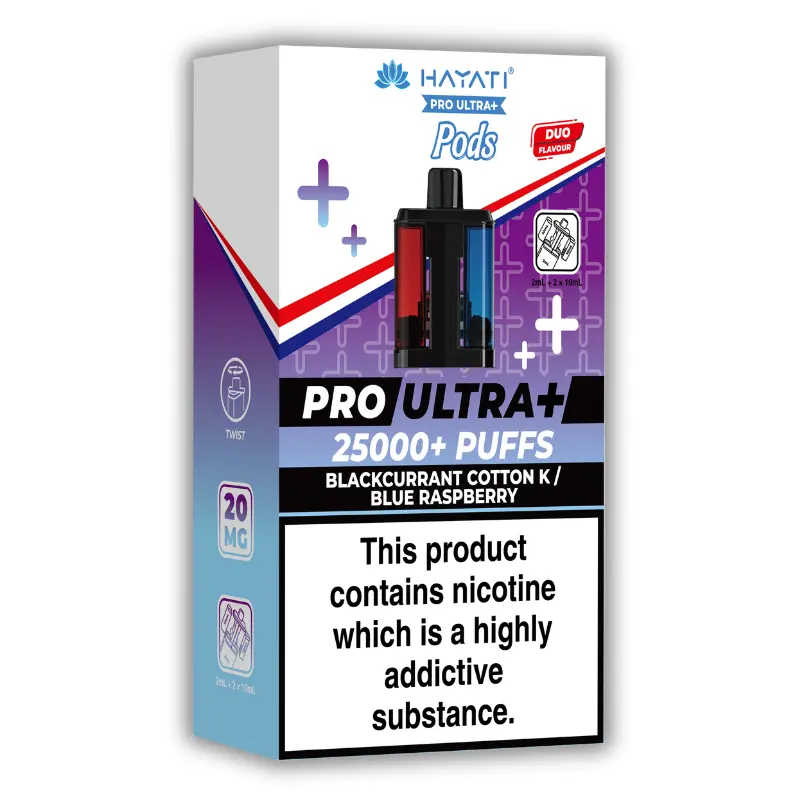
Hayati · Pro Ultra Plus
Blackcurrant Cotton K / Blue Raspberry Hayati Pro Ultra Plus Pods
£7.99
✔ In stock — ready to ship
Genuine Hayati
Free over £20
Same-day dispatch
Secure checkout
£7.99 buys one prefilled Hayati Pro Ultra Plus pod holding 22ml of liquid at 20mg nicotine salt, divided between Blackcurrant Cotton K on one side and Blue Raspberry on the other. The listing states in its own text that the two sit separately within the pod and that the rotating mouthpiece is what selects between them, so this is one divided pod rather than two pods in a packet. Hayati publish a rating of up to 25,000 puffs for it, produced on test equipment under fixed conditions, and that figure is worth treating as a rough way of ranking pods against each other rather than as a forecast of your fortnight. No hardware comes in the pack. Anyone who still needs a body buys the Blackcurrant Cotton K / Blue Raspberry Pro Ultra Plus kit at £11.99 and gets the same liquid with a device attached to the price.
Those are the numbers, and they are shared with most of the fifty-two listings on the Hayati Pro Ultra Plus Pods shelf, which is a polite way of saying they do not distinguish this pod from anything. What distinguishes it is the title, and specifically the fact that the two halves of the title are written according to two opposite habits. One half is compressed into a shorthand Hayati never expand above the fold. The other half is a flavour the same catalogue normally abbreviates, written out here at full length. They sit an oblique apart, in the same typeface, at the same size, and the buyer is given no indication that anything unusual has happened.
This page is about that. It counts how far each habit runs, establishes which of the two is genuinely opaque and which only looks it, tests whether the choice of spelling carries any information at all, and then says plainly which question the catalogue leaves open and will not answer. After that it does the flavour, which on a pod like this is more interesting than the numbers and less interesting than the name. Two of the claims I was working from did not survive the counting and I have said where and how I narrowed them, because a page that quietly drops a claim it cannot support is worse than one that never made it.
A title written in two directions at once
Start with the raw counts, taken from the catalogue as it stands rather than from any description of it.
There are 492 listings in the full Hayati range as stocked here. Cotton K appears in the titles of seven of them. Four flavours carry it: Blueberry Cotton K, Raspberry Cotton K, the pairing of those two, and Blackcurrant Cotton K, which exists in this catalogue only in the recipe you are looking at, as this pod and as its matching kit. There is no other blackcurrant anywhere in the range under that treatment, and no blackcurrant Cotton K in any other format, at any other volume, on any other body.
Now the other side. The two words "Blue Raspberry", written out in full and adjacent, appear in exactly two titles out of 492. Both of them are this recipe: this pod and its kit. Against that, the house short form Razz appears in 48 titles, which is a little under one listing in ten. Every one of those 48 is Blue Razz; there is no Razz in this catalogue that is not blue, and the two Red Razz titles are both halves of pairings whose other half is Blue Razz GB.
Set those two counts beside each other and the shape of the title becomes clear. Seven listings compress a confection into two words and an initial. Two listings expand a flavour the other 48 keep short. The intersection of those two sets, the listings that do both things at once in the same title, is this pod and its kit and nothing else in 492. That part of the brief I was handed holds up exactly, and it is the only claim in it that came through the counting unchanged.
The first correction: Cotton K is not the locked one
I was told Cotton K was the most opaque shorthand in the catalogue. It is not, and the count says so unambiguously.
All seven Cotton K listings gloss the name in their own description text. One says outright that the name points to candyfloss. Another says candyfloss is the idea behind it. The rest reach for candy floss, spun sugar or airy sweetness in the first sentence or two. This pod's own listing does it in its opening line, putting a candy-floss adjective directly in front of the blackcurrant, which is the weakest gloss of the seven because it leaves the reader to join the adjective to the name themselves, but it is still there on the page. Seven out of seven.
Run the same test on GB, which appears in 27 titles across five hardware families. Nothing in any of the 492 descriptions expands it. Not once. The word gooseberry occurs a single time in the whole catalogue and not in a GB listing. A buyer looking at Blue Razz GB or Grape GB / Strawberry GB can read the whole listing, top to bottom, and finish it not knowing what the two letters stand for. They will learn that the flavour is gummy and sugared, because the copy says so, but the initials themselves are never unpacked. Zero out of 27.
So the honest version of the claim is narrower and, I think, more useful. Cotton K is not opaque. It is opaque at the title layer only, which happens to be the layer a buyer searches, scans and reorders from, and it is resolved one line below that layer every single time. GB is the genuinely locked one. Our page for the Blue Razz Cherry / Blue Razz GB pod sits in the family where that matters most.
That distinction also refines something a sibling page says. The H'Berg / P'Man pod page groups GB and Cotton K together as shorthand a reader cannot reconstruct without being told. On reconstruction from the title alone that is right, and it is the right test for the problem that page is solving, which is recognising a listing from a grid. On the wider question of whether the catalogue ever tells you, the two are not alike at all: one of them tells you seven times out of seven and the other never tells you. Both pages are measuring something real; they are measuring different layers, and the difference is exactly the subject here.
The second correction: recipe, not listing
The second claim I narrowed is smaller but worth being exact about. I was told this was the only Cotton K listing where the collar changes the treatment rather than the fruit. It is the only Cotton K recipe that does, and that recipe has two listings, this pod and its kit, which are the same liquid sold twice.
The structure across the seven is worth laying out because it is genuinely unusual. Three listings run Blueberry Cotton K against Raspberry Cotton K, which puts the same treatment on both sides and varies the berry underneath. Two listings sell a single treated flavour on its own, with no collar and nothing to compare it against. And two listings, this pod and its kit, put a treated fruit on one side and an untreated fruit on the other, which makes the collar a switch between two kinds of construction rather than between two fruits. If you want the version where the treatment is the constant, that is the Blueberry Cotton K / Raspberry Cotton K pod, sold on the same shelf at the same £7.99.
Our Mini Ultra kit page for that Blueberry and Raspberry pairing has already done the work of characterising what Cotton K actually is, and it did it properly, by counting Hayati's own vocabulary across all seven listings rather than describing candy floss from memory. Its findings are that the airy and spun and fluffy words in this catalogue belong to Cotton K and to nothing else, and that across all seven listings Hayati never once attribute an aroma to the treatment, only sweetness and texture. That page also flagged this pairing, before anyone wrote it up, as the structural odd one out among the seven. All of that is theirs, it is on the record, and I am taking it as established rather than re-deriving it here.
Does the spelling carry information? A test, and the answer is no
Here is where the interesting part of the count is, and where a tempting conclusion has to be resisted.
Pull apart the 48 Razz titles into their distinct flavour names and you get nine: Blue Razz Blackcurrant, Blue Razz Cherry, Blue Razz Fruit Twist, Blue Razz GB, Blue Razz Gummy Bear, Blue Razz Lemonade, Blue Razz Mint, Blue Razz Mojito and Blue Razz Pineapple. Look at what they have in common. Every single one carries a second word after Razz. There is no bare Blue Razz pod, bottle, kit or refill anywhere in 492 listings. The short form never stands alone.
Now look at the two titles that spell the fruit out. Neither carries a modifier. Blue Raspberry is sold here, and only here, as blue raspberry and nothing else. Across the seventeen distinct flavour names in this catalogue that spell raspberry out in full, every other one adds something: a second fruit in Blueberry Raspberry and Blackberry Raspberry and Kiwi Grape Raspberry, a sourness word in Blue Sour Raspberry and Red Sour Raspberry, a treatment in Raspberry Cotton K and Strawberry Raspberry Ice, a format in Raspberry Cola. This title is the only colour-plus-fruit construction in the range with nothing bolted on.
So the correlation is perfect. Forty-eight modified names use the short form, two unmodified names use the long form, and there are no exceptions in either direction. It looks like a grammar: Razz as the bound form that takes a modifier, Raspberry as the free form that stands alone. It is a pleasing result and I do not believe it, and the reason I do not believe it is also in the catalogue.
Test it against the other short-and-long pairs Hayati run, of which there are three. If the choice between spellings is systematic, the same recipe should never appear under both.
It does. Kiwi Banana / Straw' Banana is this pod's shelfmate at £7.99. Its matching kit, same range, same pairing, same liquid, is titled Kiwi Banana / Strawberry Banana. One abbreviates the strawberry and the other spells it out, and the two listings are the pod and kit of a single recipe, which is precisely the relationship this Blackcurrant Cotton K pod has with its own kit. Where our pairing is consistent across the two SKUs, theirs is not. The same thing happens again with bubblegum: the Pro Ultra Plus and Mini Ultra listings of one recipe are titled Straw' Watermelon B'Gum while the nic salt and the Mini Ultra pod of the strawberry, watermelon and gum idea spell out Strawberry Watermelon Bubblegum. And the H'Bubba shorthand, unlike Razz, appears bare as well as compounded, with three listings selling H'Bubba on its own and two others spelling Hubba Bubba out in full.
Three pairs, and in two of them the identical recipe is written both ways. That is not a convention with an exception in it. That is a catalogue where the short-or-long decision was made listing by listing, probably by whoever typed the title, with no rule underneath. Which means the clean Razz and Raspberry split, elegant as it is, rests on a sample of two listings in a system that demonstrably does not behave consistently anywhere else.
The conclusion is therefore deflationary, and it is the useful one for anybody spending £7.99. Do not read anything into the spelling. The fact that this pod says Blue Raspberry where 48 others say Blue Razz is not a signal that the liquid is different, not a signal that it is unmodified, not a signal that it is closer to a fruit than a sweet, and not a signal of anything else. It is almost certainly a typing decision. The correlation is real and I have stated it accurately, but the catalogue supplies its own evidence against treating it as meaningful, and a page that presented it as a discovered rule would be selling you a pattern it had not checked.
What the catalogue genuinely will not tell you
Having removed one thing people might infer, it is worth being precise about the one question that is actually open, because it is not the same question and it is the one that matters.
The catalogue resolves what Razz means. Forty-six of the 48 Blue Razz listings say "blue raspberry" somewhere in their own description text, usually in the first sentence. So the name is not a mystery: Hayati are telling you, repeatedly and in plain words, that Blue Razz is the blue raspberry flavour. What they never say, anywhere, is whether the liquid in this pod's Blue Raspberry half is the same formulation as the blue raspberry inside any particular Blue Razz product. That is a question about recipes, not about names, and no listing in the range addresses it.
It would be easy to assume either answer. One reading says a manufacturer with 48 blue razz listings has one blue raspberry base and drops modifiers into it, so this pod's half is that base with nothing added. The other reading says the change of name marks a change of formulation, which is why they wrote it differently. Both are plausible, both are reasoning from a word to a physical property, and both would be invention. Hayati publish nothing on it, and this page is not going to settle it by sounding confident.
Say it plainly instead: it is unpublished. If you want the blue raspberry you already know, buy the listing that names it the way you know it. If you are prepared to find out, this pod is where you find out, and you will know within two draws whether it matches your memory of Blue Razz Cherry minus the cherry, or whether it does not.
The retrieval problem, which is the part that costs money
One practical consequence follows from all of this, and it is worth more than the naming argument that produced it.
At the title layer, the blue raspberry population of this catalogue is split into two sets that do not intersect. Search the 492 titles for Razz and you get 48 results, none of which is this pod. Search them for Blue Raspberry and you get two results, both of which are this recipe, and neither of which is any of the 48. There is no query that returns both. A buyer who has spent two years in the Blue Razz family and types the only name they have ever used for the flavour will never be shown this listing, and a buyer who arrives at this listing first will not be shown the 48.
That cuts both ways and the second direction is the more annoying one. Suppose you buy this pod, like the blue half, and want more of it in a smaller format for a second device. Nothing in the title tells you which of the 48 to try. You would be reaching for Blueberry Raspberry Mini Ultra pods or one of the Razz listings on guesswork, and the guess is unsupported because the recipe question above is unpublished.
There is one route that does repair the split, and it is worth knowing because it is the opposite of what you would expect. The category shelves are built from the product data rather than from the titles, so they do not care how a flavour was typed. The Raspberry Vapes shelf holds 119 listings, and 43 of the 48 Razz products are on it alongside both of the Blue Raspberry ones. Browsing that shelf shows you the whole family in one place; searching the titles never will. If you are shopping for blue raspberry specifically, the shelf is the better instrument and the search box is the worse one, which is not usually how those two compare.
Two things follow for anyone reordering. First, search the catalogue both ways whenever blue raspberry is involved, because one spelling hides the other and a title query will not merge them for you. Second, and more reliably, write down or photograph the exact title of the listing you bought, not the flavour you think you bought. The Pro Ultra Plus kits and pods shelf runs to 104 listings with seven different ways of ending the same range name, and our H'Berg / P'Man pod page has already mapped that thicket in detail, including the price trap where an unfamiliar ending turns out to be a kit with hardware in it. Read that page rather than this one for the reordering mechanics; there is no point printing the same map twice.
What is actually in the pod
Naming aside, there is a liquid here, and the two halves of it are built to different specifications. Hayati's own notes are short but they are specific enough to work with, and I am going to stay inside them rather than inventing detail.
The blackcurrant side
Blackcurrant is a strange fruit to put under a candy-floss treatment and the strangeness is the point of this half. On its own it is dark, dense and properly tart, with a slightly resinous edge that most other berries do not have, and it is the one British berry flavour that reliably reads as adult rather than sweet. There are only sixteen listings in this catalogue filed under Blackcurrant Vapes, and most of them either lean into that darkness or cut it with lemonade. Putting spun sugar on it instead is the opposite move.
Hayati describe the result as the sweeter of the two halves, with the berry's natural tartness giving way to a light, sugary finish. Read that sequence carefully, because the order in it is the whole description. The tartness is not removed. It arrives, it is acknowledged, and then it is handed over to sugar before it can develop into the dry, slightly bitter tail that an untreated blackcurrant ends on. So the shape of the draw is front-loaded with fruit and back-loaded with confection, which is unusual: most treated flavours in this range do it the other way round, announcing the sweet and letting the fruit appear underneath.
What you should expect from the treatment itself is very little in the way of aroma. That is the finding from the Cotton K vocabulary census, and it is the most useful thing anybody has established about this family: across all seven listings Hayati attribute no smell to Cotton K at all, only sweetness and a texture. Candy floss is close to pure sugar with a trace of colour, so there is no vanilla, no caramel, no dairy and nothing roasted for it to contribute. Practically, that means the treatment does not add a flavour on top of the blackcurrant. It changes the blackcurrant's weight and its ending, and leaves its identity alone.
So this is still recognisably blackcurrant. If you have had Blue Razz Blackcurrant on the Pro Max Plus, you have had the berry in a sweetened context already, and the difference here is that the sweetening is weightless rather than syrupy, and that nothing else is competing with the fruit for the same space. The tartness is not masked; it is shortened.
The blue raspberry side
The other half is described in three words that do real work: sharp, vivid, and a clean berry tang. No treatment word appears, no confectionery word appears, no cooling word appears. On a catalogue this willing to tell you when something is gummy or iced or spun, three consecutive absences are reasonably good evidence that the liquid is what it says: a blue raspberry accord presented without a second idea on top of it.
Blue raspberry as a category refers to a confection rather than to anything grown, and the question of what that means for judging it has been worked through properly on our Blue Razz GB / Lemon & Lime pod page, which argues that a manufactured accord can be typical or atypical but not accurate or inaccurate, and that a shelf sorting by fruit word hides the class distinction entirely. That argument is theirs and it is the right one; take it from there and I will not restate it. What I will add is narrow and specific to this pod: because the blue half here carries no modifier and no treatment, it is the plainest statement of that accord in the whole range. Everything else in the family is the accord plus cherry, plus pineapple, plus lemonade, plus mint, plus a gummy build. This is the accord with nothing done to it, which makes it the best available reference point for anyone who wants to know what the underlying flavour actually is before deciding whether they like any of the 48.
Expect it to be bright at the front, tangy in the middle and short at the end. Sharpness in a vape accord of this kind comes from acid rather than from fruit character, and acid is fast: it lands early, it peaks quickly and it does not linger. That is consistent with what Hayati say, and it is the opposite temporal shape from the blackcurrant half, which ends long because sugar ends long.
Turning the collar, and what that actually gets you
A divided pod has one coil, one wick and one airflow path, and both sides use all three. That has a consequence people notice and misread constantly: the first draws after a switch are not a clean read of the new side. There is residue from the previous one in the shared path, and it takes several pulls to clear. So if you turn to the blue half and it tastes sugary, that is the blackcurrant leaving, not the blue raspberry arriving.
The two halves here are unusually well matched for that problem, and it is a genuine advantage of this particular pairing. Because one side ends in sugar and the other opens on acid, the carryover is audible rather than confusing: you can hear the sugar fading out under the sharpness and tell exactly when it has gone. Switch between two fruits of similar weight and you get three ambiguous draws and no idea when the transition finished. Switch between a confection and an acid and the handover announces itself. Whichever way you turn, give it four or five draws before forming an opinion.
The economics of the collar are worth one sentence and no more. Both sides draw on one 22ml budget, so liquid you do not use on the half you like less is thrown away with the pod when the other half is spent. The two halves are not separable purchases, which means a pairing is only worth buying if you will genuinely use both. On that test this one does reasonably well, because the two sides are opposed rather than adjacent, and an opposed pair is the kind you actually alternate.
What it is not
Nothing in this listing mentions ice, menthol, mint, frost or any cooling agent, and no cooling word appears in the title on either side of the oblique. Our Blue Frozen pods page established that Hayati's cooling vocabulary is not graded and that the terms appear in titles when cooling is present, so their complete absence here is meaningful rather than an oversight. Treat this as an uncooled pod on both halves. If you want the cold version of a bright berry, the Blue Razz Pineapple / Strawberry Ice pod puts an iced half behind the collar, and Fresh Mint / Blue Razz Mint runs mint through both sides.
It is also not a sour pod. Sharp and sour are different axes and this catalogue distinguishes them carefully, keeping the word sour for listings like Blue Sour Raspberry, which is the closest single-flavour neighbour to this pod's blue half and takes the acid substantially further. Sharp here means brightness and definition. If you want the pucker, buy the pod that says so.
And it is not a dessert or a bakery flavour. Candy floss contributes no vanilla, no cream and nothing baked, which is the practical meaning of the no-aroma finding. Somebody reading "confectionery" and picturing something rich will be disappointed, and correctly so.
The pod and the device
There is not much to say about the hardware on a bare pod listing and I am not going to manufacture any. What arrives is one prefilled pod and nothing else. There is no body, no charging accessory and no spare, so this listing is for somebody who already owns the device and is restocking.
The one specification that matters for this particular liquid is the 22ml volume, and it matters because of what the two halves do to a coil at different rates. Sugar-forward liquids leave more residue than acid-forward ones, so on a pod where the collar alternates between a confection and a plain fruit, the wear is not evenly distributed even though it is shared. Both halves age together on one coil, and the half that ages the coil faster is the blackcurrant. What you will notice as the pod matures is the sugary tail on the blackcurrant side flattening first, and the blue side holding its definition longer, because acid survives a tiring coil better than sweetness does.
Check the range name printed on your device against the range name in this title before ordering, since Hayati sell different pods for different hardware. Beyond that, the rest of the platform, including which bodies exist and what comes in a complete box, is covered on the Pro Ultra Plus kits and pods shelf and on the kit listings themselves. Hayati publish no parts breakdown for the pod, so how it is retained in the bay is not something this page will describe.
Specifications
| Flavour, treated side | Blackcurrant Cotton K |
| Flavour, untreated side | Blue Raspberry |
| Selection | Rotating mouthpiece, stated on this listing |
| Liquid volume | 22ml total, shared across both sides |
| Nicotine | 20mg, salt formulation |
| Manufacturer puff rating | Up to 25,000, laboratory estimate |
| Price | £7.99 |
| Hardware included | None |
| Platform | Hayati Pro Ultra Plus |
| Cooling | None stated on either side |
Two of those rows are worth a note, and I have picked the two that are unusual rather than walking through all ten.
The first is the pairing of 22ml with £7.99, which works out at a little over thirty-six pence per millilitre. That is the figure to hold in your head when the collar tempts you to write off a half you do not enjoy. Eleven millilitres is roughly four pounds of liquid, so a pairing where you only ever use one side is a pod you are buying at double its advertised rate. This pod earns its price only if the blackcurrant and the blue raspberry both get used, which is the real question to ask yourself before adding it to a basket, and it applies identically to every dual listing on the Pro Ultra Plus pods shelf, twenty-five of whose fifty-two listings are divided.
The second is the nicotine row. Twenty milligrams per millilitre is the UK ceiling for a nicotine-containing consumer e-liquid, so every prefilled pod Hayati sell at this strength sits at the same number, and it is not a choice this listing is making. Nicotine is addictive. What the strength does affect is how a sharp flavour reads, because nicotine salt carries a bite of its own that sits in roughly the same part of a draw as the acid in the blue raspberry half. On the blackcurrant side the sugar tail softens that; on the blue side there is nothing softening it, which is part of why the two halves feel further apart than their flavour descriptions suggest.
How it compares
Placing this pod properly means answering three different questions, because three different buyers arrive at it by three different routes.
If you came for the blackcurrant
Blackcurrant is thin on the ground here. Sixteen listings carry it out of 492, and they fall into three groups: the juice and mango versions on the Pro Max Plus, the lemonade versions spread across four platforms, and this Cotton K pairing. Nothing else treats blackcurrant as a confection, so if the idea of spun sugar over a dark berry appeals, this pod and its kit are the only two places in the range to buy it, and the choice between them is entirely about whether you need hardware.
The obvious alternative is the blackcurrant and lemonade construction, which is well represented and does something genuinely different: lemonade adds acid and a carbonated impression, where Cotton K adds sugar and takes acid away. One sharpens the berry, the other rounds it off. They are not substitutes and a buyer who likes one may well dislike the other. If the whole appeal of blackcurrant to you is its tartness, the lemonade route is yours and this pod will read as a compromise.
Worth noting too that the Blackcurrant Vapes shelf is the smallest of the three flavour shelves this pod sits on by a wide margin, at sixteen listings against 119 on Raspberry Vapes and 225 on Berry Vapes. That is not a judgement on the fruit; it is a fact about where a browsing buyer will find this pod most quickly.
If you came for the blue raspberry
This is the larger group and the comparison is more interesting, because you have 48 Razz listings to choose between and the choice is really about what is added rather than about the base.
Take the pairings first, since this pod is one. Grape GB / Blue Razz GB puts two gummy-style fruits behind the collar, so both halves share a construction and differ only in fruit word, which is the inverse of what happens here. Red Razz GB / Blue Razz GB narrows it further to one fruit in two colours under one treatment, which is about as close as two halves of a divided pod get to each other in this range. Blueberry Raspberry / Mr Blue pairs a named blend with a house name that describes nothing, which is a different kind of naming problem from this one and has its own page. And the Blue Razz GB / Lemon & Lime pod is the nearest structural relative on the shelf: a confectionery marker on one side of the collar, an untreated flavour on the other, same platform, same £7.99. If you want that structure with a citrus opposite instead of a berry one, buy that pod rather than this one. Its page also carries the argument about buying by class rather than by fruit word, which is the single most useful thing to read before choosing any dual listing in this range.
Among the singles, Blue Razz Cherry and Blue Razz GB are the two ways of having the accord alone on this platform, one with a dark fruit added and one with a gummy treatment. Mr Blue sits nearby and tells you nothing from its name. Blueberry Raspberry is the useful contrast to draw at this point, because it spells raspberry out in full the way this pod does and is plainly not the same accord at all, which is a second reason not to treat the long spelling as a marker of anything. If what you want is the blue accord with genuinely nothing added, this pod's untreated half is the closest the catalogue comes, and the price you pay for it is that you have to take a candy-floss blackcurrant with it.
If you came for the structure
A third group buys dual pods for the switching rather than for either flavour, and for them the relevant axis is how far apart the two halves sit. Too close and the collar is pointless; too far and you end up disliking one side and wasting eleven millilitres.
This pairing sits usefully in the middle. Both halves are berries, so there is no jarring category change, but one is sugared and long and the other is sharp and short, so the switch registers immediately. Compare that with Blueberry Raspberry / Blueberry Raspberry Cherry, where one half is the other half plus a cherry and the collar buys you a small adjustment, or with Straw' Guava / Dragon Berries, which crosses into tropical on one side. Blueberry Raspberry Lemon takes the opposite approach again and puts all three ideas in one undivided flavour.
For a reference point outside the pairings, Raspberry Cola shows what happens when raspberry is asked to share a single liquid with something structurally unlike it rather than to alternate with it. That is the other way of solving the same problem, and some people much prefer it, because a blend never needs a transition.
Pod or kit
The last comparison is the simplest. This listing is £7.99 for the liquid. The matching kit is £11.99 and adds a device. Four pounds is what the body costs when bought this way, and it is the same four pounds on the Grape GB / Blue Razz GB kit and on every other pairing that exists in both forms. If you own a Pro Ultra Plus, this is the listing you want and the kit is four pounds of hardware you do not need. If you do not, the kit is the cheaper route in, because a device bought separately does not arrive at four pounds.
Getting the best from it
Most of the standard advice applies to every pod in this range and repeating it here would waste your time, so this section covers the four things that are specific to a divided pod with a sugar-forward half.
Let it settle before the first draw. A pod that has been through a cold van wants a few minutes at room temperature before use, and that goes double for a confectionery liquid, because a sugared blend is thicker when cold and a thick liquid wicks slowly. The first draw on a cold pod is where dry hits come from. Two or three short pulls before a proper one gives the wick time to catch up.
Start on the side you want to judge. Because carryover is real and shared, the first flavour you use on a fresh pod is the only one you will ever taste in isolation. If you want an honest read on whether this blue raspberry matches your memory of the Razz family, turn the collar to it before anything else and take a dozen draws. Do it in the other order and the blackcurrant's sugar will be sitting in the path for your whole first impression.
Watch the blackcurrant side for the wear signal. On this pod the sweetness goes before the fruit does. A tiring coil struggles with sugar first, so the symptom to look for is the blackcurrant's long sugary finish getting shorter and drier while the berry itself still reads fine. That is earlier and more obvious than anything the blue side will show you, and it is a better indicator than counting days. When the confectionery tail has gone, the pod is past its useful middle even if it still has liquid in it.
Do not chain the blue half. Acid-led flavours saturate quickly. Four or five draws in close succession and the sharpness that makes that side worth having stops registering, at which point people turn the collar and conclude the blackcurrant is better, when what has actually happened is that their palate has stopped reading acid. Leave a gap, or switch sides deliberately rather than in frustration.
Two pieces of housekeeping, kept short. Store the pod upright and out of sunlight, somewhere children and pets cannot reach, and away from heat, since warmth thins a sugared liquid and encourages it to seep. And when it is finished, it still contains a coil and a residue of blackcurrant and blue raspberry liquid, so it belongs at an electrical recycling point rather than in a household bin. Many vape retailers and larger supermarkets accept small electricals for disposal.
Questions people actually ask about this one
Is Blue Raspberry the same flavour as Blue Razz?
As a name, yes: 46 of the 48 Blue Razz listings describe themselves as blue raspberry in their own copy, so Hayati use the two terms for the same flavour idea. As a recipe, it is unpublished. Nothing in the catalogue says whether this pod's blue half is the identical formulation to any specific Blue Razz product, and we are not going to guess on your behalf.
Why is this pod spelled differently from the other 48?
Almost certainly because somebody typed it that way. We checked whether the short and long spellings follow a rule and they do not: the same Kiwi Banana recipe is titled with Straw' on its pod and Strawberry on its kit, and the same bubblegum recipe appears as B'Gum on one platform and Bubblegum on another. There is no evidence the spelling tells you anything about the liquid.
What does Cotton K mean?
Candy floss. Hayati never expand it in a title, but they gloss it in the description of all seven listings that carry it, usually in the opening sentence. Our Blueberry Cotton K / Raspberry Cotton K Mini Ultra kit page counts the vocabulary across all seven and establishes what the treatment does and, importantly, what it does not contribute.
Is this two pods or one?
One. The listing states that the two flavours are kept apart inside a single pod and that turning the rotating mouthpiece selects between them, so the plural in the title refers to the product type rather than to the quantity in the pack. Both halves share the 22ml total.
Is there any menthol or ice in it?
No cooling agent is named on either side, and neither half of the title carries a cooling word. Hayati do put those words in titles when cooling is present, so read this as an uncooled pod throughout. For a cold option behind a collar, the Blue Razz Pineapple / Strawberry Ice pod ices one side.
Which half is sweeter?
The blackcurrant, clearly, and Hayati say so themselves. The candy-floss treatment takes over the end of the draw where an untreated blackcurrant would finish dry. The blue raspberry half is sweet in the way a sharp fruit accord is sweet, which is to say considerably less.
Can I buy the two halves separately?
Not as this recipe. Blackcurrant Cotton K exists nowhere else in the catalogue, in any format. The two single Cotton K pods that do exist are the blueberry and the raspberry versions on the Mini Ultra, and there is no standalone Blue Raspberry listing either. Both halves of this pod are only available together.
Will it fit my device?
It is a Pro Ultra Plus pod and belongs with Pro Ultra Plus hardware. Compare the range name on the body you own with the one in this title, and do not take a compatibility decision from a retail page, ours included.
How long does a pod like this last?
Hayati rate it at up to 25,000 puffs, which is a laboratory estimate produced under controlled conditions rather than a promise about your use. Real duration depends on draw length, frequency and how often you turn the collar, since switching costs a few draws each time. Treat the figure as a way of comparing pods, not as a calendar.
I only want the blue side. Should I buy this?
Probably not. You would be paying £7.99 for 22ml and using roughly half of it, which doubles your effective cost per millilitre, and the unused blackcurrant goes in the bin with the pod. A single-flavour listing such as Blue Razz GB or Blue Razz Cherry serves that buyer better, unless the untreated accord is specifically what you are after and you accept the waste.
Is the nicotine a salt?
Yes, 20mg nicotine salt, which is the standard preparation for a prefilled pod at this strength and the figure every pod in the range carries because it is the UK maximum. The listing itself gives the strength without naming the preparation.
The short version
One divided pod, £7.99, 22ml at 20mg, no device, rated by the manufacturer at up to 25,000 puffs as a laboratory estimate. Candy-floss blackcurrant on one side of the collar and an untreated blue raspberry on the other, which makes it the only Cotton K recipe in 492 listings where turning the mouthpiece changes the construction rather than the fruit, and the only place blackcurrant appears under that treatment at all.
The title is the unusual part and the counting mostly backed it up. Two titles in 492 spell Blue Raspberry out in full and both of them are this recipe; 48 use the short form and every one of those 48 attaches a second word to it. What the counting did not back up is the idea that the spelling means something, because this catalogue writes the same recipe both ways elsewhere, so the neat pattern is a coincidence rather than a rule and I have said so rather than selling it to you. I also narrowed the claim that Cotton K is the most opaque shorthand here: it is glossed in all seven of its listings, while GB is glossed in none of its 27, so the opacity is a property of the title layer rather than of the catalogue.
Buy it if you want both halves. The two are opposed enough that the collar earns its place, the carryover between a sugared side and an acid side is easy to hear and therefore easy to work around, and the blue half is the plainest version of that accord Hayati sell. Do not buy it expecting the spelling to have told you something, and do not buy it for one side, because the other side is not optional and you are paying for it either way.
Strictly for adults aged 18 and over. Nicotine is an addictive substance.
You might also like


