
Home / Hayati Pro Max Plus Pods / Strawberry Raspberry Blueberry Hayati Pro Max Plus Pods
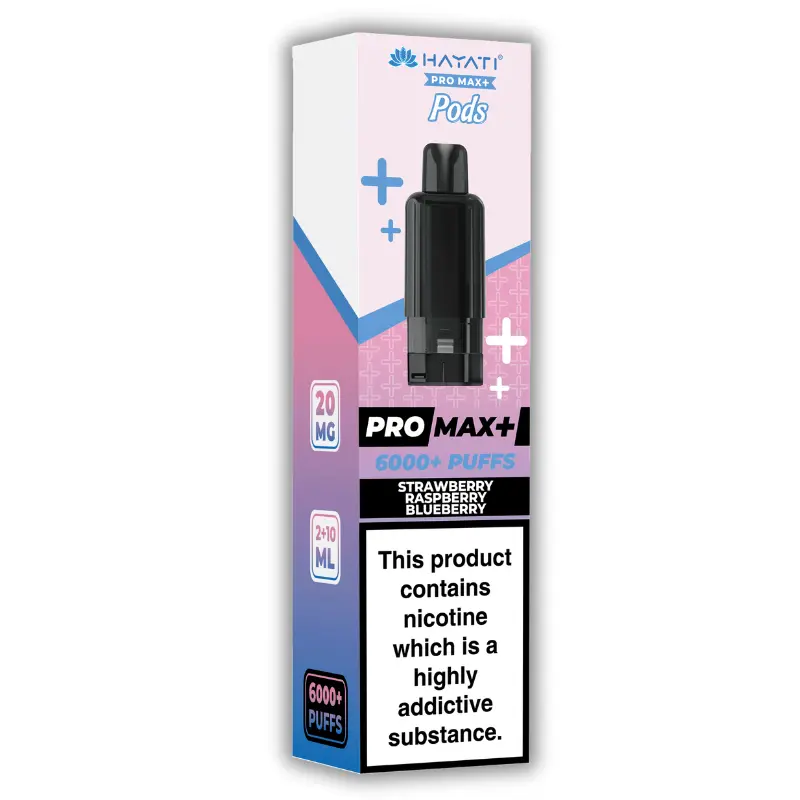
Hayati · Pro Max Plus
Strawberry Raspberry Blueberry Hayati Pro Max Plus Pods
£5.49
✔ In stock — ready to ship
Genuine Hayati
Free over £20
Same-day dispatch
Secure checkout
Strawberry Raspberry Blueberry is a prefilled replacement pod for the Hayati Pro Max Plus, £5.49, holding 12ml of 20mg nicotine salt e-liquid and rated by the manufacturer at up to 6,000 puffs, a figure Hayati arrive at in laboratory conditions rather than one you should read as a promise. No device comes with it. If you are here you already own the body and you are restocking, which is a different transaction from the one the Strawberry Raspberry Blueberry Pod Kit at £7.99 is designed for.
This is the first page anyone has written on this liquid, so two jobs fall to it. The first is the flavour analysis, done properly, because no kit page or bottle page has done it and there is nothing here to defer to. The second is the question a refill page is better placed to answer than any other listing in the range: what this blend is like on the second pod, and the third, once novelty has worn off and you are no longer tasting it so much as living with it.
Those two jobs pull against each other, which is worth admitting up front. A flavour description is written as though every draw were the first one. It describes a liquid the way a new palate meets it, all three fruits distinct and legible, and that description is accurate for about a day. What happens afterwards is not decay in the liquid. It is adaptation in you, and it hits a three-component blend differently from a two-component one. This page does the first-encounter description because it has to, then spends most of its length on the part that a first-encounter description structurally cannot reach.
Before either, there is a piece of evidence lying in plain sight that nobody has picked up. This liquid is sold three times on this site and Hayati wrote fresh copy for each listing. Three descriptions of one recipe, written independently, is the entire published record of what this liquid is. Lining them up against each other is cheap, it takes ten minutes, and it turns out to settle more than a paragraph of adjectives would.
Three listings, one recipe: what the published record actually says
The three are the 10ml Pro Max Nic Salt bottle at 10mg, the Pro Max Plus Pod Kit at £7.99, and this refill pod at £5.49. That is the complete set. Hayati have not put this blend on the Mini Ultra, the Rubik, the Pro Ultra Plus, the 70/30 line or either shortfill, and there is no iced version of it anywhere on the site.
Reading the three together, some properties are asserted by all of them, some by two, and some by exactly one. That distinction is the useful part. A property every listing names is the closest thing to a fact this site can offer about a liquid, because three different pieces of copy converged on it independently. A property only one listing names is either the most interesting thing available or a copywriter's flourish, and saying which is a real contribution rather than a hedge.
What all three assert
Every one of the three assigns the same three roles, to the same three fruits, in the same order. Strawberry is the sweet anchor. Raspberry is the tang. Blueberry is the softer, deeper close. The bottle calls strawberry the sweet, familiar anchor, gives raspberry tang and brightness, and has blueberry round things off with a softer, deeper fruitiness. The kit has strawberry lead with familiar sweetness, raspberry follow with a sharp lively tang, and blueberry finish with a softer, deeper note. This pod has strawberry bring bright sweetness, raspberry add a sharp tang, and blueberry soften the finish with a deeper, mellow note.
Three independent pieces of copy agreeing that precisely is not nothing. It rules out the possibility that the role assignment is an artefact of one writer's preference, and it means the recipe has an intended shape that Hayati are consistent about. Whatever else you conclude, the sweetness comes from the strawberry, the acid comes from the raspberry, and the blueberry is the component doing the settling.
The second thing all three assert is body. The bottle calls it full-bodied, the kit calls it rich and well-rounded, this pod calls it rich and rounded. Here a caution applies. The word "rounded" appears in 99 of the 492 product descriptions on this site, which makes it house vocabulary rather than evidence. Three listings agreeing that a berry blend is rounded tells you roughly as much as three listings agreeing that it is fruity. The role assignment above is meaningful because it is specific and repeated; the roundness is meaningful only in the weak sense that nobody described it as thin.
What two of the three assert, and why the odd one out matters
Two of the three state, in as many words, that there is no cooling in this liquid. The bottle opens by calling it a three-berry blend without ice and later says that leaving out the cooling lets the fruit come through on its own terms. The kit closes its flavour paragraph by calling it a good choice if you want plenty of berry character without the chill of an iced flavour.
The listing that never says it is this one. The refill pod's copy mentions ice only in passing, as a suggestion that this blend sits well in a rotation alongside lighter cooled ones. That implies the pod itself is not iced without ever stating it. That is an implication, not a statement, and a buyer who reads only this listing, which is exactly what a restocking buyer does, never gets told outright.
So the record is clear about the absence of cooling in two places out of three, and the one place it is silent is the listing most likely to be read alone. For the avoidance of doubt: there is no ice, menthol, frozen or cooler note in this blend, the two listings that address it say so directly, and nothing in the third contradicts them. The phrase "without ice" appears in only six of the 492 descriptions on the site, so Hayati do not routinely flag an absence of cooling. When they do flag it, it is because the blend would otherwise be mistaken for a cooled one, and a bright red-and-blue berry mix is exactly the sort of thing that gets mistaken for one.
Two of the three also quietly deny that the fruits arrive in sequence. The bottle says each draw gives you all three fruits at once. The kit says all three sit side by side rather than one dominating. This matters more than it looks, because the same two listings also use the language of sequence, with strawberry leading and blueberry finishing. Both things cannot be literally true of a single draw, and the reconciliation is that the name's order is a role order rather than a time order. Strawberry is listed first because it is the loudest and most familiar, not because it arrives first. Raspberry is listed second because it is the corrective, not because it arrives second.
Once you read the order that way, the middle slot stops being a stage you pass through and becomes a component you have to separate out of a simultaneous mixture. Separation is a harder perceptual task than sequencing, and it is the task that degrades with familiarity. That is the hinge this whole page turns on, and it came out of a ten-minute comparison rather than out of tasting.
What exactly one listing asserts
The bottle alone calls the blend layered rather than muddled, and alone positions it as a middle ground between the sharper cranberry blends and the sweeter, candy-style flavours in the range. The word "muddled" appears exactly once in all 492 descriptions on this site, on that bottle. A word used once in 492 is not house vocabulary. Somebody wrote it deliberately, and the thing it is defending against is the specific failure mode of three-fruit blends, which is that they collapse into an indistinct red smear.
This pod alone calls the blend dependable, alone says it suits all-day vaping, and and alone reaches for a four-word phrase, "picked at their best", which likewise turns up exactly once across all 492 descriptions. "Dependable" turns up on 12 listings and "all-day" on 14, so those are mild house vocabulary and should be discounted. The picked-at-their-best phrase is a singleton and is doing the same defensive work as "muddled": it is insisting the fruit reads as fruit rather than as confectionery.
The kit alone calls the blend generous without being overbearing. That is the vaguest of the three singletons and the one I would weight least.
Taken together, the singletons say something consistent. Whoever wrote these listings was worried about two specific criticisms, that the blend would taste like an undifferentiated berry mush and that it would taste like sweets rather than fruit, and each writer defended against them in their own words. Copy that anticipates a criticism is telling you where the risk lies. It is not proof the criticism is wrong.
The flavour, taken seriously
With the record established, here is the blend as it actually presents. This is a first-encounter description, which is the only kind a description can be, and the section after it explains why that is a limitation rather than a complete answer.
Strawberry as the anchor
The strawberry here is the ripe, red, slightly jammy kind rather than the pale green-shouldered kind, and it carries almost no acid of its own. That is the standard character for a strawberry flavouring in a prefilled pod, because the acid a real strawberry has is fragile and does not survive the concentrate. What you get instead is a warm, broad sweetness that occupies the front of the palate and sets the register for everything after it.
Its job in this accord is to be present rather than to be interesting. It fills the space the other two fruits will be judged against, and because it is wide and untextured, the other two have room to be narrow and textured. A strawberry with more acid in it, the sort you find in a sharper red blend, would crowd the raspberry and the whole thing would read as one fruit at two intensities.
There is no vanilla, no cream and no bakery note underneath it. Nothing is propping the strawberry up from below, which keeps the blend on the fruit side of the line and is the reason it does not go claggy over a long session the way a dessert-adjacent strawberry does. It also means the strawberry has nothing to hide behind when it fades.
Raspberry in the middle, carrying the only acid in the blend
The raspberry is the entire reason this liquid has structure. It is the only component with real acidity, and its acidity is the fast, bright, high-frequency kind that arrives and clears quickly rather than the drying, tannic kind. It cuts across the strawberry, gives the mixture an edge to be read against, and then gets out of the way before the exhale.
On the inhale it is not separately audible at first. What you register is that the strawberry has a point on it. Somewhere in the middle of the draw the raspberry becomes identifiable as itself, a distinct seedy, slightly green tartness sitting over the top of the sweetness. On the exhale it recedes faster than either of the others.
Count the shelf and the placement turns out to be structural rather than incidental. The Hayati Pro Max Plus Pods shelf carries 89 products, of which exactly five name three berries in the title. They are this one, Strawberry Raspberry Cherry, Blueberry Raspberry Cherry, Strawberry Cherry Cranberry and Blueberry Cherry Cranberry. Read their listings side by side and the acid sits in the middle slot in three of the five, the ones with raspberry in the name, and in the final slot in the other two, the ones with cranberry. Hayati's own copy confirms it: cranberry sharpens and gives a dry tangy finish, while raspberry supplies sparkle or a bright tart lift from the middle.
That is a real fork in the road for a buyer, and it is legible from the names once you know to look. A cranberry blend puts its corrective at the end of the draw, where it scrubs the palate on the exhale. A raspberry blend puts its corrective in the middle, where it has to cut through rather than clear up.
Blueberry as the close, and the only soft ending of the five
The blueberry is the quietest component and the last to be noticeable. It is not the bright, sherbet-ish blue-raspberry character that dominates so much of this range; it is the duskier, slightly skin-bitter, faintly wine-like note that a real blueberry has, and it sits low and broad underneath the exhale.
What it does functionally is stop the raspberry's acid from being the last thing you taste. It lengthens the finish and lowers its pitch. Without it the blend would end on a sharp note and would be tiring within half a pod; with it the tail is soft, a little dusty, and slightly darker in colour than the middle of the draw.
Of the five three-berry pods on the shelf, this is the only one whose own listing describes the final component as softening. The two cranberry blends end sharp and dry. Strawberry Raspberry Cherry ends on cherry depth, and Blueberry Raspberry Cherry ends on rich dark sweetness. Only here does the third fruit lower the volume rather than add something. That single structural fact is what distinguishes this liquid from its four nearest neighbours, and it is also what makes it vulnerable in a way they are not, for reasons the next section works through.
Sweetness, and what this liquid is not
On a scale running from an unsweetened botanical at the bottom to a dessert liquid at the top, this sits somewhere above the middle but not near the top. It is sweeter than the two cranberry pods and sweeter than a straight Blueberry Raspberry, less sweet than the confectionery-leaning blue razz family, and roughly level with Mixed Berries. The bottle's own positioning, between the sharper cranberry blends and the candy-style flavours, is accurate, and it is the single most useful sentence in the published record.
Four things this liquid is not, each of which somebody will be hoping for. It is not cooled, as established above. It is not sour: raspberry tang is not the same as the deliberate sourness of Blue Sour Raspberry, which is built around an acid spike rather than balanced by one. It is not a blue-razz liquid, despite containing blueberry, and anyone expecting the sherbet character of Blue Razz GB or Blue Razz Fruit Twist will find this drier and more literal. And it is not a dark-fruit liquid: it has none of the depth of Blackberry Raspberry or the bramble weight of Blue Razz Blackcurrant.
How a draw assembles
Pull it slowly, which this format wants anyway, and the assembly runs roughly like this. The first part of the inhale is almost entirely strawberry, broad and warm. Partway through, the raspberry arrives as a narrowing, a sense that the sweetness has acquired an outline. The blueberry is not really present on the inhale at all. Hold it briefly and the three do mix, which is presumably what the bottle means by all three at once, and the mixture is more homogeneous than the inhale was. On the exhale the strawberry falls away first, the raspberry a moment later, and what is left in the mouth for the next several seconds is the blueberry, low and soft and slightly drying.
Chain three or four draws quickly and the assembly stops happening. The strawberry saturates, the raspberry stops registering as separate, and you get a general sweet red impression with a dusty tail. That is not a fault in the liquid. It is the ordinary behaviour of a sweet fruit accord under repeated stimulus, and it is the first hint of what the rest of this page is about.
The second pod onwards
Everything above describes a first meeting. A refill buyer is not having one. You are on your second pod at minimum, possibly your fifth, and the question that actually decides whether you reorder is not what the liquid tastes like but what it still tastes like after a fortnight of it.
The honest answer for this blend is that something specific happens, it happens reliably, and it is easy to misread. By the second or third pod, most people stop hearing three berries and start hearing two. The strawberry is still there because it is the loudest and the least specific. The blueberry is still there because it owns the tail and the tail is where attention naturally lands. The raspberry is the one that goes quiet.
Why the middle goes first
This is reasoning rather than a published fact, so take it as reasoning. Two things about the raspberry's position make it the component most exposed to habituation.
The first is that it is the only acid in the blend, and acid is a contrast signal rather than a content signal. You do not taste acidity in isolation; you taste it as a departure from whatever it is cutting across. A departure is only detectable while the baseline is still novel. Once your palate has a settled expectation of what this pod does, the raspberry stops reading as an interruption in the sweetness and starts reading as part of the sweetness, which is the same thing as not reading at all.
The second is the simultaneity established earlier. If the three fruits arrived in sequence, the raspberry would get its own moment and would survive on timing alone. Two of the three listings say they do not arrive in sequence, and the draw confirms it: the middle of the accord is a separation task, not a waiting task. Separation is exactly the skill that familiarity erodes, because your brain stops doing work it has already done. A component that only exists as a distinction is a component that disappears when you stop making the distinction.
Put those together and the middle slot is the structurally weakest position in a three-component accord. The Strawberry Cherry Cranberry nic salt page on this site works through the formulation version of the same problem, the one about the middle fruit having nowhere obvious to sit in the mix itself, and it is worth reading if you want the chemistry side of the argument. What is being described here is the other half: not whether the mixer can find room for the middle fruit, but whether you can still find it three pods later. The two failures look identical from the mouthpiece and have nothing to do with each other.
One more count makes this blend a particularly clean case. Of the five three-berry pods on the shelf, this is the only one where the acid sits in the middle and the close is soft. In Strawberry Raspberry Cherry and Blueberry Raspberry Cherry the raspberry is also in the middle, but the cherry ending is assertive enough to carry identity on its own; in the two cranberry blends the acid is at the end, where the exhale renews it on every draw. Here the loud component is in the fragile position and the closing component is deliberately quiet. When the middle goes, this blend has less left over than any of its four neighbours would.
Telling adaptation apart from a pod that is genuinely tiring
Here is the practical problem. A coil past its best also loses the top and middle of a blend before it loses the base. Adaptation and wear take the same thing from you in the same order, and the pod does not tell you which is happening. Most people conclude the liquid has gone off, throw away a pod with several millilitres left in it, and buy something else. Some of them were right. Most of them were not.
Four tests will separate them, and none requires anything you do not already have.
Change the stimulus, not the pod. Put the device down for four or five hours, or better, run a completely different profile through a second pod for an evening. A cooled or citrus-forward liquid does the job fastest, which is precisely what this pod's own listing is recommending when it suggests alternating with lighter iced flavours. Come back to the berry pod cold. If the raspberry is audible again, the pod was fine and you had simply stopped listening. If it is still absent after a real break, the pod has changed.
Check the base, not the top. Adaptation is selective: it takes the contrast signal and leaves the bulk. Coil wear is not selective in that way. If the strawberry is still broad and sweet and the blueberry tail is still soft and long, and only the raspberry has gone, that pattern points at your palate. If everything has thinned, the sweetness included, and the whole draw feels smaller than it did, that points at the hardware.
Read the tail rather than the middle. This blend's tail is the blueberry, and the blueberry is the most wear-resistant component because it is a low, broad note without much volatility. A tail that has become short or slightly bitter, or that has acquired a faint burnt edge, is a hardware signal. A tail that is intact while the middle is missing is a perception signal. On this particular liquid the tail is unusually informative, because it is the only one of the five three-berry pods whose closing component is doing nothing but softening, which means anything else appearing in the tail is new and is not the recipe.
Watch the draw, not the flavour. A tiring pod usually announces itself mechanically before it announces itself in taste. The draw gets warmer, the vapour gets drier, and the mouthfeel gets thinner. If none of those has changed, the liquid is almost certainly fine.
Run all four and you will be right most of the time. The reason it is worth running them is arithmetic: this pod holds 12ml, and abandoning it at the two-thirds mark on a false reading throws away roughly a third of £5.49 for nothing, several times over if it becomes a habit.
What a settled buyer knows that a first-time buyer cannot
There is a compensation for all of this, and it is the reason a refill buyer is in a better position than a kit buyer despite having less information available on the listing page.
By your third pod you have a reference sample in your memory that nobody reading the kit page has. You know what this blend does on day one of a fresh pod, and that is a calibration point. It lets you judge whether a new pod has arrived in the state the last one did, which is not something you can assess without the comparison. It lets you tell a genuinely weak pod from a normal one. And it lets you notice the thing this section is about, because you cannot detect a component going quiet unless you remember it being loud.
It also changes what a bad week means. A first-time buyer who finds the raspberry missing concludes the liquid is a two-berry blend with a misleading name. A third-pod buyer knows it is not, and treats the same experience as information about themselves rather than about the product. That distinction is worth more than any tasting note.
When to stop rebuying it anyway
Not every case of the middle going quiet is recoverable. If you have run the break test twice, given it a full week away, come back and still cannot find the raspberry, the honest reading is that this blend has become a two-berry liquid for you and will stay that way. It happens most often to people who use one pod exclusively, and it happens faster on sweet blends than on sharp ones.
At that point the move is lateral rather than upward. You do not need a stronger version of this; you need a different structure. A blend with the acid at the end, such as either of the cranberry pods, restores the contrast because the exhale refreshes it every draw. A cooled blend restores it by a different route, because a coolant is a sensation rather than a flavour and does not habituate the same way. Both are covered in the comparison below. What will not work is buying this same pod again and hoping.
The refill in practice
What arrives is the pod and nothing else. It is prefilled and sealed, it goes straight onto a Pro Max Plus body you already own, and there is no filling, priming or wicking wait. Check the range name printed on your device against the range name in this title before ordering, because Hayati sell several pod formats that look broadly similar and a compatibility decision from a retail page, ours included, is not a substitute for reading your own hardware.
The specification that actually matters for this liquid is the 12ml volume, and it matters for a reason particular to a three-component blend rather than for the obvious one. Twelve millilitres is a long commitment to a single flavour. On a two-fruit pod that is fine, because two fruits stay distinguishable almost indefinitely. On this one it is the direct cause of everything the previous section describes: the pod outlasts your attention to it. A 2ml pod would be finished before the raspberry went quiet. This one will not be.
That is the argument for running two pods rather than one, and it is a flavour argument rather than an economic one. The break test described above is much easier to perform if there is already a second profile loaded on something. Anything with a different structure will do the job; a cooled pod does it best.
The rest of the hardware story is the same as it is for every other pod on the Hayati Prefilled Pods & Refills shelf, which runs to 201 products, and there is no point retelling it here.
Specifications
The table below is everything Hayati publish for this listing. Anything absent from it is absent because it is not published, not because it was left out for brevity. In particular there is no coil resistance, no wattage figure and no statement of the VG/PG ratio on this listing, and the bottled version of this flavour is the only member of the set that names a mixing ratio.
| What you are buying | Refill pod only. No device included. |
| Listed price | £5.49 |
| Liquid in the pod | 12ml, prefilled |
| Nicotine | 20mg/ml nicotine salt |
| Manufacturer puff rating | Up to 6,000, described by Hayati as an approximate laboratory figure |
| Hardware required | A compatible Hayati Pro Max Plus device |
| Cooling | None. Not stated on this listing, stated plainly on the other two listings of this liquid |
| Brand | Hayati |
| Product code | hpm-plus-6k-pods-strawberry-raspberry-blueberry |
| Listings of this recipe on this site | Three: this pod, the £7.99 kit, and a 10ml bottle at 10mg |
Two of those rows deserve a sentence. The 20mg figure is the maximum strength permitted for a nicotine-containing e-liquid sold in the UK, so it is not a choice Hayati made for this flavour; it is the ceiling, and every prefilled pod on this platform carries it. The consequence for a berry blend specifically is that the nicotine contributes a small amount of its own throat presence, and on a liquid whose only sharp component is a mid-draw raspberry, that presence is easy to confuse with the raspberry itself. If you are trying to work out whether the tang is still there, that is one more reason to run the break test rather than trusting a single draw.
The puff rating is a laboratory estimate produced under controlled draw conditions, and it is not a durability claim. Draw length is the variable that moves it most, and a long, slow draw of the kind this blend rewards will not reach the rated figure. That is a fair trade on this liquid, because a short sharp draw does not give the three fruits time to assemble and reduces it to sweet-and-tart with no tail.
How it sits among the neighbours
Four of the five three-berry pods on this shelf are directly comparable and all four sit at the same £5.49. The choice between them is not really about which fruits you like. It is about where the corrective sits in the draw, which is the thing that determines how the blend behaves over a full pod rather than over a single puff.
If you want the acid at the end, take Strawberry Cherry Cranberry or Blueberry Cherry Cranberry. Both put cranberry last, both are drier and more austere than this blend, and both are more resistant to the fade described above because the exhale renews the contrast on every draw. The cost is that neither is a comfortable all-day liquid for most people; a dry tannic finish is more tiring in a different way.
If you want the acid in the middle but a heavier close, Strawberry Raspberry Cherry is the nearest relative of all. Swap the blueberry for cherry and you keep the same front and middle and gain a denser, sweeter tail. Its own listing reaches for a summer pudding comparison, which is a fair description of what cherry depth does to the ending. Blueberry Raspberry Cherry is the same idea with the strawberry replaced, darker at the front and jammier throughout.
If three fruits are one too many, the two-berry route is Blueberry Raspberry, which is this blend with the strawberry removed and the balance recalculated. It is less sweet, more obviously tart, and it does not suffer the middle-fade problem at all, because with two components there is no middle to lose. That is the real argument for it over this one, and it is a better argument than any flavour preference.
Going the other way, Mixed Berries is the version with no defined roles at all, a general berry impression that never asks you to pick anything out. For some people that is the point. If you have read this page and concluded that separating fruits is more work than you want from a pod, Mixed Berries is the honest recommendation rather than a lesser one.
The cooled routes are worth naming because they solve the fade by a different mechanism. Strawberry Raspberry Ice is the closest cooled relation on the shelf, two of these three berries with a coolant standing in for the third component, and a coolant is a physical sensation rather than a flavour, so it keeps working long after a flavour note has gone quiet. Blackberry Ice does the same from a darker base. Either makes a good rotation partner for this pod for exactly that reason.
Further out, Blue Fusion and Blue Razz Mojito sit in the confectionery-leaning part of the same shelf, and both are sweeter and less literal than this. The wider Berry Vapes shelf runs to 225 products, the Blueberry Raspberry Vapes subset to 46, Raspberry Vapes to 119, Blueberry Vapes to 90 and Strawberry Vapes to 82, if you want to work outwards by single fruit rather than by blend.
Where this liquid cannot take you
One paragraph on a constraint that sounds worse than it is. This recipe exists in three listings and two hardware families, and that is the end of it: no cooled version, no smaller pod for a second device, no larger pod, nothing on the Mini Ultra, the Rubik or the Pro Ultra Plus. Before reading that as neglect, note that 145 of the 174 distinct flavour names on this site have three listings or fewer, so three actually puts this liquid ahead of about two thirds of the catalogue, and a directly named cooled counterpart is genuinely rare across the range rather than withheld from this one. What is true is the comparison with its own neighbours. Blueberry Raspberry Mini Ultra Pods at £3.49, Blueberry Raspberry Rubik Pods at £3.99 and Blueberry Raspberry Pro Ultra Plus Pods at £7.99 are three of the eleven listings that two-berry recipe has, and Strawberry Ice / Strawberry Raspberry Ice shows the cooled red-berry idea carried right across to the largest format. So if you settle on this blend, you have settled on one device and one size permanently, and the things you might want next exist for the flavours either side of it and not for this one.
Handling it across a pod's life
Most general pod advice applies here and is not worth repeating. What follows is the part specific to a sweet three-berry blend at 12ml.
The first hour. A pod that has been sitting in stock or in transit has had time for the liquid to settle and for the wick to take up as much as it will. There is nothing to prime, but the first few draws of a new pod frequently read sweeter and flatter than the pod will read an hour later, which is the strawberry arriving before the raspberry has found its level. Do not judge a new pod on its first five draws, and particularly do not judge whether the raspberry is present on them.
Draw length. This blend needs the full length of a slow draw to assemble, for the reason described earlier: the raspberry becomes identifiable partway through rather than at the start. A short, quick pull gives you strawberry and almost nothing else, and repeated short pulls are the fastest way to convince yourself the blend is one-dimensional when it is not.
Spacing. Sweet fruit accords saturate quickly. Three or four draws in close succession will flatten this one into a general red sweetness, and the recovery takes a couple of minutes. If you want to keep hearing three fruits, space them out. This is worth knowing because it is the single most common cause of the two-berry impression on a pod that is working perfectly.
Sweetness and the coil. Sweetened liquids leave residue on a coil over time and this one is on the sweeter side of the shelf without being a dessert. The practical consequence for this specific blend is predictable from its structure: the first thing a coated coil loses is the bright, volatile, high-frequency material, which here is the raspberry, and the last thing it loses is the low broad blueberry. In other words a tiring coil mimics adaptation almost exactly. That is why the four tests above are built around the tail and the mechanics of the draw rather than around the middle of the flavour.
Storage. A spare pod wants to be somewhere cool, dark and upright, away from a windowsill or a car dashboard. Heat and light age a fruit liquid by degrading its most volatile components first, and once again that is the raspberry. A spare pod that has spent a summer month in a warm room can arrive at your device already missing its middle, which is a third possible cause of the same symptom and the only one that is entirely avoidable. Keep it out of reach of children and pets.
The end of the pod. When the liquid is low the flavour turns thin and warm and the tail shortens. That is the signal to change it. A spent pod holds a coil and a residue of liquid, so it does not belong in household waste; it goes to a retail take-back point or a local recycling facility for electrical items.
Questions buyers actually ask
Is there any ice or menthol in this pod?
No. This listing does not say so directly, but the other two listings of the same recipe both state it plainly, the bottle calling it a three-berry blend without ice and the kit describing it as berry character without the chill of an iced flavour. If you want a cooled version of a similar profile, Strawberry Raspberry Ice is the nearest thing on the same shelf.
Is this the same liquid as the kit version?
Yes. The £7.99 kit is this pod plus a rechargeable device, and Hayati describe the flavour in the same terms on both listings. The difference is the hardware and the price, not the recipe.
Why can I only taste two berries after a week?
That is the most common experience with this blend and it is usually your palate rather than the pod. The raspberry sits in the middle of the accord and is the only acid in it, which makes it the component that stops registering first once you are familiar with the liquid. Take a real break, run a different profile for an evening, and come back to it before concluding the pod has failed.
How do I tell adaptation from a worn-out pod?
Check the base and the mechanics rather than the middle. If the strawberry is still broad, the blueberry tail is still long and soft, and the draw has not become hot or dry, the pod is fine. If the whole draw has thinned, or the vapour is warmer and drier than it was, or the tail has picked up a burnt edge, the pod is at the end of its life.
Which of the three-berry pods should I pick?
Decide where you want the sharpness. The two cranberry pods put it at the end of the draw and are drier and less sweet. This one and Strawberry Raspberry Cherry put it in the middle and are rounder. Within the middle-acid pair, this one finishes soft and that one finishes on cherry depth.
Is it sweet enough to be a dessert-style liquid?
No. It sits above the middle of the sweetness range for this shelf but there is no vanilla, cream or bakery note under the fruit, and the finish is dry rather than syrupy. It is sweeter than a cranberry blend and less sweet than the blue razz confectionery flavours.
Does the nicotine strength come in anything other than 20mg?
Not in this format. Every prefilled pod on this platform is 20mg, which is the UK maximum for a nicotine-containing e-liquid. The 10ml bottled version of this same flavour is a 10mg nicotine salt, so the bottle is the only route to a lower strength for this recipe.
Will it work in a Mini Ultra or a Rubik?
This is a Pro Max Plus pod and the Mini Ultra and Rubik are separate product lines with their own pods. Neither of those lines carries this recipe at all, so there is no version of this flavour for them.
Is this a good pod to use on its own, all day?
It is designed to be, and its own listing says so. The caveat is the one this page is about: a single sweet three-component blend used exclusively is the condition under which the middle component fades fastest. Running a second, structurally different pod alongside it costs nothing and keeps this one legible for longer.
How much liquid is wasted if I change pods early?
Whatever is left in the pod, because the liquid and the coil are one sealed unit and there is no way to recover either. On a 12ml pod at £5.49, abandoning it at two thirds throws away roughly a third of the purchase, which is the practical reason to run the break test before deciding a pod has gone.
Does the flavour change as the pod empties?
Slightly, and in a predictable direction. The last millilitre or so runs warmer and thinner, the blueberry tail shortens, and the raspberry becomes harder to find. That final stage is genuine wear rather than adaptation and it does not reverse with a break.
Where do I find the rest of the range?
The Hayati Pro Max Plus Pods shelf holds 89 products and is the direct comparison set. The broader Hayati Pods shelf runs to 202 and covers every pod format on the site, and the full catalogue is 492 products.
The short version
Strawberry Raspberry Blueberry is a rounded, uncooled, moderately sweet three-berry refill for the Pro Max Plus at £5.49, holding 12ml at 20mg. All three published listings of the recipe agree on its shape: strawberry as the sweet anchor, raspberry as the tang, blueberry as the soft close. Of the five three-berry pods on this shelf, it is the only one whose third fruit lowers the volume rather than adding to it, which is what makes it comfortable over a long session.
The thing a refill buyer needs to know, and the reason this page exists, is what happens after the first pod. The raspberry sits in the structurally weakest position in a three-component accord, and by the second or third pod most people stop hearing it. That is usually adaptation rather than a failing pod, and the four tests set out above will tell you which you have. If it turns out to be adaptation and a break does not fix it, the answer is a blend with a different structure rather than more of this one, and both the cranberry pods and the cooled red-berry options do that job.
Buy it if you want a berry pod you can leave on the device for weeks and if you are willing to run something else alongside it occasionally. Look elsewhere if you want cooling, if you want the sharpness at the end of the draw, or if you want a flavour that exists in more than one pod size, because this one does not. Browse the rest of the Hayati Pods range or the full Hayati catalogue if none of that quite lands.
Strictly for adults aged 18 and over. Nicotine is an addictive substance.
You might also like


