
Home / Hayati Pro Max Plus Prefilled Pod Kit / Blue Frozen Hayati Pro Max Plus 6000 Pod Kit
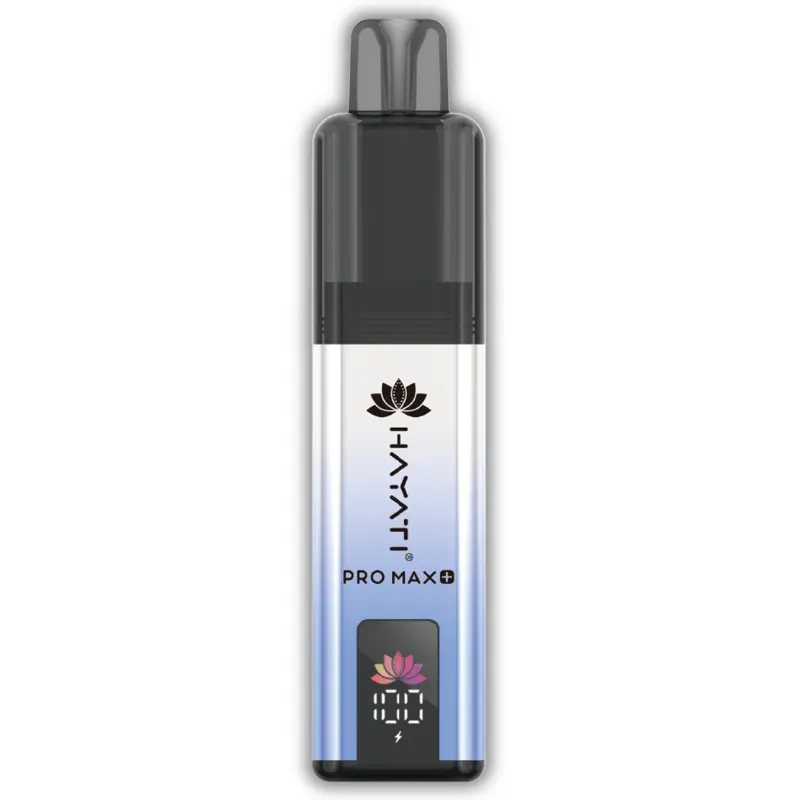
Hayati · Pro Max Plus
Blue Frozen Hayati Pro Max Plus 6000 Pod Kit
£7.99
✔ In stock — ready to ship
Genuine Hayati
Free over £20
Same-day dispatch
Secure checkout
Blue Frozen arrives here as the complete kit: a rechargeable Hayati Pro Max Plus body with an 850mAh cell, a prefilled pod system holding 12ml of liquid at 20mg nicotine salt, and a price of £7.99 for the pair. The liquid is a sweet blue confectionery fruit carrying a great deal of cold. Hayati put a laboratory figure of up to 6,000 puffs against the pod, which is a number produced by test apparatus running a fixed routine and not a forecast of your week.
That is the transaction. What follows is not, because the interesting question about this product is not what is in the box. Three listings in the whole Hayati range carry the word Frozen and all three are this one flavour, so anyone shopping the cold corner of the catalogue eventually arrives at Blue Frozen and wonders what the unusual word is buying them. The answer to that question has already been worked out in detail, on a different page, and it is no.
The Blue Frozen Hayati Pro Max Plus Pods listing counted every cooling word across all 492 Hayati products and established that Ice, Frozen and Cooler are not rungs on a ladder. Ice is the house default with 21 flavours behind it. Frozen names exactly one flavour, this one. Cooler names exactly one, Kiwi Cooler. The words never appear together on a single title, which is how alternatives behave rather than how measurements behave, and Hayati's own tagging files the Frozen bottle in the same group as the Ice products rather than above them. That work is done and this page will not redo it.
What that page deliberately did not do is describe the liquid. It said so, and it was right to leave it, because a naming argument and a flavour analysis are different pieces of work and cramming both into one listing serves neither. So the flavour is this page's job. Not adjectives stacked on adjectives, but the accord itself: what a blue raspberry profile is assembled from, which of its parts you taste and which you smell, what happens when a menthol rather than a bare coolant is dropped on top of it, the order the whole thing arrives in, and what a heavily sweetened confectionery liquid does to a coil that cannot be changed over the course of 12ml.
What is established, what is probable, and the reason for the distinction
Before any of the analysis, the evidence it rests on, sorted honestly. Two claims here are on the record and one is an inference that a worked counterexample says could be wrong.
On the record. Hayati's description for this kit says the base is sweet blue-toned fruit in the blueberry and blue raspberry mould, and that the chill is pronounced and a main feature rather than a finishing touch. It says there is enough fruit underneath to stop the result reading as plain menthol. That is unusually forthcoming for a cold listing. Plenty of iced products on the same shelf tell you a chill exists and nothing at all about its weight.
Probable, not established. That the coolant is specifically menthol. Fifteen listings out of 492 carry a structured profile field naming what is actually in the blend, and every one of the fifteen is a bottle in the nic salt line. The Blue Frozen bottle's field reads Blue Raspberry & Menthol. That is a stronger statement than any of the prose, because prose says a liquid is cold and a named ingredient says what is doing the cooling, and those are different pieces of information. Look at what the same field does elsewhere and the point sharpens: Red Apple Ice is recorded as Red Apple & Ice, Blackberry Ice as Blackberry & Ice. The field just repeats the title word. For Blue Frozen it names a substance instead.
Why it stays probable. That field belongs to a 10ml bottle at 10mg on an even base. This is a sealed 12ml pod at 20mg with a coil chosen by the manufacturer. The two share a flavour name and nothing else that Hayati publish, and this listing's own profile field is empty. The range supplies a worked counterexample to the assumption that a shared name means a shared recipe, and it is worth stating precisely because it is the strongest reason to hedge. Black Mamba's bottle records its profile as Mixed Berries & Cool Finish and its flavour text describes a cooling note that arrives late and sharpens the fruit. The Black Mamba Hayati Pro Max Plus 6000 Pod Kit and its bare pod sibling describe no cooling whatsoever. Same manufacturer, same flavour name, two formats, and one of them is cold while the other never mentions temperature. If that can happen to Black Mamba it can happen here.
So the menthol claim is carried forward as likely rather than settled, and the section on what menthol specifically does is written as a conditional. There is a test at the end of this page that settles it for your own pod in about four seconds, which is a better outcome than either asserting or ducking it.
Taking the blue raspberry accord apart
An accord is a flavourist's word for a set of materials combined so that the combination reads as one thing. Nobody tastes the parts separately in ordinary use, which is exactly the point of building one. But the parts do not behave identically once a liquid is heated, moved through a coil and breathed out, and on this particular product they come apart in a way that decides how the whole thing lands.
Why blue has no plant behind it, and what that does to the idea of a correct blue liquid, is worked out at length on the Blue Fusion pod listing, which treats the category as a convention whose only reference standard is other manufactured products. That argument is sound and it belongs there. What follows takes it as read and goes one level down, into the parts themselves.
Four components, and the channel each one uses
No manufacturer publishes an ingredient breakdown for a vape liquid and Hayati are no exception, so nothing below is a claim about a specific formulation. It is a description of how blue raspberry accords behave in the mouth, which is observable without knowing the recipe. Sorted by which sense actually receives them, there are four things going on.
The sweetener. Modern confectionery accords are not sweetened with sugar. They carry a high-intensity sweetener that delivers far more perceived sweetness per unit of mass, which matters here for a practical reason rather than a nutritional one: it is present in a small quantity and it does not evaporate. Sweetness is a taste, received on the tongue, and it requires the compound to be physically deposited there. It has a long tail, it builds across a session rather than resetting between draws, and at high loading it develops a faintly metallic back end that most people register as heaviness rather than as a flavour.
The acid edge. A blue accord almost always carries a small acid component, and on this one it is small. Acid is also a taste, also received on the tongue, and it brings a light trigeminal prickle with it at the sides. What acid does in a sweet liquid is provide contrast, which is why a blue with plenty of it reads sharper and shorter than a blue with little. The Blue Razz Fruit Twist Hayati Pro Max Plus 6000 Pod Kit listing sets out at length why sugar and acid move as two independent dials in this corner of the range, and that grid is the right way to place any blue. On this one, sugar is high and acid is low.
The ester top. This is the part everybody means when they say the liquid tastes of raspberry, and it is not a taste at all. Fruity esters are volatile aromatic compounds and they reach you through the nose, not the tongue, arriving up the back of the throat on the exhale. They are the brightest, most recognisable fragment of the accord and they are also the most fragile: they evaporate readily, they degrade with heat, and they are the first thing a tiring coil stops reproducing properly.
The perfumed fragment. There is a soft, faintly floral, slightly powdery element in a well-built blue accord that has no counterpart in red raspberry at all. It is what makes blue read as blue rather than as an ordinary raspberry sweet, and it is why the profile has always had something slightly unreal about it. Like the esters, it is aromatic, so it travels through the nose and it is subject to the same fragility.
The consequence of that split
Two of the four parts are tastes and two are smells. Put them in columns and the structure of this liquid becomes obvious in a way that no amount of tasting notes would make it.
| Component | Received by | Volatile | Weight in this blend |
| High-intensity sweetener | Tongue | No | High |
| Acid edge | Tongue, plus a light prickle | No | Low |
| Fruity ester top | Nose, on the exhale | Yes | Moderate |
| Perfumed blue fragment | Nose, on the exhale | Yes | Moderate |
| Cooling agent | Trigeminal nerve, plus the nose if it is menthol | Yes | High |
Everything that makes this liquid recognisably a blue raspberry rather than generic sweetness lives in the bottom two rows of the fruit, which is to say it lives in the aroma. The tongue only receives sweet and a trace of sour, and sweet and sour describe about two hundred products in this catalogue. Identity is carried entirely by the volatile half.
That is true of most fruit liquids to some degree. It is more true here than almost anywhere else in the range, because a real fruit brings texture cues, astringency, sometimes a bitter skin note, all of which are received on the tongue and all of which help a liquid stay identifiable even when the aroma is weak. Blue raspberry has none of those. Strip the aroma from a blackcurrant liquid and there is still tartness and a faint tannic dryness telling you what it was. Strip the aroma from a blue raspberry liquid and what remains is sweet, and only sweet.
Menthol is a coolant that also occupies the nose
Now put the cooling on top, and take seriously the difference between the two ways of doing it, because it is the whole argument of this page.
There are broadly two approaches available to anyone building a cold liquid. The first is a synthetic cooling agent, of which several are in common trade use. These work on the temperature receptors directly and produce a cold sensation with very little smell attached. They are efficient, they scale to high intensity without becoming unpleasant, and crucially they leave the aroma channel alone. The second is menthol, which is a natural product with a real smell, and it does both jobs at once: it triggers the same cold receptors and it is a strongly aromatic molecule in its own right.
Hayati name the second one on the bottle. If that carries across to this pod, and the evidence says it probably does, the implication is not just that the liquid is cold. It is that the cooling and the fruit are competing for the same channel.
What that predicts, part by part
Go back to the four components and apply the pressure where it actually falls.
The sweetener is untouched. Sweetness is a tongue event and menthol is an aroma and a nerve signal; they do not occupy the same receptors and neither can erase the other. What cold does do is temporarily suppress how sweet something registers while the cold is present, which is a real perceptual effect and not the same as removing the sugar. The sweetener is all still there, and it reappears the moment the chill fades.
The acid edge is largely untouched for the same reason, though on this liquid there is so little of it that the point is close to academic. A blue with a serious sour component, something like the direction Blue Razz Lemonade Hayati Pro Max Plus Pod Kit takes, would keep more of its character under the same cooling load, because acid survives where aroma does not.
The ester top is where the damage lands. Both the esters and the menthol reach you as volatiles up the back of the nose, and menthol is present in far greater quantity and is far more insistent. It does not chemically destroy the esters. It simply arrives in the same place at the same time and dominates the reading, in the way a loud instrument does not silence a quiet one but does make it very hard to follow the melody.
The perfumed fragment fares worst of all. It is the subtlest thing in the blend and the one with the least volume behind it, and it is the first casualty of anything aromatic being layered over the top. Which means the very component that distinguishes a blue raspberry from a red one is the component least likely to survive a heavy menthol.
The honest conclusion from that
A heavily mentholated blue raspberry is a sweet cold liquid with a fruit outline, and the outline is broader and less specific than the same accord would be uncooled. Hayati's own text says the fruit stays recognisable underneath, and on the evidence of how the accord is built that is a fair claim rather than a boast: the sweetness is pitched high precisely so that something survives. But recognisable is doing careful work in that sentence. You will know it is a sweet blue thing. You are less likely to be able to say which sweet blue thing, and anyone who has met several blues in the range will find this one harder to place blind than an uncooled equivalent.
Note the contrast with a cooled liquid whose fruit lives on the tongue rather than in the nose. A dark, tart, slightly astringent berry keeps its identity under cold because cold cannot reach the part that makes it identifiable. Blackcurrant Juice Hayati Pro Max Plus 6000 Pod Kit is an uncooled example of that sort of fruit, and imagining the same cooling load on it is a useful exercise: much less would be lost, because much less of it is aroma.
If the coolant here turns out to be a synthetic rather than menthol, most of this section relaxes. The cold would still suppress perceived sweetness, but the aroma channel would be clear and the esters would come through more distinctly. That is the practical difference between the two approaches and it is why the bottle naming menthol is worth as much attention as it gets here.
The order things arrive in, across one draw
Component analysis explains what is in the liquid. It does not explain why the experience unfolds the way it does, and the unfolding is where most of the disappointment and most of the pleasure in this product actually lives. The order is not arbitrary. It follows from the fact that the three channels involved are physically separate and deliver at different speeds.
Contact: sugar first, because sugar is already there
Taste requires physical deposition on the tongue, and vapour condenses on the tongue immediately. There is no lag at all. The first sensation of a draw on this liquid is sweetness, broad across the whole surface rather than concentrated anywhere, arriving inside the first fraction of a second. The small acid component lands with it and produces a faint tightening at the sides, more of a texture than a flavour.
What is notably absent at this stage is any fruit. People report tasting the fruit at the start of a draw and what they are actually experiencing is sweetness, plus an expectation supplied by the label. The aromatic half has not been delivered yet, because the mechanism that delivers it has not operated.
Through the pull: the cold builds rather than switching on
Cooling does not arrive as an event. The receptors involved are recruited progressively as more of the agent reaches them, so a short pull produces noticeably less cold than a long one, and the sensation is still climbing at the point most people stop drawing. On a heavily loaded liquid such as this, the cold is clearly present somewhere around a third of the way into an ordinary pull and it keeps intensifying to the end of it.
This is the single most useful mechanical fact on the page, because it means draw length is a genuine cooling control. A short, restrained pull on this pod is a substantially different product from a long one, and the difference is larger here than it would be on a lightly iced liquid where the cold reaches its ceiling early. Anyone who finds the chill excessive has a dial available before they consider anything else, and anyone who finds it underwhelming is probably not drawing for long enough.
The exhale: the aroma finally gets its turn, into an occupied room
Aromatic compounds reach the olfactory receptors from behind, carried on air passing from the mouth up through the back of the nose, and that mostly happens on the breath out. So the fruit, the entire identity of the accord, is a late arrival by physical necessity. It cannot be otherwise.
By the time it gets there the menthol is already established, having ridden the same path with far more mass behind it and having had the whole length of the draw to accumulate. The first part of the exhale is therefore cold with sweetness behind it and very little else. Then, somewhere in the second half of the breath, the fruit comes up: quieter than it would be in an uncooled liquid, broader in outline, unmistakably a sweet blue confectionery thing without being precisely locatable.
That sequence explains the most common complaint about liquids of this type and also the most common defence of them. The complaint is that you cannot taste the fruit, which is not quite right; you can, but only at the end, only faintly, and only if you are paying attention. The defence is that the fruit is definitely there, which is also true. Both parties are describing the same sequence and disagreeing about whether a late quiet arrival counts.
The tail
Cold outlasts everything. Fifteen to twenty seconds after the breath out there is still a chill across the palate and the roof of the mouth, and by then the sweetness has faded and the fruit has gone entirely. The last thing you are left with is temperature, which is what the name promised and which is the honest reason to buy this over an uncooled blue.
One consequence of the long tail is worth flagging for anyone who vapes in short bursts. Draws taken less than half a minute apart stack, because the previous chill has not cleared, and the cumulative effect after five or six is considerably colder than any individual draw. Spread the same number of draws over an hour and the pod reads as moderate. This is not the liquid changing.
What it is not
- Not a mint liquid. If the menthol claim holds there is a minty aromatic character in here, but it sits on a sweet fruit base and there is no herbal leaf, no spearmint roundness and no peppermint bite. Double Menthol is the listing on this shelf for anyone who wants the cold with no fruit in the way.
- Not a blueberry liquid. Blue raspberry and blueberry share a colour word and nothing else. Blueberry Raspberry Hayati Pro Max Plus Pod Kit is where an actual berry character leads.
- Not sour. The acid is a trace and it is there for contrast, not for effect. Nothing in this pod will make the sides of your tongue contract.
- Not subtle, and not trying to be. High sweetener, high coolant, moderate aroma. It is built for volume rather than for detail, which is a coherent decision rather than a compromise.
- Not a lightly iced fruit. Hayati say so directly and the naming supports it. Anyone who wanted a chill sitting behind a fruit should look at the Ice listings instead, where the arrangement is the other way round.
- Not complicated. Two ideas, executed hard. Whatever else is arguable about it, nobody could call the construction cluttered.
What 12ml of sweetened cold liquid does to a coil that cannot be changed
This is the part of the analysis with the most practical money in it, and it starts with an observation that sounds backwards until you follow it through.
Cold suppresses perceived sweetness. That is settled perceptual science and it is why a chilled soft drink tastes less sugary than the same drink at room temperature. A formulator building a cold liquid therefore has a problem: whatever sweetener level produces the right balance in an uncooled version will read as under-sweetened once the coolant goes in. The fix is to add more. Which means a heavily cooled confectionery liquid almost certainly carries a higher sweetener load than an uncooled version of the same accord, not despite the cold but because of it.
Sweetener does not evaporate. It is deposited on the coil, it caramelises there under heat, it darkens, and it forms a layer that progressively insulates the wick from the metal and muffles everything passing through. This is ordinary and every sweet liquid does it. The point specific to this product is that a Frozen blue is very likely doing it faster than the uncooled blues sitting next to it on the shelf, and it is doing it to a coil that is sealed into the pod and cannot be replaced.
Twelve millilitres is a long run for one coil
The distinguishing feature of this format is volume. Twelve millilitres is six times what a conventional small refillable pod holds, and on a refillable you would have changed the coil at least once and probably twice across that much liquid. Here you cannot. The coil you start with is the coil you finish with, and the whole arc of its decline happens inside a single purchase.
That reframes what coil ageing means on this product. It is not a maintenance event that you respond to. It is the shape of the product's life, and knowing the shape lets you plan around it instead of being annoyed by it.
The order things are lost in
Go back to the component table, because it predicts the sequence exactly. A coil gunking up loses volatile aromatics before it loses anything else, because aromatics are the most heat-sensitive part of the mix and they are the part the fouled surface interferes with most.
So the perfumed blue fragment goes first, and it goes early enough that most people never notice it leaving, because it was the quietest thing in the blend to begin with. The ester top goes next, which is the loss you do notice: the pod stops reading as blue raspberry and starts reading as unspecified sweet. The acid edge holds longer, though there was not much of it. The sweetener holds longest of all, because it is not aromatic and a dull coil still deposits it on your tongue. And the coolant holds nearly as long, because a cold receptor does not need aromatic fidelity to fire.
The result is that this pod does not fade evenly. It becomes lopsided. Late in its life it delivers cold and sweetness at close to full strength with the fruit hollowed out from underneath, which is a specific and slightly unpleasant combination and is not at all the same as a pod simply going quiet. If you have had a cold pod that felt fine but somehow unsatisfying towards the end without being able to say why, this is the mechanism.
What to do about it, given that you cannot change the coil
Three things, none of which involve maintenance.
Judge the flavour in the first couple of days and write the verdict down in your head then. The pod's best account of itself is early and your opinion of the flavour should be formed while the aromatic half is intact. Deciding on day nine whether to reorder Blue Frozen means deciding on the basis of a degraded sample.
Expect the lopsided ending and do not read it as a fault. A pod that has gone cold-and-sweet is behaving exactly as the chemistry says it should. There is no rescue available in a sealed format and nothing you did caused it.
Moderate the chaining, which helps more here than on a lighter liquid. Rapid consecutive draws leave the wick insufficiently rewetted, run the coil hotter and accelerate the caramelising. On a liquid this sweet that is the difference between the fruit lasting most of the pod and the fruit lasting half of it.
Who this suits, and who should leave it
It suits somebody whose primary axis is temperature and whose secondary axis is sweetness, who wants the cold to be the thing they remember and is content for the fruit to be a broad sweet shape supporting it. It suits anyone already running heavy cold liquids, for whom this will read as squarely in range rather than extreme. And it suits a rotation as the loud member, because it is legible when you are not concentrating.
It is the wrong purchase for anyone who buys fruit liquids for detail and layering, because the construction here actively sacrifices detail. It is wrong for anyone who wants cooling as a finishing accent, which Hayati themselves say in as many words. It is wrong if sweetness is the thing you are trying to keep down, since the coolant hides it in the moment and not over an evening. And it is wrong as the only pod you own, for reasons the comparison section covers.
The kit, kept short
The Pro Max Plus hardware is documented across this site at length and none of it changes for a blue liquid, so this is three paragraphs rather than ten.
The box contains a rechargeable Pro Max Plus device with an 850mAh cell and a prefilled pod system holding 12ml at 20mg. Nothing else in the specification is published, so nothing else is stated here: no coil resistance, no airflow figures, no charging detail. Where a page tells you one of those about this device, treat it as somebody's inference rather than as a fact. Hayati sell several pod formats that look broadly similar, so match the range name printed on your device to the range name in this title before ordering a replacement.
The one specification that genuinely matters for this particular liquid is the nicotine, and not for the usual reason. Twenty milligrams per millilitre is the maximum permitted for sale in the United Kingdom, so every standard pod on the Hayati Pro Max Plus Prefilled Pod Kit shelf carries the same figure and it is not a choice you are making. What is worth knowing is that heavy cooling and a high salt strength interact on the inhale. Cold raises the apparent firmness of a draw at the back of the throat, so this pod will feel more assertive than a warm fruit pod carrying exactly the same nicotine. Nothing about the nicotine has changed; the cold has changed how it reads. There is also a listing sold by strength rather than by flavour, Hayati Pro Max Plus 6000 Prefilled Pod Kit 10mg, for anyone whose priority is the lower figure rather than the flavour name.
When the pod and device reach the end of their life they are electronics with a coil and a residue of liquid inside, so they belong at an electrical take-back point or a local recycling facility rather than in a household bin. Keep the kit somewhere children and pets cannot reach it.
Specifications
Everything Hayati publish against this listing, with the flavour rows first because they are the only rows that distinguish it from anything else.
| Flavour name | Blue Frozen |
| Profile as recorded by Hayati | Not filled in for this listing |
| Cooling word used | Frozen, one of three listings in the range carrying it |
| Cooling dose | Not published, here or anywhere in the range |
| Liquid in the pod | 12ml, prefilled and sealed at the factory |
| Nicotine | 20mg/ml, salt form |
| Cell | 850mAh, rechargeable |
| Manufacturer puff rating | Up to 6,000, a laboratory estimate |
| In the box | Device and prefilled pod system |
| Price | £7.99 |
| Brand | Hayati |
Here is the uncomfortable thing about that table. Eighty-eight kits sit on this shelf and every row below the flavour name is identical across all of them. The volume, the strength, the cell, the puff figure, the contents and the price do not vary at all. Which means the specification is not a way of choosing between products on this shelf; it is a description of the platform, and the entire buying decision rests on one row.
Two of the eleven rows are worth a note beyond that. The profile row is blank in Hayati's own data for this listing and populated for the bottle of the same flavour, which is the whole reason the menthol question earlier had to be marked probable instead of settled. And the cooling dose row is empty because no manufacturer in this trade publishes one. There is no percentage, no index, no scale. The absence of that single number is why the naming vocabulary carries so much weight with buyers, and it is why it matters that the vocabulary turns out not to be carrying any information.
Fifteen of the 88 kits on the shelf put a cooling word in the title: eleven say Ice, one says Cooler, one says Menthol, one says Mint, and this one says Frozen. Read those fifteen flavour paragraphs rather than sorting by the noun, which is the practical form of the finding the pod page established.
How it compares, and who would prefer which
Nineteen of the 88 kits on this shelf are built on blue fruit, and exactly one of the nineteen carries a cooling word in its name. That makes the choice inside the blue family unusually clean, because the axis is not which blue but whether you want the blue cold.
The blues, sorted by what corrects the sugar
Every blue listing has the same problem to solve, which is that a confectionery accord pitched this sweet becomes tiring over a long session unless something is set against it. There are four solutions in use on this shelf and they are the cleanest way to choose.
Blue Frozen answers with cold, which is the bluntest of the four and the only one that also costs you aroma. Blue Razz Mojito Hayati Pro Max Plus 6000 Pod Kit answers with a herbal thread and a citrus line, so the sweetness is corrected rather than overwhelmed and the cooling stays mild; it is the other cooled blue on the shelf and the two are not close to each other. Blue Razz Blackcurrant Hayati Pro Max Plus Pod Kit answers with dark fruit tartness, which does the same job as cold by a different route and leaves your palate readable afterwards. And Blue Razz Cherry Hayati Pro Max Plus Pod Kit answers with a slightly tart stone fruit at the finish, the gentlest of the four corrections.
Against the uncorrected blues, the difference is simply the presence of the chill. Blue Razz GB Hayati Pro Max Plus Pod Kit is the most confectionery of the group and makes no attempt to cut its own sweetness, and Blue Fusion Hayati Pro Max Plus 6000 Pod Kit layers a second blue reading over the first for a jammier result. Either is the kit to take if what you liked about this one was the fruit and what you disliked was the temperature. Galaxy Aura Hayati Pro Max Plus 6000 Pod Kit sits in the same family but declines to name its fruit at all, which is a different kind of purchase.
If you want an actual berry rather than a convention
The blue accord has no plant behind it, and for some people that is the whole objection. Three kits on this shelf put recognisable fruit in front instead. Blackberry Raspberry Hayati Pro Max Plus Pod Kit is a dark jammy pair with the seedy, faintly tannic character that blue raspberry deliberately omits. Blueberry Cherry Cranberry Hayati Pro Max Plus Pod Kit uses cranberry astringency as its brake, so it finishes dry rather than cold, which is the closest thing on the shelf to an alternative structural solution. Cherry Berry Hayati Pro Max Plus Pod Kit brings a kernel note that nothing in the blue family has an equivalent for.
The other cold kits, and how they differ in arrangement
Cooling on this shelf comes in two arrangements and the difference matters more than the dose. On an Ice listing the fruit is the subject and the chill is applied to it. On this one the arrangement is inverted.
Blackberry Ice Hayati Pro Max Plus 6000 Pod Kit is the useful comparison because its fruit has tannic dryness on the tongue, so the cold has something non-aromatic to sit against and the berry survives the treatment better than a blue does. Banana Ice Hayati Pro Max Plus Pod Kit sits at the other end, with its own listing describing the chill as a light breeze whose job is to stop a soft fruit turning cloying. And Ice Pop Hayati Pro Max Plus Pod Kit is the nearest thing to a sibling in intent rather than in flavour: another confectionery profile with no real-world original, built cold on purpose. If the logic of Blue Frozen appeals but the blue accord does not, that is the kit to look at next.
The rotation problem, which is real on this one
A heavily cooled pod is a difficult neighbour. It raises the threshold at which anything else registers, so a delicate liquid vaped in the half hour after it will read as muted and you will blame the wrong product. Peach Green Tea Hayati Pro Max Plus 6000 Pod Kit is precisely the kind of quiet, aromatic kit that is wasted in that slot, and Mango Banana Hayati Pro Max Plus 6000 Pod Kit is soft enough to suffer the same fate.
What survives the treatment is loudness. Blackcurrant Mango Hayati Pro Max Plus 6000 Pod Kit has two fruits trading places and enough tartness to cut through a lingering chill. Cherry Peach Lemon Hayati Pro Max Plus 6000 Pod Kit has three distinct arrivals in a single draw and a citrus line at the end. Either makes a sensible second device rather than a replacement.
Refreshment without cold, which is a real category
Plenty of people reaching for a frozen liquid actually want something that does not feel heavy, and cold is only one way to achieve that. Carbonation cues and citrus structure do it differently. Berry Lemonade Hayati Pro Max Plus 6000 Pod Kit and Blackcurrant Lemonade Hayati Pro Max Plus 6000 Pod Kit both give you a light, sharp finish with no coolant involved, which leaves the aroma channel completely clear and the fruit correspondingly more legible. If your real complaint about sweet liquids is weight rather than temperature, one of those solves it without the trade-off this page has spent two thousand words describing.
The same flavour without the device
If you already own a Pro Max Plus body, the bare pod at £5.49 is the same 12ml of the same liquid with nothing else in the pack, and the kit costs £2.50 more because there is a device in the box. That listing also carries the full cooling-vocabulary count if you want the naming evidence rather than the flavour analysis. The rest of the range is on the Hayati Pod Kits shelf and its prefilled subset, and the complete Hayati range is there for browsing at leisure.
Getting the best out of a pod built this way
Six practical points, each of which follows from something specific about this liquid rather than from general pod advice.
Settle the menthol question in four seconds. Take one draw normally and one with your nose pinched shut. A synthetic coolant produces almost identical results both ways, because it is a nerve signal and not a smell. Menthol produces a marked difference, because the minty aromatic half disappears when the nasal path is blocked. The size of that gap tells you whether the bottle's profile field carried across to your pod, which is the one open question on this page and the only one you can personally close.
Use draw length as the cooling dial. Cold receptors recruit progressively through a pull, so a shorter draw genuinely delivers less chill rather than the same chill in less vapour. This is the primary adjustment available on a device with no published airflow control, and on a liquid this heavily cooled the range between a short pull and a long one is wide enough to matter.
Form your view of the flavour early. The aromatic half of the accord is the part that degrades, and it degrades on a schedule that starts as soon as the coil begins accumulating sweetener. Whatever you think of Blue Frozen on day two is the fair assessment. Whatever you think on day ten is an assessment of an ageing coil, and reordering decisions made then are made on bad information.
Leave gaps between draws. A wick that has not fully rewetted runs hot, and a hot coil on a liquid carrying this much sweetener caramelises faster. Ten seconds is usually plenty early in the pod's life and it is not plenty late in it, when the wicking channel has already been slowed by residue. Adjust upwards as the pod ages rather than pulling harder.
Do not judge the next pod immediately after this one. Your own sensitivity to cold shifts with exposure, and after a session on this liquid a moderately iced pod reads as barely cooled and an uncooled one reads as flat. Give it a few hours before forming an opinion on anything else, particularly if you are deciding whether a different flavour was worth the money.
Storage matters in a specific direction here. The cooling agent is stable and will still be doing its job in three months. The ester top and the perfumed fragment are the volatile, fragile parts, and warmth accelerates their loss. So a spare kit stored badly does not go less cold, it goes less fruity, which is the wrong half to lose on a liquid whose fruit is already under pressure. Somewhere dark, indoors and at room temperature is all it needs, well away from where children and pets get to.
Questions buyers actually ask about this one
Is Frozen colder than the kits labelled Ice?
There is no published evidence that it is. Frozen appears on three listings in the whole range and all three are this flavour, so there is no second Frozen product to establish a convention with, and Hayati's own tagging files the Blue Frozen bottle alongside the Ice products rather than above them. What tells you this kit is heavily cooled is Hayati's flavour text, which says so directly. The word in the title is not doing that work.
Is the coolant actually menthol?
Probably, and the evidence is one step removed. The nic salt bottle of this flavour records its profile as Blue Raspberry and Menthol in a structured field, which is the only place in 492 listings where a cooling word gets decoded into a named substance. This kit's profile field is blank, and Hayati nowhere state that the pod and bottle recipes match. Pinch your nose on one draw and the answer will be obvious.
Why does it matter whether it is menthol or a synthetic coolant?
Because menthol is aromatic and most synthetic coolants are not. A synthetic agent produces cold without occupying the nose, leaving the fruit's aroma clear. Menthol produces cold and a strong minty smell in the same molecule, so it competes directly with the part of the blue accord that carries its identity. Same temperature, different amount of fruit surviving.
Can I taste the fruit through it?
Yes, but late and broadly. The identity of a blue raspberry accord lives almost entirely in its aroma, which reaches you on the exhale, by which point the cooling has had the whole draw to establish itself. Expect to recognise it as a sweet blue confectionery thing rather than to pick out individual layers, and expect that to be more true at the end of the pod than at the start.
How sweet is it, honestly?
Well above the middle of this shelf. A cold liquid has to be sweetened harder than an uncooled one to land in the same place, because cold suppresses perceived sweetness while it is present, so the sweetener load here is likely higher than on the uncooled blues rather than lower. The chill disguises a good deal of it in the moment. It shows up across a long session as a coating, and on the coil as residue.
Why has the flavour gone dull while the cold is still strong?
That is the expected ageing pattern rather than a fault. Sweetener bakes onto the coil and the volatile aromatics are the first casualties of a fouled surface, while cooling and sweetness both survive a tired coil comfortably. So the pod does not fade evenly; it becomes cold and sweet with the fruit hollowed out. In a sealed pod there is no remedy, which is why forming your opinion early is worth doing.
Should I buy this kit or just the pod?
The kit at £7.99 if you do not already own a Pro Max Plus body, the pod at £5.49 if you do. The liquid is identical between them and the £2.50 difference is the device. Nothing about the flavour analysis on this page changes depending on which listing you buy.
Is this a blueberry flavour?
Not really. Hayati's description names the blueberry and blue raspberry mould together, but blue raspberry is a manufactured confectionery profile with no plant behind it and it dominates any blend it appears in. If a recognisable berry is what you want, a listing that leads with blueberry or blackberry will give you a fruit you can place.
Will the heavy cooling make the pod run out faster?
Nothing published suggests so. The pod holds 12ml at 20mg with a laboratory rating of up to 6,000 puffs, the same as every other kit on this shelf. What heavy cooling changes is the character of the decline rather than its speed, since the chill is among the last things a tiring coil stops delivering.
How does it sit against Double Menthol?
Double Menthol is cold with no fruit in the way and its own listing uses stronger language than this one does, so it is the reference point at the top of the shelf. This kit is a sweet fruit carrying a heavy chill, which is a different proposition even if the temperature turns out to be comparable. No dose is published for either, so nobody can rank them numerically.
Is there anything in the specification unique to this listing?
One row, the flavour name. All 88 kits on this shelf share the same volume, strength, cell, puff rating, contents and price, so the specification describes the platform rather than the product. That is why this page spends its length on the liquid.
What should I keep alongside it?
Something loud and preferably tart, because a heavily cooled pod raises the threshold at which anything subtle registers for a while afterwards. A two-fruit or three-fruit listing with some acid in it will still read properly; a delicate single fruit will be wasted. Running two cold pods in rotation is the arrangement that works least well, since the second one will always seem weaker than it is.
The short version
Blue Frozen as a kit is £7.99 for an 850mAh Pro Max Plus device and a prefilled pod holding 12ml at 20mg, rated by Hayati in laboratory conditions at up to 6,000 puffs. The liquid is a sweet blue confectionery accord under a heavy cooling load, and Hayati describe the chill as a main feature rather than a finish, which is more candid than most cold listings manage.
The naming question was settled elsewhere and the answer was that Frozen is a name rather than a tier. What this page adds is the liquid. A blue raspberry accord keeps its sweetness and its trace of acid on the tongue and carries its entire identity in the aromatic half, which reaches you only on the exhale. Drop a menthol on top of that, as the bottle's profile field indicates and this listing's blank field cannot confirm, and the cooling competes with the fruit in the same channel rather than alongside it. The sweetness survives intact, the acid survives, and the fruit arrives late and broad. Across 12ml on a coil that cannot be changed, the aromatics go first and the cold and the sugar go last, so the pod ends lopsided rather than merely quiet.
Buy it if temperature is the axis you shop on and you want a sweet base underneath rather than bare menthol. Leave it if you buy fruit liquids for detail, if you want cooling as an accent, or if you were hoping the sweetness would be modest. And settle the menthol question yourself on the first day with one pinched-nose draw, because that is one fact about this pod that no catalogue field can give you and you can establish in four seconds.
Strictly for adults aged 18 and over. Nicotine is an addictive substance.
You might also like


