
Home / Hayati Pro Ultra Plus Pods / Fresh Mint / Blue Razz Mint Hayati Pro Ultra Plus 25K Pods
Hayati · Pro Ultra Plus
Fresh Mint / Blue Razz Mint Hayati Pro Ultra Plus 25K Pods
£7.99
✔ In stock — ready to ship
Genuine Hayati
Free over £20
Same-day dispatch
Secure checkout
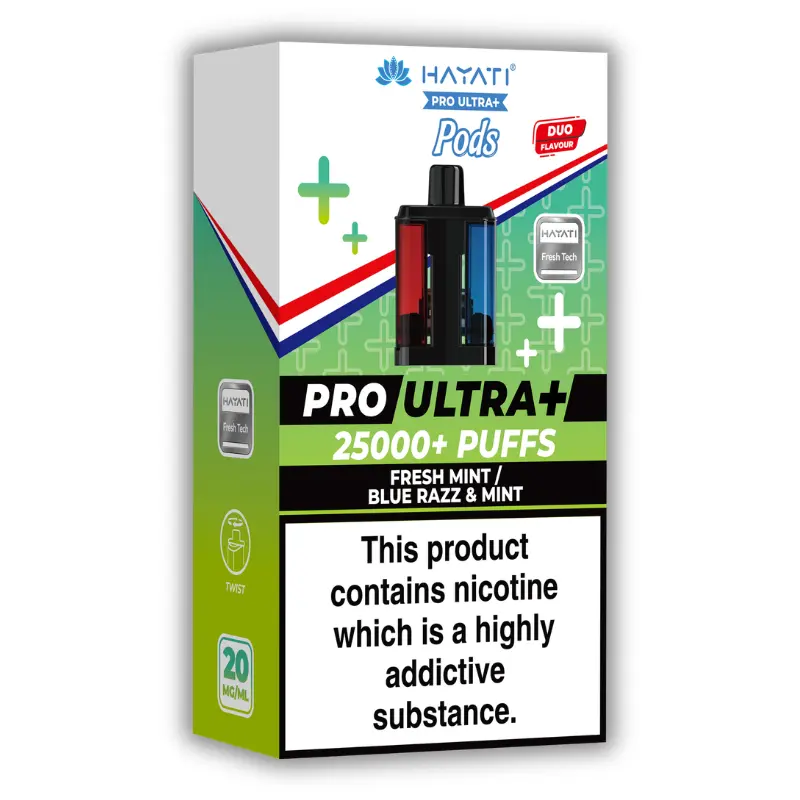
This is the refill on its own. One Fresh Mint / Blue Razz Mint pod for the Hayati Pro Ultra Plus, £7.99, no device in the box. Twenty-two millilitres of 20mg nicotine liquid sit inside it, divided between two flavours that are kept apart, and the mouthpiece section rotates to select which one feeds the coil. Hayati publish a figure of 25,000 puffs for the pod, produced on test equipment repeating an identical draw at a fixed interval, so read it as a bench measurement rather than a quantity of vaping you have bought. If there is no Pro Ultra Plus already in the house, this listing does nothing on its own, and the complete Fresh Mint / Blue Razz Mint kit at £11.99 is the order to place instead.
The flavour analysis is not here. It is on that kit page, along with the finding most buyers never work out for themselves: only one of the two halves carries sweetener, both halves are served by a single sealed coil, and that imbalance settles which side you ought to work down first. It is argued through properly over there and there is nothing to gain from saying it again.
What this page is for is a question the kit page has no reason to raise. A kit buyer is beginning with a flavour. A refill buyer already knows how the first pod went, and in the specific case of mint, a striking number of those buyers are not restocking their main vape at all. Mint is the profile people keep on hand to interrupt something else. It is what you go to when a sweet fruit has stopped registering, and it gets used in short bursts rather than across a day. That makes this one of the few refills in the Hayati catalogue more often bought as the second pod in a rotation than as the first.
A second pod is a different purchase from a first in nearly every respect that matters. It empties at a completely different rate, it is judged by what it does to another flavour rather than on its own merits, and it raises a question nobody asks about a primary pod: whether 22ml was ever a sensible amount to sell it in. The honest answer is probably not, and the rest of this page works out what that costs.
The second pod in a rotation is a different purchase
Most refill listings are bought by somebody replacing what they vape all day. They finished one, they got on with it, they are ordering the same again, and the only live question is whether to keep buying it or move sideways. That is the ordinary repeat purchase, and the Hayati prefilled pods and refills shelf is arranged around it.
A rotation partner gets bought for the opposite reason. You choose it precisely because you do not intend to vape it for long. Its function is to break something up.
What a rotation partner is actually for
Flavour perception fades with exposure. Stay on one sweet fruit long enough and your reading of it goes quiet: notes that were separate and legible on Monday have collapsed into a single generalised sweetness by Thursday, and the liquid has not altered by a molecule. This is a property of tasting, not of hardware. Nothing has failed. You have stopped noticing.
Three things can be done about it. Push on and accept a flavour you are no longer really tasting, which is the cheapest option and the least satisfying. Abandon the pod part-used and open a fresh one, which at £7.99 a time adds up quickly. Or keep a second, structurally unlike pod within arm's reach, spend ten or fifteen draws on it, and return to the first with your reading of it restored.
Look at what that does to the second pod's job description. Its success is measured on the draw after you put it down rather than on any draw you take from it, which inverts the usual criteria. A rotation pod can be dull, can lack development, can have nothing interesting happening in the middle of the draw, and still be doing its work perfectly. Those are ordinarily faults. Here they are close to specifications.
Why mint keeps ending up in the role
Any flavour far enough from your main one can serve as a break, but mint holds the position more reliably than the alternatives, and the reason has to do with what it leaves on the palate rather than what it puts there.
A contrasting fruit is the obvious candidate and it disappoints in practice. Swap a berry for a citrus and the citrus is still sugared, still fruit-shaped, still competing for the same ground, and it leaves a residue of its own. Come back to the berry and you are now reading it through a lemon. The interruption worked, but it installed a replacement instead of clearing space.
Mint behaves differently on two counts. The cooling is a physical sensation rather than a flavour, so it does not occupy the territory the fruit was standing on. And the mint aroma itself is volatile and short, with little body to it and almost no sugar riding underneath, so it comes off the tongue fast instead of settling in. Fifteen draws of mint, then a pause, and there is genuinely very little left of it. Strong while it happens and gone almost immediately afterwards is exactly what the job needs, and it is rarer than it sounds. The narrow fresh mint vapes shelf exists partly because of this pattern of use: eleven products, most of them bought by people who already have a main flavour sorted.
The complication nobody mentions: half of this pod is fruit
Here is where the neat story runs into this particular listing. A rotation buyer wants a mint pod. This is not a mint pod. It is a dual pod, one half of which is Fresh Mint and the other half of which is Blue Razz Mint, a tangy confectionery blue raspberry sitting over the same cooling.
For a primary buyer that is the whole appeal, and the kit page makes the case for it well. For a rotation buyer it creates an awkward arithmetic. If you bought this to interrupt a sweet berry pod, the Blue Razz Mint side is a sweet berry. It is not going to interrupt anything. You already have one of those, which is the reason you are on this page.
Hayati do not publish how the 22ml divides between the two reserves. Two flavours in one pod points to roughly eleven millilitres a side and that is the sensible working figure, but it is an inference and worth labelling as one. Take it at face value and a rotation buyer with a berry main pod is paying £7.99 for eleven millilitres of usable liquid plus eleven millilitres of something they have no slot for.
That is not an argument against buying it. No mint-only pod exists in this format, so the fruited half is not an alternative you are turning down, it is along for the ride. It does mean the pod suits some rotations far better than others, which is what the comparison section below is organised around, and it makes one thing nearly certain before you open the packet: you are going to bin this pod with liquid in it.
Judging a flavour by what it leaves behind
Ordinary flavour writing describes the draw. For a pod bought to do this job the draw is only half the story, because the useful part happens after you stop. What follows measures both halves on that second criterion.
The five properties that decide whether a flavour can do the job
Finish length is the first. How long after the exhale can you still taste it? A long, pleasant, lingering finish is a virtue on a primary pod and a defect on a rotation one, because the lingering is precisely what you were trying to be rid of.
Residue is second and it is not the same thing. A flavour can fade quickly and still leave a physical film, most often from sweetener, which coats the tongue and dulls whatever comes next. You stop tasting the raspberry within seconds and the sweetness stays for minutes.
Aroma persistence is third, and it is the one people forget. A great deal of flavour is retronasal, so a profile that parks itself in the nasal cavity keeps colouring the next thing you draw on even when the tongue is clear. Heavy vanillas and dense berry compounds are the worst offenders.
The sweetness floor is fourth. Not how sweet a flavour is at its peak, but how much sugar is present at its quietest. A liquid with a high floor never lets your reading of sweetness recalibrate. Temperature is fifth, and it is the one mint brings that nothing else does: a cooling agent overwrites whatever was happening on the tongue for as long as it lasts, then stops. It does not blend with the previous flavour. It changes the subject.
The Fresh Mint side scored against those five
Finish length is short, and notably so. The cold outlasts the mint aroma by a second or two, and then there is nothing at all. Twenty seconds after the last draw the palate is close to neutral, which is the strongest single argument for this pod in the role.
Residue is minimal, because there is very little sugar in the plain side to leave any. It reads as a dry finish rather than a sticky one, and that dryness is less an absence of flavour than an absence of anything clinging on. Aroma persistence is low too, lower than most mint products, because this comes across as a rounded confectionery mint rather than an oily peppermint. Peppermint oils tend to sit in the nose long after the taste has gone. This one does not.
The sweetness floor is low. Hayati describe the pod's sweetness as medium, fair averaged across both sides, and taken alone the plain half sits well under it. Temperature is present and moderate: enough to register as a defined cold current through the throat, not enough to be numbing. That moderation is the right setting, because an extremely cold liquid takes so long to wear off that you spend the return waiting for it to release, which is an interruption to the interruption.
On all five counts this half does the job well. It is not an interesting flavour to sit with for a week, and the kit page is candid about that narrowness. Narrowness is the whole point.
What comes back first, and in what order
Switch back to a sweet fruit after a mint break and the return is not instant, which surprises people the first time. There is a sequence to it, and knowing the sequence stops you misreading the result.
The first draw back is mostly texture and sweetness with the fruit indistinct behind it, because the cooling has not fully released the surface of the tongue. The second and third draws are where the fruit reassembles, and this is the pay-off: notes you had stopped separating come apart again, and a berry that had flattened into general sugar on Thursday is legibly a berry once more. By the fifth or sixth draw you are reading the flavour at something close to the way it read when the pod was new.
Then it decays again, and faster than it did the first time. This is worth being straight about. A reset does not restore your palate to its day-one condition and hold it there. It buys a window, and the window narrows the more often you use it in a single day. Three breaks in a day each work slightly less well than the one before. The pattern that actually holds up is one deliberate break, properly long, rather than constant flicking between two pods.
Where a mint break works against you
Two situations where the reset is pointless or unhelpful, neither of them obvious in advance.
The first is a main pod that is already iced. If your daily flavour is something like Strawberry Ice / Strawberry Raspberry Ice, the cooling is not a change of subject because you are already cooled. What you get is a shift in fruit content at the same temperature, which does far less to your reading than the same break does for somebody on a warm, uncooled berry. The reset still functions to a degree, but you are paying £7.99 for a weaker version of it.
The second is a main pod built on cream, custard or candyfloss. Cooling sits badly over a dairy or spun-sugar profile, and the mint trace that survives into your first couple of draws back reads as a fault rather than as freshness. Anyone rotating out of Blueberry Cotton K / Raspberry Cotton K should expect a slightly odd two or three draws on the way back in. Leaving a longer gap fixes it. Rushing the return does not.
The Blue Razz Mint half, scored the same way
For the rotation buyer wondering what the other eleven millilitres are good for, run the fruited side through the same five tests and it fails three of them. Finish length is longer, because the raspberry tang takes a moment to let go. Residue is higher, because this is the sweetened half. The sweetness floor is much higher, sitting at or a shade above the medium Hayati quote for the pod overall. It passes on aroma persistence, which is low, and on temperature, which matches the plain side.
Which is to say it is a decent fruit pod and a poor reset. That is not a criticism of the liquid, which was never designed for this and comes out considerably better on the kit page, where it is assessed as a flavour in its own right. As a spare fruit option for an evening when you want something other than your usual, it is perfectly serviceable.
Twenty-two millilitres for a flavour used in bursts
Now the uncomfortable part, and the reason this page exists in the form it does. The pod is the wrong size for the way a rotation buyer uses it, by a large margin, and no amount of good handling closes the gap.
Do the division and the number stops meaning anything
Take Hayati's laboratory figure at face value for a moment, purely as a workload statement: one sealed coil, 22ml, 25,000 machine draws before the liquid is gone. Now apply a rotation pattern. Three breaks a day at ten to twelve draws each is a heavy rotation habit by most standards, and it comes to around 35 draws a day. Even ignoring every reason a real draw differs from a machine draw, the division lands near two years.
Two years is not a forecast. It is a signal that the calculation has broken. No sealed pod is going to be in service that long, and the arithmetic is useful only for what it proves: liquid volume has stopped being the binding constraint. You will not run this pod out. Something else ends it first.
What actually ends a pod used this way
Elapsed time is the most likely candidate. A pod opened and used intermittently for months is not the pod that arrived: the liquid has been in contact with air at the mouthpiece, has warmed and cooled repeatedly, and the mint top notes are the volatile part of the profile, so they are the part that quietly thins. Because the drift is slow you tend not to catch it. The pod you are using in month five is a duller version of the one you were using in month one, and you probably adjusted to it without noticing.
Coil condition is second. The kit page covers in detail how the sweetened half loads the shared mesh and why that decides the run order, and that argument holds here exactly as written. What differs is the wear pattern. A primary pod's coil does a lot of work over a short life; this one does very little work over a very long one, and a coil that spends most of its existence standing idle with liquid against it ages by a different route.
Physical mishap is third and it is not a trivial category here. A pod that lives in a bag, gets swapped in and out of a device and travels in a coat pocket is handled far more per millilitre consumed than one that stays in the device until it is finished. Over six or nine months, the chance of a knock ending it before the liquid does is not small.
Pence per millilitre is the wrong unit
Divide £7.99 by 22ml and you get a shade over 36p. That figure is on a hundred comparison tables and for a primary pod it is a reasonable way to shop. Here it is close to meaningless, because you are not going to consume 22ml and the denominator is fiction.
Try the honest version. Suppose you get through six millilitres before the pod is done, which is a realistic outcome for a rotation partner retired at eight or nine months. The liquid you actually drew on cost about £1.33 per millilitre, roughly four times the shelf rate, and if you are the kind of buyer who compares pods on cost per millilitre then that is a genuinely bad number.
It is bad because the unit is wrong. What you bought is not liquid. It is the standing availability of a reset, in your pocket, for as long as the pod survives. Price that instead: £7.99 over six months of ownership is about four and a half pence a day, which at three breaks a day is under a penny and a half each time, and a pod stretched to a year halves it again. Both figures are true at once, expensive liquid and cheap function, and the trouble is that rotation buyers keep evaluating the purchase with the primary buyer's calculator.
So is 22ml wrong for this? Yes
Say it plainly rather than dressing it up. A pod used for ten or fifteen draws at a time should be sold in a fraction of this volume. The right product for the job would be four or five millilitres of plain mint at two or three pounds, replaced every couple of months while it still tastes like itself. Nobody sells that, and Hayati in particular do not.
The closest thing in the catalogue is the Mini Ultra format, where Blueberry Raspberry Hayati Mini Ultra Pods sit at £3.49, which is the right kind of commitment at the right kind of price. The format is not offered in this flavour, so it answers the size question for a fruit you do not need and not for the mint you do. That is a dead end rather than a recommendation.
The practical conclusion is not to avoid the pod but to stop expecting the volume to be consumed. Two things follow. Do not buy a spare, because a spare for a pod that will last most of a year is money parked for no reason, and the liquid in it ages on the shelf as surely as the liquid in the one you are using. And consider promoting it occasionally: a week as your main vape every couple of months, on the fruited side, converts some of that stranded liquid into something you actually tasted, and gives you a read on the coil that intermittent use otherwise hides.
Living with a pod you keep taking out and putting back
The mechanics of a rotation differ from the mechanics of a single pod run to the end, and none of the standard advice covers them.
The swap itself
A pod removed part-filled is wetter than a fresh one. There is liquid in the chamber above the coil, condensate around the base, and a little transfers to your fingers or to the device contacts on the way out. None of that is a fault and all of it is easier to manage if you expect it. Hold the pod upright as it comes out, wipe the base, and set it down on that base, because a pod on its side lets liquid migrate towards the mouthpiece opening.
Going back in, the wick has been standing saturated and the first draw is often heavier than the ones after it. Judging a pod on that draw, after a fortnight in a drawer, is the most common way people conclude that a perfectly good pod has gone off.
The collar you will probably never turn again
A small consequence of rotation use with a real effect on the money. The collar on this pod is a mechanical selector and it works, but a rotation buyer sets it to Fresh Mint on day one and has no reason to move it, ever. Where a primary buyer works both sides and has a run-order decision to make, you have a permanent setting.
Two things follow. Check the collar position when the pod comes back out after a long gap, because a pod knocking about in a bag can rotate against a seam and you will not know until the first draw arrives tasting of raspberry. And accept that a permanently parked collar is the practical face of the eleven-millilitre problem described earlier: the fruited side is not being rationed, it is being ignored. Turning the collar once a month, for an evening rather than for a draw, is a reasonable habit and the only realistic way any of the sweetened half gets used.
The gaps in the specification, and which one matters here
Hayati publish the volume, the strength, the puff figure and the two flavour names. They do not state a coil resistance for this pod, a battery capacity for the device it fits, or a charging connector, and we are not going to supply those from a neighbouring listing, because the range is not consistent enough for that. If one of those numbers decides your purchase, ask before ordering. For a rotation buyer the omission that bites is the split between the two reserves, since everything above turns on it.
The specification, read as a duration problem
| Format | Replacement pod for the Hayati Pro Ultra Plus, no device included |
| Flavours | Fresh Mint and Blue Razz Mint, held apart inside one pod |
| Selecting a side | Rotating mouthpiece section |
| E-liquid volume | 22ml across both sides combined |
| Nicotine | 20mg per millilitre |
| Manufacturer puff figure | 25,000, a laboratory result on test equipment |
| Cooling | Noticeable on both sides, at a comparable level |
| Sweetness | Medium across the pod, lower on the plain side |
| Coil | Sealed into the pod, shared by both flavours |
| Price | £7.99 |
| Brand | Hayati |
| Product code | HPU-25K-PODS-FRESH-MINT-BLUE-RAZZ-MINT |
| Not published | How the 22ml divides between the two reserves |
Every row in that table describes a pod in continuous service, which is the hook worth pulling on. Re-read the volume line as a duration and it says something different depending on who is holding it. For a primary user, 22ml is a few weeks. For somebody using it fifteen draws at a time, it is a commitment measured in seasons, and the specification cannot tell you that because it assumes a pattern of use you are not going to follow.
The nicotine line is the one that does not bend. Twenty milligrams per millilitre is the UK legal ceiling and no lower option appears here. A rotation pod delivers nicotine in small, infrequent bursts rather than steadily, so the strength on the label describes the liquid rather than your intake from it. Nicotine is addictive. What strength anybody uses is their own decision and not something a retailer should be steering.
The puff figure came out near two years under the arithmetic above, which is the most useful thing it will ever tell a rotation buyer. Treat it as a statement about how much work one sealed coil absorbs without servicing, not as a countdown. The coil row underneath is the more consequential line: one element, no replacement part, both flavours dependent on it.
Which main pod does this actually partner?
The value of this listing is not fixed. It varies more with what else is in your rotation than with anything about the pod itself, which is unusual and is the right way to shop for it. Five cases, strongest first.
If your main pod is a candyfloss or gummy sweet
Best case, and not close. The heavily confected pods flatten fastest, because a high sweetness floor is what stops a palate recalibrating. Anyone living on Blackcurrant Cotton K / Blue Raspberry or on Grape GB / Blue Razz GB gets more out of a dry mint break than any other buyer, because the contrast is at its widest and the fatigue sets in soonest. The one caveat is the spun-sugar clash noted earlier: leave a proper gap on the way back.
If your main pod is a warm, uncooled berry
Also strong. Blueberry Raspberry Hayati Pro Ultra Plus Pods as a single flavour, or Blueberry Raspberry / Blueberry Raspberry Cherry as a pairing, both give you a temperature change as well as a flavour change when you break out of them, which is the version of the reset that works best. Blueberry Raspberry / Mr Blue and Blue Razz Cherry behave the same way. If your rotation looks like this, the mint half is earning its place and the fruited half is surplus.
If your main pod is already a blue raspberry
Weaker, for a reason that is about the pod rather than the reset. The mint side still works, but you are buying eleven millilitres of a flavour you already have plenty of. Somebody on Blue Razz GB Hayati Pro Ultra Plus Pods, Red Razz GB / Blue Razz GB or Blue Razz Cherry / Blue Razz GB is paying the full £7.99 for half a pod's worth of new material. Worth doing if you want the mint enough, and worth knowing before you order. If it is a sharper blue raspberry you are after rather than a break from it, Blue Sour Raspberry pushes the sourness considerably further than anything in this pod does.
If your main pod is already dry or citrus-led
Moderate. A dry profile fatigues more slowly than a sweet one, so the problem this pod solves is smaller for you to begin with. Lemon Lime / Lemon Blueberry and Blue Razz GB / Lemon & Lime both have a dry half built in, which is a rotation inside a single pod and costs nothing extra. Blackcurrant Lemonade gets some of the same effect from its fizz. Mint will still work as a break, but the case for a second £7.99 pod is thinner when your main one already has somewhere to go.
If the rotation needs somewhere to live
Running two pods through one device means swapping every time, with all the handling described above. Keeping a separate unit for the rotation flavour removes that, and the cheapest route to spare hardware is a complete kit rather than another bare pod. Grape GB / Blue Razz GB as a complete kit, Lemon Lime / Lemon Blueberry as a kit and Blueberry Raspberry / Blueberry Raspberry Cherry as a kit all land at £11.99, £4 over the pod price for the device.
Smaller hardware changes the sums again, and often for the better, because a rotation flavour does not need a big pod. The Pro Max Plus refills at £5.49 are the place to look, with Blue Razz GB Hayati Pro Max Plus Pods and Blueberry Raspberry among them. Kits and refills for this range sit together on Hayati Pro Ultra Plus, the bare refills are separated out on Hayati Pro Ultra Plus Pods, the fruit end of a rotation is easiest to browse on berry vapes, and the complete Hayati range is there if none of the above fits.
Handling a pod that spends most of its life switched off
Standard pod advice assumes daily use, and almost none of it applies to a pod you pick up three times a day for a minute and then leave alone for a fortnight. These are the habits that matter for that pattern.
Store it base down and out of the light. A pod lying on its side for weeks lets liquid creep towards the mouthpiece, and a pod on a windowsill is warmed and cooled daily, which is the fastest way to thin the mint top notes. A drawer that children and pets cannot open, at room temperature, upright, is the whole requirement.
Give it three draws before you judge it. This is the single most useful handling note for intermittent use. After a long idle spell the first draw is wet and heavy and reads as if something has gone wrong. It has not. The wick has been standing saturated and needs a moment to find its rhythm.
Do not chain the break. Ten to fifteen unhurried draws does the job. Thirty rapid ones outrun the wick, which on a cooled liquid is easy to miss because cold vapour feels lighter in the throat than warm sweet vapour at the same volume. You get a flat, slightly scorched draw and learn nothing about your main flavour when you go back.
Keep the rotation to two. Three or four pods on the go sounds like more variety and produces less, because each one spends longer idle, ages on the clock rather than by use, and gets retired part-full. Two is the number where a rotation pays for itself.
Know what the end looks like here. A rotation pod rarely goes out with the dry, scorched finish of one run to empty. It fades instead: the cold stays, the mint behind it gets quieter month by month, and one day the reset is not resetting anything. There will be liquid left, it is not recoverable, and it was priced in from the start.
Questions from people buying this as a rotation pod
Will I actually finish 22ml if I only use it for short breaks?
Almost certainly not. On three breaks a day the liquid will outlast the pod's practical life by a wide margin, and what ends it will be elapsed time, coil condition or a knock rather than an empty reserve. Plan on retiring it part-full and price the purchase accordingly.
Is the mint side strong enough to break up a very sweet flavour?
Yes, and the reason is its finish rather than its intensity. The cooling is moderate rather than extreme, but it leaves almost nothing behind, and a short dry finish is what clears the way for the flavour after it.
Am I paying for half a pod I will never touch?
If your main flavour is already a blue raspberry, effectively yes. The fruited side duplicates what you have, and Hayati do not publish how the 22ml splits, though roughly eleven millilitres a side is the sensible reading. If your main flavour is something else, the second half is a usable spare rather than dead weight.
How many draws should a break be?
Ten to fifteen, taken unhurriedly, is where most people land. Fewer than that and the palate has not fully changed subject. Many more and you are chain-vaping a cooled liquid, which outruns the wick and tells you nothing useful about the flavour you are going back to.
Does the pod go off while it sits unused?
It drifts rather than spoils. The volatile mint notes are the first thing to thin over months of an opened pod being warmed, cooled and handled, so a pod in its eighth month is a quieter version of the one that arrived. Keeping it upright, at room temperature and out of direct light slows that down noticeably.
Should I buy a spare while I am ordering?
Not for this use. A rotation pod that lasts most of a year makes a spare money sat idle, and the liquid in the unopened one ages on the shelf too. Order one, then order the next when the mint in this one starts going quiet.
Is it better to keep a second device for the rotation flavour?
It removes the swapping, the wet contacts and the wondering which way the collar is pointing, so if you rotate several times a day it is worth considering. Spare hardware comes cheapest as a complete kit at £11.99 rather than as another bare pod, since the £4 gap between the two listings is the device.
Which side should I run down first?
That is worked through properly on the kit page, because the answer depends on how the sweetened half loads the shared coil and it takes some explaining. The short version for a rotation buyer is that you will park the collar on the plain side and leave it there, which sidesteps the decision rather than answering it.
What does the 25,000 figure mean for someone using it occasionally?
Very little, and that is the useful part. It is a laboratory result from a machine taking identical draws, and dividing it by a realistic rotation pattern produces an answer in years, which proves the liquid is not what limits the pod. Read it as a measure of how much work one sealed coil is being asked to take on.
Can I refill this pod or change the coil?
Neither is possible. The pod arrives filled, the coil is sealed inside it and no replacement element is sold, so the whole pod is changed when it is done. Both flavours depend on that one coil, which is why there is no scenario where one half keeps working after the other has stopped.
Is there a smaller version of this flavour?
Not in this format. Mini Ultra pods at £3.49 are the right size for a flavour used in bursts, but Hayati do not offer this pairing in that format, so 22ml is what is available. The fresh mint shelf is the place to check whether anything smaller exists across the rest of the range.
The short version
Seven pounds ninety-nine buys one Pro Ultra Plus pod holding 22ml at 20mg per millilitre, split between plain Fresh Mint and a tangy Blue Razz Mint, selected by turning the mouthpiece, with 25,000 puffs as the manufacturer's laboratory figure. The device is not included. Everything about how the two flavours taste, and which order to run them in, is set out on the kit listing, and that is the page to read if you are choosing the flavour rather than restocking it.
The argument here is narrower. Mint gets bought as a rotation partner more often than as a main flavour, and on those terms this pod is good at the job: a short finish, very little residue on the plain side, low aroma persistence, and a moderate cooling that changes the subject without taking too long to let go. It is also the wrong size for that job by a factor of several, and the fruited half is close to redundant if the pod you are interrupting is already a blue raspberry. You will not finish it. The cost per millilitre you actually draw on will be poor, and the cost per day of having it available will be a few pence.
Buy it if your main pod is sweet and warm and you have had enough of it by Thursday. Skip it if your daily flavour is already iced or already dry, because the reset has less to give you. And whichever way that lands, do not shop for it on price per millilitre, because that is the one number on this listing that will tell you nothing true about how you are going to use it.
Strictly for adults aged 18 and over. Nicotine is an addictive substance.
You might also like


