
Home / Hayati Pro Ultra Plus Pods / Blue Razz GB/Lemon & Lime Hayati Pro Ultra Plus 25K Pods
Hayati · Pro Ultra Plus
Blue Razz GB/Lemon & Lime Hayati Pro Ultra Plus 25K Pods
£7.99
✔ In stock — ready to ship
Genuine Hayati
Free over £20
Same-day dispatch
Secure checkout
Two flavours are printed on this listing and they belong to two different categories of thing, which is not something the shelf will ever tell you. Blue Razz GB is a sweet. Lemon & Lime is a pair of fruits. Hayati charge the same for both, file them under one heading, seal them into one pod and let a turn of the mouthpiece move you between them, and all of that packaging makes the pair look like two positions on a single scale. They are not on a single scale. They answer different questions, they are graded with different instruments, and this pod has put one of each in your hand at one price.
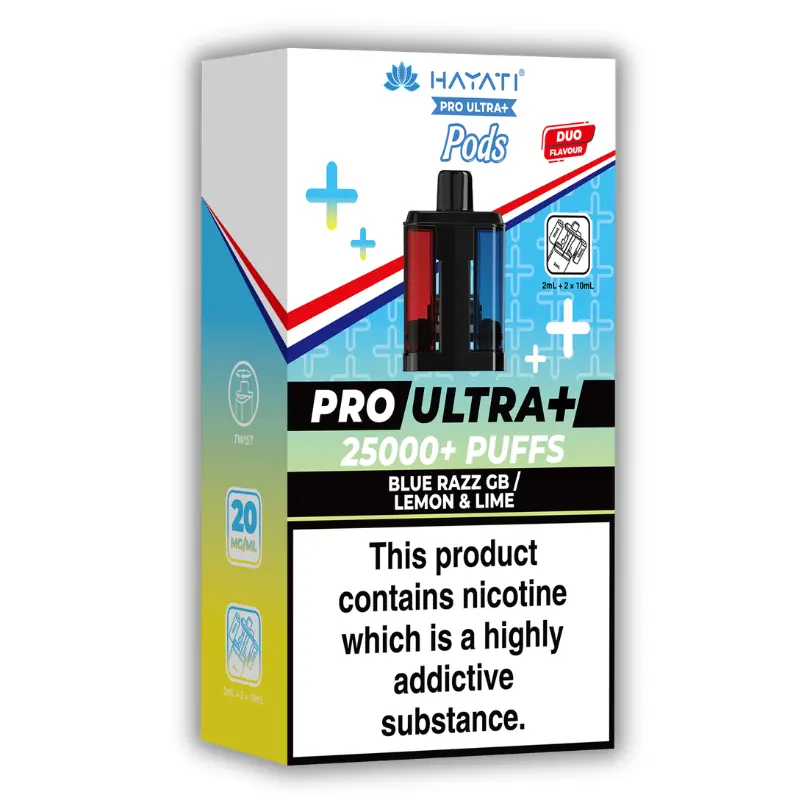
The commercial part is short. Seven pounds ninety-nine buys one prefilled pod, not a pair of them, whatever the plural in the title suggests. Inside it sit twenty-two millilitres of liquid at 20mg nicotine salt, split between two reserves, with a rotating mouthpiece deciding which reaches you. Hayati attach a rating of up to 25,000 puffs, produced on laboratory equipment and worth treating as a ranking device rather than a forecast. No hardware is in the pack, so anyone who still needs the device wants the complete Blue Razz GB / Lemon Lime kit at £11.99.
The rest of this page is about the boundary the pod crosses. One of these flavours refers to something you can buy at a greengrocer and check the pod against; the other refers to a sweet, which refers in turn to a colour convention nobody has ever tasted in a field. That difference changes what counts as a fault, changes how much attention each half repays, and decides a preference most people hold firmly without having been asked to state it. There is a verdict at the bottom, and it is not that everyone should own one.
One pod, two kinds of flavour
A sweet that refers to another sweet
Start with what Blue Razz GB actually points at. There is no blue raspberry. No plant produces one, no farm grows one, and no buyer of this pod has eaten the thing the name describes. What exists is a confectionery accord, worked out decades ago for slush drinks and boiled sugar and refined since by everyone selling into the same market. Why the colour ended up attached to raspberry at all is a settled piece of industry history, argued out properly on our Pro Max Plus page for Blue Razz Fruit Twist rather than here.
Take the conclusion and move on with it. The accord is a manufactured convention, learned rather than observed, and every version on sale is chasing the same reference sweet. Hayati's contribution is the treatment: the letters in the name mark this as the chewy, gummy-style reading rather than the fizzy or the sour one, the same signal the range uses on Grape GB / Strawberry GB, where two different fruit words get an identical treatment and end up closer to each other than either is to its own fruit.
Hold on to that. In the confectionery register the fruit word is a colour and a rough direction; the treatment is the flavour. Swap grape for blue raspberry inside a gummy build and you have changed less than you would by moving the same blue raspberry from a gummy build into a sherbet one.
A fruit that refers to a fruit
Now the other half. Lemon and lime are real, cheap and in every supermarket. A person who wants to check this pod against its original can do it in about a minute for less than a pound. Nothing about the confectionery half can be checked that way, and no amount of effort would make it checkable, because the original does not exist to be bought.
This is not a point about honesty. Nobody is deceived by a blue raspberry, and sweet counters sold impossible flavours long before anyone put one in a pod. The point is narrower: one of these two flavours has an external referent and the other has only an internal one, and none of that is visible on a listing printing both names in the same typeface at the same price.
Nor is the citrus half claiming to be juice, because no vape flavour is. A formulator assembles an accord that references the fruit; the reference can be close or loose, and this one is loose in the direction of cordial. But loose against a real target is still a different relationship from a target that was never real. A photograph can be out of focus. A drawing cannot.
Typical is not the same test as accurate
Here is the first practical consequence, and it changes how you should read your own reactions to the pod.
When you taste the blue side and form a judgement, the comparison set in your head is other blue razz products. It has to be, because there is nothing else available. The verdicts in that comparison are things like typical, atypical, well made, crude, sweeter than most, closer to a chew than to a fizz. Notice what is missing. Accurate is missing, and so is inaccurate, because there is no original to be accurate to. A blue razz that tastes nothing like a raspberry has not failed at anything. It was never attempting it.
On the citrus side a harsher verdict becomes available. You can say it is not much like a lemon, that the lime reads as cordial rather than as fruit, that the sharpness is the right shape but the weight is missing. Those are fidelity judgements, possible only because a real lemon exists and you have had one recently.
That last clause matters more than it looks. Your reference for a lemon is refreshed constantly by ordinary life, in drinks and on fish and in cleaning products. Your reference for blue razz was formed once, probably years ago, and is refreshed only by other manufactured blue razz. One standard is a moving target maintained by the world; the other is a fixed memory maintained by the category itself. Which is why two people can disagree violently about whether a citrus vape is any good while agreeing completely about a blue one.
Follow that through and something awkward falls out. "Which half of this pod is better" is not a well-formed question. You can rank two confections, and you can rank two fruit renderings, but ranking a typical confection against a middling fruit rendering needs a common unit and there is not one. When people answer anyway, and they always do, what they report is which class of flavour they prefer. The pod is not being assessed. The buyer is declaring an allegiance and calling it a review.
One rewards attention, the other does not ask for any
The second consequence is about time, and it is the one you notice fastest in use.
A confectionery accord is built to be recognised instantly. That is the commercial requirement it was designed against: announce itself in the first moment, through a wrapper, at a counter, to somebody who is not concentrating. So it is front-loaded, high in contrast, low in component count and deliberately stable across the whole event. Blue Razz GB delivers essentially all of itself on the first draw. Draw four contains nothing draw one did not. That is not a criticism; it is the specification being met.
A fruit accord is usually built the other way, because the original has more going on and the imitation has to gesture at the structure as well as the taste. There is a bright part, something with body behind it, and an edge that stops the thing rather than letting it trail. Those arrive in sequence, quiet enough that the loud opening takes your whole attention on draw one. Detail on the citrus side turns up on the second or third pull.
Three things follow. The first concerns the shape of a long pod: a flavour that gives you everything at once has nothing held back for week two, so the confectionery half plateaus almost immediately and then has one direction available, which is down. The fruit half has more places to go and more places to lose, because detail is what goes first as any pod wears and the citrus half is substantially made of detail.
The second concerns your own state. The blue side works perfectly well while you are doing something else. The citrus side is largely wasted when chained, because the part worth having arrives after the first pull and a chained draw never gets there. There is a half for the middle of a busy afternoon and a half for a quiet ten minutes, and they are not the same half.
The third explains why the change between them feels lopsided, which nearly everyone notices and few can account for. Moving from sweet to citrus feels like a step up in information, since suddenly there is a sequence where there was a single event; moving back feels like a step down in required effort. Both reports are about attention rather than taste. The pod has not become sweeter when you turn back. You have stopped concentrating.
Nobody has ever asked you which side you are on
The third consequence is the quietest and does the most damage to a basket.
Almost every adult vaper has a settled preference between the two classes, and very few have ever articulated it, because nothing in the buying process invites them to. The shelf sorts by fruit word, not by register. The Pro Ultra Plus pods shelf runs to fifty-two listings arranged by name, so a gummy blue raspberry and a fresh-fruit berry blend sit a few squares apart looking like variations on one theme, and the flat price removes the only other signal that might have separated them. The category pages cut by ingredient too, so Raspberry Vapes gathers a hundred and sixteen products covering both registers without distinguishing them, and Lemon Lime Vapes does the same across twenty-one.
The preference is unusually stable, for a structural reason. Sweetness is a dial you can slide along, and a person will move a little in either direction over a year. Class is not a dial. There is no halfway point between referring to a fruit and referring to a sweet, so there is nothing to slide along, and a person who wants one does not gradually come to want the other. They may buy the other occasionally. They rarely convert.
Three tells beat anything you would say if asked directly. What do you buy when you are not thinking, since a thirty-second reorder is less contaminated by an idea of what you ought to like? What do you reach for when you are tired, given that fatigue strips out curiosity? And how do you describe liquids to other people? Confectionery buyers tend to say what something tastes like, naming another product. Fruit buyers say what it tastes of, naming a thing in the world.
Which matters commercially, because a preference that does not move makes variety purchases across this boundary fail. Buying one of each is the commonest way of discovering that what you wanted was not variety at all, but a second good example of the thing you already liked. The pod in front of you is precisely that purchase.
The honest weaknesses in that distinction
The argument is worth stating against itself, because it is tidier in prose than it is in a mouth.
The fruit side is partly learned too. Very few people's internal reference for lemon is an actual lemon; it is lemon cordial, lemon sherbet, lemon in a cleaning product. A vape citrus is frequently judged against those rather than against fruit, which drags the supposedly external standard some way back towards the internal one. Lime is worse, because the reference most British buyers hold is cordial, and cordial is a manufactured accord of exactly the kind this page puts on the other side of the line.
Both accords are also assembled by the same flavour houses from an overlapping set of materials, chosen for how they behave when heated rather than for fidelity to anything. The distinction is about what the finished thing points at, not about how it was made. And the range is more honest here than the argument allows: Hayati mark the confectionery register explicitly, with the letters on this listing and the cotton-sugar wording on Blueberry Cotton K / Raspberry Cotton K doing the same job as several other suffixes across the catalogue. The labelling exists. What does not exist is any organisation of the shelf around it, so the information is present and useless at once.
Does that sink the distinction? No. A lemon can be produced on demand and a blue raspberry cannot. One flavour can be checked against something outside its own product category, even if most people check it lazily and against a cordial; the other can only be compared with other members of its class. That asymmetry changes the rubric, and changing the rubric is the whole of the argument.
Draw by draw, on both sides of the turn
Blue Razz GB from front to finish
Sugar arrives before anything identifiable does. That is characteristic of the register: for a short moment at the front of the draw you are tasting sweetness rather than a flavour, and the blue raspberry resolves out of it a beat later.
The chewy quality the name advertises is not a texture, since there is nothing in vapour to chew. What produces the impression is that small lag, plus a thickness in the way the sweetness sits, both imitating the way a sugar sweet has to be worked before it gives up what is in it.
Through the middle the accord proper takes over and the tang appears, and it is easy to overstate. The tang is bright and definitely present, but it sits on top of the sugar rather than cutting through it and it never takes the sweetness down. Set it beside a listing built to push acid hard, such as Blue Sour Raspberry, and the gap is large. That pod makes sharpness the headline. This one uses it as a seam.
The finish is long, sweet and slightly coating, and nothing arrives to stop it. No cold, no dry edge, no bitterness, so the draw fades out over several seconds instead of ending. Across a session that accumulates, which is the reason the other half of this pod has a job to do.
Placed on the shelf: high sugar, medium tang, no cooling at all. The nearest thing to it in structure is Blue Razz Cherry / Blue Razz GB, which keeps this exact liquid and puts another confection opposite it instead of a fruit.
Lemon and Lime from front to finish
The sharpness is the first event here, not the second. There is no sweet preamble, which after a stretch on the blue side registers as a small shock rather than as a flavour, and the first draw after a change is not a fair assessment of this half for that reason alone.
Lemon reads as the rounder of the two in this pairing and lime as the harder edge, which is the opposite of how the two words are usually ranked. Lemon supplies most of the brightness and most of what body there is; lime supplies the stop at the end. Between them there is not much middle, because neither fruit brings weight of the kind a berry or a stone fruit has and nothing has been added underneath to supply it. The pairing is narrow by construction, which is a criticism only if you wanted breadth from it. Sweetness is clearly lower than on the blue side, though not as low as the sharpness makes it seem, since a tart liquid always reads drier than it is formulated.
The finish is short and dry. It stops rather than fading, and the mouth returns to neutral quickly, which is the property that makes this half functional as well as pleasant. Anyone who wants the same citrus without a confection on the other side of the collar should be looking at Lemon Lime Hayati Pro Ultra Plus Pods, which gives the full twenty-two millilitres to it. On the shelf: low to medium sweetness as experienced, high sharpness, no coolant named or implied on either side of this pod.
What happens at the change, and why it is not symmetrical
Hayati state that the two liquids stay apart inside the pod and that the mouthpiece selects between them. They publish no parts breakdown, so this page will not tell you how the division is achieved or what closes off the side you are not using, and any page that does is describing something it has not been told. What is not in dispute is the shape of the thing: one pod, two reserves, one coil, and a collar deciding which reserve feeds it.
That arrangement is why the crossing this pod performs is more than a matter of what is printed on the label. The two flavours are run through the same piece of mesh seconds apart, which puts a confectionery accord and a fruit accord into direct physical contact in a way that buying two separate pods never would. You are not comparing two classes of flavour across days. You are switching between two kinds of claim inside one session, on one coil, with nothing in between.
What is observable is the handover, and it is not instant. The first draw or two after turning the collar still carries something of the side you have just left, which is what a shared wick and a shared coil would produce however the selection is arranged. On this pairing the carry-over is more noticeable than on a pod holding two related flavours, because the two things occupying one space for those few seconds come from different registers and do not resolve into anything coherent. Sugar plus fresh acid is not a flavour. It is two flavours in one place.
That hands a real complication to the fidelity argument above, worth conceding rather than hiding. If the citrus side is always tasted with a trace of the confection still on the mesh, it is never quite assessed clean against its real-world original. The external standard is available in principle and slightly contaminated in practice, on every draw, by a liquid that has no external standard at all. It does not collapse the distinction, because the film clears and a real lemon still exists to be checked against. It does mean the fairest reading of the fruit half comes late in a stretch on it rather than early, and that anyone turning the collar constantly is denying themselves the one test the fruit side, alone of the two, could pass or fail.
The two directions also cost different amounts. Going from blue to citrus takes three or four draws to come good, because the sweetness has to clear first. Going back is immediate, since sugar needs no clear field to register. Judging the fruit half on the draw straight after leaving the sweet one is the commonest way people conclude the citrus is thin.
Six things this pod is not
- Not two pods. One pod arrives holding both liquids. The plural in the title is a range naming habit, not a quantity.
- Not a blend. The two never meet as a recipe. Nobody formulated a blue raspberry citrus, and a single liquid carrying both ideas is a different product, along the lines of Blueberry Raspberry Lemon.
- Not cooled. No ice, menthol or coolant on either side, so neither half has a component that holds up as the pod ages.
- Not sour. The citrus is tart from fruit acid and the blue half has a tang, but there is no dosed sour treatment in either.
- Not a lemonade. No fizz and no sugar-water base on the citrus side. For that construction the range offers Straw’ Lemonade.
- Not adjustable. One strength, one split, one pairing, and nothing about the ratio is configurable once the seal is broken.
Where the two halves sit for sugar, sharpness and cold
Two independent readings beat a single sweetness score, because sugar and acid move separately. The blue half is high on sugar and middling on acid; the citrus half is the reverse. Both are at zero for cold.
That makes the gap visible, and it is a deliberate gap. A pairing built inside one register, such as Blueberry Raspberry / Blueberry Raspberry Cherry, moves you a short way and keeps the rubric constant. This one moves you the full width of the category and changes the rubric on the way.
What arrives, and what has to be yours already
A single sealed pod, prefilled, ready to seat. Nothing else. Across this shelf the price is the most reliable indicator of which kind of listing you are looking at: £7.99 means the pod on its own, £11.99 means the pod with a body.
The pod is a consumable and is not serviceable. The coil arrives with the liquid, wears while it is used and is discarded with it, so coil condition and flavour condition are one event rather than two. On this pairing that matters unevenly, because the halves lose different things: the confection loses volume and the citrus loses detail, and detail is the more noticeable loss.
Hayati publish the capacity, the strength, the two flavour names, the selection method and the puff rating. They do not publish a coil resistance, a wattage, an airflow figure, any dimensions, or how the twenty-two millilitres is divided. None of those has been supplied for this page from anywhere else and none is stated here, and a hardware figure taken off a retail listing, including a sibling of this one, is worth what it cost to read. The rest of the format sits on the Pro Ultra Plus kits and pods shelf, and the wider family of everything Hayati sell this way is under prefilled pods and refills.
The sheet, and the line that is missing from it
| Two liquids, one pod | Blue Razz GB, a confectionery accord, and Lemon & Lime, a fruit accord |
| How you choose between them | By turning the mouthpiece |
| How the 22ml is divided | Not published |
| Liquid held | 22ml, filled before sale |
| Strength | 20mg, nicotine salt, the only option on this listing |
| Coolant | None named on either side |
| Hayati’s puff rating | Up to 25,000, obtained in a laboratory |
| Coil | Sits inside the pod and is not replaceable |
| In the pack | One pod. No device, no accessories. |
| Device required | A Hayati Pro Ultra Plus you already own |
| Listing reference | blue-razz-gb-lemon-and-lime-hayati-pro-ultra-plus-pods |
| Maker | Hayati |
| Price | £7.99 |
One row on that table is a blank, and on this product it is the blank that would have settled everything. The division between the two sides is not published. Hayati say the pod holds twenty-two millilitres and that two flavours are in it, and no more than that, so there is no way to find out short of running one to the end and looking. On a pairing whose halves serve different purposes, that absence bites harder than it would on a pod holding two related fruits. If the confection is your main flavour and the citrus is your interruption, an even split is the wrong shape for you and you finish with citrus left over. If the reverse is true, you run out of the thing that was doing the work. No version exists weighted either way.
The first row is doing something else, and it is why the table is laid out in this order. Every sheet in this range prints the two flavours as one line, as though they were two values of one variable. Collapsing a confectionery accord and a fruit accord into a single row is the exact move that makes the shelf unreadable for anyone trying to buy by register rather than by fruit word.
Two other rows deserve a sentence. The strength is fixed at 20mg in salt form with no alternative here; nicotine is an addictive substance, and what strength suits any individual is their own business rather than something a retail page should advise on. The coolant row is empty on both sides, so neither half has anything durable holding it up late in the pod's life.
Buying by class instead of by fruit word
This section is organised by which side of the line you turn out to be on rather than by which fruits you like the sound of.
If you conclude you are a confectionery buyer
Then the question is whether you want a fruit opposite your sweet at all, or a second sweet. The lowest-risk move is Blue Razz Cherry / Blue Razz GB, which keeps this exact liquid on one side and puts a cherry-deepened version of the same idea on the other, so half the pod is known before you open it and the rubric never changes. Blackcurrant Cotton K / Blue Raspberry is more interesting, keeping a blue raspberry on one side and changing the treatment rather than the fruit on the other, which demonstrates the earlier point about treatment mattering more than fruit word. Blueberry Cotton K / Raspberry Cotton K runs that experiment the other way round, holding the treatment constant and swapping the fruit.
If you want this liquid and nothing opposite it, Blue Razz GB on its own hands the entire twenty-two millilitres to it at the same £7.99, which is the right purchase for anybody whose citrus reserve keeps outliving the pod and a more honest one than buying a pairing and ignoring half of it. For the same treatment on two other fruit words, Grape GB / Strawberry GB is the nearest like-for-like swap.
If you conclude you are a fruit buyer
Then this pod is probably the wrong purchase, and it is better to say so than to sell you one.
The reason is not that the blue half is bad. It is that a confection does not work as a break from a fruit the way a fruit works as a break from a confection. A sharp, short, dry flavour clears a sweet one. A sweet, long, coating flavour clears nothing; it adds to what is already there and leaves more for the next citrus draw to cut through. A fruit buyer uses the blue side less and less, and pays for a reserve that turns into ballast.
Better options at the same price. Lemon Lime as a single removes the question. Lemon Lime / Lemon Blueberry keeps both sides inside the fruit register while isolating one variable, the closest thing to a controlled experiment the shelf sells. Blueberry Raspberry is the plain fruit reading of the berry idea and useful as a control against the confectionery reading here. Straw’ Grapefruit / Straw’ Dragonfruit pairs two genuinely unlike fruits without either leaving the register. And Strawberry Raspberry Ice draws its contrast from a coolant instead of a category change, which is a third way of solving the same problem.
Pairings that cross the line a different way
Blue Razz Pineapple / Strawberry Ice keeps a blue confection on one side and uses cold rather than acid as the counterweight. That is a larger physical contrast than this pod offers and a smaller conceptual one, because a coolant is a sensation rather than a rival kind of flavour, so the rubric holds when you turn the collar.
Fresh Mint / Blue Razz Mint steps outside both classes, since mint is neither a confection nor a fruit and answers to yet another standard again. And Lemon & Lime / Summer Dream is the same citrus with something Hayati decline to specify opposite it, so you buy one known quantity and one unknown.
Smaller ways to test the same question
Twenty-two millilitres is a long commitment for an experiment, and the question can be answered with less liquid. Blue Sour Raspberry Hayati Mini Ultra Pods at £3.49 holds far less, so the cost of being wrong is smaller, and Blue Razz Pineapple Hayati Pro Max Plus Pods at £5.49 shows the same confectionery register inside a different format. One caveat applies to both: these sit in other Hayati ranges, nothing on this page says what fits what, and no compatibility chart is published across ranges, so match the range name on your device against the range name in the title rather than extrapolating from a family resemblance.
Shelves worth reading end to end
Three are short enough for a proper look. Lemon Lime Vapes runs to twenty-one listings, the entire sharp-citrus offering in one place. Lemon Vapes widens that to fifty-four by including everything where lemon plays any part. Berry Vapes at two hundred and ten is the opposite case, large enough that reading it end to end only makes sense once you know which register you are hunting, which is the practical payoff of working that out first.
Running a pod that contains two rubrics
General pod handling applies here as everywhere. What follows is the narrower set for a pod holding one flavour from each class.
Assess each half against its own standard, deliberately. On the blue side, ask whether it is a good example of the type, because that is the only question available. On the citrus, ask whether it is doing a recognisable job of being citrus. Applying the fidelity test to a confection produces a complaint nobody can act on; applying the typicality test to the fruit lets a poor rendering off the hook.
Give the citrus a runway. Turn to it a few minutes before you want it. Three or four draws are needed for the sugar to clear, and the pull taken immediately after switching is the most misleading draw the pod produces.
Use the halves at different times rather than in alternation. The natural division is by situation and not by draw count: the confection covers the parts of a day when you are not concentrating, the citrus repays the parts when you are. Alternating every few minutes wastes the half with detail in it and keeps the shared coil carrying a trace of the wrong liquid.
Do not chain the sharp side. Repeated draws without a pause run the coil hotter and push the profile towards the loudest thing in it, which on the citrus means acid without the rest. That is a temperature effect rather than a failing pod and it recovers after a rest.
Expect the halves to age unequally. Detail goes before volume as any pod wears. The confection is mostly volume and will still read as itself late on. The citrus is mostly detail and narrows towards generic sharpness well before the blue side shows anything. If the pod starts feeling like a sweet with an odd sour setting, that is ageing rather than a change in the recipe.
Store spares cool, dark and upright, because a warm windowsill or a car over a fortnight strips the light end out of anything and on this pod that loss lands almost entirely on one side. Keep every pod out of reach of children and pets, including the ones in the drawer, since a sealed pod is not a locked one.
Note which side you leave behind. When the pod is finished, look at which reserve still had liquid in it. That single observation answers the question this page has been circling, with evidence rather than an opinion about yourself, and what the waste costs you is a separate matter argued elsewhere on this site. A spent pod then belongs at a retailer take-back point or a recycling facility rather than the household bin, since it still holds a coil and a film of liquid.
Questions this pairing raises
Is this two pods or one?
One. A single pod arrives holding both flavours, with twenty-two millilitres of liquid divided between two reserves and a rotating mouthpiece selecting which one you draw on. The plural in the listing title is how the range names its refill products and is not a count of what is in the box.
Can I taste both at the same time?
Not usefully. The mouthpiece selects one side, and the only moment the two overlap is the brief carry-over on the first draw or two after a change. Those draws are not a blend so much as two flavours occupying one space.
Which side should I start on?
The citrus, on a fresh pod, on a rested palate. It is the half that carries detail and the half most affected by anything preceding it, so that is the only reading of it you will get uncoloured by sugar. The confectionery side can be assessed at any point because very little influences it.
What does GB stand for in the flavour name?
Hayati publish no expansion for it, so anybody who tells you definitively is guessing. What is observable is where the letters appear: on listings whose flavour sits in the chewy confectionery register rather than the fresh fruit one. Read it as a treatment marker rather than an ingredient, and note that the same marker turns up on other fruit words across the range.
Is the pod split evenly between the two flavours?
Not published. The total is twenty-two millilitres and the division between the sides is not stated anywhere in the specification, so there is no planning around it in advance. The only way to find out is to run one to the end and see which reserve still has liquid in it.
Why does the sharp side seem to lose its character first?
Because detail is the part of any flavour that goes first as a pod wears, and the citrus half is largely made of detail while the confectionery half is largely made of volume. The pairing therefore grows more lopsided over its life without anything having gone wrong. It follows from what the two flavours are built from.
Does the device come with it?
No. At £7.99 this is the pod alone and it assumes a Hayati Pro Ultra Plus already in your possession. The kit version at £11.99 pairs the same two flavours with a body, and across this shelf the price is the most reliable way to tell the two kinds of listing apart.
Is twenty-two millilitres too much for a pairing I only half want?
Possibly, and it is the right worry. A pod this size is a long commitment, and if one side functions as an occasional interruption rather than a flavour you want, a meaningful share of the liquid is bought for a job that needs very little of it. A single-flavour pod at the same price removes the problem.
So does anyone actually want both?
Some people do, and they are a smaller group than the number who buy this pod. They are recognisable by how they use it: the halves belong to different parts of a day rather than alternating half-hours, and both reserves empty at roughly the same time. For them the pairing is well judged and the unpublished split is probably close to right.
Everybody else is buying one flavour and tolerating the other, and the arrangement suits one group far better than the other. A confectionery buyer who wants an exit from twenty-two millilitres of sugar is genuinely well served, and should understand what they are purchasing: not a lemon and lime flavour, but a functional interruption that happens to be a fruit, effective precisely because it is a different class of thing rather than a different point on one scale. A fruit buyer is not well served, because the asymmetry runs one way, and the correction is a citrus single or a pairing that stays inside the fruit register.
So the verdict is that most buyers of this pack want one half and put up with the other, while the pod is built as though that were not the case. What survives is the diagnostic argument. This is the cheapest instrument on the shelf for finding out which side of the line you are on, because it puts both classes on one coil at one price and lets the leftover reserve tell you the answer, and on a shelf of fifty-two listings sorted by fruit word rather than by register that answer changes every purchase you make afterwards. Buy it once for the finding out. Buy accordingly ever after.
Strictly for adults aged 18 and over. Nicotine is an addictive substance.
You might also like


