
Home / Hayati Pro Ultra Plus Pods / Blue Razz Cherry/Blue Razz GB Hayati Pro Ultra Plus 25K Pods
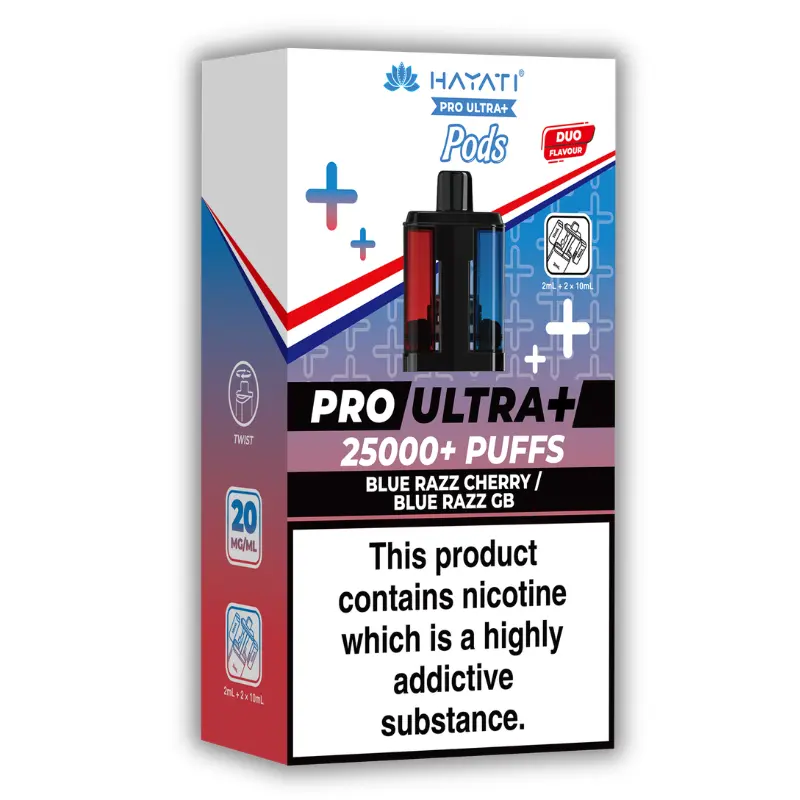
Hayati · Pro Ultra Plus
Blue Razz Cherry/Blue Razz GB Hayati Pro Ultra Plus 25K Pods
£7.99
✔ In stock — ready to ship
Genuine Hayati
Free over £20
Same-day dispatch
Secure checkout
One pod, not two. That needs settling first, because the listing name carries two flavours and a reasonable person reads that as a pack with a pod of each. It is not. £7.99 buys one replacement pod for a Hayati Pro Ultra Plus you already own, prefilled with twenty-two millilitres of liquid at a nicotine strength of 20mg, both flavours inside the single housing. A collar on the mouthpiece rotates between them: Blue Razz Cherry at one end of its travel, Blue Razz GB at the other. The liquids are held apart and do not blend in storage, and whichever the collar selects is fed to one coil serving both. How that division is arranged inside the housing is not something Hayati describe, so this page will not either. Hayati rate the pod at up to 25,000 puffs, a figure produced on laboratory test apparatus rather than by anybody drawing on one, so read it as workload for a single sealed coil. No device is supplied here.
Everything above is ordinary for the format. What is not ordinary is the relationship between the two sides, and it is the reason this page exists rather than repeating a tasting note you could get from the label.
Both flavours are built on the same blue raspberry. One takes that base and deepens it with cherry, giving the berry a red-fruit weight it does not have on its own. The other takes the identical base and pushes it into sweet-shop territory instead, softer and chewier, with the fruit edge rounded off by sugar. The base is the constant. The treatment is the variable. There is exactly one difference between the two settings of your collar, and you are holding a pod that lets you switch between them in the time it takes to turn a mouthpiece.
That is a controlled comparison, and almost nothing else on this shelf is one. Buy any two ordinary pairings and the halves differ in three or four respects at once: different fruit, different sugar level, one cooled and one not, one sour and one not. Prefer one and you have learned that you prefer it, which is not the same as learning why. Here a preference has somewhere to attach, because only one thing moved. What follows is what the comparison can establish, what it cannot, where it misleads if run carelessly, and what the answer is worth at your next reorder.
The one thing that moves, and why that is unusual
Contrast is the enemy of attribution
A dual pod is normally sold on how far apart its halves sit, and the reasoning is sound as far as it goes: a second flavour is only an escape from the first if it does not taste like the first. Straw’ Cranberry Cherry/Strawberry Raspberry Ice Hayati Pro Ultra Plus 25K Pods does this properly, changing the fruit set and adding cold to one side, and nobody finishes one unsure which position they were on.
The cost of that design is invisible until you try to learn something from it. When four things differ and you reach for one side, your preference is a single result with four candidate causes and no way to divide it up. Was it the strawberry, the cranberry, the cold, or simply that the other half was a blue raspberry you were tired of? Every answer fits the evidence equally well, so you finish knowing one more thing you like and nothing about why, and the knowledge does not travel past that one listing. Hold everything still except one element and a detected difference has a single explanation left standing. That is the whole of the logic, and it is why a comparison worth running looks dull from the outside.
What this pod controls for without you lifting a finger
The usual objection to comparing two vape liquids is that you never compare only the liquids. You compare two manufacturing units, filled on different days, shipped separately, stored differently, running on coils of differing tolerance, met weeks apart by a palate in two different states. Every one of those confounds is larger than the difference being looked for.
Nearly all of them disappear here, because of the physical fact established at the top of this page. This is one pod. Both liquids were filled into the same unit, sealed at the same moment, shipped in the same box and stored on the same shelf for the same number of days, and both are drawn through one coil, one wick and one airflow path, in one device, on the same afternoon, by the same person. The collar switches between them in two seconds rather than two weeks.
Count what that eliminates. No difference in coil unit, so no manufacturing tolerance between the arms. No difference in wear state, because both sides have gone through the same mesh. No difference in age, batch, storage, transport, device, airflow or day. This is a paired design, the strongest thing available to anybody working with a sample of one, and the packaging hands it over rather than any effort of yours. Short of a laboratory, a tighter single-variable comparison of two vape liquids is hard to construct.
The reason most people cannot say what a partner fruit contributes is not a poor palate. It is that they have only ever met the two liquids weeks apart, in separate pods on separate coils, where the noise between occasions dwarfs the signal.
The family of shared-component pairings is small, and this one sits oddly in it
Honesty first: this is not the only pod in the range with something held constant. Blueberry Raspberry / Blueberry Raspberry Cherry Hayati Pro Ultra Plus 25K Pods keeps a two-fruit base and adds cherry to one side. Strawberry Ice / Strawberry Raspberry Ice does the same with raspberry over a cold strawberry, and Kiwi Banana / Straw’ Banana holds banana still while swapping the fruit beside it. The family runs to perhaps five or six listings out of a shelf of fifty-two, and its shape is worth being precise about.
Most of it is nested: side two is side one with something added and nothing removed, which isolates an ingredient. This pod is built differently. Neither side is the plain base, so nothing here isolates an ingredient. Both sides are treated, and what the comparison isolates is the choice between two routes away from one starting point. That changes what you can conclude, which is set out under what the result licenses.
The second distinguishing feature is the base. Blue raspberry is the most reproduced profile in the catalogue, appearing in every hardware family and half a dozen treatments: soured on Blue Sour Raspberry Hayati Pro Ultra Plus Pods, taken into soft drink as Blue Razz Lemonade, darkened as Blue Razz Blackcurrant, left comparatively plain as one half of Blackcurrant Cotton K / Blue Raspberry Hayati Pro Ultra Plus Pods. A constant that appears everywhere is one you have already calibrated without meaning to, which gives a result from this pod reach beyond it.
The case against, which is a serious one
There is an opposite reading of exactly this structure, and it should be stated at full strength rather than in a version built to be knocked down. A pairing whose halves share their principal component is barely a pairing: £7.99 for two flavours buys one flavour and a footnote. A rotating collar exists so there is somewhere to go when the first liquid stops registering, and a destination that tastes like where you started is not a destination. Worse, the two sides converge as residue builds, so whatever separation exists on day one is partly gone by the middle of the pod. On that reading the shared base is a defect dressed as a design, and the sensible purchase is a high-contrast pairing or a single flavour with the whole volume behind it. The argument is put at length on the Blue Razz Cherry / Blue Razz GB Hayati Pro Ultra Plus 25000 Prefilled Pod Kit listing and deserves reading.
That is wrong, because it measures the pod against the wrong objective. It assumes variety is the only thing a second liquid can supply. Information is the other, and the two trade off in precisely the way the sceptical case fails to notice: the more contrast a pairing offers, the less any preference within it can tell you. A pod that maximises variety minimises what you learn, and what you learn here is portable to every purchase you make afterwards.
Two points in the sceptical case stand. If you want a real change of scenery partway through a pod, this one supplies less of it than almost anything at the same price, and a contrasting pairing is the better buy. And the payoff is a one-off: once you have the answer, the pod has spent its usefulness as an instrument and you are carrying a divided volume for no return. The conclusion is not that this is the best pairing on the shelf. It is that it is the most useful one to own exactly once.
What is actually in each half
The part that does not change
Blue raspberry opens both settings and it opens them identically, which is the first thing to verify for yourself rather than take on trust. The note arrives early in the inhale, sits along the edges of the tongue, and reads as tang rather than sourness: a bright, frankly artificial berry with an acid line through it, reproduced dozens of times across this catalogue. Sweetness on both sides sits in the medium-to-high band, and the acid is what stops it reading as flat.
Neither position is cooled. Hayati list no ice, no menthol and no coolant against either flavour, and nothing of that kind is perceptible on either setting, so both finishes run warm from start to end. That is worth knowing before committing twenty-two millilitres to it, because a warm sweet profile with no cold escape is the sort of thing people tire of late in a pod. Anyone who wants a cold half in the rotation should be looking at Fresh Mint / Blue Razz Mint Hayati Pro Ultra Plus 25K Pods, which puts cold on both sides, or at Strawberry Raspberry Ice Hayati Pro Ultra Plus 25K Pods for a chilled single.
The cherry setting
Turn the collar to Blue Razz Cherry and the front of the draw is unchanged. That is the important observation and it is easy to miss, because the expectation created by the word cherry is of something arriving early and red. It does not. The tang comes first, exactly as it does on the other side, at the same moment and at roughly the same intensity.
What changes happens from the middle of the inhale onwards. The body fills out. Where the plain berry construction is bright and slightly hollow underneath, the cherry supplies a darker, juicier weight below it, and the profile stops being a single-storey flavour. On the exhale the finish runs longer and reads rounder, and at the very back of it there is a faint dry edge, the nearest thing in the pod to a recognisable stone fruit. It is quiet. A quick draw taken while doing something else will pass straight over it.
The word that fits the cherry here is backbone rather than topping. It is not a second flavour laid over the first, it is structure underneath it, which is precisely why it is difficult to describe and easy to detect. Anybody who has run Cherry Ice Hayati Pro Ultra Plus 25K Pods or Cherry Berry Hayati Pro Ultra Plus Pods will recognise the register but should not expect the same prominence: those put cherry in front, this one puts it underneath.
The GB setting
Rotate to Blue Razz GB and the same base arrives, then goes somewhere else entirely. The sugar comes up rather than the fruit, the acid line is softened rather than removed, and the whole thing takes on a chewy, sweet-counter character: less juice, more confection. Where the cherry side gains depth, this one gains cushioning. The finish is shorter and sits higher in the mouth, and it leaves a sweeter film behind than the cherry side does.
If you have met this treatment applied to another fruit, on Blueberry Cotton K / Raspberry Cotton K Hayati Pro Ultra Plus Pods for instance, you already know the register. That listing is this pod's mirror image: it holds the treatment constant and varies the fruit, where this one holds the fruit constant and varies the treatment. Between the two, the effects could in principle be separated properly, which is more design than most people want from a vape and available all the same.
How far apart they actually sit
Not very far, and there is no point pretending otherwise. Side by side they are clearly two things. Met three days apart with nothing to compare against, most people would call them one liquid. That is why the sceptical case has force, and why the comparison has to be run deliberately rather than waited for.
The gap is also not constant across the life of the pod. It is widest at the start, when the mesh is clean and the quietest components are still coming through, and it narrows steadily as residue builds, because the parts that get buried first are the low-level ones: the dry cherry edge at the back of the finish and the acid line under the sugar. Both of those are load-bearing for the distinction. A comparison run in the third week is measuring a difference that has already been partly erased, and it will return a confident false negative.
What neither setting is
Neither is sour. The acid is a seam through the sweetness rather than the headline, and anybody wanting the headline version should look at Blue Sour Raspberry Hayati Mini Ultra Pods, which at £3.49 is the cheapest way to hear what soured blue raspberry sounds like. Neither is a realistic fruit rendering. Neither is mild, and if a high sugar level is something you avoid, both settings will be too much rather than one of them. Neither contains a drink profile, so there is no fizz and no citrus anywhere in the pod. And the cherry side is not a cherry liquid in the sense somebody browsing cherry vapes usually means: the word order on the label matches the order of importance inside the liquid, with the blue raspberry first and the cherry supporting it.
Running the comparison so the answer means something
The two confounds that survive, and one that turns out to be a gift
Strip out everything the single-pod construction has handled and the list of real problems is short: two, plus a third that looks like one and is not.
Carryover, the direct price of the shared coil. One wick serves both sides, so the instant you turn the collar it is still holding the liquid you were on a second ago. The draws that follow are a mixture rather than a sample of anything, and they taste like a plausible version of either flavour, which is what makes them dangerous: they give a confident reading rather than an obviously useless one. The fix is mechanical. Turn the collar, take four draws at normal pace, judge none, then start recording. Every impression formed by switching and immediately inhaling measured the transition, not the liquid.
Order. One side always comes second, met by a palate the first has already prepared. The bias has a direction: after a sweet draw the next sweet draw reads less sweet, so whichever side goes second is under-rated on sugar and over-rated on what remains once the sugar recedes. Here that penalises the GB setting when it follows the cherry one and flatters the cherry setting's dry edge when it follows the GB one. It is big enough to reverse a close verdict and it cannot be removed from any single round, only cancelled across a balanced set.
Coil ageing, which is shared and therefore harmless. This one is worth pausing on, because on two separate pods it would wreck the test. On two pods the wear runs on two independent clocks, so a week-three comparison measures two liquids at two states of degradation with no way to tell that apart from a flavour difference. Here both sides wear together, through the same mesh, at the same rate. The arms stay matched for the whole life of the pod, so a verdict reached in week three is as fair as one reached on day two.
Fair is not the same as sensitive. A worn coil buries quiet notes first, and the quiet notes are where most of the separation lives, so a late test is unbiased and blunt at once. It will not favour a side. It will simply find less difference than there was.
Expectation. You set the collar, so you know which side you are on, and two flavour names carry expectations about which ought to be nicer. This is the largest single source of error in casual tasting and the easiest to remove.
A protocol that controls what can be controlled
Run it in the first three or four days. The separation is at its maximum while the coil is clean. Everything else on this list is wasted effort if the test happens late.
Label the two collar positions before your first draw. Nothing on the pod says which flavour a position selects, and the packaging will be long gone by the middle of twenty-two millilitres. One line in a notes app, written before you have an opinion to protect, turns an anonymous two-position switch into a labelled one. Skip it and every later observation is filed without the detail that gives it meaning.
Run it in both directions, on different days. One session of cherry followed by GB is not a comparison, it is a comparison plus an order effect. Cherry first on Monday, GB first on Tuesday, directions kept balanced across however many rounds you manage. Splitting them over separate days also stops one odd afternoon deciding the result.
Switch, take four, then read. Four draws at normal pace after every turn of the collar, judged by nobody, before the draws that count. The shared wick makes this non-optional, and skipping it is the reason so many people conclude the two sides are identical.
Standardise the draw. Same length, same pace, same number per side, with a gap between rounds rather than a run of quick pulls. Chain-drawing leaves a film that flattens the tail of the next draw, and the tail is where the cherry side keeps most of its identity.
Get somebody else to set the collar. A mechanical selector cannot be blinded by the person operating it, because your hand knows where it went. Hand the device over, have it set at random out of sight, take your draws, write your preference and your guess at which side it was, then check. Six rounds of that beats a month of unstructured impressions, and it is the only way to find out whether you are tasting a liquid or a label.
Record preference, not description. Naming what changed is hard and beside the point. One word per round, better or worse or neither, plus your guess at the side. A tally is a result; a paragraph of adjectives is not.
Hold the rest of your day still. Same hour, similar interval since eating, not straight after coffee. Fussy, free, and worth it, because the effect is small enough for any of those to swamp it.
Then run it once more near the end. A second reading on a worn coil measures how quickly the two sides converge, which the first reading cannot tell you.
What the result licenses, and what it does not
Suppose it runs properly and comes out eight rounds to two for the cherry setting, blind guesses well above chance. Here is what that entitles you to say.
You may say that for you, on this pod, with a blue raspberry base held constant, the cherry treatment beat the confectionery one, and that the gap was wide enough to detect without being told which was which. That is a solid finding and more than most people ever establish about their own taste.
You may not say that cherry improves blue raspberry. Nothing here tests that, because the pod contains no plain blue raspberry arm. Both sides are treated, so you have compared one modification against another, neither against a baseline. Had the two scored level, this pod could not have separated the two available explanations: the base dominates and the modifiers do nothing, or both modifiers work and happen to cancel. Those imply very different shopping, and telling them apart needs a third arm.
That third arm is cheap but weaker, and it is worth knowing why before you trust it. The plainest blue raspberry on this shelf is the second half of Blackcurrant Cotton K / Blue Raspberry, which sets a comparatively untreated base opposite a sweet-shop partner. Run it the same disciplined way and the design is complete. The catch is that it arrives in a different pod on a different coil, so every between-unit confound this page has been congratulating itself on avoiding comes straight back. Treat the result as an indication rather than as evidence of the same quality as the two arms you already hold.
You may not generalise the finding to other fruits either. Cherry over blue raspberry and cherry over blueberry are different propositions, as anybody who has met the fruit beside cranberry elsewhere in the range will recognise. Nor may you generalise from one pod to the recipe: you have tested a single production unit, batch variation exists across a range this size, and repeating the test on your next pod is the only thing that turns a result into a reliable one.
And a narrow margin is not a result. Five rounds to three, with blind guesses near chance, is a tie dressed as a winner. Reading a tie correctly is covered below, because it is the outcome that changes a shopping habit most.
Specification, arranged by what is held still
| Supplied as | One replacement pod. No device. |
| Price | £7.99 |
| Setting one | Blue Razz Cherry |
| Setting two | Blue Razz GB |
| Held constant across both | Blue raspberry base, nicotine strength, coil, device, fill date, storage history |
| The variable | Cherry depth on one setting, a confectionery treatment on the other |
| Choosing between them | Rotating mouthpiece |
| Total liquid | 22ml, prefilled |
| Nicotine | 20mg. No other strength listed. |
| Cooling | None listed against either setting |
| Hayati’s puff figure | Up to 25,000, measured in a laboratory |
| Device needed | A compatible Hayati Pro Ultra Plus, bought separately |
| Brand | Hayati |
| Listing reference | blue-razz-cherry-blue-razz-gb-hayati-pro-ultra-plus-pods |
| Not published by Hayati | Coil resistance, wattage, airflow, how the 22ml is apportioned between the two sides, and any detail of how the division inside the pod is arranged |
The last row bears on everything above it, so start there. Four specifications an experimenter would want are absent, and the absence is stated rather than filled in, because pages across this trade quote figures that appear in no manufacturer material and then quote each other until the invention looks corroborated. Where this page describes behaviour it is describing what sweetened liquid does to mesh in general, not reading a number that does not exist.
The apportionment gap has a direct effect on the comparison. Hayati state twenty-two millilitres in total and do not say how it is divided, so an even split is an assumption. If the division is uneven, one side runs short before the other, and a late comparison may be measuring a starved wick rather than a difference in liquid. One more argument for testing early, while both sides are certainly supplied.
The 20mg figure is a statement of concentration and nothing else. Nicotine is addictive, and the number is printed here so it can be lined up against whatever you are already using, not as a recommendation of any kind. The puff rating is best read as designed workload: an indication of how much liquid one unchangeable coil is expected to process before the whole unit is replaced, which is why the practical end of this pod is a question about the mesh rather than about the last millilitre.
What each outcome should change about your next order
If the two sides tied
This is the most valuable outcome and the one people are most inclined to file as a failure. A genuine tie, with blind guessing at chance, is strong evidence that you are here for the blue raspberry and that the partner is decoration. That conclusion is worth money immediately. Stop paying for a variable you cannot detect and put the whole twenty-two millilitres behind the base: Blue Razz GB Hayati Pro Ultra Plus Pods costs the same £7.99 and carries one flavour with no collar to keep track of and no half of a pod going stale while you use the other. It also tells you something about how to shop the rest of the shelf, which is that a pairing built around blue raspberry is not offering you anything you value and a change of fruit family is a better use of the same money.
If the cherry side won
Then red-fruit depth under a blue berry is the thing you are responding to, and there are cheaper and more concentrated ways to get it. Blue Razz Cherry Hayati Pro Ultra Plus Pods is the same liquid with the full volume behind it at the same price, which is straightforwardly the better purchase once the question is settled. Blue Razz Cherry Hayati Pro Max Plus Pods at £5.49 is the smaller-format version for a different device if you run one. From there the direction of travel is towards listings where the cherry has more room: Straw’ Cranberry Cherry / Cherry Ice Hayati Pro Ultra Plus Pods puts cherry on both settings, and Blueberry Raspberry / Blueberry Raspberry Cherry Hayati Pro Ultra Plus 25000 Prefilled Pod Kit runs the same cherry idea under a different berry base, which is a useful second data point on whether it is the cherry or the combination you like.
If the GB side won
Then it is the treatment rather than any particular fruit, and the treatment is applied across the catalogue. Blueberry Cotton K / Raspberry Cotton K is the obvious next test, since it varies the fruit while holding the sweet-shop register still, which is the complementary experiment to the one you have just run. Blue Razz GB / Lemon and Lime Hayati Pro Ultra Plus 25K Pods keeps your winning half intact and puts something genuinely unlike it opposite, which is a low-risk rotation because fifty per cent of the pod is a known quantity before you open it.
If the answer was that you are tired of blue raspberry entirely
That turns up often and the test tends to surface it, because concentrating on a flavour is a reliable way to discover you have finished with it. Blueberry Raspberry Hayati Pro Ultra Plus Pods stays in berries while dropping the blue-sweet construction, Blueberry Raspberry Lemon Hayati Pro Ultra Plus 25K Pods adds the citrus counterweight this pod has no version of, and Blueberry Raspberry/Mr Blue Hayati Pro Ultra Plus 25K Pods is a middle step that keeps the blue register without the confectionery framing. For a full departure, Blackberry Raspberry Hayati Pro Max Plus Pods goes darker and drier at £5.49.
Browsing rather than shortlisting
The Hayati Pro Ultra Plus Pods shelf holds every refill that fits this device, and the wider Pro Ultra Plus range adds the complete kits for anyone whose hardware is on its way out. Raspberry vapes gathers the base across every format, berry vapes opens that out considerably further, and new products is where recent additions land.
Living with the pod once the question is answered
The test occupies the first week. The other three weeks are ordinary use, and a few points are specific enough to this pod to be worth stating.
Keep using the labels. Having gone to the trouble of writing down which collar position is which, leave the note where you will find it, because the value of the experiment evaporates the moment you can no longer attribute a good evening to a setting. It also lets your behaviour vote: glance at the collar when you put the device down, and if after a fortnight it has been sitting one way four days out of five, that is a preference expressed by your own hand with no tasting involved at all, and it is usually a better answer than anything your palate will tell you under pressure.
Give each setting long runs rather than switching constantly once the testing is done. Frequent alternation adapts you to everything the two sides have in common, which here is most of them, and leaves you tasting only the shared material. Whole days on one setting are also what keeps the two volumes depleting at similar rates, and on a pod where neither side is ever actively unwanted it is easy to drain one and leave the other sitting.
Slow the draws down in the last stretch. A tired coil trying to re-wet itself from a shallow supply is where thin, hot draws come from, and short pulls taken in quick succession are what cause it. The dry cherry edge is the first casualty long before that point, so if the two settings have become indistinguishable it is generally the mesh that has finished rather than the liquid, and resting the device will not bring the separation back.
Wipe the collar seam every few days. Sweetened liquid that works into a rotating joint dries tacky rather than wet, and a stiff collar quietly discourages switching, which is how a two-flavour pod turns into a one-flavour pod through neglect instead of choice.
Store spares upright, out of direct light and at ordinary room temperature, and keep the whole lot somewhere children and pets cannot get at it. Warmth exaggerates perceived sweetness and light takes the most delicate parts of a profile first. On this pod those delicate parts are the acid line and the dry cherry edge, which are precisely the two things the comparison depends on, so a pod that has spent a fortnight somewhere warm arrives with part of its distinction already gone. If you are running the test on a second pod to confirm the first result, storage is a confound worth ruling out before concluding the recipe has changed.
Questions this listing raises
Is this two pods, one of each flavour?
No. It is a single replacement pod holding twenty-two millilitres in total, with both flavours inside the one housing and a rotating mouthpiece selecting between them. The liquids are kept apart and do not blend in storage. If you were expecting two separate pods for £7.99, this is not that.
Do I get 22ml of whichever side I prefer?
No, the volume covers both. Hayati do not publish how it is apportioned, so an even split is an assumption rather than a stated fact. A single-flavour pod at the same price is the only way to put the whole twenty-two millilitres behind one profile.
How different are the two settings, honestly?
Clearly different when compared back to back within a few minutes, and easy to confuse when met days apart. They share their base entirely and differ in what has been done to it, so the separation is a matter of depth and finish rather than of two distinct fruits. Anyone wanting a pronounced change of scenery partway through a pod should buy a contrasting pairing instead.
Can I just switch and compare straight away?
No, and this is the mistake that produces most of the shrugging about these pods. One wick feeds both sides, so immediately after a turn of the collar it still holds the liquid you were on, and the next few draws are a blend rather than a sample. Take four at your normal pace, judge none of them, then begin.
Does the order I taste them in matter?
Considerably. The second side is always met by a palate that has just had the first, and sweetness in particular reads lower on a second exposure. Alternating which side goes first across a balanced set of rounds cancels most of that out, and it is the single most useful control available.
Is there any cooling on either side?
None is listed against either flavour and none is detectable in use, so both finishes run warm and reasonably long. That removes the usual escape route from sweetness on a long pod, which matters more here than on a cooled pairing because both settings sit in the same sugar band.
Which side is sweeter?
The GB setting, by a modest margin, and it presents as a chewier, more cushioned sweetness rather than as more sugar in the same style. The cherry setting reads deeper instead of sweeter, gaining weight underneath the berry rather than height on top of it.
What does the 25,000 figure actually describe?
It is Hayati's own laboratory rating, produced by apparatus drawing to a fixed pattern under fixed conditions, which makes it usable for ranking one listing against another and unreliable for predicting your own week. Read as workload it is more informative, since it describes what a single sealed coil is expected to process across the whole pod.
Will this pod fit my device?
It is made for a compatible Hayati Pro Ultra Plus and no device is supplied with this listing. Hayati publish nothing beyond that, no compatibility chart and no dimensions, so match the range name on your device to the range name in the title and do not extrapolate from other Hayati formats.
When should I stop running the test and just use the pod?
Once you have eight to twelve balanced rounds, or once the first week is up, whichever comes first. The separation narrows as the coil ages, so results gathered later are measuring a difference that has partly worn away. A brief second round near the end is worth doing, but as a measure of convergence rather than as a fresh verdict.
The short version
A single £7.99 replacement pod for a Hayati Pro Ultra Plus you already own, carrying twenty-two millilitres of prefilled liquid at 20mg, with Blue Razz Cherry on one setting of the rotating mouthpiece and Blue Razz GB on the other, and a Hayati laboratory rating of up to 25,000 puffs. Both settings run warm with no cooling listed anywhere, both sit in the medium-to-high sweetness band, and both are built on the same blue raspberry. The cherry setting deepens that base with red-fruit weight and a longer finish. The GB setting cushions it with sugar into something chewier and shorter.
The reason to own this one is that it holds a component still. A preference formed here has a single candidate cause, which is not true of almost any other pairing on the shelf, and the pod hands you a paired comparison with the same coil, the same day and the same palate on both sides. Run it early, label the collar positions, alternate which side goes first, discard the draws straight after a switch and have somebody else set the collar. What you get is a defensible statement about which treatment you prefer with the base held constant. What you do not get is a verdict on what cherry contributes to blue raspberry, because no untreated arm exists in this pod to measure against. The sceptical reading, that a pairing sharing its principal component is barely varied, is right about variety and wrong about value: you buy this one to learn something once, then buy whatever the answer points at.
Strictly for adults aged 18 and over. Nicotine is an addictive substance.
You might also like


