
Home / Hayati Pro Ultra Plus Pods / Blackcurrant Lemonade Hayati Pro Ultra Plus 25K Pods
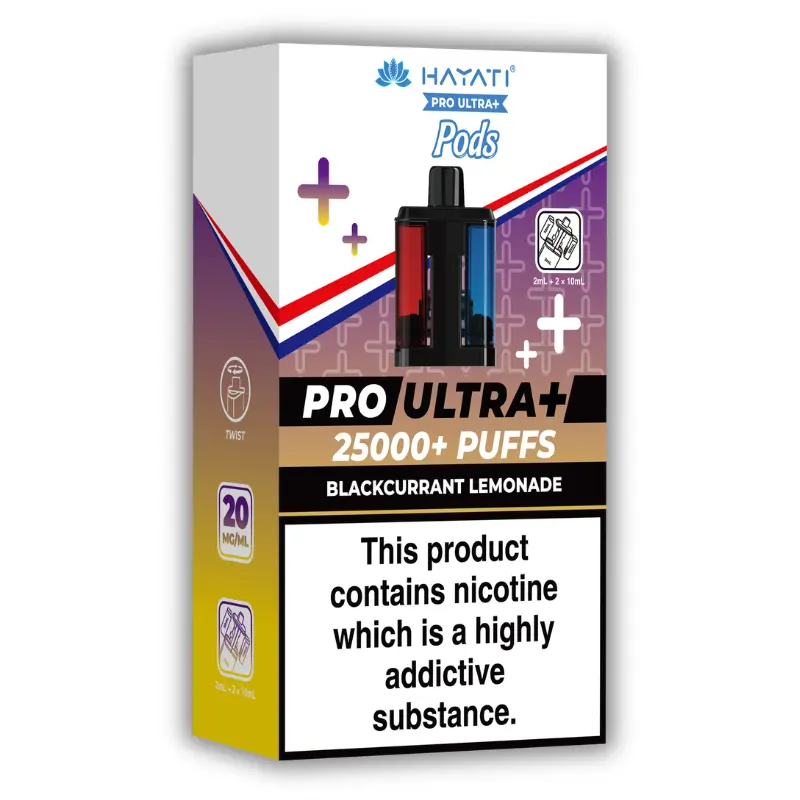
Hayati · Pro Ultra Plus
Blackcurrant Lemonade Hayati Pro Ultra Plus 25K Pods
£7.99
✔ In stock — ready to ship
Genuine Hayati
Free over £20
Same-day dispatch
Secure checkout
£7.99 puts one prefilled Pro Ultra Plus pod in your hand: 22ml of liquid, 20mg nicotine salt, filled with Blackcurrant Lemonade and with nothing else. Hayati's own rating for the pod is up to 25,000 puffs, a figure their laboratory produces on test equipment drawing to a fixed pattern, which makes it useful for ranking listings against one another and useless as a forecast of your month. The pack contains the pod. No device, no accessories. Anyone who does not already own the hardware wants the Blackcurrant Lemonade kit at £11.99, which carries this same liquid with a body attached to it.
One point of fact to settle first, because the naming convention on this shelf misleads people weekly. This is a single blend. Around half the listings in the Pro Ultra Plus range print two flavour names divided by an oblique and hide a rotating collar under the mouthpiece to move between them. This listing does not. Every millilitre in the pod is the same blackcurrant lemonade, there is no second side, and turning the mouthpiece selects nothing because there is nothing behind it to select.
Now the argument. The word on the label names a fruit, and the fruit is entirely real. It is grown in this country, commercially, in quantity. And almost nobody who buys this pod has eaten one.
That combination is stranger than it first appears, and it decides how the liquid ought to be judged. What British buyers carry in their heads is not the berry. It is the sweetened, dilutable blackcurrant drink that has stood in kitchen cupboards here for generations, poured a couple of inches deep and topped up from the tap, stocked by every supermarket, and known to most adults in this country for as long as they can remember. That drink, and not the fruit, is what a blackcurrant vape gets measured against, whether or not any individual buyer has put the comparison into words.
The rest of this page follows from that. What a drink standard implies for sweetness, acidity and body. Why a lemonade partner sits naturally beside that standard and would make almost no sense beside the raw berry. And why the objection people most often raise about blackcurrant vapes is, on inspection, a complaint about accuracy to a reference hardly anyone holds.
The fruit with an absent public
A berry grown here and eaten by almost nobody
Describe the raw fruit plainly first, because the description is why the rest of this works. A blackcurrant is small, matt black, thick-skinned and packed with tiny seeds. It is sharply acidic, far more so than a raspberry or a strawberry, with a grip at the back of the tongue that comes from the skin rather than the flesh. Eaten off a bush and unsweetened it is bracing rather than pleasant, which is the ordinary reaction and not a failure of palate.
The commercial consequence is visible in any supermarket. Punnets of strawberries, raspberries, blueberries and blackberries are stacked in the chiller more or less all year. Fresh blackcurrants are not, or only in a narrow midsummer window, or only at a farm gate. Most of the British crop is grown on contract and goes straight into processing, which is where the fruit meets the public. Some people keep a bush at the end of a garden and know the taste properly. Far more have never deliberately eaten one.
Set that against the drink. A blackcurrant concentrate diluted with water is not a niche product here. It is a staple of the soft drink aisle, poured in pubs and cafes, familiar as the dark half of a mixed drink ordered by name, and a domestic fixture for well over half a century. No brand needs naming, because the point does not depend on any particular one. The category is what people know.
So the asymmetry runs in an unusual direction. The manufactured version is the common experience, and the natural one, which exists and grows a few miles from most people reading this, is the rarity.
Three kinds of flavour name, and why this is the awkward one
Sorting the names on this shelf into classes helps, because they do not all work the same way and the class decides what counts as a fault.
The first class has no original at all. Nothing in any orchard corresponds to the blue confectionery accord that fills half the range, and there is no version of it growing anywhere to check a pod against. A buyer holding Blue Razz GB can only ask whether it is a good example of the accord, not a faithful one, because faithfulness has nothing to attach to. Our page for Blue Razz GB / Lemon & Lime works that distinction out at length.
The second class has an original woven into ordinary life. Lemons, limes, oranges, strawberries: cheap, stocked everywhere, eaten by nearly everyone several times a month without thinking about it. A pod of Lemon Lime can be held against the actual fruit within a minute of deciding to, and the comparison means something because the memory behind it is fresh and constantly topped up.
Blackcurrant belongs to neither. There is an original. It is not imaginary and not a marketing invention, and someone determined to taste it could manage it in July. But the season is short, the supply is thin, and the reference in nearly every buyer's head was therefore never formed from the fruit. It was formed from the drink and has been maintained by the drink ever since. A third case: an original that exists and is nonetheless not the standard, because the public went round it.
That is not a curiosity. It determines what a good blackcurrant vape aims at. In the first class the target is the accord. In the second it is the fruit. In this one the target is a manufactured intermediate sitting between the two, and a formulator who hit the fruit dead on would be marked down for it.
What is being claimed here, and what is not
Stated as fact: the pod holds 22ml at 20mg nicotine salt, costs £7.99, is a single flavour, and carries a manufacturer rating of up to 25,000 puffs from laboratory conditions. Those come from Hayati's listing data and nowhere else.
Stated as a general observation about this market rather than a measurement: that a sweetened blackcurrant drink is far more familiar to British adults than the raw berry. Nobody has surveyed it and this page has counted no one, but the produce aisle and the soft drink aisle are both open to inspection and they point the same way.
Stated as inference, and flagged as such wherever it appears below: what that familiarity implies for the profile buyers expect. That reasoning is mine, and it is not a statement about what Hayati formulated against, because Hayati publish no flavour brief, no development notes and no target profile for any listing. Everything about intention is guesswork and is labelled as guesswork. No brand of drink is named here, deliberately, since the argument concerns a category many products occupy rather than any one of them.
Reading the label backwards from the drink
If the operative standard is the cordial rather than the berry, four consequences follow. Each is an inference about buyer expectation rather than a claim about how this liquid was built, and each is testable on your own first pod.
Sugar set high, and set deliberately
The raw berry is too sharp for most palates alone. Every domestic form it takes here arrives sweetened, because sweetening is what makes it drinkable, and a concentrate carries more sugar again since it is built to be stretched. So the sweetness people associate with the word blackcurrant is not incidental. It is part of the definition. Someone who has only met this fruit in a glass has never tasted a blackcurrant that was not sugared, which means unsweetened blackcurrant is not a purer version of what they know. It is an unfamiliar flavour sharing a name.
The prediction, then, is that a blackcurrant pod aimed at a British buyer sits above the middle of any sweetness scale you care to draw, and that a restrained one reads as thin rather than as elegant.
Less acid than the berry, which is where intuitions fail
This is the point most likely to surprise, and the load-bearing one.
People assume the drink is the softened version and the fruit the sharp one, which is true of total acidity but misleading about perception. Sugar does not remove acid, it masks it, and the masking is substantial. A glass of diluted concentrate tastes of dark fruit with a tang running under it. A mouthful of the actual berry tastes of acid first, fruit second, and closes with a dry grip. They are not remotely the same intensity of sourness, and the drink is much the gentler.
Which means an accurate-to-fruit blackcurrant vape, if anyone built one, would strike a British vaper as too sour and oddly astringent. It would not read as authentic. It would read as wrong, and the complaint would be that somebody had overdone the sourness, when in truth they would have got it right and missed the target. Accuracy and expectation pull in opposite directions here in a way they never do on a strawberry or a lemon.
Cooked rather than picked
A concentrate is not raw fruit in a bottle. Making one involves heat and reduction, and heat moves fruit character in directions anyone who has made jam already knows. The fresh, faintly sappy top note sitting above a blackcurrant on the bush does not survive the process. What survives is deeper, rounder and darker, nearer a preserve than a punnet.
The remembered profile is therefore a cooked one: sweet dark fruit with the edges rounded off, weight in the middle of the mouth, and none of the leafy lift the living plant carries. A vape reproducing that lift would be doing something clever and would very likely be marked down for tasting unfamiliar, which is the standing hazard for flavours whose public reference is a processed product.
Water is part of the flavour
The fourth implication is almost never stated and is arguably the most useful for judging a vape.
Nobody drinks concentrate neat. The product exists in a diluted state in every memory anyone has of it, so the reference profile includes the water. Dilution does not merely reduce intensity, it changes texture: the drink is thin in the mouth, moves quickly, does not coat, and carries its sweetness on something light rather than something heavy. A syrupy, clinging blackcurrant is not a concentrated version of the standard. It is off the standard in texture, however well the flavour itself is judged.
Vapour is not liquid and cannot literally be thin or thick, but the impression translates well enough. Some pods leave a film that persists between draws and builds across an afternoon. Others release and clear. On a drink-referenced flavour the second behaviour is correct, and a pod that gums up the palate has failed a test most buyers apply without being able to name it.
The four taken together
Assemble them and the profile a British buyer unconsciously expects looks like this: distinctly sweet, dark and rounded rather than bright, tang present but moderate, body staying light in the mouth, and no green edge anywhere.
Hayati describe the blackcurrant half of this pod as deep and tart-sweet with the lemonade supplying a sharp lift over the top, and their framing is that the two behave like a mixed soft drink. That is a description of a drink profile, which is what the argument above predicts, though it is their description rather than my tasting, and a listing description is marketing text before it is anything else.
Why lemonade belongs beside a cordial and not beside a berry
A pairing borrowed from a glass, not from a bowl
Here is the neat confirmation that the drink standard is the operative one, sitting in the product name where nobody looks for it.
Nobody pours lemonade over fresh blackcurrants. The combination has no culinary existence, and proposing it as a dish would earn you a raised eyebrow. What does exist, ordinarily and commonly, is blackcurrant cordial lengthened with lemonade instead of with water. It is made at home, poured in pubs, and unremarkable enough that most people in this country have drunk it without thinking of it as a recipe.
Read the product name in that light and it stops being a fruit pairing. It is a drink pairing, which is a different thing: two beverages combined rather than two ingredients. The lemonade is not there to complement a berry. It is there because that is what people put in the cordial. Whether Hayati reasoned it out that way is unknowable and I am not claiming they did, but the combination they have chosen only makes sense downstream of the drink, and that is evidence about the reference even while it stays silent about the intention.
What the citrus puts back
Follow the logic one step on and the lemonade turns out to be doing a job the sugar created.
Sweetening the fruit costs it sharpness. Diluting the concentrate costs it intensity. Both moves make the drink pleasant and both make it less interesting, which is why the version with lemonade in it exists at all: the citrus returns an edge the sugar took away. It is not the same edge. The berry's own sharpness is broad and slightly drying, felt across the tongue and lingering. Lemon acid is narrow, quick, felt at the sides and then gone. Substituting one for the other is a replacement with different characteristics, not a restoration.
That distinction matters more in a vape than in a glass, because a vape is drawn on repeatedly across hours. A broad astringency accumulates and tires the mouth, where a quick citric acid resets it. Whatever else the lemonade does here, it makes the blend easier to live with over a long stretch than a plain sweetened blackcurrant would be, which counts for something on a 22ml format specifically.
The draw, in the order it arrives
Taking Hayati's characterisation as the starting point and reasoning from the construction, here is the sequence to expect. Flagged as reconstruction rather than laboratory analysis, since no flavour breakdown is published and nobody outside the factory holds one.
The front of the inhale ought to be the blackcurrant, arriving with weight rather than brightness. Dark fruit sits low on the palate and announces itself by density, not attack, so the opening is slower than a citrus pod gives you and leads with sweetness and depth together.
The lemonade should surface across the middle, doing two separable things. The obvious one is citrus flavour. The less obvious one is that it changes the weight of the draw, cutting the density so the middle feels lighter than the opening did. That shift is the drink character arriving, and a plain berry pod cannot produce it.
The exhale is where a lemonade construction shows its hand, because citrus outlasts dark fruit on a finish. Expect the tang last, with the blackcurrant fading beneath it, so the pod ends brighter than it began. No cooling is involved anywhere. Nothing in the specification mentions ice, menthol or a coolant, so the finish runs warm and any freshness you notice is acidity doing the work. That trips people up regularly: an acidic profile gets called refreshing, the buyer goes looking for the same sensation, and orders something chilled that turns out to be a different experience entirely.
How sweet it is, placed against this shelf
Draw a line across the Pro Ultra Plus pods from dry to sugared and the ends mark themselves. Bare citrus sits at the dry end, where Orange Lemon & Lime piles three citrus fruits together with no sweet counterweight underneath. Confectionery holds the other end, where sugar is the structural material and the fruit word is a direction: Grape GB / Strawberry GB gives two entirely different fruits the identical gummy treatment and ends up with two things more alike than either is to its own fruit.
A cordial-referenced blend lands above the midpoint and below the confectionery end. A drink standard demands real sugar, but a drink is not a sweet: cordial sugar carries fruit, whereas confectionery sugar is the flavour with fruit decorating it. Those produce different sensations at matching sugar levels, and the second coats where the first does not. Anyone who has found a gummy pod exhausting by late afternoon and concluded they cannot handle sweet liquids has probably blamed the quantity when the build was the culprit.
Six things this pod is not
- Not cooled. No ice, menthol or coolant appears in the specification and nothing substitutes for one. The finish is warm.
- Not a dual pod. One liquid fills all 22ml, the mouthpiece turns onto nothing, and there is no collar function to learn.
- Not a sour. There is acidity, supplied mostly by the lemonade half, and acidity is a different sensation from sourness. Nothing here is built to pucker.
- Not an accurate rendering of the raw berry. That is this page's argument rather than a criticism, and a pod that did render the raw berry would suit fewer buyers rather than more.
- Not a confectionery build. The sweetness has a drink shape rather than a sweet-counter shape, which is a different sensation from the gummy and candyfloss listings alongside it.
- Not configurable. One strength, one volume, one flavour, and no options published against the listing at all.
The complaint aimed at the wrong reference
What "it just tastes like squash" is actually reporting
Read enough discussion of blackcurrant vapes and one objection recurs in various phrasings. It does not taste like real blackcurrant. It tastes artificial. It tastes like squash out of a bottle rather than like fruit.
Take that last one seriously, because it is the most revealing. The buyer has noticed, correctly, that the liquid resembles a manufactured drink, and has then filed the observation as a fault. But the manufactured drink is the thing nearly every British buyer knows this flavour by, so the complaint describes a blend arriving accurately at the standard its market actually holds. Reported as a failure, it is a description of success.
Where does the mistaken rubric come from? My reading, offered as inference, is that it gets imported from categories where it works. A strawberry pod can be held against a strawberry and found wanting, and people do that constantly and are right to. Having learned the move on fruits that are genuinely available, buyers carry it across to blackcurrant without noticing the comparison has quietly stopped being possible for them. The rubric survives the move; the reference does not. And in most cases the person saying a blackcurrant vape misses the real fruit is not comparing it to the real fruit either, but to an idea of it constructed backwards from the drink and then imagined sharper.
Two objections that survive the reframing
None of this means every criticism of a blackcurrant vape is confused. Two hold up entirely, and separating them from the misdirected one is the useful part.
First, a dark berry accord wearing a blackcurrant label. Blackcurrant has a specific identity and is not interchangeable with blueberry, blackberry or the generic purple note filling a lot of listings across the trade. A liquid reading simply as dark sweet fruit with no particular character has missed the drink standard too, and saying so is correct. The distinguishing question is not whether the pod tastes like fruit off a bush. It is whether the dark note has a recognisable identity at all, or could be swapped for any other dark berry without you noticing.
Second, sweetness that overshoots even the cordial. A drink standard licenses real sugar. It does not license unlimited sugar, and past a certain level a blackcurrant stops reading as a drink and starts reading as a sweet, at which point it has crossed into the territory of Blackcurrant Cotton K / Blue Raspberry, where the candyfloss treatment is announced in the name and is the entire point. A blend arriving at that level without announcing it has missed, and objecting to it is objecting to something real.
Both are failures against the drink standard rather than against the fruit, which is exactly why the distinction is worth drawing. The rubric is not "is it authentic". It is "is it a good version of what the word actually refers to in this country", and that question has teeth.
Three questions to answer in your first week
Nobody outside the factory has a breakdown of this liquid, so here is how to establish the answer yourself rather than trusting any description, this page's included.
Is the dark note specific or generic? Draw with attention and ask whether you could identify the fruit blind. A blackcurrant has a slightly drying quality at the back of the swallow, inherited from the skin, and it usually survives even a heavily sweetened treatment. If that grip is present in some form, the note has identity. If the draw is simply sweet and purple, you have the first legitimate complaint and this is a berry liquid rather than a blackcurrant one.
Does it clear, or does it coat? Take four or five draws over a few minutes, leave it a quarter of an hour, then notice what is still in your mouth. Drink-shaped sweetness releases and fades. Confectionery-shaped sweetness is still sitting there, and if it is, you are nearer the sweet-counter end of the shelf than the listing suggests.
Which half wins the finish? Citrus last means the construction is behaving as a lemonade should and the pairing is working. Berry swamping the finish from day one means you have a sweetened blackcurrant with a citrus note laid over it, which is a legitimate flavour but a different purchase, and worth knowing early.
Answer those three while the coil is new and nothing has shifted, and you own a reference you can judge the rest of the pod against. Leave it until you are deep into the 22ml and you will be assessing liquid and mesh together with no way to separate them.
The buyer for whom the fruit really is the standard
One group deserves a warning rather than the argument above, because for them the argument does not apply.
Some people know blackcurrants properly: a bush in the garden, a farm in July, jam every summer, or a childhood somewhere the fruit is ordinary. For them the reference is the berry, it was formed from the berry, and a cordial-shaped liquid will read as sweetened and slightly flattened however well it is made. That reaction is not a failure of understanding. It is a correct judgement against a standard they genuinely hold and most people do not.
There is no honest recommendation to offer that buyer here, because nothing in the range is built for them. A blend designed around the fresh fruit, acidity intact and green edge preserved, would be a difficult commercial product and Hayati do not appear to sell one. Better to know that before spending £7.99 on 22ml than at the halfway mark.
What arrives, and what has to be yours already
The pack contains one sealed pod, filled at the factory. No device, no charger, no spare. The entire difference between this listing and the £11.99 kit is whether hardware comes with it, and mistaking one for the other is the commonest reason a Pro Ultra Plus order arrives and disappoints.
Inside sits one mesh coil carrying the whole 22ml, fixed and unserviceable. Nothing can be removed, rinsed, rewicked or swapped, so whatever state it is in is the state you are drawing through, and it goes out of service with the last of the liquid. Every prefilled listing in the range works this way. What belongs to this flavour specifically is that a sugared drink profile asks more of that mesh than a dry citrus liquid would, which matters for the handling notes further down.
On fitment the listing says the pod is for a Hayati Pro Ultra Plus and says nothing more. There is no compatibility table, no dimension, no fitting description and no cross-range note. Work from the range name marked on your device and the range name in this title, and stop there. Two dark rectangles in a drawer can belong to quite different hardware, and a shop page, ours included, is not where an unanswered hardware question gets settled.
What Hayati do not publish here, said plainly so nobody reads silence as assent: no coil resistance, no wick material, no airflow figure, no wattage, no pod dimensions, no fill date and no batch code. Other listings will state some of those without hesitation. Whatever they are quoting, it is not this product's data sheet, and a number invented once and repeated twice does not become true by circulation.
The sheet, read against a drink profile
| Flavour | Blackcurrant Lemonade, one blend throughout |
| Reference standard | A sweetened blackcurrant drink rather than the fresh berry (this page's reading) |
| Manufacturer rating | Up to 25,000 puffs, produced in Hayati's laboratory |
| Price | £7.99 |
| Cooling | None specified, none described |
| Liquid | 22ml, prefilled and sealed |
| Selectable sides | None. No oblique in the name, no collar under the mouthpiece |
| Nicotine | 20mg nicotine salt, no alternative strength listed |
| In the pack | The pod alone |
| Coil | One, sealed in, carrying the full volume |
| Brand and SKU | Hayati, blackcurrant-lemonade-hayati-pro-ultra-plus-pods |
| Device | A Hayati Pro Ultra Plus, purchased separately |
Three rows repay a second look and the rest are there for completeness.
The cooling row matters more on this flavour than the format usually makes it. Dark fruit is the profile most often paired with ice across the wider trade, to the point where plenty of buyers assume a blackcurrant listing will be cold unless told otherwise. This one is not, nothing in its data suggests it is, and the brightness in it comes from citrus acid alone. Anyone wanting a chilled dark berry should treat that row as disqualifying rather than as a detail.
The rating row exists to be attributed rather than relied on. Up to 25,000 puffs is Hayati's figure from Hayati's bench, generated by a machine drawing to a set pattern, and neither the pattern nor the conditions are published. Read it as a statement about the workload one non-serviceable coil is built to take, not as a prediction about a person, and resist comparing it with the ratings printed on other formats, since those come from different rigs on different hardware and were never calibrated against each other.
The nicotine row offers no choice at all. 20mg salt is the only strength published against this listing, and the salt formulation is what the format uses throughout. Nicotine is addictive. Which strength suits a given person is not a question a retail page should answer.
Placing it among the neighbours
The same liquid, in smaller quantities
Blackcurrant Lemonade exists in more than one Hayati format, which matters because 22ml is a lot of an untasted flavour to commit to, and this page has just spent several thousand words arguing the flavour may not be what you assumed.
Blackcurrant Lemonade in Mini Ultra form at £3.49 is the least expensive route to a verdict, though it runs on that device rather than this one. The Pro Max Plus version at £5.49 sits in the middle and again needs different hardware. Neither is a perfect preview, since each format presents a liquid slightly differently, but either settles whether a sweetened blackcurrant with citrus over it is something you want weeks of.
The other lemonades
Lemonade as a construction recurs across the range with the fruit underneath as the variable.
Straw' Lemonade is the counterpart at this size and price, and the comparison is unusually clean because only the fruit changes. Strawberry brings sugar and very little sharpness of its own, so that pod reads rounder and softer and leans harder on the citrus for its lift. Blackcurrant brings depth plus a tang of its own, giving this one more happening underneath and a darker centre of gravity. Preference turns on whether you want the fruit supporting the citrus or answering it. The Mini Ultra strawberry lemonade at £3.49 exists for the same trial reasons as its blackcurrant equivalent.
Two further lemonades sit in the Pro Max Plus format and both illuminate the reference argument. Blue Razz Lemonade at £5.49 pours citrus over a confectionery accord with no natural original at all, making it a drink built on a sweet rather than on a fruit. Berry Lemonade at £5.49 goes the other way and names no fruit in particular, leaving the dark note free to be anything. Beside those two, the blackcurrant version has much the most specific target, for better and worse. The Lemonade Vapes shelf gathers nineteen listings for anyone shopping the construction rather than the fruit.
Blackcurrant given other treatments
Blackcurrant Cotton K / Blue Raspberry is the most instructive contrast on the shelf for anyone following the argument above, because it hands the same fruit word to the candyfloss register instead of the drink one. Sugar goes up, the sweetness changes from something that clears to something that coats, and the blackcurrant becomes a direction rather than a subject. It is also a dual pod with a collar, so it behaves differently in the hand as well as on the palate. Anyone who likes blackcurrant as a sweet rather than as a drink should start there instead. The Blackcurrant Vapes shelf runs to sixteen listings and is the quickest way to see how many different things the trade does with one fruit name.
If the dark fruit is what you want and the drink is not
Several listings supply depth with no beverage framing at all. Cherry Berry puts a stone fruit in front of a berry base and stays in fruit territory throughout. Blueberry Raspberry / Blueberry Raspberry Cherry is a dual pod varying one dark blend by a single ingredient, a narrow change but a real one. For the confectionery reading of dark fruit, Blue Razz Cherry and Blue Razz Cherry / Blue Razz GB both work in the accord with no fruit behind it, and Blueberry Cotton K / Raspberry Cotton K applies candyfloss to two berries at once.
If the citrus is what you want and the fruit is not
Strip the dark half out and several routes keep the lemonade end. Lemon Lime is zest and acid with almost no fruit body under it, considerably drier than this. Orange Lemon & Lime stacks three citrus fruits and still declines to sweeten them much. Lemon & Mint adds a cooling element and stays deliberately austere, which makes it about as far from a cordial build as this shelf goes.
For citrus kept as a top note over something softer, Blueberry Raspberry Lemon is the nearest structural relative using different fruit, and worth a look for anyone who likes this listing's shape but wants a lighter berry beneath it. Citrus on both sides of a collar is what Lemon Lime / Lemon Blueberry offers, varying only what sits underneath, while Lemon & Lime / Summer Dream pairs a sharp half with an unnamed rounder one. Fifty-four listings sit on the wider Lemon Vapes shelf.
Shelves worth opening
Fifty-two listings sit on the Pro Ultra Plus pods shelf, all priced the same, so switching flavour changes nothing about what you pay and loyalty to one earns nothing either. Pro Ultra Plus kits and pods combines both into a hundred and four, which is the shelf to open if a second device rather than a second pod is under consideration. The full Hayati catalogue is there for longer browsing.
Running a drink-profile pod to the end
General pod handling applies here as everywhere. What follows is specific to a sweetened, acid-lifted drink blend in a large sealed unit, which is where the advice genuinely differs.
Take your reading while the coil is new. The three questions above are only answerable in the opening days. Later you are assessing liquid and mesh at once, and most people who decide a flavour was disappointing are in fact describing its final third.
Watch the texture before the flavour. On this profile the first casualty is usually not taste but lightness. A drink build depends on releasing cleanly, and as residue gathers on mesh the draw starts to feel heavier even while the notes remain identifiable. Once the blend sits on the tongue instead of clearing off it, the pod has turned its corner. That signal arrives before any change in the fruit and beats counting days.
Expect the citrus to thin before the berry. Bright top notes are the fragile components in any blend and they move first. Here that leaves a sweetened dark fruit with steadily less lift over it, which is a perfectly drinkable liquid and is not the one you bought. A balance visibly tilted towards the blackcurrant means the late stage has begun.
Do not pull harder when it fades. The draw is narrow by design and force extracts no extra lemonade. Harder pulls run the coil hotter and empty the wick quicker than it refills, and the bright citrus top is the first thing both of those cost you. Chasing a fading pod brings the fade on faster.
Give a rested pod a few draws before judging it. Leave one part-used for a week and liquid stands against a static wick, so the opening pulls arrive heavy and a little stewed. On a sugared dark fruit that presents as syrup, this flavour at its least appealing. Three or four unhurried draws bring the drink character back.
Keep spares out of warmth and daylight. A drawer or cupboard will do. Heat and light work on the fragile end of a liquid first, so a pod that has spent a fortnight on a windowsill opens duller at the citrus end rather than less sweet. Nicotine products belong where children and pets cannot get at them, sealed spares as much as the pod in use.
Settle the endgame before you reach it. A 22ml pod has a late phase long enough to matter, so there is a real choice at the tail: run it to empty and accept a diminished version for that stretch, or retire it the day the lemonade stops turning up and write off what remains. Either is a defensible policy. Having no policy, and wavering for a week, delivers the drawbacks of both.
Dispose of it properly. A finished pod still holds mesh and the dregs of a nicotine liquid, which keeps it out of the household bin. Vape shops and council recycling points accept them, and nothing inside is worth salvaging.
What buyers ask before ordering a blackcurrant
Is this one flavour or two?
One. The title carries a single flavour name with no oblique, which on this shelf marks a single blend, and all 22ml is the same liquid. There is no collar beneath the mouthpiece and nothing to select, so anyone arriving from a dual listing will find that turning it changes nothing.
Does it taste like actual blackcurrants?
Almost certainly not, and this page argues it should not try to. The reference nearly every British buyer holds is a sweetened blackcurrant drink rather than the fresh berry, and the drink is both sweeter and much less sharp than the fruit. A liquid built to the fruit would read as sour and unfamiliar to most people ordering it.
Is there any cooling in it?
No coolant of any kind is specified against this product and none appears in its flavour text. The freshness people report on lemonade blends comes from citrus acidity, which is a different sensation from menthol and does not behave like it. Anyone specifically after a chilled dark fruit should pick a listing that says so in its name.
Why pair blackcurrant with lemonade rather than something else?
Blackcurrant cordial lengthened with lemonade instead of water is an ordinary British drink, made at home and poured in pubs, so the pairing comes from a glass rather than from any culinary logic about the fruit. Nobody puts lemonade on fresh blackcurrants. That the combination exists is a small piece of evidence that the drink is the reference, though Hayati publish nothing about their reasoning and this stays an inference.
What is in the pack for £7.99?
One sealed prefilled pod and nothing besides. No device, charger or accessories are included, so the listing only makes sense for someone who already owns a Pro Ultra Plus. The complete kit at £11.99 carries the same liquid with hardware and is the right order otherwise.
Can I try the flavour before committing to 22ml?
Blackcurrant Lemonade is listed in the Mini Ultra format at £3.49 and the Pro Max Plus format at £5.49, each needing its own device rather than this one. Neither is an exact preview, since hardware changes how a liquid presents, but either will tell you whether the profile suits you at all. Spending £3.49 on information is sound arithmetic if it heads off a £7.99 pod you do not enjoy.
Will the flavour hold across the pod?
Hayati publish no coil data here, so any millilitre figure for when it starts to change would be invention. The defensible expectation is that fragile components go first, meaning the citrus lift fades ahead of the berry, and that the draw thickens in the mouth before the flavour itself moves. Fix a reference in the opening days and you have something to compare against later.
Can the pod be refilled once empty?
No filling arrangement is published and the description makes no provision for one, so treat the pod as a single committed unit rather than a vessel you own. The coil cannot be exchanged either, so even a topped-up pod would be drawing through mesh that has already worked through 22ml.
Will it fit the Hayati device I already have?
The specification names a Hayati Pro Ultra Plus and stops there. Hayati issue no compatibility table, no dimensions and no cross-range guidance for this pod, so the only reliable check is that the range marked on your device matches the range in this title. Do not assume a pod from a neighbouring Hayati range will seat because it looks similar.
The short version
What £7.99 buys: 22ml of 20mg nicotine salt in one sealed pod for a Pro Ultra Plus you already own, a single blend with no collar and nothing to select, no cooling anywhere in it, and Hayati's bench rating of up to 25,000 puffs. Dark sweet fruit, citrus lift across the top, finishing brighter than it opens.
The argument here is that the word on the label points somewhere other than where it appears to. Blackcurrant is a real fruit that British buyers overwhelmingly have not eaten, so the sweetened drink became the standard by default, and a blend reading as a drink is hitting its target rather than missing the fruit. Practical consequences follow: expect sweetness above the middle of the shelf, tang rather than sourness, a cooked depth rather than a fresh green edge, and a body that stays light in the mouth. Expect the lemonade to make sense as a partner to the drink rather than to the berry, because that is where the combination comes from.
Two criticisms still hold: a dark note with no particular identity fails whatever standard you apply, and sweetness crossing from cordial into confectionery has missed as well. The three questions earlier separate those from the misdirected complaint.
Anyone who genuinely knows the fresh fruit, from a garden or a farm or a summer of jam-making, should read all of the above as a warning rather than a recommendation, because nothing in this range is built for that palate. Everyone else is buying a competent drink flavour at the largest sealed size Hayati sell, and should judge it as a drink.
Strictly for adults aged 18 and over. Nicotine is an addictive substance.
You might also like


