
Home / Hayati Pro Ultra Plus Pods / Blueberry Raspberry / Blueberry Raspberry Cherry Hayati Pro Ultra Plus 25K Pods
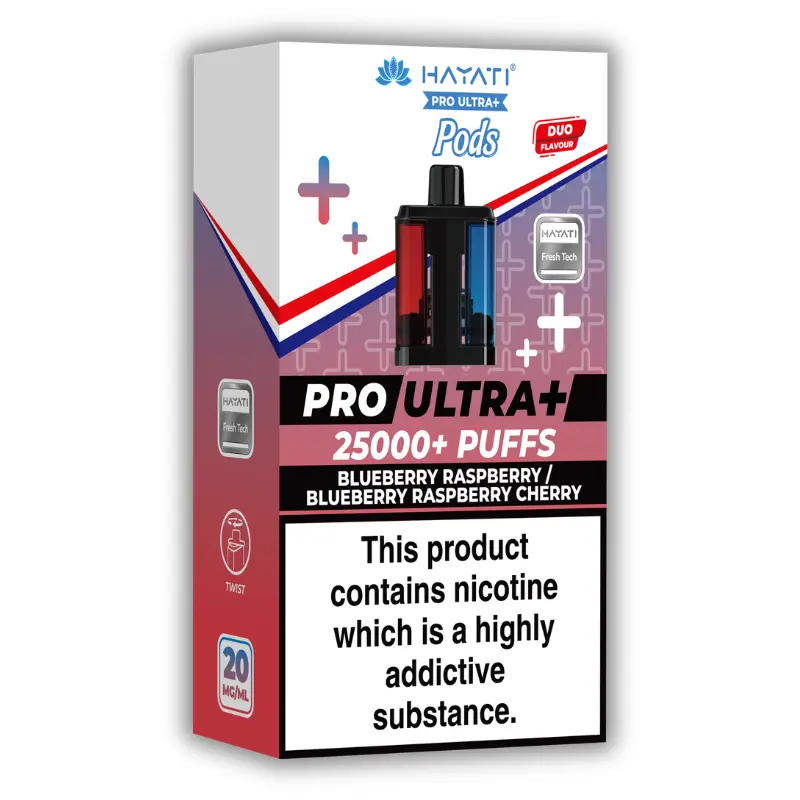
Hayati · Pro Ultra Plus
Blueberry Raspberry / Blueberry Raspberry Cherry Hayati Pro Ultra Plus 25K Pods
£7.99
✔ In stock — ready to ship
Genuine Hayati
Free over £20
Same-day dispatch
Secure checkout
This is the replacement pod on its own, at £7.99, for a Hayati Pro Ultra Plus device you already own. Inside it are 22ml of prefilled 20mg nicotine salt, split between two reserves, with a rotating mouthpiece deciding which of them reaches the coil. No device is included and none is needed if yours is still working. Hayati's published figure for the pod is up to 25,000 puffs, generated on a test rig rather than by a person, which makes it a statement about how much liquid one sealed coil is being asked to process and a poor guide to how many days that will take you.
The hardware question is therefore settled before you arrive. What is not settled is the one a repeat buyer is actually standing over, and it is narrower than the question they answered the first time. First time round you chose a pairing. Second time round the useful question is which half of the last pod you preferred, because that decides whether you buy this listing again, buy one of its two halves as a single flavour for roughly the same money, or move to a pairing that offers somewhere further to travel. Almost every dual pod on this shelf answers that question for you without being asked. This one, alone among them, does not.
Why it does not comes down to how the two sides were assembled. Side two is side one with cherry added to it, nothing removed and nothing else adjusted, and the Blueberry Raspberry / Blueberry Raspberry Cherry Hayati Pro Ultra Plus 25000 Prefilled Pod Kit page sets out at length what that nesting does to the liquid itself, where exactly the cherry lands, and why the two halves stop differing at all once the mesh has aged. Those arguments are not rebuilt here. This page begins where that one finishes and follows a separate consequence: a pairing assembled by addition rather than by opposition does not leave a buyer holding two comparable memories. It leaves one memory, with an unrecorded variable sitting inside it.
What follows works through that rather than around it: why the usual reorder machinery fails on this pod specifically, whether the failure makes it a lower-risk repeat purchase or a slightly pointless one, and a method for settling the question on the pod in front of you inside about a week.
The memory a nested pairing never gives you
What a reorder is really running on
Nobody re-reads a product page to decide whether to rebuy something they have already finished. That decision was taken over the preceding fortnight, by a small accumulated record of unremarkable moments: the draw taken without thinking about it, the evening you turned the collar because the other reserve had started to bore you, the morning you realised you had left the setting alone for three days running. None of that is deliberate and none of it is written down, yet on most pairings it is a reliable record, and it works because your palate was handed two things different enough to file in separate places.
Take a pairing where one half is cold and the other is not, such as Fresh Mint / Blue Razz Mint Hayati Pro Ultra Plus 25K Pods. Nobody finishes that pod unsure which half suited them. The two sides sit under separate headings in the mind, cold and cold-with-fruit, and every session deposited a little evidence against one heading or the other. The same holds for a pairing divided by fruit family or by sugar register. Grape GB / Blue Razz GB Hayati Pro Ultra Plus 25K Pods puts two confectionery flavours together, but they are different fruits under the same treatment, and a grape recollection and a blue raspberry recollection do not end up in the same drawer.
Something similar happens on the citrus pairings. Lemon Lime / Lemon Blueberry Hayati Pro Ultra Plus 25K Pods shares a fruit across both halves, and even there the second lemon is pointed in a different direction by what accompanies it, sharp against soft, so the sides stay separable in recall. The common factor across all of these is not how large the difference was. It is that the difference had a direction and a name.
Contrast is what makes the record retrievable
Flavour memory is comparative long before it is descriptive. Very few people can summon a taste from nothing in the way they can summon a tune or a face. What they can do, easily and quickly, is say that one thing was sweeter than another, colder than another, sharper than another. The mind stores the gap rather than the thing, which is why a blind tasting of two liquids is straightforward and a blind identification of one liquid is close to impossible for almost everybody.
Feed that system two halves separated by a named quality and it works perfectly well. Cold is a named quality. Sour is a named quality. Grape rather than raspberry is a named quality. Now feed it two halves separated by the presence of a quiet third fruit that contributes body and length rather than a new note, and the system has nothing to hang a label on. The difference is real, and it is measurable in the mouth while both are available to compare. It simply does not survive into storage, because there is no word attached to it and no direction for it to point in.
Look at what your recollection of this pod is likely to contain a week after finishing it: berry, tart at the start, sweet all the way through, warm finish, no cold anywhere. Every single item on that list is true of both reserves. The description that survives in memory is a description of the pod, not of either half of it.
The variable nobody thought to record
Now add the awkward part. Even supposing you did form a genuine preference, and plenty of people do, you have no way of knowing which side it attached to.
The mouthpiece rotates between two positions, and the positions have no persistent identity in ordinary use. You do not look at the collar each time you pick the device up. You cannot see liquid levels through the pod, and Hayati publish nothing about any gauge or indicator, so nothing on the outside of the product tells you which reserve is currently feeding the coil or how far down each one has gone. The device does not report it and the packaging is long gone by the middle of a 22ml pod. If you set the collar one way on a Tuesday, took a run of draws you enjoyed on the Wednesday, and moved it at some unremembered point afterwards, the enjoyable Wednesday is stored without the label that would make it worth anything.
On a contrasting pairing this does not matter at all, because the liquid itself is the label. You do not need to remember the collar position on a mint pairing, since a cold draw announces which reserve it came from. Here the liquid cannot label itself. The only record of which side you were on was the physical orientation of a component you were not paying attention to, and that record is gone.
What you do remember, and why it does not help
Ask somebody who has just finished one of these what they thought of it and the answer is usually specific and usually useless for the purpose. They liked it. It was sweet. It got samey towards the end. They preferred it in the first week. Every one of those statements describes a shared property or a trajectory rather than a reserve.
There is one exception worth noting, and it is a partial one. A few people do retain a mouthfeel memory: a sense that at some point in the pod's life the vapour was leaving a heavier film behind, and that at other times it was not. That impression is reliable, because it tracks the extra sugar on the cherry reserve rather than the aroma. But it comes back as a period of time rather than as a setting, so it tells you that the two sides were not identical while still failing to tell you which one you were on when you were most content. It confirms the pairing is real. It does not answer the reorder question.
So is that an argument for or against buying it again?
Both, and they are worth separating rather than averaging into a verdict.
The case for calling this the lowest-stakes reorder on the shelf is straightforward. If you cannot remember which side you preferred, it is because there was no side you disliked. A pairing built by addition cannot strand you with half a pod you will not touch, which is a genuine hazard on pairings built on opposites, where anybody who turns out not to want the cold half has effectively paid £7.99 for eleven millilitres. Buying this again is a bet you cannot really lose, because both outcomes are a liquid you already know suits you. Nothing in your unreliable memory is evidence against rebuying.
The case against is that the same fact makes the pairing itself close to redundant for you. The point of two reserves is having somewhere to go when one of them stops registering. A pairing whose halves you cannot tell apart in recall is a pairing that never gave you anywhere to go, which means you have been carrying a rotating mouthpiece and a divided 22ml for the benefit of a change you cannot describe. The same £7.99 buys 22ml of a single flavour, undivided, and if the variation was never doing any work, the single is the better purchase and has been all along.
Which of those is right depends on a fact you currently do not possess. That is the whole argument of this page, and it has one obvious remedy: find out on this pod, while you have it, instead of arriving at the next reorder in the same condition. The method is set out further down, it takes about a week, and it costs nothing.
What the two reserves taste like, and which parts of that survive
The opening, which both sides share
Raspberry sets the edge on the inhale. It arrives almost immediately, sits along the sides of the tongue, and reads as tang rather than as sourness, which is a meaningful distinction on a shelf that also sells deliberately soured liquids. It is bright and it does not last, thinning out well before the draw is over. In memory this note survives well, because tartness is one of the qualities the palate labels reliably. It is also identical on both reserves, so its survival does you no good at all when you are trying to tell them apart afterwards.
Blueberry occupies the middle. It brings weight rather than edge, a jammy sweetness with a faint floral lift at the top of it, and it comes up under the raspberry about halfway through the inhale and stays put. Left alone it would read as slightly one-dimensional, which is why the catalogue almost never sells it by itself, and why it works so well with a fruit that supplies the sharpness it lacks. The combination is one of the most heavily reproduced in the range, on every hardware family Hayati make, and its popularity is a function of how well the two halves of it cover each other's gaps.
The exhale on side one is warm, rounded and moderately long. Nothing cools it and nothing cuts it, so the sweetness fades out slowly rather than being stopped. Sweetness across the pod sits in the medium-to-sweet band: clearly a sweetened fruit liquid, well short of the candyfloss and gummy builds that make up much of the shelf, and well above anything citrus-led.
Where side two departs, and why that departure is the hardest kind to store
Turn the collar and the arrival is unchanged. The tang is the same tang, arriving at the same moment with the same intensity, because the cherry brings no acid of its own to the front of the draw. What changes happens later, and it happens gradually.
Through the middle of the inhale the profile sits a shade darker and a shade heavier. On the exhale the difference becomes easier to notice: the finish runs longer, the sweetness reads stickier, and where side one has tailed away to nothing the second reserve is still faintly present. Right at the back of that extended finish there is a dry edge, the closest thing in the pod to an identifiable cherry, and it is quiet enough that a quick draw taken while doing something else will miss it completely.
Here is the problem, stated in memory terms rather than flavour terms. Every one of those changes is a change of degree along an axis the base already occupied. Heavier is not a new note, it is more of an existing one. Longer is not a new note either, it is the same note staying around. Stickier is a property of the mouth after the draw rather than of the draw. None of them is the arrival of a thing that was not there before, and the palate stores arrivals far better than it stores increments.
Compare what a different third fruit would have done. Put citrus over the same base, as Blueberry Raspberry Lemon Hayati Pro Ultra Plus 25K Pods does, and the addition lands at the front of the draw where nothing else is standing. That registers as an event, it gets a name, and six weeks later you can still say which reserve had the lemon in it. The cherry here has been kept deliberately low, which is a defensible decision for a fruit blend, and the price of the restraint is that its contribution is a dimmer switch rather than a new instrument.
How the difference moves across the life of the pod
The gap between the two sides is not constant, which is another reason a whole-pod memory is a poor guide to either half. It is widest on the first day, when the mesh is clean and the quietest components are still coming through intact. It narrows steadily afterwards as sweetener residue accumulates, and the quiet components are the ones it buries first.
The consequence for anybody running the test described later is a timing one. If you have owned this pod for a fortnight already and only now want to settle the question, the fair thing is to wait and run the test properly on the next one.
What neither reserve is
No cooling appears on either side. Hayati list no ice, no menthol and no coolant against this pairing, and none is perceptible in use, so both finishes run warm from end to end. If a cold close is part of what you want from berries, this pairing will frustrate you on both settings rather than one, and Strawberry Ice / Strawberry Raspberry Ice Hayati Pro Ultra Plus 25K Pods is the nearer fit.
Neither reserve is sour. Neither is a confectionery build: there is no gummy chew, no candyfloss powder and no sugar-counter character, which is what separates this listing from a large part of the shelf it sits on. Neither contains a drink profile, so no fizz and no cola. And side two is not a cherry liquid in the way somebody shopping the cherry vapes shelf usually means it. The cherry is underneath the berries, supporting them, and the order of the words on the label is an accurate description of the order of importance inside the pod.
A pod that keeps no record of how it was used
What arrives, and what has to be yours already
One prefilled pod, sealed, with the liquid already in contact with the wick, so there is nothing to prime and nothing to fill. It fits a compatible Hayati Pro Ultra Plus device, which is not supplied here and is the reason this listing costs £7.99 rather than the £11.99 that a complete kit does. If your existing device has stopped holding a charge or has taken a knock, a kit is the sensible purchase and the same pairing is sold that way; if it is working, a second device is money spent on a duplicate.
Fitting it is the whole of the setup. The coil is sealed inside the pod and cannot be changed, rinsed or rotated, so the pod and the coil retire together, and the pod's working life ends when the mesh gives up rather than when the last millilitre is gone. Everything else about operation is mechanical: the mouthpiece turns, and the position it is left in decides which reserve feeds the chamber above the coil.
The collar has no memory either
Worth dwelling on, since it is the mechanism this entire page depends on. The rotating mouthpiece is a selector, not a display. It holds a position and it will hold it indefinitely, but it does not announce which of the two liquids that position corresponds to, and neither does anything else on the product.
On a pairing of opposites this is a non-issue, because two draws tell you where you are. Here two draws tell you almost nothing, which means that unless you impose your own labelling, you are operating a two-position switch whose positions are unmarked as far as your palate is concerned. Anybody intending to reach a conclusion about this pod needs to fix that first, and it costs one line in a notes app.
The two reserves are held apart from one another inside the pod, so the liquids do not blend in storage. What they do share is the small chamber sitting above the coil, which is why the first handful of draws after a switch are a mixture rather than a clean sample of the new side. On a mint pairing that transitional stretch is unpleasant and obvious. On this one it is neither, which sounds like an advantage and is actually the reason so many people conclude the halves are the same: an immediate back-to-back comparison is contaminated by design, and a delayed one is contaminated by memory.
What Hayati do not publish
Stated plainly rather than filled in, because pages across this trade routinely quote figures that appear nowhere in a manufacturer's material and then quote each other. For this pod Hayati publish a capacity, a nicotine strength, a puff rating, two flavour names and the device family it fits. They do not publish a coil resistance, a wattage, an airflow figure, a wick material or a flavouring composition, and since no device ships with this listing there is nothing to say about charging or battery at all.
Nothing above or below invents any of those. Where this page describes how the pod behaves as it wears, it is describing what sweetened liquid does to mesh in general and what that means for a profile with one quiet ingredient in it, not reading a specification that does not exist.
The specification, and the row that would have answered everything
| Product | Blueberry Raspberry / Blueberry Raspberry Cherry Hayati Pro Ultra Plus 25K Pods |
| Price | £7.99 |
| Supplied as | Pod only, no device included |
| First reserve | Blueberry Raspberry |
| Second reserve | Blueberry Raspberry Cherry |
| Liquid | 22ml prefilled, divided between the two reserves |
| Nicotine | 20mg nicotine salt |
| Manufacturer rating | Up to 25,000 puffs, a laboratory estimate |
| Flavour selection | Rotating mouthpiece |
| Cooling | None listed against either side |
| Device required | A compatible Hayati Pro Ultra Plus, bought separately |
| Brand | Hayati |
| Product code | HPU-25K-PODS-BLUEBERRY-RASPBERRY-BLUEBERRY-RASPBERRY-CHERRY |
Read that table with the reorder question in mind and its limitation becomes obvious. Every row except two describes the pod as a whole. The capacity is shared, the strength is shared, the rating is shared, the absence of cooling is shared, the device requirement is shared. Only the two reserve rows distinguish the halves, and they do it by printing names that differ by one word, which is precisely the information that failed to help you the first time.
The 22ml figure deserves a note, because it is easy to misread as 22ml of whatever you like best. It is not. The volume is apportioned between the two reserves, so each side carries in the region of eleven millilitres once the working chamber has taken its share, and neither flavour will run the full length of the pod. That matters more here than on a pairing you have a clear preference within, because a buyer who eventually discovers they wanted the cherry side has been buying half a pod of it at full pod price for however long they have been on this listing.
The 20mg figure is a statement of concentration and nothing more. Nicotine is an addictive substance, and no product page should be steering anybody towards a particular strength; the number is here so you can line it up against whatever you are already using. As for the 25,000 rating, the honest reading is workload rather than duration. It describes what one unchangeable coil is being asked to process across the whole pod, which is why the practical end of this pod is a question about the mesh rather than about the liquid.
Where to go next, depending on what you conclude
If it turns out the base is the one you want
Then stop paying for a variation you do not use. Blueberry Raspberry Hayati Pro Ultra Plus Pods is the same £7.99 and puts the entire 22ml behind the two-fruit blend, roughly doubling the amount of the thing you actually wanted per purchase. There is no collar, nothing held in reserve and nothing to keep track of, and for a repeat buyer who has settled the question that is straightforwardly better value than this listing. The same blend arrives as a complete kit under Blueberry Raspberry Hayati Pro Ultra Plus 25000 Prefilled Pod Kit if a device replacement is due at the same time, and on the smaller format as Blueberry Raspberry Hayati Pro Max Plus Pods at £5.49, which is a lower commitment per pod if you prefer buying more often in smaller quantities.
If it turns out the cherry side is the one you want
The three-fruit recipe exists without a two-fruit companion attached to it. Blueberry Raspberry Cherry Hayati Pro Max Plus Pods at £5.49 is the cheapest route to it, and Blueberry Raspberry Cherry Hayati Pro Max Plus 6000 Pod Kit at £7.99 supplies the same liquid with its own device if you want to run it in parallel with your existing one rather than swapping pods. Neither carries a second reserve, and that is the point: once you know which half you want, the other half is just liquid you will turn away from.
The cheap way to settle it outside the pod entirely
There is a shortcut that avoids all of the difficulties described on this page, and for £5.49 apiece it is not an extravagant one. Buy the two-fruit version and the three-fruit version as separate Pro Max Plus pods and run them on separate occasions with no shared chamber between them. Two independent pods on independent coils remove the contamination problem completely, and because each one is a single flavour there is no collar position to lose track of. Nothing you learn that way is wasted: whichever one wins, the answer applies directly to which half of this pod was carrying you, and to whether the pairing is worth buying at all.
If the conclusion is that nested pairings are not for you
Plenty of people reach that point, and the shelf has a straightforward answer at the same price. Blueberry Raspberry/Mr Blue Hayati Pro Ultra Plus 25K Pods keeps this exact base on one side and puts Hayati's house blue-fruit mixture opposite it, which is sharper and more confectionery in character, so the two reserves file separately in memory without either of them being unwelcome. Blue Razz Cherry/Blue Razz GB Hayati Pro Ultra Plus 25K Pods is an interesting inversion for anybody who came out of this pod curious about cherry, since there the cherry is the variable between the halves rather than a passenger inside one of them. And Straw’ Cranberry Cherry/Strawberry Raspberry Ice Hayati Pro Ultra Plus 25K Pods separates its two sides by cooling as well as by fruit, which is about as far from a nested pairing as this format goes.
The other pairing built the same way
This is not quite a one-off, and the comparison is instructive. Strawberry Ice and Strawberry Raspberry Ice, sold together as a single 25K pod, are also nested: side two is side one with a fruit added. The difference is what gets added. Raspberry brings acid, and acid lands at the front of the draw rather than in the body, so that pairing produces two halves you can still name a fortnight later even though it was built by the same method. Nesting on its own is not the problem. Nesting with an ingredient that reinforces what is already there is.
Cherry given more room, and where to browse
If the dry edge at the back of side two was the most interesting thing about this pod, there are listings where cherry is not buried under a fruit blueberry. Blue Razz Cherry Hayati Pro Ultra Plus Pods runs it beneath a sharper, more artificial blue raspberry, which gives the cherry a clearer outline because the thing on top of it is not competing for the same register. Blue Razz Cherry Hayati Mini Ultra Pods at £3.49 is the cheapest way to test that idea before committing 22ml to it. Blueberry Cherry Cranberry Hayati Pro Max Plus Pods at £5.49 keeps the blueberry but swaps the raspberry for a cranberry, which is tarter and drier and pushes the cherry forward by contrast.
Elsewhere on the shelf, Blueberry Cotton K / Raspberry Cotton K Hayati Pro Ultra Plus Pods is the mirror image of this listing, applying one candyfloss treatment to two different berries rather than one berry blend at two depths. Blackcurrant Cotton K / Blue Raspberry Hayati Pro Ultra Plus Pods pairs a sweet-shop side against a plainer fruit one, and Raspberry Cola Hayati Pro Ultra Plus 25K Pods keeps a raspberry in play while moving the other half out of fruit entirely. For browsing rather than shortlisting, the Hayati Pro Ultra Plus Pods shelf holds every refill in this format, the wider Pro Ultra Plus range adds the kits, prefilled pods and refills covers the other Hayati formats, blueberry raspberry vapes gathers this specific combination across every device family, berry vapes opens it out further, and new products is where recent additions land.
Finding out on the pod in front of you
The general handling advice applies here as it does to everything, so the points below are the ones that are specific to a pairing you cannot tell apart from memory. Done properly this takes a week and settles a question that will otherwise recur at every reorder.
Label the two positions on day one. This is the single highest-value thing on the page and it costs about fifteen seconds. Before you take a draw, fit the pod, set the collar to one end of its travel, and write down in your phone which end that is and what today's date is. From then on you have a two-position switch with named positions instead of an anonymous one. Without this step nothing else below works, because every observation you make will again be filed without the detail that gives it meaning.
Run the comparison in the first few days. The halves are furthest apart while the mesh is clean, and residue narrows the gap steadily from the first heat cycle onwards. A test run at the halfway point of the pod measures a difference that has already been partly erased, and it will produce a confident false negative.
Record preference, not identification. The instinct is to try to name what is different, which is difficult and mostly beside the point. What you actually want to know is which setting you would rather be on. Take five or six draws, wait, and write one word: better, worse or same. Do that eight or ten times across several days and the tally answers the reorder question even if you never manage to describe the difference in words.
Have somebody else set the collar. You cannot self-blind a mechanical selector, because you feel where you put it. Hand the device to whoever is nearby, ask them to set it at random without telling you, take your draws, write down your one word and your guess at which side it was, then ask. A handful of rounds of that is worth more than a month of unstructured impressions, and it separates a real preference from an expectation about which name ought to be nicer.
Let behaviour vote as well as taste. Memory is unreliable here but habit is not. Once the positions are labelled, glance at the collar whenever you put the device down and note which way it is facing. If after a fortnight it has spent four days one way for every one day the other, that is a preference expressed by your own hand, recorded without any tasting at all, and it is probably a better answer than anything your palate will give you.
Give each side a long run rather than switching constantly. Frequent alternation adapts the palate to everything the two halves have in common, which is almost all of it, and leaves you tasting the shared material and nothing else. Whole days on one setting, then whole days on the other, is what makes the residual difference perceptible. It also stops one reserve quietly draining while the other sits untouched, which happens easily on a pairing where neither side is ever actively unwanted.
Slow the draws down while you are testing. The part of side two that carries most of its identity sits at the very end of the finish, and it is the first casualty of chain-drawing. Four quick pulls in a row leave a film on the tongue that flattens the tail of the next one, which is precisely the moment people decide the two halves are the same thing.
Keep the collar seam clean. Sweetened fruit liquid that creeps into a rotating joint dries tacky rather than wet, and a collar that has become stiff discourages switching, which is how a pairing quietly turns into a single flavour through neglect rather than through design. A dry wipe every few days is enough.
Store spares dark, upright and at ordinary room temperature, and store the whole lot where children and pets cannot reach it. Warmth exaggerates perceived sweetness and light degrades the most delicate parts of a profile first. On this pod those delicate parts are the raspberry tang and the dry cherry edge, which happen to be the only two things keeping the halves distinguishable, so a pod that has spent a fortnight somewhere warm arrives with the difference already partly gone. If you are comparing a new pod against your recollection of the last one, storage conditions are a confound worth ruling out before you conclude the recipe has changed.
Questions from people buying this one again
I cannot remember which half I preferred last time. Is that normal?
On this pairing, yes, and it is the expected outcome rather than a lapse. The two reserves differ by depth and finish length rather than by a named quality, and memory stores differences that have a direction and a label far better than differences of degree. Add to that the fact that nothing marks which collar position you were on, and most people finish the pod with one impression rather than two.
Does that make it a bad repeat purchase?
Not necessarily. If you cannot recall a preference it is generally because neither side disappointed you, which makes this one of the lower-risk reorders in the format: you will not end up with eleven millilitres you refuse to touch. The counterargument is that a variation you cannot detect is a variation you are not using, in which case a single-flavour pod at the same price gives you twice as much of the thing you like.
How do I tell the two sides apart on the pod I have now?
Label the two collar positions in writing on the first day, run the comparison inside the first week while the coil is clean, and record whether each setting was better, worse or the same rather than trying to name what changed. Getting somebody else to set the collar at random removes your expectations from the result. The full method is set out above and takes about a week.
Why can I not just switch and compare straight away?
Because the two reserves share the small chamber above the coil, so the draws immediately after a switch are a mixture of both liquids. On a contrasting pairing that stretch is obvious and easy to wait out. Here the mixture tastes like a plausible version of either side, so an immediate back-to-back test gives you a confident answer that happens to be meaningless.
Is there any cooling on either reserve?
No. Hayati list no ice, menthol or coolant against either flavour and nothing of the kind is detectable in use, so both finishes are warm and fairly long. That also removes the most common escape route from sweetness on a long pod, which is worth knowing before you commit 22ml to it.
Which side is sweeter, and by how much?
The cherry reserve, by a modest margin. The additional fruit contributes sugar and body without contributing any acid to balance them, so the difference presents as a heavier mouthfeel and a longer tail rather than as a new flavour note. Both sides sit in the medium-to-sweet band overall.
Do I get 22ml of whichever half I prefer?
No. The 22ml is divided between the two reserves, so each side holds somewhere around eleven millilitres once the chamber at the coil has taken its portion. A single-flavour pod at the same £7.99 is the only way to put the full volume behind one profile.
Will this pod work with my device?
It is made for a compatible Hayati Pro Ultra Plus, and no device is supplied with this listing. If your existing one came from that family and is still charging and firing, this is the like-for-like refill. Pods from other Hayati ranges are not interchangeable with it.
What does the 25,000 rating actually describe?
It is Hayati's own laboratory estimate, produced by a machine drawing at fixed intervals under fixed conditions, so it is a reasonable way of ranking products against one another and a poor way of predicting your own week. Read as workload it is more informative: one sealed coil is being asked to process the entire 22ml with no option to replace it partway.
Is the strength the same on both sides?
Yes, 20mg nicotine salt throughout, with no alternative strength listed for this pairing. That is a plain statement of concentration rather than a recommendation. Nicotine is addictive, and choosing a strength is a decision for the person buying, not for a product page.
How do I know when to retire the pod?
The clearest signal on a pairing this close is the two sides ceasing to differ at all, which is covered in detail on the kit page for this flavour. Once turning the collar changes nothing, the mesh has finished rather than the liquid, and resting the device will not restore the separation. Carrying on past that point simply puts more heat through a sweet liquid.
The short version
A £7.99 refill pod for a Hayati Pro Ultra Plus you already own, carrying 22ml of 20mg nicotine salt shared between two reserves and rated by Hayati at up to 25,000 puffs as a laboratory estimate. The shared material is a tangy raspberry over a soft, sweet blueberry, warm from start to finish with no cooling on either setting and sweetness in the medium-to-sweet band. The second reserve adds cherry as depth and length rather than as a recognisable third fruit, and the full account of why that happens is on the kit listing for the same pairing.
The practical problem this creates for a repeat buyer is the one this page has been about. Because the halves differ by degree rather than by kind, and because nothing on the pod marks which position the collar was in, most people finish it with a single impression and no way to attribute it to a side. That makes the pod an unusually forgiving thing to rebuy, since no outcome leaves you stuck with liquid you dislike, and at the same time makes the pairing itself hard to justify over a single flavour at the same price. Only one of those two readings can be right for you, and the pod in your hand can tell you which within a week if you label the collar positions on the first day and pay attention early, while the difference is still there to be found.
Strictly for adults aged 18 and over. Nicotine is an addictive substance.
You might also like


