
Home / Hayati Pro Ultra Plus Pods / Lemon Lime / Lemon Blueberry Hayati Pro Ultra Plus 25K Pods
Hayati · Pro Ultra Plus
Lemon Lime / Lemon Blueberry Hayati Pro Ultra Plus 25K Pods
£7.99
✔ In stock — ready to ship
Genuine Hayati
Free over £20
Same-day dispatch
Secure checkout
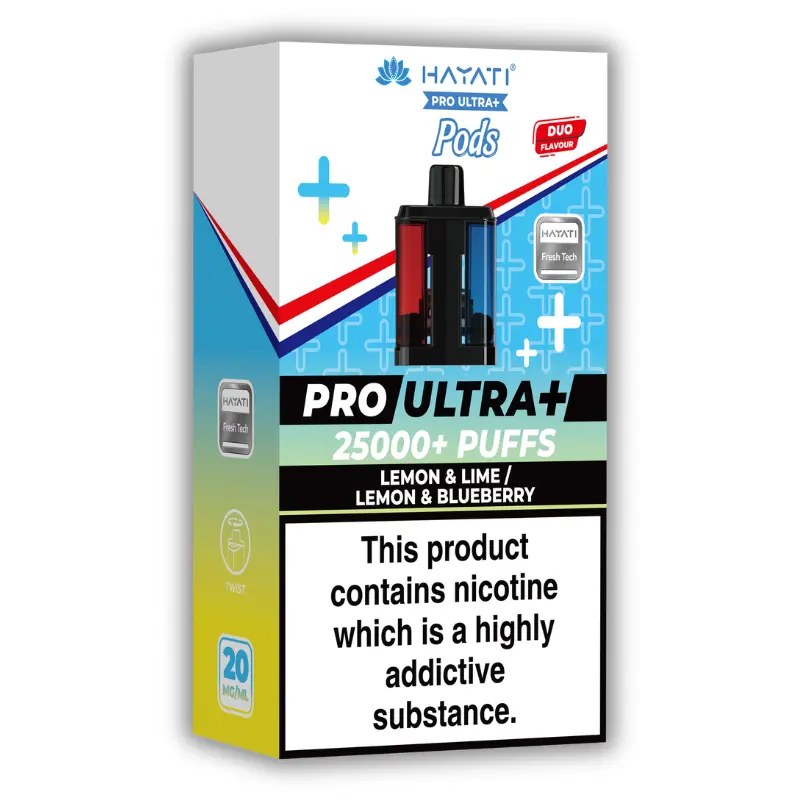
A single replacement pod for the Hayati Pro Ultra Plus, £7.99, holding 22ml of liquid at 20mg nicotine salt, split between Lemon Lime in one position and Lemon Blueberry in the other. Hayati put a laboratory rating of up to 25,000 puffs on it. No hardware is in the pack, and a pod on its own will not produce anything without a Pro Ultra Plus body to sit in, so anyone who has arrived here without the device wants the £11.99 kit version of the same pairing instead.
Almost nobody buys a bare pod as an introduction. You are here because you finished one, and that changes what is worth writing. The taste is settled. The case for whether two lemon-led liquids in one housing count as a pairing at all is argued out on the kit listing, which lands on variation rather than two separate flavours, and repeating that argument here would waste your time and the page's length. The same listing carries the mechanical finding that actually matters in use: carry-over across the shared wick runs in one direction only. A berry trace is audible in the citrus for roughly the first dozen draws after a swap, while a citrus trace is swallowed whole by the blueberry and never surfaces. From that comes the standard advice for this pod, which is to work the blueberry side down before you settle into the citrus.
Fine as a tip. The second time you buy the pod it stops being a tip. You already know the order, so you run it, and from then on the order is not a suggestion you are testing, it is a schedule you are following on every pod you will ever own. That is a different situation and it has consequences nobody sets out, because the advice was written for somebody holding their first one.
Three of those consequences are worth your attention before you press reorder. A permanent running order quietly assigns each half of the pod to a different stage of the coil's working life. It makes your second pod taste measurably unlike your first without anything in the product having changed. And over three or four pods it pushes you towards treating one half as the pod and the other as a queue to get through, which is the point at which a single-flavour listing becomes the honest purchase. This page works through all three.
What a permanent running order does to the hardware
One coil, two halves, two different ages
Everything below follows from a single structural fact, so it is worth stating plainly. The two liquids are held apart inside the pod and a twist of the collar selects which of them reaches the mesh, but there is only one mesh. It is fitted at manufacture, it is not a serviceable part, and it processes every millilitre of the 22ml regardless of which side that millilitre came from. Roughly 11ml sits behind each position.
Mesh does not stay the same across 22ml. It accumulates residue from sweeteners, it wicks fractionally slower as the cotton compacts, and the profile it produces shifts. None of that is a fault and all of it is gradual. What matters is that a coil eleven millilitres in is a different instrument from the one you fitted, and a fixed running order decides in advance which flavour gets which instrument.
Run the blueberry down first and the blueberry is consumed entirely across the fresher half of the coil's life. The Lemon Lime side then starts from a mesh that has already worked through eleven millilitres, and it carries on from there to the end. Do that on every pod and the assignment is permanent: the berry always gets the good hardware, the citrus always gets the tired hardware, pod after pod, and you never once taste either of them in the other condition.
Why that lands unevenly on this particular pairing
If both halves aged identically the assignment would not matter. They do not. Citrus is the profile most sensitive to coil condition in the whole catalogue, for a reason that has nothing to do with quality: the aromatics that make a lemon read as bright are light and volatile, they sit at the front of the draw, and they are the first thing a working mesh stops delivering properly. What survives longer is the body underneath, which on the Lemon Lime side is a modest amount of sweetener and a little lime resin. So a lemon on worn mesh does not go faint. It goes rounder and duller, and it reads as slightly sweeter than it is.
Blueberry behaves in the opposite way. It is a heavy, low, persistent note with almost no volatile top, and it is about as robust as fruit flavouring gets. A blueberry on a mesh eighteen millilitres into a pod is still recognisably itself. The dark middle is the part of the profile doing the work and the dark middle is durable.
Put those two together with the running order and the problem becomes visible. The advice hands fresh mesh to the half that needs it least and worn mesh to the half that shows wear first. The Lemon Lime reserve, which is the sharper, drier and more fragile of the two, is systematically encountered in its least accurate condition on every pod you buy.
The advice is still right, which is the awkward part
It would be neater if the conclusion were that the order is wrong. It is not. It is a trade, and on any individual pod it is the right one, because the two distortions it chooses between are not equal.
Ghosting is immediate, obvious and repeated. Every single swap muddles a dozen draws of the citrus with a berry residue that has no business being there, and if you switch a few times a week you are spending a meaningful slice of the Lemon Lime side's life tasting something that is neither half. Coil ageing is slow, one-directional and, crucially, something you can mentally discount once you know it is happening. Choosing the drift over the muddle is sound.
What the advice is not is neutral across repeat purchases, and that is the bit that goes unsaid. Told once to a first-time buyer, it improves one pod. Adopted permanently, it bakes a bias into every pod after it, and the bias runs against the half with the least margin to give.
Why your second pod does not taste like your first
This is the complaint that turns up most often on repeat purchases across the range, and on this pairing specifically it has a real cause rather than an imagined one. Three things change between pod one and pod two, and they do not all pull the same way, which is why the experience is hard to put a finger on.
The halves move further apart, not closer
Your first pod was an exploration. You turned the collar early and often, because that is what anybody sensibly does with two flavours they have not had before, and you were comparing them against each other in quick succession. Every one of those comparisons dragged blueberry across into the citrus draw. The Lemon Lime side you tasted on pod one was, a good deal of the time, a slightly sweetened and slightly rounded version of itself.
Pod two, run to a schedule, involves one swap. The citrus finally gets to be what it actually is, which is dry, sherbet-adjacent and thin through the middle. Most people read this as the two sides having become more distinct, and some conclude the batch is better. Neither is true. You changed your technique and stopped blurring the two together, and the pairing that reads as a near-miss on pod one often reads as a properly separated pairing on pod two. That is the good news and it is genuine.
The citrus loses its ceiling at the same time
Here is the offsetting change. Somewhere in that first pod, because you were switching around early, you tasted the Lemon Lime side on a coil that was close to new. That is the brightest that half of this pod ever gets: the peel note at full volume, the lime's green edge sitting clearly behind it, and a finish that stops sharply rather than trailing.
Under a permanent running order you will never have that again. By the time the citrus goes live it is inheriting a coil eleven millilitres in. What you get is accurate but lower: a truer picture of the liquid with the top of it already softened. Sharper in separation, quieter in peak. That combination is genuinely confusing to describe, and it is exactly what people mean when they say a reordered pod is somehow not the same without being able to name what moved.
Recency does the rest
The third effect is psychological and it compounds. Whatever you tasted in the last few days before a pod died is what you carry into the next buying decision, because that is the memory closest to hand. Under this running order those last few days are always Lemon Lime, always on the most worn mesh the pod will ever have, and always after several weeks of the same two flavours.
So every pod ends on the same low note, and every reorder decision is made in the shadow of it. Across three or four cycles the verdict drifts downward without a single thing having changed in the product. People attribute the drift to the liquid, or to a supplier having altered something, or to the pod having been in stock too long. Usually it is the running order, correctly followed, producing a predictable ending.
The one-pod test that settles it
You can find out which of these applies to you for the price of a single pod and no extra money at all. Run the next one backwards. Citrus first, berry second, and accept the ghosting when you make the swap, which will be mild in that direction anyway because a lemon trace disappears under blueberry.
That inversion gives you the flattering assignment for both halves rather than the accurate one. The Lemon Lime side gets fresh mesh and comes in at full brightness. The Lemon Blueberry side takes the worn second half, which it is well equipped to survive, because a dark fruit shows coil age far less readily than a peel note does. If the inverted pod is obviously better, your dissatisfaction was never about the liquid and you have a habit to change. If it is much the same, the pairing has simply stopped holding your interest, and the second half of this page is about what to do with that.
There is also a middle setting, which is to split each side into two runs: berry, citrus, berry, citrus. It costs you one extra muddled swap and it shares the coil's ageing between the two halves rather than giving one half all the good mesh. On a pairing where both sides lead with the same fruit, the muddle is less destructive than it would be on a pod built out of opposites, which is a small mechanical advantage of two lemons sharing a housing and one worth taking.
The flavour, compressed, and what the order does to it
The full account of both halves, written out draw by draw, is on the kit listing and is not worth printing twice. What follows is enough to orient a returning buyer, with the emphasis on how each side behaves under a schedule rather than on a first tasting.
Lemon Lime. Peel-forward lemon at the front, lime widening the sourness behind it rather than deepening it, and a dry finish that stops short. Very little body in the middle. Sweetness is moderate and exists mainly to keep the acid civil. On fresh mesh this is one of the more precise things in the format. On the back half of a coil it thickens and sweetens, and the dry stop at the end softens into something that trails. Both readings are the same liquid.
Lemon Blueberry. The same opening lemon, essentially unchanged, and then a low, jammy blueberry that fills the hollow the lime version leaves and carries the draw well past the point the citrus has finished. It is the fuller of the two rather than the sweeter in any sugary sense. It is also the more forgiving, and under the standard order it is the half you will meet in the best condition every time.
Sweetness and temperature. Both sides sit below the middle of the range on sweetness, with the citrus lower than the berry. Neither side carries ice, menthol or any cooling agent, which is more consequential than it sounds on a pod this large. A coolant is durable across a coil's life in the way a peel note is not, so pods with a cold half tend to hold their apparent freshness late while this one relies entirely on fruit acid to stay lively. Soften the acid and nothing is left holding the line. That is the honest reason this pairing fades in its last quarter more noticeably than a cooled one such as Fresh Mint / Blue Razz Mint does.
What it is not. There is no lemonade construction here, no fizz and no diluted sugar-water base. There is no dessert element, no cream, no biscuit. The sharpness in the citrus half comes from fruit acid rather than a sour coating, so it is dry rather than mouth-watering. And the blueberry is not the headline it would be on a berry-led pod: for that reading the range offers Mr Blue or Blueberry Raspberry, and the broader group is gathered on the Blueberry Vapes shelf.
Are you buying a pairing, or buying one half of it?
A running order does something else besides distributing coil wear. It removes the one thing a dual pod exists to provide, which is a choice available at any moment. If you have committed in advance to berry then citrus and you stick to it, you are not switching between two flavours. You are running two single-flavour pods in sequence that happen to share a housing and a coil. Whether that is what you want is a real question and it deserves asking honestly rather than being assumed away.
Four tells worth being straight with yourself about
None of these requires you to taste anything. They are all about behaviour you can observe in your last pod.
Does your consumption slow down in the second half? If the pod took ten days to get through the blueberry and three weeks to finish the citrus, the citrus is not a flavour you chose, it is the part of the purchase you are working through. That pattern shows up as a pod that seems to last unusually long, which people report as good value and is generally the opposite.
Do you hurry the first half? The reverse pattern is just as telling. Some people find themselves chain-running the blueberry to get it out of the way, which wastes the freshest part of the coil on a flavour they are treating as an obstacle. If the interesting part of the pod only begins when the collar turns, you are a citrus buyer paying for a berry preamble.
Do you ever turn the collar back? Under a schedule you should not need to, but the instinct is informative. Somebody who occasionally reaches back for a blueberry draw in the fourth week is using both halves. Somebody who has never once gone back has mentally retired that side long before the pod did.
Which half would you actually miss? Answer it quickly rather than diplomatically. If one name comes out immediately, that is the flavour you are buying, and the other one is packaging.
What the single-flavour alternative actually trades
If the tells point one way, the obvious move is a pod with only the half you want in it, at the same £7.99. For the citrus that is Lemon Lime Hayati Pro Ultra Plus Pods, which is the direct single-liquid version and the shortest route out of the running-order problem entirely. For the berry, Mr Blue and Blueberry Raspberry are the standalone options in the same format.
The trade is not the one most people expect, and it is worth setting out because it cuts both ways. A single-flavour pod gives you the flavour on fresh mesh from the very first draw, which on a citrus liquid is a real gain and the whole point. What it also gives you is the entire ageing arc of one coil applied to one profile. You will ride a lemon from its brightest condition all the way down to a mesh twenty-two millilitres in, and on a profile whose top note is the first casualty, that descent is visible for the whole second half of the pod.
The dual under a fixed order does something odd in comparison. Neither flavour experiences the full arc. The berry sees only the first half and the citrus only the second, so each half is more consistent within itself than a single-flavour pod would be, even though one of them is consistently worse off. If what irritates you about large pods is the slow decline from fresh to finished, a divided pod is genuinely better at hiding it, and that is an argument for the format that the format does not make for itself.
So the choice is not simply better or worse. A single lemon pod gives you a higher peak and a longer fall. This pairing under a schedule gives you a shorter fall on each half and no peak at all on the citrus. Which one suits depends on whether you would rather have a good week and then a mediocre one, or two adequate ones.
When the answer is neither
There is a third possibility, which is that the running order has done its job so thoroughly that both halves have become predictable and the problem is not which one to keep but that neither is surprising you any more. Two liquids that already share a fruit make for a very long spell of one idea when you spread them over 22ml. If that is where you are, the fix is a different pairing rather than a subtraction from this one, and the next section covers the sensible directions.
Specification, and the number that is not on it
| Product | Lemon Lime / Lemon Blueberry Hayati Pro Ultra Plus 25K Pods |
| Brand | Hayati |
| SKU | HPU-25K-PODS-LEMON-LIME-LEMON-BLUEBERRY |
| Price | £7.99 |
| In the pack | One prefilled pod. No device, no charger, nothing else. |
| Needs | A Hayati Pro Ultra Plus device you already own |
| Liquid volume | 22ml total, prefilled |
| Division | Two separated sides, in the region of 11ml each |
| Side A | Lemon Lime, dry and sharp, short finish |
| Side B | Lemon Blueberry, same opening, rounder and longer |
| Switching | Rotating collar at the mouthpiece |
| Nicotine | 20mg nicotine salt, no other strength offered |
| Cooling agent | None declared on either side |
| Coil | Built into the pod, replaced with it |
| Manufacturer rating | Up to 25,000 puffs, produced in laboratory testing |
Most of that table repeats on every listing in the format, so rather than walk through it, here is the row that is missing.
There is no specification for coil condition at any point in the pod's life. Hayati publish the total volume and a puff rating, and both of those describe the pod as a single undivided quantity. Nothing on the sheet acknowledges that the eleven millilitres you draw first and the eleven you draw second are processed by hardware in two different states. That is not an omission you could reasonably expect a manufacturer to fix, since the variables are yours, but it does mean the one factor that most changes how this pod tastes is entirely absent from the only document describing it.
Two other rows deserve a comment. The 20mg figure is the UK maximum and is what every prefilled pod in this range carries, with no lower option listed for these flavours. Nicotine is addictive, the strength here is fixed by the product, and on a repeat purchase it is a decision you quietly remake every time rather than one you took once. The puff rating is a bench figure, taken from a rig that inhales identically for hours, which makes it fair for lining two products up beside each other and close to useless as a forecast of your own fortnight. Its better reading on a pod like this one is as a statement of workload: an indication of how much liquid one non-serviceable mesh element is expected to process before it is done.
Several things buyers ask about are not published for this pod and are not stated here as a result. Coil resistance, airflow and the wattage the device runs at appear nowhere in its specification. Numbers for all three circulate, they are inferences rather than manufacturer figures, and repeating them on a product page is how an invented specification becomes a fact everyone cites.
Where to go next, depending on which tell fired
If the citrus is the half you want
Lemon Lime Hayati Pro Ultra Plus Pods is the straightforward answer: the same citrus idea, the whole 22ml of it, and no collar to schedule. If pure lemon and lime gets wearing by the third session of a day, Orange Lemon & Lime adds the low-acid member of the family and fills the hollow middle that a two-citrus blend always has. Both sit with the rest of their group on the Lemon Lime Vapes shelf, and the wider Lemon Vapes shelf takes in the lemon-led profiles across every Hayati format.
For a citrus that keeps a second option without keeping a second lemon, Lemon & Lime / Summer Dream sets a subdued mixed fruit against the sharp side, and Blue Razz GB / Lemon & Lime puts a chewy sugared blue raspberry there instead. Both change the running-order calculation, because the second half is no longer a relative of the first and a swap is a genuine change of register rather than a change of texture.
If the blueberry is the half you want
Mr Blue is the standalone blueberry in the format and Blueberry Raspberry adds a tangier berry over the top of the same base. If you want the berry with a second option that is still a berry, Blueberry Raspberry / Mr Blue and Blueberry Raspberry / Blueberry Raspberry Cherry are both intensity steps rather than contrasts, which means the running order matters far less on them. Two robust halves age at a similar rate and neither is fragile enough to be spoiled by inheriting a worn coil.
If what you liked was the lemon sitting over a berry rather than under one, Blueberry Raspberry Lemon inverts the hierarchy entirely: three fruits blended into a single liquid, berries leading, lemon arriving late as a cut. There is no collar on it and no order to plan, which for a repeat buyer tired of scheduling is part of the appeal. The same liquid comes as a complete kit if you are replacing a device at the same time, and the whole family sits on the Berry Vapes shelf.
If the running order itself is what you are tired of
The order problem exists because this pod has one fragile half and one durable one. Pairings built from two durable halves do not have it, and that is an underrated reason to pick a confectionery pod rather than a fruit one. Blueberry Cotton K / Raspberry Cotton K keeps a spun-sugar base constant and moves the fruit over it, Blueberry H'Bubba / Watermelon H'Bubba does the same with bubblegum, and Red Razz GB / Blue Razz GB and Blue Razz Cherry / Blue Razz GB pair two versions of the same sweet-shop register. On all of those you can switch daily and lose nothing, because there is no delicate top note for a worn mesh to take away. The cost is sweetness: every one of them sits well above this pod on that scale.
The opposite move is worth naming too, because it is the one people reach for and it makes the order question harder rather than easier. Anything with a cooled half has the same asymmetry this pod does and more of it, since a coolant leaves a persistent mark on a wick that fruit acid does not. Blue Razz Pineapple / Strawberry Ice and Straw' Cranberry Cherry / Strawberry Raspberry Ice both put cold on one side only, so they need a running order of their own. Fresh Mint / Blue Razz Mint avoids the issue by cooling both halves.
For a clean break from fruit altogether, Blackcurrant Lemonade takes the soft-drink route and reads drier than its sugar level suggests, while Raspberry Cola is the furthest thing from a citrus pod that this shelf sells.
If you want the same idea in a smaller commitment
Twenty-two millilitres is a long run to give to any one decision, and a shorter pod is a perfectly reasonable way to test whether you still like a profile before committing again. Blueberry Raspberry Cherry Hayati Pro Max Plus Pods puts three berries into one liquid on the mid-sized system for £5.49. Blueberry Cherry Cranberry Hayati Rubik Pods, £3.99, uses cranberry for the sharp lift that lemon supplies here. Both are different hardware rather than refills for this device, so check what you own before ordering. The Hayati Prefilled Pods & Refills shelf sets out every prefilled format side by side, and the Hayati Pro Ultra Plus Pods shelf is the right place to browse if you are staying with this device. Anything recently added shows up under New Products.
Running the pod to a plan
General pod handling applies here the way it applies everywhere. What follows is only the part that is specific to keeping a deliberate order on two lemon-led liquids and one shared coil.
Mark the collar before you fit it, not after. There is no indicator showing which side is live, and under a schedule that matters more than it does under free switching, because you are trying to know how far into the plan you are rather than simply what you are tasting. A pen mark aligned with one position takes seconds. The useful version is to mark the berry position specifically, since that is the one you start on and the one you should not be returning to.
Resist the mid-run sample. The single most common way a running order gets undone is turning the collar back for one curious draw of the other side. It does not cost you one draw. It re-seeds the wick, and if the curious draw was blueberry you have just reintroduced berry into a citrus run you had deliberately kept clear. If you want to check the other half, do it properly with a dozen draws or not at all.
Take a reading at the handover. The moment you turn the collar is the only point at which you can judge the citrus half against a coil of known age, so pay attention to it rather than letting it pass. What the citrus tastes like in its first day is your baseline for the rest of the pod, and it is also the comparison you will want when the next pod arrives and you are trying to work out whether anything actually changed.
Watch for the convergence tell. On this pairing the sign that a coil has had enough is unusually clear, because the two halves are relatives. As the mesh tires, the Lemon Lime side loses its top and gains body, which moves it towards the Lemon Blueberry side. When you can no longer tell the two apart with the collar in front of you, it is not the liquid that has gone. It is the coil, and the pod is into its last stretch regardless of how much is left in it.
Slow down late in the second half. A mesh that has already processed most of a pod re-saturates more slowly than a new one, and drawing in quick succession at that stage outruns the wick. What comes back on a lemon is heat and thinness with the top note scorched away, and that is both the poorest thing this pod is capable of producing and the most likely reason somebody writes the flavour off unfairly.
Heat is the enemy of the half you have not started. This one is specific to a schedule. Under a fixed order the Lemon Blueberry supply is being drawn down while eleven millilitres of citrus sit untouched for two or three weeks, and citrus aromatics are the first casualty of warmth. A pod living on a dashboard or a sunny sill loses the top of the unused side before you ever reach it. Somewhere cool and out of direct light solves it and costs nothing. Store it where children and pets have no access.
Let a new pod settle. Liquid shifts about in transit, so whatever the pod does in its opening puffs is not a fair sample of anything. Stand it up for sixty seconds, take three or four slow pulls, and only then decide what you think. A returning buyer has an expectation ready and will apply it instantly, which is precisely why the first minute is the wrong moment to do so.
Retire it into the right bin. There is mesh and a film of liquid left in a spent pod, which puts it outside household waste and inside the remit of a vape retailer's collection point or a local recycling facility.
Questions that come up on a second or third pod
Is a device included?
No. The pack contains one prefilled pod and nothing else, which is why it is £7.99 rather than £11.99. If you need hardware as well, the same two flavours are listed separately as a complete kit with a Pro Ultra Plus device included.
Should I really always run the blueberry side first?
On your first pod, yes, because it spares the citrus the berry residue that carries across the shared wick. As a permanent habit it has a side effect worth knowing about: the citrus then always inherits a coil that is already halfway through its life, and citrus shows coil age more than blueberry does. Inverting the order for one pod is a cheap way to see which distortion bothers you more.
My new pod tastes different from the last one. Has something changed?
Usually not in the product. Two things move between a first pod and a later one: you stop switching around, which makes both halves read more distinct, and the citrus never gets the fresh coil it got by accident the first time, which lowers its peak. Those pull in opposite directions and the combined effect is hard to name, which is why it tends to get blamed on the batch.
Do the two halves hold 11ml each exactly?
Roughly. Hayati publish 22ml as a total and do not break it down, so treat a little over or under half per side as the working assumption rather than a specification. Neither flavour runs the full length of the pod.
Is there any cold element in this pod?
No ice, no menthol and no coolant is declared on either side, and none is apparent in use. Fruit acid supplies all the crispness, and acid does not hold up the way a coolant does: it softens as the mesh ages. If cold on the exhale is what you are after, the mint pairings are where to look.
Which half tends to get left behind?
Whichever one you did not schedule first, because the coil ends the pod rather than the liquid does. Under the usual order that means citrus, and if you are consistently retiring pods with a visible amount of Lemon Lime still inside, the single-flavour Lemon Lime pod is the purchase that matches how you actually use the format.
Can I top the pod up or replace the coil?
Neither. No filling arrangement is described anywhere in this product's specification, and the mesh sits inside as part of the unit rather than as a component you can change. From the moment the seal is broken the pod is one committed item.
Will the two sides taste less different as the pod gets older?
Yes, and that convergence is the most reliable signal the format gives you. The citrus half loses its bright top and gains body as the mesh works, which moves it towards the berry half. Two sides that were clearly separable in week one and are hard to distinguish in week four are telling you about the coil, not about the liquids.
Is a lower nicotine strength available for these flavours?
Not in this pairing. The listing gives 20mg nicotine salt and offers nothing else, so the product settles the strength rather than you. Nicotine is addictive, and anyone for whom 20mg is above their usual level is better served looking at a format that publishes the figure they want than buying this on optimism.
How does this compare on sweetness with the rest of the shelf?
Both halves sit under the midpoint, with the citrus lower than the berry. Nothing here approaches the confectionery end of the format, and the sweet-shop naming conventions are a reliable guide: a GB, a B'Gum or a Cotton K in the title marks a pod substantially sweeter than either side of this one.
What is the puff rating actually good for?
Ranking products against each other, and not much else. It comes off a machine drawing to a fixed pattern, so it says nothing reliable about your own week. Read it as an indication of the workload one non-replaceable coil is designed to absorb across the full 22ml.
Is it worth keeping a spare pod of a different flavour alongside this one?
It solves a different problem from the one this page is about. A second pod gives you a change of register whenever you want it, which turning the collar on this pairing does not really provide, since both halves lead with the same fruit. Whether that is worth the outlay depends on how much the sameness bothers you.
The short version
This is the refill, at £7.99, for a device you already own: 22ml of 20mg nicotine salt split between a dry, peel-forward Lemon Lime and a rounder Lemon Blueberry built on the same opening note. Hayati rate it in the laboratory at up to 25,000 puffs. The flavour case is made on the kit listing and does not need remaking.
What is different about buying it a second time is that the recommended running order has become a permanent one, and a permanent order is not the same thing as a good tip. It hands the fresher half of a single shared coil to the blueberry, which barely needs it, and hands the worn half to the citrus, which shows wear first. That makes pod two read as better separated and quieter at the same time, and it means every pod ends on the same fading note just as you are deciding whether to reorder.
Three responses are reasonable. Invert the order for one pod and find out whether the citrus was ever the problem. Keep the pairing and accept the trade, alternating the order between pods to keep your own judgement honest. Or admit that you have been buying two sequential single-flavour runs and buy an actual single-flavour pod, at the same price, with the whole coil behind it. The one response that is not worth making is reordering the same pairing, running the same order, and expecting a different ending.
Strictly for adults aged 18 and over. Nicotine is an addictive substance.
You might also like


