
Home / Hayati Pro Max 70-30 E-Liquid / Vimbull Ice Hayati Pro Max 70/30 E-Liquid
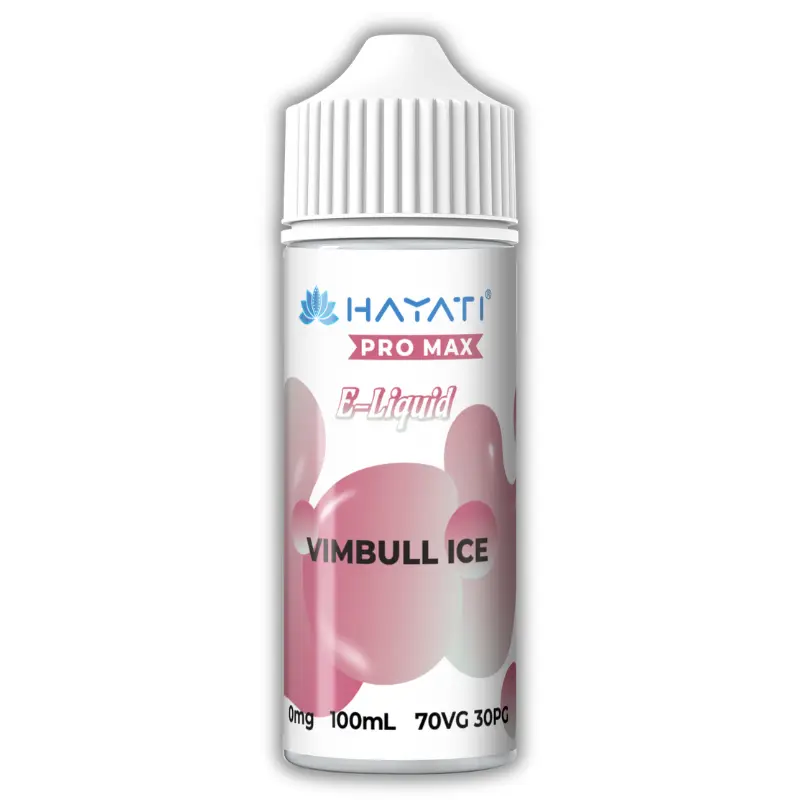
Hayati · Pro Max
Vimbull Ice Hayati Pro Max 70/30 E-Liquid
£6.99
✔ In stock — ready to ship
Genuine Hayati
Free over £20
Same-day dispatch
Secure checkout
Vimbull Ice in the Hayati Pro Max 70/30 line is a 120ml bottle listed at 0mg, priced at £6.99, mixed at seventy parts vegetable glycerol to thirty parts propylene glycol. Four numbers, and the last of them is the one that decides everything else. A ratio weighted that far towards glycerol is not a cosmetic variation on the bottles around it. It is a different physical liquid, it behaves differently in hardware, it presents flavour differently at the coil, and it suits a different sort of device from almost everything else this shop sells.
That is the argument this page makes, and it is worth stating plainly at the top because the listing itself does not make it. On a shelf page the 70/30 bottle and the even-ratio bottle sit side by side at the same price, in the same size, with the same flavour name printed on both, and the only thing separating them is a pair of numbers most buyers scroll past. Those numbers are the product. Everything else about the two bottles is identical.
There is a second thing worth flagging before the reasoning starts, because it cuts against the flavour rather than for it. Vimbull Ice is a cordial build. Hayati describe it as a dark blackcurrant and grape concentrate character lifted with the sugary sharpness of an energy drink and closed with cooling, which is to say it is already one of the sweetest and densest profiles on the shelf before anything happens to it. Glycerol is faintly sweet in its own right. Putting a syrup character into a glycerol-heavy base is therefore a compounding move rather than a balancing one, and the cooling is the only element in the blend pulling in the other direction. Whether that produces a richer version of the flavour or a blunter one is the question the middle of this page works through, and it reaches an answer rather than leaving it open.
The third thread is the name, which is doing something unusual and deserves an honest paragraph rather than a wink. Nothing below is a tasting note dressed up as a measurement. Hayati publish a ratio, a volume, a strength and a paragraph of descriptive copy, and where a conclusion here goes past those four things it is labelled as reasoning from published properties rather than presented as observation.
Twenty flavours, two ratios, and only one variable between them
Start with the shape of the range, because it turns out to be the cleanest evidence available and nobody has to take anyone's word for it. The shop lists 492 products. Of those, 105 publish a base ratio at all. Eighty-five of them are even splits and twenty are weighted to glycerol. The remaining 387 listings, which is everything prefilled and every pouch, publish no ratio whatsoever, so nothing on this page claims to know what is inside them.
Now narrow it. Of the eighty-five even-ratio listings, sixty-five are 10ml bottles carrying nicotine and twenty are 120ml bottles at 0mg. That leaves forty large bottles in total: twenty at 50/50 and twenty at 70/30. And here is the part that makes the range legible. Those two sets of twenty are the same twenty flavours. Every single one. Banana Ice, Watermelon Ice, Red Apple Ice, Pineapple Ice, Strawberry Raspberry Ice, Blue Razz Cherry, Blue Razz Gummy Bear, Blue Sour Raspberry, Blueberry Raspberry, Blueberry Cherry Cranberry, Lemon Lime, Watermelon Lemon Burst, Triple Mango, Juicy Peach, Fizzy Cherry, Fresh Mint, Rainbow, Summer Dream, Mr Blue and Vimbull Ice each exist twice, once in each ratio, at £6.99 and 120ml and 0mg both times. There is no flavour available in one ratio and not the other, in either direction.
That is a rare thing to find in a catalogue of this size and it is genuinely useful. Hayati have held every other variable constant and moved one. Same concentrate name, same bottle, same strength, same price, same shelf furniture. If you want to know what a base ratio does to a flavour, this range is set up to tell you, and you can test the answer on whichever of the twenty you already know best rather than taking a general principle on trust.
It also fixes the purchase decision in a way that is easy to state. Choosing between the two Vimbull bottles is not a choice between two versions of a taste. It is a choice about what hardware you own and what you want the liquid to do inside it. Get that backwards and the flavour will disappoint you for reasons that have nothing to do with the flavour.
The Hayati Pro Max 70-30 E-Liquid shelf holds all twenty of the glycerol-weighted bottles, and it is worth browsing as a set rather than as individual products, because membership of that shelf tells you more about how a bottle will behave than the flavour name on it does. The wider Hayati E-Liquids heading holds 105 listings and mixes the two bottle ratios in with the sixty-five small nicotine bottles, which makes it a worse place to shop if the ratio is what you are actually deciding on.
One honest qualification on the count. Twenty out of 492 sounds vanishingly small, and as a share of the shop it is, at a little over four per cent. But it is twenty out of the forty products that are bottles at all, which is half. The glycerol-weighted bottle is a minority format in this shop because this shop mostly sells prefilled hardware, not because the format is unusual in the trade. Both of those things are true and the second one is easy to lose sight of when you are looking at a shelf.
What glycerol actually does, and the three directions it pushes in
The corpus of pages on this site has covered the carrier split several times already, always from the even-ratio side, where the argument is about keeping a small coil fed and keeping a delicate note legible. The 10ml bottles own that discussion and there is no point restating it here. What has not been written is the view from the other end: not what an even split preserves, but what an uneven one adds, and what it costs to add it. Glycerol has three properties that matter, and each one pushes the finished liquid in a direction you can predict before you open the cap.
It is viscous, and viscosity is a rate limit
Glycerol is a thick, slow, syrupy liquid at room temperature. Propylene glycol is thin and runny and moves roughly the way water does. A base at seventy per cent glycerol is therefore substantially more viscous than a base at fifty, and the difference is not marginal. It is the difference between a liquid that soaks into cotton on its own and a liquid that needs pressure, capillary width and time to get where it is going.
Everything downstream of that follows from one question: can the wick refill itself between draws as fast as the coil is emptying it? That is a race, and the two sides of it are set by different parts of the device. The emptying side is set by how much power is going into the coil and how much surface area it has. The refilling side is set by how wide the feed slots are, how much cotton there is, and how fast the liquid can move through it. A thick liquid loses that race in narrow channels and wins it comfortably in wide ones.
Which is why the hardware direction here is not a matter of taste. Small pods for a restricted, narrow draw are built with small feed apertures and a modest volume of wick, sized for a thin liquid. Feed them something at 70/30 and the refill side of the race slows down while the emptying side does not, and the wick runs dry at the hot spot. Tanks built for a wide, open draw at higher power go the other way: big apertures, a lot of cotton, a mesh strip with a large surface area, and a liquid thin enough to flood them is a liquid that will leak past the seals and pool in the airflow. Hayati's own listing places this bottle with sub-ohm tanks and direct-to-lung kits on low-resistance coils, and sends the restricted-draw pod owner to the even-ratio bottle instead. That is their placement rather than a resistance figure recommended here, and this page does not name a coil value, because the listing does not publish one and the right value is a property of your tank rather than of the liquid.
It makes more vapour, which magnifies and dilutes at the same time
Glycerol is the component that produces visible aerosol. More of it in the mix means more condensed droplets per draw, a denser cloud, and a heavier, more coating sensation in the mouth. That is the headline reason the ratio exists and it is the reason most people who buy it, buy it.
The part that gets less attention is arithmetical. A flavour concentrate is dosed as a percentage of the finished liquid, so the amount of flavouring in a millilitre of the 70/30 bottle and a millilitre of the even-ratio bottle is, as far as anybody outside the factory can tell, the same. But the 70/30 millilitre becomes a considerably larger volume of aerosol when it is vaporised. Spread the same quantity of flavour compound across a bigger cloud and the concentration per mouthful of vapour goes down, even though the total delivered per millilitre has not changed at all.
So the ratio magnifies the physical presence of the vapour and dilutes its flavour density in the same movement. Most people experience the two together and read the result as one thing, which is how you get the widespread impression that high-glycerol liquids taste muted. They are not muted. They are the same flavour spread thinner across more air, and whether that reads as generous or as vague depends entirely on what the flavour was built to do.
It is sweet, on its own, before any flavouring goes in
Pure glycerol tastes mildly sweet. Not sugar-sweet, and not sharp, but a soft, rounded, slightly cloying sweetness with a thick mouthfeel attached to it. It is a real taste, it is present in every draw, and it does not switch off when a flavour concentrate is added on top.
On most profiles this is either neutral or helpful. A tart liquid gets padded. A thin one gets body. A dry, astringent one gets something to sit against. The glycerol sweetness is genuinely doing work in those cases, and one of the small bottles on this shop makes exactly that argument for a tannic dark berry, where the base sweetness is what stops the astringency becoming unpleasant.
On a profile that arrived already sweet, the same property is a problem rather than a feature, and it is a problem of a particular kind: it is not additive noise but a fourth voice singing the same note. That is the situation this bottle is in, and the next section is about what it does to this specific liquid rather than to liquids in general.
What the ratio does to a cordial, and why this flavour is the hard case
A cordial is a concentrate, and concentrates assume what they will be diluted with
The most useful thing about the word cordial is that it names a manufacturing intention rather than a taste. A cordial is not a drink. It is a concentrate designed from the outset to be let down, and every decision in its formulation assumes something specific about what will do the letting down. The sugar level is set high because it is going to be quartered. The acid is set high for the same reason. The fruit character is pitched loud and slightly artificial because most of it is about to be diluted away. A cordial tasted undiluted is unbalanced on purpose.
What it assumes it will be diluted with is water. Water is thin, it is cold, it is neutral in taste, and it contributes nothing but volume. Dilution by water is subtractive. It reduces the concentration of everything in the syrup by the same proportion and adds nothing back, and the reason the finished drink tastes balanced is precisely that the diluent is inert.
Now put that concentrate character into a base that is seventy per cent glycerol, and look at the diluent. It is viscous where water is thin. It is warm and coating in the mouth where water is cooling and clean. And it is faintly sweet where water is neutral. On all three of the properties that make water a good diluent for a syrup, glycerol is the opposite. It still dilutes the flavour compounds, because the concentrate is still a small percentage of the finished liquid, but it dilutes them into something that is itself a mild syrup.
That is the crux of this page. A high-glycerol base does not let a cordial character down. It lets it down and then puts some of the syrup back, from a different direction and without any of the fruit or acid that made the original syrup interesting. The result is not a cordial at drinking strength. It is a cordial thinned with a second, blander syrup.
The energy-drink tang is the first thing that goes
Hayati's copy puts the sharp, sugary tang of an energy drink over the dark fruit as the lifting element, and that half of the build is structurally the more fragile of the two. An energy-drink signature is essentially a specific acidity married to a specific intense sweetness, with a faintly medicinal edge that makes it recognisable. Take the acid out and what is left is generic sweetness.
Two separate mechanisms in a 70/30 base work against that acid, and they are independent of each other, which is what makes the conclusion reasonably firm rather than a guess. The first is straightforward perceptual arithmetic: sweetness and sourness suppress each other, so raising the background sweetness of the base reduces how sour a fixed quantity of acid reads. The glycerol does not neutralise the acid chemically. It just makes it harder to notice. The second is the dilution effect described above, and acid notes tend to be among the smaller and more volatile molecules in a blend, which is exactly the fraction that suffers most when the same dose is spread across a larger aerosol volume.
Both mechanisms point the same way, and the tang is the element of Vimbull Ice that most depends on staying pointed. The dark fruit core can afford to soften, because a blackcurrant and grape character is a broad, heavy, low-pitched thing that survives being blurred. A tang cannot. It is either present as an edge or it is not present at all, and blurred sharpness is indistinguishable from no sharpness.
The cooling is the second, and the same lever moves it
Cooling is the one element in this blend pulling against sweetness rather than adding to it, which makes it the load-bearing part of the structure. Unfortunately it is also affected by the ratio, and in the unhelpful direction.
The mechanism is established elsewhere on this shop rather than here, and is worth citing rather than re-deriving. The Blue Frozen Hayati Pro Max Nic Salts page works through the solubility point properly: coolant compounds dissolve readily in propylene glycol and considerably less readily in glycerol, so a glycerol-weighted base carries the same quantity of coolant less efficiently, and the cold arrives softer and more diffuse, spread across a larger volume of vapour rather than concentrated into a small mouthful. That page goes as far as predicting the experience of anyone who has tried a 70/30 version of a cold profile and found it gentler than expected. The Blackberry Ice Hayati Pro Max Nic Salts page covers the same solubility ground from the flavour side. Neither conclusion is restated here as if it were new.
What is new is the consequence when you lay it over a cordial. The ratio raises the base sweetness and softens the cooling. One lever, two dials, both moving in the direction of a sweeter and rounder liquid. On a tart profile those two effects would partly cancel, because the sweetness gain would be welcome and the cooling loss would matter less against an acid backbone. On a profile whose entire counterweight to sweetness is the coolant, they compound. The 70/30 base adds sweetness to the side of the scale that was already heavy and takes weight off the side that was already light.
The cooling itself is declared and not quantified, which is the normal situation across this range. The word Ice in the title means there is a coolant present, and Hayati are reliable about declaring one in the name when it is there. The intensity is published nowhere, on this bottle or on any other. The Blue Frozen pods page ran a census of the cooling vocabulary across the catalogue and established that the terms Hayati use are not graded, so nothing can be read from the choice of word beyond the fact that a coolant exists. That finding stands and is not recounted here.
The verdict: blunter in outline, and more liveable at volume
Taking the three glycerol properties together against this particular flavour, the honest answer is that the 70/30 version of Vimbull Ice reads as blunter rather than richer, and the reasoning is not close enough to call it a toss-up.
Richer would require the ratio to add something the flavour lacked. It does add physical body, density and a heavier mouthfeel, and for a liquid whose character is syrupy in the first place, extra body is the one improvement with the least to offer. The flavour did not need weight. What it needed was definition, which is the property the ratio takes away, and it takes it away from both of the two elements that provide the definition: the acid tang by suppression and dilution, the cooling by solubility. Three of Vimbull Ice's four named components, the fruit core, the tang and the cooling, either gain nothing from the ratio or lose to it. The fourth, sweetness, gains a contributor it did not need.
So the outline blurs. The three-stage structure the name and the copy promise, dark fruit leading, tang lifting, cold closing, compresses towards a single sweet dense impression with the stages less separable than they are in the even-ratio bottle. That is the verdict, and it is a real mark against this version of this flavour rather than a hedge.
The verdict has a second half, though, and leaving it out would be dishonest. Blunter is not automatically worse, and on a 120ml bottle it may well be better. A hundred and twenty millilitres of a loud, pointed, high-acid cordial is a great deal of one insistent thing, and sharpness is the property that wears out its welcome fastest when you are working through a bottle over weeks rather than sampling it once. A rounder, softer, less pointed version of an already emphatic flavour is easier to stay with. If you bought the even-ratio bottle of something like this and found yourself reaching past it by the second week, the blunting described above is not a defect you should be avoiding. It is the correction you wanted.
Where that leaves the recommendation is specific rather than general. If you own a wide-airflow tank and you want Vimbull Ice as an all-day bottle, the 70/30 is the version that will still be tolerable in the fourth week, and the ratio is doing you a favour. If you want to hear what Hayati actually built, with the tang and the cold still sitting proud of the syrup, the even-ratio bottle is the one that presents it, and the shop lists Vimbull Ice at 50/50 in the same 120ml size at the same £6.99.
Where this reasoning could be wrong
Everything above is derived from the published ratio and from the known behaviour of the two carriers. It is not a tasting report and it should not be read as one. Three specific ways it could fail are worth naming.
Hayati may not use the same concentrate dose in both bottles. Formulators routinely lift the flavouring percentage in a high-glycerol mix precisely to compensate for the dilution effect, and if that has been done here then the blunting is smaller than predicted or absent. Nothing in the listing says either way, and the flavour percentage is not published for any bottle in the range.
The two bottles may not share a concentrate at all. A flavour name is a name, and this shop has already caught cases where Hayati's own descriptions of one flavour disagree between formats. The 70/30 and 50/50 descriptions of Vimbull Ice are close but not identical in emphasis, which is weak evidence of nothing much, since separate copywriting is the likelier explanation.
And individual sensitivity to coolant compounds varies a great deal more than sensitivity to sugar does. Somebody at the sensitive end of that range may find the softened cooling perfectly adequate to hold the sweetness in check, in which case the compounding argument above simply does not describe their experience of the bottle.
The bottle itself: 120ml, 0mg, and what the shortfill format is
The physical product is a 120ml bottle of liquid with nothing else in the package. No coil, no hardware, no measuring equipment, nothing that wears out. It is the simplest thing this shop sells and the only one with no failure mode beyond running out.
The nicotine strength on this listing is 0mg. That is stated here as a plain property of the product, in the same register as the volume and the price, and this page offers no view on strengths, no comparison between them and no guidance about what anybody should do with a bottle listed at zero. What Hayati publish about nicotine in this product is the number, and the number is nought.
The format needs describing because it is genuinely different from a small bottle and the difference is not obvious from a photograph. A shortfill is a bottle sold containing less liquid than the container can hold, with deliberate headroom left in it, and sold at 0mg. That is what the format is, as a matter of product description. Hayati's own tagging puts this listing in the shortfill group, which is worth knowing because the product title does not use the word, while the title of the even-ratio Vimbull bottle does. Two bottles of one flavour, tagged the same way, titled differently. That inconsistency is in the source data rather than an error on this page.
There is an ambiguity in the published figure that should be pointed out rather than smoothed over, because it affects how much liquid you are buying. Hayati state 120ml. They do not state whether that figure is the volume of liquid in the bottle or the capacity of the bottle itself, and for a shortfill those are conventionally two different numbers. Every large bottle in this range carries the same 120ml figure with the same silence attached to it. This page will not resolve it by inference, because a volume you can reason your way to is exactly the sort of claim the shop has been wrong about before. Treat 120ml as the number on the listing and nothing more.
What the format changes in practice is the shape of the purchase. A small bottle is a low-commitment way to find out whether you like something. A 120ml bottle is twelve times that volume for less than three times the money, which makes it a very different decision: cheap per millilitre and expensive to be wrong about. Nobody should be meeting a flavour for the first time at this size, and with a cordial profile that is doubly true, because sweetness tolerance is the single axis on which people differ most and the one you cannot establish from a description.
The bottle is also, in strict unit terms, the cheapest liquid the shop sells. At £6.99 for 120ml the cost is a shade under 5.9p per millilitre. A 10ml nicotine bottle at £2.49 works out at 24.9p, roughly four and a quarter times as much, and the cheapest prefilled millilitre in the catalogue is just over 33p, which the Rubik kit page computes across every prefilled format on the shop. That comparison is honest only in one direction, and the qualification matters: the bottles are listed at 0mg and the prefilled pods at 20mg, so the per-millilitre figures are measuring volume rather than measuring the same product. The bottle is the cheapest way to buy this liquid. It is not straightforwardly the cheapest way to buy anything else.
The name, what it is pointing at, and what does not follow from it
Vimbull is a portmanteau, and it is transparently one. The first element is a clipped form that this shop has already analysed at length. Hayati sell a flavour called Vim Ice across four listings on two prefilled platforms, and the Vim Ice kit page works through the decoding properly: the word is a truncation rather than a mood, it follows a house habit of clipping names the brand cannot print in full, and the trail through Hayati's own catalogue and the shop's category filing points to a long-established British dark-fruit concentrate whose name belongs to somebody else as a registered trade mark. That page reaches its conclusion carefully and tags it as an inference. None of that work is repeated here and the trade mark is not printed here either, for the same reason it was not printed there.
The second element is the same manoeuvre applied to a second drink. A clipped syllable, evidently pointing at an energy drink whose name is likewise somebody's property, welded onto the first. The compound is doing in two syllables what a sentence of description would otherwise have to do, which is to tell a British shopper that the target is a specific dark cordial crossed with a specific energy drink. Hayati's own copy confirms that reading in so many words, describing the profile as a blackcurrant and grape cordial character with an energy-drink tang over it, so this is not a case where the name has to be decoded against the brand's wishes. The name and the description agree.
The clipping habit is well attested rather than a one-off. Vim Ice does it, this listing does it twice in one word, and Bru Ice does it again to a third drink. Grape GB and Strawberry GB reduce a fruit and a confection to initials. Mr Blue and Mr Pink gesture at things through nicknames. Whatever else is going on, a Hayati flavour name that looks like a fragment usually is one.
Here is the part that matters commercially, and it needs saying flatly. Nothing follows from the name about what is in the bottle. Not a licence, not a partnership, not an endorsement, and above all not an ingredient. Neither of the two drinks the name evokes has anything to do with this product. What the name conveys is a flavour direction, which is a legitimate and quite efficient thing for a name to convey, and the evoking is done by suggestion precisely because the direct claim is not available to make. A liquid called Vimbull Ice contains a flavouring formulated to head in a recognisable direction, in the same way that a liquid called Fizzy Cherry does not contain carbonation.
Judged as a name it is unusually informative for this range, and the comparison is countable. Of the twenty bottles on the 70/30 shelf, thirteen are named after fruit, and the rest split between a mood name, a confection reference, a herb, a nickname and a texture word. Vimbull Ice is the only one of the twenty that points at manufactured drinks rather than at an ingredient. Set that against Mr Blue Hayati Pro Max 70/30 E-Liquid on the same shelf, which names nothing at all and leaves the buyer to work it out, and the portmanteau starts to look like the more considerate option of the two. A name that gestures at two well-known drinks tells you more about the taste than a name that gestures at a colour.
The label in full, and what each line governs
Everything in this table is taken from this product's own listing. Where Hayati publish nothing, the row says so rather than being filled in from a sibling product or from the range in general.
| Base ratio | 70 vegetable glycerol to 30 propylene glycol |
| Volume stated | 120ml |
| Nicotine | 0mg |
| Price | £6.99 |
| Cost per millilitre | Just under 5.9p at the stated volume |
| Flavour direction stated | Blackcurrant and grape cordial character with an energy-drink tang, finished cold |
| Coolant | Declared by the word Ice in the title; intensity not published |
| Format | Tagged by the shop as a shortfill e-liquid |
| Listed name | Vimbull Ice Hayati Pro Max 70/30 E-Liquid |
| Brand and line | Hayati, Pro Max 70/30 bottles |
| Shelves | Hayati Pro Max 70-30 E-Liquid, Hayati E-Liquids, Ice Vapes, New Products |
| Not published | Flavour concentrate percentage, coolant strength, coil resistance, whether 120ml is fill volume or bottle capacity |
The ratio row is first because it is the row this whole page is about, and because it is the only line in the table that changes anything physical about how the liquid behaves. Read the rest of the table against it and most of the entries make more sense.
The strength row and the format row are connected and neither of them is advice. A shortfill is a 0mg product by definition of the format, so the nought is a consequence of the category rather than a choice Hayati made about this particular flavour. All forty large bottles in this range carry the same figure.
The cost per millilitre row exists because it is the only fair way to compare a bottle against anything else in the shop, and because the headline price hides it. A bottle at £6.99 looks dearer than a pod at £5.49 and is roughly an eighth of the price by volume. Whether that is relevant to you depends entirely on whether you own hardware that takes liquid, which is the one thing a price comparison cannot tell you.
The final row is the important one and it is unusual to print. Four things a buyer might reasonably want are simply not in the data, and the concentrate percentage in particular is what would settle the central question of this page one way or the other. Anybody stating those figures with confidence has got them from somewhere other than Hayati.
Choosing between this and everything next to it
The same flavour in the other ratio
This is the comparison that matters most and the one the shop makes hardest to see, because the two listings sit on different shelves under slightly different titles. Vimbull Ice exists at 50/50 as well, in the same 120ml size, at the same 0mg, for the same £6.99. If you run a restricted-draw pod rather than an open tank, that is the version built for your hardware, and this page has already argued that it is also the version that presents the flavour with its edges intact. Two separate reasons pointing at the same bottle.
The rest of the thick shelf, sorted by how much the ratio suits them
Within the twenty glycerol-weighted bottles there is a useful spread, and the argument of this page gives you a way of sorting them. Profiles built on acid or on a thin bright fruit have the most to gain from a base that adds body, because the ratio is supplying something they lack. Profiles built on syrup have the least, because it is supplying more of what they already have.
At the acid end, Blue Sour Raspberry Hayati Pro Max 70/30 E-Liquid is the clearest case on the shelf of a flavour the ratio genuinely helps: a declared sour profile has an acid backbone strong enough to survive suppression and enough sharpness left over to benefit from padding. Lemon Lime Hayati Pro Max 70/30 E-Liquid and Watermelon Lemon Burst Hayati Pro Max 70/30 E-Liquid sit in the same category, with citrus doing the work that the tang does here, and rather more of it.
In the middle sit the plain fruits with cooling declared, which neither gain nor lose much. Banana Ice Hayati Pro Max 70/30 E-Liquid, Pineapple Ice Hayati Pro Max 70/30 E-Liquid, Watermelon Ice Hayati Pro Max 70/30 E-Liquid, Red Apple Ice Hayati Pro Max 70/30 E-Liquid and Strawberry Raspberry Ice Hayati Pro Max 70/30 E-Liquid are all single or double fruits with a coolant on top, and the softened cooling is the main thing the ratio costs them. Blueberry Raspberry Hayati Pro Max 70/30 E-Liquid and Blueberry Cherry Cranberry Hayati Pro Max 70/30 E-Liquid bring dark berries closer to this bottle's territory, and the cranberry in the second of those is the only genuinely dry note among them, which makes it the nearest thing on the shelf to a counterweight against a syrup build.
At the sweet end, where this bottle lives, the compounding problem repeats. Blue Razz Gummy Bear Hayati Pro Max 70/30 E-Liquid is a confection build rather than a cordial build, and it meets the glycerol sweetness the same way Vimbull Ice does, from a slightly different direction. Blue Razz Cherry Hayati Pro Max 70/30 E-Liquid keeps a little more acid in reserve and comes out better for it. If sweetness compounding is the thing you are trying to avoid, those two are the bottles to compare this one against rather than the fruits in the middle.
The thin bottles of the same size
Anyone who wants the 120ml economics without the viscosity has twenty even-ratio bottles to choose from at the same price. Banana Ice Hayati Pro Max 50/50 Shortfill E-Liquid, Red Apple Ice Hayati Pro Max 50/50 Shortfill E-Liquid, Blue Razz Cherry Hayati Pro Max 50/50 Shortfill E-Liquid and Strawberry Raspberry Ice Hayati Pro Max 50/50 Shortfill E-Liquid are the same four flavours in the other base. Comparing one of those against its glycerol-weighted twin, on the same device where your device allows it, is the cheapest experiment available for establishing what the ratio does to your own palate rather than in principle, and the conclusion will transfer to this bottle even though this bottle was not the one you tested.
The small bottles, which are a different purchase entirely
Sixty-five listings in this shop are 10ml bottles at 10mg on an even base, and they are not competitors to a 120ml shortfill so much as a different category of thing: a twelfth of the volume, a different strength, a different hardware target and a different reason for existing. They are also where most of the flavour writing on this site lives, which makes them useful reading even when they are not what you are buying.
For dark fruit near this bottle's territory, Black Mamba Hayati Pro Max Nic Salts and Blackberry Raspberry Hayati Pro Max Nic Salts are the closest small bottles. For the drinks angle specifically, Berry Lemonade Hayati Pro Max Nic Salt is a diluted-drink build on berry rather than a concentrate build, which is a genuinely different shape: thinner through the middle with the sweetness spread out rather than stacked. Blue Sour Raspberry Hayati Pro Max Nic Salt is the small-bottle version of the acid end, and Bubblegum Ice and Blue Fusion sit at the confectionery end of the same shelf for anyone who wants to place their own sweetness tolerance before committing to a large bottle of anything.
If you do not own a tank
A bottle is no use without hardware that takes liquid, and most of what this shop sells is prefilled. If that describes you, the 120ml economics are not available at all and the relevant comparison is between prefilled formats rather than between ratios. Blue Razz Pineapple / Strawberry Ice Hayati Pro Ultra Plus 25000 Prefilled Pod Kit at £11.99 is the far end of that market. The wider Ice Vapes shelf holds ninety-eight listings with cooling declared, across every format the shop carries, and the full Hayati range runs to 492. None of those prefilled products will accept liquid from a bottle, and none of the bottles will work without a refillable device.
Living with a large bottle of something this dense
A 120ml bottle is a long relationship rather than a purchase, and the practical notes that matter for this one are mostly consequences of the two things that make it distinctive: the volume and the viscosity.
Viscosity first, because it changes the mechanics of filling. A 70/30 liquid pours slowly and it settles into a tank slowly once it is in there. Give it longer than you would give a thin liquid before the first draw, and give it noticeably longer if the room is cold, because glycerol thickens appreciably as the temperature drops and a bottle that has been in a car overnight will be sluggish in a way that has nothing to do with the liquid being wrong. Warming it in the hand for a minute or two is enough to bring it back. The same property makes it slower to fill with and easier to overfill, since the level rises behind where you think it is.
Volume second, and this is where a cordial profile changes the arithmetic. A sweet, syrup-heavy liquid puts more residue on a coil than a thin, dry one does, because the compounds that make a flavour read as syrupy are heavier and they do not all vaporise cleanly. That shows up as a coil that darkens sooner and as a flavour that goes flat while the tank is still full. On this bottle the first thing to fade will be the tang, because it was the most fragile element to start with and it is the first to be buried under residue. The dark fruit and the sweetness will still be there long after the liquid has stopped being interesting, which makes flatness harder to notice than it would be on a thin citrus.
A practical consequence follows from that specifically for a 120ml bottle. You are going to be running this through more coils than a small bottle would ever require, so the point at which a coil stops presenting the tang is worth learning to recognise early, since it arrives well before the point at which the liquid tastes obviously burnt. If you are running the same tank for a second flavour, expect a cordial build to leave more of itself behind in the wick and the airflow than a fruit would, and plan the changeover accordingly.
Storage is straightforward and the reasons are chemical rather than anything else. Light and heat degrade flavour compounds over time, and a bottle this size will be open for long enough for that to matter in a way a 10ml bottle never is. A cupboard rather than a windowsill, cap fully seated between fills, and no particular need for refrigeration, which would only make a thick liquid thicker. A 120ml bottle is a substantial quantity of liquid to have in the house and it belongs somewhere children and pets cannot reach, alongside anything else you would store that way.
One last note on the volume as a commitment. Three or four weeks into a large bottle of a sweet cordial is when people discover whether they actually like it, and the honest advice is to have something unsweetened in rotation from the start rather than working that out the hard way. A mint or a plain dry fruit in a second tank costs very little and keeps the cordial tasting like a cordial rather than like the background.
Questions this listing tends to raise
What does 70/30 actually mean on this bottle?
Seventy parts vegetable glycerol to thirty parts propylene glycol, by proportion of the base liquid the flavouring is dissolved in. Glycerol is the thick, faintly sweet component that produces most of the visible vapour. Propylene glycol is the thin one that carries flavour compounds and wicks quickly. Weighting the mix towards glycerol makes the liquid more viscous, more vapour-producing and slightly sweeter before any flavouring is counted.
Will this work in a small refillable pod?
Hayati's listing places this ratio with sub-ohm tanks and direct-to-lung kits on low-resistance coils, and directs restricted-draw pod owners to the even-ratio version instead. The underlying reason is wicking rate: a thicker liquid moves through cotton more slowly, and narrow feed channels sized for a thin liquid cannot refill fast enough to keep up with the coil. The right answer depends on the specific device rather than on a rule, but the direction of the effect is not in doubt.
What nicotine strength is this?
0mg. That is the figure on the listing and it is the only thing Hayati publish about nicotine in this product.
What is a shortfill?
A bottle sold containing less liquid than the container holds, with headroom deliberately left in it, at 0mg. It is a format description rather than a flavour or a quality marker. All forty of the 120ml bottles in this range are in that group, including both ratios of this flavour, and the shop tags this listing accordingly even though the product title does not use the word.
Is the 120ml figure the liquid or the bottle?
Not published. Hayati state 120ml and do not say whether that is the volume of liquid supplied or the capacity of the container, and for a shortfill those are conventionally different numbers. Every large bottle in the range carries the same figure with the same ambiguity, so nothing can be inferred by comparing listings either.
What is Vimbull meant to be?
A portmanteau of two clipped drink names, one a dark British fruit concentrate and the other an energy drink, neither of which can be printed because both are somebody's trade mark. Hayati's own description agrees with that reading, calling the profile a blackcurrant and grape cordial character with an energy-drink tang. Nothing about the name implies any connection to either drink or any ingredient from either, and there is none.
How cold is it?
Unknown. The word Ice in the title reliably means a coolant is present, and Hayati are consistent about declaring one when there is one, but no intensity figure is published on this bottle or on any other in the range. The glycerol-weighted base does affect how the cooling presents, carrying it less efficiently than an even base would and spreading it across more vapour, so expect it to read softer and more diffuse than the same coolant in a small bottle.
Is it the same liquid as the 50/50 Vimbull Ice?
Same flavour name, same brand, same 120ml, same 0mg, same £6.99, different base ratio. Whether the flavour concentrate underneath is identical is not published, and formulators do sometimes adjust the dose between ratios to compensate for the dilution effect. Treat them as two presentations of one flavour idea rather than as one liquid in two bottles.
How sweet is it?
Sweet, and this is the version of it that will read sweetest. A cordial character is built on concentrated syrup, the energy-drink element adds more sugar signature on top, and the glycerol-weighted base contributes a faint sweetness of its own. No sweetness figure is published for any product in this range, so that is a structural reading rather than a measurement.
Which of the two ratios should I buy?
It is a hardware question first. Open tanks with wide airflow want the thicker liquid; narrow restricted-draw pods want the thinner one, and putting either in the wrong device produces problems that get blamed on the flavour. If your hardware takes both, the even-ratio bottle presents the tang and the cooling with more definition, and the 70/30 gives more body and is the easier one to live with over 120ml.
Why is it so much cheaper per millilitre than everything else?
Volume, and the absence of hardware. A bottle at £6.99 for 120ml works out just under 5.9p per millilitre against roughly 25p for a 10ml bottle and just over 33p for the cheapest prefilled pod in the catalogue. The prefilled figures include a coil, a container and in some cases a device, and they are at 20mg while the bottles are at 0mg, so the comparison measures liquid volume rather than equivalent products.
Will it gunk a coil faster than a plain fruit?
A sweeter, syrup-heavier liquid leaves more residue on a coil than a thin dry one, so yes, expect shorter coil life than you would get from a light citrus or a mint. On this profile the tang is the first element to disappear as residue builds, while the dark fruit and the sweetness carry on for some time afterwards, which makes the fade harder to spot than it would be on a sharper flavour.
The short version
Vimbull Ice at 70/30 is 120ml of a dark cordial and energy-drink profile with cooling declared, at 0mg, for £6.99, in a base weighted three-quarters of the way towards vegetable glycerol. The ratio is the whole of what separates it from the identically priced even-ratio bottle of the same name, and it is a real separation: thicker liquid, more vapour, slower wicking, a sweeter base and a coolant carried less efficiently.
On this particular flavour that combination is a compounding one rather than a balancing one, and the verdict reached above is that it reads blunter rather than richer. A cordial character is a concentrate built to be let down by something neutral, and glycerol is not neutral. It dilutes the flavour compounds while adding sweetness of its own, and it softens the one element, the cooling, that was holding the sweetness in check. The tang loses twice over.
That is a mark against it and it is not the end of the matter. Over 120ml, a blunter version of an emphatic flavour is often the more liveable one, and the bottle is by a wide margin the cheapest liquid in the shop per millilitre. If you run a wide-airflow tank and want a sweet, dense, cold all-day bottle that will not exhaust you by the third week, this is a sound purchase. If you want to hear the flavour Hayati actually designed, with the tang and the cold still sitting proud, buy the even-ratio version of the same name. And if you run small pods, buy that one regardless, because this liquid is the wrong viscosity for your hardware and the flavour will get the blame.
Strictly for adults aged 18 and over. Nicotine is an addictive substance.
You might also like


