
Home / Hayati Pro Max Nic Salts / Blackberry Ice Hayati Pro Max Nic Salts
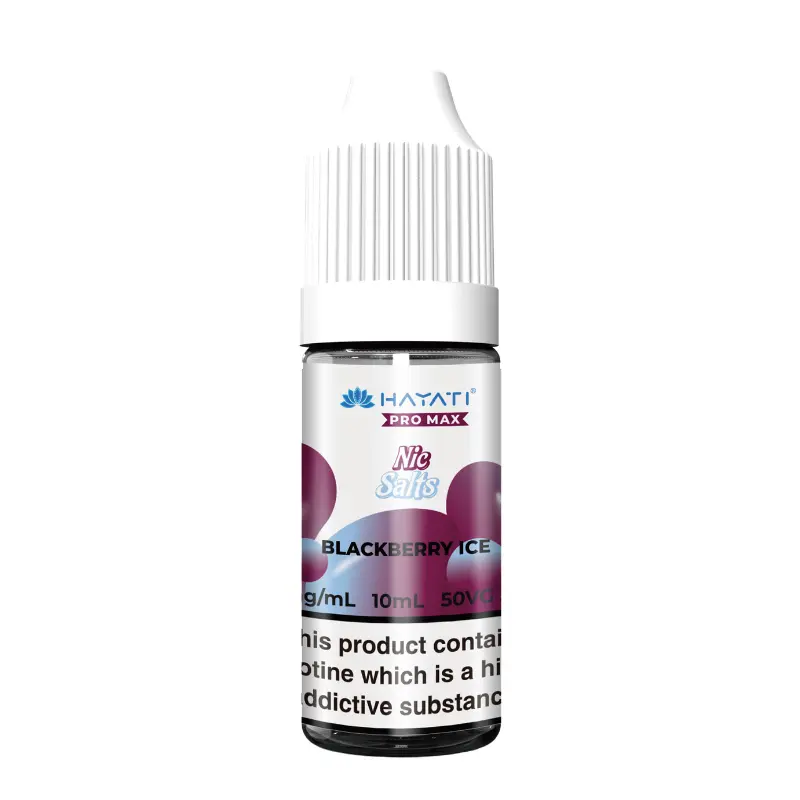
Hayati · Pro Max
Blackberry Ice Hayati Pro Max Nic Salts
£2.49
✔ In stock — ready to ship
Genuine Hayati
Free over £20
Same-day dispatch
Secure checkout
Blackberry Ice puts one fruit and one coolant in a 10ml bottle at £2.49, carrying 10mg of nicotine in salt form on a base that is half glycerine and half glycol. Two decisions define it before you open the cap. Hayati named a single berry rather than hiding behind a blend, and they declared cooling in the title rather than burying it in a profile line. Both of those are useful, and neither is as common on the Hayati Pro Max Nic Salts shelf as it ought to be.
The reason this page is worth reading before you order is that blackberry is not interchangeable with the other berries, and the difference is structural rather than a matter of shade. Blackberry is the darkest and the most tannic fruit in the common berry set. It has a seedy grit and a faintly woody, bramble-stem quality that no raspberry or blueberry carries, and that character is the first thing a flavour house removes when it builds a commercial recipe, because astringency is a harder sell than sugar. Most blackberry liquids you will have tried are a dark sweet purple note with the bramble sanded clean off. The honest question about any bottle wearing this name is how much of the original fruit survived the sanding.
There is a second consequence, and it is the one that makes an iced blackberry behave unlike an iced anything else. Cooling agents fight for attention with a fruit's volatile top notes, the light aromatic material that lifts off first and reads as brightness. Blackberry has very few of those. It is a bottom-heavy fruit, weighted towards depth rather than lift, which leaves the coolant with almost nothing to shout over. The cold therefore does not sit on top of the fruit the way it does on a citrus, and it does not dissolve into the fruit the way it does on an apple. It runs beside it, in parallel, for the whole length of the draw. That is an unusual arrangement and it is the single most interesting thing about this liquid.
What follows answers how far this bottle leans towards the real fruit, where the cold sits relative to the berry, what the listing publishes and what it leaves out, and which neighbour to buy instead if the description here is not what you were after.
Blackberry is the most tannic berry, and ice does something specific to that
Everything below is a tasting impression rather than a specification. Hayati publish a flavour name and a short profile, not an ingredient breakdown, so treat the detail as one careful account of what the liquid does rather than as a declared recipe.
What the tannin in a blackberry actually is
Pick a wild blackberry in late August and there are four separate things happening in your mouth at once. Sugar, obviously. A moderate acidity, lower than a raspberry and much lower than a redcurrant. A dark, slightly jammy aromatic depth that reads almost winey. And then, arriving last and staying longest, a dry pull across the tongue and the inside of the cheeks that has nothing to do with taste at all. That last sensation is tannin, and it is tactile rather than gustatory. Tannins bind to the proteins in saliva and strip the lubrication off the surface of your mouth, which is why strong tea, red wine and sloes all produce the same dryness despite tasting nothing alike.
Blackberry carries more of that than any other fruit in this part of the shelf, and it carries it in two places. The skin holds most of it. The seeds, which are hard, numerous and impossible to avoid when you eat the fruit whole, hold the rest along with a faint nutty woodiness closer to a stalk than to a berry. That seedy, stemmy grit is the part of the real fruit that separates blackberry from a generic dark purple sweetness, and it is also the part that most people cannot articulate but immediately notice when it is absent.
Flavourists remove it deliberately, and not out of laziness. Astringency is hard to reproduce in vapour, because the mechanism is physical contact between tannin and saliva and a vapour barely touches the tongue that way. The workaround is to suggest it with bitter and woody aromatic notes the brain reads as dryness, which takes restraint and costs sweetness. Sweetness is what sells. So the default blackberry, in liquid form, is jam.
The inhale: dark before it is sweet
Depth registers before sugar does, which is a slight reversal of the usual order. On most sweet fruit bottles a broad wave of sweetness lands and the fruit resolves out of it a beat later. Here the first impression is a dark, low, faintly syrupy fruit, with the sugar arriving alongside rather than in front. It lasts under a second, and it is the reason the bottle does not read as generic on a first try.
The berry is identifiable, not a vague purple accord that could equally be blackcurrant or blueberry, which is worth something on a shelf carrying several bottles that are exactly that. You could name it blind. The tell is the winey depth at the back, the faintly fermented jammy quality that separates blackberry from blueberry, which is flatter and more powdery, and from blackcurrant, which is sharper and carries a green resinous edge.
Cold is present in this opening section. Not as a separate event announcing itself, and not as a sharp menthol prickle at the front of the mouth, but as a low cool undertone that arrives with the fruit rather than after it. If you were describing the first half second honestly you would say the liquid tastes of a dark berry and feels cold, and you would say those as two facts rather than as a sequence.
Where the cold sits, and why it sits beside the fruit
Take a bright fruit as the counter-example. A lemon, a green apple, a raspberry: all of these lead with volatile top notes that evaporate fast and hit the olfactory receptors early. Put a cooling agent on top of one and the two compete directly for the opening of the draw. The coolant usually wins, because a temperature signal is blunt and immediate where an aromatic top note is delicate, and the result is a liquid with the cold laid clearly over the fruit. You can hear the seam. People call those bottles minty first and fruity second even when the fruit is well made.
Blackberry has almost nothing in that register. Its character lives in the mid and low aromatic range, in the jammy and the winey and the woody, and those notes are slow, persistent and heavy rather than quick and volatile. A coolant arriving at the same time does not mask them, because they were never occupying the same space to begin with. Nothing is being covered up. The two components are simply co-present, running side by side, each doing its own job for the length of the pull.
In practice the cold never feels like something added afterwards. Nor does it feel like the temperature of the fruit, which is the effect you get on an apple, where a chilled version is something the palate already has a reference for. Nobody eats blackberries straight from a fridge as a matter of course, so the brain has no ready interpretation and declines to merge the two. You get the third option: a dark fruit and a cool sensation sharing a mouthful without interfering. Parallel, not stacked and not fused.
On intensity it sits mid-range, below the bottles that put cold in the driving seat. It is unmistakable from the first draw and still present on the finish, so nobody will buy this and miss it, but it does not numb, does not scour the throat and never builds into the eye-watering territory a dedicated freeze liquid reaches by the third puff. Heavy ice users will read it as moderate. Anyone arriving from warm, uncooled fruit will find it properly cold for a pod and then recalibrate.
The exhale, and the dry corner at the end of it
Exhaling is where the tannin question gets answered. The fruit thins first, shedding its jammy weight and leaving the darker skeleton of the berry behind, while the cooling holds longer as a temperature signal usually does. So far, unremarkable.
What happens next is the interesting bit. A second or two after the vapour has gone there is a small, genuine dryness across the middle of the tongue. Not sourness, which is a different sensation entirely and absent from this liquid. Not bitterness either. A brief tightening, the ghost of the astringency a real blackberry leaves, and it is the clearest surviving trace of the actual fruit in the whole recipe. The coolant makes it more noticeable rather than less, because cold and dry reinforce one another on the palate in a way that cold and sweet do not.
That dry corner is short. Five or six seconds and it is gone, leaving almost no residue, which is why the bottle stays legible over a long session rather than building the sweet film that dulls the next draw. A warm blackberry at this sugar level would turn cloying inside half a pod. This one does not, because the coolant scrubbing and the astringency drying pull in the same direction.
How far this one leans towards the real fruit
Roughly two thirds of the bramble character has been sanded off. The seed grit is gone completely, and there is no nutty or kernel-adjacent note anywhere in the liquid. The woody, stalky quality of a fresh-picked berry is reduced to a shadow, detectable on a slow draw if you go looking for it and invisible if you do not. What has survived, and survived intact, is the winey depth and that short astringent finish described above. So the honest placement is: more of the real fruit than the average commercial blackberry keeps, well short of what the fruit itself has.
On a ten-point scale where one is a purple sweet with the word blackberry on the wrapper and ten is a handful of berries off a hedge, this lands at about a four. Further up than most, nowhere near the top. Anyone let down by blackberry liquids for being generically sweet will register it as a clear improvement without it being the thing they are actually chasing. Anyone who has never noticed something missing will find the whole distinction overthought, which is a fair response.
Sweetness, and an honest placement for it
Middle of the range, and slightly under the middle if you judge across a whole session rather than on one puff. The sugar is present and obvious, this is not a dry or an adult-serious flavour, but it is doing supporting work rather than leading. It is fruit sweetness, the kind that comes from a ripe berry, rather than the sugar-shell confectionery sweetness you get from the gummy and bubblegum end of the catalogue.
Two things hold it down. The astringent finish, which removes some of the residue every draw, and the coolant, which does the same by a different route. The net effect is that the perceived sweetness after twenty minutes is lower than the first puff suggested, which is the opposite of what happens with most sugared fruit bottles and is the most practically useful property this liquid has. Anyone who has abandoned a sweet bottle two thirds of the way down because it became tiring should note that this one is unusually resistant to that.
What this bottle is not
- Sourness is absent. No acid spike, no sherbet, no citric pucker anywhere. The dryness at the end is astringency, a separate sensation that gets confused with sourness constantly.
- It is not a blend. One fruit is declared and one fruit is what arrives. Nothing red, nothing tropical and nothing blue is hiding in it.
- It is no kind of freeze bottle. The chill is clear and unbroken but pitched in the middle, and it never takes over as the subject.
- It is not a menthol flavour. The exhale finishes on cold berry, not on the sharp herbal note that a peppermint or a spearmint gives you.
- It is not a lemonade, a soda or any kind of drink profile. No fizz, no citrus, no carbonation effect.
- It carries nothing creamy, nothing bakery and no jam-on-toast framing. The fruit is raw rather than cooked, despite the winey depth.
- It is not complex. One fruit, one coolant, a short dry finish. It does not unfold over a long session and it does not reward close attention with hidden layers, because there are none.
The bottle, and how an even base presents a coolant
Rather than run through every property of a 50/50 mix, which the rest of this shelf has covered exhaustively, it is worth taking one angle and following it properly. The relevant one here is what an even glycerine-to-glycol split does to a cooling agent specifically, because that is the choice this liquid lives or dies by.
Cooling agents used in e-liquid are, for the most part, synthetic compounds that bind to the cold receptors on the tongue and in the throat without carrying much aroma themselves. Whether they are menthol proper or one of the newer non-mint coolants, they share a practical characteristic: they dissolve readily in glycol and considerably less readily in glycerine. Glycol is the thin, watery half of a base. Glycerine is the viscous, faintly sweet half that produces most of the visible vapour. A mix weighted towards glycerine, of the sort you would put in a high-power tank, holds the coolant in a heavier suspension and delivers it more slowly and more diffusely across the draw.
An even split does the opposite. The coolant is carried in a thin fluid that flashes to vapour readily at low temperatures, so it arrives early, arrives whole, and arrives at close to full strength rather than gradually. That is exactly why this liquid registers cold on the first half second rather than building towards it. The same mechanism explains why the identical cooling level can feel milder in a thicker liquid, and why moving a flavour you already know between formats sometimes produces a result you did not expect.
The glycerine half is not just filler. It is mildly sweet in its own right, and that background sweetness is part of what pads the blackberry and stops the astringent element becoming unpleasant. Take the glycerine out and you would have a thin, cold, dry liquid that very few people would enjoy. Half and half turns out to be a reasonable compromise for this particular flavour: enough glycol to present the cold with immediacy, enough glycerine to keep the fruit rounded.
The thinness has ordinary consequences too. It moves through narrow wicking channels quickly, so the cotton keeps up with a run of consecutive draws instead of drying out behind you, and it needs no long standing time after a fill. It will also find a worn seal or an over-tightened pod faster than a syrupy liquid would, so the failure mode on tired hardware is wet rather than dry.
Nicotine here is 10mg per millilitre in salt form. The salt version is the same nicotine bound to an acid, which changes how it presents on the inhale at a given concentration without changing what it is. Nicotine also has a taste of its own at the back of the throat, faintly peppery and slightly bitter, and that is worth naming on this page specifically because it stacks with the astringency described earlier. On a bright sweet fruit that background bitterness is buried. On a tannic dark fruit it lines up with the drying finish and adds very slightly to it. Not enough to complain about, but enough that the finish here is drier than the same coolant on the same base would produce over a raspberry.
The format is matched to low-power hardware with a restricted airway and a higher-resistance coil. That constraint applies to every 10ml on this shelf equally, and it is a question of matching gear to liquid rather than a fault in the bottle.
The numbers, and the one the listing does not give you
Everything in the table comes from what Hayati publish for this product. Nothing has been inferred, filled in from a sibling listing or borrowed from a similar bottle, because a specification that looks complete and is partly invented is worse than one with visible gaps.
| What it is | Bottled nicotine salt e-liquid |
| Flavour | Blackberry Ice |
| Maker | Hayati |
| Line | Pro Max |
| Volume | 10ml |
| Nicotine content | 10mg per ml, salt form |
| Glycerine to glycol | 50/50 |
| Cooling | Declared in the flavour name |
| Strengths listed | One, with no variants on this listing |
| Retail price | £2.49 |
| Hardware match | Low-power pods and restricted-draw refillables |
| Catalogue shelves | Berry Vapes, Ice Vapes, Hayati Pro Max Nic Salts, Hayati E-Liquids, New Products |
The row most people skim is the strength, and it carries more information than it looks like it does. One published concentration with no option selector means the decision is already made. There is no variant to pick at checkout and no second figure behind a dropdown, so if 10mg is not your number, you are shopping for another bottle rather than reconfiguring this one. Plenty of salt ranges publish two figures per flavour. This listing publishes one.
Unit economics are the other thing the table supports. At £2.49 for ten millilitres the liquid costs a fraction under twenty-five pence per millilitre, and because every 10ml bottle in this line is listed at the same price, comparing two flavours is never a budget calculation. That flat pricing is quietly useful, because it means every this-or-that question further down the page can be settled by buying both, running them on the same hardware in the same week, and keeping whichever one you reach for. Two bottles is five pounds and nobody else's palate is yours.
What the listing does not publish, and what this page will therefore not tell you: a coil resistance, a wattage window, the names of the aromatic compounds in the flavouring, which cooling agent is used, any steeping guidance, or any test or conformity detail. If you find those figures attached to this bottle somewhere else, they came from somebody's assumption rather than from Hayati.
Choosing between this and what sits either side of it
Sixty-five bottles share this shelf and a large share of them are berries. Naming what each neighbour does beats piling up further adjectives, so the groupings below are arranged by what you might be after rather than by colour.
The other bottle with blackberry in the name
The direct comparison is Blackberry Raspberry Hayati Pro Max Nic Salts, and the two are further apart than the shared word suggests. Adding raspberry to a blackberry does not deepen it, it brightens it. Raspberry brings acid, a light floral top and a sharper, faster attack, all of which sit in exactly the aromatic register that blackberry leaves empty. The result is a busier, livelier liquid with more happening in the first half second and less of the low winey depth, and it carries no declared coolant, so the finish stays warm.
Which you want depends on whether you like the empty space. A single blackberry with cold running through it is quiet and focused. The pair is more conventionally enjoyable on a first pod and less distinctive by the third, and the raspberry buries most of the astringency that makes the fruit interesting. Found the two-fruit version cluttered? This is the calmer, colder one. Found this one austere? Go the other way.
The dark berries that are not blackberry
Black Mamba Hayati Pro Max Nic Salts is the closest thing on the shelf in terms of overall impression, and the difference is definition. It blends several dark fruits until no single one is identifiable and then puts cooling on the exit, which produces something rounder, jammier and less specific. Blackberry Ice names its fruit and delivers it recognisably. Pick the blend for body and the named one for clarity.
Blackcurrant Juice Hayati Pro Max Nic Salts is the most instructive comparison, because blackcurrant is what people reach for when they mean dark and land somewhere else. It is sharper, higher in acid, and carries a resinous green note behind the sweetness. Call it a bright dark fruit, if that is not too contradictory, against a genuinely low and heavy one. Want dark with a bite? Blackcurrant. Want dark that sits still? This.
The same fruit turns up with a mixer in Blackcurrant Lemonade Hayati Pro Max Nic Salts, which pushes further towards sharpness again with a citrus and carbonation suggestion over the top. That one is about as far from the quiet end of the spectrum as the dark fruits go.
Blueberry Raspberry Hayati Pro Max Nic Salt is the other common dark option, and blueberry is the opposite failure mode. Blackberry risks austerity; blueberry risks being too soft, with less acid, far less tannin and a powdery, muffin-adjacent quality that is easy to like and easy to forget. Raspberry gives it the lift it needs. No coolant is declared on it.
The other single fruits with ice declared on them
A handful of bottles use the same construction: one named fruit, one coolant, nothing else. That makes them the most useful comparison set, since the fruit is the only variable.
Cherry Ice Hayati Pro Max Nic Salt is the structural twin. Cherry sits darker than a red berry and lighter than a blackberry, and it brings a kernel note, the faint almond character off the stone, which blackberry has no equivalent of. It also reads more confected, nearer a cherry sweet than the fruit, which is a property of the aromatic compounds rather than a fault in any recipe.
Red Apple Ice Hayati Pro Max Nic Salts is the instructive one, because apple shows the merging behaviour described earlier: a chilled apple is an ordinary thing, so the cold reads as the fruit's own temperature and the two fuse. Blackberries are not habitually chilled, so here they stay separate. Same coolant idea, two different outcomes, and owning both lets you taste the difference in an afternoon.
Banana Ice Hayati Pro Max Nic Salts is the third point on that axis and the most divisive, since banana and cold have no natural relationship at all and the two register as separate events stacked on one another. Red Berry Ice Hayati Pro Max Nic Salt swaps the named fruit for an unspecified red accord, which is sweeter, brighter and considerably less precise. Strawberry Raspberry Ice Hayati Pro Max Nic Salt does the same job with two fruits named and a small acid lift the dark side of the shelf does not offer.
If the cold is the part you actually want
Be honest about this, because it changes the recommendation completely. Cooling here is a constant companion to the fruit rather than the point of the bottle. Blue Frozen Hayati Pro Max Nic Salts builds around the freeze and treats the berry as the vehicle, a reversed priority and a colder result. Fresh Mint Hayati Pro Max Nic Salt drops fruit entirely, which is the right answer for anyone who has worked out the fruit was never the appeal.
Between those poles sit the iced flavours that are not fruit at all. Bubblegum Ice Hayati Pro Max Nic Salt keeps the cold and moves the flavour into sweet-counter territory, and Bru Ice Hayati Pro Max Nic Salt does it with a soft drink profile. The Ice Vapes shelf runs to ninety-odd entries and is the right place to browse when cold, not fruit, is the thing you are sorting on.
If you want the dryness from somewhere other than tannin
The astringent finish is the distinguishing feature, and two other routes reach something comparable. One is genuine sourness, a different sensation filling a similar role in cutting sweetness: Blue Sour Raspberry Hayati Pro Max Nic Salt says so in the title and delivers an acid bite rather than a dry tightening. The other is a second tannic fruit. Blueberry Cherry Cranberry Hayati Pro Max Nic Salt is the one to look at, since cranberry out-astringes blackberry and is used there as a brake on two sweeter fruits.
Citrus is the third and commonest route. Blueberry Raspberry Lemon Hayati Pro Max Nic Salt lays a named citrus over a berry pair, and Berry Lemonade Hayati Pro Max Nic Salt takes it into drink territory. Both cut sugar with acid at the top of the draw rather than dryness at the bottom, so the effect lands somewhere else entirely.
The rest of the berry shelf, briefly
If you rotate bottles rather than committing to one, contrast is worth more than similarity, and two dark berries in a row will fatigue your palate faster than either would alone. Cherry Berry Hayati Pro Max Nic Salts sits in the red and confectionery register, far enough away to work as an alternate, and Blue Razz Mojito Hayati Pro Max Nic Salts adds a herbal thread that nothing in the dark fruit family offers. The full Berry Vapes listing runs over two hundred products deep across every brand the site carries.
The same flavour without a bottle, and the same idea in other bases
Anyone who would rather not refill at all can get this exact flavour in prefilled hardware. Blackberry Ice Hayati Pro Max Plus 6000 Pod Kit is £7.99. The figure in its name is rated by the manufacturer as an upper bound and derives from laboratory conditions, so treat it as a comparative marker between products rather than as a quantity you can plan around. Against a £2.49 bottle the kit costs more for the convenience, which is the trade every prefilled format asks you to make.
Larger bottles exist for other flavours in the same line if the format rather than the fruit is what interests you. Blueberry Cherry Cranberry Hayati Pro Max 50/50 Shortfill E-Liquid at £6.99 keeps the even base in a bigger bottle, while the thicker mixes such as Blueberry Raspberry Hayati Pro Max 70/30 E-Liquid and Blue Sour Raspberry Hayati Pro Max 70/30 E-Liquid are cut for wider, higher-powered hardware, which makes them a hardware decision rather than a flavour one. The complete Hayati E-Liquids range and the recently added stock under New Products are both worth a look if you are building an order rather than buying one thing.
Living with a dark, cold bottle
Three properties of this liquid, the dark pigment, the moderate sweetener and the coolant, each ask for a slightly different habit.
Wet the cotton properly before power touches it. A thin liquid soaks into a fresh wick quickly, so this is a short job rather than a long one. Fill, cap, and let the pod stand while you do something else for a few minutes. Then take two or three pulls with the device off. On this liquid the penalty for skipping that is specific: a scorched wick produces a bitter note, and bitterness on a tannic fruit is almost impossible to distinguish from the fruit's own dry finish, so you can spend a week thinking the flavour is meant to taste like that.
Expect the pod to stain, and do not read it as failure. Dark berry flavourings carry strong pigment and a clear pod will take on a purple cast within a fill or two, usually around the wicking ports where the liquid sits hottest. That is colour, not carbon. The way to tell the difference is that staining is even and translucent while a tired coil goes opaque and dark brown in patches around the coil head itself. Judging this liquid by how the pod looks will make you change coils long before you need to.
Know which note dies first, because it is not the obvious one. On most sweet fruit bottles the coolant fades before the fruit does. This one runs the other way. Because the cold here is not competing with a delicate aromatic top note, it is the sturdy component, and what actually goes first is the woody back half and the dry finish. A pod past its best on this liquid tastes flatly sweet and still cold, which is a comfortable enough experience that people keep using it for days. If the draw no longer tightens your tongue a couple of seconds afterwards, the coil has gone even though nothing tastes burnt.
Do not chase the fruit with more power. The instinctive response to a flattening flavour is to turn the device up. On a tannic dark fruit that makes it worse, because heat pushes the coolant and the bitterness forward while doing nothing for the winey depth, and you end up with something thin and sharp. If anything, easing off half a watt and narrowing the airflow will bring more of the fruit back than adding power will.
Cap it, and keep it out of the light. Warmth and daylight break aromatics down, and the first casualty on this recipe is the woody element that makes it worth buying in the first place. The liquid may also darken in the bottle over months, which is oxidation of the flavouring rather than spoilage and does not change the taste. Keep it locked away from children and animals, as with anything carrying nicotine.
Give it a pod of its own if you rotate. Dark berry is persistent and it ghosts into whatever you fill next, which only matters when the next thing is delicate. A light citrus or a soft strawberry poured into a pod this has lived in will taste faintly purple for a fill. Anything heavier or colder is unaffected.
Judge it on the second fill. Fresh cotton distorts a flavour in one direction or the other until it beds in, so impressions formed on a new coil are the least trustworthy you will have. The astringent finish is the slowest part to show itself. A first pod that reads as plain sweet berry deserves a second before you write the bottle off.
The questions that come up most
Is this one fruit or a mixed berry blend?
One fruit. Hayati name a single berry and the liquid delivers a recognisable blackberry rather than an unspecified dark accord. That is worth something on a shelf that also carries several deliberately blended dark bottles, because you can predict what arrives before you open it.
Does it taste like an actual blackberry?
Partly. The winey depth and a short drying finish both survive, which is more of the real fruit than most commercial blackberry recipes keep. The seedy grit is gone entirely and the woody bramble character is reduced to a trace. Call it a recognisable version of the fruit rather than a faithful one.
What does astringent mean here, and is it the same as sour?
No, they are separate sensations. Sourness is acid registering as a taste on the sides of the tongue. Astringency is tannin binding to your saliva and producing a physical dryness, the same thing strong tea does. This liquid has the second and essentially none of the first.
How cold is it, in practical terms?
Moderate and constant. It is present from the first half second and still there on the finish, so nobody will miss it, but it does not numb the throat and it does not build the way a dedicated freeze liquid does. Anyone currently running heavily iced bottles will read it as mild.
Why does the cold feel different here from other iced fruits?
Blackberry has very little in the way of volatile top notes, so a coolant has nothing to compete with at the front of the draw. Instead of layering over the fruit or merging into it, the cold simply runs alongside. The two occupy the same mouthful without interfering, which is a shape you do not get from citrus or apple.
Is it sweet?
Middle of the range on a single puff and below the middle across a session, because the coolant and the dry finish both clear residue as you go. The sweetness is the ripe-fruit kind rather than the confectionery kind, and there is no sugar-shell or gummy layer sitting over the berry.
What nicotine strength is this and are there others?
Ten milligrams per millilitre in salt form, and it is the only concentration published here. No option selector, no second figure behind it. Nicotine is addictive at any strength.
What sort of device should it go in?
A low-power pod system or a refillable pod with a restricted, narrow draw and a higher-resistance coil. Both the even base and the salt form of the nicotine point the same way. Wide-open, high-wattage hardware drinks a thin liquid faster than the wick can replace it, and pushes this concentration through at a rate that turns unpleasant.
How can I tell when the coil is finished on this liquid?
Watch the dry finish rather than the cold or the sweetness. On most bottles the coolant fades first, but here it is the sturdiest component and the woody back half goes before it does. When the draw stops tightening your tongue a second or two after the exhale, the coil is past its useful life even though it still tastes acceptable.
Why has my pod turned purple?
Pigment from the flavouring, which dark berries carry a lot of. Even translucent colouring across the plastic is cosmetic and harmless to the flavour. Patchy opaque brown around the coil itself is a different thing and does indicate a worn coil.
Does it need steeping?
No. A thin single fruit carrying a coolant arrives finished, and standing time only lets volatile material escape. Roll the bottle to redistribute anything settled, then use it.
How does it differ from Blackberry Raspberry?
Raspberry brightens rather than deepens. Adding it fills the empty top register that blackberry leaves open, producing a livelier and more conventional liquid with more acid and less of the low winey weight. The pair also has no declared cooling, so the finish stays warm where this one stays cold.
What it comes down to
Blackberry Ice is 10ml of 10mg nicotine salt on an even base at £2.49, built from one named dark berry with a moderate coolant running through it. The fruit is recognisably blackberry rather than generic purple sweetness, it leads with depth rather than sugar, and it leaves a brief astringent dryness a couple of seconds after the exhale that is the clearest surviving trace of the real thing. About two thirds of the bramble character has been smoothed away in the mixing, which puts it further towards the actual berry than most liquids of this kind and still well short of the hedgerow.
The cold is the part worth understanding before you buy. It does not sit over the fruit and it does not become the fruit's temperature. It runs beside it the whole way, because blackberry has no bright top notes for a coolant to bury, and the result is dark and cool at once with neither half winning. Buy it if you want a single identifiable dark fruit with constant cooling and a dry finish, and if you have got tired of sweet bottles turning cloying two thirds of the way down a pod. Look elsewhere if you want acid, if you want maximum chill, or if you want something that keeps revealing new facets, because this one states its case inside ten seconds and then repeats it reliably. Five pounds buys the answer and a second opinion, which is a quicker route to certainty than any amount of reading. Everything else Hayati make is on the full shop listing.
Strictly for adults aged 18 and over. Nicotine is an addictive substance.
You might also like


