
Home / Hayati Pro Max Nic Salts / Blue Sour Raspberry Hayati Pro Max Nic Salt
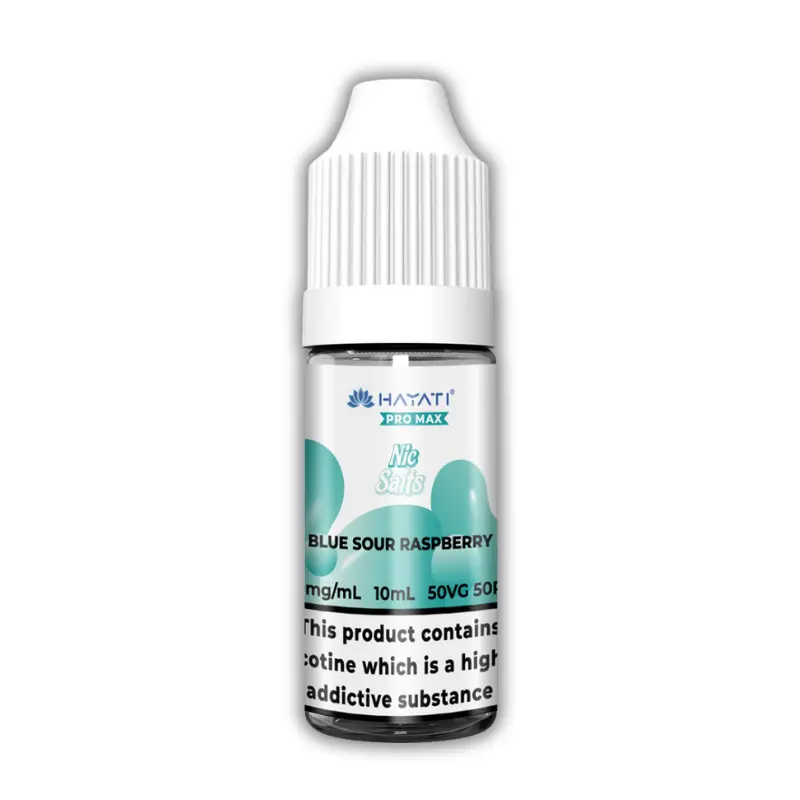
Hayati · Pro Max
Blue Sour Raspberry Hayati Pro Max Nic Salt
£2.49
✔ In stock — ready to ship
Genuine Hayati
Free over £20
Same-day dispatch
Secure checkout
Blue Sour Raspberry Hayati Pro Max Nic Salt is a 10ml bottle at £2.49, filed under SKU HPM-NS-BLUE-SOUR-RASPBERRY, supplied at 10mg in an even 50:50 base. It sits on five shelves: Hayati Pro Max Nic Salts, Berry Vapes, Raspberry Vapes, Hayati E-Liquids and New Products. Ten millilitres for £2.49 puts the liquid at 24.9p a millilitre. There is no device in the purchase, no pod, no cell and no heating element. You supply all of that.
Four pages on this site have already written about how this liquid tastes, and between them they have covered it from the front of the draw to the twelfth millilitre. This page does not add a fifth account of the sour, and the reason is not modesty. It is that the taste is finished and something else on this listing is not.
Hayati wrote one sentence into the description of this bottle that appears nowhere else in their catalogue. It tells you that when the sour note starts to taste muted, the coil is usually the thing that has changed. I counted, because the brief handed to me made a claim about that sentence that turned out to be too generous in two places and not generous enough in a third. What the counting produced is better than what I was given, and it is the whole subject of this page.
The short version is this. A muted sour is one observation with at least three different causes behind it, and the three call for three completely different responses. On eight of the eleven listings Hayati publish for this flavour, the three causes collapse into a single action, because the only thing you can do about any of them is throw the whole item away and open another. On this bottle they come apart, because the heating element is a separate object that you own, bought separately and replaced separately from the liquid sitting on top of it. That is the difference this page is about: not what the liquid tastes like, but what you are able to do when it stops tasting like that.
What five earlier pages already settled, so that none of it is rebuilt here
The Pro Max Plus refill page for this flavour owns replacement cadence. It works out what retiring a pod on a signal rather than on an empty tank does to a reorder habit, sets out the two rates that come apart when you do it, and prices the discarded liquid. Its central observation, that the ending of a declared sour is audible in a way the ending of a fruit-true berry is not because you are auditing a named expectation rather than noticing a general impression, is the foundation everything here stands on. It also records that the corpus has not settled which way a tiring element fails on this liquid, whether the acid goes first and leaves a sweet blue, or the aromatic material goes first and leaves a thin bite. That page's account of what a nearly empty pod does and does not tell you in advance is the source for the second of my three causes, and I am citing it rather than rebuilding it.
The Rubik refill page owns palate adaptation. It tested the proposal that habituation announces itself as sweetness arriving earlier, found that sweetness and acidity suppress each other so that a weakened acid and an adapted tongue produce the identical percept, and then located the discriminator at the pod boundary rather than inside a draw. That finding is the third of my three causes and it is not mine. I use its conclusion, which is that a hardware effect resets when the hardware is replaced and a palate effect does not, and I take it to a format where the hardware can be replaced without replacing anything else.
The Mini Ultra kit page owns the listing diff across all eleven of this flavour's entries and the sour census: twenty-one titles in the catalogue carry the word, eleven of them this liquid. Both figures were re-checked today and both hold. That page also owns the proportional argument about how much of a fill arrives before the acid delivery drops, and the storage finding that an acid-carrying liquid drifts downwards over a long stay rather than upwards. The Pro Ultra Plus refill page owns the pairing analysis and the placement of this liquid among the blues.
Two pages outside the flavour matter as well. The Blue Razz Cherry Hayati Pro Max Nic Salt page owns the observation that Hayati sell no coil, no element and no atomiser anywhere in 492 listings, which is one clause here and a whole argument there. And the Summer Dream bottle page owns the idea of a 10ml bottle used as a test instrument, along with the two limits on that idea: the strength is a different number on each side of any bottle-to-pod comparison, and the equipment doing the measuring is yours rather than the factory's. Both limits recur below, and one of them behaves very differently in this test than it did in that one.
The count, and the three places the brief was wrong
I was handed the claim that exactly one listing in 492 names a wear signal, that only one other bottle on the nic salt shelf mentions replacement at all, and that the ten other listings of this flavour all have the element sealed away inside a pod. The first is true. The second understates it. The third is wrong, and correcting it produced the sharpest figure on the page.
Start with the whole catalogue. Fifty-five of the 492 listings use the word coil in their description. Every single one of those fifty-five is a bottle. Not one of the 387 prefilled listings, across every platform Hayati sell, mentions a heating element in any form whatsoever. That is a clean structural split and it is the most informative number here, because it means the entire vocabulary of maintenance in this catalogue lives on the liquid-only side of it.
Sort the fifty-five by what they actually ask of you and they fall into four groups.
- Twenty-eight are fitment only. They name an element to tell you what sort of device the liquid belongs in, usually by resistance band, and ask nothing of you afterwards. This bottle is partly in that group too, since its own text points at a higher-resistance element before it says anything else.
- Fifteen mention one in passing, usually about wicking. White Peach Raspberry Hayati Pro Max Nic Salts is typical, noting only that the even base is easy going on small elements. Five of the fifteen go a step further and warn that sweet liquids wear one faster and that you should keep a spare to hand, which is a purchasing instruction with no signal attached to it.
- Seven ask you to let a new one soak before the first draw. Strawberry Raspberry Ice Hayati Pro Max Nic Salt and Blueberry Raspberry Hayati Pro Max Nic Salt are both in this group. Priming is not replacement. It is advice about the beginning of a component's life rather than the end of it, and lumping the two together is what made the handed-over figure look smaller than it is.
- Five tell you to change one. That is the group that matters.
The five are Strawberry Watermelon Bubblegum, H'Bubba, Blue Razz Gummy Bear in its 10ml nicotine-bearing form, Blue Razz Gummy Bear again in its 120ml zero-nicotine shortfill, and this bottle. Four of those five sit on the 65-listing nic salt shelf, so the figure I was given, two of sixty-five, should have been four of sixty-five. The fifth is off that shelf and on the shortfill side. Extending the census across the other 427 listings adds nothing, because the other 427 contain no replacement instruction at all.
Now sort the five by what signal they give you.
- Strawberry Watermelon Bubblegum says to change the coil or pod once the flavour fades, and explains that sweeter liquids shorten a component's working life.
- Blue Razz Gummy Bear says the same thing twice, on two different listings, in two different constructions. Its nic salt bottle says to change them when the flavour starts to fade rather than pushing on. Its shortfill says to change them when the flavour dulls. Its third listing, the Blue Razz Gummy Bear Hayati Pro Max 70/30 E-Liquid, drops the signal entirely and tells you only to keep spares on hand.
- H'Bubba gives no signal whatsoever. It gives a frequency instead, saying to expect to replace pods or elements a little more often than with mint or citrus.
- This bottle names a component. Not the flavour, not the general impression, but the sour specifically.
So the claim survives counting in its strongest form and is narrower than the one I started with. Of 492 listings, five carry a replacement instruction. Three of the five point at the flavour as a whole, one points at nothing and gives you a rough interval instead, and exactly one names a single declared element of its own profile as the thing that goes first. That one is this bottle, and the narrowing is worth stating plainly because the vague version and the precise version are different products from the buyer's side. A flavour fading is a description of everything getting quieter together. A named component going while the rest stays put is a diagnosis.
The third correction, which produced a better number than the one it replaced
I was told the other ten listings of this flavour all keep the element inside a pod. Eight of them do. The other two are bottles: a 120ml 70/30 at 0mg intended for low-resistance tanks, and the Blue Sour Raspberry Hayati Pro Max 50/50 Shortfill E-Liquid, also 120ml, also 0mg, and explicitly pointed at the same sort of low-powered hardware this one is. Both go into an element you own, so both could have carried the instruction and neither does. The shortfill mentions elements once, only to say the even blend wicks into small ones without trouble.
Repairing the claim makes it better rather than weaker, and here is the repaired version. Taking the Mini Ultra page's census of twenty-one sour-titled listings and adding one column to it, three of the twenty-one are bottles and all three of those three are Blue Sour Raspberry. Every other declared sour in the catalogue, the Cherry Sour Raspberry pair, the Red Sour Raspberry pair, the Tropical Sour Juice pair, the four Sour Apple entries, arrives prefilled and is never sold as liquid on its own. So there are exactly three points in 492 listings where a declared acid meets an element the buyer chose and paid for separately. All three are this flavour. One of the three carries the instruction, and it is the only one of the three that arrives with nicotine already in it.
That is a much tighter thing to have found than the version I was handed. It is not that Hayati wrote a rare sentence. It is that they wrote it at the only point in the catalogue where a buyer holds both halves of the problem at once: a liquid whose value is concentrated in one declared component, and a component-carrier they can change on their own.
One observation, three causes, three different bills
Here is the situation the sentence is written for. You have been running this bottle for a week or two. You take a draw and the sharp front that the liquid is named for is not doing what it did. The sweetness is still arriving. Something at the leading edge has gone quiet.
That is one percept with a single description, and at least three distinct things produce it.
Cause one: the element has taken what it takes
Residue accumulates on anything a sweetened liquid passes over, and the acid is generally the first casualty of that. This is not my finding and I am not going to re-derive it. The Mini Ultra kit page sets out the volume-based version of the argument, in which the quantity of liquid that passes before the sharp front is audibly reduced is a fixed property of the liquid and the hardware and therefore the same absolute number regardless of how much liquid is queued up behind it. The Pro Max Plus refill page records that the direction of the failure is genuinely unsettled, and that the two competing accounts predict opposite things, one leaving a sweet blue with nothing on the front of it and the other leaving a bite with nothing behind it. Both pages are careful to say that nobody outside a factory can put a number on when this happens, and neither will I.
What matters here is the remedy rather than the mechanism. If this is what has happened, the correct action is to fit a new element and keep every millilitre of the liquid you have left, because the liquid is fine. The purchase is a small one and it does not come from this catalogue.
Cause two: there is less liquid in there than you think
A wick that is not being fed properly produces a weaker, flatter draw before it produces anything dramatic, and on a liquid whose defining property is a sharp leading edge, the leading edge is what you notice going. The Pro Max Plus refill page has the better treatment of this in its prefilled form, where its point is that a pod running down does give you a rough kind of notice while the signal on a declared sour gives you none at all. I am citing that rather than restating it, because the interesting part here is the one thing that differs.
On a bottle, this cause is the only one of the three you can settle by looking. Most refillable hardware lets you see the level in some form, and where it does not, the bottle on the desk tells you how much has gone into the device since you last filled it. This is the cheapest test available and it costs nothing, which is exactly why it should be run first and almost never is. Nobody reaches for the dull explanation when an interesting one is available.
Cause three: you have stopped registering it
The Rubik refill page did the work on this and did it properly. Its finding is that adaptation and element residue are not distinguishable inside a draw or across a session, because sweetness and acidity mask each other and a fall in the acid signal reads identically whichever end of the system produced it. Its discriminator is the hardware boundary: a hardware effect resets when the hardware is replaced, a palate effect does not, because your tongue does not know you have been shopping. That page's version of the test requires buying a fresh pod to take a reading, and it is honest about what that costs.
The remedy for this cause is not a purchase at all. It is time away from the liquid, which means a second liquid in rotation, and that is a different sort of spend with different consequences for the rest of your week.
Why getting it wrong is not free
Three causes, three remedies, and each wrong diagnosis has its own cost.
Read residue as adaptation and you carry on drawing through a tired element for another week, on the assumption that the problem is you. The direct cost is small. The indirect cost is the one the Pro Max Plus refill page identifies when it describes a buyer sitting in the worst material a pod produces and then forming their opinion of the flavour from it. A liquid judged on its final quarter is judged on the part of its life it is least good at, and the judgement sticks.
Read adaptation as residue and you buy a new element, fit it, and discover the sour is exactly as quiet as it was. You have spent money and learned something, which is not the worst outcome, but you have also used up a fresh element on a reading you could have got for free.
Read a low level as residue and you do the same thing, except that the new element immediately reads as fixed, because you refilled at the same time. You now believe you have confirmed the diagnosis, and the belief is wrong, so the next time this happens you will change the element again. That is the mistake that compounds.
And the fourth mistake, the one the sentence on the listing exists to prevent, is reading residue as a fault in the liquid. Conclude that the bottle has gone off and you throw away the liquid and keep the tired element, which is the one combination that guarantees the next fill tastes the same. Six millilitres discarded at 24.9p each is about £1.49, which is not a catastrophe, but you have also thrown away the only control sample you had.
Why the three collapse into one on eight of the eleven, and separate here
Every listing of this flavour except the three bottles arrives with the liquid and the heating element as a single purchase, fixed together, bought and finished together. I want to be careful about what I am and am not saying there. Hayati publish no parts breakdown for any prefilled product, and as established above, not one of the 387 prefilled listings uses the word at all, so I am not going to tell you what can or cannot be got at inside one. What is published is that the pod arrives filled and is sold as one item, and that is enough for the argument.
The consequence is that on a prefilled listing the three causes have one shared remedy. Whatever is wrong, the only lever available is to open the next pod. If it was residue, that fixes it. If it was the level, that fixes it. If it was adaptation, it does nothing at all and you have spent the price of a pod finding out. The signal is the same signal, the reasoning is the same reasoning, but the action is undifferentiated, so the diagnosis buys you nothing. There is no decision to inform.
This also puts a ceiling on how much any pod-based test can resolve, and it is worth naming because it is the limit the Rubik page's method runs into and acknowledges. Fitting a fresh pod changes the element and the liquid simultaneously. It therefore separates hardware from palate cleanly, which is what that page needed, but it cannot separate the element from the liquid, because the two arrive welded into one transaction. If a pod reads better, you know the problem was in the pod. You do not know which half of the pod.
A bottle breaks that. Here the liquid is one object, bought at £2.49 for ten millilitres, and the element is another object, bought from somewhere else entirely at a price this catalogue does not set. Hayati sell no element, no atomiser and no replacement part anywhere in their 492 listings, a fact the Blue Razz Cherry bottle page works through at length and which I am not going to reproduce beyond noting that it puts the coil side of every sum below outside this shop. The relevant point for diagnosis is simply that the two things are independently replaceable. You can change one and hold the other still. Nothing else about this bottle matters more than that, and nothing in the prefilled range offers it.
Nothing here is a cross-range fitment statement about any specific hardware: the device is yours, and its element compatibility is a question for whoever made it rather than for a retail page.
Three tests a bottle supports, in the order they should be run
Because the variables come apart, they can be moved one at a time. That is the entire methodological advantage of this format and it is available on precisely three listings of this flavour, of which this is the cheapest and the only one carrying nicotine.
Test one, and it is free. Look at the level. Check how much liquid has actually gone through since the last fill and how much is sitting above the wick right now. Top it up, wait a couple of minutes, take the same draw. If the sour comes back, you are finished and the other two tests are unnecessary. Run this first every time, including the time you are certain it is not the answer, because the cost of running it is nothing and the cost of skipping it is a wrong diagnosis that then confirms itself.
Test two. Change the element, keep the liquid. This is the test the listing's own sentence is pointing at, and it is only conclusive if you keep everything else constant. That means filling the new element from the same bottle, not a fresh one, which in turn means not finishing the bottle before you do it. Hold three or four millilitres back for exactly this purpose. If the sour returns at full strength on the same liquid in a new element, residue was the cause, the diagnosis is confirmed, and the remaining liquid is worth keeping. If it does not return, you have eliminated the most expensive explanation and you are down to your palate.
Test three. Change the liquid, keep the element. This is the one nobody runs and it is the most informative of the three, because it works in the opposite direction from test two and does not require any new hardware at all. Put a low-sweetener liquid through the element that you think has failed. Black Mint Hayati Pro Max Nic Salt is the obvious candidate on this shelf, since a mint reads as either present or absent with very little in between and is not carrying much sugar into the element on its own account. If the mint is clear and full, the element is working and something else is going on. If the mint is also flat, you have your answer without having spent anything.
The two limits, which behave differently here
The Summer Dream bottle page set out two constraints on using a 10ml bottle as a measuring instrument, and both apply to what is above, but only one of them applies in the same direction.
The first limit holds without modification. That page records that this bottle's strength is a different number from the strength in a prefilled pod of the same flavour, that the whole nic salt shelf is fixed at one figure, and that no configuration of purchases lets you run a bottle test at a pod's concentration. So nothing you learn here transfers to a question about how a pod of this liquid will feel. Nicotine contributes to the physical character of a draw independently of the flavouring. Nicotine is an addictive substance, and the figures on this page are statements of what is in the bottle rather than a recommendation about strength.
The second limit is the one that inverts. That page's larger worry was that the equipment doing the measuring is yours rather than the factory's, that Hayati publish no resistance, power or airflow figure for any prefilled product, and that predicting an unpublished system from an unpublished system is worse than predicting across a known numerical gap. That is correct, and for a test whose target is a sealed pod it is decisive. For the test on this page it is not a problem at all. It is the precondition. The whole diagnostic only exists because the element is yours, and the thing that made Summer Dream's test weak is the thing that makes this one possible. I am not claiming that as a contradiction of that page. It is the same fact pointing in two directions depending on whether the equipment is the confound or the variable under test.
One thing neither page can settle, and it is worth naming rather than quietly omitting. None of the three tests tells you anything about batch variation, because no Hayati listing publishes a fill date or a batch code. A bottle opened today and a bottle bought eight months ago are indistinguishable on paper, and the Mini Ultra kit page's storage finding, that acidity in an acid-carrying liquid drifts downwards over a long stay rather than upwards, is exactly the sort of effect that would masquerade as residue. Date the bottle when you open it. That single habit removes the only confound in this method that no amount of care otherwise controls for.
What each outcome costs, and the one figure I cannot give you
The liquid side of the arithmetic is straightforward because both numbers are published. Ten millilitres at £2.49 is 24.9p a millilitre. Discarding a bottle with six millilitres left throws away £1.49. Holding back four millilitres for test two costs nothing at all, because you were going to use them anyway; it only moves when.
The element side is a figure I am not going to invent. Hayati publish no price for one because they do not sell one, no resistance, and no recommended interval, and every number on that side of the sum would have to come from whichever supplier your device belongs to. What can be said without inventing anything is the shape of the comparison. A replacement element is a recurring small purchase; the liquid it sits under is 24.9p a millilitre; and the whole point of getting the diagnosis right is that one of those two costs is avoidable in any given week and the other is not.
Set that against the prefilled case and the contrast is sharp. The Pro Max Plus refill page prices an early retirement policy on a twelve millilitre pod and finds that acting on the signal moves the effective cost of the liquid from a shade under 46p a millilitre to just under 69p, because the unused portion is discarded with the pod. Half as much again, for the same liquid, and the figure never appears on any listing. On this bottle the same decision costs the price of one element and no liquid whatsoever, because the liquid is not attached to the thing being retired. That is the concrete form of the argument and it is the reason the sentence in the description is worth reading as an instruction rather than as filler.
There is a cheaper way to own a large volume of this liquid for testing purposes, and it comes with a condition attached. The 120ml shortfill is £6.99, which is 5.83p a millilitre, less than a quarter of what the 10ml bottle costs per unit. It is supplied at 0mg. For somebody running a series of element tests and wanting a large, consistent, single-batch reference sample, that is the sensible container. For somebody who wants nicotine in the liquid, it is not this product and the two are not interchangeable on that axis.
Why Hayati wrote it here, and whether they meant to
Two readings of the sentence are available and the evidence does not cleanly settle between them. I will set out what points each way and then say which one I lean towards, without pretending the question is closed.
The case for it being deliberate at the format level is strong and it is quantitative. Zero of 387 prefilled listings mention an element. All five replacement instructions in the catalogue sit on bottles. Whoever wrote this copy, or whatever process generated it, is consistently aware of which format puts a serviceable component in the buyer's hands, and never once offers maintenance advice to somebody who cannot act on it. That is a high level of consistency across 492 listings and it is not what carelessness looks like.
The case for the specific wording being incidental is also real. Look at which four other liquids got a replacement instruction: Strawberry Watermelon Bubblegum, H'Bubba, and Blue Razz Gummy Bear twice. Every one of them is a confectionery profile, and three of the four explicitly attribute the wear to sweetener content. The selection rule appears to be sweetness, not sourness. This liquid is a confectionery accord as much as those are, so it qualifies for the warning on sugar grounds alone, and the appearance of the word sour in its sentence may be nothing more than the flavour's own name being reused where the other four said the flavour. Under that reading the sentence is a template with a noun substituted, and the noun happened to be a component.
I tried to break the tie by looking for a second case. If naming a component were a policy, other single-component liquids would get component-specific signals, and they do not. Blue Frozen Hayati Pro Max Nic Salts declares a cooling element in its title and its description gives no signal for the cold going. Blueberry Raspberry Lemon Hayati Pro Max Nic Salt declares an acid-bearing fruit by name and gets a priming instruction instead. Blackberry Ice Hayati Pro Max Nic Salts gets nothing of either kind. So the sentence has no company, which is weak evidence for both readings at once: a one-off is what an accident looks like, and it is also what a single writer paying attention to a single product looks like.
Where I come down, and it is a lean rather than a conclusion, is that the phrasing is diagnostic in a way that noun substitution does not usually produce. The other four sentences state a cause and describe an outcome: sweet liquids wear elements, so change them when things fade. This one states no cause at all. It runs in the opposite direction, from an observation to an inference about what produced it, and it hedges the inference with a qualifier about it usually being the sign of a particular thing. That is the grammar of a diagnosis rather than of a warning, and templates do not generally change their logical direction when the flavour name changes. I would not build anything load-bearing on that, and a reader who prefers the accident reading is not being unreasonable.
The useful part is that it does not much matter which is true, because the sentence is correct on this listing either way and would be misleading on eight of the eleven. Accident or intent, it landed on one of the three listings of this liquid where the remedy it names is a thing the buyer can actually buy.
Specification, with the blanks kept as blanks
The rows below are ordered by how much they constrain a purchase rather than by the usual running order, and the absent fields are listed rather than omitted, because on this product two of the absences are the point.
| Heating element supplied | None. Not in this purchase and not sold anywhere in the 492 listings |
| Device supplied | None. Liquid only |
| Volume | 10ml |
| Ticket price | £2.49, which is 24.9p a millilitre |
| Nicotine | 10mg, as a salt |
| Carrier split | 50:50 VG/PG |
| Stock reference | HPM-NS-BLUE-SOUR-RASPBERRY |
| Declared profile | Blue Sour Raspberry |
| Filed under | Five shelves, listed at the top of this page |
| Element resistance recommended | Described only as higher-resistance. No figure published |
| Replacement interval | Not published. A signal is given instead |
| Puff rating | Not applicable and not published for a bottle |
Two of those rows carry most of the weight. The even carrier split is the figure that decides what hardware this belongs in, since a balanced base moves through a narrow wick without the hesitation a thicker blend produces, and that in turn is why the description points at a higher-resistance element rather than a low one. The other is the absent replacement interval. Hayati could have written a number there, as some manufacturers of other things do, and they did not. They wrote a perceptual signal instead. Given that a number would be wrong for most buyers anyway, since consumption and draw length vary enormously between two people running the same liquid, a signal is the more honest form of the advice even if it is harder to act on.
The strength row is fixed rather than chosen. The Hayati Pro Max Nic Salts shelf is uniform: sixty-five listings, every one 10ml, every one 10mg, every one an even split, and sixty-four of the sixty-five at £2.49 with a single outlier at £2.79. That census belongs to the Mr Blue bottle page, it was re-checked today and it holds, and there is no point in recounting it here. What it means for this page is that no decision you make about this liquid involves a strength decision, because the shelf offers none.
What else to buy, sorted by what it does to the signal
Most comparison sections on this site sort neighbours by taste. This one sorts them by what each does to the diagnostic problem above, because taste is covered four times over elsewhere for this flavour and because the sorting is more useful for somebody who already knows they like it.
If you want a control liquid for test three
You want something with as little dosed acid and as little sweetener as possible, so that a flat reading points at hardware rather than at the liquid. Black Mint is the first choice for the reasons given above. Red Berry Ice Hayati Pro Max Nic Salt is a reasonable second, since cold registers or it does not and the judgement is close to binary, though the berry underneath it carries more sugar than a mint does. Blackcurrant Juice Hayati Pro Max Nic Salts is a poorer control for this specific job, because blackcurrant brings its own acidity and you would be trying to read one acid through the loss of another.
If you want the same liquid in a form better suited to a series
The Blue Sour Raspberry shortfill at 120ml is the single-batch reference sample, at 5.83p a millilitre and 0mg. The trade is the nicotine, and it is not a small trade for most people. The other 120ml bottle of this flavour is a 70/30 pointed at low-resistance tanks, which puts it in different hardware and outside the comparison this page is making.
If you have decided the acid is the problem rather than the point
Several blues on the same shelf give you the colour and the confectionery framing without a declared sour sitting on the front of them, which removes the whole diagnostic question along with the thing being diagnosed. Mad Blue Hayati Pro Max Nic Salt and Blue Fusion Hayati Pro Max Nic Salt are both in that territory, and both are named in a way that tells you less about the contents than this one does, which is its own kind of trade. Blue Razz Mojito Hayati Pro Max Nic Salts takes the blue in a drink direction, and Strawberry Mojito Hayati Pro Max Nic Salt does the same thing off the blue entirely.
If you want sharpness that comes from a fruit rather than from a dose
This is the substantive alternative and it changes the wear question rather than dodging it. A fruit's own acidity is bound up with the rest of its flavour, so when an element tires you lose a proportion of everything together and there is no single component to go missing. Blueberry Cherry Cranberry Hayati Pro Max Nic Salt has cranberry doing that job. Berry Lemonade Hayati Pro Max Nic Salt and Blueberry Raspberry Lemon both put a citrus in the name and therefore an acid with an address. Blackberry Raspberry Hayati Pro Max Nic Salts and Kiwi Grape Raspberry Hayati Pro Max Nic Salt are both fruit-true builds where the same amount of change reads as a shift in balance rather than as a failure, which is the Pro Max Plus refill page's point and the reason those liquids are easier to live with on a tiring element even though nothing about the element is different.
If you want more fruits sharing the work
Strawberry Raspberry Blueberry Hayati Pro Max Nic Salt spreads the profile across three components, so no single one leaving is decisive and the signal this page is about never becomes legible in the first place. That is a genuine advantage for somebody who does not want to be auditing their hardware every morning, and a genuine loss for somebody who values knowing when to act. Blueberry Raspberry and White Peach Raspberry sit in the same bracket with two components each.
If sharpness by temperature suits you better
Cold is the other way to get a defined leading edge, and it fails differently. Blue Frozen, Blackberry Ice, Red Berry Ice and Strawberry Raspberry Ice Hayati Pro Max Nic Salt all put it on the front. The cooling-vocabulary question, whether Ice and Frozen are graded terms, is settled elsewhere in this corpus and they are not, so read them as the same intent differently worded. Black Mamba Hayati Pro Max Nic Salts is a mood name rather than an ingredient list and belongs in a different conversation, which the pages on the named-for-a-mood listings handle properly.
If none of this applies because you do not own a refillable device
Then nothing on this page is actionable and the honest recommendation is a prefilled product, where the element question does not arise because it is not a question you can answer. Blue Razz Fruit Twist Hayati Pro Max Plus Pods is a blue on that platform. Blackcurrant Cotton K / Blue Raspberry Hayati Pro Ultra Plus Pods puts a blue raspberry behind a collar alongside a second flavour. Either removes the decision this page is about, along with the saving it makes available.
The wider shelves
The full bottled range is on Hayati E-Liquids at 105 listings, which is the 65 nic salts plus the 40 large-format zero-nicotine bottles. Raspberry Vapes runs to 119 across every format, Berry Vapes to 225, and all 492 Hayati products are on one page if you would rather sort it yourself. New Products carries the whole catalogue as well.
Running the bottle when the signal is part of what you bought
Everything below is anchored to the two things that make this listing different from its neighbours: a heating element you own and can change, and an acid that has been dosed in rather than grown in. General handling advice that would apply to any bottle on the shelf is not repeated here.
Date the bottle. Write the day you open it somewhere on it. Acidity drifts downwards over a long stay rather than upwards, per the Mini Ultra kit page's storage work, and no listing publishes a fill date, so the interval since opening is the only part of the liquid's history you can know. Without it, a slow drift in the liquid is indistinguishable from residue on the element, and the whole diagnostic method above quietly stops working.
Do not finish the bottle before you change the element. This is the single most useful habit on this page and it costs nothing. Three or four millilitres held back is your control sample. Fit the new element, fill it from the old bottle, and you have a clean comparison. Open a new bottle at the same time and you have changed two variables and learned nothing.
Take your reference reading early in an element's life, not on day one. A newly fitted element needs its wick properly wetted before it is telling you anything about the liquid, and a dry first draw is not a reading. Once it is settled, the first two or three millilitres through it are the condition the liquid was designed to arrive in, and that is the reading everything later gets compared against. A morning draw is the version of it least contaminated by whatever else you have been doing, which is a point the Mini Ultra kit page makes and which holds regardless of format.
Do not top up a tank you are in the middle of measuring. Mixing a fresh fill into a part-used one produces a liquid whose age you no longer know, and on a profile whose declared component is the perishable one, that is the measurement you care about. Run a fill down, then refill. It is less convenient and it is the only way the series means anything.
Resist the urge to pull harder. The instinct when a sharp front goes quiet is to draw longer or deeper to chase it. That changes the amount of liquid passing over the element per unit time, which changes the reading, and it makes the next comparison worthless because your technique has become a variable. Take the same draw you always take and let the difference be the difference.
Keep the element in mind as a consumable rather than as a fixture. On the prefilled listings of this flavour it is a consumable whether you think about it or not, because it leaves with the pod. Here it is one you have to decide about, and the decision is the thing the listing's sentence is trying to prompt. A buyer who treats it as a fixture will eventually conclude the liquid is worse than it is.
Keep the bottle upright and out of direct light. Ordinary advice, included only because the component this liquid is named for is the one with the shortest patience for heat, so the general rule bites slightly harder here than it does on a berry with no dosed acid in it.
Questions this bottle gets asked once it is in use
The sour has gone quiet. Is it the element?
It might be, and that is what the listing's own sentence suggests, but run the free test first. Check the level and top up before you conclude anything, because a wick that is not being fed properly produces the same flat leading edge. If topping up does not bring it back, change the element while keeping some of the same liquid to fill it with. If that does not bring it back either, the change is in you rather than in the hardware.
Why does this bottle tell me to change the element when the others do not?
Five listings in the whole 492 carry a replacement instruction and all five are bottles, so the pattern is about format rather than about this flavour. What is unique here is that the signal names a specific component of the profile rather than the flavour in general. Whether that was deliberate or a side effect of the flavour's name being reused in a standard sentence is genuinely unclear, and the section above sets out the evidence for both readings without settling it.
Is it worth keeping the leftover liquid when I change the element?
Yes, and it is the main practical advantage this format has over the prefilled versions. The liquid is not what wore out. Discarding six millilitres because the hardware under it has tired throws away about £1.49 and, more importantly, throws away the control sample that would have confirmed your diagnosis.
Does any of this apply to the prefilled pods of this flavour?
The reasoning does, the action does not. The signal reads the same way and the earlier pages on the pod and refill listings analyse it properly. What differs is that on a prefilled product the only available response is to open the next one, so the three possible causes all resolve to a single action and the diagnosis does not change what you do.
What element should I use?
The description says higher-resistance and gives no figure, and no figure appears anywhere else in the product data either. The even 50:50 carrier split is the relevant fact: it moves easily through a narrow wick, which is why the liquid is pointed at restricted, low-powered hardware rather than at a wide-open tank. Beyond that, the specification for your element is a question for whoever made your device.
Does Hayati sell replacement elements?
No. Across all 492 listings there is no element, atomiser or replacement part of any kind, which the Blue Razz Cherry bottle page covers in detail. That is worth knowing before you act on the advice in this listing, since the thing it tells you to change has to come from somewhere else.
How long should an element last with this liquid in it?
Nobody publishes a figure and this page is not going to invent one. What can be said is that four of the five listings carrying a replacement instruction attribute faster wear to sweetener content, that this is a confectionery profile, and that the listing gives you a signal instead of an interval. Consumption and draw length vary enough between two people that an interval would be wrong for most of them anyway.
Can I use the 120ml shortfill for the same thing more cheaply?
For element testing, yes, and 5.83p a millilitre against 24.9p is a substantial difference if you are running a long series. The shortfill is supplied at 0mg, which is the entire catch. It is a different transaction rather than a cheaper version of this one.
How do I tell adaptation from residue without buying anything?
Put a different liquid through the same element. A low-sweetener profile is the cleanest reference, and Black Mint is the obvious one on this shelf. If the second liquid reads clear and full, the hardware is fine and the change is in you. The Rubik refill page's version of this test uses a fresh pod as the boundary, which works on that format and costs the price of a pod; this version costs nothing if you already have a second bottle open.
Is there any ice or cooling in this one?
Nothing in the product data indicates any, and the profile is declared as sweetness plus acid rather than sweetness plus cold. If a cold leading edge is what you are after, the shelf has plenty of it and several are named above; the wear behaviour is different there and so is the signal you would be watching for.
What strength is this and is there a choice?
10mg, and no. All sixty-five listings on the nic salt shelf are recorded at the same strength, the same volume and the same carrier split, so the shelf offers no strength decision to make. Nicotine is an addictive substance and that figure is a statement of what is in the bottle.
Should I stockpile it?
One spare is sensible, a deep stack is not, and the reason is specific to this liquid rather than general caution. An acid-carrying liquid drifts downwards in storage rather than upwards, and no listing publishes a fill date, so a bottle that has sat for a year looks identical on paper to one filled last month. Stockpiling the thing whose perishable component you are trying to monitor defeats the monitoring.
The short version
Ten millilitres of a declared sour at £2.49, 10mg, an even carrier split, no hardware included. The taste has been written about four times on this site already and there is nothing left to add to it, so this page took the sentence in the description instead: the one that tells you what a muted sour usually means. That sentence exists on one listing out of 492, and the counting tightened the claim rather than breaking it. Five listings carry a replacement instruction, three of them point at the flavour as a whole, one gives an interval instead of a signal, and only this one names a component. All five are bottles. None of the 387 prefilled listings mentions a heating element at all.
What makes the sentence worth acting on is not its rarity but where it landed. Three listings in the catalogue pair a declared acid with an element the buyer owns, and all three are this flavour. A quiet sour has three plausible causes and on a prefilled product they collapse into one response, so knowing which one you have buys you nothing. Here they separate, each has its own remedy, and two of the three can be ruled out without spending anything. Check the level first, change the element second while keeping some of the same liquid to fill it with, and if neither restores the sharp front, the change is in you and no purchase will fix it.
Strictly for adults aged 18 and over. Nicotine is an addictive substance.
You might also like


