
Home / Hayati Pro Ultra Plus Pods / Blueberry Raspberry Lemon Hayati Pro Ultra Plus 25K Pods
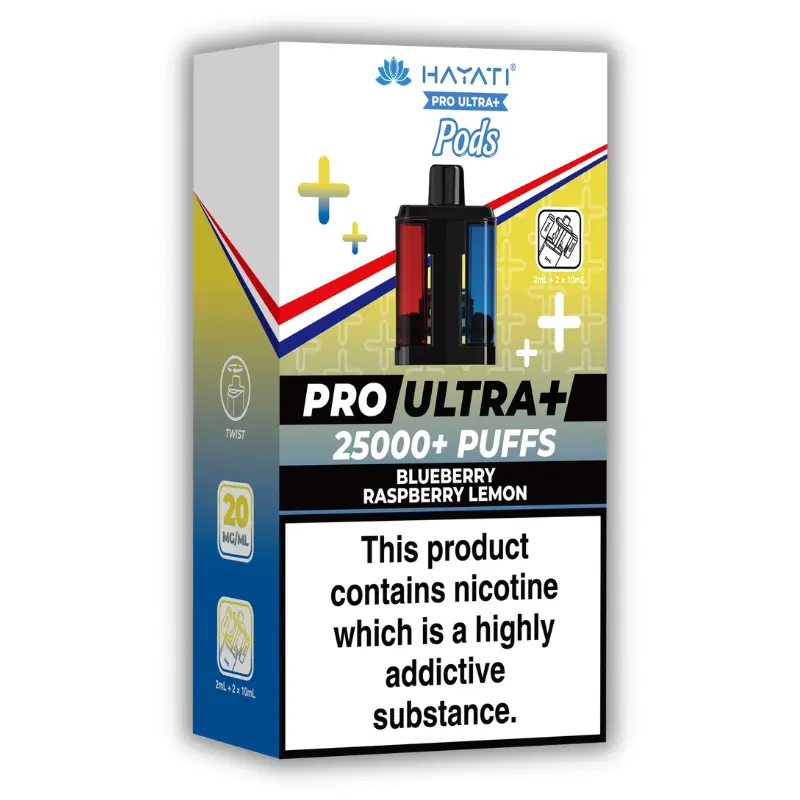
Hayati · Pro Ultra Plus
Blueberry Raspberry Lemon Hayati Pro Ultra Plus 25K Pods
£7.99
✔ In stock — ready to ship
Genuine Hayati
Free over £20
Same-day dispatch
Secure checkout
£7.99 buys one sealed replacement pod for the Hayati Pro Ultra Plus, holding 22ml of prefilled liquid at 20mg nicotine salt, flavoured as a single Blueberry Raspberry Lemon recipe. Hayati's own laboratory figure against the pod is up to 25,000 puffs. Nothing else is in the pack: no battery, no charger, no spare anything. A Pro Ultra Plus body has to be yours already, and if it is not, the Blueberry Raspberry Lemon kit at £11.99 is the listing that arrives able to do something.
The title carries no oblique stroke. About half the listings on this shelf do, and on those the stroke marks two liquids held apart with a collar to choose between them. Here there is one recipe, mixed before the pod was filled, and you draw on it from the first puff to the last. Nothing to select, nothing to schedule, no half of the volume waiting behind a switch.
A name with three fruits in it invites you to read three equals, and that reading is wrong in a way that changes what you should be looking for. Blueberry and raspberry are not two ingredients here so much as one region of taste visited twice. Both are sweet. Both are low on bright acid once they have been through a flavouring concentrate. Both carry the same soft, jammy weight, and left to themselves they collapse into a single generic red-purple impression that your palate files under berry and stops examining. The lemon is not a third flavour standing beside them. It is the structure they stand on, the thing that holds them apart far enough to be heard as two, and the only component in the pod stopping the whole arrangement from reading as syrup.
That reframing decides what you should check before you buy and what you should watch for once you have. The question is not whether you like lemon with berries, because at the level a blend like this uses citrus, almost nobody objects to it. The question is whether there is enough of it, since the way this recipe fails is with the citrus too quiet rather than too loud. It also produces a specific prediction about how the pod behaves as it wears, one you can test on the pod in your hand, and that prediction is set out below with its reasoning shown rather than asserted, because it is an inference from how the recipe is built and not something Hayati publish.
Two berries and a citrus that is not a third berry
Why blueberry and raspberry keep landing on top of each other
Pick the fruit up off a market stall and the two are obviously different things. A raspberry is tart, it has a perfumed, faintly floral top that arrives before the sweetness does, and its seeds and hollow structure give it a texture nothing else has. A blueberry is dense, mild, low in acid and slightly skin-bitter at the edges. Nobody confuses them in a bowl.
Vapour is a much narrower channel than a bowl. Texture is gone entirely, since there is nothing to chew. Skin bitterness rarely survives the translation into a flavouring. What tends to carry across is sweetness, depth and the broad colour of the fruit, and on those three axes blueberry and raspberry are close relatives rather than opposites. The perfumed top of the raspberry does survive in principle, but it is the lightest part of the profile and it needs room to be heard, which a dense sweet base does not give it.
The result is familiar to anyone who has worked through a few berry pods. You draw, you get something dark and sweet and pleasant, and if you were asked to name which berry you were tasting without looking at the label, you would hesitate. The label then does the work your palate did not, and you reconstruct two fruits from the packaging rather than from the vapour. That is not a failure of attention. It is what happens when two profiles sit within a few degrees of each other and nothing in the liquid is pushing them apart.
What acid does that another fruit cannot
Acid is not a flavour in the sense that blueberry is a flavour. It is closer to a contrast control. Three things happen to a sweet blend when you put a genuine citric edge across the top of it, and all three matter here.
It shortens the finish. Sugar and heavy fruit both linger, coating the tongue and staying there, and a coated tongue cannot resolve much of anything. Acid cuts that residue and clears the palate between draws, which is why an acidic liquid stays legible over a long session while a purely sweet one blurs into itself by the third hour.
It lifts the front of the draw. Citrus aromatics are light and they arrive early, which puts a bright edge at the leading edge of the inhale. That edge is where the raspberry's perfumed top also lives, and a bright opening gives that top somewhere to be heard instead of being buried under the sweetness arriving behind it.
It creates a gap. This is the important one and it is the reason the whole page exists. Two fruits that overlap in the middle of a draw are only distinguishable if something occupies the space between them, and acid occupies that space without adding another fruit to the crowd. Lemon is not competing with blueberry or raspberry for the same ground, because it is not doing the same job. It sits above both of them and pushes down, and in doing so it gives the raspberry a top and leaves the blueberry as the bottom, and now there are two audible things where there was one.
Take the lemon out of this recipe and you do not get a two-fruit blend that is slightly less interesting. You get one anonymous dark fruit with a name that promises two. The Blueberry Raspberry Pro Ultra Plus pod at the same £7.99 is exactly that experiment run for you: the same two berries, the same format, nothing between them. It is a perfectly good liquid and plenty of people prefer it. What it is not is two distinguishable fruits, and comparing the two listings is the cheapest way to find out whether separation is something you value or something you have never bothered about.
The draw, in the order things arrive
The opening is citrus, and it is peel rather than juice. Thin, bright, slightly resinous, and over almost as soon as it registers. It is not sour in the way a sour sweet is sour, and it is not the rounded sugary lemon of a lemonade build. Think of the smell that comes off a lemon when you scratch the skin, translated into a draw that lasts perhaps a second.
Raspberry steps in behind it. This is the position the acid has cleared, and on a fresh pod the raspberry's perfumed quality is clearly present: a slightly floral, slightly sharp note that reads as the more assertive of the two berries. It carries the middle of the inhale and it is the part of the blend most people mean when they say the pod tastes like raspberry, even though it occupies less of the draw than the blueberry does.
Blueberry arrives underneath and stays. Dense, low, sweet, without much definition of its own, and functioning here as the floor the other two components stand on rather than as a headline. It is the last thing still present on the exhale and it is the reason the pod reads as substantial rather than thin.
Then the lemon comes back, which is the part that surprises people. The citrus is not only an opening act. There is a dry, faintly tart finish on the exhale that stops the blueberry from settling into a sugary film, and it is the difference between a pod you can draw on all afternoon and one that becomes cloying by the middle of the day. The aftertaste is tartness on the sides of the tongue rather than sweetness across it.
Run all of that together and you have a blend with a top, a middle and a bottom, which is a more organised piece of construction than a three-fruit name usually delivers. When it is working, you can point at each layer. That pointability is the product, and the rest of this page is largely about the conditions under which you keep it.
Sweetness, and the complete absence of cold
On a scale running from the driest citrus pods at one end to the confectionery builds at the other, this one sits a little below the middle. It is unmistakably sweet, because two of its three components are sweet fruits and neither is being held back, but the acid pulls the perceived level down by a noticeable margin. Measured against the sugar-forward end of the shelf it is restrained. Measured against a straight lemon and lime pod it is sweet. Both statements are true and neither is much use without the other.
No cooling is listed for this blend and none is detectable in use. No ice, no menthol, no coolant of any kind. That matters more than it sounds, and not for the obvious reason. A coolant is a second way of keeping a sweet liquid legible, and it is a more durable one, because a cooling agent does not fade the way a volatile aromatic does. This pod has no such backstop. Acid is the only thing holding the structure up, and if the acid goes quiet there is nothing else in the recipe standing in for it. That is the single most consequential fact about the liquid and the next section is entirely about its consequences.
What it is not, stated plainly
It is not a lemonade. There is no fizz illusion, no sugar-water base, no soft-drink register. Lemonade builds make the citrus the subject and sit the fruit on top of it, which inverts the hierarchy here entirely. Straw' Lemonade on this shelf and Blue Razz Lemonade on the Pro Max Plus format are what a lemonade construction actually tastes like, and both are a different proposition from a berry blend with citrus across the top.
It is not sour. The sharpness comes from fruit acid distributed through the liquid, not from a sour coating sitting on the front of the draw. A genuine sour build makes your jaw tighten for a moment; this does not. Blue Sour Raspberry at £5.49 takes the coated approach on a single berry and is the fair comparison for anyone who wants the tartness to be the event rather than the scaffolding.
It is not cold, it is not a dessert, there is no cream or biscuit anywhere in it, and it is not a blue raspberry confectionery liquid despite sharing two thirds of its fruit with several that are. It is also not a subtle pod. The lemon is audible from the first draw and it is meant to be.
So is there enough lemon in it?
This is the question the page has been building towards and the honest answer has a limit in it. Hayati publish the name and the volume and the nicotine strength. They do not publish proportions, and no listing in this range does. Nobody outside the factory can tell you what percentage of this recipe is citrus.
What can be said is what the naming convention suggests, tagged as the inference it is. Across this range the fruit that leads a title tends to lead the liquid, and the fruit at the end tends to be the accent. Lemon is last here, behind two berries, which reads as a supporting role rather than a co-lead. That is a convention rather than a measurement, and a convention is not evidence about a particular batch, so treat it as a reasonable expectation and nothing firmer.
The stronger signal is what the title does not say. Nothing in it says lemonade, nothing says sour, nothing says zest. The range contains listings that announce citrus as the headline when citrus is the headline, and this is not one of them. A buyer who wants the lemon to be the main event should be reading Lemon Lime / Lemon Blueberry or Blue Razz GB / Lemon & Lime instead, or browsing the Lemon Vapes shelf where the citrus-led builds across every Hayati format are gathered in one place.
On your own pod, though, the question is answerable, and it takes about a minute. Draw once, slowly, and then pay attention to what your tongue is doing five seconds later. If there is a dryness, a slight pucker at the sides, then the acid is present in working quantity. If what you are left with is a sweet film and no edge at all, the citrus is either under-dosed in that batch or the pod is further through its life than you thought. That test is worth running on day one of every pod you buy, because it gives you a fixed reference against which everything later can be judged, and because the answer on day one is the only one that tells you about the liquid rather than about the coil.
A prediction about how this pod wears, with the reasoning shown
What follows is an inference. It is not in Hayati's specification, it is not a measured result, and it should be read as a hypothesis that happens to be testable rather than as a fact about your pod. It is set out with its steps visible so you can disagree with any of them.
The steps
Step one, reasonably confident. The lemon in this blend is carried by the lightest and most volatile material in the recipe. Citrus identity lives in aromatics that evaporate readily, which is why a cut lemon smells of less after twenty minutes on a worktop while still tasting sour. Nothing about this is specific to vaping.
Step two, reasonably confident. A mesh coil that has processed a lot of sweetened liquid does not fail all at once and does not fail evenly. Residue builds against it, the cotton around it compacts and re-saturates more slowly, and the effective temperature of the draw climbs. The parts of a recipe that suffer first under those conditions are the light ones. Heavy, sugar-bound components carry on arriving long after delicate ones have stopped.
Step three, probable. Put those together and the lemon is likely to be the first component this pod stops delivering properly. Not the first to vanish, since the sourness is more durable than the aroma, but the first to lose its definition. What you would be left with is a vague general tartness detached from anything recognisably citrus.
Step four, the actual prediction. Because the lemon is the structure rather than a voice, its loss should not read as a missing flavour. It should read as the two berries merging. The blend would not fade so much as collapse inwards, from three legible layers into one dark sweet mass with a sour edge on it. A buyer expecting gradual quietening would be looking for the wrong signal entirely.
Why that is different from ordinary fading
Most pods lose volume as they age. The whole draw gets quieter, the vapour thins, and eventually there is not much there. That is the standard arc and everyone recognises it, which is precisely why it is the only thing most people watch for.
A structurally acidic blend should show something else first, and the difference is between losing loudness and losing resolution. Resolution goes before volume. The pod is still producing a full, sweet, substantial draw at the point where you can no longer say which berry you are tasting, and it will go on producing one for a good while afterwards. If the prediction holds, the interesting failure on this liquid happens weeks before the boring one, and it happens without any drop in intensity to alert you.
A second consequence follows from the same reasoning. The acid is not only separating the berries, it is also keeping the sweetness in check, so the same event that flattens the blend should make it read as sweeter than it did when new. A pod that seems to have got sweeter over time has almost certainly not changed its recipe. It has lost the thing that was holding the sugar down.
How to check it for nothing
The test is a naming test and it needs no equipment. Early in a new pod, on a neutral palate, take two unhurried draws and answer one question: can you identify raspberry as a distinct thing in there, separate from the general berry sweetness? Note the answer. One word is enough.
Ask the same question again once you are roughly halfway through the pod, under the same conditions, which means not after coffee, not after anything sweet and not at the end of a long session. If the answer has changed from yes to no while the draw is still full and strong, the prediction is holding on your pod. If the blend gets quieter and stays separable, it is not holding and you should trust your own pod over this page.
One confound will produce a false alarm. Several quick draws in succession run the coil hot, and heat costs you the light components temporarily, so a chain of five pulls can make any citrus blend read as jam on a pod that is perfectly healthy. Rest it for half an hour and take the reading again. A loss of separation that comes back after a rest is thermal and means nothing. One that persists across two calm days is the pod.
What is not knowable from here
Two things sit firmly in the unknown column and it would be dishonest to fill them in. The first is what the citrus in this recipe is actually built from, since a flavouring house can deliver a lemon impression in several ways and they do not all age alike. The second is whether the decline is smooth or has a step in it. Nothing in the published information touches either question, and anyone giving you a confident answer is guessing.
If the prediction matters to your buying decision, the practical response is not to resolve it but to move your reorder trigger. On a durable blend you can reasonably wait for vapour to thin. On this one, the sensible trigger is the day the naming test starts coming back negative, which buys you a comfortable margin and stops you spending the last stretch of every pod on a liquid that is no longer the one you chose.
The pod, and the one specification that matters here
What arrives is a single sealed prefilled pod in its packaging. No device, no cable, no second pod. The coil is fitted inside at manufacture, it is not a part you can reach or replace, and no arrangement for topping the pod up appears anywhere in its description, so the unit is a committed item from the moment the seal comes off. When the mesh is finished the liquid goes with it and the whole pod is replaced.
The specification that actually matters for this particular liquid is the volume, and it matters for a reason that has nothing to do with value. Twenty-two millilitres is a long service life to ask of one mesh element. On a robust blend that is simply a lot of vaping for £7.99. On a blend whose entire structure depends on the most fragile component in it continuing to arrive, it is a long time to be depending on the coil's good behaviour. The same 22ml that makes this pod economical also guarantees that you will spend part of it past the point where the recipe is intact.
Several things buyers reasonably ask about are not published for this pod, and they are not stated here as a result. There is no coil resistance in its specification, no wattage figure, no airflow measurement, no fill or manufacture date and no batch reference. Numbers for the first three circulate in the trade. They are not read off this product's documentation, because this product's documentation does not contain them, and a figure invented once tends to get repeated until it looks corroborated.
On fitment, the honest position is the same. Hayati list this as a Pro Ultra Plus pod and that is the extent of what is published about what it will seat in. Whether it fits anything else in the range is not documented either way, so do not take a compatibility answer from a retail page, this one included. Check what device you own against the listing before ordering, and if you are weighing up hardware at the same time, the Pro Ultra Plus kits and pods shelf lists the bodies and the refills side by side.
The specification, and the row that would have settled the argument
| Listing | Blueberry Raspberry Lemon Hayati Pro Ultra Plus 25K Pods |
| Price | £7.99 |
| Maker | Hayati |
| Recipe | One blend of blueberry, raspberry and lemon |
| Second liquid | None. No oblique in the title, nothing to select. |
| Structure | Two berries carried on a citrus layer |
| Fill | 22ml, prefilled, sealed |
| Nicotine | 20mg in salt form, no alternative strength listed |
| Cooling | None declared, none detectable |
| Sweetness | Moderate, held down by the acid |
| Mesh | Inside the pod, not serviceable, replaced with it |
| Needed to use it | A Pro Ultra Plus body you already own |
| Supplied | The pod alone |
| Maker's puff figure | Up to 25,000, obtained by laboratory measurement |
The row that would have answered the question this page is about is not in the table, and could not be, because no manufacturer in this category publishes it. There is no figure for how much of the recipe is lemon. Three fruits are named, in an order that hints at a hierarchy, and the proportions between them are the entire product. A version of this blend with the citrus at half strength would carry exactly the same specification and would be a different liquid, and you would have no way of telling from the listing which one you were buying.
Two other rows are worth a sentence each. The 20mg figure is the ceiling for a prefilled pod sold in the UK and it is the only strength offered here, so the product settles it rather than you. Nicotine is addictive, and on a repeat purchase that is a decision you quietly remake each time rather than one you took once and finished with. The puff figure is bench data from a rig drawing to a fixed pattern for hours on end, which makes it fair for lining one format up against another and close to useless as a forecast of your own month. Its better use on a pod like this is as a statement of expected workload for one non-replaceable mesh element across the full 22ml.
Where it sits among the neighbours
The useful way to sort the alternatives is not by fruit. It is by what each one does about the problem this pod solves with acid, because that is the axis on which they genuinely differ.
The same berries with the structure removed
The plain Blueberry Raspberry pod at £7.99, linked above, is this blend minus the lemon, in the same format and the same 22ml. It is the direct comparison and the one worth making first. What you get is a rounder, heavier, sweeter liquid with a longer finish and less definition, and whether that sounds like a loss or a gain is the most informative thing you can learn about your own preferences on this shelf. Plenty of people find the citrus fussy and want the berries to be uncomplicated. If that is you, the simpler pod is the better purchase and this one will irritate you.
Cheaper again, and on entirely different hardware, Blueberry Raspberry Hayati Rubik Pods put the same two-fruit idea on a smaller system at £3.99. Those are not refills for a Pro Ultra Plus and will not seat in one, so they are a test of the flavour rather than a cheaper route to this pod. Check what you own before ordering.
More fruit instead of more acid
The instinct when a berry blend feels flat is to add another berry, and the range offers that in several arrangements. It does not address the problem. Blueberry Raspberry / Blueberry Raspberry Cherry holds the base on one side and the same base with cherry over it on the other, which deepens the mass rather than dividing it. Blueberry Raspberry / Mr Blue does something similar with a plainer blueberry in the second position, and Cherry Berry takes the single-blend route with cherry as the lead. All three are worth having if weight is what you want. None of them will give you the separation the lemon provides here, because a fourth sweet fruit is one more thing in the crowd rather than a way through it.
The exception is the fruit that brings its own acid. Straw' Cranberry Cherry / Cherry Ice is the closest thing on the shelf to a parallel solution, since cranberry does on that pod roughly what lemon does on this one: a sharp, dry, non-sweet element holding two rounder red fruits apart. It arrives at the same destination by a different road, and its cold half gives it a second structural device this pod does not have.
Cold as the structural element instead
Cooling is the other way to keep a sweet blend readable, and it has one clear advantage over acid, which is durability. A coolant leaves its mark on a wick and goes on arriving late into a pod's life, where a volatile citrus top does not. If the wear prediction above worries you, a cooled pod is the direct answer to it.
Fresh Mint / Blue Razz Mint cools both of its sides and is the firmest palate reset the format offers. Blue Razz Pineapple / Strawberry Ice puts the cold on one side only and keeps a warm fruit opposite it, with pineapple supplying a sharp edge of its own on the uncooled half. The cost of both is that cold is a blunter instrument than acid. It separates by interrupting rather than by clearing space, and the fruit underneath gets flattened along with the sugar.
Sugar as the base, with no structure at all
A whole wing of this shelf declines the problem outright and builds on confectionery, where nobody expects the fruits to be separable because the sugar is the point. Blueberry Cotton K / Raspberry Cotton K keeps a spun-sugar base constant and moves the berry across it. Blue Razz Cherry / Blue Razz GB and Grape GB / Blue Razz GB work the same register in the gummy-sweet direction.
If the citrus is what you came for
Several buyers arrive at this listing from the lemon end rather than the berry end, and for them the recommendation is usually a different pod. Lemon Lime / Lemon Blueberry, linked further up, makes citrus the subject on both sides and is the direct answer. Blue Razz GB / Lemon & Lime keeps a sharp citrus half and puts a chewy sugared blue raspberry opposite it, which is a wider swing between positions than anything on the berry side of the shelf.
Leaving the berry family altogether
If the conclusion after a pod of this is that berries in general have run their course, the useful moves are sideways rather than deeper. Straw' Guava / Dragon Berries keeps a berry thread but takes it somewhere tropical. Kiwi Banana / Straw' Banana changes the fruit family entirely and is worth knowing about for one specific reason: kiwi carries real acid, so that pod is built on the same principle as this one with different ingredients.
Where to browse from here
The Hayati Pro Ultra Plus Pods shelf is the right place to work through if you are staying with the device you own, since everything on it is the same £7.99 and a change of flavour costs nothing except the risk of preferring the old one. Blueberry Raspberry Vapes gathers this exact fruit pairing across every format Hayati build, which is the shelf to read if the combination is what you are loyal to rather than the hardware. Blueberry Vapes and Raspberry Vapes split it the other way, by single fruit, and Berry Vapes is the whole family in one list. For the format rather than the flavour, Hayati Prefilled Pods & Refills lays out every prefilled system side by side and Hayati Pods covers the pod ranges as a group.
Keeping the citrus alive for as long as possible
General pod handling applies to this one as it does to everything on the shelf. What follows is only the part that is specific to a warm, uncooled blend whose whole structure rests on the most fragile thing in it.
Heat costs you the lemon before you ever fit the pod. A spare sitting on a windowsill or in a car through a warm month is losing volatile aromatics through no fault of the coil, and on this recipe that is not a general dulling, it is the loss of the component that holds the blend apart. A drawer or a cupboard is entirely adequate and costs nothing. Store it badly and you will fit a pod that has already collapsed towards jam, then blame the device.
Slow the draw down, especially late. Consecutive pulls run the mesh hot and heat takes the light components first, which on this blend produces a temporary jam effect that people mistake for a dead pod. It is worse in the last third, when a mesh that has already processed most of 22ml re-saturates more slowly than it used to. Space the draws out and a good deal of the separation comes back.
Do not take your reading after something sweet. Coffee, mint and anything sugary will each suppress your ability to register the acid in this pod for a good while afterwards. A palate that has just finished a dessert will report a flat berry liquid on a pod that is perfectly intact. Mid-morning is a sensible standing appointment if you want a comparison you can trust across pods.
Watch for the merge, not for the fade. The signal that this pod is into its last stretch is the naming test coming back negative while the draw is still strong, not vapour thinning. Catching it there is what gives you time to reorder without spending a fortnight on a liquid that has stopped being the one on the label. Nothing about a pod improves with further use, so there is no case for waiting to see.
Retire it properly. A finished pod still holds a mesh element and a film of liquid, which puts it outside household waste and inside the remit of a vape retailer's take-back point or a local recycling facility. There is nothing inside worth keeping back. Store spares and spent pods alike where children and pets cannot reach them.
Questions this pod actually raises
Is there a device in the pack at £7.99?
No. This listing is the pod on its own, sealed and prefilled, with no battery and nothing you can draw on unless a Pro Ultra Plus is already in your pocket. The version that includes hardware is a separate listing at £11.99.
Is this one flavour or two?
One. Three fruits were blended into a single recipe before the pod was filled, and all 22ml is that recipe from start to finish. Pods holding two separate liquids put an oblique stroke between the names in the title, and there is none here.
How much lemon is actually in it?
Not published, and no listing in this range publishes flavour proportions. The position of the word in the title suggests an accent rather than a lead, which is a convention rather than a measurement. What you can establish in a minute on your own pod is whether the acid is present in working quantity, by noticing whether there is a dry tartness at the sides of your tongue a few seconds after a draw.
Is it sour?
No, not in the sense that a sour sweet is sour. The sharpness is fruit acid running through the liquid rather than a coating on the front of the draw, so it reads as brightness and dryness rather than as a bite. Anyone wanting the tartness itself to be the event is better served by a build that says sour on the label.
Is there any ice or menthol in it?
None is declared and none is apparent in use. The finish runs warm throughout. That absence matters on this particular blend because the acid is the only thing holding the sweetness in check, with no coolant standing behind it as a second line.
Why can I no longer tell the two berries apart halfway through the pod?
The likely explanation is that the citrus has lost definition before the berries have, which removes the thing that was separating them. Check it by resting the pod for half an hour first, because several quick draws in a row produce the same effect temporarily through heat alone. A merge that survives two calm days is the pod rather than your technique.
My pod seems to have got sweeter. Has the recipe changed?
Almost certainly not. A blend that relies on acid to hold its sugar down will read as sweeter once the acid stops arriving cleanly, even though nothing has been added. It is the same event as the two berries merging, noticed from a different angle.
Can I refill the pod or replace the coil?
Neither. No topping-up arrangement is described anywhere in this product's information, and the mesh sits inside the pod as part of the unit rather than as a component you can change. Liquid and coil are retired together when the pod is done.
Will it fit other Hayati devices?
It is listed as a Pro Ultra Plus pod and that is the whole of what is published about fitment. Anything beyond that is not documented either way, so check the device you own against the listing rather than taking a compatibility answer from any retail page.
Is a lower nicotine strength available for this flavour?
Not on this listing. It is offered at 20mg in salt form with no alternative published, so the strength is fixed by the product rather than chosen by you. Nicotine is addictive and the figure is worth registering consciously each time you reorder rather than only on the first purchase.
The short version
One sealed Pro Ultra Plus pod at £7.99, holding 22ml of 20mg nicotine salt as a single Blueberry Raspberry Lemon recipe, with a laboratory figure from Hayati of up to 25,000 puffs. No hardware in the pack, no second liquid, nothing to select.
The thing to understand before buying is that the three fruits are not three equals. Blueberry and raspberry occupy nearly the same ground once they have been turned into vapour, and left alone they read as one sweet dark mass. The lemon is what holds them apart: it clears the front of the draw so the raspberry's perfumed top can be heard, it keeps the blueberry from settling into a film, and it is the reason the pod stays legible over a long session. Call it a third flavour and you will misjudge what you are buying.
Two things follow. The risk with this recipe is a citrus that is too quiet rather than too loud, so the acid is what to check on day one. And because the lemon is carried by the lightest material in the blend, the reasonable expectation is that it fades first, which would show up not as a quieter pod but as one that has stopped being separable while still drawing strongly. That is an inference rather than a published fact, it is testable in a minute with a naming test, and if your pod behaves differently then your pod is the better authority. Either way, the moment the two berries merge is a more useful reorder signal than the moment the vapour thins.
Strictly for adults aged 18 and over. Nicotine is an addictive substance.
You might also like


