
Home / Hayati Pro Ultra Plus Pods / Watermelon B’Gum / Strawberry B’Gum Hayati Pro Ultra Plus Pods
Hayati · Pro Ultra Plus
Watermelon B’Gum / Strawberry B’Gum Hayati Pro Ultra Plus Pods
£7.99
✔ In stock — ready to ship
Genuine Hayati
Free over £20
Same-day dispatch
Secure checkout
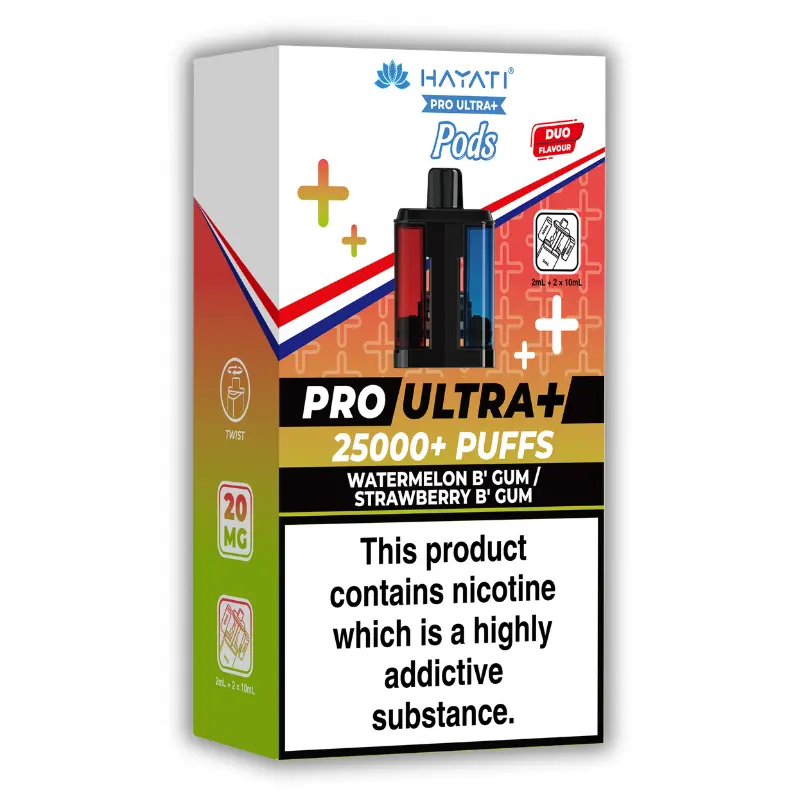
Watermelon B’Gum / Strawberry B’Gum is one replacement pod for the Hayati Pro Ultra Plus, £7.99, holding 22ml of 20mg nicotine salt liquid, with no device in the packet. The two names in the title are two flavours kept apart inside that single pod, and the rotating mouthpiece is what selects which of them is feeding the coil. Hayati rate it at up to 25,000 puffs, a figure produced under laboratory conditions rather than a forecast of your fortnight. Neither side carries a cooling agent. That is the entire commercial description of the product, and it fits in a paragraph.
The interesting part is how the title is built. Two flavour names, and between them a shared suffix that does not move. B’Gum on the left, B’Gum on the right. Strip that constant out and what remains is watermelon against strawberry, which means the pod varies exactly one term and holds everything else fixed. Most two-sided listings in this range are not built that way. They pair a warm fruit against an iced one, or a sharp one against a sweet one, or a specific fruit against a blend, and the two sides are meant to be different in several directions at once. This one changes the fruit and nothing else.
Which turns an ordinary £7.99 restock into a small piece of apparatus. A bubblegum accord is a heavy, sweet, long-finishing construction, and heavy sweet constructions have a reputation for swallowing fine distinctions whole. Watermelon is among the quietest things Hayati sell. Strawberry is among the most used. Put both under the same confectionery coat, keep them apart so they can be compared, and you have a test of something that matters well beyond this pod: whether a strong treatment makes two different fruits converge on one flavour.
This page works that question through properly, because the answer decides whether you are buying two flavours or one flavour with a decorative variation. The short form of the verdict, argued below rather than asserted here, is that convergence is real, that it is larger than the listing implies, that it is not symmetric between the two sides, and that the fruit which survives the treatment is not the one most buyers would bet on. There is also a serious case on the other side, since holding a background constant is exactly how a tasting flight makes small differences audible, and that case is put at its strongest before it is answered.
How rare this arrangement actually is, counted rather than asserted
Claims about how a range names things are cheap until somebody counts, so here is the count, taken from the 492 listings in Hayati’s catalogue.
Sixty-one of those listings carry an oblique in the flavour part of the title. Once you normalise the spelling variants, since the same pairing is sold two or three times over across kit and pod and across two slug conventions, those 61 listings collapse to 28 distinct pairings. That is the population this pod belongs to.
Now sort the 28 by what the pairing holds constant. Seven of them repeat a treatment word on both sides and swap only the fruit attached to it:
- Watermelon B’Gum / Strawberry B’Gum, this pod
- Blueberry H’Bubba / Watermelon H’Bubba, gum again under a different spelling
- Blueberry Cotton K / Raspberry Cotton K, candy floss instead of gum
- Blackcurrant Lemonade / Straw’ Lemonade, a drink treatment rather than a confection
- Grape GB / Strawberry GB, plus two further GB pairings that work the same way
Three of the seven are GB pairings, and GB has to come out of the count rather than be quietly folded into it. The Blueberry B’Gum pod page has already established why: the letters are never expanded in a title, and the retail copy attached to different GB listings glosses them two incompatible ways, with a third listing going out of its way to distinguish its GB product from the bubblegum elsewhere in the range. An abbreviation with three accounts and no agreement between them is not a known treatment, so it cannot serve as a fixed constant in anybody’s experiment. If you want the gum register with certainty, buy a name that spells it.
Take the GB entries out and four pairings remain that hold a stated treatment fixed while the fruit moves. One of those four is a lemonade. So the structure this page is about, a named confection applied identically to two different fruits and the two kept separate inside one pod, exists exactly three times in 492 listings: this one, the H’Bubba pair and the Cotton K pair. Three out of twenty-eight pairings, and all three sit on the Hayati Pro Ultra Plus Pods shelf, which runs to 52 listings.
The near misses, which are informative in their own right
Holding something constant across an oblique is not itself unusual. What is unusual is holding a treatment constant. Several pairings hold a fruit constant instead and let the treatment or the second fruit vary: Kiwi Banana / Straw’ Banana keeps the banana and swaps its partner, and Straw’ Grapefruit / Straw’ Dragonfruit keeps the strawberry and changes what it is pointed at. Those are the mirror image of this pod, and a sibling page in this corpus is working through that arrangement in detail, so between the two of you both directions are covered.
Two others hold more constant than this pod does rather than less. Strawberry Ice / Strawberry Raspberry Ice keeps both the fruit and the coolant and adds a third term to one side, which tests the contribution of a single added berry. Blueberry Straw’ Menthol / Blueberry Raspberry Menthol does the same with a coolant and a blueberry both pinned. Those are cleaner experiments in one sense and worse ones in another, because when only a fraction of a fraction is moving, the thing you are trying to measure may simply fall below what anyone can detect.
The remaining twenty-one pairings are built for contrast rather than comparison, most obviously the warm-against-iced constructions such as Cherry Ice / Peach Mango and Straw’ Cranberry Cherry / Cherry Ice. The Strawberry Watermelon pod page has already run a census on how those contrast pairings are distributed and there is no point running it twice. What matters here is only the residual: a pairing built on a fixed treatment is a minority structure, and it is the only structure that makes the two sides answer a question instead of simply covering two moods.
What the treatment is, taken as settled
The independent variable in this pod is the fruit. The constant is the gum. For the comparison to mean anything, the constant has to be understood first, and it has been worked through at length already on Blueberry B’Gum, which owns that argument in this corpus. Rather than rebuild it, here is what that page established, cited and taken as given.
First, the family. Four separate tokens in this catalogue mean chewing gum and they are spread across different spellings: B’Gum, H’Bubba, the fully spelled Hubba Bubba and the fully spelled Bubblegum, twenty listings between them out of 492, roughly four in every hundred. Three spellings for one confection, with nothing in the spelling that tells a buyer anything. Exactly one of those twenty carries a cooling word, and it is a bottle rather than a pod, which is why this pod having no coolant is the default for the category and not a decision anyone made about melon.
Second, the composition. A bubblegum accord is a flavour with no original: there is no bubblegum fruit, so the thing was assembled out of a stack of loud fruit esters deliberately arranged so that none of them wins, with a rosy floral note over the top that no real fruit has and a broad sweet base underneath. That page sets out the components. The consequence it draws is the one that matters here, which is that the accord works precisely because your nose cannot land on a dominant marker and therefore files the whole stack under the category it learned the combination from.
Third, the transfer. Because a gum flavouring was engineered to be robust, loud and heat-stable in the first place, it survives vaporisation better than a delicate fresh fruit does, so the aroma half of the name arrives more or less intact. What cannot arrive is the fade, because a stick of gum is stateful and a pod is not: the liquid is a uniform solution, the dose is flat across a draw, and nothing about your last draw alters the one after it. That argument belongs to the Blueberry B’Gum page and this page does not re-derive it.
Take those three findings together and the constant in this pod is characterised: a loud, sweet, ester-dense, slightly floral, heat-stable, non-cooled aroma that occupies a large share of everything you will perceive, and that behaves identically on both sides of the collar because it is the same treatment applied twice. That last clause is doing more work than it looks.
The two fruits, and why this is the most difficult pair to separate
The other half of the experiment is the pair Hayati chose to vary, and they could hardly have chosen a harder one.
The Strawberry Watermelon pod, a single-flavour blend of the same two fruits on the same hardware at the same £7.99, has already established what these two are as flavour objects. Its finding, which this page accepts rather than repeats, is that strawberry and watermelon differ in degree and not in kind: both carry almost no perceptible acid, both are watery rather than syrupy, both depend on aroma for their identity because nothing structural is holding them up, and both are among the first things a warm coil takes. What separates them is that strawberry is a little heavier and rounder and watermelon a little thinner and greener. That page reaches the conclusion that a blend of the two has nothing to keep its halves distinguishable and will most likely read as one generically pink impression.
So the pair being varied here was already the closest pair in the range before anybody added a confection to it. That is a confound and it should be stated as one rather than glossed over. A clean test of whether a treatment flattens fruit difference would use two fruits that are plainly different to begin with, a cranberry and a mango, say, and see how much of the gap survives. This pod uses two fruits with a small gap and then coats both in something loud. If the sides come out indistinguishable, you will not be able to tell from this pod alone whether the gum did it or whether there was never much there to lose.
There is a way to partially resolve that, and it is worth flagging now because it affects what you can learn from the purchase. The Blueberry H’Bubba / Watermelon H’Bubba pod runs the same treatment over a wider fruit gap, since blueberry and watermelon are further apart than strawberry and watermelon are. And the Blueberry Cotton K / Raspberry Cotton K pod runs a different treatment over a pair where one fruit brings an acid line and the other does not. Three pods, three fruit gaps, two treatments. Anyone genuinely curious about the general question has a three-pod series available at £7.99 each, which is a more honest description of what that costs than pretending one pod settles it.
One structural difference between this pod and the blended Strawberry Watermelon one deserves emphasis, because it is the reason this listing can answer a question its blended cousin cannot. In the blend, the two fruits are dissolved into each other and there is no way to hear either alone. Here they are kept apart and the mouthpiece moves you between them. Whatever else is true, this pod lets you compare where the blend only lets you experience. That is a real advantage and the case for the optimistic reading rests on it.
A treatment can only flatten the axes it occupies
Here is the mechanism this page proposes, stated generally before it is applied, because it turns out to predict the range’s behaviour across several products rather than just this one.
Perceived flavour is not one quantity. It is a handful of largely independent channels reporting at once: how sweet a thing is, how acidic, how aromatic and of what, whether there is a floral lift, whether there is a cooling sensation, how much weight or body it seems to have in the mouth, and how long it hangs about afterwards. Two liquids are distinguishable to the extent that they differ on at least one channel by more than the amount that channel can resolve.
Now consider what happens when you apply one loud treatment to two different things. The treatment occupies certain channels and saturates them. Sweetness, in a confectionery register, is pushed near the top of its range, and once a channel is near its ceiling, a small addition from the fruit cannot move it: both sides read as maximally sweet, so sweetness reports nothing about which side you are on. Ester-borne fruit aroma is likewise not merely occupied but crowded on purpose, since the accord is a deliberately unresolvable stack, so a further fruit ester joins a crowd that was already designed to defeat identification. The floral lift is the accord’s own signature and is present identically on both sides. The vanilla-ish rounding underneath is the same on both. Finish length is mostly a property of the sweetener load, which is the same on both.
That is five channels closed. What is left open is acid, cooling, and body or weight. And this is where the choice of fruits decides the outcome:
- Acid. Open, in the sense that a gum accord supplies very little of it, so a sharp fruit would still be audible underneath. But neither watermelon nor ripe strawberry supplies any to speak of. The channel is free and both sides leave it empty, so it reports nothing.
- Cooling. Open, and confirmed empty by the listing, which states that neither side is iced. Again free, again unused, again reports nothing.
- Body and water. Open, because a gum accord is an aroma-and-sugar construction and does not have much to say about how heavy or how watery a draw feels. And this is the one channel on which the two fruits genuinely differ: strawberry brings a little more weight, watermelon a little more thinness and a faint green edge.
So of roughly eight channels, the treatment closes five, two more are free but unused by either fruit, and exactly one is both free and carrying a difference. The entire distinction you are paying for travels down a single channel out of eight, and it is the channel that is hardest to put into words, easiest to confuse with how hard you drew, and least likely to be what somebody means when they ask whether they can taste the strawberry.
Why the masking is not even-handed
The second half of the mechanism is the part that surprised me while working it through, and it is where the conventional expectation inverts.
A gum accord is built out of fruit esters. Which fruit esters matters. The stack described on the Blueberry B’Gum page includes a cherry and almond corner, a pear drop and banana ester, a general sweet-fruit ester load, a rosy floral and a vanilla rounding. Set strawberry against that inventory. Ripe strawberry’s character is a jammy, cooked-sugar sweetness, a light floral, and a soft aromatic signature with no sharp edges. Nearly every one of those properties already exists inside the accord. Strawberry is not being covered up by the gum so much as absorbed into it, because the gum was assembled out of the same neighbourhood of flavour space that strawberry lives in.
Now set watermelon against the same inventory. Watermelon’s distinguishing material is not a sweet ester at all. It is a thin, green, faintly cucumber-adjacent freshness sitting over a very dilute sugar, and the thing that makes melon read as melon is that green watery top note rather than any sweetness. A bubblegum accord contains nothing of that kind. There is no green in it, no vegetal edge, nothing watery. So the melon’s one distinguishing property is landing in a region the treatment has left completely unoccupied.
The prediction that follows is counterintuitive and it is the central claim of this page. Under a bubblegum treatment, the loud familiar fruit is camouflaged more thoroughly than the quiet one. Loudness in the same register as the treatment is not an advantage, it is camouflage, because your nose cannot pull apart two things that sit on top of each other. Quietness in a different register is contrast, because even a small signal is detectable when nothing else is occupying that frequency. Everyone expects the strawberry to come through and the watermelon to disappear. The mechanism says the opposite, and it says it for a reason you can check.
Stated with the confidence it deserves rather than more: reasonably confident that the strawberry side will read as gum with very little separately attributable to strawberry, and that most people asked to name the fruit on that side without being told would not arrive at strawberry. Probable that the watermelon side will carry a detectable green or watery top edge that marks it as the other one, without necessarily reading as watermelon either. Unknown, and not knowable from anything Hayati publish, is the ratio of fruit concentrate to gum concentrate in either side, which is the number that would settle how large any of these effects is.
What that does to the pod as a two-flavour purchase
If the masking is asymmetric then the pod is not two halves of equal standing. One side is a bubblegum. The other side is a bubblegum with a small identifiable modification. That is a different product from what the title advertises, which is two named fruit gums of parallel status.
It also has a consequence for how much use you get out of the collar. The reason a two-sided pod is worth having is that turning it changes the experience enough to reset your attention. A switch that moves you between a gum and a slightly greener gum resets rather less than a switch between a warm sweet and a cold sharp does, which is what a contrast pairing like Blue Razz Pineapple / Strawberry Ice offers. You are buying a narrower switch. Whether a narrow switch is what you want is a legitimate preference and plenty of people prefer it, but it should be a choice rather than a surprise.
Six listings of this treatment, lined up against each other
Mechanism is one kind of evidence. Here is another kind, which is what Hayati’s own copy does when it has to describe these fruits with and without the gum on them. Every flavour in this range is sold several times over and the descriptions are written fresh each time, so lining them up shows what the people writing them reach for without thinking.
Six relevant listings exist. This pod and its matching 25000 kit at £11.99 describe the same liquid twice. The Strawberry Watermelon Bubblegum Mini Ultra pod at £3.49 puts the same three components into one blend on smaller hardware. The Fruit Bomb / Straw’ Watermelon B’Gum pod carries a side that fuses both fruits under one gum. The plain Strawberry Watermelon pod is the same fruit pair with the gum removed, which makes it the control. And the H’Bubba pair applies a differently spelled gum to watermelon and a different berry.
Three patterns come out of the comparison.
The division of labour between the two fruits never once flips. In every listing, in every format, with the gum present or absent, watermelon is the light, watery, juicy one and the berry is the ripe, rich, weighty one. Never the reverse. The Strawberry Watermelon page found that holding across the untreated listings of this pair, and the finding extends cleanly to the treated ones, which is new information rather than a repetition of it: adding a confection to both fruits does not change which fruit the copy desk thinks is carrying the body. Whatever the gum does, it does not reverse the fruits’ relative positions.
The berry side’s vocabulary is interchangeable and the melon side’s is not. Compare the two gum pairings directly. On this pod the berry side is the riper, sweeter one. On the H’Bubba pod, where the berry is blueberry rather than strawberry, the berry side is described as soft and dark and rounded. Those are the same words doing the same job for two different berries. Meanwhile the watermelon side is described in near-identical terms across both pods, across the blended Mini Ultra listing and across the untreated control: light, watery, juicy, every time. That is exactly what the asymmetric-masking prediction implies. Under a gum treatment the berries become interchangeable in description because the treatment has absorbed their distinguishing material, while watermelon keeps a stable description because the property it contributes is one the gum does not touch.
The maker’s own copy reaches for a layering preposition on one side and a fusion verb on the other. On the kit listing for this exact liquid, the melon side is described as freshness laid over the gum, two things stacked, while the strawberry side is described as the berry and the gum combining into a single dessert-like thing. Same paragraph, same writer, same pod, and two structurally different descriptions: one separable, one merged. That is a small piece of evidence and it needs the right caution around it, because it is evidence about how the copy was written rather than about two recipes. A copywriter reaching for stacked language on one side and fused language on the other is reporting an impression, not a formulation. But it is an impression from someone who presumably tasted it, pointing in the same direction as the mechanism, and it would be dishonest to leave it out because it is only circumstantial.
One more data point sits slightly outside this family and is the most useful of the lot. On the Blueberry Cotton K / Raspberry Cotton K pod, the same structure is used with candy floss as the constant, and there the copy claims a real divergence: the blueberry side is soft and rounded, the raspberry side brighter and tangier. That is the only one of the three treatment-constant pods where the two sides are given genuinely different characters, and the reason is visible in the fruit list. Raspberry brings an acid line and candy floss does not supply one, so the difference travels down a channel the treatment left open. A treatment flattens what it covers and leaves alone what it does not, and Hayati’s own descriptions behave exactly as though that were true, whether or not anyone there framed it that way.
The case for the opposite reading, put properly
A fair page has to make the other argument as well as it can be made, and there is a good one.
The principle behind a tasting flight is that difference detection improves when everything except the variable of interest is held constant. Serve two wines in different glasses on different evenings after different meals and small differences vanish into the noise. Serve them side by side, same glass, same temperature, same minute, and differences you would never have noticed become obvious. On that logic, a shared bubblegum base is not a mask at all. It is a controlled background, and the only thing changing when you turn the collar is the fruit, which is precisely the condition under which a small fruit difference becomes easiest to hear.
The argument gets stronger when you look at what task is actually being performed. Naming a fruit blind is identification, which is genuinely hard and which people are famously bad at even with ordinary foods in front of them. Saying which of two adjacent draws is which is discrimination, which is a far easier task with a far lower threshold. You do not have to know that the greener one is watermelon. You only have to notice that one of them is greener. The collar makes this a two-alternative comparison available within seconds, and comparisons made seconds apart resolve differences that comparisons made days apart cannot. Two separate £7.99 pods bought a fortnight apart could never be compared this way, because your memory of a flavour degrades far faster than the flavour does.
There is a third point in the same direction. A quiet fruit under a loud treatment is not necessarily inaudible, because audibility depends on whether the two occupy the same channels rather than on relative volume. A whisper is perfectly audible over a loud constant tone if the whisper is at a different pitch. That is the same physics the masking argument uses, which means the optimistic reading and the pessimistic one are not opposites so much as the same model with different assumptions about how much the fruits actually differ.
Two things weaken the flight case, and neither of them destroys it.
The first is that a flight holds a neutral thing constant. The glass, the temperature, the order. What is held constant here is not the glassware, it is most of the drink. A gum accord is not a background, it is the loudest element present and probably the majority of the perceived flavour. Holding the majority of the signal constant and varying a minority of it is not the same experimental design as holding the apparatus constant and varying the sample, even though it looks similar when written down.
The second is that the instrument contaminates its own measurement, and this is the point where the hardware matters. One coil, one wick, one airflow path serve both sides. When you turn the collar, whatever was in that shared path is still in it, so the first draws after a switch are a mixture of the side you left and the side you arrived at. The very architecture that gives you the back-to-back comparison is the architecture that blurs the two things being compared. A tasting flight with an unrinsed glass reports smaller differences than really exist, every time, and that is structurally what this pod is. Carryover pushes the result toward convergence independently of anything about the recipes, which means a reading of "these two taste the same" is partly an artefact of the measuring device unless you deliberately control for it.
The verdict
Taking the mechanism, the listing census and the counter-argument together, here is where this page lands, with each claim tagged by how much weight it will bear.
Reasonably confident: the treatment does flatten the difference, and substantially. Five of roughly eight perceptual channels are occupied and saturated by the gum identically on both sides. Two of the three that remain open are unused by either fruit, because neither watermelon nor ripe strawberry brings acid and the listing confirms no cooling on either side. One channel out of eight is left to carry the entire distinction. Whatever difference exists between the two sides is travelling down a very narrow path.
Reasonably confident: the flattening is asymmetric. Strawberry’s distinguishing material sits inside the accord’s own region of flavour space and is absorbed by it. Watermelon’s sits outside that region, in a green and watery direction the accord has nothing to say about. The consequence is that the melon side is the one more likely to remain identifiable as different, which inverts what most buyers would predict from the fact that strawberry is by far the louder and more familiar fruit.
Probable: you will be able to tell the sides apart, and probably not able to name them. Discrimination back to back is an easier task than identification, and the collar makes discrimination available. Expect to notice that one side is a touch thinner and greener and the other a touch heavier and rounder. Do not expect to arrive independently at the words strawberry and watermelon, and do not treat a failure to arrive at them as a fault in the pod.
Probable: the two sides converge further as the pod ages. This follows from something the Blueberry B’Gum page established about sweetened liquids, which is that coil residue takes the volatile aromatics first and leaves the sweetness and the heavy base notes standing longest. The fruit differentiators in this pod are aromatic. The gum’s sweet core is not. So the component carrying the entire difference between the two sides is the first component the ageing coil removes, and the two halves should become progressively more alike across the life of one pod. If you want to know whether these are two flavours, the honest answer is that they are more nearly two flavours on day one than on day six.
Unknown: the concentrations. Nothing published tells you how much fruit is in either side or whether the two sides carry equal fruit loads. A pod whose strawberry side carries twice the fruit concentrate of its melon side would behave differently from one that is evenly balanced, and both are consistent with everything Hayati state. This page infers a direction, not a magnitude, and anyone telling you the magnitude is guessing.
The general finding, which is worth more than the specific one. A confectionery treatment does not flatten fruits uniformly. It flattens them along the channels it occupies, and it leaves them distinguishable along the channels it does not. That predicts, correctly, that gum over two low-acid fruits produces near-convergence, while candy floss over a berry pair where one has an acid line produces a difference the maker is happy to advertise. If you are choosing any treatment-constant pod, look at what your two fruits have that the treatment does not. If the honest answer is nothing, you are buying one flavour with two labels.
Testing convergence on your own pod
The above is reasoning. Here is how to find out for yourself, because a claim like this should come with a way of checking it, and none of this requires anything you do not already own.
Establish the carryover number first, before anything else. This is the step everyone skips and it invalidates the rest if you do. Turn the collar, then take slow draws and count how many it takes before the taste stops changing. Somewhere between three and six is typical for a shared path, and until you hit that number you are tasting a mixture of both sides rather than either one. Write your number down. Every subsequent comparison starts after that many clearing draws, discarded and not scored.
Score channels, not fruits. Asking yourself "can I taste the strawberry" invites your expectations to answer for you, because you know what the label says and knowing what the label says is enough to make most people taste it. Instead rate each side out of five on four separate things: how sweet, how heavy or thin it feels in the mouth, whether there is any green or watery edge, and how long the finish hangs on. Four numbers per side. If the two columns land within one point of each other on all four, they have converged for practical purposes, whatever the title says.
Run it as A, B, A rather than A then B. Take the first side, clear, take the second, clear, then return to the first. If your third reading matches your first and not your second, the difference is real and repeatable. If your third reading has drifted toward your second, what you measured was carryover and fatigue. This costs about two minutes and it is the difference between an opinion and a result.
Get the collar set for you. The single biggest contaminant here is knowing which side you are on. Have another adult in the household turn it out of your sight, then guess. Do it six times. Four or more correct out of six means you can genuinely discriminate the two sides. Three out of six is chance, which is the answer this page predicts is most likely for the naming version of the task and less likely for the pure discrimination version.
Run the subtraction test on each side separately. Take a draw and try to describe what is left if you mentally remove the gum. If the remainder on the strawberry side is "sweetness" with no further detail, the strawberry is functioning as a label rather than an ingredient. If the remainder on the melon side is "something thin and slightly green", the melon is doing real work. That asymmetry is the specific prediction of this page, and it is the one most worth checking, because if you find the reverse then the reasoning above is wrong and you should trust your own pod over an argument.
Repeat the whole thing at day five or six. Same four channels, same procedure, same clearing count. Compare the size of the gap between the two columns against the gap you measured on day one. The prediction is that it shrinks. If it does, you have watched a treatment eat a fruit difference in real time, which is a more interesting thing to get for £7.99 than most pods provide.
One thing not to bother with. Comparing this pod against a different pod from memory tells you almost nothing, because flavour memory degrades within minutes and you will mostly be measuring your own expectations. The comparison this pod is uniquely good for is the internal one. If you want an external reference, buy the untreated Strawberry Watermelon pod and run them in the same session on the same day, which is the only way that comparison means anything.
The pod itself, and the one property the argument depends on
Very little needs saying about the hardware here, partly because the Pro Ultra Plus kits and pods shelf carries the full account and partly because only one of its properties bears on anything above.
What arrives is a single sealed pod holding 22ml of liquid with its own coil built in, and nothing else. No battery, no cable, no spare. It is a restock item for somebody who already owns the device, and if you do not own one, the Watermelon B’Gum / Strawberry B’Gum 25000 kit at £11.99 is the same liquid supplied with a body, which makes the hardware cost £4 on a first purchase and nothing thereafter. Check the range name printed on your device against the range name in this title before ordering, because Hayati run several pod formats that look broadly similar in a photograph.
The property that matters for everything this page argues is that one coil serves both flavours. Not two coils with a switch between them, one coil and one wick and one airflow path, with the mouthpiece selecting which reserve is feeding it. Hayati state that the collar chooses a side and they publish nothing whatever about how the division works internally, so this page describes what the control does and stops there. Three consequences follow from the shared path and all three have been used above rather than stated for their own sake: carryover contaminates every switch, coil ageing happens to both sides simultaneously because there is only one coil to age, and the 22ml is a single budget rather than two separate ones, so liquid sitting in the side you stop using is discarded with the pod when the other side is finished.
That last point is the practical one. The two halves are not separable purchases. If you decide after two days that the strawberry side is the only one you want, you are still paying for and discarding whatever melon remains, which is a reason to establish your preference quickly rather than leaving the question open for a fortnight.
The published numbers, ordered by how much they bear on this page
| How the two flavours are selected | Rotating mouthpiece; Hayati state it chooses between the two, and publish nothing about the internal arrangement |
| Coil | One, shared by both sides. Resistance not published |
| Cooling on either side | None. The listing states that neither flavour is iced |
| Named flavours | Watermelon B’Gum and Strawberry B’Gum |
| Liquid, both sides together | 22ml |
| Nicotine | 20mg/ml nicotine salt |
| Manufacturer puff rating | Rated by the manufacturer at up to 25,000 puffs, measured under laboratory conditions |
| Price | £7.99 |
| Device | Not included; a compatible Pro Ultra Plus body is required |
| Refilling | Not a refillable pod; the liquid and the coil are finished together |
| Shelves | Watermelon Vapes, Strawberry Vapes, Sweet Vapes and Berry Vapes |
Two of those rows deserve a sentence each, and they are not the rows a spec sheet usually draws attention to.
The single shared coil is listed second because it is the most consequential line in the table for anyone reading this page for the convergence question. It is what makes the comparison possible, since you can move between the two flavours in seconds, and it is simultaneously what degrades the comparison, since the path is not rinsed between them. A specification that both enables and limits the same thing is unusual enough to be worth naming.
The cooling row is listed third because its emptiness is doing work. On a pod where the only difference between the halves is a quiet fruit, a coolant on one side would have swamped the question entirely, since cooling is a loud sensation on a channel the gum does not occupy. Both sides being uncooled is what leaves the experiment intact. It also tells you what kind of vaping this is for: sustained, sweet and warm throughout, with nothing sharp anywhere in it, which some people find tiring over a long session and others prefer precisely because it never jolts.
The nicotine figure is the UK maximum for this kind of product and there is nothing unusual about it on this shelf, so the only thing worth adding is that a sweet, warm, uncooled liquid tends to carry its nicotine with less of a physical edge than a cold or a sharp one does, because there is no coolant and no acid contributing sensation of their own. That is a description of the draw and not a recommendation about strength.
What sits near this pod, and who should buy which
The useful comparisons for this listing fall into four groups, and which group you belong to depends entirely on what you wanted from the two names in the title.
If you wanted the fruits and the gum was incidental
Buy the Strawberry Watermelon pod instead, same two fruits, same £7.99, same 22ml, no confectionery treatment on top. Its own page argues that the two fruits blur into each other even without a gum over them, so you should not expect to hear them separately there either, but you will at least be tasting fruit rather than fruit-shaped sugar. It is one of only twenty-nine listings on the Watermelon Vapes shelf, short enough to read end to end, and it is the control condition for everything above and it is the single most useful neighbour on the shelf for anyone who read this page and concluded that the treatment is the problem.
If you wanted the gum and the fruits were incidental
Then the honest recommendation is that you do not need two sides at all, and a single-flavour gum is a better buy because nothing is being spent on a distinction you are not going to use. Blueberry B’Gum at £5.49 is a single gum flavour on the Pro Max Plus platform rather than this one, so it is not a drop-in alternative if you own a Pro Ultra Plus body, but it is the page that sets out what a gum accord does and it is worth reading before you commit to the register. Within this platform, the Blueberry H’Bubba / Watermelon H’Bubba pod is gum again under a different spelling, and the H’Bubba family includes a plain unfruited version for anyone who wants the confection with nothing attached.
If you wanted a switch worth turning
A treatment-constant pairing gives you the narrowest switch on the shelf by construction. If the reason you buy two-sided pods is that you want the second position to actually change something, go to a contrast pairing instead. Cherry Ice / Peach Mango puts a cold side against a warm one. Straw’ Cranberry Cherry / Strawberry Raspberry Ice runs a warm berry stack against an iced one. Blackcurrant Cotton K / Blue Raspberry is the interesting middle case, because it applies the candy floss treatment to one side only, which means the treatment itself is the variable rather than the constant. That is the third possible design and nobody in this range uses it often.
If the problem is that everything here is too sweet
Both sides of this pod sit near the top of the sweetness range with no acid and no coolant to counterweight them, which is why it is filed on the Sweet Vapes shelf as well as the fruit ones, which is a plain description rather than a complaint, and for a good number of people it is the reason to buy. If it is not, the opposite direction is well stocked. Blue Sour Raspberry leads with acid. Straw’ Lemonade keeps the strawberry but hangs it on a citrus frame that gives it something to push against. Lemon Lime abandons the sweet register entirely. For cold rather than sharp, Cherry Ice and Strawberry Raspberry Ice are the obvious single-flavour options, and the Shisha 30000 pod is the one nearby listing that is not really competing in the fruit category at all.
Two more worth naming for specific reasons
The Strawberry Watermelon Bubblegum Mini Ultra pod at £3.49 is the same three components blended into one flavour on smaller, cheaper hardware. If your interest in this page was theoretical rather than practical, that pod is the cheapest way to taste what these fruits do under a gum when nobody is trying to keep them apart. It is a different platform, so check what you own first.
And Blue Razz GB is worth a mention only as a warning. It sits on the same shelf, it looks like it belongs to the confectionery family, and as the count earlier in this page set out, nobody outside Hayati knows with certainty what the letters mean. If the sweet-shop register is what you are shopping for, a listing that spells the confection out is a surer bet than an abbreviation with three contradictory glosses attached to it.
Living with a pod that is sweet on both sides
Everything practical about this product follows from one fact, which is that there is no low-sweetness position on the collar. A two-sided pod with an iced or a sharp half gives the coil and your palate a change of load when you switch. This one does not: whichever way the mouthpiece is turned, the coil is vaporising a heavily sweetened confectionery liquid, and it does so for the whole life of the pod.
The first consequence is residue. Sweeteners do not vaporise cleanly and a fraction of them bakes onto the coil and into the wick as a dark crust, which insulates the wire, slows the feed and eventually contributes a scorched note of its own. A pod that is sweet on both sides accumulates that crust faster than a pod with one restrained half, so expect the decline to begin earlier in this pod’s life than in a mixed one. There is nothing to be done about it beyond knowing, because the coil is not accessible.
The second consequence is what you lose first, and this matters more here than on most pods. The volatile aromatics go before the sweetness does. On this pod, the volatile aromatics are precisely the fruit differentiators, the thin green edge on one side and whatever separately attributable weight the berry brings on the other. The gum’s sweet core is the robust part. So the ageing of this pod is not a general dulling, it is a targeted removal of the only thing that distinguishes the two halves, and a pod three-quarters through its life is a pod whose collar has less and less to say. Judge the pod against its own first day rather than against another pod, because the drift is slow enough that your palate will track it down without noticing.
The third is drawing style. A sweet, warm, uncooled liquid rewards a slow steady draw and punishes chain-vaping more than a cold one does, partly because the sweetness deposits and builds and partly because there is nothing cold in the mix to reset your attention between draws. Long uninterrupted runs on a constant sweet stimulus also flatten perceptually, which is a fact about perception rather than about the liquid, and it is the single most common reason somebody decides a confectionery pod has gone off when nothing has changed in it. If the two sides stop seeming different in the middle of a long session, put it down for twenty minutes and check again before concluding anything.
Storage is ordinary but worth one line anchored to this pod specifically: a sweet liquid left somewhere warm darkens faster than a sharp one, and since this pod has no acid or coolant to mask an oxidised note, any staleness shows up plainly. Somewhere cool and dark, upright, not a car in summer, and away from children and animals. A part-used pod stored for a few weeks will read duller on the first draws when you come back to it, and the honest test is whether it recovers after a dozen draws or stays flat.
One last piece of handling advice that is specific to a two-sided pod rather than general. Do not leave the collar parked in one position for days at a time and then expect a clean read on the other side. The longer one side has been feeding the shared path, the more clearing draws the other will need, so your carryover number from the first day is a floor rather than a constant.
Questions this pod actually raises
Is this two pods in the packet?
No. It is one pod containing both flavours, kept apart inside it, with the rotating mouthpiece selecting which one reaches the coil. The two names in the title describe two sides of a single 22ml pod rather than a two-pack, and the liquid budget is shared between them.
Will I be able to taste the difference between the two sides?
Probably, though less than the title implies, and more as a difference in weight and in a faint green edge than as two nameable fruits. This page argues that the gum treatment occupies most of the channels on which two fruits normally differ, and that the two fruits chosen here were unusually close to begin with. The test protocol above is the way to settle it for your own pod.
Which side is which after I turn it?
Hayati publish nothing about how the two positions are marked, so this page will not tell you. The practical approach is to establish it once on the first day, using the green or watery edge as the marker for the watermelon side, and then to note the collar position rather than relying on tasting it again each time.
Is there any cooling on either flavour?
No, and the listing says so explicitly for both sides. That is also the norm for the gum family across this catalogue rather than a decision specific to this pod. If you want the sweet-shop register with a cold finish you will need to look outside the gum names entirely.
Do I have to use both sides?
No, you can leave the collar where it is and never move it. The cost of doing so is that the liquid in the unused side is discarded with the pod once the side you are using is finished, since the 22ml is one budget rather than two. That is an argument for deciding your preference in the first few days rather than the last few.
How sweet is it compared with the rest of the shelf?
Near the top of the range on both sides. Two things put it there: a confectionery treatment supplies sweetness as its main structural element, and neither of the two fruits brings any acid to work against it. There is no restrained position anywhere on this pod, which is worth knowing before you buy 22ml of it.
Is this the same liquid as the kit version?
Hayati describe the two listings as the same two flavours, and the kit is that liquid supplied with a device for £11.99 against £7.99 for the pod alone. The wording of the two descriptions differs slightly, which is a difference between two pieces of copy rather than evidence of two recipes. If you already own a compatible body, the pod is the one you want.
Why would a bubblegum pod need two fruits at all?
That is the question this page exists to answer, and the answer it reaches is that the two fruits buy you less than the title suggests. They vary one term against a fixed treatment, which is an interesting structure and a narrow one. If the two names were the reason you were interested, the reasoning above is worth reading before you commit.
Does it get less distinct as it goes on?
Expect so, yes. Coil residue takes the light aromatic material before it takes the sweet base, and the light aromatic material is exactly what separates these two sides. The gap between the halves should be widest on the first day and narrower by the end, which is one of the few predictions on this page that you can check directly.
Can the pod be refilled when it runs out?
No. The liquid and the coil finish together and the pod is replaced as a unit, which on this platform means another £7.99 rather than a bottle. When it is spent it holds a coil and a residue of liquid, so it goes to a shop take-back point or a local recycling facility rather than the household bin.
Is there a version of this comparison with a wider gap between the fruits?
Yes, two of them, and both are on the same shelf at the same price. The H’Bubba pod runs a gum over blueberry and watermelon, which are further apart than strawberry and watermelon. The Cotton K pod runs candy floss over blueberry and raspberry, where one fruit brings an acid line the treatment cannot cover. Between the three, you can watch the same mechanism operate across three different fruit gaps.
The short version
Watermelon B’Gum / Strawberry B’Gum is one £7.99 pod for the Hayati Pro Ultra Plus holding 22ml of 20mg liquid, no device, no cooling on either side, rated by the manufacturer at up to 25,000 puffs as a laboratory figure. What makes it worth a page is that it holds a confectionery treatment fixed and varies only the fruit, which fewer than a handful of listings in a catalogue of 492 do, and which turns a restock into a question about how much a strong treatment costs a fruit.
The answer this page reaches is that it costs a great deal, but not evenly. A gum accord saturates sweetness, crowds the fruit-ester channel by design, and supplies its own floral signature, so the fruits cannot differ on any of those. Neither of these two fruits brings acid or cooling, so the channels the gum leaves open go unused. What is left is a single narrow axis of body and water, and the fruit that survives on it is the quiet one rather than the loud one, because watermelon’s green thinness lies outside the accord’s range while strawberry’s jammy sweetness lies squarely inside it. Expect to discriminate the two sides and not to name them, and expect the gap to shrink as the coil ages.
Buy it if the bubblegum register is what you want and a small variation between two sides is a pleasant extra rather than the point. Buy the untreated Strawberry Watermelon pod if the fruits were the point. Buy a contrast pairing if you want the collar to earn its place. And if you do run the test properly, trust your own pod over this argument, because a measurement beats a mechanism every time.
Strictly for adults aged 18 and over. Nicotine is an addictive substance.
You might also like


